TRON Integration Pushes Kolo Further Into Real-World Stablecoin Payments – Details

bitcoinistОпубліковано о 2026-02-05Востаннє оновлено о 2026-02-05

Анотація

Kolo's integration with the TRON network enables direct TRC-20 USDT transfers to Kolo cards, allowing near-real-time settlement after on-chain confirmation. This move aims to reduce reliance on traditional exchanges and banking systems, streamlining the use of on-chain liquidity for everyday payments. Amid broader crypto volatility, TRON is defending the $0.30 price level, with its technical structure remaining intact despite market weakness. TRX continues to trade within a key consolidation range, supported by rising long-term moving averages and declining selling pressure. Kolo has processed over $250 million in transactions, with 30% occurring on the TRON network, highlighting TRON’s growing role in real-world payments. Lower transaction costs and faster confirmations make TRON suitable for frequent, smaller transactions. The network has also surpassed Ethereum in USDT circulating supply, reflecting its increasing adoption in practical, real-world stablecoin usage.

Trusted Editorial content, reviewed by leading industry experts and seasoned editors. Ad Disclosure

TRON is attempting to defend the $0.30 level as broader crypto markets remain under sustained selling pressure and risk appetite stays fragile. Price action across major assets has been dominated by deleveraging and reduced spot participation, leaving altcoins particularly exposed to downside volatility. Within this context, TRON’s ability to hold key technical levels is being closely watched, not only as a price signal but also as a reflection of ongoing network activity and real-world usage.

Against this uncertain market backdrop, Kolo announced its integration with the TRON network, enabling direct TRC-20 USDT transfers to Kolo cards with near-real-time settlement following on-chain confirmation. The integration allows funds to move from the TRON network to payment cards without relying on traditional exchange withdrawals or banking rails, reducing settlement delays that have historically limited practical usage of on-chain liquidity.

Rather than signaling speculative expansion, this development highlights an operational use case at a time when markets are contracting. With stablecoin flows increasingly concentrated on the TRC-20 USDT standard, the integration underscores how existing blockchain infrastructure is being used to support everyday transactions even during market stress.

TRON’s Growing Role in Stablecoin Payments

Recent data around Kolo provides useful context for understanding TRON’s role in today’s stablecoin market. Kolo has processed more than $250 million in total transaction volume to date, with roughly 30% of that activity executed directly on the TRON network. This concentration is notable given the broad range of chains available for stablecoin transfers and points to sustained usage rather than short-term experimentation.

The platform has also recorded a high number of individual deposits, reinforcing the idea that TRC-20 USDT is increasingly used as a settlement rail for everyday payments and routine transfers, rather than solely for trading or arbitrage.

Lower transaction costs and faster confirmation times make the TRON network particularly suited for smaller, frequent payments, which tend to dominate real-world spending behavior. Kolo’s design emphasizes speed and operational simplicity, allowing users to open an account, complete verification, and begin spending within minutes, while remaining fully compliant with global KYC and AML requirements.

At the network level, this activity aligns with a broader structural shift. TRON has now surpassed Ethereum in USDT circulating supply, reflecting where stablecoins are actually being held and moved at scale.

TRX Price Holds Key Structure Amid Market Weakness

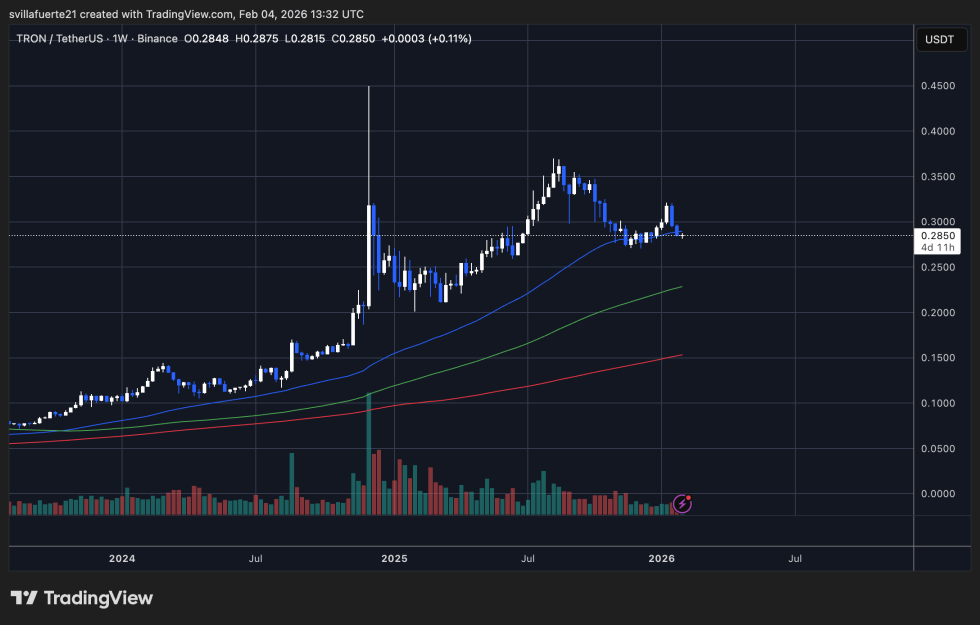
TRON (TRX) continues to trade near the $0.28–$0.30 zone, a level that has become structurally important on the weekly chart. After a strong advance throughout 2024, price entered a consolidation phase following the sharp spike and rejection above the $0.35 area. Since then, TRX has been moving sideways, suggesting the market is digesting prior gains rather than entering a clear distribution phase.

TRX testing critical demand level | Source: TRXUSDT chart on TradingView

From a trend perspective, the broader structure remains constructive. Price is still holding above the rising 100-week moving average (blue), which has acted as dynamic support during pullbacks. The 200-week moving average (green) continues to slope higher well below the current price, reinforcing that the long-term trend remains intact despite recent volatility. The 50-week moving average (red) also continues to rise, indicating that long-term momentum has not yet broken.

Volume behavior supports this interpretation. The largest volume spike occurred during the impulsive rally, while recent weeks show declining activity, consistent with consolidation rather than aggressive selling. This suggests sellers are not pressing the market with urgency.

However, the inability to decisively reclaim and hold above $0.30 highlights near-term caution. A sustained break below the $0.27–$0.28 range would weaken the structure and expose deeper support near the 100-week average. Conversely, a clean weekly close above $0.30 would signal renewed strength and open the door for a retest of prior highs.

Featured image from ChatGPT, chart from TradingView.com 

Editorial Process for bitcoinist is centered on delivering thoroughly researched, accurate, and unbiased content. We uphold strict sourcing standards, and each page undergoes diligent review by our team of top technology experts and seasoned editors. This process ensures the integrity, relevance, and value of our content for our readers.

Sebastian Villafuerte

Follow

Sebastian's journey into the world of crypto began four years ago, driven by a fascination with the potential of blockchain technology to revolutionize financial systems. His initial exploration focused on understanding the intricacies of various crypto projects, particularly those focused on building innovative financial solutions. Through countless hours of research and learning, Sebastian developed a deep understanding of the underlying technologies, market dynamics, and potential applications of cryptocurrencies. As his knowledge grew, Sebastian felt compelled to share his insights with others. He began actively contributing to online discussions on platforms like X and LinkedIn, focusing on fintech and crypto-related content. His goal was to expose valuable trends and insights to a wider audience, fostering a deeper understanding of the rapidly evolving crypto landscape. Sebastian's contributions quickly gained recognition, and he became a trusted voice in the online crypto community. To further enhance his expertise, Sebastian pursued a UC Berkeley Fintech: Frameworks, Applications, and Strategies certification. This rigorous program equipped him with valuable skills and knowledge regarding Financial Technology, bridging the gap between traditional finance (TradFi) and decentralized finance (DeFi). The certification deepened his understanding of the broader financial landscape and its intersection with blockchain technology. Sebastian's passion for finance and writing is evident in his work. He enjoys delving into financial research, analyzing market trends, and exploring the latest developments in the crypto space. In his spare time, Sebastian can often be found immersed in charts, studying 10-K forms, or engaging in thought-provoking discussions about the future of finance. Sebastian's journey as a crypto analyst and investor has been marked by a relentless pursuit of knowledge and a dedication to sharing his insights. His ability to navigate the complex world of crypto, combined with his passion for financial research and communication, makes him a valuable asset to the industry. As the crypto landscape continues to evolve, Sebastian remains at the forefront, providing valuable insights and contributing to the growth of this revolutionary technology.

Full Profile

Related Posts

Les altcoins dans le rouge : l’altseason n’aura plus jamais lieu sur le marché crypto ?

Claude IA évoque une phase haussière sur les cryptomonnaies : trois jetons à surveiller en février 2026

Famous Analyst Says Altcoin Holders Will Be Disappointed, Bitcoin Rotation Not Coming?

Cardano’s Big Rally In Sight? ADA’s Interest Sees Subtle Shift As Smart Money Accumulates

From Boom To Goodbye: NFT Marketplace Nifty Gateway To End Operations

ONDO’s Silent Accumulation: Whales Absorb The 1.94B Unlock While Price Bleeds

Пов'язані питання

QWhat is the significance of Kolo's integration with the TRON network?

AThe integration enables direct TRC-20 USDT transfers to Kolo cards with near-real-time settlement, allowing funds to move from the TRON network to payment cards without relying on traditional exchange withdrawals or banking rails. This reduces settlement delays and supports practical usage of on-chain liquidity for everyday transactions.

QWhat percentage of Kolo's total transaction volume is executed on the TRON network?

AApproximately 30% of Kolo's total transaction volume, which is over $250 million, is executed directly on the TRON network.

QWhy is the TRON network particularly suited for real-world payments according to the article?

AThe TRON network is suited for real-world payments due to its lower transaction costs and faster confirmation times, which are ideal for smaller, frequent payments that dominate real-world spending behavior.

QWhat key technical level is TRON (TRX) attempting to defend amidst market weakness?

ATRON (TRX) is attempting to defend the $0.30 level, which is a structurally important zone on the weekly chart. A break below the $0.27–$0.28 range would weaken its market structure.

QHow does the article characterize the current trend and momentum for TRX based on its moving averages?

AThe broader structure remains constructive as TRX is holding above the rising 100-week moving average, and the 200-week moving average continues to slope higher, indicating the long-term trend is intact. The 50-week moving average is also rising, showing that long-term momentum has not broken.

Пов'язані матеріали

Stuck Polymarket: The Real Test After Riding the Traffic Boom Has Arrived

Polymarket, a leading prediction market platform, is facing significant technical challenges as its growth outpaces its current infrastructure on Polygon. Users are experiencing laggy transactions, unresponsive orders, and delayed confirmations, severely impacting the trading experience. In response, DeFi Engineering VP Josh Stevens outlined a comprehensive engineering overhaul. The plan includes reducing on-chain data delays, fixing order cancellation issues, rebuilding the central limit order book (CLOB), improving website performance, and developing a unified SDK and API. A major revelation was the ongoing "chain migration," indicating a potential move away from Polygon. The core issue is that Polymarket has evolved from a simple prediction market into a high-frequency trading platform, making Polygon's limitations—such as block space, gas fees, and block time—a ceiling for further growth. The migration is not just a simple chain switch but a fundamental rebuild of its trading system to support more complex products like perpetual contracts (Perps). This announcement has sparked competition among chains like Solana, Sui, and Algorand, all vying to host Polymarket. For Polygon, losing this key application, which contributes significantly to its gas fee revenue, would be a major setback. The real test for Polymarket is no longer attracting users but proving it can provide a stable, reliable trading environment that retains them.

Odaily星球日报16 хв тому

Stuck Polymarket: The Real Test After Riding the Traffic Boom Has Arrived

Odaily星球日报16 хв тому

Lowering Expectations for BTC's Next Bull Market

The author, Alex Xu, explains his decision to significantly reduce his Bitcoin holdings (from full to ~30% of his portfolio) during the current bull cycle, citing a lowered long-term outlook for BTC's price appreciation in the next cycle. He outlines six key reasons for this reduced expectation: 1. **Diminished Growth Drivers:** The narrative of exponential user adoption has largely played out with institutional ETF adoption. The next major growth phase—adoption by sovereign national reserves or central banks—seems unlikely in the near future. 2. **Personal Opportunity Cost:** More attractive investment opportunities have emerged in other assets, such as undervalued companies. 3. **Industry-Wide Contraction:** The broader crypto industry is struggling, with most Web3 business models (SocialFi, GameFi, DePIN) failing. This overall萧条 (depression) reduces the fundamental demand and consensus for Bitcoin. 4. **Strain on Major Buyer:** MicroStrategy, a major corporate buyer of BTC, faces rising financing expenses for its debt, which could slow its purchasing rate and create significant marginal pressure on the market. 5. **Increased Competition from Gold:** The emergence of "tokenized gold" has closed the functional gap (portability, divisibility) between physical gold and Bitcoin, offering a strong competitor in the non-sovereign store-of-value space. 6. **Security Budget Concerns:** The block reward halving continues to exacerbate the long-standing issue of funding Bitcoin's network security, with new fee source explorations like Ordinals and L2s largely failing. The author's decision to hold a significant (though reduced) position reflects a cautious, not bearish, outlook. He remains open to increasing his exposure if the fundamental reasons for his skepticism change or if new positive catalysts emerge.

marsbit54 хв тому

Lowering Expectations for BTC's Next Bull Market

marsbit54 хв тому

Can Iran 'Control' the Strait of Hormuz?

Iran has announced a comprehensive plan to assert control over the strategic Strait of Hormuz, a critical global oil shipping chokepoint. The proposed measures include requiring all vessels to obtain Iranian permission for passage, imposing fees for security, environmental protection, and navigation management—preferably paid in Iranian rials—and absolutely banning Israeli ships. Vessels from countries deemed hostile by Iran’s top security bodies may also be barred. Analysts suggest Iran’s motives are multifaceted: increasing pressure on the U.S. and Israel by leveraging control over oil transit to influence global prices and inflation; creating a new revenue stream, potentially exceeding $7.7 billion annually, to counter Western sanctions and support postwar reconstruction; and using transit permissions as bargaining chips in future negotiations, notably with the U.S. However, the plan faces significant practical and diplomatic challenges. Enforcing comprehensive interception and fee collection in the busy waterway, patrolled by international military forces, would be difficult. The U.S. has already countering with a blockade of Iranian ports and threats to intercept any ship paying fees, potentially strangling Iran’s oil exports and fee revenue. Broad international opposition, led by European and Gulf states, and legal controversies further complicate implementation. The proposal may ultimately serve more as a negotiating tactic than a feasible policy, with its execution remaining highly uncertain.

marsbit2 год тому

Can Iran 'Control' the Strait of Hormuz?

marsbit2 год тому

Торгівля

Спот
Ф'ючерси

Популярні статті

Як купити TRX

Ласкаво просимо до HTX.com! Ми зробили покупку TRON (TRX) простою та зручною. Дотримуйтесь нашої покрокової інструкції, щоб розпочати свою криптовалютну подорож.Крок 1: Створіть обліковий запис на HTXВикористовуйте свою електронну пошту або номер телефону, щоб зареєструвати обліковий запис на HTX безплатно. Пройдіть безпроблемну реєстрацію й отримайте доступ до всіх функцій.ЗареєструватисьКрок 2: Перейдіть до розділу Купити крипту і виберіть спосіб оплатиКредитна/дебетова картка: використовуйте вашу картку Visa або Mastercard, щоб миттєво купити TRON (TRX).Баланс: використовуйте кошти з балансу вашого рахунку HTX для безперешкодної торгівлі.Треті особи: ми додали популярні способи оплати, такі як Google Pay та Apple Pay, щоб підвищити зручність.P2P: Торгуйте безпосередньо з іншими користувачами на HTX.Позабіржова торгівля (OTC): ми пропонуємо індивідуальні послуги та конкурентні обмінні курси для трейдерів.Крок 3: Зберігайте свої TRON (TRX)Після придбання TRON (TRX) збережіть його у своєму обліковому записі на HTX. Крім того, ви можете відправити його в інше місце за допомогою блокчейн-переказу або використовувати його для торгівлі іншими криптовалютами.Крок 4: Торгівля TRON (TRX)Легко торгуйте TRON (TRX) на спотовому ринку HTX. Просто увійдіть до свого облікового запису, виберіть торгову пару, укладайте угоди та спостерігайте за ними в режимі реального часу. Ми пропонуємо зручний досвід як для початківців, так і для досвідчених трейдерів.

1.1k переглядів усьогоОпубліковано 2024.12.10Оновлено 2025.03.21

Як купити TRX

Обговорення

Ласкаво просимо до спільноти HTX. Тут ви можете бути в курсі останніх подій розвитку платформи та отримати доступ до професійної ринкової інформації. Нижче представлені думки користувачів щодо ціни TRX (TRX).

活动图片