Tron acquires 177K TRX: Why this ‘long-term’ treasury move matters

ambcryptoОпубліковано о 2026-02-20Востаннє оновлено о 2026-02-20

Анотація

Tron has acquired 177,587 TRX tokens, boosting its treasury to over 682.6 million TRX, as part of a strategy to enhance long-term shareholder value and stabilize market trust. This move, combined with a nearly 2% rise in Total Value Locked (TVL) exceeding $4 billion, reinforces investor confidence amid market volatility. The network appears to be executing a classic "buy the fear" strategy, aiming to protect the key $0.27 price floor—a level that previously sparked a 15% rally in late 2025. If TRX breaks past the $0.30 resistance, it could signal a strong buying opportunity and set the stage for a potential breakout rally.

As the market becomes more mainstream, any bear-market triggers have broad ripple effects. With digital assets now held in treasuries and by public investors, even a modest pullback could erode market trust quickly.

Technically, controlling the supply is crucial to stabilizing sentiment. Following this principle, Tron [TRX] executed an acquisition, purchasing 177,587 TRX tokens and boosting its treasury to over 682.6 million TRX. This was aimed at enhancing ‘long-term shareholder value.’

Meanwhile, on-chain liquidity is showing signs of recovery. Tron’s Total Value Locked (TVL) has risen nearly 2% in the past 24 hours, and was exceeding $4 billion as of writing. This suggests that engagement remains healthy despite the FUD.
Taken together, Tron is executing a classic market playbook.

Strong on-chain liquidity, combined with TRX acquisitions, reinforces investor confidence and helps preserve stakeholder value. These moves show a clear focus on maintaining commitment in a volatile environment.

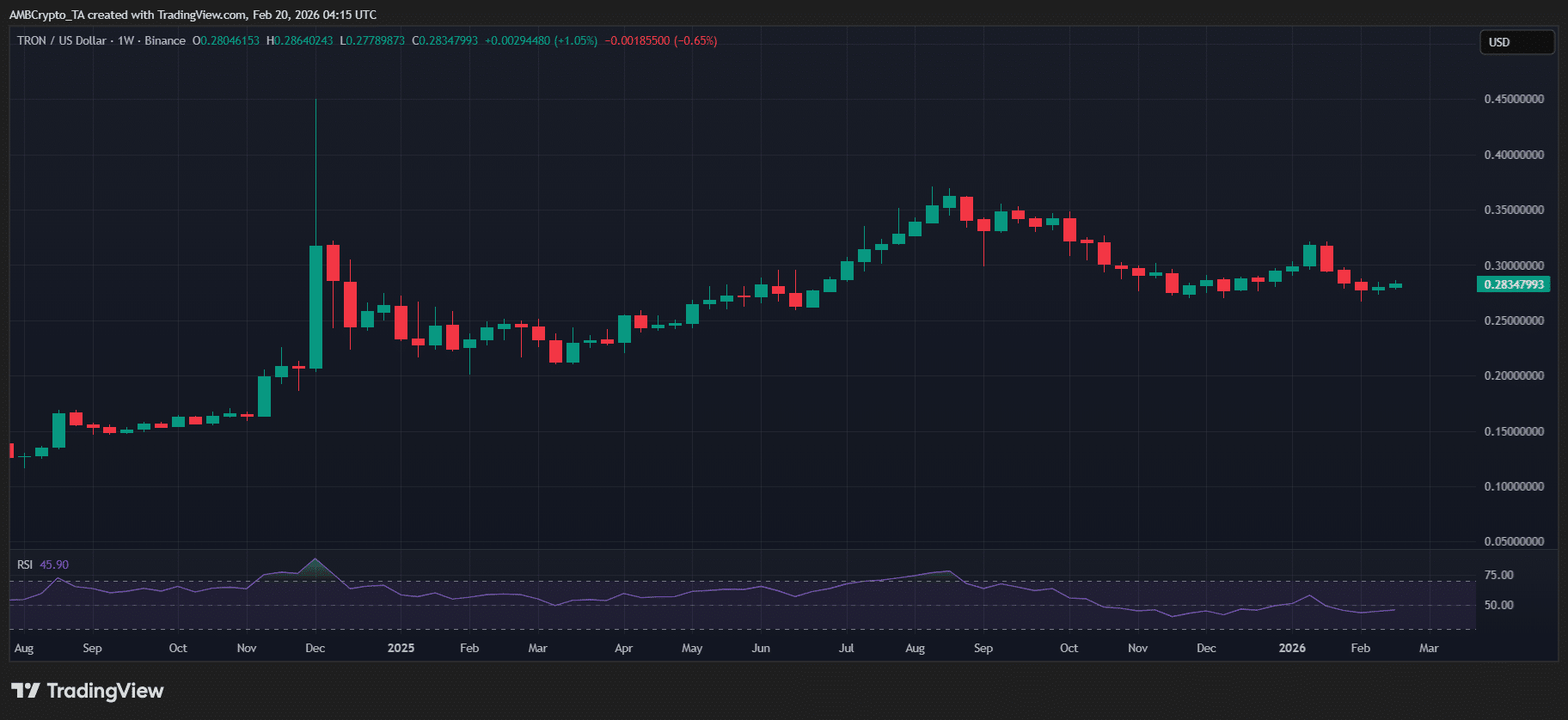
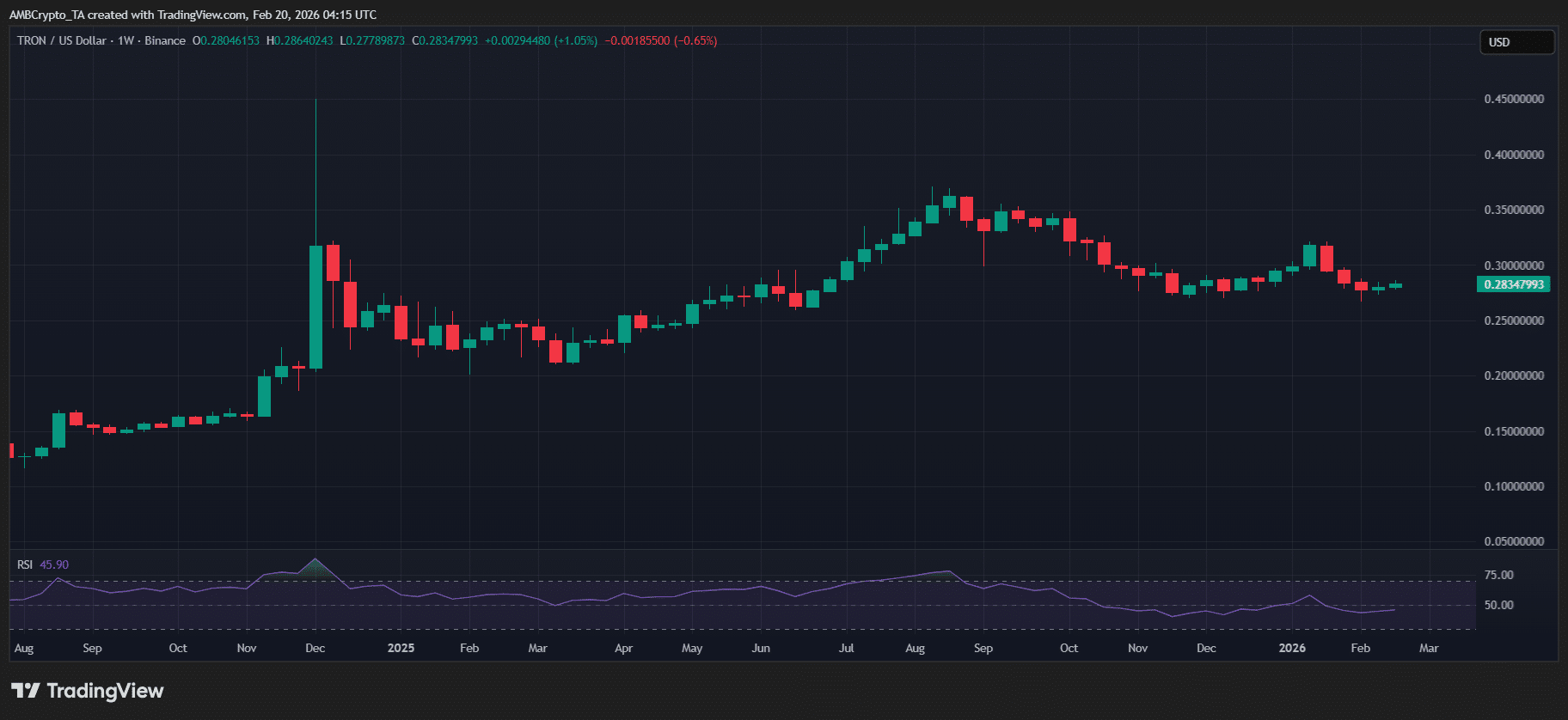
From a technical perspective, this isn’t just a coincidence. Looking at TRX’s price chart, it seems the network is executing a classic “buy the fear” strategy, the kind that often sets the stage for breakout rallies once the market shifts back to risk-on.

Tron’s TRX builds momentum around key support

In today’s market, no move is really a “coincidence.”

With Tron making recent TRX acquisitions and strong DeFi inflows, it’s clear the network is trying to buck risk-off sell-offs by psychologically encouraging HODLing. In turn, keeping investors from offloading.

This strategy is especially notable as TRX trades near a critical support that, back in mid-December 2025, sparked a nearly 15% rally over the month to $0.30, before the market crash wiped out 100% of those gains.

This strategy is especially notable as TRX trades near a critical support that, back in mid-December 2025, sparked a nearly 15% rally over the month to $0.30, before the market crash wiped out 100% of those gains.

Strategically, Tron’s recent moves suggest it’s aiming to protect that floor and set the stage for a potential repeat rally. Strong TVL comes into play here, signaling robust liquidity, active investor participation, and confidence.

Combined with TRX acquisitions, this reinforces $0.27 as a potential price floor. In turn, this supports for a breakout once the market shifts risk-on. If this trend holds and Tron breaks past $0.30 resistance, it could signal a strong buying opportunity.


Final Summary

  • Tron’s TRX acquisitions and rising TVL reinforce $0.27 as a key price floor. In turn, boosting investor confidence and stabilizes sentiment.
  • With TRX trading near critical support, a move past $0.30 resistance could trigger a strong buying opportunity, following a classic “buy the fear” strategy.


Трендові криптовалюти

Пов'язані питання

QWhat was the purpose of Tron's recent acquisition of 177,587 TRX tokens?

AThe acquisition was aimed at enhancing 'long-term shareholder value' and is part of a strategy to control supply and stabilize market sentiment.

QWhat key metric shows that on-chain liquidity for Tron is recovering?

ATron's Total Value Locked (TVL) has risen nearly 2% in the past 24 hours, exceeding $4 billion, indicating a recovery in on-chain liquidity.

QWhat classic market strategy is Tron's network executing according to the article?

ATron is executing a classic 'buy the fear' strategy, which involves acquiring assets during market fear to set the stage for a potential rally when the market sentiment shifts back to risk-on.

QWhat is the critical price floor that Tron's recent moves are aiming to protect for TRX?

ATron's recent moves, including acquisitions and strong TVL, are aiming to protect the $0.27 price level as a critical support floor for TRX.

QWhat potential price level could signal a strong buying opportunity for TRX if broken?

AIf Tron's TRX breaks past the $0.30 resistance level, it could signal a strong buying opportunity, potentially triggering a breakout rally.

Пов'язані матеріали

Gate Research Institute: The 'Wall Street-ization' Wave of Crypto Financial Products – Competition or Integration?

The article titled "Gate Research Institute: Are Crypto Financial Products Sparking a 'Wall Street' Wave—Competition or Convergence?" explores the evolving relationship between the crypto ecosystem and traditional finance (TradFi). The piece begins by reflecting on Bitcoin's original 2009 vision of decentralization, disintermediation, and moving away from banks. It then contrasts this with the 2024 landscape, where key crypto assets like Bitcoin are increasingly held through Wall Street products like ETFs issued by giants like BlackRock. The article questions whether this signifies that TradFi is systematically taking over the rights to issue, price, custody, and distribute crypto financial assets. The core argument is that this is not a zero-sum takeover but rather a bidirectional convergence where each side addresses the other's weaknesses. Crypto offers 24/7 global markets, programmable settlement, and open access but lacks compliant channels, institutional-grade custody, deep fiat liquidity, and mainstream distribution. TradFi possesses these but is constrained by legacy systems, limited operating hours, and slow settlement. Two primary convergence paths are highlighted: * **Path A (CEX to TradFi):** Exemplified by Gate, which has progressed from offering tokenized stocks and CFDs to providing direct, real stock trading (US, Hong Kong, South Korea) within its platform, using USDT. * **Path B (TradFi to Crypto):** Exemplified by Robinhood, which has integrated crypto trading, acquired exchanges like Bitstamp, and is moving traditional assets like stocks onto the blockchain via tokenization and its own Layer 2. Both paths are ultimately competing to become the next-generation, unified financial account—a "super account" where users can seamlessly trade cryptocurrencies, stocks, ETFs, RWA (Real World Assets), and tokenized treasury products in one interface. The growth of RWA and tokenized treasuries (e.g., BlackRock's BUIDL) is presented as the asset-layer fusion, providing stable, yield-bearing assets on-chain and acting as a bridge between the two worlds. In conclusion, the "Wall Street-ization" of crypto is framed as a mutual transformation. Decentralized ideals persist in the protocol layer, while at the application layer, a more efficient, global, and accessible unified capital market is emerging from this convergence. The future competition lies not between crypto exchanges and stockbrokers, but between platforms vying to offer the most comprehensive asset coverage, liquidity, and user experience within a single account.

marsbit4 хв тому

Gate Research Institute: The 'Wall Street-ization' Wave of Crypto Financial Products – Competition or Integration?

marsbit4 хв тому

Claude's Major New Feature: Screen Recording + Voice, Distilling Your Skills into AI Tasks in One Click

Claude has introduced a major new feature called "Record a Skill," available for Pro, Max, and Team users. This function, found in the Claude desktop app's CoWork menu, allows users to create reusable AI skills simply by recording their screen and providing voice narration while performing a task. Claude then automatically analyzes the recording and generates a functional Skill. A hands-on test confirmed the feature works seamlessly. Users start recording via the Skills manager, perform their workflow while verbally explaining the steps and logic, and avoid including sensitive information. After recording, Claude processes the content and creates the Skill, which can be saved and later invoked with a slash command (/). This eliminates the need for manual adjustments or writing complex instruction files. The innovation goes beyond mere efficiency. Previously, creating a Skill required writing a detailed SKILL.md file in Markdown—a significant barrier for non-technical users. "Record a Skill" bypasses this by directly capturing both actions and the implicit reasoning shared in the narration. This lowers the barrier to knowledge transfer and automation, addressing a core challenge in corporate knowledge management: the difficulty of getting experts to write and maintain documentation. However, the feature also highlights a shift in the nature of work. A case study from March 2026 showed a freelancer whose five-year client relationship was effectively replaced by a hand-coded Claude Skill automating their content workflow. With the even lower barrier of screen recording, the ability to distill personal expertise into automatable skills accelerates this trend. The "moat" for work is moving from simply knowing how to do a task to mastering tasks that are difficult or impossible to automate.

marsbit9 хв тому

Claude's Major New Feature: Screen Recording + Voice, Distilling Your Skills into AI Tasks in One Click

marsbit9 хв тому

Feeding AI "Noise" Can Also Boost Scores, This Work Enables Positive Transfer with Noise

Feeding "Noise" to AI Can Improve Performance: A Method Enables Positive Transfer from Noise This work, Semi-Supervised Noise Adaptation (SSNA), introduces a Noise Adaptation Framework (NAF) that challenges traditional transfer learning. Instead of requiring a labeled source domain of real data (e.g., images, text), NAF uses randomly generated Gaussian noise as the source. For a target task with C classes, it constructs C noise clusters by sampling from Gaussian distributions. Although this synthetic noise contains no semantic meaning, NAF trains it to form a discriminative class structure in a shared representation space—clustering same-class noise and separating different classes. The key is aligning this learned structure from the noise domain to the real, sparsely labeled target domain. A small number of target labels are still essential to establish the correspondence between noise clusters and actual classes. The training objective combines: 1) supervised loss on the few labeled target samples, 2) classification loss for the noise to build its structure, and 3) a distribution alignment loss (using Negative Domain Similarity) to minimize the gap between the noise and target domains in the shared space. Experiments show significant gains in few-label settings. With just 4 labels per class, NAF with a ResNet-18 backbone improves accuracy over a standard supervised baseline (ERM) by +12.35% on CIFAR-10, +7.61% on CIFAR-100, +4.38% on DTD-47, and +2.74% on Caltech-101. It also benefits fine-grained datasets and scales to ImageNet-1K (with 100 labels/class) and text classification (AG News). NAF can be integrated into existing semi-supervised methods like FixMatch for further gains. Ablation studies confirm the transferred benefit comes from the discriminative structure of the noise, not randomness itself. Collapsing all noise into a single point causes negative transfer, while increasing separation between noise cluster centers improves performance. The amount of noise per class is less critical once a basic structure forms. In conclusion, this work demonstrates that for positive transfer, the semantic content of source data may not be necessary. What can be effectively transferred is the *organizational structure* of categories within a representation space. This offers a promising alternative for scenarios where real source data is unavailable due to privacy, copyright, or procurement constraints.

marsbit10 хв тому

Feeding AI "Noise" Can Also Boost Scores, This Work Enables Positive Transfer with Noise

marsbit10 хв тому

Торгівля

Спот

Популярні статті

Як купити TRX

Ласкаво просимо до HTX.com! Ми зробили покупку TRON (TRX) простою та зручною. Дотримуйтесь нашої покрокової інструкції, щоб розпочати свою криптовалютну подорож.Крок 1: Створіть обліковий запис на HTXВикористовуйте свою електронну пошту або номер телефону, щоб зареєструвати обліковий запис на HTX безплатно. Пройдіть безпроблемну реєстрацію й отримайте доступ до всіх функцій.ЗареєструватисьКрок 2: Перейдіть до розділу Купити крипту і виберіть спосіб оплатиКредитна/дебетова картка: використовуйте вашу картку Visa або Mastercard, щоб миттєво купити TRON (TRX).Баланс: використовуйте кошти з балансу вашого рахунку HTX для безперешкодної торгівлі.Треті особи: ми додали популярні способи оплати, такі як Google Pay та Apple Pay, щоб підвищити зручність.P2P: Торгуйте безпосередньо з іншими користувачами на HTX.Позабіржова торгівля (OTC): ми пропонуємо індивідуальні послуги та конкурентні обмінні курси для трейдерів.Крок 3: Зберігайте свої TRON (TRX)Після придбання TRON (TRX) збережіть його у своєму обліковому записі на HTX. Крім того, ви можете відправити його в інше місце за допомогою блокчейн-переказу або використовувати його для торгівлі іншими криптовалютами.Крок 4: Торгівля TRON (TRX)Легко торгуйте TRON (TRX) на спотовому ринку HTX. Просто увійдіть до свого облікового запису, виберіть торгову пару, укладайте угоди та спостерігайте за ними в режимі реального часу. Ми пропонуємо зручний досвід як для початківців, так і для досвідчених трейдерів.

1.5k переглядів усьогоОпубліковано 2024.12.10Оновлено 2026.06.02

Як купити TRX

Обговорення

Ласкаво просимо до спільноти HTX. Тут ви можете бути в курсі останніх подій розвитку платформи та отримати доступ до професійної ринкової інформації. Нижче представлені думки користувачів щодо ціни TRX (TRX).

活动图片