"Trillion-Dollar" Liquidity Release: Pre-IPO Equity Tokenization and the Restructuring of PE/VC Exit Paradigms

比推Опубліковано о 2026-01-26Востаннє оновлено о 2026-01-26

Анотація

The article explores the potential of tokenizing pre-IPO equity to unlock trillions in illiquid private market assets, addressing structural barriers like high entry thresholds and limited exit options. It identifies three dominant models: synthetic assets (e.g., Republic, Ventuals) offering derivative exposure without direct ownership; SPV-based models (e.g., Jarsy, PreStocks) using offshore vehicles to hold and tokenize shares, though facing legal challenges from companies like OpenAI; and native collaborative models (e.g., Securitize, Centrifuge) that leverage Transfer Agent licenses for compliant, direct equity tokenization, termed Tokenization-as-a-Service (TaaS). Despite a nascent market size of $1-2 billion (with free-floating tokens under $100 million), concentrated in AI unicorns like SpaceX and OpenAI, the industry must overcome key hurdles: regulatory and corporate legal pressures, shallow liquidity, and uncertain IPO integration. Future growth depends on shifting toward compliant TaaS infrastructure, expanding beyond top unicorns to long-tail private firms, and building specialized trading systems like compliant AMMs.

Author: PKU Blockchain Association Owen Chen(X @xizhe_chan)

Original Title: "Trillion-Dollar" Liquidity Release: Can Pre-IPO Equity Tokenization Restructure the PE/VC Exit Model? — The Evolution from Perps to TaaS


Abstract

Unlisted company equity (Pre-IPO Stock) represents a trillion-dollar value in global asset allocation but has long been constrained by two structural dilemmas: high entry barriers on the participation side and scarce liquidity exits on the exit side. Against the backdrop of real-world asset (RWA) tokenization becoming a focal point of financial innovation, "equity tokenization" is seen as a key mechanism to break the liquidity deadlock in the private market. This report focuses on the tokenization of underlying equity in unlisted companies (especially unicorns), aiming to clarify the evolution logic of this sector from early speculation to compliant infrastructure by analyzing the market status, implementation paths, and key challenges. The core conclusions of the report are as follows:

1. Market Status: Although global unicorn valuations reach trillions of dollars, the actual implemented scale of the tokenization market is only in the range of $100–200 million (if partially non-freely circulating projects are excluded, the actual tradable scale is only in the tens of millions). The market exhibits a strong head effect, with assets highly focused on a few AI tech unicorns like OpenAI and SpaceX. This indicates the industry is still in a very early stage, transitioning from "narrative space" to an "effective market," and has not yet formed a scaled asset supply and承接 capacity.

2. Path Differentiation: The industry has formed three differentiated paths, with the core differences lying in the "degree of rights confirmation" and "level of involvement of the target company":

  • Synthetic Asset Type (Republic, Ventuals): Includes Perps and debt note types, does not hold the underlying equity, only provides valuation exposure, meets speculative demand with high leverage, and primarily serves a traffic introduction role.

  • SPV Indirect Holding Type (Jarsy, PreStocks, Paimon): Holds equity through offshore SPVs and tokenizes the rights. This is the most mainstream落地 form currently. However, it faces dual compliance crackdowns from target companies and regulators. Recent public warnings from companies like OpenAI have exposed the legal fragility of this model in violating "transfer restriction clauses."

  • Native Collaborative Type (Securitize, Centrifuge): Essentially provides TaaS (Tokenization-as-a-Service) for target companies. Relying on Transfer Agent qualifications, it achieves a legal mapping between on-chain tokens and the shareholder register, realizing true equity on-chain. Although the landing cycle is long, it can solve the legal finality dilemma and provide a compliant path for IPO conversion and衔接.

3. Trend Analysis: Tokenization does not automatically create liquidity. The current market faces liquidity issues (thin markets, pricing failure). The future breakthrough point for the industry lies not in unilateral issuance but in collaboration with target companies:

    Twitter:https://twitter.com/BitpushNewsCN

    Bitpush TG Group:https://t.me/BitPushCommunity

    Bitpush TG Subscription: https://t.me/bitpush

    Original Link:https://www.bitpush.news/articles/7605974

Пов'язані питання

QWhat are the three main implementation paths for pre-IPO equity tokenization discussed in the article, and how do they differ in terms of ownership rights and company involvement?

AThe three main paths are: 1) Synthetic Asset Type (e.g., Republic, Ventuals): Provides valuation exposure without holding underlying equity, offering no shareholder rights and primarily meeting speculative demand. 2) SPV Indirect Holding Type (e.g., Jarsy, PreStocks): Uses offshore SPVs to hold shares, tokenizing the SPV's equity rights. This is the most common form but faces dual compliance risks from both the target company and regulators regarding transfer restrictions. 3) Native Collaborative Type (e.g., Securitize, Centrifuge): Offers Tokenization-as-a-Service (TaaS) to the target company. It utilizes Transfer Agent qualifications to achieve legal mapping between on-chain tokens and the shareholder register, enabling true equity on-chain with a compliant path for IPO conversion.

QWhat is the estimated current market size of pre-IPO equity tokenization, and what does this indicate about the market's development stage?

AThe current market size for pre-IPO equity tokenization is estimated to be in the range of $1-2 billion. However, after excluding projects without free circulation, the actual tradable scale is only around tens of millions of dollars. This indicates that the industry is still in an extremely early stage, transitioning from 'narrative space' to an 'effective market,' and has not yet formed a scalable asset supply and承接 capacity.

QWhat key role does a Transfer Agent (TA) play in the native collaborative model of equity tokenization?

AIn the native collaborative model, the Transfer Agent (TA) is crucial as it is a registered entity (e.g., with the SEC) responsible for maintaining and updating the shareholder register. The TA ensures the legal mapping between on-chain tokens and the offline equity ownership, enabling token holders to obtain complete shareholder rights (such as voting, dividends, and information rights) within the company's charter and applicable legal framework. This addresses the legal finality issues and provides a compliant path for IPO conversion.

QWhat are the major compliance challenges faced by the SPV indirect holding model in pre-IPO equity tokenization?

AThe SPV indirect holding model faces significant compliance challenges, primarily from two sources: 1) Regulatory agencies: The structure may violate securities laws and licensing requirements. 2) Target company legal constraints: It often contravenes 'transfer restriction clauses' in shareholder agreements. Recent public warnings from companies like OpenAI have exposed the legal fragility of this model. Additionally, the offshore SPV structure poses transparency challenges, as investors can typically only verify asset-side proof of SPV shareholding but not fully penetrate the liability-side operational and financial information.

QHow does the article characterize the asset preference in the current pre-IPO equity tokenization market, and what is the reason behind this concentration?

AThe current market shows a strong preference for and concentration in top-tier tech unicorns, particularly AI-related assets such as OpenAI, SpaceX, and xAI. This concentration occurs because, in the early market stage, project parties prioritize assets with high recognition, strong narratives, and concentrated attention to achieve product cold-start and market validation with lower education costs. This strategy helps attract trading heat and traffic conversion more easily.

Пов'язані матеріали

ByteDance Adopts Arm CPUs, Jensen Huang: So Sad I Didn't Buy Arm

**Summary:** At Computex 2026, Arm CEO Rene Haas announced that ByteDance and Oracle have adopted Arm's self-designed Arm AGI data center CPU. The company expects significant revenue growth from this product, projecting $20 billion in demand for the 2027/2028 fiscal years. Haas noted that restricting AI-capable CPUs from the US to China is nearly impossible due to their widespread applications. Arm's stock has surged dramatically this year, notably rising 16% after NVIDIA's Arm-based Vera CPU and RTX Spark announcements. A highlight was the informal, humorous on-stage conversation between Haas and NVIDIA CEO Jensen Huang. Huang joked about NVIDIA's failed attempt to acquire Arm and playfully lamented selling his Arm shares. Both executives showed a clear sense of camaraderie and shared regret over the missed merger. Key technical topics were discussed: 1. **AI PC Design:** Huang explained NVIDIA's RTX Spark superchip (with a 20-core Arm CPU) is designed for future AI agents that will autonomously run and use tools on PCs, blending local and cloud processing. 2. **Agent vs. OS:** Huang emphasized the operating system remains crucial, as AI agents rely on its APIs and tools to function. 3. **Growth Constraints:** He identified the shift to "useful AI" that generates profitable tokens as a primary driver for immense, almost limitless, computational demand. Haas outlined Arm's strategy across PC and data centers. For PCs, Arm collaborates with partners like NVIDIA and MediaTek, offering its compute subsystem (CSS) for custom SoCs. In data centers, its Arm AGI CPU (built on TSMC's 3nm process) has gained major partners including OpenAI, Meta, and now ByteDance and Oracle. Arm presented a multi-year roadmap for its in-house CPU line. The article concludes that while GPUs dominated the AI training race, the explosion of AI agents is shifting significant focus to CPUs for inference, state management, and tool orchestration. The industry is trending towards vertical integration, with companies like cloud providers designing chips and chip/IP firms offering full solutions, all competing to deliver more efficient computing per watt.

marsbit18 хв тому

ByteDance Adopts Arm CPUs, Jensen Huang: So Sad I Didn't Buy Arm

marsbit18 хв тому

New Wall Street Play: Yen Shorts Still Adding, But Japan Stocks Don't Rely on Carry Trade Unwinding

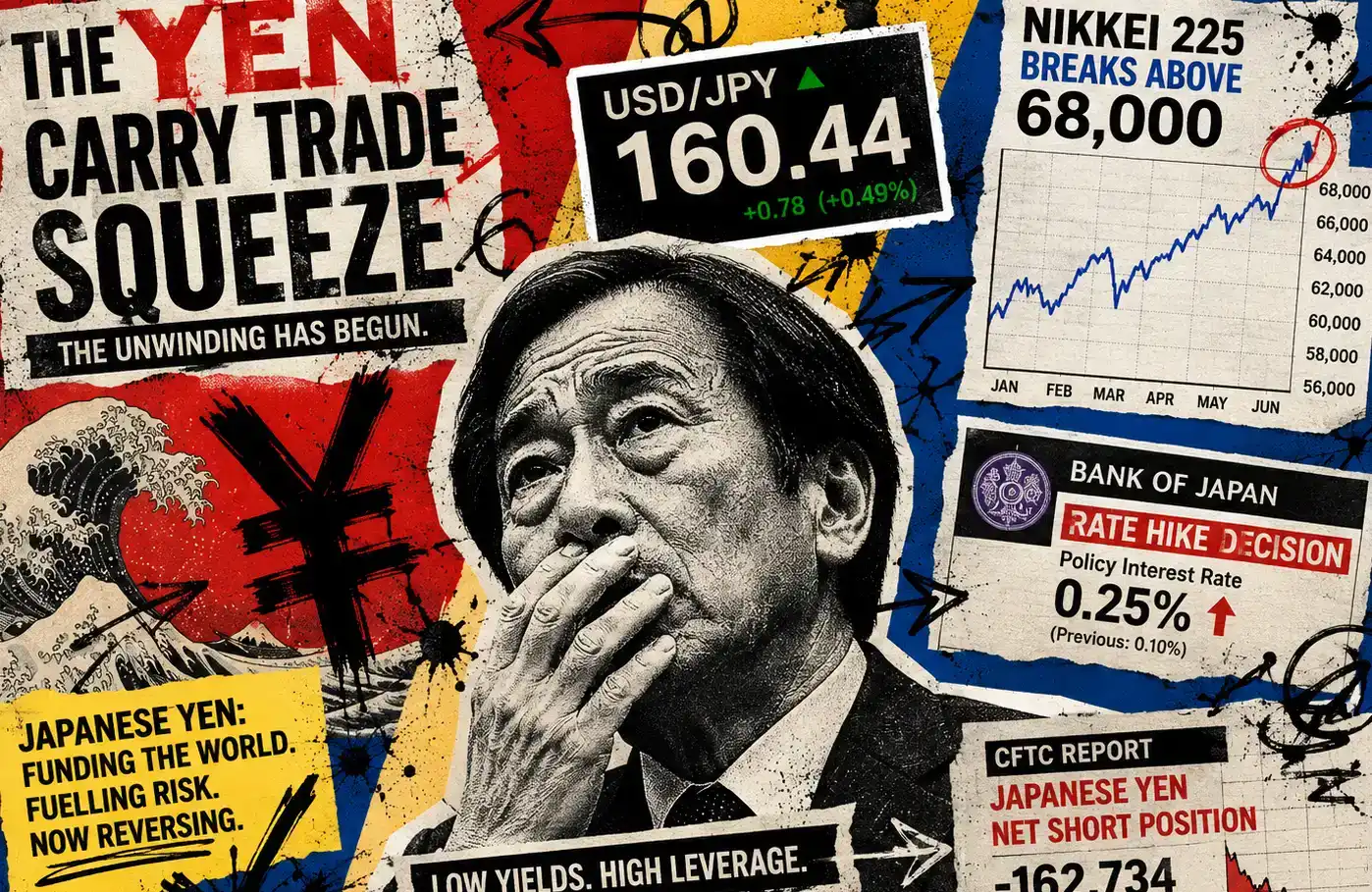
On June 3rd, USD/JPY hit 160.44, its highest level since July 2024, while the Nikkei 225 surged past 68,000 points. Contrary to popular narratives of an imminent "carry trade unwind" akin to August 2024, data reveals a more complex picture. Speculative net short positions in yen futures have actually increased, reaching -114,667 contracts by late May, suggesting traders are doubling down rather than retreating. Meanwhile, Japan's Finance Ministry conducted its largest-ever single-round FX intervention (11.73 trillion yen) in April-May but failed to hold the 160 yen line. The Nikkei's rally is not driven by carry trade dynamics. Foreign investors are aggressively buying Japanese stocks, with net purchases in 2026 running nearly 16 times higher than 2025 levels. This inflow is concentrated in AI and semiconductor-related stocks like SoftBank and Socionext, fueled by positive sector outlooks, rather than being a flight from unwinding yen shorts. Furthermore, the Nikkei has continued climbing despite the Bank of Japan's (BOJ) rate hikes to 0.75%. This disconnect exists because the current equity boom is fueled by AI-driven foreign investment, not reliant on cheap yen funding. However, this relationship remains fragile. Should the BOJ hike rates further (e.g., to 1.0%) while dollar weakness increases carry trade costs, the trajectories of the yen and Japanese stocks could reconverge, potentially triggering volatility.

marsbit22 хв тому

New Wall Street Play: Yen Shorts Still Adding, But Japan Stocks Don't Rely on Carry Trade Unwinding

marsbit22 хв тому

Broadcom's Q3 Guidance Misses Expectations by $12 Billion, After-Hours Trading Plummets Over 13%, AI Narrative "Cooling"?

On June 3, Broadcom released record Q2 FY26 results with revenue of $22.19B, up 48% YoY, and AI chip sales of $10.8B, up 143%. Adjusted EPS of $2.44 beat estimates. However, its Q3 AI semiconductor revenue guidance of $16B, while up over 200% YoY, fell roughly $1.2B (7%) short of analyst consensus expectations of $17.2B. This miss, coupled with slightly weaker-than-expected software revenue, triggered a severe market reaction. CEO Hock Tan maintained the FY26 AI revenue outlook of over $100B but did not raise it, disappointing investors who had priced in more robust growth. The stock plummeted over 13% in after-hours trading, erasing roughly $270B in market cap. The sell-off extended to peers like Marvell. A key concern for markets, particularly for Chinese optical module suppliers, was Tan's comment that the contribution of AI networking (e.g., Ethernet switches, optical interconnect chips) to AI revenue, currently near 40%, is expected to normalize to around 30% over time, signaling a potential peak in growth for that segment. Despite the guidance shortfall, Tan reiterated that AI demand remains "insatiable" and reaffirmed the long-term target of exceeding $100B in AI revenue by FY27. The reaction highlights the heightened sensitivity and premium valuation placed on AI-exposed stocks, where anything less than stellar guidance can prompt significant profit-taking. The broader question is whether this represents a cooling AI narrative or a correction in overstretched valuations.

marsbit22 хв тому

Broadcom's Q3 Guidance Misses Expectations by $12 Billion, After-Hours Trading Plummets Over 13%, AI Narrative "Cooling"?

marsbit22 хв тому

Торгівля

Спот
Ф'ючерси
活动图片