Author: Xiao Jing, Tencent Technology
Editor: Xu Qingyang
Two things happened simultaneously on the evening of May 26th.
Xiaomi released its Q1 2026 financial report. Total revenue was 99.1 billion yuan, down 10.9% year-over-year; adjusted net profit was 6.07 billion yuan, plummeting 43.1% year-over-year. Smartphone business revenue was 44.3 billion yuan, down 12.5% year-over-year, with gross margin dropping to 10.1%, a decrease of 2.3 percentage points compared to the same period last year.
On the earnings call, Lu Weibing, President of Xiaomi Group, mentioned a number: the price of memory with the same specs has skyrocketed nearly 4 times compared to last year. For a phone with 12GB LPDDR5 + 512GB UFS configuration, memory costs alone have increased by about 1,500 yuan. He said Xiaomi "will not pass on the increased memory costs to consumers," but also predicted the price hike cycle would continue into 2027 or even 2028. To survive, Xiaomi proactively cut entry-level models, leading to quarterly shipments dropping to 33.8 million units.
The second thing, Micron Technology surged over 19% in a single day, with its market cap surpassing $1 trillion. UBS raised its price target for Micron from $535 directly to $1,625, an increase of about 204% at once, becoming the highest target among the 46 brokerages currently covering Micron.
A few days earlier, Citigroup had just raised Micron's target from $425 to $840, and HSBC raised it from $750 to $1,100. Wall Street hasn't been this unanimous on a cyclical stock in a long time. Twelve months ago, Micron's stock price was below $110. It has multiplied eightfold in a year.
On the same day, trillion-dollar euphoria for memory sellers, halved profits for memory buyers.
Goldman Sachs played a noteworthy role in this frenzy. In December 2025, Goldman gave Micron a Neutral rating with a $205 target. In Q1 2026, Goldman reduced its Micron position by nearly 20%.
On March 19th, the day Micron reported earnings, Goldman raised its target from $360 to $400, but maintained Neutral—at a time when the stock price had already far exceeded $400. Then Micron soared 40% in a week, and Goldman perfectly missed the rally.
On May 17th, Goldman issued a storage industry report concluding "the most severe supply shortage in 15 years," upgrading the overall storage sector rating. But for Micron, it was still Neutral, with the target price still at $400. As an outlier, Goldman is either the last sane person in this euphoria, or the one who missed out the worst.
But such intense divergence is also worth serious thought.
01 Why the Frenzy? A New Story Called LTA?
The core thesis of UBS analyst Timothy Arcuri's report on May 26th is that Long-Term Agreements (LTA) are fundamentally eliminating the cyclicality of the memory industry.
Memory chips are the product in the semiconductor industry most akin to a commodity. DRAM and NAND prices have followed a brutal forty-year law: up for two years, down for two years; price collapses have never been absent. The profits of Micron, Samsung, and SK Hynix resemble EKG readings, and the market has never dared to value these companies based on "steady-state earnings." For forty years, the valuation fluctuation range for cyclical stocks has roughly been 8 to 15 times P/E.
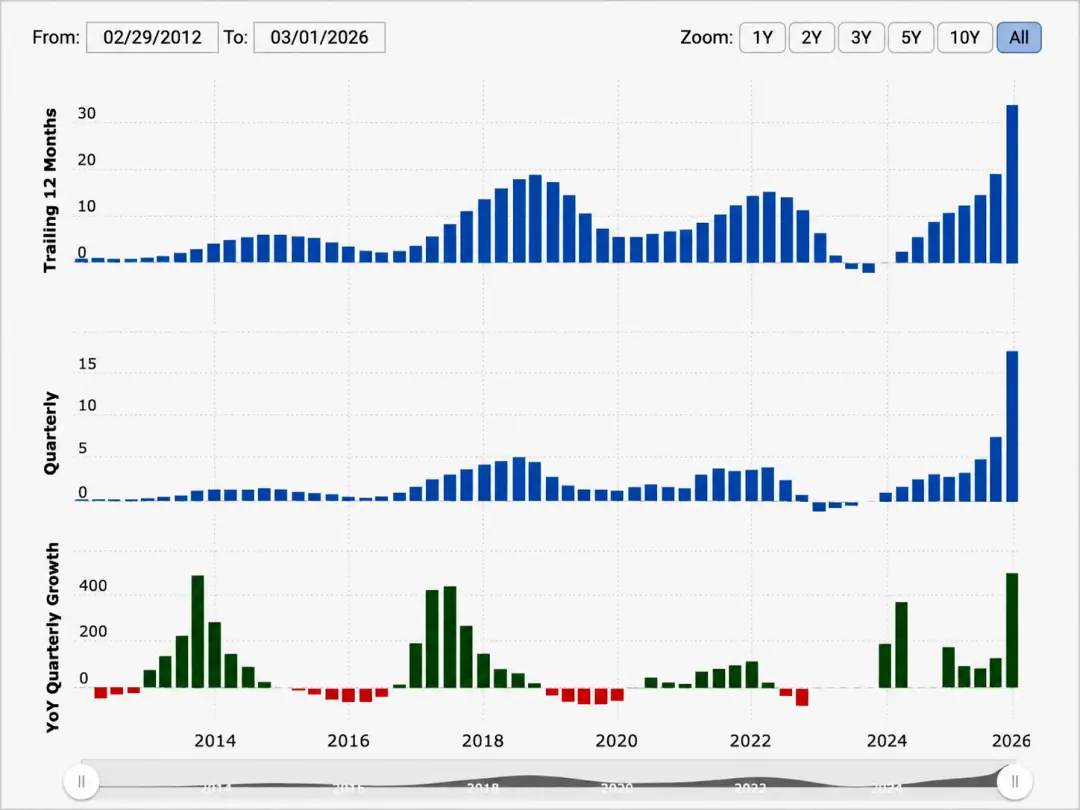
Figure: Micron's EKG-like Financial Data Fluctuations
UBS's story is that the "cycle curse" of these companies will be broken, and the protagonist behind it is "AI."
Cloud vendors like Microsoft, Google, Amazon, and Meta, to secure HBM and DDR5 supply in the AI arms race, are proactively signing 3 to 5-year fixed-price long-term contracts with memory manufacturers, even with prepayments. These contracts are not the traditional "intent-based" agreements in the semiconductor industry but binding purchase commitments, locking in volume, price, and even wafer capacity.
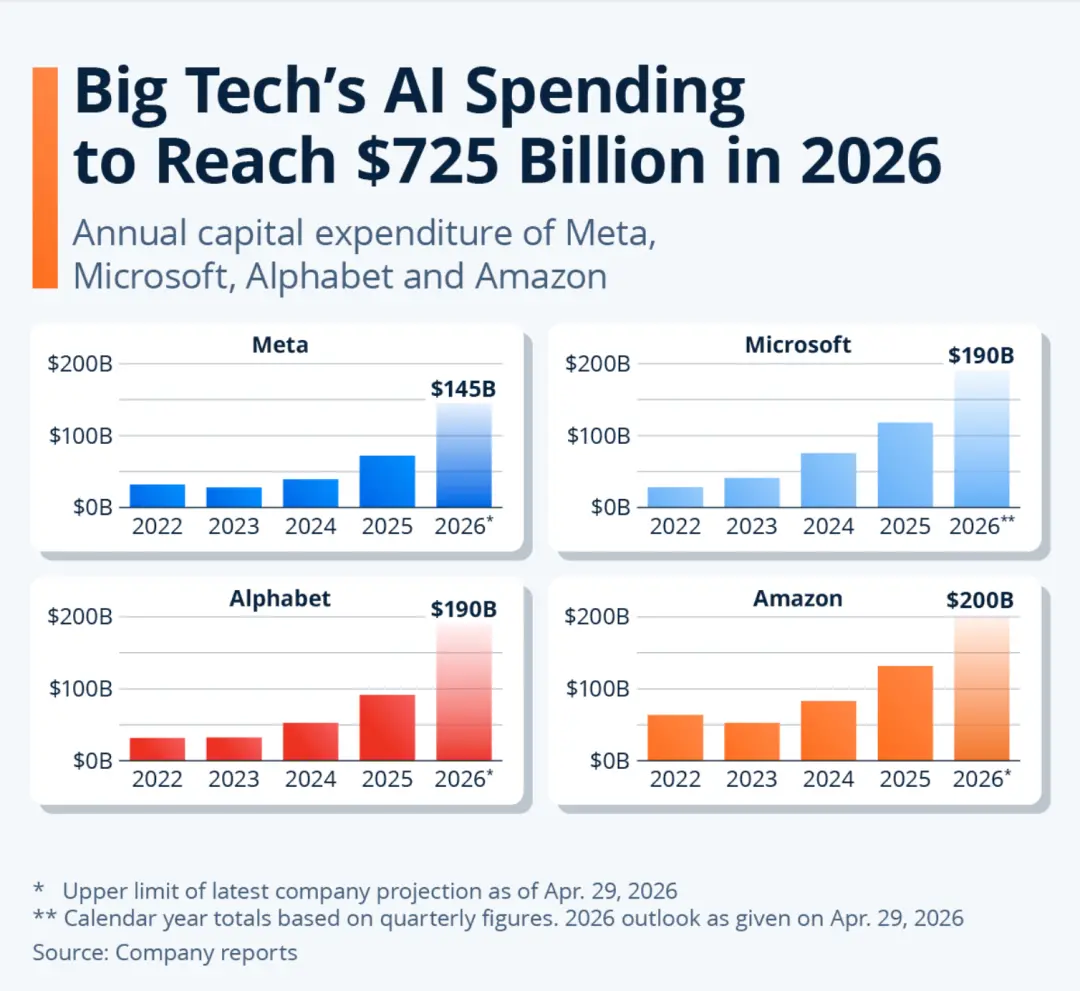
Figure: AI Capital Expenditure of Major Tech Companies (2022—2026E): The four combined are expected to reach $725 billion in 2026. Individually: Amazon $200B, Microsoft $190B, Alphabet $190B, Meta $145B. 2026 data based on each company's latest guidance upper limit as of April 29; Microsoft figures are calendar year aggregates based on quarterly data.
Microsoft and Google were reported in April to be negotiating three-year DRAM LTAs with SK Hynix, structures including prepayment deposits. Previously, manufacturers begged customers for orders; now, customers pay deposits to lock capacity. The power dynamics of the supply chain have reversed.
UBS's model calculations show that after incorporating LTAs into Micron's earnings forecasts, even if DRAM spot prices crash 50% in FY 2029, Micron's annual EPS could still maintain over $100. LTAs can narrow the fluctuation amplitude of DDR prices from cycle peak to trough by about 50%. By 2027, 20% to 30% of the industry's total DDR bit shipments will be locked by fixed-price LTAs. For top hyperscalers' DDR5 procurement, 60% to 70% may already be under fixed contracts.
From a valuation perspective, if cyclicality disappears, memory stocks should no longer be valued as cyclical stocks but as infrastructure utilities, jumping from 8-15x P/E to 20-30x P/E.
JP Morgan also published a report with similar conclusions in mid-May, titled directly "LTAs Are Eliminating Memory Industry Cyclicality." Citigroup's logic is that HBM production will squeeze out ordinary DRAM wafer capacity, leading to long-term tightness in general-purpose memory.
Micron's stock surge welcomes the Davis Double Click of profit and valuation system switching.
02 This Memory Is Not That Memory
Wall Street uses "Memory Supercycle" to tell a unified bull narrative. But "memory" and "memory" are completely different.
The 2026 memory market shows a three-tier differentiation.
The first tier is AI memory: HBM, server DDR5, enterprise SSD. Here, price hikes, shortages, and LTAs locking capacity occur simultaneously. TrendForce expects, Q2 2026 DRAM contract prices to rise 58%-63% QoQ, NAND Flash contract prices to rise 70%-75% QoQ; Kioxia also publicly stated its 2026 capacity is basically sold out. This tier is the story behind Micron's trillion-dollar market cap.
The second tier is mobile and embedded memory: mobile DRAM and smartphone NAND. Price hikes are also severe here. Counterpoint data shows Q1 2026 DRAM prices rose over 50% QoQ, NAND Flash prices rose over 90% QoQ. Related TrendForce reports show memory typically accounted for about 10%-15% of smartphone BOM, now risen to 30%-40%, with low-end models under more pressure.
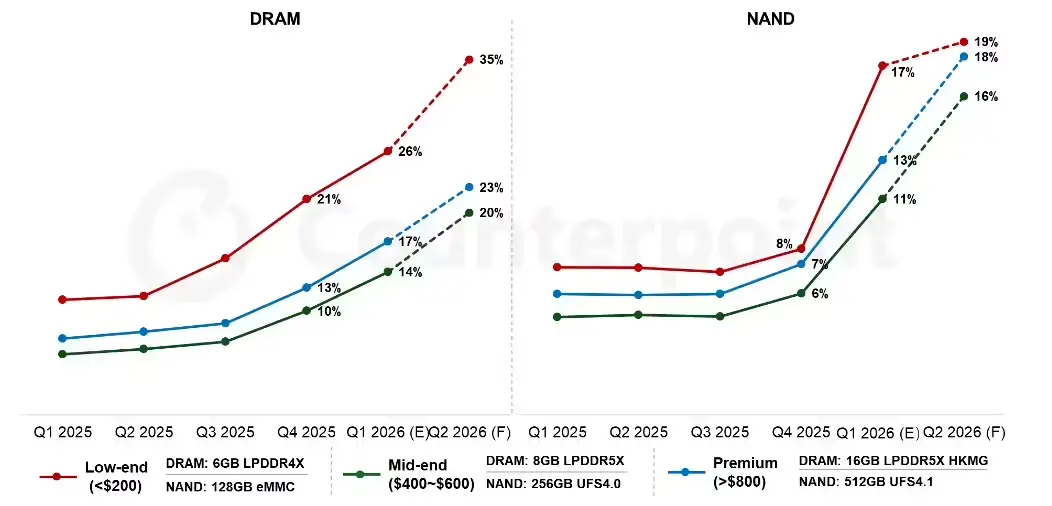
Left chart DRAM (Memory) Trend: Low-end phone increase most aggressive, rising from initial low levels to a forecast of 35% by Q2 2026; high-end to 23%; mid-range to 20%. Dashed portion (after Q1 2026) is forecast.
Right chart NAND (Flash) Trend: All price points remained basically flat through Q3 2025, but began surging sharply from Q4 2025.
Xiaomi sits in this tier. Its pain is "AI is taking away capacity, leaving less for phones, and phone makers must pay higher prices for the remaining capacity."
OEMs prioritize capacity for AI customers, leaving phone makers with few choices in contract procurement. If you want to ship, you have to buy at new contract prices; if you don't, production lines and new product schedules will be affected.
The third tier is PC retail spot: DDR5 modules, consumer SSDs. Reverse movement has appeared here. TrendForce reports show that by late March, 32GB DDR5 modules in Chinese channels dropped 500-1050 yuan from near 3000 yuan, with some clearance prices as low as 1950 yuan; Tom's Hardware also wrote that some DDR5 products in Chinese and overseas retail markets have retreated 25%-30% from highs.
But this is mainly a split between retail spot and contract procurement. PC channels have inventory and can sell off; phone makers buy via contracts and have no sell-off option.
The same "memory" industry, three tiers, three directions. The essence of this differentiation is that the three memory giants are shifting wafer capacity from consumer-grade to AI. HBM production squeezes out ordinary DRAM wafers, enterprise SSDs squeeze out consumer NAND supply, leaving less capacity for phones and PCs. Phone makers, forced to ship, have to accept price hikes; PC channels, with ample inventory, can slash prices and sell off.
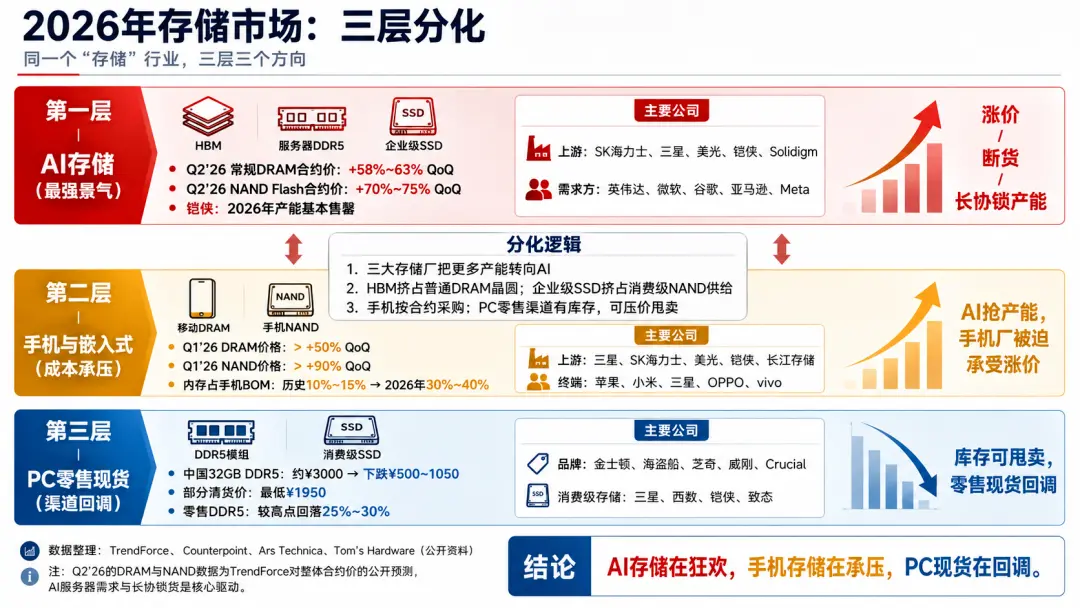
Image generated with AI assistance
Micron and others have actively chosen to allocate capacity to AI customers willing to pay more. In the short term, this is a beautiful product mix upgrade. But it also means Micron is blocking its own retreat; once AI demand slows, capacity may not switch back smoothly.
Micron's earnings report shows that sequentially, DRAM bit shipments only grew mid-single digits, NAND bit shipments only grew low-single digits; growth mainly came from ASP increases. Micron's story today rests solely on the "extreme tightness of the AI memory branch."
Micron is betting everything on this branch.
03 Can LTAs Really Eliminate the Cycle?
The logic of LTAs seems solid. Under AI spending cadence, memory chip supply elasticity is extremely low; HBM capacity takes 18 to 24 months from planning to production, and producing HBM squeezes out general-purpose DRAM wafers. Cloud vendors sign LTAs because they fear "AI project delays."
But LTAs eliminating cyclicality has one prerequisite: the demand side doesn't collapse.
Different institutions have different statistical calibers for AI CapEx, but the direction is consistent: AI infrastructure investment is moving from hundreds of billions of dollars towards nearly a trillion dollars. According to some market models, this is a capital expenditure curve with an annualized growth near 40%-50%.
However, nothing in the physical world grows at over 40% forever. No AI bubble burst is needed; just a slowdown from 45% to 20% could reverse the memory chip supply-demand balance within 18 months. All three memory makers are now expanding capacity like crazy; Micron's FY2026 CapEx is $25 billion, with an additional $10 billion in FY2027.
And there's something that must be faced: when a company's revenue growth relies entirely on price elasticity rather than volume elasticity, the story is fragile. Micron's shipment volume only grew 4%-6%; the 196% revenue growth mainly came from price increases. Prices can rise but also fall, and they fall much faster than they rise. This is the nature of cyclicality.
Let's do a simple math problem.
Micron's current market cap is $1 trillion. Micron has already raised FY2026 CapEx to over $25 billion, and expects capital expenditure to increase significantly in FY2027, with some market reports mentioning the increment could exceed $10 billion.
Micron's Q2 FY2026 non-GAAP net profit was about $14 billion, annualized simply to about $56 billion, corresponding to about 18x P/E. If future price hikes and LTAs are extrapolated further, P/E can still be calculated down to around 15x.
It might seem "cheap." But the denominator of this P/E is a super-cycle peak profit where DDR4 contract prices rose 10x in 15 months, HBM is sold out for the year, and gross margin jumped from 36% to 75%.
Multiplying a cycle-peak profit by a seemingly "reasonable" multiple to get a seemingly "not expensive" valuation is precisely the classic valuation trap when cyclical stocks peak.
In 2000, Cisco's P/E was also "only" in the 60s, based on 15 consecutive quarters of 50%+ revenue growth. When growth slowed from 50% to 20% to 0%, EPS didn't need to fall much for the stock to drop 80%, because both the multiple and earnings contracted simultaneously.
From Davis Double Click to Double Kill.
History tells us one thing: in commodity markets, LTAs are never a one-sided "floor." They protect buyers in up cycles and sellers in down cycles, but only if both sides have the ability and willingness to perform. The moment LTAs are most needed is precisely when they are most likely to fail.
This is not to say Micron is necessarily a bubble. AI demand for compute and memory may indeed be structural, LTAs may indeed rewrite industry rules, and a trillion-dollar market cap may be just the starting point.
But when all of Wall Street shouts "this time is different" simultaneously, it's at least worth stopping to ask: the last time everyone was this certain, what happened afterwards?
In a sense, only by enjoying the euphoria of the bubble can one make money.
But, it took Cisco about 25 years, into today's AI era, to finally surpass its closing high from the internet bubble period—and the internet did indeed change everything.