Trillion-Dollar Euphoria for Memory Sellers, Halved Profits for Memory Buyers

链捕手Опубліковано о 2026-05-27Востаннє оновлено о 2026-05-27

Анотація

Title: The Trillion-Dollar Memory Seller's Carnival vs. The Buyer's Halved Profits On May 26, a stark contrast unfolded. While memory chipmaker Micron's market cap surged past $1 trillion, smartphone maker Xiaomi reported plummeting profits. Xiaomi's Q1 2026 profits fell 43% year-on-year. Executive Lu Weibing cited memory prices quadrupling from last year, adding roughly $210 to a phone's cost. To survive, Xiaomi is cutting entry-level models, sacrificing volume. Micron's stock, however, skyrocketed over 19% in a day, capping an 8x gain in a year. Major banks like UBS and JPMorgan issued bullish reports, raising price targets drastically. Their core thesis: Long-Term Agreements (LTAs) with AI cloud giants (Microsoft, Google, etc.) are eliminating the memory industry's notorious boom-bust cycle. By locking in fixed-price, multi-year contracts for AI-grade memory (HBM, server DDR5), these deals promise stable, utility-like earnings, justifying a higher valuation (20-30x P/E vs. the historical 8-15x). The article reveals a three-tiered memory market in 2026: 1) **AI Storage (HBM/DDR5/Enterprise SSD)**: Extreme shortage, soaring prices, LTAs. This is Micron's story. 2) **Mobile/Embedded Memory**: Also facing sharp price hikes as AI production crowds out capacity, severely pressuring phone makers like Xiaomi. 3) **PC Retail**: Some spot prices are falling due to channel inventory liquidation, creating a divergence from contract markets. The author questions if LTAs truly end ...

Author: Xiao Jing, Tencent Technology

Editor: Xu Qingyang

Two things happened simultaneously on the evening of May 26th.

Xiaomi released its Q1 2026 financial report. Total revenue was 99.1 billion yuan, down 10.9% year-over-year; adjusted net profit was 6.07 billion yuan, plummeting 43.1% year-over-year. Smartphone business revenue was 44.3 billion yuan, down 12.5% year-over-year, with gross margin dropping to 10.1%, a decrease of 2.3 percentage points compared to the same period last year.

On the earnings call, Lu Weibing, President of Xiaomi Group, mentioned a number: the price of memory with the same specs has skyrocketed nearly 4 times compared to last year. For a phone with 12GB LPDDR5 + 512GB UFS configuration, memory costs alone have increased by about 1,500 yuan. He said Xiaomi "will not pass on the increased memory costs to consumers," but also predicted the price hike cycle would continue into 2027 or even 2028. To survive, Xiaomi proactively cut entry-level models, leading to quarterly shipments dropping to 33.8 million units.

The second thing, Micron Technology surged over 19% in a single day, with its market cap surpassing $1 trillion. UBS raised its price target for Micron from $535 directly to $1,625, an increase of about 204% at once, becoming the highest target among the 46 brokerages currently covering Micron.

A few days earlier, Citigroup had just raised Micron's target from $425 to $840, and HSBC raised it from $750 to $1,100. Wall Street hasn't been this unanimous on a cyclical stock in a long time. Twelve months ago, Micron's stock price was below $110. It has multiplied eightfold in a year.

On the same day, trillion-dollar euphoria for memory sellers, halved profits for memory buyers.

Goldman Sachs played a noteworthy role in this frenzy. In December 2025, Goldman gave Micron a Neutral rating with a $205 target. In Q1 2026, Goldman reduced its Micron position by nearly 20%.

On March 19th, the day Micron reported earnings, Goldman raised its target from $360 to $400, but maintained Neutral—at a time when the stock price had already far exceeded $400. Then Micron soared 40% in a week, and Goldman perfectly missed the rally.

On May 17th, Goldman issued a storage industry report concluding "the most severe supply shortage in 15 years," upgrading the overall storage sector rating. But for Micron, it was still Neutral, with the target price still at $400. As an outlier, Goldman is either the last sane person in this euphoria, or the one who missed out the worst.

But such intense divergence is also worth serious thought.

01 Why the Frenzy? A New Story Called LTA?

The core thesis of UBS analyst Timothy Arcuri's report on May 26th is that Long-Term Agreements (LTA) are fundamentally eliminating the cyclicality of the memory industry.

Memory chips are the product in the semiconductor industry most akin to a commodity. DRAM and NAND prices have followed a brutal forty-year law: up for two years, down for two years; price collapses have never been absent. The profits of Micron, Samsung, and SK Hynix resemble EKG readings, and the market has never dared to value these companies based on "steady-state earnings." For forty years, the valuation fluctuation range for cyclical stocks has roughly been 8 to 15 times P/E.
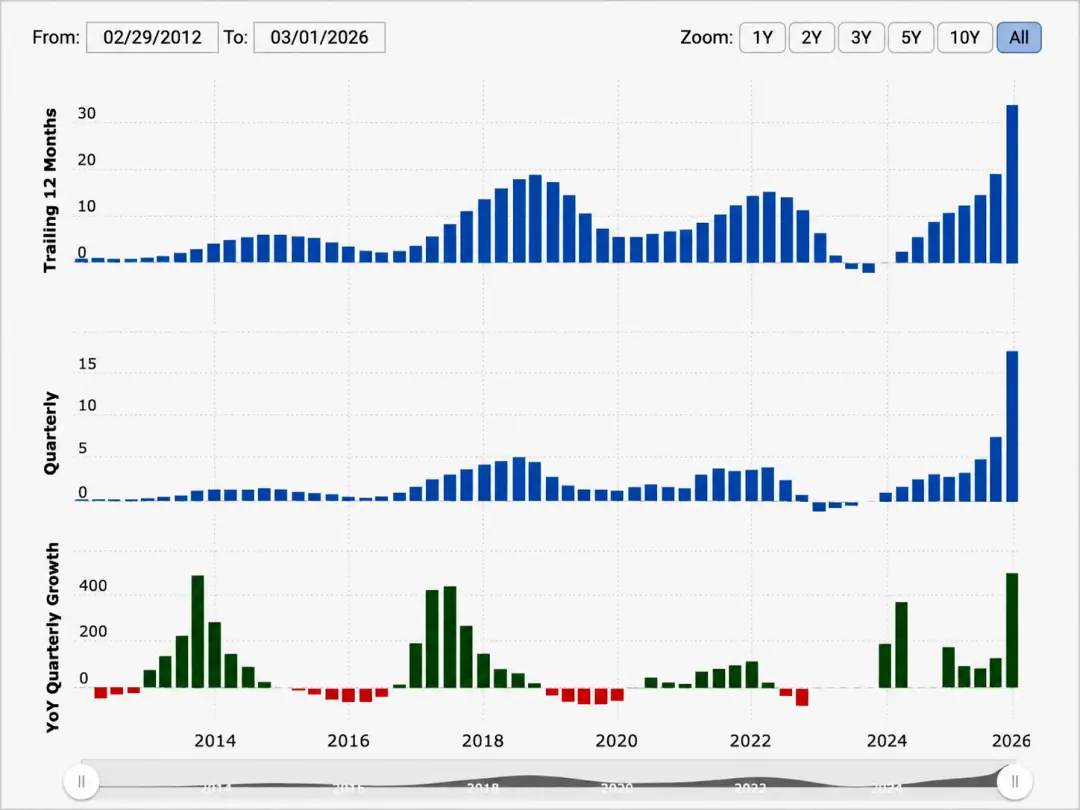
Figure: Micron's EKG-like Financial Data Fluctuations

UBS's story is that the "cycle curse" of these companies will be broken, and the protagonist behind it is "AI."

Cloud vendors like Microsoft, Google, Amazon, and Meta, to secure HBM and DDR5 supply in the AI arms race, are proactively signing 3 to 5-year fixed-price long-term contracts with memory manufacturers, even with prepayments. These contracts are not the traditional "intent-based" agreements in the semiconductor industry but binding purchase commitments, locking in volume, price, and even wafer capacity.
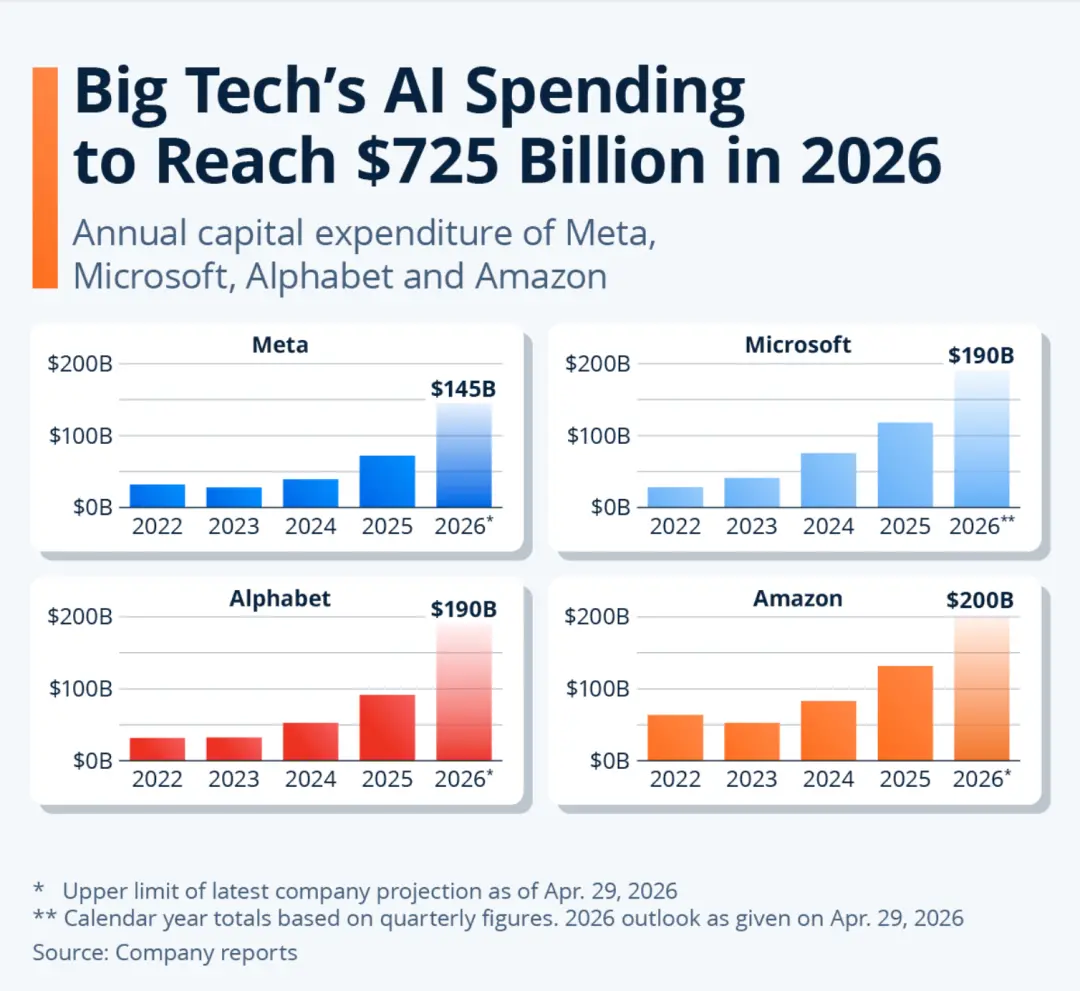
Figure: AI Capital Expenditure of Major Tech Companies (2022—2026E): The four combined are expected to reach $725 billion in 2026. Individually: Amazon $200B, Microsoft $190B, Alphabet $190B, Meta $145B. 2026 data based on each company's latest guidance upper limit as of April 29; Microsoft figures are calendar year aggregates based on quarterly data.

Microsoft and Google were reported in April to be negotiating three-year DRAM LTAs with SK Hynix, structures including prepayment deposits. Previously, manufacturers begged customers for orders; now, customers pay deposits to lock capacity. The power dynamics of the supply chain have reversed.

UBS's model calculations show that after incorporating LTAs into Micron's earnings forecasts, even if DRAM spot prices crash 50% in FY 2029, Micron's annual EPS could still maintain over $100. LTAs can narrow the fluctuation amplitude of DDR prices from cycle peak to trough by about 50%. By 2027, 20% to 30% of the industry's total DDR bit shipments will be locked by fixed-price LTAs. For top hyperscalers' DDR5 procurement, 60% to 70% may already be under fixed contracts.

From a valuation perspective, if cyclicality disappears, memory stocks should no longer be valued as cyclical stocks but as infrastructure utilities, jumping from 8-15x P/E to 20-30x P/E.

JP Morgan also published a report with similar conclusions in mid-May, titled directly "LTAs Are Eliminating Memory Industry Cyclicality." Citigroup's logic is that HBM production will squeeze out ordinary DRAM wafer capacity, leading to long-term tightness in general-purpose memory.

Micron's stock surge welcomes the Davis Double Click of profit and valuation system switching.

02 This Memory Is Not That Memory

Wall Street uses "Memory Supercycle" to tell a unified bull narrative. But "memory" and "memory" are completely different.

The 2026 memory market shows a three-tier differentiation.

The first tier is AI memory: HBM, server DDR5, enterprise SSD. Here, price hikes, shortages, and LTAs locking capacity occur simultaneously. TrendForce expects, Q2 2026 DRAM contract prices to rise 58%-63% QoQ, NAND Flash contract prices to rise 70%-75% QoQ; Kioxia also publicly stated its 2026 capacity is basically sold out. This tier is the story behind Micron's trillion-dollar market cap.

The second tier is mobile and embedded memory: mobile DRAM and smartphone NAND. Price hikes are also severe here. Counterpoint data shows Q1 2026 DRAM prices rose over 50% QoQ, NAND Flash prices rose over 90% QoQ. Related TrendForce reports show memory typically accounted for about 10%-15% of smartphone BOM, now risen to 30%-40%, with low-end models under more pressure.
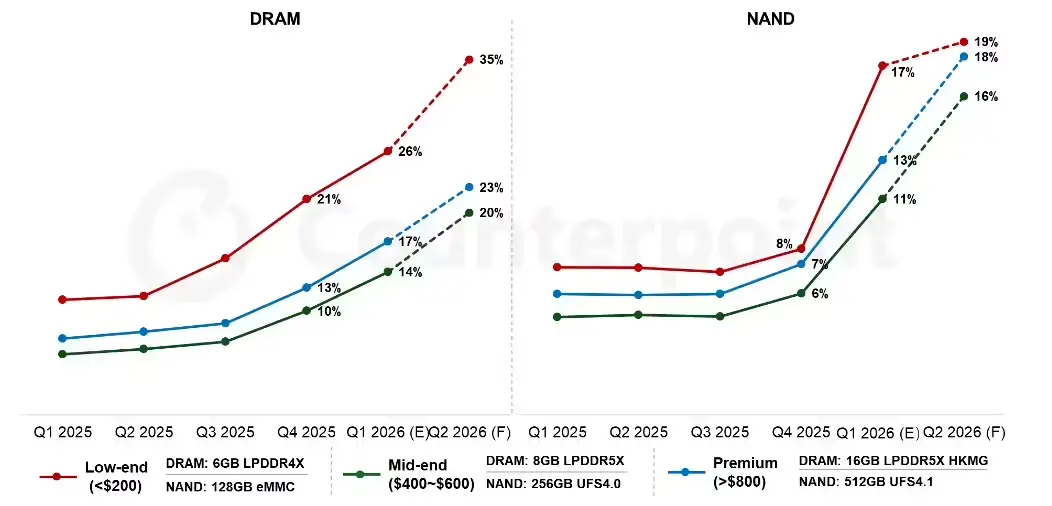
Left chart DRAM (Memory) Trend: Low-end phone increase most aggressive, rising from initial low levels to a forecast of 35% by Q2 2026; high-end to 23%; mid-range to 20%. Dashed portion (after Q1 2026) is forecast.

Right chart NAND (Flash) Trend: All price points remained basically flat through Q3 2025, but began surging sharply from Q4 2025.

Xiaomi sits in this tier. Its pain is "AI is taking away capacity, leaving less for phones, and phone makers must pay higher prices for the remaining capacity."

OEMs prioritize capacity for AI customers, leaving phone makers with few choices in contract procurement. If you want to ship, you have to buy at new contract prices; if you don't, production lines and new product schedules will be affected.

The third tier is PC retail spot: DDR5 modules, consumer SSDs. Reverse movement has appeared here. TrendForce reports show that by late March, 32GB DDR5 modules in Chinese channels dropped 500-1050 yuan from near 3000 yuan, with some clearance prices as low as 1950 yuan; Tom's Hardware also wrote that some DDR5 products in Chinese and overseas retail markets have retreated 25%-30% from highs.

But this is mainly a split between retail spot and contract procurement. PC channels have inventory and can sell off; phone makers buy via contracts and have no sell-off option.

The same "memory" industry, three tiers, three directions. The essence of this differentiation is that the three memory giants are shifting wafer capacity from consumer-grade to AI. HBM production squeezes out ordinary DRAM wafers, enterprise SSDs squeeze out consumer NAND supply, leaving less capacity for phones and PCs. Phone makers, forced to ship, have to accept price hikes; PC channels, with ample inventory, can slash prices and sell off.
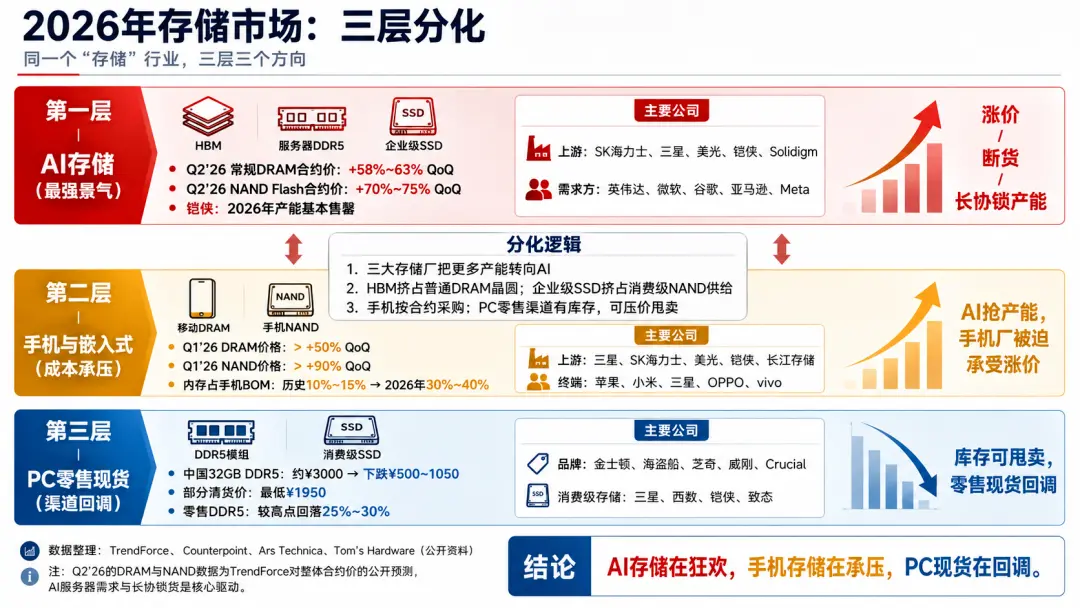
Image generated with AI assistance

Micron and others have actively chosen to allocate capacity to AI customers willing to pay more. In the short term, this is a beautiful product mix upgrade. But it also means Micron is blocking its own retreat; once AI demand slows, capacity may not switch back smoothly.

Micron's earnings report shows that sequentially, DRAM bit shipments only grew mid-single digits, NAND bit shipments only grew low-single digits; growth mainly came from ASP increases. Micron's story today rests solely on the "extreme tightness of the AI memory branch."

Micron is betting everything on this branch.

03 Can LTAs Really Eliminate the Cycle?

The logic of LTAs seems solid. Under AI spending cadence, memory chip supply elasticity is extremely low; HBM capacity takes 18 to 24 months from planning to production, and producing HBM squeezes out general-purpose DRAM wafers. Cloud vendors sign LTAs because they fear "AI project delays."

But LTAs eliminating cyclicality has one prerequisite: the demand side doesn't collapse.

Different institutions have different statistical calibers for AI CapEx, but the direction is consistent: AI infrastructure investment is moving from hundreds of billions of dollars towards nearly a trillion dollars. According to some market models, this is a capital expenditure curve with an annualized growth near 40%-50%.

However, nothing in the physical world grows at over 40% forever. No AI bubble burst is needed; just a slowdown from 45% to 20% could reverse the memory chip supply-demand balance within 18 months. All three memory makers are now expanding capacity like crazy; Micron's FY2026 CapEx is $25 billion, with an additional $10 billion in FY2027.

And there's something that must be faced: when a company's revenue growth relies entirely on price elasticity rather than volume elasticity, the story is fragile. Micron's shipment volume only grew 4%-6%; the 196% revenue growth mainly came from price increases. Prices can rise but also fall, and they fall much faster than they rise. This is the nature of cyclicality.

Let's do a simple math problem.

Micron's current market cap is $1 trillion. Micron has already raised FY2026 CapEx to over $25 billion, and expects capital expenditure to increase significantly in FY2027, with some market reports mentioning the increment could exceed $10 billion.

Micron's Q2 FY2026 non-GAAP net profit was about $14 billion, annualized simply to about $56 billion, corresponding to about 18x P/E. If future price hikes and LTAs are extrapolated further, P/E can still be calculated down to around 15x.

It might seem "cheap." But the denominator of this P/E is a super-cycle peak profit where DDR4 contract prices rose 10x in 15 months, HBM is sold out for the year, and gross margin jumped from 36% to 75%.

Multiplying a cycle-peak profit by a seemingly "reasonable" multiple to get a seemingly "not expensive" valuation is precisely the classic valuation trap when cyclical stocks peak.

In 2000, Cisco's P/E was also "only" in the 60s, based on 15 consecutive quarters of 50%+ revenue growth. When growth slowed from 50% to 20% to 0%, EPS didn't need to fall much for the stock to drop 80%, because both the multiple and earnings contracted simultaneously.

From Davis Double Click to Double Kill.

History tells us one thing: in commodity markets, LTAs are never a one-sided "floor." They protect buyers in up cycles and sellers in down cycles, but only if both sides have the ability and willingness to perform. The moment LTAs are most needed is precisely when they are most likely to fail.

This is not to say Micron is necessarily a bubble. AI demand for compute and memory may indeed be structural, LTAs may indeed rewrite industry rules, and a trillion-dollar market cap may be just the starting point.

But when all of Wall Street shouts "this time is different" simultaneously, it's at least worth stopping to ask: the last time everyone was this certain, what happened afterwards?

In a sense, only by enjoying the euphoria of the bubble can one make money.

But, it took Cisco about 25 years, into today's AI era, to finally surpass its closing high from the internet bubble period—and the internet did indeed change everything.


Пов'язані питання

QAccording to the article, what are the two main events that happened on the evening of May 26th, and what do they illustrate?

ATwo main events happened: 1) Xiaomi released its Q1 2026 financial report, showing a significant drop in profit and revenue, with its president attributing part of the pressure to memory chip costs rising nearly 4 times year-over-year. 2) Micron Technology's stock surged over 19%, pushing its market cap above $1 trillion. These events illustrate the stark contrast between memory sellers (like Micron) experiencing a 'trillion-dollar狂欢' (carnival) and memory buyers (like Xiaomi) facing '利润腰斩' (profit halving).

QWhat is the new narrative that Wall Street, specifically UBS and J.P. Morgan, is using to justify Micron's high valuation and argue against the traditional cyclical nature of the memory industry?

AThe new narrative centers on Long-Term Agreements (LTAs). Analysts argue that AI-driven hyperscalers (like Microsoft, Google, Amazon, Meta) are signing 3-5 year binding contracts with memory makers to lock in supply (especially for HBM and DDR5) at fixed prices, often with prepayments. This supposedly fundamentally eliminates the industry's traditional boom-bust cycle by guaranteeing stable demand and pricing. If the cycle is broken, memory stocks should be valued like infrastructure/utility companies (20-30x P/E) rather than cyclical stocks (8-15x P/E).

QHow does the article describe the three-tiered divergence within the broader 'storage' market in 2026?

AThe article describes a three-tiered divergence: 1) **AI Storage (HBM, server DDR5, enterprise SSD)**: Extreme shortages, soaring prices, sold-out capacity. This is the core of Micron's growth story. 2) **Mobile & Embedded Storage**: Also facing severe price hikes. Phone makers like Xiaomi are squeezed as they must purchase at high contract prices to maintain production, with memory now taking 30-40% of BOM costs. 3) **PC Retail Spot Market**: Shows the opposite trend, with prices for DDR5 modules and consumer SSD dropping 25-30% from peaks due to channel inventory sell-offs, creating a split with the contract market.

QWhat critical assumption must hold true for the Long-Term Agreement (LTA) narrative to successfully 'eliminate the cycle'? What potential risk does the article highlight regarding this assumption?

AThe critical assumption is that AI demand does not collapse or significantly slow down. The article highlights the risk that even a slowdown in AI capital expenditure growth (e.g., from 40-50% to 20%) could reverse the supply-demand balance within 18 months. As memory makers like Micron ramp up massive capital expenditure (CapEx) based on peak-cycle demand, a slowdown could lead to overcapacity. Furthermore, LTA contracts are most likely to be challenged or renegotiated precisely when they are most needed—during a downturn.

QWhat historical analogy does the article draw to caution against potential valuation risks for Micron at its current peak?

AThe article draws an analogy to Cisco during the dot-com bubble of 2000. At its peak, Cisco's P/E ratio 'was only in the 60s,' based on 15 consecutive quarters of 50%+ revenue growth. When growth slowed dramatically, Cisco's stock fell about 80% due to a simultaneous contraction in both its earnings multiple (P/E) and its earnings (EPS)—a phenomenon known as a '戴维斯双杀' (Davis Double Kill), the opposite of the戴维斯双击 (Davis Double Play) it is currently experiencing. The warning is that using peak-cycle earnings multiplied by a 'reasonable' multiple can be a classic valuation trap for cyclical stocks.

Пов'язані матеріали

AI Trading Cools, South Korean Stocks Plunge 1.8%, Spot Gold Rises 1%, Bitcoin Dives

A sell-off in AI-related stocks, triggered by Broadcom's disappointing earnings forecast, sent shockwaves through global markets. South Korea's KOSPI led Asia's decline, plunging 1.8% as the risks from concentrated chip stock gains and surging leveraged investments came to the fore. The tech-heavy Nasdaq 100 futures fell 0.5% following Broadcom's 14% after-hours plunge, which signaled a slower-than-expected transition to AI clients. This pullback extended Wall Street's weakness, halting the S&P 500's nine-day rally amid hawkish Fed signals and renewed Middle East tensions. South Korean authorities convened an emergency meeting, pledging "immediate measures" against market volatility and warning of record-high stock margin debt. The adjustment rippled across assets: Bitcoin fell to around $64,000, its lowest since February, while safe-haven gold rose 1% on bargain hunting. Oil prices dipped on Middle East ceasefire news. Market analysts noted the sell-off was driven by profit-taking after massive gains, particularly in chip stocks like Samsung and SK Hynix, which now dominate the KOSPI. Wall Street banks are divided on Korea's outlook, with Goldman Sachs raising its target while Citigroup and others warn of overvaluation and a potential bubble. Bridgewater's Ray Dalio noted that great technological shifts often create bubbles. Meanwhile, Fed officials' hints at potential future rate hikes added to the cautious mood ahead of key U.S. jobs data.

华尔街日报20 хв тому

AI Trading Cools, South Korean Stocks Plunge 1.8%, Spot Gold Rises 1%, Bitcoin Dives

华尔街日报20 хв тому

Seeking Alpha's Hot Article: Why Might the U.S. Stock Market Crash in June?

In a recent Seeking Alpha article, financial professor and analyst Damir Tokic argues that the US stock market may be poised for a significant crash in June 2026. The core thesis centers on a "mega-bubble" in equities, particularly within the technology sector, which has driven the S&P 500 to near-record valuations, with a Shiller P/E ratio exceeding 40—a level comparable to the 2000 dot-com bubble. Tokic identifies two primary catalysts for a potential collapse. First, he points to unsustainable market exuberance fueled by what he terms the "Trump Stimulus"—massive AI capital expenditure by tech giants, which he believes is politically driven and cannot last. Second, and more urgently, he highlights the escalating Iran war as a critical threat. The ongoing closure of the Strait of Hormuz has created a severe global energy supply crunch. Strategic petroleum reserves are projected to hit critically low operational levels by June, potentially causing oil prices to spike above $200 per barrel and triggering a severe, supply-driven inflationary shock. This scenario, Tokic warns, would force the Federal Reserve's hand. Despite currently maintaining a dovish bias, the Fed would likely be compelled to officially pivot to a hawkish stance at its June FOMC meeting to combat soaring inflation and bond yields. He contends that such a shift—or even a failure to act, which would destroy Fed credibility—could be the trigger that punctures the market bubble. The resulting downturn, he concludes, could rival the bear markets of 2000 and 2008, advising investors to prepare for a major correction.

marsbit42 хв тому

Seeking Alpha's Hot Article: Why Might the U.S. Stock Market Crash in June?

marsbit42 хв тому

AI PC Battle: Bet on the Toll Booth, Not the Camp

**Title:** The AI PC Battle: Don't Bet on Sides, Bet on the Tollbooth **Summary:** The AI PC competition is moving beyond simple "x86 vs. Arm" narratives. The core investment thesis should focus on identifying which players can sustain margins, cash flow, and pricing power throughout the upgrade cycle, rather than backing a particular architecture. The opportunity is analyzed in three layers: 1. **The Advanced Foundry Tollbooth:** TSMC is positioned to collect "tolls" regardless of which chip designer wins, due to its dominant ~70% share in advanced semiconductor manufacturing, which is essential for high-end AI PC chips. 2. **Compute & Platform Spillover:** AMD represents an offensive in the x86 CPU+GPU space, while NVIDIA leverages its GPU and CUDA software stack dominance. Both benefit from the demand for increased local AI compute. 3. **Architecture Diffusion & Turnaround Plays:** ARM and Intel offer potential for significant upside (elasticity), but investments here require stricter discipline due to higher execution risks and competitive challenges. The industry is transitioning from concept to shipment validation. While short-term forecasts for AI PC adoption have been revised down slightly due to tariffs and procurement delays, the long-term trend towards AI becoming a standard PC feature remains intact. The key driver for upgrade cycles will be whether compelling enterprise applications (e.g., privacy-sensitive computing, low-latency inference) emerge beyond consumer-focused features like meeting summarization. Investment strategy should prioritize companies with platform-level advantages and recurring revenue streams. TSMC offers high certainty as the foundational tollbooth. AMD presents a strong offensive play within the established ecosystem. ARM and Intel are higher-risk, higher-potential-reward turnaround bets. The report cautions against chasing short-term hype and emphasizes a disciplined, long-term approach focused on buying ecosystem strength and cash-flow certainty after market enthusiasm subsides. **Key Risks:** Underwhelming AI PC applications slowing upgrade cycles; slow improvement in Windows on Arm compatibility; macro/tariff impacts on PC demand; potential advanced node supply-demand mismatches affecting TSMC; high overall AI sector valuations making stocks vulnerable to a risk-off shift in markets.

marsbit57 хв тому

AI PC Battle: Bet on the Toll Booth, Not the Camp

marsbit57 хв тому

Ten-Thousand-Word Analysis: From $10 to $290, MRVL Wins the Entire AI Era by 'Not Making GPUs'

Marvell Technology's stock price surged from under $10 in 2016 to a record $290 in June 2026, fueled not by making GPUs, but by dominating AI infrastructure connectivity. This analysis argues the market misvalues MRVL as merely a smaller Broadcom in custom AI chips, overlooking its true, unique position. Marvell's core strength lies in enabling high-speed data flow for AI clusters through three interconnected businesses. First, it holds a commanding ~70% market share in high-speed optical DSPs (essential for data center light modules), a deep-moat business with accelerating growth. Second, its custom AI chip design business serves hyperscalers like AWS, Microsoft, and Google, with a significant revenue pipeline despite lower margins. Third, stable cash flows come from Ethernet switch chips and enterprise storage controllers. Together, they form a full-stack "AI data movement" platform. CEO Matt Murphy's transformative leadership since 2016, involving strategic divestments, key acquisitions (like Inphi for optical DSPs), and securing long-term agreements with major cloud providers, repositioned the company. A pivotal $2 billion strategic investment from NVIDIA in 2026 underscored Marvell's critical role in the AI ecosystem, particularly through collaborations like NVLink Fusion. While Marvell faces risks—including client concentration (losing the Amazon Trainium3 design), lower-margin business mix, competitive threats, insider selling, and complex supply chains—its fundamentals remain strong. The optical interconnect moat is widening with the acquisition of Celestial AI (photonics fabric), and financial metrics show accelerating revenue growth and operating leverage. With a PEG ratio suggesting undervaluation relative to its growth, the thesis is that the market undervalues Marvell's monopolistic position in AI "plumbing" while overemphasizing its competitive custom chip segment. The story transcends investing, symbolizing how in any complex system—from the internet to AI—the value of "connection" ultimately surpasses that of individual "nodes."

marsbit1 год тому

Ten-Thousand-Word Analysis: From $10 to $290, MRVL Wins the Entire AI Era by 'Not Making GPUs'

marsbit1 год тому

Торгівля

Спот
Ф'ючерси
活动图片