Treasury Secretary's Move to Suppress Treasury Yields Ignites 'Currency Debasement Trade'! Gold Hits Three-Month High, Bitcoin Surges Over 25% in a Single Week

华尔街日报Опубліковано о 2026-08-21Востаннє оновлено о 2026-08-21

Анотація

US Treasury Secretary Besant's efforts to lower long-term Treasury yields by announcing expanded buybacks had only a brief market impact. However, this move fueled a "currency devaluation trade," weakening the US dollar while boosting both gold (to a three-month high) and Bitcoin (up over 25% for the week). Analysts attribute this reaction to deepening market concerns over the massive US fiscal deficit and structural pressures keeping long-term rates elevated, including fierce competition for capital from global government borrowing and massive AI sector financing. Despite the Treasury's actions, fundamental forces like growth, inflation, and capital demand are seen as limiting its ability to sustainably suppress yields. Bitcoin's strong positive correlation with gold has reinforced its narrative as a hedge against devaluation. While equity markets have shown resilience, some strategists warn that Treasury yields nearing 5% increase pressure on the dollar and high-leverage assets. Figures like Ray Dalio have advised reducing bond exposure in favor of gold and some Bitcoin, citing US debt risks. Market opinions are divided on the sustainability of the devaluation trade, with some noting the lack of a near-term catalyst for its next leg higher. The underlying tension between the Treasury's desire for lower borrowing costs and the Federal Reserve's focus on inflation and reducing market intervention remains a key theme. Upcoming events like Nvidia's earnings and the Jackson Ho...

U.S. Treasury Secretary Besant's efforts to suppress long-end Treasury yields had a direct market impact lasting less than a day.

Yet this move pushed the dollar lower, with gold and Bitcoin both rising – reinforcing the logic of this "currency debasement trade," driven by the forces of a ballooning U.S. fiscal deficit and deeper market concerns about the direction of U.S. economic policy.

After announcing an expansion of buybacks, Besant said in an interview that the market was "overreacting a bit," and emphasized that the Treasury has a "strong toolkit."

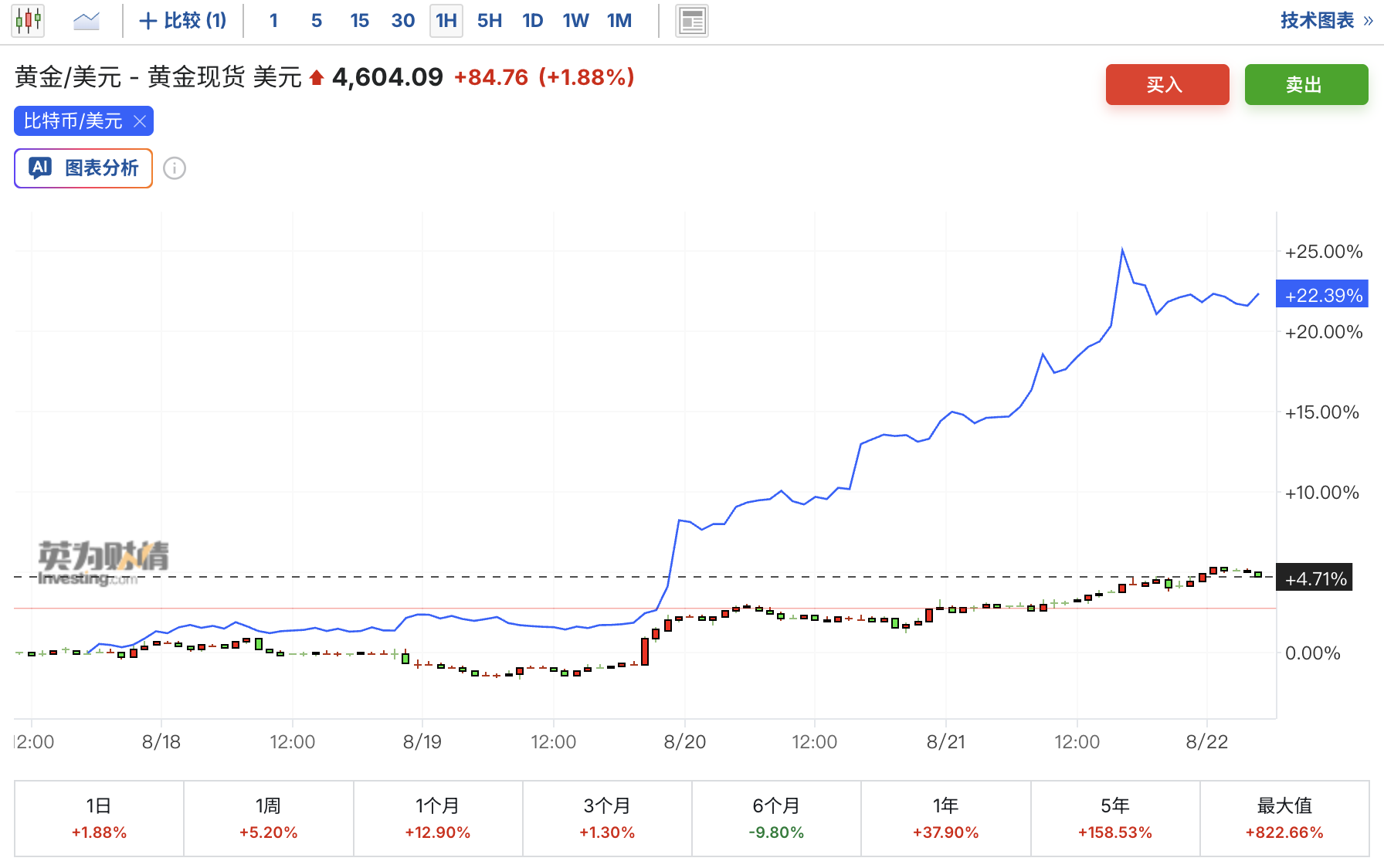
However, long-end Treasury yields only briefly retreated before coming under pressure again, ending the week largely flat. Meanwhile, Bitcoin surged over 25% this week, breaking above $78,000, while gold climbed to a three-month high.
This market reaction reveals a deeper dilemma in Washington: the U.S. government wants to lower financing costs, but inflation remains a constraint on the Federal Reserve. At the same time, governments and corporations worldwide are competing for capital more intensely than ever—from massive fiscal borrowing to the huge financing needs in the artificial intelligence sector. The structural upward pressure on long-end rates has not dissipated.

Charlie McElligott of Nomura Securities characterized this week's combination of rising gold, a falling dollar, and simultaneous Bitcoin strength as a "pressure relief valve"—when U.S. authorities try to stabilize long-end rates, market anxiety vents elsewhere.

Barclays strategists believe the dollar is the "biggest loser" from this yield-suppression action, with renewed fiscal concerns stoking safe-haven demand for gold.

The 90-day correlation between Bitcoin and gold is currently at its highest level since the pandemic, further reinforcing the narrative logic of cryptocurrencies as a "debasement hedge"—though this week's crypto rally also had its own specific catalysts.

Nathan Thooft, Senior Portfolio Manager at Manulife Investment Management, noted: "The Treasury can influence liquidity and market sentiment, but it cannot sustainably suppress the fundamental forces of growth, inflation, deficits, and supply."

The U.S. government's current fiscal deficit is nearing $2 trillion, rising oil prices are exacerbating inflation risks, and governments globally continue to expand borrowing for defense, energy, and social spending.

Barclays strategists also pointed out that rising corporate bond issuance—especially by mega-cap tech companies financing AI investments—is adding extra pressure on long-end rates. The conclusion: the Treasury can adjust duration supply, but it cannot eliminate the demand for capital.

The AI frenzy plays a dual role in this capital competition: on one hand, financing for AI creates enormous demand in the bond market; on the other, investor expectations of high AI returns are helping stocks remain resilient despite rising funding costs.

Besant expressed clear displeasure in an interview Thursday regarding AI companies' borrowing behavior, saying the debt issuance strategy of such firms is "almost yield-insensitive because they believe the returns from building AI will be so great that they don't care what rate they pay."

Priya Misra, Portfolio Manager at J.P. Morgan Asset Management, said, "A global fight for capital is driving up the discount rate for equities—from governments financing defense, energy security, and social programs, to the financing needs of the entire AI ecosystem."

Florian Ielpo of Lombard Odier believes the key figure supporting stocks is not the Treasury's $4 billion-scale buyback operation, but rather "2026's 20% earnings beat." This partly explains why the stock market has largely "looked through" Besant's actions and the renewed pressure in bond markets.

Despite stock market resilience, U.S. Treasury yields approaching 5% are becoming increasingly difficult for highly valued stocks to ignore as a source of competitive pressure.

Bank of America strategist Michael Hartnett views the 5% level on the 30-year Treasury yield as a key dividing line, arguing that failure to break below it would increase pressure on the dollar and high-leverage areas—including AI hyperscalers and private credit.

On Friday, Ray Dalio, founder of Bridgewater Associates, issued a more severe warning to markets, advising investors to reduce bond exposure and hold some gold and Bitcoin as a hedge against a potential U.S. debt crisis.

Misra also noted that markets are digesting policy disruptions faster: "The speed at which markets fade policy moves is increasing because there's some expectation of 'equity market protection' from this administration—time and again, whenever there's turmoil in risk assets or bond markets, we've seen Trump or the Treasury step in."

The advantage of the debasement trade over bonds lies in its more compelling narrative logic. But there is disagreement over whether this trade can be sustained.

Brent Donnelly, President of Spectra Markets, initially interpreted Besant's announcement as a signal to buy Bitcoin and sell the dollar against the Swiss franc. But the buyback scale is minuscule relative to the entire Treasury market, causing him to later waver.

"I think the big moves in the dollar, gold, and Bitcoin are likely to cool off significantly from here," he said. "Besant's move reinforced structural themes, but those themes aren't new, and there isn't any near-term catalyst to trigger the next leg higher for the debasement trade."

At a deeper institutional level, the tension between the Treasury and the Fed is also noteworthy. The Treasury can adjust the volume and maturity structure of bond issuance, but it cannot create money out of thin air—that's the Fed's power.

However, Fed Chairman Warsh's emphasis on scaling back the central bank's market intervention leaves Washington facing the reality of resilient economic growth, persistent inflation, and large-scale capital expenditures all pushing rates higher, even as it hopes to lower borrowing costs.

Next week's market moves may further test this tension: Nvidia's earnings will reveal whether AI company profits can continue to support stocks, while at the Jackson Hole meeting, investors will watch closely for any signs of the Fed aligning with Washington on easier financial conditions.


Трендові криптовалюти

Пов'язані питання

QWhat market reaction was described as a 'pressure release valve' in the article, and who provided that characterization?

AThe combination of rising gold, a falling dollar, and a simultaneous strong performance in Bitcoin was described as a 'pressure release valve'. This characterization was provided by Charlie McElligott of Nomura Securities.

QAccording to the article, what is the current 90-day correlation between Bitcoin and gold at, and what narrative does this strengthen?

AThe 90-day correlation between Bitcoin and gold is at its highest level since the pandemic. This strengthens the narrative of cryptocurrencies acting as a 'depreciation hedge tool'.

QWhat did Bridgewater founder Ray Dalio reportedly advise investors to do in response to a potential U.S. debt crisis?

ARay Dalio reportedly advised investors to reduce their bond exposure and hold gold and some Bitcoin to guard against a potential U.S. debt crisis.

QWhat two major events next week does the article suggest will test the market's tension between high rates and growth narratives?

AThe article suggests that Nvidia's earnings report, which will reveal if AI company profits can continue to support the stock market, and the Jackson Hole meeting, where investors will watch for signs of alignment between the Fed and Washington on easing financial conditions, will test the market tension.

QWhat key difference in authority does the article highlight between the U.S. Treasury and the Federal Reserve in influencing markets?

AThe article highlights that the Treasury can adjust the volume and maturity structure of bond issuance, but it cannot create money out of thin air—that is the power of the Federal Reserve.

Пов'язані матеріали

Mysterious "Ox Alpha" Large Model Goes Viral with Limited-Time Free Access

A mysterious anonymous AI model named "Ox Alpha," nicknamed "Cow is Coming" by Chinese netizens, has appeared on OpenRouter, sparking widespread speculation. The model offers a 1 million token context, supports text, image, and video inputs, can call tools, and is currently free. Its standout feature is strong coding ability. Initial tests on the DeepSWE benchmark, which evaluates real-world software engineering tasks, showed an 80% pass rate on a subset of tasks, reportedly nearing top-tier code models. However, follow-up tests yielded a 63% score, with variations attributed to different task sets and configurations. The model's true developer is a major topic of debate. The prevailing theory points to Zhipu AI's unreleased GLM-5.3 Flash or its multimodal variant. Evidence cited includes identical visual token consumption patterns with GLM-5V-Turbo for videos, a consistent offset in text token counts compared to GLM-5.3, and similar behavioral traits like refusing audio processing. Zhipu has a precedent of anonymous testing. Simultaneously, another anonymous model, "korrine," appeared on Code Arena, with guesses ranging from Moonshot's Kimi K3.1 to models from Qwen or MiMo, adding to the industry's guessing game. This trend of anonymous "undercover" testing allows for unbiased performance evaluation in platforms like Arena and provides real-world, high-pressure testing through tools like OpenRouter before official release. It also serves as an effective marketing tactic, prolonging discussion through suspense. If Ox Alpha is indeed a "Flash" model, its performance raises expectations for the full-scale version's potential.

marsbit4 год тому

Mysterious "Ox Alpha" Large Model Goes Viral with Limited-Time Free Access

marsbit4 год тому

Breaking News: DeepSeek Announces All-Day Off-Peak Pricing on Weekends, Making Weekend Work More Cost-Effective?

DeepSeek has announced a significant change to its API pricing model, effective August 23. The new policy removes peak/off-peak distinctions on weekends (Saturdays and Sundays), charging the lower off-peak rate for the entire two-day period. This adjustment has sparked mixed reactions within the developer and professional communities. For developers and businesses heavily reliant on DeepSeek's V4-Flash and V4-Pro APIs, this is welcome news. It allows them to schedule bulk processing tasks on weekends without the higher peak-hour costs, potentially halving their API bills for such workloads. Some users have celebrated the move for making weekend work more cost-effective. However, the announcement has also raised concerns among employees. There is apprehension that companies, particularly in cost-sensitive sectors like AI-powered short drama production, might reorganize work schedules to align with these new cost incentives. Instances are already emerging where teams schedule high-token tasks during cheaper nighttime hours or adjust staff shifts. This has led to worries about a potential shift towards weekend workdays and weekday time-off, prioritizing cost savings over traditional work-life balance. Debate has ensued regarding the practicality of such schedule changes, with questions about increased communication overhead and overall efficiency. Speculation about DeepSeek's motives for the change includes theories that peak pricing correlates with internal model training schedules, though others counter that training is largely automated. The new pricing structure is now in effect, prompting users to reconsider their task scheduling strategies.

marsbit5 год тому

Breaking News: DeepSeek Announces All-Day Off-Peak Pricing on Weekends, Making Weekend Work More Cost-Effective?

marsbit5 год тому

Just Now, The World's First Human vs. Robot Tennis Match Begins, Robot's Desperate Save Leaves Zheng Jie Astonished

Just now, the world's first human vs. robot tennis match began, featuring stunning robotic saves that left tennis star Zheng Jie in awe. This historic event, part of the second World Humanoid Robot Games and broadcast live globally by China Media Group, marked a pivotal moment in Chinese technological innovation and embodied artificial intelligence. The match featured both mixed human-robot doubles and a groundbreaking singles match between Zheng Jie and the "Galaxy Xingzai" humanoid robot developed by Galaxy General. The robot demonstrated impressive skills including serving, forehands, backhands, and strategic court movement, with serves exceeding 100 km/h. It exhibited remarkable adaptability, recovering from a fall to continue play and handling slices and spins. The doubles match highlighted its ability to coordinate dynamically with a human partner. The event's significance extends far beyond a novelty match. Tennis represents an ultimate pressure test for embodied AI, demanding real-time integration of perception, decision-making, full-body motion control, and live博弈 within fractions of a second—a stark contrast to the discrete, contemplative environment of board games like Go mastered by AlphaGo. It directly confronts Moravec's paradox, showcasing AI's move from digital cognition to physical execution. This capability is powered by Galaxy General's proprietary "Galaxy Star Brain" (AstraBrain) model. Its key innovation is a unified architecture that integrates high-level task understanding/tactical decision-making ("brain") and dynamic whole-body motion control ("cerebellum") into a single model, eliminating latency and information loss between separate modules. The model was trained using a two-step process via the "Galaxy Star Workshop" platform. First, it learned foundational movement priors from "imperfect" human motion data (both amateur and professional). Second, it underwent massive-scale evolution in a virtual tennis simulator where multiple AI agents played millions of games against each other. Through this adversarial training, skills like极限救球and recovery from falls emerged autonomously without explicit programming, before being transferred to the physical robot. This "AstraTennis" moment symbolizes a major leap: a decade after AlphaGo conquered the digital world, embodied AI from China has now demonstrated it can operate under the extreme, unpredictable physical pressures of real-world competition.

marsbit5 год тому

Just Now, The World's First Human vs. Robot Tennis Match Begins, Robot's Desperate Save Leaves Zheng Jie Astonished

marsbit5 год тому

Торгівля

Спот

Популярні статті

Як купити MOVE

Ласкаво просимо до HTX.com! Ми зробили покупку Movement (MOVE) простою та зручною. Дотримуйтесь нашої покрокової інструкції, щоб розпочати свою криптовалютну подорож.Крок 1: Створіть обліковий запис на HTXВикористовуйте свою електронну пошту або номер телефону, щоб зареєструвати обліковий запис на HTX безплатно. Пройдіть безпроблемну реєстрацію й отримайте доступ до всіх функцій.ЗареєструватисьКрок 2: Перейдіть до розділу Купити крипту і виберіть спосіб оплатиКредитна/дебетова картка: використовуйте вашу картку Visa або Mastercard, щоб миттєво купити Movement (MOVE).Баланс: використовуйте кошти з балансу вашого рахунку HTX для безперешкодної торгівлі.Треті особи: ми додали популярні способи оплати, такі як Google Pay та Apple Pay, щоб підвищити зручність.P2P: Торгуйте безпосередньо з іншими користувачами на HTX.Позабіржова торгівля (OTC): ми пропонуємо індивідуальні послуги та конкурентні обмінні курси для трейдерів.Крок 3: Зберігайте свої Movement (MOVE)Після придбання Movement (MOVE) збережіть його у своєму обліковому записі на HTX. Крім того, ви можете відправити його в інше місце за допомогою блокчейн-переказу або використовувати його для торгівлі іншими криптовалютами.Крок 4: Торгівля Movement (MOVE)Легко торгуйте Movement (MOVE) на спотовому ринку HTX. Просто увійдіть до свого облікового запису, виберіть торгову пару, укладайте угоди та спостерігайте за ними в режимі реального часу. Ми пропонуємо зручний досвід як для початківців, так і для досвідчених трейдерів.

482 переглядів усьогоОпубліковано 2024.12.13Оновлено 2026.08.21

Як купити MOVE

Обговорення

Ласкаво просимо до спільноти HTX. Тут ви можете бути в курсі останніх подій розвитку платформи та отримати доступ до професійної ринкової інформації. Нижче представлені думки користувачів щодо ціни MOVE (MOVE).

活动图片