We have spent a lot of time previously discussing the logic behind rising long-term bond yields in Europe and the US, and the various methods central banks and treasuries have devised to address this. Finally, last night, we saw the US Treasury Department directly using repurchase operations to suppress long-term Treasury yields. The exact quote was "The current maximum size of 2 billion per operation will be at least 4 billion per operation." I think there are several points worth sharing: 1. While this is not a traditional Yield Curve Control (YCC) in the strictest definition, and you can find many differences in terms of definition and the operating entity, discussing these minutiae is meaningless. This is the government directly intervening in its own financing costs. I also don't think we need to debate whether this approach will be effective in the long term. The core issue is how far the government is willing to go and what price it is willing to pay. 2. The statements from the Fed or Warsh at Jackson Hole in a few days become very delicate. Given that he and Besant frequently communicate, and the market has been saying that the Fed needs to raise rates and needs to increase communication to reduce policy uncertainty. But you see Warsh is not as hawkish, trying to further reduce communication frequency in the latest minutes. This divergence is very clear. I think, ultimately, this is a problem of short-term versus long-term.
The long-term concern for US Treasuries is the deficit ratio. The deficit has two components: economic growth rate and expenditure level. The expenditure level is unlikely to decrease, and may even increase significantly in the fall and next January. So, to solve the deficit ratio, it essentially comes down to the economy. The economy currently consists of two parts: traditional industries and technology. Right now, it seems like a fantasy for the US to rely on traditional industries to lower the deficit ratio. Everyone knows deep down that for the US to return to a low deficit ratio, higher economic growth is needed, and the hope of the entire village is pinned on technology. Of course, in the last six months, technology has been focused on GAI, and GAI is already showing signs of weakness. I believe there will be new narratives later, because aside from that, I simply don't believe America's traditional industries can pull the US back to a golden age.
This is the narrative that the White House, Besant, and even Warsh believe more in. To rebuild supply chains and develop technology, more financing, credit, and economic growth are needed, not to mention populist issues. Suppressing demand at this point might be monetary discipline in the short term, but could be a policy error in the long run. Powell has always said, "without price stability we cannot achieve anything." But the reality in the US is that they need some economic bright spots to lower the deficit ratio. "Without price stability we cannot achieve anything" is true, but having only price stability is equally useless. So, I strongly believe what the market is saying: raising rates can curb long-term yields, and increasing communication can reduce the term spread. I don't doubt at all that these measures can reduce short-term risks, but they don't really help solve the fundamental problem.
In a few days, we can see the Fed's stance. If Warsh is willing to share, his choice might be a watershed moment, affecting how the Fed views this issue in the short term. But I think in the medium to long term, they all face a strategic problem. How to make a huge investment to try to develop technology and reshape supply chains while the US deficit ratio is relatively high, and at the same time, minimize the pain felt by the American public. This is a very difficult problem. Money has three prices: interest rates, exchange rates, and inflation. You can see that over time, as inflation becomes difficult to solve and the market doesn't buy into the interest rate story, Besant, who previously always supported a strong dollar, is now starting to buy some time regardless of the dollar's exchange rate. So, the short-term core is to see whether the Fed will cooperate with the Treasury's actions.
This kind of intervention in long-term interest rates has a few comparable periods in US history, listed in increasing order of intensity: 1. Treasury repurchases of bonds from 2000-2002. This is the most similar in action, but the underlying logic is completely different. At that time, the US deficit ratio was very low. The Treasury's bond issuance wasn't to lower financing rates. According to their own statement: "Enhance liquidity of benchmark securities; prevent what would otherwise be a potentially costly and unjustified increase in the maturity of our debt; more effective use of excess cash." It was more about liquidity management than interest rate management. 2. Operation Twist, 2011-2012 and the 1960s. These operations were conducted by the Fed, not the Treasury, on a larger scale, but their effectiveness depended on whether the Treasury cooperated. 3. True wartime YCC, where short-term and long-term debt interest rates were directly pegged during WWII. Currently, we are at most at level 1, or maybe 1.5. And if the Fed joins, it might be level 2. In the short term, I don't think the Fed necessarily needs to join this process. I suspect Besant's thinking is still to achieve big results with small money—during the months of greatest tension in the long-term bond market, not causing too much disturbance, making the market dare not continuously steepen the curve. But you don't know what Warsh really wants to do, and how much influence Trump has on him. This is a move very much in line with his personality and experience, but whether it will be effective in the end depends on subsequent fiscal and economic developments.
The longer-term issue is the US economy itself. These liquidity operations, or the actions of technical officials, are essentially treating the symptoms, not the root cause. The two ends of the K-shaped US economy, the downward part, is still in the mire.
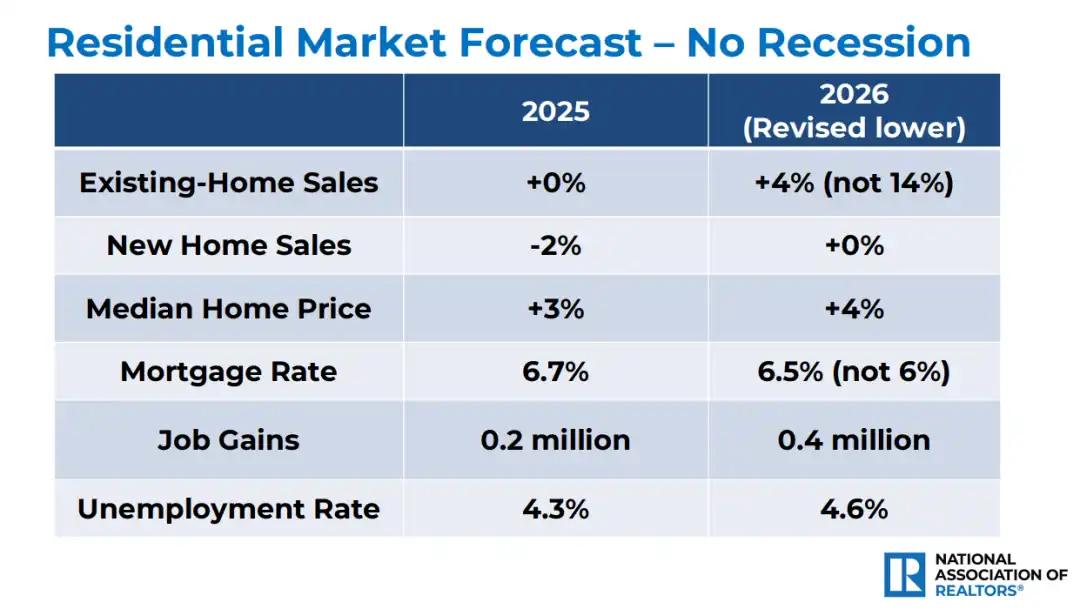
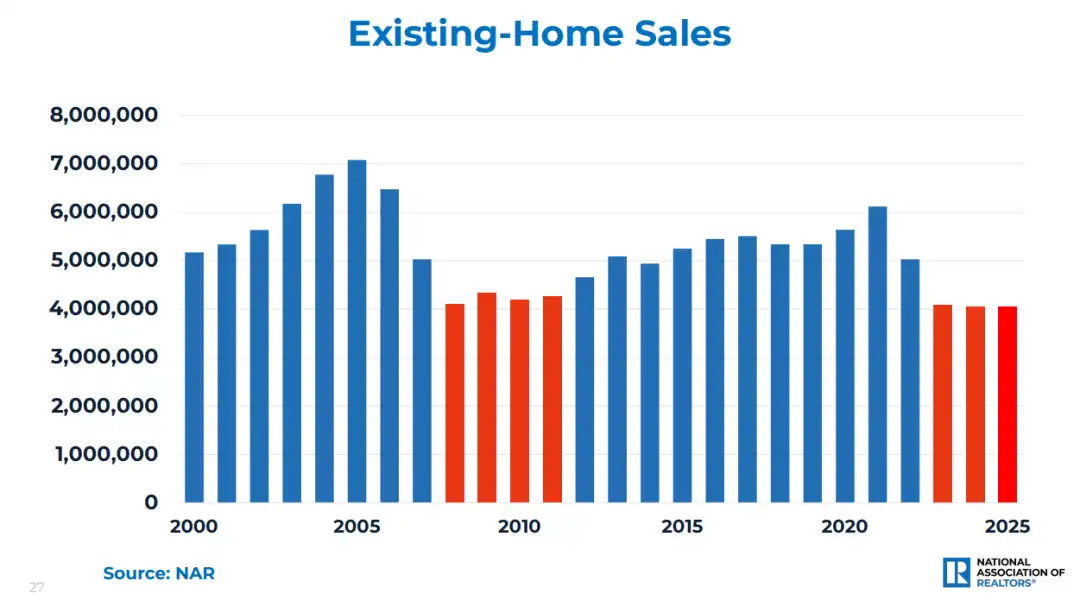
The absolute data for the real estate market looks good simply because prices are higher. Recently, the narrative for the upward part of the K-shape has loosened, so the overall economic expectations are not good. I understand Besant's thinking very well. Previously, when people saw weak economic data, they thought of lower interest rates. Now, seeing weak economic data, they might think of a rising deficit ratio. Coupled with the Fed's communication, this has led to a rapid widening of the term spread over the past month. He is making some administrative intervention. Wiping out this part of the market's bets has its own logic.
Finally, for gold, it might need to look at the Fed's stance in the short term. If the Fed's thinking is that raising rates can curb long-term yields (which is also the current thinking of many market participants), then gold will have twists and turns but it's not a major problem. If there is no actual increase in productivity, and rates are raised just for various reasons, they will be lowered again later. If the Fed's thinking is that only easing can stimulate more supply to increase US competitiveness and lower inflation, then gold may have already broken through.
For the last part, I want to briefly discuss some abstract topics. Many of the US's problems today, whether it's the Middle East quagmire or huge AI investments without seeing reasonable short-term returns, are not solvable by fiscal and monetary policy. The operations of technocrats don't solve the core problems. (Moreover, I don't think Besant and Warsh, given the current situation, can even be considered excellent technocrats. I don't understand at all why many people praise Besant: "China is just a dilapidated house that will collapse with a kick, the dollar must remain strong for the US economy, tariffs can bring sufficient revenue, 3% economic growth, 3% deficit, 3 million barrels of oil." From 2024 to today, you could make money by doing the opposite of everything he said.) When a country reaches its middle or later stages, the necessity and demand for reform increase day by day, but the feasibility and motivation for reform decrease day by day. Successful reforms exist, but failures are more common. The task itself is extremely difficult. Successful reforms are often subtle and far-reaching, while reforms launched from an ideological standpoint often trigger too much opposition and fail.
For example, in Chinese history, more people have heard of Zhang Juzheng and Wang Anshi, but fewer understand the Two-Tax System reform. Yet, the Two-Tax System reform of the Tang Dynasty was a successful and far-reaching one. To some extent, I think the views of many Wall Street financial old money are more seasoned than Besant's. For example, Jamie Dimon and Ray Dalio have both stated on the Iran issue that if you go to war, you must fight to the end, to win, rather than fighting half-heartedly. For example, they also believe that raising rates might relieve long-term debt pressure. These are correct and difficult things to do. Sometimes people just have to do the correct and difficult things. What makes politicians great is that some can make society do the correct and difficult things.
If you always try to be clever and find the so-called optimal solution, it feels a lot like many Indians I've encountered. They always think they can see things others can't, and then win easily. The biggest lesson I've learned from history is that many things cannot be cleverly solved. If you don't go through life-and-death struggles with your brothers, no brothers will come to save you when you are in a life-and-death situation yourself. Without decades of accumulation and trust, you cannot have a core team to follow you in doing things that take decades to bear fruit. Our era is full of fast narratives, and technology has reduced human importance, but I think the underlying logic hasn't changed. Many things, whether you do them with robots or with people, require time.
Today's operation by the US Treasury Department feels a lot like the Indians I've encountered at work. They always think they can achieve big results with little money and see things others can't. I never believe that. I think anyone who appears before you is not a fool, if you yourself are not a fool. So, if this is just the Treasury Department being clever in the short term to deal with seasonal and geopolitical disturbances, I think it's fine. If the Fed also joins in, then I think it's a radical change in the underlying logic.
I rarely discuss the twilight of the dollar, not because I think the US has no problems, but because I always feel these grand narratives require a lot of time. You must see sufficient catalysts to have a valuable discussion. I think if the Fed also joins this kind of control over long-term yields, and if the Strait of Hormuz ends in a fiasco, these would be sufficient catalysts. We can discuss this tomorrow.