Trading Volume of Crypto Company Preferred Shares Soars to $13 Billion, with Strategy and Alphabet Leading the Breakout of a 'New Financing Tool'

marsbitОпубліковано о 2026-07-15Востаннє оновлено о 2026-07-15

Анотація

In June 2026, trading activity in crypto company preferred shares surged dramatically, with monthly volume reaching approximately $13 billion when standardized to par value. This acceleration, primarily driven by STRK and a growing number of new preferred share listings, has transformed a niche, custom financing tool once dominated by financial institutions into a broader, more liquid, and increasingly evergreen asset class. Key indicators point to the market's maturation, with improved efficiency in pricing, secondary market depth, and persistent investor demand. Notably, this evolution is extending beyond crypto. In the same month, Alphabet launched its first convertible preferred share offering as part of a funding round exceeding $80 billion for AI infrastructure. Similarly, Super Micro Computer announced a $3.75 billion convertible preferred share issuance within a $7 billion capital raise for AI expansion, highlighting the growing role of preferred shares as a scalable financing tool across industries.

Author: Jeff Park

Compiled by: Shenchao TechFlow

Shenchao Introduction: Preferred shares were once exclusive financing tools for banks and insurance companies. Today, crypto companies like Strategy have transformed them into a highly liquid and sustainably tradable asset class. More critically, this path has evolved from crypto to traditional tech—Alphabet and Super Micro Computer are using it to finance AI infrastructure, with individual deal sizes reaching $80 billion. This is no longer a niche game.

In 2026, trading activity for crypto company preferred shares accelerated sharply, with monthly trading volume standardized at par value reaching approximately $13 billion in June. This surge was primarily driven by STRC and the increasing number of new preferred share listings, transforming a once-customized financing niche dominated by financial institutions (banks and insurance companies) into a broader, more liquid, and increasingly evergreen asset class.

Beyond higher trading volume, a key signal is the maturity of the preferred share market itself. As liquidity deepens, these instruments have become more efficient not only in terms of coupon rates and issuer quality but also in secondary market depth, relative value, and the persistence of investor demand. This evolution is beginning to extend beyond crypto: in June, Alphabet launched its inaugural convertible preferred share issuance as part of an equity financing exceeding $80 billion to fund AI infrastructure; meanwhile, Super Micro Computer announced the issuance of $3.75 billion in convertible preferred shares within a $7 billion capital raise for AI expansion, highlighting the increasingly vital role of preferred shares as a scalable financing tool across industries.
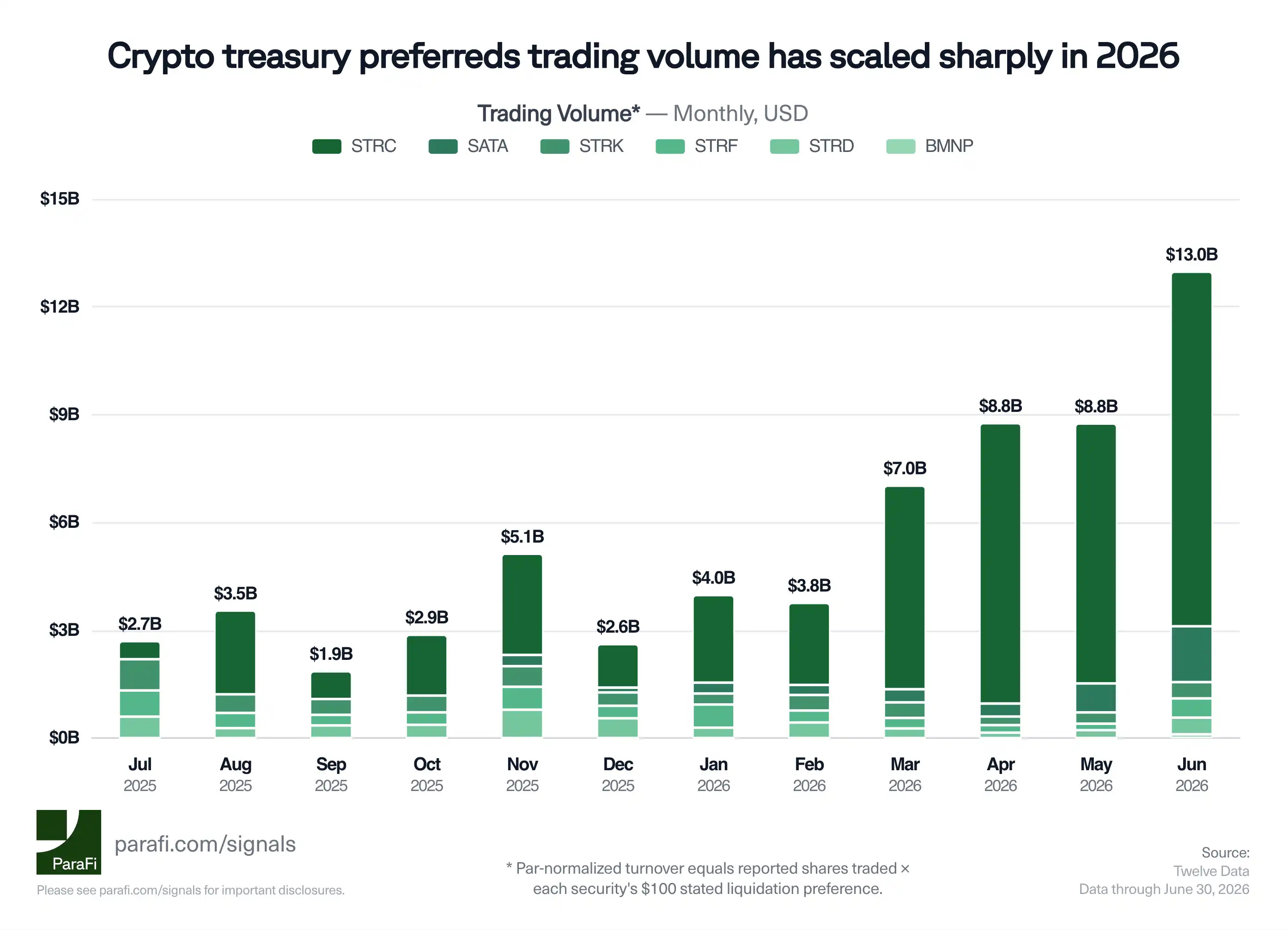
Note: The selected scope includes trading volume for STRK, STRF, STRD, STRC, SATA, and BMNP standardized on a par value basis. Par-value standardized turnover is calculated as reported traded share count multiplied by the $100 per share stated liquidation preference for each security. It does not represent actual dollar trading volume and, viewed alone, cannot establish market liquidity. Source: Twelve Data. Data as of June 30, 2026.

Important Disclosure: ParaFi Signals are for informational purposes only and should not be considered or construed as financial, legal, tax, or investment advice. The information above should not be regarded as a recommendation to buy or sell any particular security.


Пов'язані питання

QAccording to the article, what was the approximate monthly trading volume of crypto enterprise preferred shares (normalized by par value) in June 2026?

AAccording to the article, the monthly trading volume of crypto enterprise preferred shares normalized by par value reached approximately $13 billion in June 2026.

QWhich two companies are highlighted in the article as using preferred shares for AI infrastructure funding?

AThe article highlights Alphabet and Super Micro Computer (SMCI) as using preferred shares for AI infrastructure funding.

QWhat is the primary historical user group of preferred shares as mentioned in the article?

AThe article states that preferred shares were historically a customized financing niche dominated by financial institutions, specifically banks and insurance companies.

QBesides higher trading volume, what key signal indicates the maturity of the preferred share market as described in the article?

AThe key signal of the market's maturity is that these instruments are becoming more efficient not only in terms of coupon rates and issuer quality, but also in secondary market depth, relative value, and the durability of investor demand.

QWhat should the 'Par Value Normalized Turnover' metric mentioned in the note NOT be interpreted as on its own?

AThe 'Par Value Normalized Turnover' metric alone should not be interpreted as establishing market liquidity, as it represents reported traded share numbers multiplied by a $100 liquidation preference per security and does not represent actual dollar trading volume.

Пов'язані матеріали

Bitcoin Boom in Full Swing: Saylor's Latest Statement Fuels Buying Speculation

MicroStrategy's Executive Chairman Michael Saylor has fueled speculation about a new Bitcoin purchase by posting "Bitcoin Drive engaged" on August 2, accompanied by the company's customary purchase tracker. This aligns with his pattern of hinting at treasury changes ahead of weekly reports. The accompanying report showed MicroStrategy's Bitcoin holdings at 843,775 BTC, with an average cost of $75,653 per coin and an unrealized loss of -$10.58B. A similar signal preceded the company's July 27 announcement, strengthening expectations for a treasury update on Monday. However, MicroStrategy's real-time ledger reflects two recent Bitcoin sales totaling 3,588 BTC, reducing holdings from 847,363 BTC to the current 843,775 BTC. The company stated these sales funded preferred stock dividends and replenished its U.S. dollar reserve. Recent reports indicate the company made no Bitcoin purchases the week ending July 26 while increasing its dollar reserve to approximately $3.75B. The company faces financial headwinds after reporting an $8.33B operating loss for Q2 2026, including an $8.32B unrealized loss on its digital assets. Management may sell up to $1.25B more in Bitcoin to meet cash obligations. The expected Monday update will reveal if the "Bitcoin Drive" signal marks a return to accumulation as MicroStrategy balances its massive Bitcoin stash against growing cash commitments.

cryptonews.ru1 год тому

Bitcoin Boom in Full Swing: Saylor's Latest Statement Fuels Buying Speculation

cryptonews.ru1 год тому

Торгівля

Спот
活动图片




