TPS is Just the Entry Ticket, Ordering Decides Success or Failure: On-Chain Transactions Enter a New Era of 'Application-Awareness'

marsbitОпубліковано о 2025-12-29Востаннє оновлено о 2025-12-29

Анотація

The competition between blockchains has shifted from TPS (transactions per second) to transaction ordering, which critically impacts market maker behavior, liquidity depth, and pricing. Transaction ordering refers to how transactions in the mempool are sequenced and included in blocks. This process affects transaction cost, MEV (Maximal Extractable Value), success rate, and fairness. For market makers, the ability to cancel orders quickly during volatility is essential—failure leads to risks like sniping, where high-Gas transactions exploit pending orders, forcing wider spreads and reduced liquidity. Innovations are moving from generic, Gas-based ordering to "application-aware sequencing," where transaction intent and fairness rules take priority. Examples include: - Hyperliquid, which prioritizes cancellations and post-only orders at the consensus layer. - Solana’s Application Controlled Execution (ACE) and BAM nodes, allowing DEXs to set custom ordering rules (e.g., market-maker priority). - Chainlink’s SVR, which uses MEV auctions to redistribute value from liquidations triggered by oracle updates. These developments suggest that tailored transaction sequencing is becoming essential—not just an improvement—for on-chain trading, potentially enabling DEXs to surpass CEXs in efficiency and fairness.

Competition between chains has escalated to the level of "transaction ordering," which directly impacts market makers' bid-ask spreads and depth🧐🧐

The demand for "general-purpose chains" has been disproven. Current chain-to-chain competition focuses on two levels:

1) Building "application chains" on the foundation of existing mature businesses, allowing blockchain to supplement existing operations in areas like settlement;

2) Competition at the level of "transaction ordering."

This article focuses on the second level.

Ordering directly influences the behavior of market makers. This is the core issue.

What is Transaction Ordering?

On-chain, user transactions are not immediately written to a block; they first enter a "waiting area" (Mempool). There may be thousands of transactions simultaneously, and it must be decided by a sequencer, validator, or miner:

1) Which transactions are included in the next block?

2) In what order are these transactions arranged?

The process of "deciding the order" is transaction ordering, which directly affects the transaction costs for on-chain users, MEV conditions, transaction success rate, and fairness.

For example, during network congestion, ordering determines whether a transaction can be quickly added to the chain or waits indefinitely in the mempool.

For high-frequency traders like market makers, whether a cancellation order takes effect is more critical than a placement order succeeding. The priority given to processing cancellation orders directly impacts whether market makers dare to offer deep liquidity.

In the last cycle, everyone pursued TPS, believing that speed alone could improve on-chain transaction settlement. But it has been proven that, besides speed, the risk pricing of market makers is equally important.

On centralized exchanges, trade matching strictly follows the "price-time priority" principle. In this highly deterministic environment, market makers can provide deep order book liquidity with extremely narrow spreads.

On-chain, after transactions enter the Mempool waiting area, nodes select transactions based on Gas fees, which creates room for sniping existing orders by offering higher Gas.

Suppose TRUMP is priced at $4.5, and a market maker places a buy order at $4.4 and a sell order at $4.6 to provide depth. But the exchange price of TRUMP suddenly crashes to $4.

At this point, the on-chain market maker wants to cancel the $4.4 buy order but gets sniped by a high-frequency trader offering higher Gas—buying at $4 and selling to the market maker at $4.4.

Therefore, market makers can only widen their spreads to reduce risk.

The purpose of the new generation of ordering innovations is to transition from "general ordering" to "Application-Aware Sequencing."

The ordering layer can understand transaction intent and order based on preset fairness rules, not just based on Gas fees.

1) Define the ordering method at the consensus layer

A typical case is Hyperliquid. It stipulates at the consensus layer that cancellation and Post-Only transactions take priority, breaking the Gas priority rule.

For market makers, being able to exit is paramount. During sharp price fluctuations, cancellation requests are always executed before others' takers.

Market makers fear being sniped the most. Hyperliquid precisely guarantees that cancellations are always prioritized—when the price drops, market makers cancel their orders, and the system forcibly prioritizes processing the cancellations, allowing market makers to successfully hedge risks.

On the day of the 10.11 crash, Hyperliquid market makers stayed online continuously, with spreads of 0.01–0.05%. The reason is that market makers knew they could get out.

2) Add new ordering methods at the sequencing layer

For example, Solana's Application Controlled Execution (ACE). Jito Labs developed BAM (Block Assembly Marketplace), introducing specialized BAM nodes responsible for transaction collection, filtering, and ordering.

Nodes run in a Trusted Execution Environment (TEE), ensuring the privacy of transaction data and the fairness of ordering.

Through ACE, DEXs on Solana (like Jupiter, Drift, Phoenix) can register custom ordering rules with BAM nodes. For example, market maker priority (similar to Hyperliquid), conditional liquidity, etc.

Additionally, proprietary AMM market makers like HumidiFi represent innovation at the ordering level, using Nozomi to connect directly with major validators to reduce latency and complete transactions.

During specific transactions, HumidiFi's off-chain servers monitor prices across platforms. The oracle communicates with the on-chain contract to inform it of the situation. Nozomi acts like a VIP channel, allowing effective order cancellation before execution.

3) Utilizing MEV facilities and private channels

Chainlink SVR (Smart Value Recapture) focuses on the归属 (belonging) of the value generated by ordering (MEV).

By deeply integrating with oracle data, it redefines the ordering rights and value distribution of liquidation transactions. After generating a price update, Chainlink nodes send it through two channels:

1) Public channel: Sent to the standard on-chain aggregator (serving as a backup, but in SVR mode, there is a slight delay to leave an auction window).

2) Private channel (Flashbots MEV-Share): Sent to an auction market supporting MEV-Share.

This way, the auction proceeds from liquidations triggered by oracle price changes in lending protocols (i.e., the amount searchers are willing to pay) are no longer solely captured by miners; most are captured by the SVR protocol.
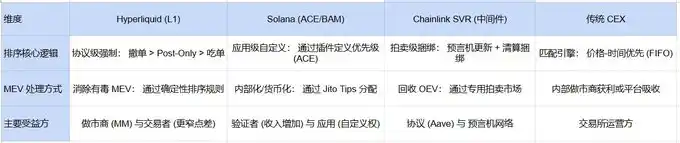
Summary

If TPS is the entry ticket, then having only TPS is completely insufficient now. Custom ordering logic might not just be an innovation but a necessary path for putting transactions on-chain.

It might also be the beginning of DEXs surpassing CEXs.

Трендові криптовалюти

Пов'язані питання

QWhat is the core argument of the article regarding the evolution of blockchain competition beyond TPS?

AThe article argues that competition between blockchains has moved beyond just transaction speed (TPS) and is now focused on the critical layer of 'transaction ordering' (sequencing). Effective and fair transaction ordering directly impacts market maker behavior, liquidity depth, and the overall user experience, making it a decisive factor for success.

QHow does transaction ordering on a blockchain negatively impact market makers, according to the article?

AIn a default 'gas-first' ordering system, market makers are vulnerable to being sniped. When an asset's price moves, a high-frequency trader can pay a higher gas fee to have their 'take order' (e.g., buying the asset at a low price) processed before the market maker's 'cancel order' (e.g., trying to withdraw their offer). This forces the market maker to buy the asset back at their own, now outdated, higher price, leading to losses and causing them to widen their spreads to mitigate risk.

QWhat is 'Application-Aware Sequencing' and can you name a project that implements it at the consensus layer?

A'Application-Aware Sequencing' is an innovative approach where the sequencing logic understands the intent of transactions (e.g., a cancelation vs. a trade) and orders them based on predefined fairness rules, not just gas fees. Hyperliquid is a prime example that implements this at the consensus layer by mandating that cancel and post-only orders are always prioritized over others, ensuring market makers can escape unfavorable positions.

QBesides consensus-layer changes, what other method does the article mention for improving transaction ordering on Solana?

AThe article mentions Solana's Application Controlled Execution (ACE) and the Block Assembly Marketplace (BAM) developed by Jito Labs. This allows decentralized exchanges (DEXs) like Jupiter and Drift to register custom ordering rules (e.g., market maker priority) with specialized BAM nodes, which operate in a Trusted Execution Environment (TEE) for privacy and fairness.

QHow does Chainlink's Smart Value Recapture (SVR) model change who benefits from MEV generated by oracle price updates?

AChainlink's SVR model changes MEV distribution by creating a two-path system for oracle price updates. After generating a new price, Chainlink nodes send it through a public channel (with a slight delay) and a private channel to a MEV auction market (like Flashbots MEV-Share). This allows the value from auctions for liquidation trades triggered by the price update to be captured mostly by the SVR protocol itself, rather than being kept entirely by miners/validators.

Пов'язані матеріали

In Conversation with Ray Dalio: We Are Currently in an AI Bubble, with 1% of My Portfolio in Bitcoin

Ray Dalio, founder of Bridgewater Associates, warns in an interview that the current AI boom shows classic bubble characteristics, which could lead to significant economic downturns as seen in past cycles like 1929 or 2000. He explains that speculative enthusiasm, fueled by debt and overvaluation, often precedes a crash when rising rates or taxation force asset sales, causing widespread losses and recession. Dalio also outlines his "Big Cycle" theory, describing an approximate 80-year pattern where widening wealth gaps, massive government deficits, and shifting geopolitical power (like China's rise) create internal conflict and global instability. He emphasizes that we are in a late-cycle, transitional phase where traditional powers like the US and UK face decline. For personal wealth protection, Dalio advises diversification beyond cash into assets like stocks, bonds, real estate, and particularly gold, which he prefers over Bitcoin. While he holds about 1% of his portfolio in Bitcoin as a non-printable hard asset, he views gold as more secure from technological or governmental threats. Regarding AI's impact, Dalio believes it will disproportionately benefit capital owners, worsening inequality by replacing both physical and cognitive labor. He suggests that human intuition and emotional intelligence, combined with AI, will be key for future workers. On taxation, Dalio argues that wealth taxes are impractical and risk triggering asset sell-offs, reducing productive investment. He points to the UK as a cautionary example of debt, low productivity, and political strife. Geopolitically, Dalio foresees a more regionalized world, with the US showing weakness in prolonged conflicts like with Iran, akin to past imperial declines. The ideal outcome, he suggests, is coexisting powerful blocs (e.g., Americas, China-Asia Pacific) without major war.

marsbit22 хв тому

In Conversation with Ray Dalio: We Are Currently in an AI Bubble, with 1% of My Portfolio in Bitcoin

marsbit22 хв тому

Daily 7.2 Trillion KRW: Foreign Capital's Record Net Buying on Friday! Wall Street Says Headwinds for Korean Stock Fund Flows Have Subsided

South Korean stock market sees a dramatic shift in fund flows. On July 31, foreign investors made a record net purchase of approximately KRW 7.2 trillion in KOSPI stocks, marking a fundamental reversal from the persistent large-scale net outflows seen in previous months. This contributed to a significant narrowing of foreign net selling in July to KRW 9.8 trillion, down sharply from KRW 48.4 trillion in June and KRW 44.5 trillion in May. Simultaneously, domestic institutional pressure eased. South Korean pension funds and asset managers turned to a net buying position in July, purchasing KRW 1.0 trillion worth of KOSPI shares, contrasting with net sales in May and June. Market volatility is expected to be dampened by new financial regulations. Effective July 31, the Financial Services Commission tightened access for retail investors to single-stock leveraged ETFs by raising the minimum cash deposit requirement. Trading volumes for these products subsequently dropped to about 50% of their monthly average. Citigroup Research maintains its year-end KOSPI target of 10,000 points. The firm cites several supportive factors: the substantial easing of headwinds from capital outflows, a robust fundamental outlook for the semiconductor sector, historically low market valuations, strong economic fundamentals, and the potential for policy support from financial authorities if needed.

marsbit22 хв тому

Daily 7.2 Trillion KRW: Foreign Capital's Record Net Buying on Friday! Wall Street Says Headwinds for Korean Stock Fund Flows Have Subsided

marsbit22 хв тому

Thanks to Dice Rolls, Bitcoin Keys Are Stored Offline, But Not Everyone Will Do It

The article discusses using dice rolls to generate secure Bitcoin wallet seeds, providing entropy independent of potentially flawed hardware random number generators. It explains that each fair dice roll offers about 2.585 bits of entropy, with around 50 rolls needed for a standard 12-word seed phrase and 99+ recommended for higher security. This method gained attention after a vulnerability was revealed in some Coldcard hardware wallets, where a faulty firmware RNG (dating back to 2021) compromised generated keys. The analysis notes that while a dice-generated main seed was safe from this specific flaw, other Coldcard functions (like creating paper wallets, backup keys, or passwords) could still be vulnerable if they used the defective RNG. The piece argues that while dice-based entropy is technically robust, the manual process is error-prone, tedious, and unrealistic for most new users, who might make mistakes in recording or inputting rolls. It concludes that while manual entropy generation should remain an option for advanced users, the long-term goal is to develop reliable, user-friendly hardware and software that securely generates randomness without requiring specialized knowledge. Coldcard users are advised to check their firmware version and replace any secondary secrets (like paper wallet keys) created with vulnerable devices, while also considering multi-signature setups with devices from different manufacturers for added security.

cryptonews.ru5 год тому

Thanks to Dice Rolls, Bitcoin Keys Are Stored Offline, But Not Everyone Will Do It

cryptonews.ru5 год тому

Торгівля

Спот

Популярні статті

Як купити O

Ласкаво просимо до HTX.com! Ми зробили покупку O1 exchange (O) простою та зручною. Дотримуйтесь нашої покрокової інструкції, щоб розпочати свою криптовалютну подорож.Крок 1: Створіть обліковий запис на HTXВикористовуйте свою електронну пошту або номер телефону, щоб зареєструвати обліковий запис на HTX безплатно. Пройдіть безпроблемну реєстрацію й отримайте доступ до всіх функцій.ЗареєструватисьКрок 2: Перейдіть до розділу Купити крипту і виберіть спосіб оплатиКредитна/дебетова картка: використовуйте вашу картку Visa або Mastercard, щоб миттєво купити O1 exchange (O).Баланс: використовуйте кошти з балансу вашого рахунку HTX для безперешкодної торгівлі.Треті особи: ми додали популярні способи оплати, такі як Google Pay та Apple Pay, щоб підвищити зручність.P2P: Торгуйте безпосередньо з іншими користувачами на HTX.Позабіржова торгівля (OTC): ми пропонуємо індивідуальні послуги та конкурентні обмінні курси для трейдерів.Крок 3: Зберігайте свої O1 exchange (O)Після придбання O1 exchange (O) збережіть його у своєму обліковому записі на HTX. Крім того, ви можете відправити його в інше місце за допомогою блокчейн-переказу або використовувати його для торгівлі іншими криптовалютами.Крок 4: Торгівля O1 exchange (O)Легко торгуйте O1 exchange (O) на спотовому ринку HTX. Просто увійдіть до свого облікового запису, виберіть торгову пару, укладайте угоди та спостерігайте за ними в режимі реального часу. Ми пропонуємо зручний досвід як для початківців, так і для досвідчених трейдерів.

453 переглядів усьогоОпубліковано 2026.06.19Оновлено 2026.06.19

Як купити O

Як купити PROS

Ласкаво просимо до HTX.com! Ми зробили покупку Pharos (PROS) простою та зручною. Дотримуйтесь нашої покрокової інструкції, щоб розпочати свою криптовалютну подорож.Крок 1: Створіть обліковий запис на HTXВикористовуйте свою електронну пошту або номер телефону, щоб зареєструвати обліковий запис на HTX безплатно. Пройдіть безпроблемну реєстрацію й отримайте доступ до всіх функцій.ЗареєструватисьКрок 2: Перейдіть до розділу Купити крипту і виберіть спосіб оплатиКредитна/дебетова картка: використовуйте вашу картку Visa або Mastercard, щоб миттєво купити Pharos (PROS).Баланс: використовуйте кошти з балансу вашого рахунку HTX для безперешкодної торгівлі.Треті особи: ми додали популярні способи оплати, такі як Google Pay та Apple Pay, щоб підвищити зручність.P2P: Торгуйте безпосередньо з іншими користувачами на HTX.Позабіржова торгівля (OTC): ми пропонуємо індивідуальні послуги та конкурентні обмінні курси для трейдерів.Крок 3: Зберігайте свої Pharos (PROS)Після придбання Pharos (PROS) збережіть його у своєму обліковому записі на HTX. Крім того, ви можете відправити його в інше місце за допомогою блокчейн-переказу або використовувати його для торгівлі іншими криптовалютами.Крок 4: Торгівля Pharos (PROS)Легко торгуйте Pharos (PROS) на спотовому ринку HTX. Просто увійдіть до свого облікового запису, виберіть торгову пару, укладайте угоди та спостерігайте за ними в режимі реального часу. Ми пропонуємо зручний досвід як для початківців, так і для досвідчених трейдерів.

523 переглядів усьогоОпубліковано 2026.06.22Оновлено 2026.06.22

Як купити PROS

Що таке VERONA

I. Вступ до проекту VERONA - це блокчейн, створений для всіх, скрізь, через абстракцію ланцюга. Використовуючи свій загальний шар абстракції, VERONA вирізняється інтеграцією складних функцій блокчейну, таких як рахунки, підписи та взаємодія, безпосередньо на рівні протоколу. Цей підхід дозволяє взаємодіяти з блокчейн-додатками без необхідності розуміти основні технології.1) Основна інформація Назва: VERONA (VERONA)III. Пов'язані посилання Офіційне посилання на сайт: https://xion.burnt.com/ Біла книга: https://xion.burnt.com/whitepaper.pdf Експлорери: https://explorer.burnt.com/ Соціальні мережі: https://x.com/burnt_xion Примітка: Вступ до проекту взято з матеріалів, опублікованих або наданих офіційною командою проекту, які є лише для довідки і не є інвестиційною порадою. HTX не несе відповідальності за будь-які прямі або непрямі збитки, що виникають внаслідок цього.

367 переглядів усьогоОпубліковано 2026.06.22Оновлено 2026.06.22

Що таке VERONA

Обговорення

Ласкаво просимо до спільноти HTX. Тут ви можете бути в курсі останніх подій розвитку платформи та отримати доступ до професійної ринкової інформації. Нижче представлені думки користувачів щодо ціни A (A).

活动图片














