Topping GitHub's Trending, the Essential Guide for Claude Code Users

marsbitОпубліковано о 2026-05-18Востаннє оновлено о 2026-05-18

Анотація

The CLAUDE.md file, trending on GitHub, is a project-level guide for Claude Code designed to dramatically improve its accuracy and efficiency. It addresses key issues like repetitive context explanations, unauthorized code changes, and forgotten decisions across sessions. By placing this plain-text file in a project root, Claude Code reads it automatically at the start of each session. The guide includes rules to eliminate redundant explanations, enforce strict behavioral constraints (e.g., no modifications outside the requested scope without confirmation), and establish a "memory" system using companion files like MEMORY.md and ERRORS.md to log past decisions and failures. It also locks in the project's specific tech stack to prevent inappropriate tool recommendations. Highlighted are four foundational rules from Andrej Karpathy that reportedly increased coding accuracy from 65% to 94%: always ask for clarity first, implement the simplest solution, never touch unrelated code, and explicitly flag uncertainties. The article quantifies significant weekly cost savings for developers and teams by eliminating wasted time on re-explaining context, rolling back unauthorized edits, and re-evaluating previously rejected solutions. The core message is that a small, upfront investment in creating a CLAUDE.md file leads to a more predictable, controlled, and cost-effective AI programming assistant.

Editor's Note: The biggest problem many people face when using Claude Code isn't that the model isn't powerful enough, but that they start from scratch every time.

You need to repeatedly tell it the project background, tech stack, code conventions, which parts must not be touched, and which approaches have already been tried. As long as this information isn't fixed, Claude will work by guessing, potentially modifying files it shouldn't, refactoring code you didn't ask it to, or even recommending tools unsuitable for the current project.

The CLAUDE.md introduced in this article is a user manual written for Claude Code. You just need to place it in your project's root directory, and Claude will automatically read it on each startup. It tells Claude in advance: how to answer, how to write code, when to ask questions first, which operations cannot be performed without permission, what tech stack the project uses, and what important decisions were made in the past.

In short, the purpose of CLAUDE.md is to: reduce repeated explanations, limit the model's overreach, and make AI programming more stable and controllable.

If you are using Claude Code, you can start with the 4 rules summarized by Karpathy: ask if unsure, do the simplest solution first, don't touch unrelated code, and clearly state uncertainty. Start by writing these rules into CLAUDE.md, then gradually add to it based on your project, and you'll see a clear improvement in your experience.

The original text follows:

A file named CLAUDE.md topped GitHub's Trending list.

82k stars, 7.8k forks.

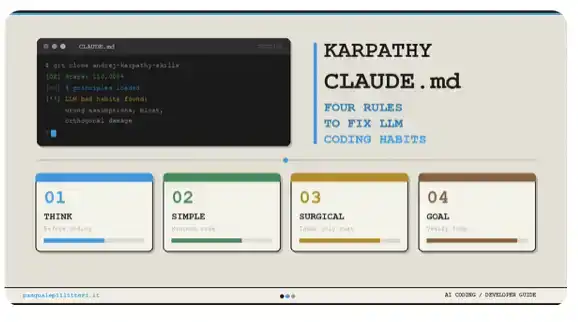
This began with Andrej Karpathy. He is the former Head of AI at Tesla and a founding member of OpenAI. He summarized four behaviors that would cause Claude Code to fail and wrote them into a file.

Later, a developer expanded upon these four rules and publicly released this file. It quickly went viral.

The reason is straightforward: coding accuracy increased from 65% to 94%.

But most developers who use Claude Code daily have never actually set this up. They start from zero every session: re-explaining the same context, cleaning up unnecessary scope changes, rolling back unrequested refactors.

Here is the complete file.
The Setup Most Developers Miss

Every time you open Claude Code, it starts knowing nothing by default.

It doesn't know your tech stack, your coding conventions, your project background, what you've already tried, let alone decisions you explicitly ruled out three sessions ago.

So it can only guess. And once it starts guessing, it might refactor code you didn't ask to be touched, recommend frameworks that would break your existing architecture, delete files without confirmation, or even overturn decisions you've already made.

CLAUDE.md is a plain text file placed in the project's root directory. Claude Code will automatically read it at the start of every session.

Set it up once, avoid repeated explanations, and fix three types of costly errors.

Default Settings: You're Spending $375 a Week Just Repeating Yourself

The average developer spends about 30 minutes a day re-explaining context to Claude.

Tech stack, coding conventions, project background, methods already tried—unless you write this information down once and have Claude read it automatically each time, it won't persist across sessions.

At a developer's hourly rate of $150:

· 30 minutes a day is $75;

· $375 per week.

· For a 5-person team, that's $1,875 in hidden costs weekly.
The following 7 rules should be placed at the top of the CLAUDE.md file.

→ Skip the Fluff

Don't start answers with "Great question," "Sure," "No problem," or similar prefaces. Get straight to the answer. No pleasantries, no restating the question.

→ Match Answer Length to Task

Answer length should match task complexity. Simple questions get direct, short answers; complex tasks get complete, detailed explanations. Don't pad length by restating the question or adding repetitive concluding remarks.

→ Give Options Before Acting

Before starting any significant task, first present 2–3 viable paths. Wait for my selection before proceeding.

→ Admit Uncertainty Before It Costs

If you are uncertain about any fact, data, date, or technical information, explicitly say so before referencing it. Don't fill knowledge gaps with plausible-sounding information. When in doubt, simply say you're unsure.

→ Who I Am, What I Know

About Me: [Name] / Role: [Your Role] / Background: [Domain].

I'm Proficient At: [What you're familiar with].

I'm Still Learning: [Knowledge gaps].

Adjust the depth of each answer based on this information. Don't over-explain what I already know, and don't skip context I need.

→ Current Project Context

I'm Working On: [Project Name] / Goal: [Specific Outcome] / Audience: [Who will use it] / Tech Stack Context: [Relevant Constraints] / Avoid: [List].

Apply this context to every task. If a request conflicts with the context, point it out before executing.

→ Lock Down Your Writing Style

My Writing Style Is: [Describe your style].

Sentence Length: [Preference].

Words I Use Often: [Examples].

Words I Never Use: [Examples].

Format: [Prose or Structured].

When writing anything on my behalf, you must strictly match this style. Do not default to your own expressive patterns.

Daily time spent re-explaining context: 30 minutes

At $150/hour developer rate: $75 / day

Weekly: $375 per developer

5-person team: $1,875 per week

Time to set up this part of CLAUDE.md: 45 minutes total

Mistake to avoid: Don't write CLAUDE.md from scratch. Start with the prompt below, then edit the output:

Based on what I've told you about myself, my project, and how I want to work, please write a complete CLAUDE.md file for me. Include: who I am, my technical background, my communication preferences, and default behaviors to follow each session. Be specific, plain text, under 500 words.

Behavioral Constraints: Those Unauthorized $150/Hour Changes

You ask Claude to fix a function.

It ends up refactoring three files, renaming variables, reorganizing imports, and rewriting comments you spent time on.

All without your confirmation.

Reviewing and rolling back these unnecessary changes might take an hour, which is $150. Happening three times a week is $450. For a 5-person team, that's $2,250 per week spent cleaning up unauthorized changes.
The following 7 rules should go in the Behavioral Constraints section of CLAUDE.md.

→ Strict Scope Control

Only modify files, functions, and lines of code directly relevant to the current task. Do not refactor, rename, reorganize, reformat, or "optimize" anything I have not explicitly asked you to change.

If you see something else worth fixing, note it at the end. Do not touch it. Never.

→ Ask Before Major Changes

Before making significant changes to content I've already created—including rewriting sections, deleting paragraphs, restructuring, changing tone—you must pause, precisely state what you plan to change and why. Wait for my confirmation before proceeding.

→ Must Confirm Before Any Destructive Action

Before deleting any file, overwriting existing code, deleting database records, or removing dependencies, you must pause, list what will be specifically affected, and request my explicit confirmation. You may proceed only if I say "yes" in the current message.

"You mentioned earlier" does not equal confirmation.

→ Mandatory Pause for Production Operations

The following operations require explicit confirmation within the current session, without exception:

· Deploying or pushing to any environment;

· Running migrations or database schema changes;

· Sending any external API calls;

· Executing any command with irreversible side effects.

· I must explicitly say "yes" in the current message.

→ Always Show What Changed

After completing any coding task, the end must include:

Files Modified: List all touched files;

What Changed: One sentence per file;

Files Intentionally Not Modified;

Follow-Up Items.

→ Do Not Act on My Behalf Without Explicit Confirmation

Do not send, post, share, or schedule anything on my behalf without my explicit confirmation in the current message. This includes emails, calendar invites, document shares, or any action happening outside the current conversation. I must explicitly say "yes" in the current message.

→ Think Before Coding

For tasks involving architectural decisions, complex problem debugging, or non-trivial feature development, first reason through the problem step-by-step before writing code. Show your reasoning, point out uncertainties, and then execute.

Weekly rollback of unnecessary scope changes: $150

Weekly manual diff checks: $75

Behavior-related waste per developer: $225 / week

5-person team: $1,125 / week

Time to set up CLAUDE.md Behavior section: 30 minutes

Memory & Tech Stack: The Setup That Makes Claude Code Truly Reliable

Claude forgets everything between sessions.

Every decision you've made, every approach that failed, why you chose Prisma over Drizzle six months ago, and why a particular constraint comes from a specific client requirement—it forgets it all.

Then, it re-proposes options you've long since ruled out.

This section is the closest thing to providing Claude with "real memory" for the current context, while also locking down your tech stack to prevent it from recommending tools that would break your existing architecture.
→ MEMORY.md Decision Log

Maintain a file named MEMORY.md in the project. Whenever an important decision is made, add a new entry:

· What was decided;

· Why it was decided that way;

· What was ruled out, and why.

Read MEMORY.md at the start of each session. Do not conflict with recorded decisions without prompting.

→ Session End Summary

When I say "session end," "wrapping up," or "let's stop here," write a session summary to MEMORY.md, including:

· What was handled;

· What was completed;

· What is still in progress;

· What decisions were made;

· Priorities for the next session.

→ ERRORS.md Failure Log

Maintain a file named ERRORS.md. When an approach has been tried more than twice without success, record it:

· What didn't work;

· What finally worked;

· What to watch for next time.

Check ERRORS.md before proposing solutions for similar tasks.

→ Permanent Fact List

The following facts are always true for this project and must be applied to every session without exception:

[Your permanent constraints, architectural decisions, and rules]

If a task conflicts with these facts, point it out before executing.

→ Lock Down the Tech Stack

The project's tech stack is as follows. Always use these tools. Do not recommend alternatives unless I explicitly ask:

Language: [e.g., TypeScript]

Framework: [e.g., Next.js 14]

Package Manager: [e.g., pnpm]

Database: [e.g., PostgreSQL with Prisma]

Testing: [e.g., Vitest]

Styling: [e.g., Tailwind CSS]

If a tool seems unsuitable, you can point it out. But unless I explicitly state otherwise, you must use the defined tech stack.

→ Enable Extended Thinking for Difficult Decisions

For problems involving system architecture, performance trade-offs, database design, or long-term technical decisions, use the extended thinking mode.

Analyze the problem step-by-step, point out trade-offs I might not have considered, identify assumptions that might not hold at scale, and then give your recommendation.

→ The 4 Viral Rules

Karpathy summarized 4 behaviors that cause Claude Code to fail. A developer distilled them into these 4 lines of rules. Coding accuracy increased from 65% to 94% as a result.

Ask, don't assume.
If anything is unclear, ask before writing the first line of code. Do not make silent assumptions about intent, architecture, or requirements.

Do the simplest thing first.
Always implement the simplest solution that works first. Do not add abstraction layers or flexibility not explicitly requested.

Don't touch unrelated code.
If a file or function is not directly related to the current task, don't modify it. Even if you think it could be optimized, leave it alone.

Explicitly mark uncertainty.
If you are unsure about a solution or technical detail, state it before proceeding. Acting confident without certainty causes more damage than admitting a knowledge gap.

· Weekly recovery cost from forgotten decisions and bad advice: $300 per developer

· Wrong tech stack recommendations and incompatible tools: $75 per week

· Memory-related waste per developer: $375 / week

· 5-person team: $1,875 / week

· MEMORY.md + ERRORS.md + Tech Stack setup time: 20 minutes

Conclusion

The full cost breakdown is as follows:

· Weekly cost of re-explaining context: $375

· Weekly cost of rolling back unauthorized changes: $225

· Weekly cost of handling problems from forgotten decisions: $375

· Total waste per developer per week: $975.

For a 5-person dev team: $4,875 per week. $253,500 per year.

Setting up CLAUDE.md only takes 2 hours in total.

Karpathy's 4 rules alone increased coding accuracy from 65% to 94%.

A plain text file, 21 rules, two hours of work.

Developers who complete this setup are effectively using a more reliable Claude: one that remembers decisions, controls task scope, asks for confirmation before destructive actions, and doesn't recommend frameworks that would break the existing architecture.

Those who haven't set it up are still spending $975 a week repeating themselves.

P.S.: Start with Karpathy's 4 rules. Just these 4. Paste them into a new file named CLAUDE.md in your project's root directory right now. It takes 2 minutes. Then gradually supplement it each week based on the gaps you discover.

Bookmark this before it gets lost in your feed. And if you find it useful, share it with someone who genuinely needs it.


Пов'язані питання

QWhat is CLAUDE.md and what problem does it solve for Claude Code users?

ACLAUDE.md is a plain text file placed in a project's root directory. It serves as an instruction manual for Claude Code, which automatically reads it at the start of each session. It solves the problem of developers having to repeatedly re-explain project context, tech stack, code standards, previous decisions, and constraints to Claude Code in every new session. This reduces repetitive explanations, prevents the AI from making incorrect assumptions or unauthorized changes, and makes AI-assisted programming more stable and controllable.

QAccording to the article, what are the four core rules from Andrej Karpathy that significantly improve Claude Code's accuracy?

AThe four core rules from Andrej Karpathy are: 1. Ask first, don't assume: If anything is unclear, ask before writing the first line of code. Do not make silent assumptions about intent, architecture, or requirements. 2. Do the simplest thing first: Always implement the simplest solution that works. Do not add abstraction layers or flexibility that weren't explicitly requested. 3. Don't touch unrelated code: If a file or function is not directly related to the current task, do not modify it. Even if you think it could be optimized, leave it alone. 4. Explicitly mark uncertainty: If you are unsure about a solution or technical detail, state it before proceeding. Acting confidently without certainty causes more harm than admitting a knowledge gap.

QWhat is the estimated weekly financial waste per developer mentioned in the article for not using CLAUDE.md?

AThe article estimates a weekly financial waste of $975 per developer for not using CLAUDE.md. This breaks down into three categories: $375 for repeating contextual explanations, $225 for rolling back unauthorized changes, and $375 for dealing with problems caused by forgotten decisions and wrong suggestions.

QWhat specific behaviors should be prevented according to the 'Behavioral Constraints' section of an ideal CLAUDE.md file?

AAccording to the 'Behavioral Constraints' section, an ideal CLAUDE.md file should enforce rules to prevent Claude Code from: 1. Making changes outside the direct scope of the task (e.g., unauthorized refactoring, renaming, reformatting). 2. Executing significant modifications (rewrites, deletions, structural changes) without prior confirmation. 3. Performing any destructive operations (deleting files, overwriting code, database changes) without explicit, in-session confirmation. 4. Taking production environment actions (deployments, migrations, external API calls) without mandatory pause and confirmation. 5. Failing to clearly list all changes made after a coding task. 6. Acting on the user's behalf (sending emails, sharing documents) without explicit confirmation. 7. Writing code for complex tasks without first showing reasoning and identifying uncertainties.

QWhat are the MEMORY.md and ERRORS.md files used for, as suggested in the article?

AThe article suggests using MEMORY.md and ERRORS.md files to provide Claude Code with a form of 'memory'. MEMORY.md is a decision log where important project decisions (what was decided, why, and what was excluded) are recorded. Claude should read this at the start of each session and avoid conflicting with logged decisions. It should also write a session summary to this file when a session ends. ERRORS.md is a failure log. When a solution attempt fails more than twice, it should be recorded (what didn't work, what finally worked, what to watch for next). Claude should check this file before proposing solutions for similar tasks.

Пов'язані матеріали

Jensen Huang: Vera Rubin Full Mass Production, AI Agent a Key Focus, Challenging Intel to Target the Next-Generation AI PC Gateway

NVIDIA CEO Jensen Huang delivered the keynote speech at GTC Taipei 2026, announcing several major product launches and strategic directions. The company's Vera Rubin architecture is now in full-scale production, with OpenAI, Anthropic, and SpaceX among the first customers. NVIDIA highlighted AI Agent as a key future focus, introducing the Vera CPU designed for AI agents and the Vera BlueField-4 STX for secure, chip-level AI storage processing. A significant move involves challenging Intel in the PC market. NVIDIA, in collaboration with MediaTek, is developing the RTX SPARK PC chip (manufactured by TSMC) for Windows systems, set to launch this fall for laptops and desktops. This signals NVIDIA's push into the next-generation AI PC arena, aiming to provide a vertically integrated core computing platform for the entire Windows ecosystem, similar to Apple's approach. Other announcements include the new Nemotron 3 Ultra AI model and the NVIDIA DSX platform, described as a complete "playbook" for building AI factories, allowing performance simulation and validation before physical deployment. In automotive, the DRIVE Hyperion platform was positioned as a global robotaxi platform, with major Chinese automakers like BYD, Geely, Zeekr, Xiaomi, and Pony.ai already adopting or developing autonomous driving solutions based on it. The Alpamayo 2 super open inference model for robotaxis was also introduced. For robotics, NVIDIA unveiled the Isaac GR00T humanoid robot reference platform for academic research and a large open-source agent tools and skills suite for Physical AI. The company plans to collaborate with global humanoid robot manufacturers, including China's Unitree, whose H2 Plus robot served as the reference hardware for the GR00T platform demonstration.

marsbit12 хв тому

Jensen Huang: Vera Rubin Full Mass Production, AI Agent a Key Focus, Challenging Intel to Target the Next-Generation AI PC Gateway

marsbit12 хв тому

Running MoE on Mobile Phones? Meta Proposes MobileMoE, Speeding Up iPhone 16 Pro by 3.8x

Meta's MobileMoE, a mobile-optimized Mixture-of-Experts (MoE) language model architecture, enables efficient on-device large language model (LLM) inference for the first time on commercial smartphones. Designed for decoder-only Transformers, it replaces dense feed-forward layers with MoE layers. Key design choices include 8 experts with granularity g=8, top-4 routing, and a shared expert. The model undergoes a four-stage training process: pre-training, intermediate training, supervised fine-tuning, and quantization-aware training. Results show MobileMoE models, with similar memory footprint, achieve equal or higher average accuracy across 14 foundational benchmarks while using only 1/2 to 1/4 of the FLOPs compared to dense baselines. After INT4 quantization, they remain competitive. Notably, on an iPhone 16 Pro, MobileMoE-S demonstrates significant speedups: up to 3.8x faster in the prompt phase and 2.2-3.4x faster in per-token generation compared to a dense counterpart, with lower peak memory usage. While MobileMoE establishes a new Pareto frontier for on-device LLMs in accuracy-compute trade-offs, particularly excelling in code and math tasks, it currently lags behind models like Qwen3.5 2B in advanced instruction following and knowledge reasoning. Future work includes improving post-training techniques, exploring NPU deployment, and managing the runtime memory sensitivity of MoE models to varying inputs.

marsbit16 хв тому

Running MoE on Mobile Phones? Meta Proposes MobileMoE, Speeding Up iPhone 16 Pro by 3.8x

marsbit16 хв тому

Bitcoin's Weak Rebound Fails to Mask Adjustment Trend, HYPE's Top Signal Warns of Short-Term Risks | Invited Analysis

**Title:** Bitcoin's Weak Rebound Fails to Mask Downtrend; HYPE Top Signal Alerts of Short-Term Risks | Exclusive Analysis **Abstract:** This weekly market analysis examines the current technical structures of Bitcoin and HYPE, outlining key trading strategies. Bitcoin's daily chart shows it has broken below the median line of its primary ascending channel, indicating structural weakness. It is currently experiencing a weak rebound within a short-term descending channel, targeting resistance at $75,000-$76,000. Failure to break above this zone could lead to a resumption of the downtrend, testing support at $69,500-$70,500. Trading strategies include positioning for a rebound rejection (Plan A) or a breakdown below key support (Plan B) with controlled short positions. For HYPE, the 4-hour chart reveals a potential seven-wave advance from the May 14 low, now showing signs of exhaustion. A bearish divergence (momentum weakening) has been observed, coupled with a top signal from the proprietary "Spread Trading Model" at potential endpoint 47. The key this week is to monitor if a confirmed top forms here, especially upon a breach of the $62.5-$64.57 support area. If broken, a larger corrective move towards $54-$56.30 is anticipated. The short-term strategy for HYPE focuses on cautious long entries only upon confirmed stabilization within the support zone. The report also details a successful short BTC trade from the previous week, yielding a ~5.07% profit, executed based on model signals and price action. Strict risk management rules, including dynamic stop-loss adjustments, are emphasized.

marsbit33 хв тому

Bitcoin's Weak Rebound Fails to Mask Adjustment Trend, HYPE's Top Signal Warns of Short-Term Risks | Invited Analysis

marsbit33 хв тому

Торгівля

Спот
Ф'ючерси

Популярні статті

Що таке $S$

Розуміння SPERO: Комплексний огляд Вступ до SPERO Оскільки ландшафт інновацій продовжує еволюціонувати, виникнення технологій web3 та криптовалютних проектів відіграє ключову роль у формуванні цифрового майбутнього. Один з проектів, який привернув увагу в цій динамічній сфері, — це SPERO, позначений як SPERO,$$s$. Ця стаття має на меті зібрати та представити детальну інформацію про SPERO, щоб допомогти ентузіастам та інвесторам зрозуміти його основи, цілі та інновації в рамках web3 та крипто-сектору. Що таке SPERO,$$s$? SPERO,$$s$ — це унікальний проект у криптопросторі, який прагне використати принципи децентралізації та технології блокчейн для створення екосистеми, що сприяє залученню, корисності та фінансовій інклюзії. Проект розроблений для полегшення взаємодії між користувачами новими способами, надаючи їм інноваційні фінансові рішення та послуги. У своїй основі SPERO,$$s$ прагне надати можливості індивідам, забезпечуючи інструменти та платформи, які покращують користувацький досвід у криптовалютному просторі. Це включає в себе можливість більш гнучких методів транзакцій, сприяння ініціативам, що підтримуються спільнотою, та створення шляхів для фінансових можливостей через децентралізовані додатки (dApps). Основна концепція SPERO,$$s$ обертається навколо інклюзивності, прагнучи зменшити розриви в традиційній фінансовій системі, використовуючи переваги технології блокчейн. Хто є творцем SPERO,$$s$? Особистість творця SPERO,$$s$ залишається дещо невідомою, оскільки є обмежені публічно доступні ресурси, що надають детальну інформацію про його засновників. Ця відсутність прозорості може бути наслідком зобов'язання проекту до децентралізації — етики, яку багато проектів web3 поділяють, ставлячи колективні внески вище за індивідуальне визнання. Зосереджуючи обговорення навколо спільноти та її колективних цілей, SPERO,$$s$ втілює суть наділення без виділення конкретних осіб. Таким чином, розуміння етики та місії SPERO є більш важливим, ніж ідентифікація єдиного творця. Хто є інвесторами SPERO,$$s$? SPERO,$$s$ підтримується різноманітними інвесторами, починаючи від венчурних капіталістів до ангельських інвесторів, які прагнуть сприяти інноваціям у крипто-секторі. Зосередження цих інвесторів зазвичай узгоджується з місією SPERO — пріоритет надається проектам, які обіцяють технологічний прогрес у суспільстві, фінансову інклюзію та децентралізоване управління. Ці інвесторські фонди зазвичай зацікавлені в проектах, які не лише пропонують інноваційні продукти, але й позитивно впливають на спільноту блокчейн та її екосистеми. Підтримка з боку цих інвесторів підкріплює SPERO,$$s$ як значного конкурента в швидко змінюваній сфері крипто-проектів. Як працює SPERO,$$s$? SPERO,$$s$ використовує багатогранну структуру, яка відрізняє його від традиційних криптовалютних проектів. Ось деякі ключові особливості, які підкреслюють його унікальність та інноваційність: Децентралізоване управління: SPERO,$$s$ інтегрує моделі децентралізованого управління, надаючи користувачам можливість активно брати участь у процесах прийняття рішень щодо майбутнього проекту. Цей підхід сприяє відчуттю власності та відповідальності серед членів спільноти. Корисність токена: SPERO,$$s$ використовує свій власний криптовалютний токен, розроблений для виконання різних функцій в екосистемі. Ці токени дозволяють здійснювати транзакції, отримувати винагороди та полегшувати послуги, що пропонуються на платформі, підвищуючи загальну залученість та корисність. Шарова архітектура: Технічна архітектура SPERO,$$s$ підтримує модульність та масштабованість, що дозволяє безперешкодно інтегрувати додаткові функції та додатки в міру розвитку проекту. Ця адаптивність є надзвичайно важливою для збереження актуальності в постійно змінюваному крипто-ландшафті. Залучення спільноти: Проект підкреслює ініціативи, що підтримуються спільнотою, використовуючи механізми, які стимулюють співпрацю та зворотний зв'язок. Підтримуючи сильну спільноту, SPERO,$$s$ може краще задовольняти потреби користувачів та адаптуватися до ринкових тенденцій. Фокус на інклюзію: Пропонуючи низькі комісії за транзакції та зручні інтерфейси, SPERO,$$s$ прагне залучити різноманітну базу користувачів, включаючи осіб, які раніше не брали участі в крипто-просторі. Це зобов'язання до інклюзії узгоджується з його загальною місією наділення через доступність. Хронологія SPERO,$$s$ Розуміння історії проекту надає важливі уявлення про його розвиток та етапи. Нижче наведено пропоновану хронологію, що відображає значні події в еволюції SPERO,$$s$: Етап концептуалізації та ідеації: Початкові ідеї, що стали основою SPERO,$$s$, були сформовані, тісно пов'язані з принципами децентралізації та фокусом на спільноті в індустрії блокчейн. Запуск білого паперу проекту: Після концептуального етапу був випущений комплексний білий папір, що детально описує бачення, цілі та технологічну інфраструктуру SPERO,$$s$, щоб залучити інтерес та зворотний зв'язок від спільноти. Створення спільноти та ранні залучення: Активні зусилля були спрямовані на створення спільноти ранніх прихильників та потенційних інвесторів, що полегшило обговорення цілей проекту та отримання підтримки. Подія генерації токенів: SPERO,$$s$ провів подію генерації токенів (TGE) для розподілу своїх рідних токенів серед ранніх прихильників та встановлення початкової ліквідності в екосистемі. Запуск початкового dApp: Перший децентралізований додаток (dApp), пов'язаний з SPERO,$$s$, став доступним, дозволяючи користувачам взаємодіяти з основними функціями платформи. Постійний розвиток та партнерства: Безперервні оновлення та вдосконалення пропозицій проекту, включаючи стратегічні партнерства з іншими учасниками блокчейн-простору, сформували SPERO,$$s$ у конкурентоспроможного та еволюціонуючого гравця на крипто-ринку. Висновок SPERO,$$s$ є свідченням потенціалу web3 та криптовалют для революціонізації фінансових систем та наділення індивідів. Завдяки зобов'язанню до децентралізованого управління, залучення спільноти та інноваційно спроектованих функцій, він прокладає шлях до більш інклюзивного фінансового ландшафту. Як і з будь-якими інвестиціями в швидко змінюваному крипто-просторі, потенційним інвесторам та користувачам рекомендується ретельно досліджувати та обдумано взаємодіяти з поточними подіями в SPERO,$$s$. Проект демонструє інноваційний дух крипто-індустрії, запрошуючи до подальшого дослідження його численних можливостей. Хоча подорож SPERO,$$s$ ще триває, його основні принципи можуть справді вплинути на майбутнє того, як ми взаємодіємо з технологією, фінансами та один з одним у взаємопов'язаних цифрових екосистемах.

73 переглядів усьогоОпубліковано 2024.12.17Оновлено 2024.12.17

Що таке $S$

Що таке AGENT S

Агент S: Майбутнє автономної взаємодії в Web3 Вступ У постійно змінюваному ландшафті Web3 та криптовалюти інновації постійно переосмислюють, як люди взаємодіють з цифровими платформами. Один з таких новаторських проектів, Агент S, обіцяє революціонізувати взаємодію людини з комп'ютером через свою відкриту агентну структуру. Прокладаючи шлях для автономних взаємодій, Агент S прагне спростити складні завдання, пропонуючи трансформаційні застосування в штучному інтелекті (ШІ). Це детальне дослідження заглиблюється в складності проекту, його унікальні особливості та наслідки для сфери криптовалюти. Що таке Агент S? Агент S є революційною відкритою агентною структурою, спеціально розробленою для вирішення трьох основних викликів в автоматизації комп'ютерних завдань: Набуття специфічних знань у галузі: Структура інтелектуально навчається з різних зовнішніх джерел знань та внутрішнього досвіду. Цей подвійний підхід дозволяє їй створити багатий репозиторій специфічних знань у галузі, покращуючи її продуктивність у виконанні завдань. Планування на довгих горизонтах завдань: Агент S використовує планування з підкріпленням досвіду, стратегічний підхід, який полегшує ефективний розподіл та виконання складних завдань. Ця функція значно підвищує її здатність ефективно та результативно управляти кількома підзавданнями. Обробка динамічних, неоднорідних інтерфейсів: Проект представляє Інтерфейс Агент-Комп'ютер (ACI), інноваційне рішення, яке покращує взаємодію між агентами та користувачами. Використовуючи багатомодальні великі мовні моделі (MLLMs), Агент S може безперешкодно орієнтуватися та маніпулювати різноманітними графічними інтерфейсами користувача. Завдяки цим новаторським функціям Агент S надає надійну структуру, яка вирішує складнощі, пов'язані з автоматизацією людської взаємодії з машинами, прокладаючи шлях для численних застосувань у ШІ та за його межами. Хто є творцем Агент S? Хоча концепція Агент S є фундаментально новаторською, конкретна інформація про його творця залишається невідомою. Творець наразі невідомий, що підкреслює або початкову стадію проекту, або стратегічний вибір зберегти засновників у таємниці. Незважаючи на анонімність, акцент залишається на можливостях та потенціалі структури. Хто є інвесторами Агент S? Оскільки Агент S є відносно новим у криптографічній екосистемі, детальна інформація про його інвесторів та фінансових спонсорів не задокументована. Відсутність публічно доступних відомостей про інвестиційні фонди або організації, що підтримують проект, викликає питання щодо його фінансової структури та дорожньої карти розвитку. Розуміння підтримки є критично важливим для оцінки стійкості проекту та потенційного впливу на ринок. Як працює Агент S? В основі Агент S лежить передова технологія, яка дозволяє йому ефективно функціонувати в різних умовах. Його операційна модель побудована навколо кількох ключових функцій: Взаємодія з комп'ютером, подібна до людської: Структура пропонує розширене планування ШІ, прагнучи зробити взаємодії з комп'ютерами більш інтуїтивними. Імітуючи людську поведінку при виконанні завдань, вона обіцяє підвищити досвід користувачів. Наративна пам'ять: Використовується для використання високорівневого досвіду, Агент S використовує наративну пам'ять для відстеження історій завдань, тим самим покращуючи свої процеси прийняття рішень. Епізодична пам'ять: Ця функція надає користувачам покрокові інструкції, дозволяючи структурі пропонувати контекстуальну підтримку в міру виконання завдань. Підтримка OpenACI: Завдяки можливості працювати локально, Агент S дозволяє користувачам зберігати контроль над своїми взаємодіями та робочими процесами, узгоджуючи з децентралізованою етикою Web3. Легка інтеграція з зовнішніми API: Його універсальність і сумісність з різними платформами ШІ забезпечують те, що Агент S може безперешкодно вписатися в існуючі технологічні екосистеми, роблячи його привабливим вибором для розробників та організацій. Ці функціональні можливості колективно сприяють унікальному положенню Агент S у крипто-просторі, оскільки він автоматизує складні, багатоступеневі завдання з мінімальним втручанням людини. У міру розвитку проекту його потенційні застосування в Web3 можуть переосмислити, як відбуваються цифрові взаємодії. Хронологія Агент S Розробка та етапи Агент S можуть бути узагальнені в хронології, яка підкреслює його значні події: 27 вересня 2024 року: Концепція Агент S була представлена в комплексній науковій статті під назвою “Відкрита агентна структура, яка використовує комп'ютери як людина”, що демонструє основи проекту. 10 жовтня 2024 року: Наукова стаття була опублікована на arXiv, пропонуючи детальне дослідження структури та її оцінки продуктивності на основі бенчмарку OSWorld. 12 жовтня 2024 року: Було випущено відеопрезентацію, що надає візуальне уявлення про можливості та особливості Агент S, ще більше залучаючи потенційних користувачів та інвесторів. Ці маркери в хронології не лише ілюструють прогрес Агент S, але й вказують на його прихильність до прозорості та залучення громади. Ключові моменти про Агент S У міру розвитку структури Агент S кілька ключових характеристик виділяються, підкреслюючи її новаторський характер та потенціал: Інноваційна структура: Розроблена для забезпечення інтуїтивного використання комп'ютерів, подібного до людської взаємодії, Агент S пропонує новий підхід до автоматизації завдань. Автономна взаємодія: Здатність автономно взаємодіяти з комп'ютерами через GUI означає стрибок до більш інтелектуальних та ефективних обчислювальних рішень. Автоматизація складних завдань: Завдяки своїй надійній методології він може автоматизувати складні, багатоступеневі завдання, роблячи процеси швидшими та менш схильними до помилок. Безперервне вдосконалення: Механізми навчання дозволяють Агенту S покращуватися на основі минулого досвіду, постійно підвищуючи свою продуктивність та ефективність. Універсальність: Його адаптивність до різних операційних середовищ, таких як OSWorld та WindowsAgentArena, забезпечує його здатність служити широкому спектру застосувань. Оскільки Агент S займає своє місце в ландшафті Web3 та криптовалюти, його потенціал покращити можливості взаємодії та автоматизувати процеси означає значний прогрес у технологіях ШІ. Завдяки своїй інноваційній структурі Агент S є прикладом майбутнього цифрових взаємодій, обіцяючи більш безперешкодний та ефективний досвід для користувачів у різних галузях. Висновок Агент S представляє собою сміливий крок вперед у поєднанні ШІ та Web3, з можливістю переосмислити, як ми взаємодіємо з технологією. Хоча проект все ще на ранніх стадіях, можливості для його застосування є величезними та переконливими. Завдяки своїй комплексній структурі, що вирішує критичні виклики, Агент S прагне вивести автономні взаємодії на передній план цифрового досвіду. У міру того, як ми заглиблюємося в сфери криптовалюти та децентралізації, проекти, подібні до Агент S, безсумнівно, відіграватимуть ключову роль у формуванні майбутнього технологій та співпраці людини з комп'ютером.

668 переглядів усьогоОпубліковано 2025.01.14Оновлено 2025.01.14

Що таке AGENT S

Як купити S

Ласкаво просимо до HTX.com! Ми зробили покупку Sonic (S) простою та зручною. Дотримуйтесь нашої покрокової інструкції, щоб розпочати свою криптовалютну подорож.Крок 1: Створіть обліковий запис на HTXВикористовуйте свою електронну пошту або номер телефону, щоб зареєструвати обліковий запис на HTX безплатно. Пройдіть безпроблемну реєстрацію й отримайте доступ до всіх функцій.ЗареєструватисьКрок 2: Перейдіть до розділу Купити крипту і виберіть спосіб оплатиКредитна/дебетова картка: використовуйте вашу картку Visa або Mastercard, щоб миттєво купити Sonic (S).Баланс: використовуйте кошти з балансу вашого рахунку HTX для безперешкодної торгівлі.Треті особи: ми додали популярні способи оплати, такі як Google Pay та Apple Pay, щоб підвищити зручність.P2P: Торгуйте безпосередньо з іншими користувачами на HTX.Позабіржова торгівля (OTC): ми пропонуємо індивідуальні послуги та конкурентні обмінні курси для трейдерів.Крок 3: Зберігайте свої Sonic (S)Після придбання Sonic (S) збережіть його у своєму обліковому записі на HTX. Крім того, ви можете відправити його в інше місце за допомогою блокчейн-переказу або використовувати його для торгівлі іншими криптовалютами.Крок 4: Торгівля Sonic (S)Легко торгуйте Sonic (S) на спотовому ринку HTX. Просто увійдіть до свого облікового запису, виберіть торгову пару, укладайте угоди та спостерігайте за ними в режимі реального часу. Ми пропонуємо зручний досвід як для початківців, так і для досвідчених трейдерів.

1.5k переглядів усьогоОпубліковано 2025.01.15Оновлено 2025.03.21

Як купити S

Обговорення

Ласкаво просимо до спільноти HTX. Тут ви можете бути в курсі останніх подій розвитку платформи та отримати доступ до професійної ринкової інформації. Нижче представлені думки користувачів щодо ціни S (S).

活动图片













