Top-10 European Bank Picks XRP Ledger For MiCA-Ready Stablecoin

bitcoinistОпубліковано о 2026-02-19Востаннє оновлено о 2026-02-19

Анотація

Societe Generale's digital asset arm, SG-FORGE, has expanded the deployment of its euro stablecoin, EUR CoinVertible, to the XRP Ledger (XRPL). This move is part of a multi-chain strategy that also includes Ethereum and Solana. The bank highlights XRPL's scalability, speed, low costs, and security as key reasons for the integration, targeting institutional users for predictable settlement and low operational risk. The launch is supported by Ripple's custody technology, with potential future use as trading collateral and integration into Ripple's product suite. This follows through on SG-FORGE's 2024 roadmap to broaden adoption of its MiCA-aligned stablecoin.

Societe Generale’s digital-asset arm SG-FORGE has launched its euro stablecoin, EUR CoinVertible, on the XRP Ledger, extending a deployment that already spans Ethereum and Solana and putting another bank-issued, compliance-forward asset into the XRPL ecosystem.

Cassie Craddock, Ripple’s UK & Europe managing director, celebrated the go-live in a post that leaned heavily on the “institutional” framing. “Delighted that EUR CoinVertible is live on the XRP Ledger! A win for the ecosystem. Proud to have Ripple’s custody tech powering this milestone,” she wrote.

XRP Ledger Lands Major TradFi Win

In its February 18, 2026 press release, SG-FORGE described the XRPL integration as part of a “multi-chain deployment strategy,” explicitly positioning the ledger alongside Ethereum and Solana rather than as a one-off experiment. The firm said it expects the move to “increase adoption” by tapping XRPL’s scalability, speed, and low costs on what it called a “secure and decentralized Layer 1 blockchain.”

That line matters because it clarifies the target user: not retail “stablecoin tourists,” but institutions that care about predictable settlement characteristics and operational risk. In parallel messaging shared on social channels, SG-FORGE framed the choice in plain infrastructure terms, performance, cost, and architecture, rather than community affinity or token narratives.

Ripple’s involvement is not merely promotional. SG-FORGE said the XRPL launch is “supported by Ripple’s custody solution,” and it flagged follow-on paths that sound tailored to professional trading and treasury workflows: potential integration into Ripple’s product suite and use of EUR CoinVertible as trading collateral.

Craddock echoed that institutional positioning in the release itself, describing SG-FORGE as “a pioneer... market-leading crypto-assets offering.” She added: “Ripple is proud to have played a part... providing proven and trusted technology.”

Ripple staff also used the moment to underline how these launches tend to happen in practice. One Ripple employee, Luke Judges, wrote that the partnership is real and added: “A top 10 European bank with $1.8TN in assets does not follow XRP ledger community norms or niceties and has their own compliance reqs & timescale for announcements.”

For SG-FORGE, the XRPL rollout also reads like a delivered roadmap item. Back in November 2024, the firm publicly signaled its intent to deploy its MiCA-aligned euro stablecoin on XRPL to broaden adoption, language that closely matches the rationale in today’s announcement.

Jean-Marc Stenger, CEO of SG-FORGE, framed the XRPL go-live as a continuation of that regulated product push. “The successful launch of EUR CoinVertible on the XRP Ledger is a new step. We look forward to further innovation and expanding the reach,” he said.

At press time, XRP traded at $1.42.
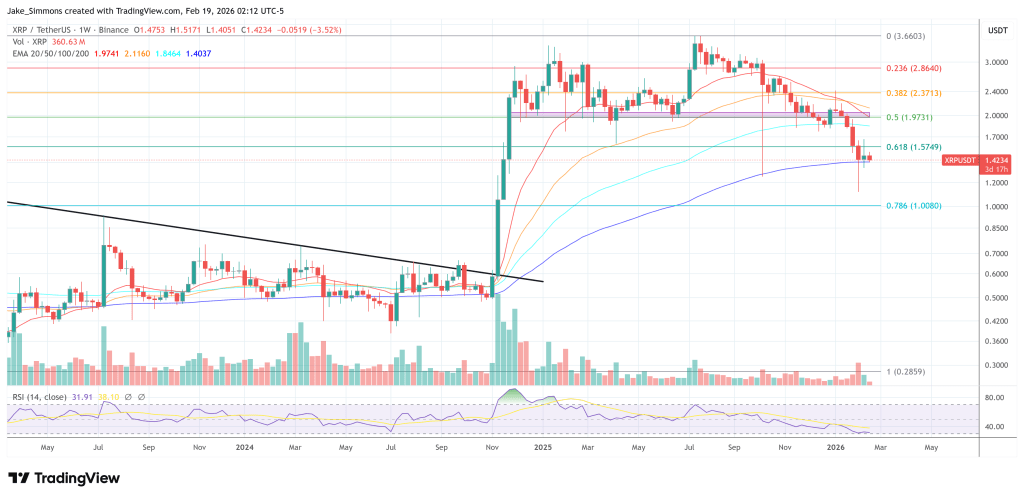
XRP remains above the 200-week EMA, 1-week chart | Source: XRPUSDT on TradingView.com

Трендові криптовалюти

Пов'язані питання

QWhich bank's digital-asset arm launched the EUR CoinVertible stablecoin on the XRP Ledger?

ASociete Generale's digital-asset arm, SG-FORGE, launched the EUR CoinVertible stablecoin on the XRP Ledger.

QOn which blockchains is the EUR CoinVertible stablecoin now deployed?

AThe EUR CoinVertible stablecoin is deployed on the XRP Ledger, Ethereum, and Solana.

QWhat specific Ripple technology is supporting the launch of EUR CoinVertible on the XRPL?

AThe launch is supported by Ripple's custody solution.

QAccording to the article, what are the key features of the XRP Ledger that SG-FORGE expects will increase adoption?

ASG-FORGE expects the XRP Ledger's scalability, speed, low costs, and its status as a secure and decentralized Layer 1 blockchain to increase adoption.

QWhat regulation is the EUR CoinVertible stablecoin aligned with, as mentioned in the article?

AThe EUR CoinVertible stablecoin is aligned with MiCA (Markets in Crypto-Assets Regulation).

Пов'язані матеріали

Who Decides the Rules of Bitcoin? BIP-110 Ignites Governance Debate

Bitcoin's governance is once again at the center of a heated debate, this time ignited by BIP-110, the "Reduced Data Temporary Softfork." This proposal aims to curb non-monetary data (like inscriptions and Runes) by introducing seven new consensus-layer restrictions over a year, such as limiting new output scripts to 34 bytes and restoring the OP_RETURN cap to 83 bytes. The controversy stems from BIP-110's fundamental shift: it moves the battle against "spam" from node relay and miner policies to the consensus layer, rendering currently valid transactions invalid. Supporters, arguing that default policy governance has failed (highlighted by Bitcoin Core v30's relaxation of OP_RETURN limits), see this as necessary to protect node resources and Bitcoin's monetary focus. Opponents, led by figures like Michael Saylor and Adam Back, warn it dangerously centralizes governance. Saylor listed 110 reasons against it, criticizing its low 55% miner activation threshold and potential for chain splits. Back emphasized Bitcoin's "permissionless" ethos, arguing no single group should impose value judgments via consensus rules. Further complicating matters, technical critiques suggest BIP-110 may be technically circumventable, and a "BlockSlop" vulnerability in its upgrade path poses a consensus risk. The debate has drawn in diverse stakeholders: miners (with pools like Ocean signaling support and Foundry polling clients), node operators (like Bitcoin Knots), and new players like corporate treasury holder MicroStrategy (Saylor), whose market influence adds a novel dimension. Ultimately, BIP-110 acts as a governance stress test, exposing the unresolved question: who decides Bitcoin's rules? It pits the authority of miners, node operators, developers, and capital holders against each other, with each side claiming to defend Bitcoin's core principles of neutrality and security.

marsbit12 хв тому

Who Decides the Rules of Bitcoin? BIP-110 Ignites Governance Debate

marsbit12 хв тому

Who Decides Bitcoin's Rules? BIP-110 Ignites Governance Debate

Title: Who Decides Bitcoin's Rules? BIP-110 Ignites Governance Debate A new technical proposal, BIP-110 (Reduced Data Temporary Softfork), has sparked a fundamental governance debate within the Bitcoin community. It aims to impose new consensus rules for one year to limit non-financial data (like inscriptions and Runes) on-chain, moving beyond simple node and miner policy filters to invalidate currently valid transactions. Supporters argue that default policies have failed due to workarounds, necessitating consensus-layer changes to protect Bitcoin's core monetary function from data spam. Critics, including Michael Saylor and Adam Back, contend this dangerously centralizes judgment, undermines permissionlessness, and sets a risky governance precedent. They advocate for market-based solutions like fees or Layer 2s instead. The debate exposes deeper tensions: miners are divided on activation; node operators assert their sovereignty; Bitcoin Core developers influence defaults without direct accountability; and large corporate holders like MicroStrategy now wield narrative influence. Technically, BIP-110 may not fully block data and carries a disclosed consensus bug risk. Ultimately, BIP-110 acts as a stress test, forcing the community to confront the unresolved question: who legitimately decides what Bitcoin is and how it evolves, amidst competing claims from miners, nodes, developers, and capital holders.

链捕手24 хв тому

Who Decides Bitcoin's Rules? BIP-110 Ignites Governance Debate

链捕手24 хв тому

Zcash's New Node Zakura Goes Live: Privacy Payments Can Reach 50,000 TPS, Aiming to Rival Visa and Mastercard

Zcash, a privacy-focused cryptocurrency, has launched a new full node software called Zakura version 1.0.0. Developed by Zcash co-founder Sean Bowe and Dev Ojha, with private ZEC donations, its goal is to enable Zcash to process over 50,000 transactions per second (TPS)—matching the scale of Visa and Mastercard—while maintaining full transaction privacy and verifiability. This addresses a key bottleneck, as Zcash currently handles only about 1 private transaction per second. Zakura is a fork of the Zcash Foundation's Zebra node. It features chain pruning and snapshots, reducing disk usage and allowing new nodes to sync in under two minutes. It also offers compatibility with the legacy `zcashd` client interface. The scalability challenge stems from the large data size of privacy proofs. Bowe's Tachyon project aims to use recursive proofs to reduce consensus-layer data needs from ~500 MB/s to ~100 MB/s. For wallet scalability, Valar Group is researching Private Information Retrieval (PIR) tech to allow wallets to fetch their data privately. Zakura supports fast block propagation and the upcoming "Ironwood" network upgrade (NU6.3), scheduled for activation around July 28th. Ironwood was created to contain a critical inflation bug discovered in the Orchard shielded pool in May 2024. The fix uses "turnstiles" to trap any counterfeit ZEC created during the vulnerability period within the shielded pool, preventing it from entering circulation and restoring supply integrity.

marsbit39 хв тому

Zcash's New Node Zakura Goes Live: Privacy Payments Can Reach 50,000 TPS, Aiming to Rival Visa and Mastercard

marsbit39 хв тому

Replicating the "DeepSeek Moment"? Wall Street Unanimously Says: Kimi K3 Instead Strengthens Computing Power Demand

Title: Wall Street Sees Kimi K3 as a Catalyst for Compute Demand, Not a "DeepSeek Moment 2.0" Summary: Following the release of Moonshot AI's powerful open-source model Kimi K3, initial market reaction mirrored the "DeepSeek moment" that sparked a sell-off in compute stocks earlier in 2025, fearing reduced demand for AI infrastructure. However, major Wall Street banks including UBS, Nomura, BofA, and Citi argue the opposite: K3 will accelerate, not weaken, demand for compute, memory, storage, and networking. Their analysis centers on K3's specifications—2.8 trillion parameters, 1M token context, and MoE architecture—which represent a "scale" story rather than a pure "efficiency" one like DeepSeek R1. These features increase pressure on inference, memory (especially KV cache), and storage. Analysts invoke Jevons Paradox: as high-quality models become more affordable (K3 is cheaper than top closed models but not the cheapest), usage and token volumes expand, ultimately increasing total compute consumption. The reports highlight that competition will force leading US AI labs (OpenAI, Anthropic, Google) to invest more in training and iteration to maintain their edge. Furthermore, the rise of capable open-source models like K3 is expanding the global AI developer ecosystem, with Chinese models now accounting for over 45% of developer traffic. Key beneficiaries identified across the AI infrastructure chain include memory/storage players (e.g., Micron, Samsung), compute leaders (Nvidia, TSMC), networking suppliers (due to "super-node" cluster needs for deploying K3), and cloud platforms (e.g., Alibaba) that host diverse model ecosystems. The consensus is that stronger open-source models are an entry point for the next wave of infrastructure demand diffusion, provided workload growth outpaces efficiency gains.

链捕手42 хв тому

Replicating the "DeepSeek Moment"? Wall Street Unanimously Says: Kimi K3 Instead Strengthens Computing Power Demand

链捕手42 хв тому

Торгівля

Спот

Популярні статті

Що таке $BANK

Bank AI: Революційний крок у майбутнє банківської справи Вступ В епоху, що характеризується швидкими технологічними змінами, Bank AI знаходиться на перетині штучного інтелекту (ШІ) та банківських послуг. Цей інноваційний проєкт прагне переосмислити фінансовий ландшафт, підвищуючи ефективність роботи, заходи безпеки та досвід клієнтів завдяки потужності ШІ. Розпочинаючи дослідження Bank AI, ми заглибимося в суть проєкту, його операційні динаміки, історичний контекст і значущі етапи. Що таке Bank AI? У своїй основі Bank AI представляє собою трансформаційну ініціативу, спрямовану на інтеграцію штучного інтелекту в різні банківські операції. Цей проєкт використовує можливості ШІ для автоматизації процесів, покращення протоколів управління ризиками та підвищення взаємодії з клієнтами через персоналізовані послуги. Основні цілі Bank AI включають: Автоматизація банківських функцій: Використовуючи технології ШІ, Bank AI прагне автоматизувати рутинні завдання, зменшуючи навантаження на людські ресурси та підвищуючи ефективність. Покращене управління ризиками: Проєкт використовує алгоритми ШІ для прогнозування та виявлення ризиків, тим самим зміцнюючи заходи безпеки проти шахрайства та інших загроз. Персоналізація банківських послуг: Bank AI зосереджується на пропозиції індивідуальних фінансових продуктів і послуг, аналізуючи дані і поведінку клієнтів. Покращення досвіду клієнтів: Впровадження рішень на основі ШІ, таких як чат-боти та віртуальні асистенти, має на меті забезпечити користувачам більш природну взаємодію, революціонізуючи спосіб, яким клієнти спілкуються з банками. З цими цілями Bank AI займає важливу роль в робленні банківської справи більш ефективною, безпечною та орієнтованою на користувача. Хто є творцем Bank AI? Деталі стосовно творця Bank AI залишаються невідомими. Таким чином, жодна конкретна особа або організація не були ідентифіковані в доступній інформації. Анонімність навколо створення проєкту піднімає питання, але це не зменшує його амбітного бачення та цілей. Хто є інвесторами Bank AI? Аналогічно творцеві проєкту, конкретна інформація стосовно інвесторів або організацій, що підтримують Bank AI, не була розкрито. Без цієї інформації важко окреслити фінансову підтримку та інституційну підтримку, які могли б сприяти розвитку проєкту. Тим не менше, важливість наявності міцної інвестиційної бази є вирішальною для забезпечення розвитку в такій інноваційній сфері. Як працює Bank AI? Bank AI функціонує на кількох інноваційних фронтах, фокусуючись на унікальних факторах, які відрізняють його від традиційних банківських структур. Нижче наведено ключові операційні характеристики: Автоматизація: Застосовуючи алгоритми машинного навчання, Bank AI автоматизує різні ручні процеси в банках. Це призводить до зниження операційних витрат і дозволяє працівникам перенаправити свої зусилля на більш стратегічні завдання. Покращене управління ризиками: Інтеграція ШІ в практики управління ризиками забезпечує банки інструментами для точного прогнозування потенційних загроз, таких як шахрайство, забезпечуючи при цьому безпеку інформації і активів клієнтів. Індивідуальні фінансові рекомендації: Завдяки безперервному навчанню з інтерaktionen з клієнтами, системи ШІ розвивають тонке розуміння потреб користувачів, що дозволяє їм пропонувати персоналізовані поради щодо фінансових рішень. Покращені взаємодії з клієнтами: Використовуючи чат-ботів і віртуальних асистентів на базі ШІ, Bank AI дозволяє створити більш залучений досвід для клієнтів, дозволяючи користувачам швидше отримувати відповіді на свої запитання, зменшуючи час очікування та підвищуючи рівень задоволеності. Разом ці операційні характеристики позиціонують Bank AI як піонера в банківському секторі, встановлюючи нові стандарти для надання послуг і операційної досконалості. Хронологія Bank AI Для розуміння траєкторії Bank AI необхідно ознайомитися з його історичним контекстом. Нижче наведено хронологію, що підкреслює важливі етапи та розробки: Ранні 2010-ті: Концептуалізація інтеграції ШІ в банківські послуги почала привертати увагу, коли банківські установи визнали потенційні переваги. 2018: Відбулося помітне збільшення впровадження технологій ШІ, коли банки почали використовувати інструменти ШІ, такі як чат-боти для базового обслуговування клієнтів та системи управління ризиками для покращення безпеки. 2023: Софістикація ШІ продовжувала розвиватися, з введенням генеративного ШІ для більш складних завдань, таких як обробка документів і аналіз інвестицій в реальному часі. Цей рік став важливим стрибком у можливостях, які забезпечує технологія ШІ для банків. 2024-актуальний статус: Станом на цей рік, Bank AI знаходиться на зростаючій траєкторії, з постійними дослідженнями та розробками, які готові подальше покращити можливості в банківських операціях. Продовження дослідження застосувань ШІ натякає на захоплюючі події, які ще попереду. Ключові моменти про Bank AI Інтеграція ШІ в банківську справу: Bank AI зосереджується на прийнятті штучного інтелекту для оптимізації банківських процесів та покращення досвіду користувачів. Автоматизація та фокус на управлінні ризиками: Проєкт сильного підкреслює ці сфери, прагнучи зshift тягар рутинних завдань, водночас підвищуючи безпеку через прогнозну аналітику. Персоналізовані банківські рішення: Завдяки використанню даних клієнтів, Bank AI забезпечує персоналізовані банківські послуги, що відповідають потребам окремих користувачів. Прихильність до розвитку: Bank AI залишається відданим постійним дослідженням і розробкам, що забезпечують його адаптацію та постійну актуальність у міру того, як технології продовжують розвиватися. Висновок Підсумовуючи, Bank AI є важливим кроком вперед у банківській індустрії, використовуючи штучний інтелект для переформатування операційних парадигм, підвищення безпеки та сприяння задоволеності клієнтів. Незважаючи на прогалини в інформації щодо творця та інвесторів, чіткі цілі і функціональні механізми Bank AI забезпечують міцну основу для його подальшої еволюції. Оскільки технологія ШІ продовжує розвиватися та інтегруватися в банківський сектор, Bank AI має всі шанси суттєво вплинути на майбутнє фінансових послуг, покращуючи спосіб, яким ми розуміємо та взаємодіємо з банківською справою.

171 переглядів усьогоОпубліковано 2024.04.06Оновлено 2024.12.03

Що таке $BANK

Як купити BANK

Ласкаво просимо до HTX.com! Ми зробили покупку Lorenzo Protocol (BANK) простою та зручною. Дотримуйтесь нашої покрокової інструкції, щоб розпочати свою криптовалютну подорож.Крок 1: Створіть обліковий запис на HTXВикористовуйте свою електронну пошту або номер телефону, щоб зареєструвати обліковий запис на HTX безплатно. Пройдіть безпроблемну реєстрацію й отримайте доступ до всіх функцій.ЗареєструватисьКрок 2: Перейдіть до розділу Купити крипту і виберіть спосіб оплатиКредитна/дебетова картка: використовуйте вашу картку Visa або Mastercard, щоб миттєво купити Lorenzo Protocol (BANK).Баланс: використовуйте кошти з балансу вашого рахунку HTX для безперешкодної торгівлі.Треті особи: ми додали популярні способи оплати, такі як Google Pay та Apple Pay, щоб підвищити зручність.P2P: Торгуйте безпосередньо з іншими користувачами на HTX.Позабіржова торгівля (OTC): ми пропонуємо індивідуальні послуги та конкурентні обмінні курси для трейдерів.Крок 3: Зберігайте свої Lorenzo Protocol (BANK)Після придбання Lorenzo Protocol (BANK) збережіть його у своєму обліковому записі на HTX. Крім того, ви можете відправити його в інше місце за допомогою блокчейн-переказу або використовувати його для торгівлі іншими криптовалютами.Крок 4: Торгівля Lorenzo Protocol (BANK)Легко торгуйте Lorenzo Protocol (BANK) на спотовому ринку HTX. Просто увійдіть до свого облікового запису, виберіть торгову пару, укладайте угоди та спостерігайте за ними в режимі реального часу. Ми пропонуємо зручний досвід як для початківців, так і для досвідчених трейдерів.

734 переглядів усьогоОпубліковано 2025.05.09Оновлено 2026.06.02

Як купити BANK

Обговорення

Ласкаво просимо до спільноти HTX. Тут ви можете бути в курсі останніх подій розвитку платформи та отримати доступ до професійної ринкової інформації. Нижче представлені думки користувачів щодо ціни BANK (BANK).

活动图片