Tokens Not Selling? 90% of Crypto Projects Overlook Investor Relations

marsbitОпубліковано о 2026-03-17Востаннє оновлено о 2026-03-17

Анотація

The article argues that effective Investor Relations (IR) is a critical yet often neglected function for crypto projects, with 90% failing at it and struggling to sell their tokens. Good IR acts as a bridge between a project and the market, broadening the buyer base and improving holder quality. The core of a successful IR strategy is distribution: maximizing the number of target investors who know about the token and converting them into buyers. The two primary buyer types are active crypto funds (requiring clear narratives and data for value reassessment) and large strategic institutions (requiring a long B2B sales cycle). The author emphasizes the necessity of proactively controlling the project's narrative with honesty and context, rather than remaining silent. A major tactical error is poor planning for token unlocks; teams should start 30-50 weeks in advance to manage supply and demand. Data is presented as the best ally for building a compelling story, providing context and comparisons for investors. The author contends that crypto IR should not be a dry, compliance-driven task but an engaging, interactive process similar to modern marketing. To lower the barrier to entry, projects must provide ample public data and research, making it easier for funds to conduct due diligence. Furthermore, the article highlights the power of on-chain data for deep investor analysis and argues that greater transparency, not less, actually expands the market by reducing uncertainty. ...

Written by: Mippo

Compiled by: Chopper, Foresight News

The core responsibility of the Investor Relations (IR) department is to help the market understand an asset, its strategy, and its potential value. It serves as the bridge between the project and the market.

When I first entered the crypto industry, what was considered "good IR" was actually that great. Over the years, while we have made progress in some areas, we are far from where we should be in terms of how we communicate with investors.

Good IR can broaden your buyer base and improve the quality of your holder structure. Doing it poorly, or not doing it at all, will cause your token to decline relentlessly, no matter how good the product is.

Over the past year, we have communicated with almost all the top projects in the crypto space about building investor relations systems and have now provided services for over 20 projects. This article is a practical, actionable guide to investor communication.

Distribution is King
If you want to maximize token value, you only need to look at two factors:

  • How many target investors are aware of your token's existence
  • How many of these investors convert into buyers

A great IR strategy must optimize both points simultaneously.

Potential token buyers essentially fall into only two categories:

The first category is crypto liquidity funds. They are actively managed institutions that already hold your token or are tracking it continuously. For them, the core is value re-rating: getting an institution that values your token at $1 to see a path to $5. You need to achieve this with precise data, a clear narrative, and consistent progress proof. This is the work of narrative building and data presentation.

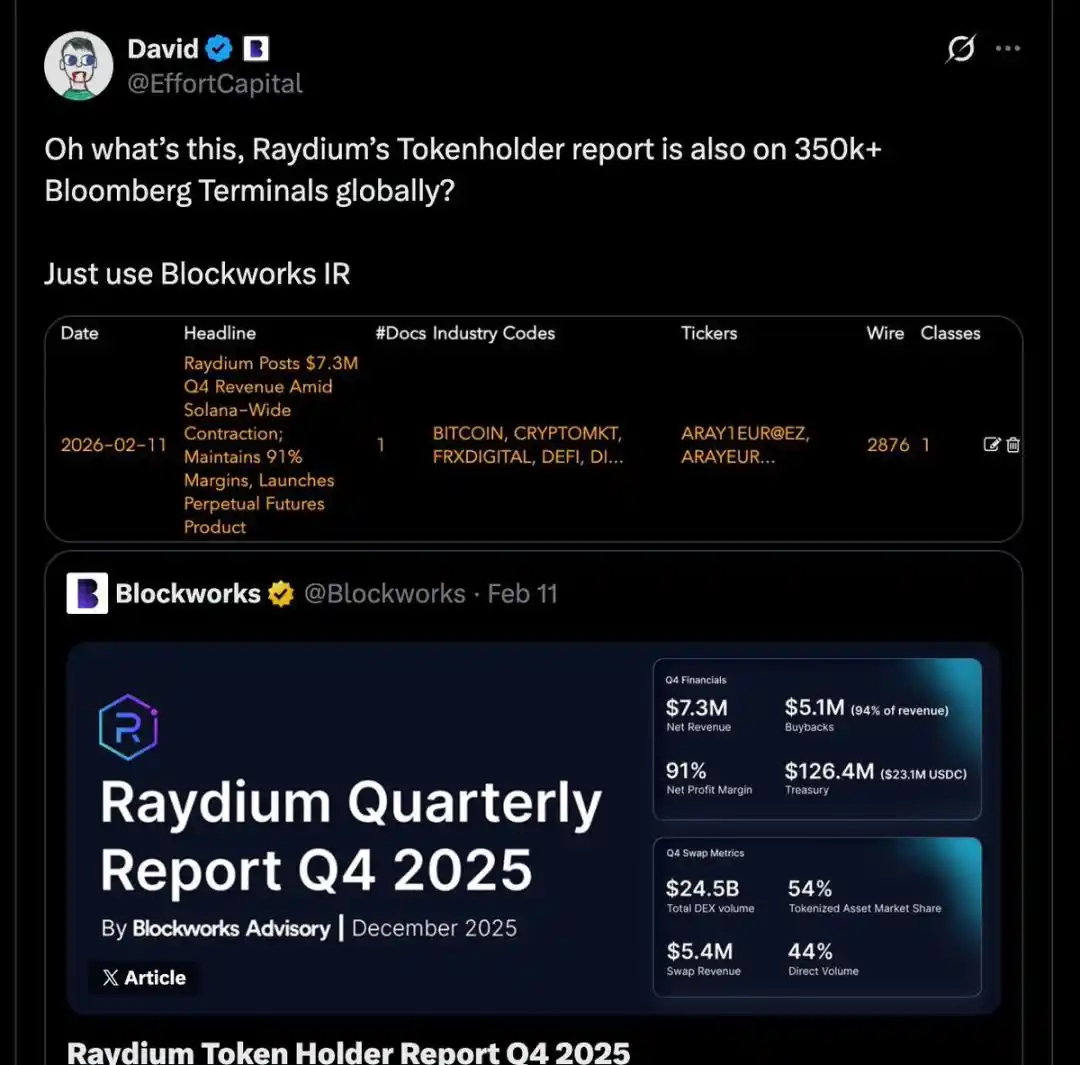
The second category is large strategic investors or institutions. Think of recent collaborations like Morpho & Apollo, or BlackRock & Uniswap. This operates on a completely different logic: longer sales cycles, stricter due diligence, and you need a mature product. If you are in the early stages or need capital in the short term, frankly, these institutions are not for you. But if you are ready, you should be where they are: on Bloomberg Terminals, at institutional summits, and building networks offline. Apply B2B sales thinking, not marketing thinking.

Control Your Narrative

If you don't proactively tell your story well, the market will tell it for you.

The reality is that the data for most protocols cannot be perfect, and that's okay. The real problem is: trying to hide it, or remaining silent for months. The excuse I hear most often is: "I don't want to get roasted on Twitter."

Projects don't die from being mocked on Twitter; they die from being forgotten by investors. The longer you go without communicating with the market, the angrier and more disappointed investors become.

You don't need perfect data; you need honesty, context, and a coherent explanation of what matters, what is improving, and what still needs work.

This is the key to building trust. Silence directly destroys it.

Token Unlocks

Token issuers must respect supply and demand.

If you want to understand price action, you only need to understand this core factor of supply and demand. Often, price management is more about the tactical operation of matching supply and demand than anything else.

The biggest mistake I see is teams starting to think about a response plan only 1-2 months before an unlock. In just 30 days, you have no time to fix a huge supply-demand imbalance.

Start planning at least 30 weeks in advance; 40-50 weeks is optimal. You need time to connect with buyers, find demand to absorb the supply, and communicate with investors if an unlock needs to be postponed.

This is the tedious, unglamorous, but critical part of IR. Give yourself enough of a time window to handle it.

Data is Your Best Ally

Narrative is important. But by 2026, a narrative unsupported by data is meaningless.

The best IR systems use data to make a token easier to understand, compare, and evaluate. The data itself should tell a complete story.
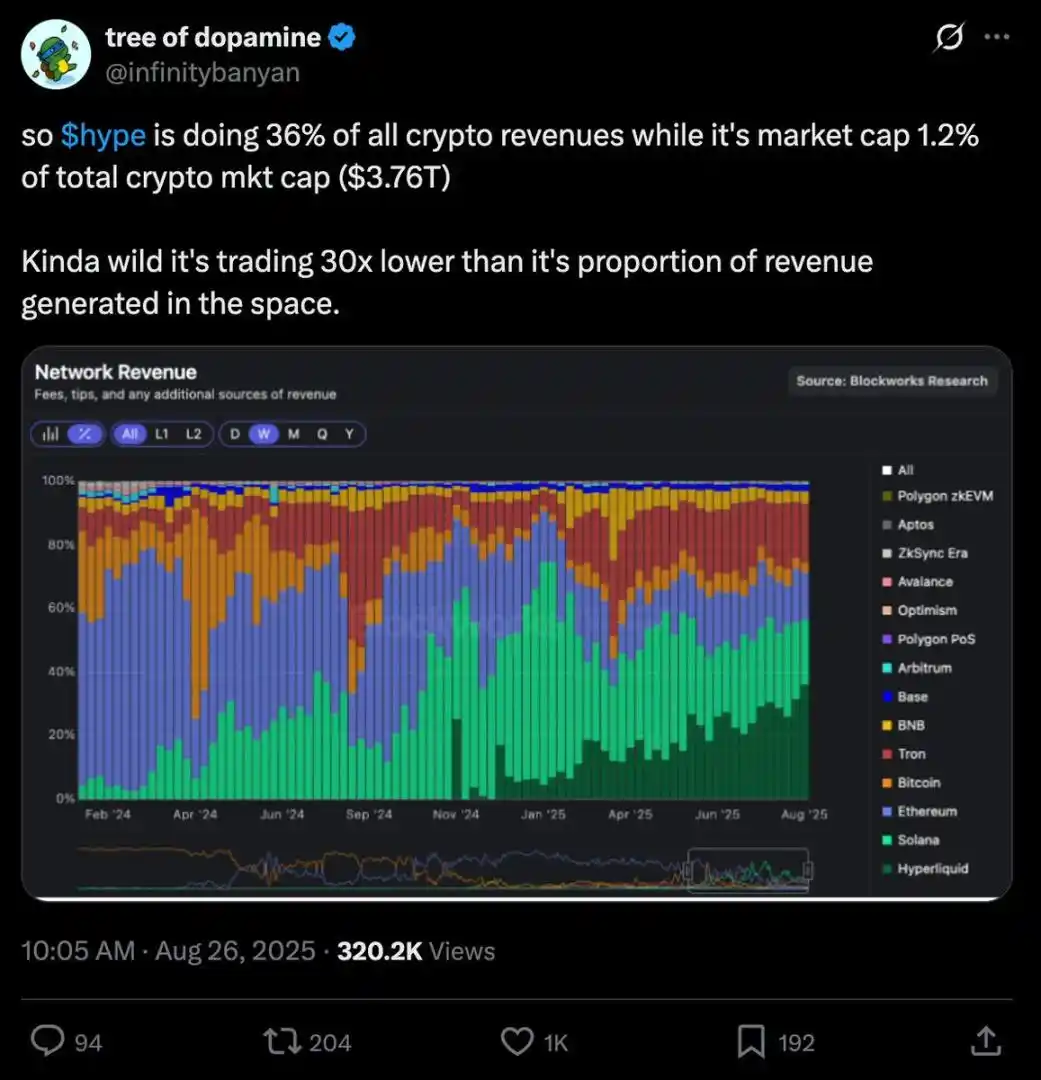
Data can come from multiple sources:

  • Proprietary data from your own protocol
  • On-chain market structure data
  • Competitive benchmarking data
  • Real-world analogies that help traditional investors understand crypto behavior

The last category is severely underestimated today. Truly excellent investor communication isn't just about showing an internal dashboard; it's about helping investors understand the role your protocol plays in the bigger picture.

For example: You operate a perpetual futures DEX, and your dashboard shows $75 million in trading volume last month. Is that good? Is it bad? Who should it be compared to? Should investors buy or run?

I see a crypto industry today with vast amounts of data but almost no context. Great teams don't just report numbers; they use numbers to tell a story.

IR is Not a Procedural Compliance Task

Most people assume investor relations in crypto is the same as in the stock market. The only problem is: IR in the stock market is incredibly boring.

Don't believe me? Listen to Vlad Tenev's perspective.

Vlad envisions a future where earnings calls are not dry Zoom presentations by a CFO to 60 sell-side analysts, but have the live feel, interaction, and emotion of an NBA post-game interview.

I completely agree. We have 8 years of experience in goal-oriented, data-driven marketing that blends offline and social media. IR should operate the same way. The goal isn't just to "inform the market"; it's to engage existing investors, deepen their conviction, and expand the pool of potential future token holders.
What will the future look like? Live streams on earnings day, CEOs connecting with industry guests, inviting major holders to share their insights on camera... truly interacting with investors and acquiring new holders.

Lower the Entry Cost for Potential Investors

Today, all liquidity funds must justify their holdings to their LPs. This means due diligence. This means investment memos.

If your protocol lacks public data, research reports, and contextual information, you are forcing every potential investor to build an analytical framework from scratch.

You are artificially raising the cost of investing in you. The result: fewer people will be willing to invest.

Lower the barrier for them. Continuously output high-quality information: research reports, protocol data analysis, ecosystem progress, third-party analysis. Make it easy for fund analysts to write a report and include your token in their portfolio.

Without Data Analysis, You're Flying Blind

Even the top protocols in crypto have a surprisingly weak understanding of their investor structure. Basic behavioral analysis is almost non-existent: How long do investors hold on average? Do they open perpetual hedges at token launch?

And on-chain data makes the kind of deep analysis that stock market IR teams dream of possible.

If an investor claims to be a long-term believer, the truth is already permanently recorded on-chain. Protocols that embed this analytical capability into their IR function will have a huge advantage: understanding not only existing holders but also precisely targeting the next wave of investors.

Transparency Expands Market Size

Most teams instinctively think that less disclosure is safer, but the opposite is true.

Investors are already bearing uncertainty for your token: unlocks, treasury spending, market making agreements, non-standardized terms, etc. If you don't provide answers, the market won't ignore these issues; it will fill in the blanks in the most pessimistic way possible.

The cost of insufficient transparency is incalculable. You will never know how many investors passed on your token because the information was incomplete or difficult to verify. This cost is real.

Success Metrics

It's easy to measure IR success by token price. The problem is, price is too noisy, influenced by a multitude of factors outside IR's control: macroeconomics, liquidity, market sentiment, geopolitical conflicts, etc.

A more reasonable approach is to measure whether IR has improved the quality and breadth of the investor structure.

Here are some metrics worth tracking:

  • Growth in the number of target investors actively following the token
  • Growth of quality holders across segments, especially liquidity funds and strategic institutions
  • Changes in holder concentration
  • Number of investor conversions from initial contact → active due diligence → holding a position
  • Proportion of core holders aligned with the target holding period
  • Frequency and quality of investor outreach throughout the year
  • Growth in proactive investor inquiries
  • Increased exposure in target buyer channels
  • Measured through direct communication and feedback: improvement in investors' understanding of your core thesis

For liquidity funds, a practical gauge is: compared to a year ago, do more investors have a clear valuation framework for your token?

Not everyone has to buy now, but if more people understand how to look at your token, know which milestones are important, and what price is attractive, that is real progress.

IR success isn't just "did the price go up," but "did we expand the potential holder base."

The Road Ahead

We are building in this direction because the current state of tokens is an existential challenge for the entire industry. A regrettable truth is: most tokens today do not have investment value. Jason and I genuinely want to solve this problem, and years of experience have shown us the way forward.

Tokens should be more transparent and investor-friendly than stocks because they are built on crypto infrastructure. Projects have a strong incentive to move in this direction because it vastly expands the addressable market.

More importantly, the field of investor relations hasn't seen innovation in a long time. In our view, the future of IR is绝对不是枯燥的流程任务 (definitely not a boring procedural task), but vibrant, multimedia, highly interactive, and proactive. It requires actively engaging offline, sparking discussions on social media, and telling compelling stories to attract new investors. This is the direction the industry must take.


Трендові криптовалюти

Пов'язані питання

QWhat are the two main factors to maximize token value according to the article?

AThe two main factors are: 1) How many target investors are aware of the token's existence, and 2) How many of those investors convert into buyers.

QWhat are the two primary categories of potential token buyers identified in the article?

AThe two primary categories are: 1) Active management crypto liquidity funds, and 2) Large strategic investors or institutions.

QWhy is it a critical mistake for teams to start planning for a token unlock only 1-2 months in advance?

ABecause 30 days is not enough time to fix a massive supply and demand imbalance. The article recommends starting planning at least 30 weeks, and ideally 40-50 weeks, in advance to have enough time to find buyers, secure demand, and communicate with investors if a delay is needed.

QWhat does the article suggest is the future of Investor Relations (IR), contrasting it with traditional, 'boring' stock market IR?

AThe future of IR is described as a枯燥的流程任务 (dry procedural task), but rather as生动、多媒体、高互动、主动出击 (vivid, multimedia, highly interactive, and proactive). It should involve live earnings day streams, CEO interviews with industry guests, and leveraging offline interactions and social media to tell compelling stories and attract new investors.

QAccording to the article, what is a more reasonable way to measure the success of IR efforts than token price?

AA more reasonable way is to measure whether IR has improved the quality and breadth of the investor base. This includes tracking metrics like growth in the number of target investors following the token, an increase in quality holders from specific segments, changes in holder concentration, and the number of investors moving from initial contact to active due diligence to holding the token.

Пов'язані матеріали

Base Under Pressure

**Title: The Pressure Mounts for Base** Base, the Ethereum Layer 2 scaling solution backed by Coinbase, is facing significant pressure and public scrutiny from its leadership following the launch of Robinhood Chain. Base co-founder Jesse Pollak recently acknowledged strategic missteps, admitting that the chain's past focus on social and creator tokens (e.g., through Farcaster, Zora) failed to deliver sustainable adoption. He has refocused on core infrastructure, handing leadership of the Base App back to Coinbase's Cobie. While Base remains a top L2 contender alongside OP Mainnet and Arbitrum, and boasts the highest TVL (nearly $12B), its weaknesses are being highlighted by the new competitor. Key criticisms include its slow progress on decentralization. Base has faced issues with its single sequencer causing block production halts, and L2BEAT is reportedly considering downgrading its decentralization rating from Stage 1 to Stage 0. This contrasts sharply with the rapid initial success of Robinhood Chain, whose DEX quickly entered the top five by volume. The leadership styles of the parent companies are also being compared: Robinhood's CEO actively engages with new projects, while a recent incident where Coinbase's Brian Armstrong briefly changed his profile picture—sparking and then crashing a related meme token—drew community ire and mockery. Pollak stated Base is working with Coinbase on tokenized stocks backed 1:1 by real equity, differentiating it from Robinhood's derivatives model. However, the article argues that Base's most urgent task is to address its long-standing technical and trust issues. With more traditional finance players likely to emulate Robinhood's path, Base must use this competitive pressure to solidify its position as long-term financial infrastructure.

Foresight News12 хв тому

Base Under Pressure

Foresight News12 хв тому

White House Concession Removes Ethical Hurdle, Clarity Act Races Against Final Window Before Recess?

On July 21st, industry sources reported that the Trump administration has agreed to include an ethics provision in the "Clarity Act" (Digital Asset Market Clarity Act of 2025). This concession addresses the long-standing conflict-of-interest concerns regarding government officials and the crypto industry, potentially removing the final major obstacle to the bill's progress. Additionally, Patrick Witt, the executive director of the White House's Digital Asset Advisory Committee, confirmed he will remain in his role to help finalize the bill, alleviating previous concerns about his potential departure. The Clarity Act aims to establish a unified federal regulatory framework for the U.S. digital asset market. Its core objective is to resolve regulatory ambiguity by defining different types of digital assets (digital commodities, investment contract assets, and permitted payment stablecoins) and clarifying the respective oversight roles of the SEC and CFTC. This would end the long-running jurisdictional dispute between the two agencies and provide clearer compliance paths for the industry. With the ethics issue moving toward resolution, the most urgent challenge now is time. The U.S. Congress is set to begin its August recess in mid-August, leaving only a few working weeks to finalize the text and advance the bill through the Senate. Industry advocates, like the Blockchain Association's Kristin Smith, stress that this is a critical moment. If negotiations conclude successfully in the coming weeks, the Clarity Act could pass a key hurdle before the recess; otherwise, it may face significant delays. If enacted, the Clarity Act could mark a historic turning point in crypto regulation. By providing a clearer and more predictable legal framework, it aims to reduce uncertainty for businesses, developers, and traditional financial institutions looking to enter the digital asset space, potentially setting a global benchmark for market structure regulation.

Odaily星球日报18 хв тому

White House Concession Removes Ethical Hurdle, Clarity Act Races Against Final Window Before Recess?

Odaily星球日报18 хв тому

AI Era, Industrial Revolution, and Future Civilization Interview — Zhang Dingwen: The Future Does Not Belong to Chasers

"AI Era, Industrial Revolution and Future Civilization: An Interview with Zhang Dingwen – The Future Does Not Belong to Those Who Chase" In this interview, entrepreneur Zhang Dingwen reflects on his entrepreneurial journey and philosophy, moving beyond discussions of financing or success to emphasize understanding the "era" itself. He argues that true entrepreneurs should not chase short-term trends ("winds"), but position themselves in the direction of long-term technological and societal evolution. Zhang shares key lessons from his early days, including the realization that user value does not automatically translate to commercial value. For him, the core of entrepreneurship is not building a company but constantly upgrading one's own "cognition" – the ability to interpret information, ask the right questions, and understand the underlying "causes" behind business outcomes, not just the effects. His thinking has evolved from a focus on creating good products to a strategic focus on building "entrances" – platforms that naturally connect users to digital services. He sees smart wearables, like watches, not merely as hardware but as potential future gateways combining technological, financial, social, and even fashion attributes to create sustained user relationships and ecosystems. Ultimately, Zhang's vision transcends individual products or companies. He discusses business competition in three stages: product, platform, and finally, "civilization" – where the greatest companies influence how society operates by defining new rules and ways of life. He believes the mission of a truly great enterprise is to solve problems of its time, build enduring trust, and contribute lasting value, leaving behind not just wealth but a positive impact on how the world works. The future, he concludes, belongs not to the fastest, but to those with the correct long-term direction and a commitment to continuous learning and evolution.

marsbit29 хв тому

AI Era, Industrial Revolution, and Future Civilization Interview — Zhang Dingwen: The Future Does Not Belong to Chasers

marsbit29 хв тому

Cryptocurrency & Stock Market Barometer丨Strategy Cash Reserves Increase to $3.23 Billion, Halting BTC Purchases; Vanguard and Other Asset Managers Increase Holdings in Strategy Stock (July 21)

Market Overview & Warnings: The article warns of high volatility in South Korean stocks and continued dependence on U.S. stocks on geopolitics. Chinese A-shares remain under pressure. It advises against using leverage in current equity markets. For crypto-linked stocks, most have limited growth except Robinhood, with caution advised. U.S. Stock Market: Bearish bets on U.S. stocks, particularly targeting AI-related companies, have reached record highs since 2010, signaling deep skepticism about the sustainability of the AI-driven rally. Tech and chip stocks led a market decline, with the Philadelphia Semiconductor Index potentially entering a bear market. Increased expectations for Federal Reserve interest rate hikes and geopolitical tensions contributed to the negative sentiment. Bitcoin Treasury Company Updates: * Strategy: Increased its cash reserves to $3.23 billion and paused Bitcoin purchases. Several major asset managers, including Vanguard Group and Capital Group, increased their holdings of Strategy (MSTR) stock. * Global corporate Bitcoin buying slowed significantly to just $1.33 million last week. * Other notable activity: Strive purchased 21 BTC; ORANGE JUICE raised $40 million for Bitcoin acquisitions; Bitcoin Japan Corp. raised $60 million, allocating $4.08 million for its first BTC purchase. Other Crypto Treasury Holdings: * Ethereum: BitMine increased its ETH holdings to 5.78 million, nearing its 5% of supply goal. Its total crypto assets, cash, and securities are valued at $11.5 billion. * Solana: No significant corporate treasury activity reported. * Altcoins: HypeStrat made no adjustments to its treasury; its mNAV ratio fell to a long-term low. (Note: This summary is for informational purposes only and does not constitute investment advice.)

marsbit30 хв тому

Cryptocurrency & Stock Market Barometer丨Strategy Cash Reserves Increase to $3.23 Billion, Halting BTC Purchases; Vanguard and Other Asset Managers Increase Holdings in Strategy Stock (July 21)

marsbit30 хв тому

Торгівля

Спот

Популярні статті

Як купити CORE

Ласкаво просимо до HTX.com! Ми зробили покупку CORE (CORE) простою та зручною. Дотримуйтесь нашої покрокової інструкції, щоб розпочати свою криптовалютну подорож.Крок 1: Створіть обліковий запис на HTXВикористовуйте свою електронну пошту або номер телефону, щоб зареєструвати обліковий запис на HTX безплатно. Пройдіть безпроблемну реєстрацію й отримайте доступ до всіх функцій.ЗареєструватисьКрок 2: Перейдіть до розділу Купити крипту і виберіть спосіб оплатиКредитна/дебетова картка: використовуйте вашу картку Visa або Mastercard, щоб миттєво купити CORE (CORE).Баланс: використовуйте кошти з балансу вашого рахунку HTX для безперешкодної торгівлі.Треті особи: ми додали популярні способи оплати, такі як Google Pay та Apple Pay, щоб підвищити зручність.P2P: Торгуйте безпосередньо з іншими користувачами на HTX.Позабіржова торгівля (OTC): ми пропонуємо індивідуальні послуги та конкурентні обмінні курси для трейдерів.Крок 3: Зберігайте свої CORE (CORE)Після придбання CORE (CORE) збережіть його у своєму обліковому записі на HTX. Крім того, ви можете відправити його в інше місце за допомогою блокчейн-переказу або використовувати його для торгівлі іншими криптовалютами.Крок 4: Торгівля CORE (CORE)Легко торгуйте CORE (CORE) на спотовому ринку HTX. Просто увійдіть до свого облікового запису, виберіть торгову пару, укладайте угоди та спостерігайте за ними в режимі реального часу. Ми пропонуємо зручний досвід як для початківців, так і для досвідчених трейдерів.

346 переглядів усьогоОпубліковано 2024.12.13Оновлено 2026.06.02

Як купити CORE

Обговорення

Ласкаво просимо до спільноти HTX. Тут ви можете бути в курсі останніх подій розвитку платформи та отримати доступ до професійної ринкової інформації. Нижче представлені думки користувачів щодо ціни CORE (CORE).

活动图片