Token FOLD Auction Imminent, What is The Interfold, Supported by Vitalik?

Foresight NewsОпубліковано о 2026-07-08Востаннє оновлено о 2026-07-08

Анотація

**Title:** FOLD Token Auction Approaches: What is The Interfold, Supported by Vitalik? **Summary:** The Interfold, a "confidential coordination infrastructure" previously known as Enclave, is launching its functional token FOLD via a Uniswap Continuous Clearing Auction (CCA) starting July 8th. Endorsed by Ethereum co-founder Vitalik Buterin in May, the protocol tackles the core problem of governance bribery in decentralized voting (e.g., on platforms like Votium) by enabling multiple parties to compute a verifiable result without exposing their private input data. Its core technology, the Encrypted Execution Environment (E3), uses a distributed network of "Ciphernodes" that perform computations on fully encrypted data using Fully Homomorphic Encryption (FHE), with process integrity verified by Zero-Knowledge (ZK) proofs and decryption keys managed via Decentralized Threshold Cryptography (DTC) to eliminate a single point of trust. The primary application is CRISP (Coercion-Resistant Impartial Selection Protocol) for DAO governance, which ensures encrypted voting, "receipt-free" votes to prevent bribery, and verifiable tallying. The Interfold, developed by the Gnosis Guild team (creators of the Zodiac DAO tooling), positions itself as a focused solution to make on-chain voting truly un-buyable, realizing the vision of Vitalik's earlier MACI (Minimal Anti-Collusion Infrastructure) framework without its reliance on a single trusted coordinator. FOLD tokens will be used for C...


Author:angelilu,Foresight News

Originally Published on June 2nd


Vitalik wrote an article in May this year supporting The Interfold, a confidential coordination infrastructure. Its token FOLD will officially start auctioning today (July 8th) at 22:00 via the Uniswap CCA (Continuous Commitment Auction) mechanism, lasting for 48 hours until July 10th.


FOLD is the functional token of The Interfold: Ciphernodes can use it to stake and join the network and receive rewards, applications can use it to pay for encrypted computation requests, and holders can participate in protocol governance.


This auction adopts a uniform clearing price mechanism, where all successful bidders transact at the same price. Portions of bids exceeding the clearing price can be withdrawn for rebidding. Participation in the auction requires KYC verification via Predicate, and the pre-registration window closed yesterday. After the auction, there is a 40-day cooling period, during which FOLD can only be used for Ciphernode staking and cannot be freely transferred. The official TGE is expected on August 19th.


Below is the original article:


On-chain voting is one of the most attractive aspects of decentralized protocols—transparent, open, and accessible to anyone. But openness does not guarantee it fully represents community consensus. The existence of 'governance bribery markets' like Votium allows anyone with sufficient funds to directly bid to voters before the voting deadline. The result is: the direction of a protocol is often not decided by community consensus, but by the highest bidder.


A protocol called The Interfold has chosen to tackle this problem at its root.


Confidential Coordination Infrastructure


The Interfold (formerly known as Enclave) positions itself as a 'confidential coordination infrastructure,' aiming to allow multiple independent participants to jointly produce a verifiable result without exposing their respective input data.
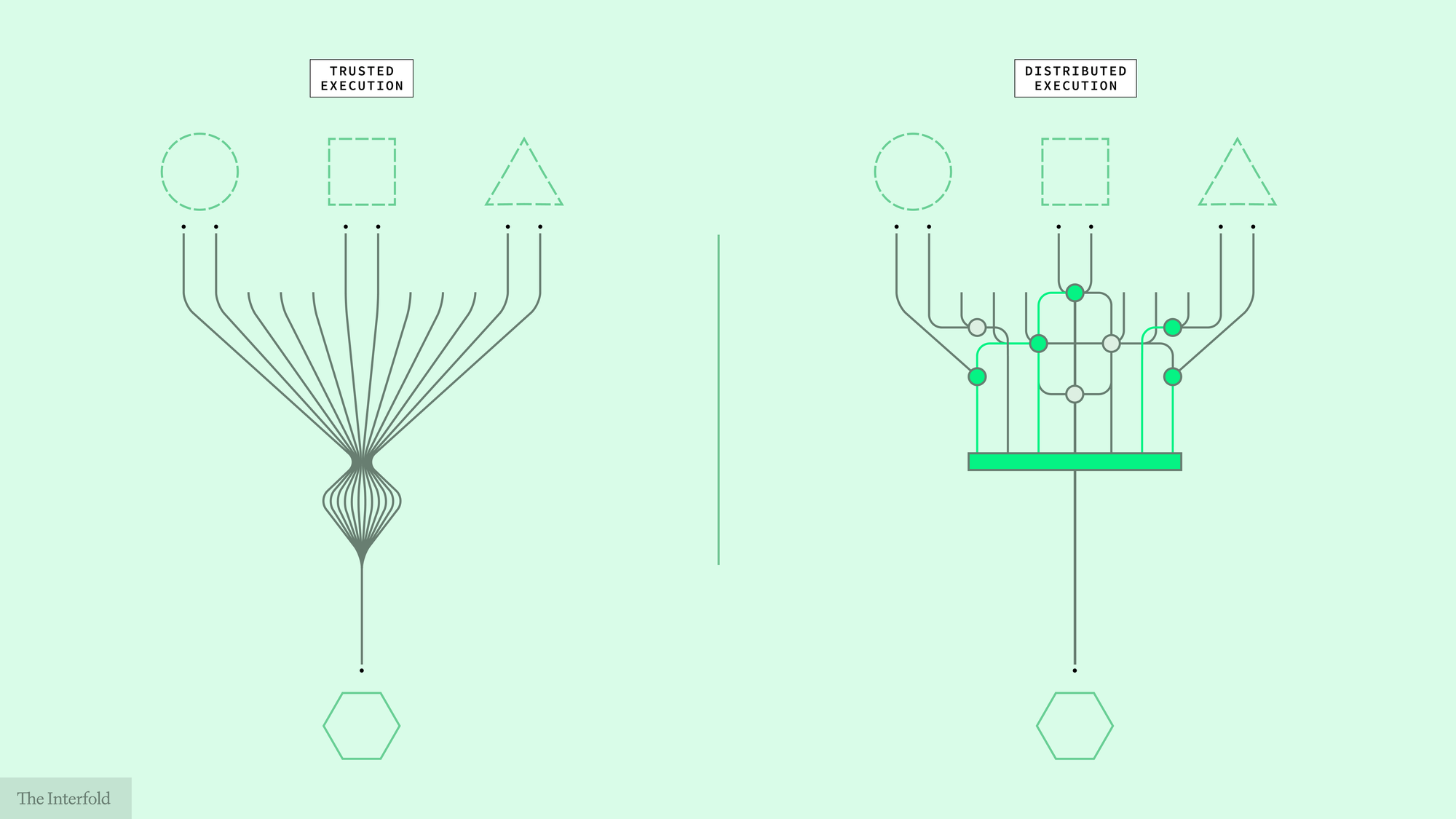


The core concept of The Interfold is E3 (Encrypted Execution Environment). Its principle is: computation tasks are assigned to a distributed network of 'Ciphernodes': user input always remains encrypted, computations are performed directly on ciphertext, and finally, only the aggregated result is decrypted and made public. No party can see anyone else's original data throughout the entire process.
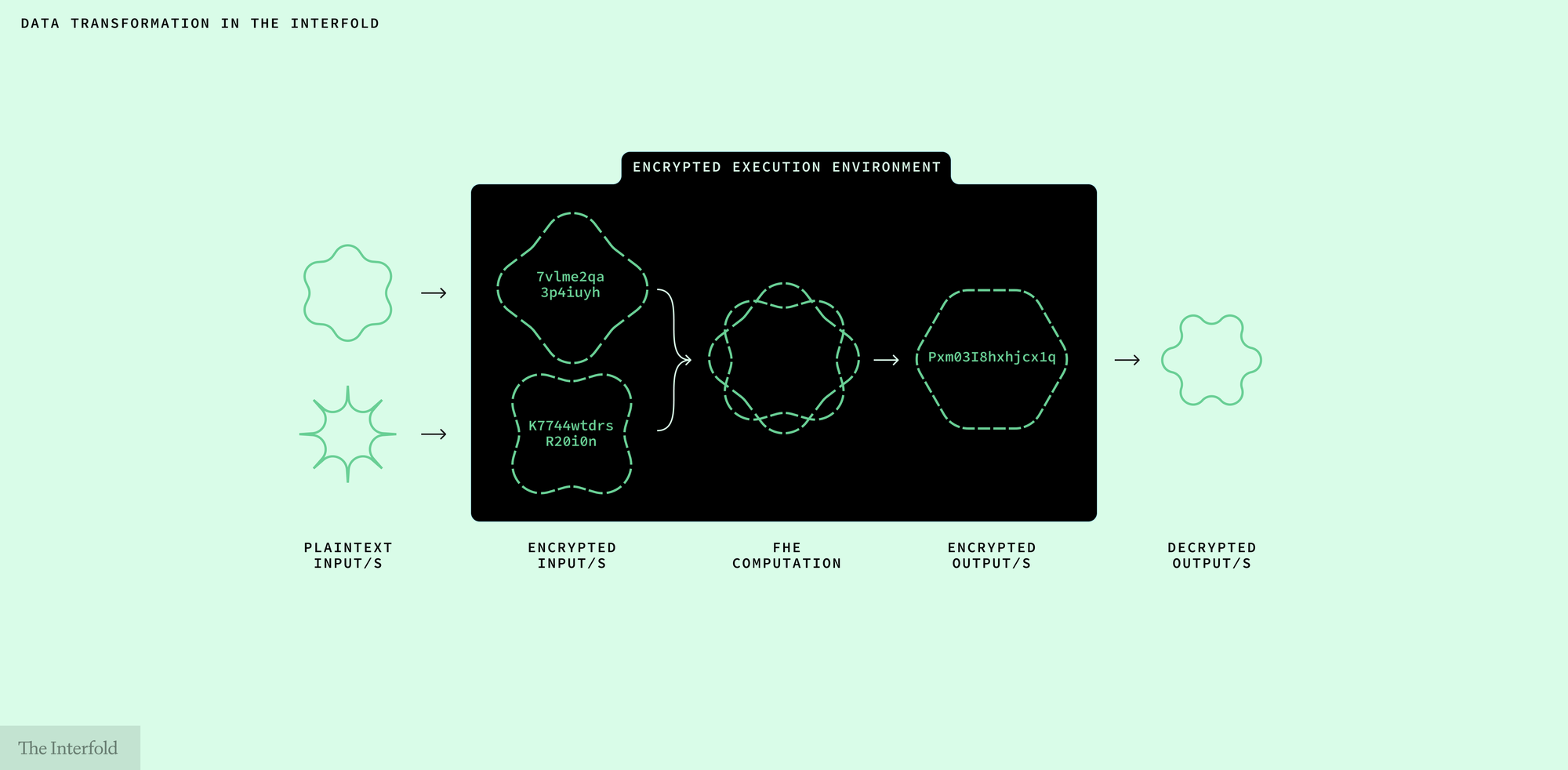


The technology stack supporting this mechanism consists of three layers: FHE (Fully Homomorphic Encryption) allows computations directly on encrypted data; ZK proofs (Zero-Knowledge proofs) verify whether the computation process itself was executed honestly; and DTC (Decentralized Threshold Cryptography) distributes decryption authority across multiple nodes, eliminating single points of trust.


The Interfold's currently promoted application scenario is CRISP (Coercion-Resistant Impartial Selection Protocol), designed for voting scenarios within DAO governance. CRISP achieves three things: the entire voting process is encrypted, and no one can view individual votes before the tally; 'receipt-free voting,' where users cannot prove to a third party how they voted, fundamentally cutting off bribery paths; and ZK proofs ensure the verifiability of tally results.


Two demo versions of CRISP are already live, with the team currently in the system integration and internal testnet validation phase. Confirmed ecosystem partnerships include: Zcash community's private governance tool Zecret Ballots, mobile DAO governance application Goverland, and joint integrations with Aragon and Status App.


Vitalik's Public Endorsement


On-chain governance bribery is not a new problem, but its measurable scale has rapidly expanded since 2024. Within the Curve ecosystem alone, the total value of bribes flowing through platforms like Votium exceeded $120 million in 2024; meanwhile, the median voter participation rate for various DAO proposals remains in the single digits.


The Ethereum community has not been unaware of this issue. In 2019, Vitalik posted a research note on ethresear.ch, proposing the conceptual framework of MACI (Minimal Anti-Collusion Infrastructure), envisioning the use of cryptographic means to eliminate voting bribery. This post has since been frequently cited, but practical implementation progress has been limited—the MACI scheme relies on a trusted 'Coordinator' role, who can see all votes. Once data is leaked, privacy guarantees immediately fail.


On May 28th, 2026, Vitalik publicly endorsed The Interfold on the X platform, stating: 'It basically is the thing I've been yelling for almost a decade for someone to build, and it's now built in a generalized way.'


The Interfold's core bet is: a single trusted coordinator is the fundamental bottleneck of MACI, and distributed threshold decryption is the correct path.


Team Background


The Interfold is developed by Gnosis Guild, a team with long-term expertise in Ethereum DAO infrastructure, previously well-known for its modular DAO toolset Zodiac. Zodiac is one of the most widely used permission and execution frameworks in the Ethereum DAO ecosystem, with partners covering several leading protocols. Specific core member names have not been publicly disclosed through official channels. The project also has no publicly disclosed institutional funding records.


Compared to larger-scale general-purpose privacy protocols like Aztec and Zama, The Interfold is a 'small but beautiful' project. It does not attempt to become a general-purpose privacy infrastructure; instead, it focuses on a specific, long-unresolved problem—making on-chain votes truly un-purchasable. The ambition may not be vast, but the target is precise.


From MACI to The Interfold


The conceptual framework of MACI (Minimal Anti-Collusion Infrastructure), proposed by Vitalik in 2019, has seen deployment in scenarios like Gitcoin but always had a structural flaw: it required a trusted coordinator, and if its private key were leaked, the entire privacy guarantee would fail. The Interfold is a generalized implementation of this framework—replacing a single coordinator with a distributed network of Ciphernodes, turning 'trust in a person' into 'trust in cryptography.'

Трендові криптовалюти

Пов'язані питання

QWhat is the main problem in DAO governance that The Interfold aims to solve?

AThe Interfold aims to solve the problem of governance bribery in DAO voting, where individuals or entities with sufficient funds can directly 'bribe' voters to sway decisions, undermining true community consensus.

QWhat is the core technological concept of The Interfold, and what does it stand for?

AThe core technological concept of The Interfold is the E3, or Encrypted Execution Environment. It enables a distributed network of 'Ciphernodes' to perform computations directly on encrypted user data, with only the final aggregated result being decrypted and revealed.

QAccording to the article, what is the key difference between The Interfold's approach and the earlier MACI framework proposed by Vitalik Buterin?

AThe key difference is that the original MACI framework relied on a single trusted 'coordinator' who could see all votes, creating a privacy vulnerability. The Interfold replaces this single point of trust with a distributed network of nodes using threshold cryptography.

QWhat are the primary uses of the FOLD token within The Interfold ecosystem?

AThe FOLD token has three primary uses: 1) For Ciphernodes to stake and join the network to earn rewards. 2) For applications to pay for encrypted computation requests. 3) For holders to participate in protocol governance.

QWhat major public endorsement did The Interfold receive, and who gave it?

AVitalik Buterin publicly endorsed The Interfold on the X platform on May 28, 2026, stating, 'It's basically the thing I've been shouting for almost a decade that someone should build, and it's now implemented in a general form.'

Пов'язані матеріали

SemiAnalysis: Anthropic's Q3 Profit to Exceed $1 Billion

Research firm SemiAnalysis reveals that Anthropic is reshaping the AI commercialization landscape with profitability and growth rates far exceeding competitors. Leveraging a high-margin, API-centric business model, Anthropic has become a leader in the B2B AI market. The report projects that Anthropic will achieve a GAAP EBIT of $1 billion in Q3 2026, with a 6% margin. Its Annual Recurring Revenue (ARR) has surged from $9 billion at the end of 2025 to over $60 billion currently. If it maintains a Net New ARR (NNARR) of approximately $15 billion per month, its ARR could reach $300 billion by the end of 2027, implying a $6 trillion enterprise value and making it the world's most valuable company. Anthropic secretly filed for an IPO on June 1st. SemiAnalysis argues the timing is strategically urgent due to narrowing capital market windows as rivals like Alphabet and Meta secure major funding. The superior financials and business model suggest Anthropic should go public before OpenAI to seize the competitive initiative. The performance inflection stems from the explosive adoption of Claude Code, which now accounts for over 7% of all GitHub commits, driving monthly NNARR from $3 billion in January to $11 billion in March. Anthropic's revenue structure differs significantly from OpenAI's. Approximately 75-85% of Anthropic's ARR comes from usage-based API fees, with consumer subscriptions constituting only about 5%. In contrast, over 65% of OpenAI's Q1 2026 revenue was from subscriptions, with ~40% from consumers. The API model's key advantage is no per-user revenue cap, enabling growth within existing accounts. Anthropic's Net Revenue Retention (NRR) is an extraordinary 500%. This drives superior gross margins, now in the mid-60% range versus -94% in 2024, with API margins exceeding 80%. Core drivers are improved inference efficiency and a largely enterprise-focused model without the cost of serving hundreds of millions of free users. The report introduces "EBTIT" (Earnings Before Training & Interest & Taxes) to measure re-investment capacity, projecting Anthropic's cumulative EBTIT through 2028 will be $250 billion higher than OpenAI's. Over 65% of lab ARR currently comes from programming use cases. Cybersecurity is seen as the next major vertical, with upcoming model releases like Fable expected to further increase token pricing and expand NNARR. Indirect sales via hyperscaler platforms (AWS Bedrock, Azure Foundry) now account for 15-20% of ARR. A core constraint is compute supply. By 2030, combined unconstrained compute demand from Anthropic and OpenAI could exceed 100 GW, far outstripping projected new capacity. IPO proceeds are seen as crucial to lock in future compute resources. Key risks include potential price cuts by OpenAI, competitive pressure from Google DeepMind and Meta in coding models, potential government restrictions on frontier model releases, and margin dilution from growing indirect "Token-as-a-Service" sales. Regulatory actions that narrow the capability gap between open-source and proprietary models are highlighted as a fundamental threat to Anthropic's moat.

marsbit9 хв тому

SemiAnalysis: Anthropic's Q3 Profit to Exceed $1 Billion

marsbit9 хв тому

Торгівля

Спот

Популярні статті

Як купити AUCTION

Ласкаво просимо до HTX.com! Ми зробили покупку Auction (AUCTION) простою та зручною. Дотримуйтесь нашої покрокової інструкції, щоб розпочати свою криптовалютну подорож.Крок 1: Створіть обліковий запис на HTXВикористовуйте свою електронну пошту або номер телефону, щоб зареєструвати обліковий запис на HTX безплатно. Пройдіть безпроблемну реєстрацію й отримайте доступ до всіх функцій.ЗареєструватисьКрок 2: Перейдіть до розділу Купити крипту і виберіть спосіб оплатиКредитна/дебетова картка: використовуйте вашу картку Visa або Mastercard, щоб миттєво купити Auction (AUCTION).Баланс: використовуйте кошти з балансу вашого рахунку HTX для безперешкодної торгівлі.Треті особи: ми додали популярні способи оплати, такі як Google Pay та Apple Pay, щоб підвищити зручність.P2P: Торгуйте безпосередньо з іншими користувачами на HTX.Позабіржова торгівля (OTC): ми пропонуємо індивідуальні послуги та конкурентні обмінні курси для трейдерів.Крок 3: Зберігайте свої Auction (AUCTION)Після придбання Auction (AUCTION) збережіть його у своєму обліковому записі на HTX. Крім того, ви можете відправити його в інше місце за допомогою блокчейн-переказу або використовувати його для торгівлі іншими криптовалютами.Крок 4: Торгівля Auction (AUCTION)Легко торгуйте Auction (AUCTION) на спотовому ринку HTX. Просто увійдіть до свого облікового запису, виберіть торгову пару, укладайте угоди та спостерігайте за ними в режимі реального часу. Ми пропонуємо зручний досвід як для початківців, так і для досвідчених трейдерів.

187 переглядів усьогоОпубліковано 2024.12.12Оновлено 2026.06.02

Як купити AUCTION

Обговорення

Ласкаво просимо до спільноти HTX. Тут ви можете бути в курсі останніх подій розвитку платформи та отримати доступ до професійної ринкової інформації. Нижче представлені думки користувачів щодо ціни AUCTION (AUCTION).

活动图片