Tiger Research: If I Were the Founder of Kaito, How Would I Make Decisions in the Face of InfoFi's Upheaval?

marsbitОпубліковано о 2026-01-20Востаннє оновлено о 2026-01-20

Анотація

Tiger Research analyzes the collapse of the InfoFi ecosystem following X platform's abrupt API policy change, which banned apps incentivizing posts with rewards. Within three days, major projects like Kaito faced existential threats, revealing the structural vulnerability of Web3 projects over-reliant on centralized platforms. The report outlines five potential survival strategies for InfoFi projects: 1) Shutting down entirely; 2) Pivoting to a bounty-based funding platform with manual review (e.g., Scribble); 3) Adopting a Korean-style sponsored blog model with pre-selected creators; 4) Expanding to multiple platforms (e.g., YouTube, TikTok) to diversify risk; or 5) Evolving into a data-driven MCN-style management agency for KOLs. The future of the sector, termed InfoFi 2.0, is predicted to be smaller, more controlled, and quality-focused, shifting from permissionless scaling to curated, professional networks. However, fundamental challenges remain: designing fair incentive structures to prevent low-quality content and proving the intrinsic value of InfoFi tokens beyond speculative narratives. The path forward requires aligning project sustainability with tokenholder利益.

This report is written by Tiger Research. The drastic changes in X platform's API policy have led to the instantaneous collapse of the InfoFi ecosystem. As a leading project in the industry, if I were the founder of Kaito, what viable transformation paths are available at this juncture?

Core Insights

  • Ecosystem Collapse in Three Days: X platform's policy adjustments destroyed the InfoFi ecosystem in just three days, fully exposing the structural fragility of Web3 projects' over-reliance on centralized platforms.
  • Five Survival Paths: InfoFi projects currently face five choices: complete shutdown, transformation into a bounty funding platform, adoption of a Korean-style sponsorship model, multi-platform expansion, or evolution into a KOL management model akin to an MCN.
  • Evolution of InfoFi 2.0: The future model will be more refined and controllable, shifting from "permissionless scaling" to "curated high-quality collaboration."
  • Fundamental Challenge: Establishing a fair incentive compensation system and re-proving the intrinsic value of tokens remain chasms the industry must cross.

1. The "Collapse" of InfoFi in Three Days
Source: X(@nikitabier)

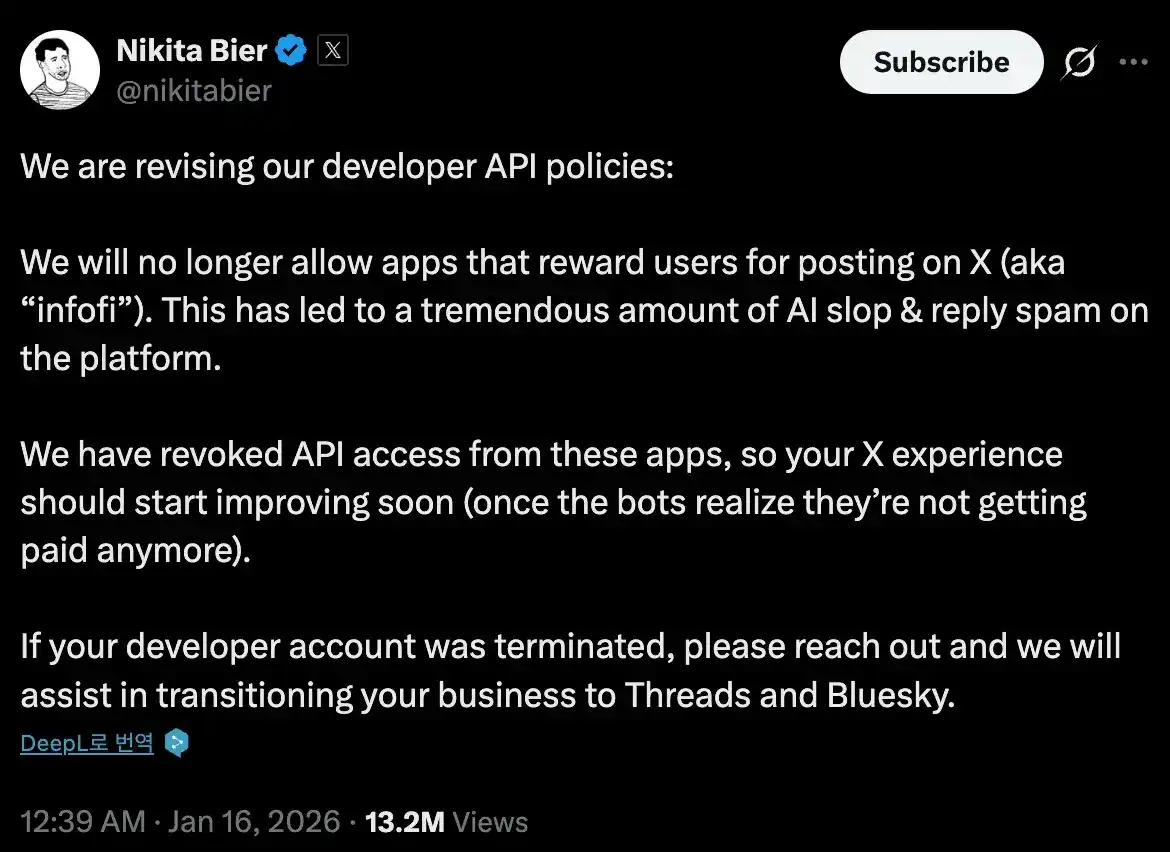
On January 15th, X platform's Product Lead, Nikita Bier, published a brief announcement stating that applications incentivizing user posts with rewards would no longer be permitted to operate on the platform. For the InfoFi sector, this was tantamount to a "death sentence."

According to the timeline disclosed by Kaito founder Yu Hu, the events unfolded as follows:

  • January 13th: Kaito received an email from X platform hinting at a potential review and requesting clarification.
  • January 14th: X platform sent a formal legal notice, to which Kaito submitted a legal response the same day.
  • January 15th: The official statement was publicly released, and Kaito, along with the entire industry, learned of the final decision simultaneously.

The market reaction was extremely severe, with the $KAITO price plummeting. The community accused the team of failing to provide an early warning, despite claiming to have contingency plans. Kaito subsequently issued an emergency statement explaining that they had previously resolved similar disputes through legal channels multiple times, leading to a misjudgment of the negotiation room in this incident.

Lesson: A single decision by a centralized company ended an emerging Web3 category in just three days. This reality, where the "power of life and death" lies in the hands of others, is suffocating the entire ecosystem.

2. If I Were an InfoFi Founder Now

Does this mean InfoFi has reached a dead end? Projects like Kaito are already preparing their next development plans. However, what is needed now is not a continuation of the old path but a completely different "InfoFi 2.0" version.

If I were the founder of an InfoFi project like Kaito, what practical choices are actually available now? By examining these potential forward paths, we can begin to outline the contours of InfoFi's next phase.

2.1 Complete Shutdown

This is the simplest and most direct option: cease operations before funds are completely exhausted. In reality, many small and medium-sized projects may enter a "zombie phase"—largely inactive, occasionally posting some social media updates, and gradually fading from public view.

Since the previously established "Product-Market Fit" (PMF) around the X platform has now vanished, choosing to shut down might be more realistic than continuously burning cash in search of an elusive new direction. If the project still holds usable data assets, these could be sold to other companies to recover some residual value. Therefore, most smaller InfoFi projects will likely choose this path.

2.2 Bounty-Based Funding Platform

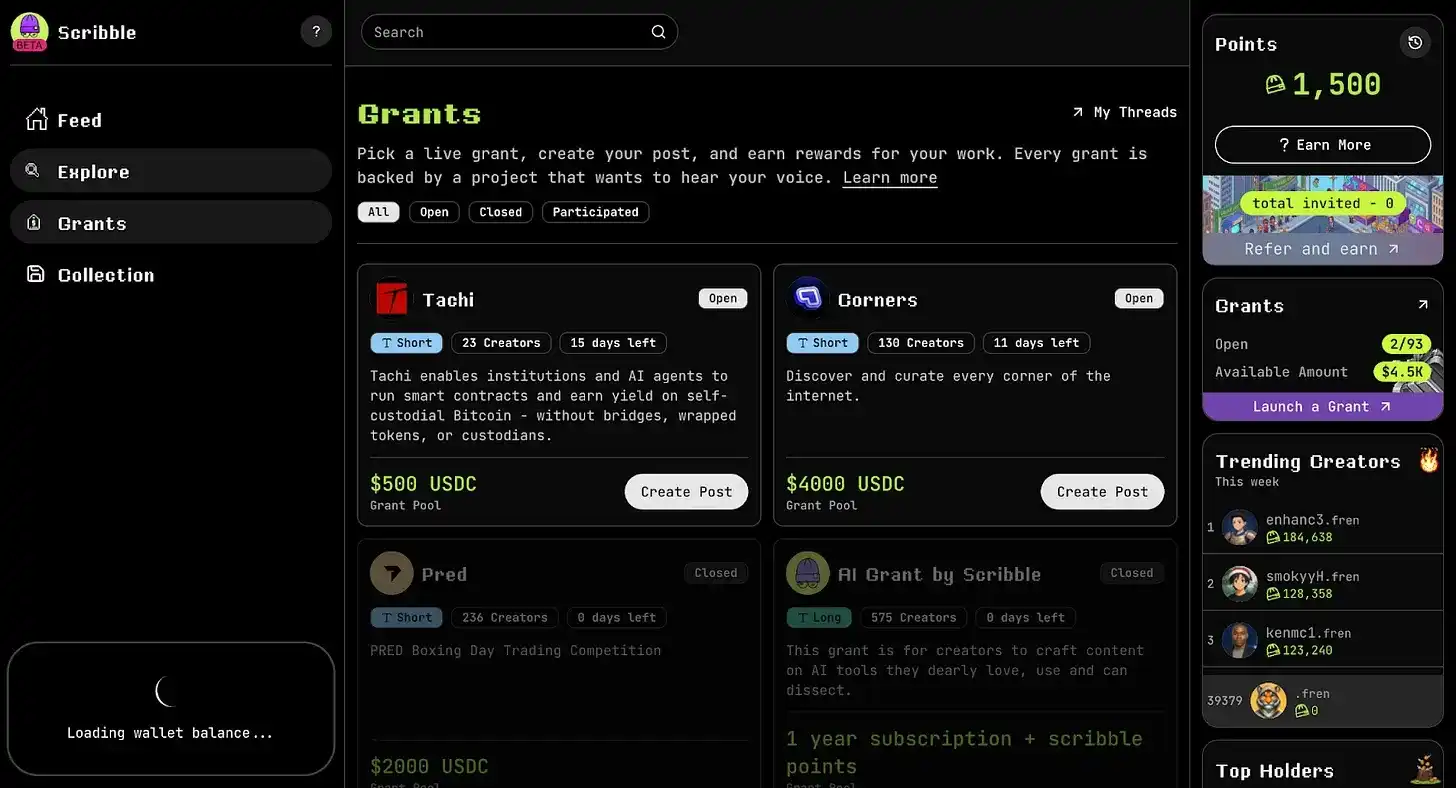
If access to X's API is no longer possible, another option is to revert to an earlier business model: KOLs directly apply for relevant activities, submit content for manual review, and receive rewards upon approval.
Source: Scribble

The model represented by Scribble is a typical example. Project parties post funding tasks in the form of bounties, KOLs create and submit content for platform review, and receive payment upon approval. This is a "submit first, review later" model, rather than relying on real-time API tracking.

This structure can be scaled as an open platform: the platform merely provides matching intermediation and infrastructure, while individual project parties manage their own campaigns. As more projects participate, the KOL pool expands accordingly; the growth of the KOL base, in turn, offers more choices for project parties. The drawback is the significant uncertainty for KOLs—if submitted content is rejected, the time and effort invested are wasted. After multiple failures, high-quality KOLs are likely to leave the platform.

2.3 Korean-Style Sponsored Blog Model
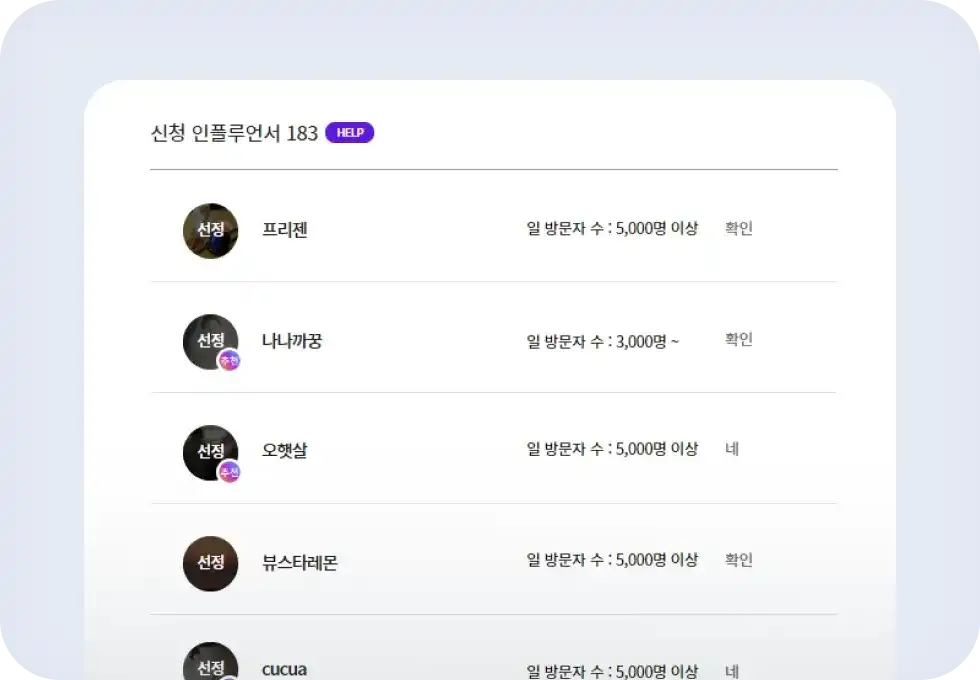
The Korean sponsored blog model follows a "select first, manage later" approach, rather than post-hoc review. Agencies like Revu have used this model for over a decade.

The process is very clear: the project party sets the target number of participants and launches a campaign, applicants submit their applications, and the project party selects suitable KOLs based on data like follower count and past performance. Selected KOLs receive clear creation guidelines, and after content is published, it is reviewed by operational staff. If it doesn't meet standards, revisions are requested; if deadlines are missed, corresponding penalties are applied.

In this model, KOLs can effectively avoid futile efforts. Once selected,报酬 is basically guaranteed as long as guidelines are followed. Unlike bounty-based systems, there is no risk of completing work only to be unreasonably rejected. From the project party's perspective, quality control becomes easier since only pre-vetted participants are chosen.

2.4 Multi-Platform Expansion

If X platform is no longer fertile ground, the next choice is inevitably to pivot to YouTube, TikTok, and Instagram. In the Web3 space, there is already a strong push to move beyond the X platform. The prevailing view is that real growth requires shifting from platforms dominated by crypto-native users to mainstream channels with a broader audience.

The main advantage of this path is a much larger potential user base than X platform, especially in emerging markets like Southeast Asia and Latin America, where TikTok and Instagram hold significant influence. Additionally, each platform runs on different algorithms, so even if one channel is restricted, overall operations can continue.

However, the trade-off is a dramatic increase in operational complexity. On X platform, reviewing text-based posts was usually sufficient; on YouTube, content length and production quality are paramount; on TikTok, the first three seconds of a video determine its performance; and on Instagram, the execution of Stories and format quality must be evaluated. This requires platform-specific expertise and may necessitate developing entirely new internal tools. Given the vastly different API policies and data collection methods across platforms, this is practically equivalent to rebuilding the entire project from scratch. Furthermore, policy risks still loom—any platform could change its rules abruptly, just like X did. However, dispersing activities across multiple platforms does significantly reduce reliance on any single one and is the only option that offers substantive scalability for larger projects.

2.5 MCN-Style KOL Management

In the Web2 MCN (Multi-Channel Network) model, the brand value of KOLs is crucial. In Web3, this influence is even more decisive: narratives drive capital, and a single comment from an opinion leader can directly impact token prices.

Successful InfoFi projects have typically cultivated an active and highly loyal group of KOLs, creators who have grown through months of deep engagement on the platform. The project party could retain this group and pivot them towards a data-driven management model, rather than starting from scratch to find creators. This differs from traditional Web2 MCNs that rely on continuously discovering new talent.

An MCN-style structure implies establishing formal contractual relationships, rather than loose, selective participation. With accumulated historical data and established relationships, the platform can wield stronger influence within the Web3 ecosystem and negotiate better business deals. For InfoFi projects, this requires a robust management system, with data becoming the core asset. If KOLs can be precisely guided through data, and project parties are provided with professional, data-driven GTM (Go-To-Market) strategies, this model will offer a lasting competitive advantage.

3. InfoFi 2.0

This collapse of the InfoFi ecosystem has left two profound lessons for the Web3 world:

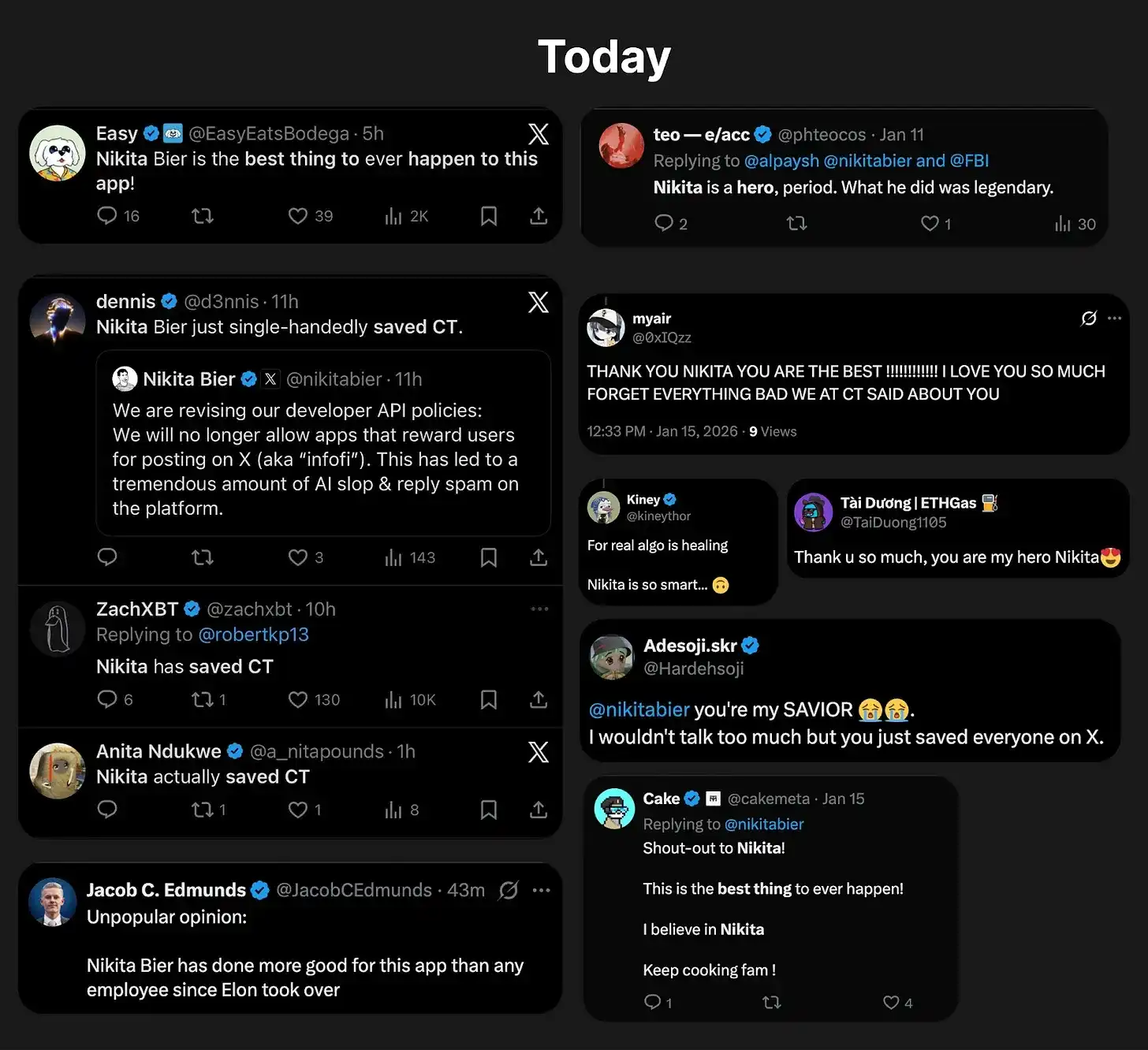
  1. The Irony of Decentralization: Many Web3 projects were deeply dependent on the centralized X platform, and a single decision by X was enough to destroy the entire system.
  2. The Limitations of Incentive Design: Reward mechanisms successfully attracted a large number of participants but lacked effective methods to control content quality. The flood of spam content gave X platform a clear reason to intervene.
Source: X(@nikitabier)

Does this mean the road for InfoFi has come to an end?

Not entirely. A minority of projects that found "Product-Market Fit" might survive by altering their business form. They could pivot to multi-platform expansion, curate premium campaigns, or transform into MCN-style management.

InfoFi 2.0 will likely become smaller in scale, more controllable, and more focused on content quality. It will shift from an open, permissionless platform to a rigorously vetted professional network, its form more closely resembling an integrated marketing platform that combines native GTM efforts and components like offline advertising.

However, fundamental questions remain on the table. Joel Mun from Tiger Research House points out: once incentive mechanisms are introduced, participants inevitably find ways to exploit system loopholes, making fair incentive structures extremely difficult to design. This speculative behavior leads to low-quality content and creates a negative feedback loop that can破坏 the platform.

Furthermore, researcher David raises a more essential question: he believes that the value maintenance of InfoFi tokens in the past relied more on staking airdrop expectations and belief in a certain narrative, rather than the platform's actual performance. Now, both have lost relevance. This leads to a direct question: why should investors buy InfoFi tokens in the future?

For InfoFi 2.0 to truly survive, these questions must be answered clearly and convincingly. If a project cannot align its interests with those of its token holders, it cannot achieve genuine sustainable development.

Original article link

Пов'язані питання

QWhat was the immediate impact of X platform's API policy change on the InfoFi ecosystem, according to the article?

AThe policy change led to the instantaneous collapse of the InfoFi ecosystem within three days, completely exposing the structural vulnerability of Web3 projects that are overly reliant on a centralized platform.

QWhat are the five potential survival paths outlined for an InfoFi project like Kaito after the policy change?

AThe five paths are: 1. Complete shutdown, 2. Transitioning to a bounty-based funding platform, 3. Adopting a Korean-style sponsored blog model, 4. Expanding to other platforms (multi-platform expansion), and 5. Evolving into an MCN-style KOL management system.

QHow does the article describe the fundamental shift in the future model of InfoFi, referred to as 'InfoFi 2.0'?

AInfoFi 2.0 is described as becoming more refined and controllable, shifting from 'permissionless scaling' to 'curated, high-quality collaborations'. It will be smaller, more manageable, and more focused on content quality.

QWhat core challenge does the article identify regarding incentive systems in the InfoFi model?

AThe core challenge is the extreme difficulty in designing a fair incentive and compensation system. Once rewards are introduced, participants inevitably find ways to exploit the system, leading to low-quality content and negative feedback loops that can destroy the platform.

QWhat fundamental question about the value of InfoFi tokens is raised by researcher David in the article?

ADavid questions why investors would buy InfoFi tokens in the future, arguing that their value was previously maintained more by staking for airdrop expectations and belief in a narrative rather than the platform's actual performance, both of which have now lost relevance.

Пов'язані матеріали

Gensyn AI: Don't Let AI Repeat the Mistakes of the Internet

In recent months, the rapid growth of the AI industry has attracted significant talent from the crypto sector. A persistent question among researchers intersecting both fields is whether blockchain can become a foundational part of AI infrastructure. While many previous AI and Crypto projects focused on application layers (like AI Agents, on-chain reasoning, data markets, and compute rentals), few achieved viable commercial models. Gensyn differentiates itself by targeting the most critical and expensive layer of AI: model training. Gensyn aims to organize globally distributed GPU resources into an open AI training network. Developers can submit training tasks, nodes provide computational power, and the network verifies results while distributing incentives. The core issue addressed is not decentralization for its own sake, but the increasing centralization of compute power among tech giants. In the era of large models, access to GPUs (like the H100) has become a decisive bottleneck, dictating the pace of AI development. Major AI companies are heavily dependent on large cloud providers for compute resources. Gensyn's approach is significant for several reasons: 1) It operates at the core infrastructure layer (model training), the most resource-intensive and technically demanding part of the AI value chain. 2) It proposes a more open, collaborative model for compute, potentially increasing resource utilization by dynamically pooling idle GPUs, similar to early cloud computing logic. 3) Its technical moat lies in solving complex challenges like verifying training results, ensuring node honesty, and maintaining reliability in a distributed environment—making it more of a deep-tech infrastructure company. 4) It targets a validated, high-growth market with genuine demand, rather than pursuing blockchain integration without purpose. Ultimately, the boundaries between Crypto and AI are blurring. AI requires global resource coordination, incentive mechanisms, and collaborative systems—areas where crypto-native solutions excel. Gensyn represents a step toward making advanced training capabilities more accessible and collaborative, moving beyond a niche controlled by a few giants. If successful, it could evolve into a fundamental piece of AI infrastructure, where the most enduring value in the AI era is often created.

marsbit13 год тому

Gensyn AI: Don't Let AI Repeat the Mistakes of the Internet

marsbit13 год тому

Why is China's AI Developing So Fast? The Answer Lies Inside the Labs

A US researcher's visit to China's top AI labs reveals distinct cultural and organizational factors driving China's rapid AI development. While talent, data, and compute are similar to the West, Chinese labs excel through a pragmatic, execution-focused culture: less emphasis on individual stardom and conceptual debate, and more on teamwork, engineering optimization, and mastering the full tech stack. A key advantage is the integration of young students and researchers who approach model-building with fresh perspectives and low ego, prioritizing collective progress over personal credit. This contrasts with the US culture of self-promotion and "star scientist" narratives. Chinese labs also exhibit a strong "build, don't buy" mentality, preferring to develop core capabilities—like data pipelines and environments—in-house rather than relying on external services. The ecosystem feels more collaborative than tribal, with mutual respect among labs. While government support exists, its scale is unclear, and technical decisions appear driven by labs, not state mandates. Chinese companies across sectors, from platforms to consumer tech, are building their own foundational models to control their tech destiny, reflecting a broader cultural drive for technological sovereignty. Demand for AI is emerging, with spending patterns potentially mirroring cloud infrastructure more than traditional SaaS. Despite challenges like a less mature data industry and GPU shortages, Chinese labs are propelled by vast talent, rapid iteration, and deep integration with the open-source community. The competition is evolving beyond a pure model race into a contest of organizational execution, developer ecosystems, and industrial pragmatism.

marsbit14 год тому

Why is China's AI Developing So Fast? The Answer Lies Inside the Labs

marsbit14 год тому

3 Years, 5 Times: The Rebirth of a Century-Old Glass Factory

Corning, a 175-year-old glass company, is experiencing a dramatic revival as a key player in AI infrastructure, driven by surging demand for high-performance optical fiber in data centers. AI data centers require vastly more fiber than traditional ones—5 to 10 times as much per rack—to handle high-speed data transmission between GPUs. This structural demand shift, coupled with supply constraints from the lengthy expansion cycle for fiber preforms, has created a significant supply-demand gap. Nvidia has invested in Corning, along with Lumentum and Coherent, in a $4.5 billion total commitment to secure the optical supply chain for AI. Corning's competitive edge lies in its expertise in producing ultra-low-loss, high-density, and bend-resistant specialty fiber, which is critical for 800G+ and future 1.6T data rates. Its deep involvement in co-packaged optics (CPO) with partners like Nvidia further solidifies its position. While not the largest fiber manufacturer globally, Corning's revenue from enterprise/data center clients now exceeds 40% of its optical communications sales, and it has secured multi-year supply agreements with major hyperscalers including Meta and Nvidia. Financially, Corning's optical communications revenue has surged, doubling from $1.3 billion in 2023 to over $3 billion in 2025. Its stock price has risen nearly 6-fold since late 2023. Key future catalysts include the rollout of Nvidia's CPO products and the scale of undisclosed customer agreements. However, risks include high current valuations and potential disruption from next-generation technologies like hollow-core fiber. The company's long-term bet on light over electricity, maintained even through the telecom bubble crash, is now being validated by the AI boom.

marsbit15 год тому

3 Years, 5 Times: The Rebirth of a Century-Old Glass Factory

marsbit15 год тому

Торгівля

Спот
Ф'ючерси

Популярні статті

Що таке $S$

Розуміння SPERO: Комплексний огляд Вступ до SPERO Оскільки ландшафт інновацій продовжує еволюціонувати, виникнення технологій web3 та криптовалютних проектів відіграє ключову роль у формуванні цифрового майбутнього. Один з проектів, який привернув увагу в цій динамічній сфері, — це SPERO, позначений як SPERO,$$s$. Ця стаття має на меті зібрати та представити детальну інформацію про SPERO, щоб допомогти ентузіастам та інвесторам зрозуміти його основи, цілі та інновації в рамках web3 та крипто-сектору. Що таке SPERO,$$s$? SPERO,$$s$ — це унікальний проект у криптопросторі, який прагне використати принципи децентралізації та технології блокчейн для створення екосистеми, що сприяє залученню, корисності та фінансовій інклюзії. Проект розроблений для полегшення взаємодії між користувачами новими способами, надаючи їм інноваційні фінансові рішення та послуги. У своїй основі SPERO,$$s$ прагне надати можливості індивідам, забезпечуючи інструменти та платформи, які покращують користувацький досвід у криптовалютному просторі. Це включає в себе можливість більш гнучких методів транзакцій, сприяння ініціативам, що підтримуються спільнотою, та створення шляхів для фінансових можливостей через децентралізовані додатки (dApps). Основна концепція SPERO,$$s$ обертається навколо інклюзивності, прагнучи зменшити розриви в традиційній фінансовій системі, використовуючи переваги технології блокчейн. Хто є творцем SPERO,$$s$? Особистість творця SPERO,$$s$ залишається дещо невідомою, оскільки є обмежені публічно доступні ресурси, що надають детальну інформацію про його засновників. Ця відсутність прозорості може бути наслідком зобов'язання проекту до децентралізації — етики, яку багато проектів web3 поділяють, ставлячи колективні внески вище за індивідуальне визнання. Зосереджуючи обговорення навколо спільноти та її колективних цілей, SPERO,$$s$ втілює суть наділення без виділення конкретних осіб. Таким чином, розуміння етики та місії SPERO є більш важливим, ніж ідентифікація єдиного творця. Хто є інвесторами SPERO,$$s$? SPERO,$$s$ підтримується різноманітними інвесторами, починаючи від венчурних капіталістів до ангельських інвесторів, які прагнуть сприяти інноваціям у крипто-секторі. Зосередження цих інвесторів зазвичай узгоджується з місією SPERO — пріоритет надається проектам, які обіцяють технологічний прогрес у суспільстві, фінансову інклюзію та децентралізоване управління. Ці інвесторські фонди зазвичай зацікавлені в проектах, які не лише пропонують інноваційні продукти, але й позитивно впливають на спільноту блокчейн та її екосистеми. Підтримка з боку цих інвесторів підкріплює SPERO,$$s$ як значного конкурента в швидко змінюваній сфері крипто-проектів. Як працює SPERO,$$s$? SPERO,$$s$ використовує багатогранну структуру, яка відрізняє його від традиційних криптовалютних проектів. Ось деякі ключові особливості, які підкреслюють його унікальність та інноваційність: Децентралізоване управління: SPERO,$$s$ інтегрує моделі децентралізованого управління, надаючи користувачам можливість активно брати участь у процесах прийняття рішень щодо майбутнього проекту. Цей підхід сприяє відчуттю власності та відповідальності серед членів спільноти. Корисність токена: SPERO,$$s$ використовує свій власний криптовалютний токен, розроблений для виконання різних функцій в екосистемі. Ці токени дозволяють здійснювати транзакції, отримувати винагороди та полегшувати послуги, що пропонуються на платформі, підвищуючи загальну залученість та корисність. Шарова архітектура: Технічна архітектура SPERO,$$s$ підтримує модульність та масштабованість, що дозволяє безперешкодно інтегрувати додаткові функції та додатки в міру розвитку проекту. Ця адаптивність є надзвичайно важливою для збереження актуальності в постійно змінюваному крипто-ландшафті. Залучення спільноти: Проект підкреслює ініціативи, що підтримуються спільнотою, використовуючи механізми, які стимулюють співпрацю та зворотний зв'язок. Підтримуючи сильну спільноту, SPERO,$$s$ може краще задовольняти потреби користувачів та адаптуватися до ринкових тенденцій. Фокус на інклюзію: Пропонуючи низькі комісії за транзакції та зручні інтерфейси, SPERO,$$s$ прагне залучити різноманітну базу користувачів, включаючи осіб, які раніше не брали участі в крипто-просторі. Це зобов'язання до інклюзії узгоджується з його загальною місією наділення через доступність. Хронологія SPERO,$$s$ Розуміння історії проекту надає важливі уявлення про його розвиток та етапи. Нижче наведено пропоновану хронологію, що відображає значні події в еволюції SPERO,$$s$: Етап концептуалізації та ідеації: Початкові ідеї, що стали основою SPERO,$$s$, були сформовані, тісно пов'язані з принципами децентралізації та фокусом на спільноті в індустрії блокчейн. Запуск білого паперу проекту: Після концептуального етапу був випущений комплексний білий папір, що детально описує бачення, цілі та технологічну інфраструктуру SPERO,$$s$, щоб залучити інтерес та зворотний зв'язок від спільноти. Створення спільноти та ранні залучення: Активні зусилля були спрямовані на створення спільноти ранніх прихильників та потенційних інвесторів, що полегшило обговорення цілей проекту та отримання підтримки. Подія генерації токенів: SPERO,$$s$ провів подію генерації токенів (TGE) для розподілу своїх рідних токенів серед ранніх прихильників та встановлення початкової ліквідності в екосистемі. Запуск початкового dApp: Перший децентралізований додаток (dApp), пов'язаний з SPERO,$$s$, став доступним, дозволяючи користувачам взаємодіяти з основними функціями платформи. Постійний розвиток та партнерства: Безперервні оновлення та вдосконалення пропозицій проекту, включаючи стратегічні партнерства з іншими учасниками блокчейн-простору, сформували SPERO,$$s$ у конкурентоспроможного та еволюціонуючого гравця на крипто-ринку. Висновок SPERO,$$s$ є свідченням потенціалу web3 та криптовалют для революціонізації фінансових систем та наділення індивідів. Завдяки зобов'язанню до децентралізованого управління, залучення спільноти та інноваційно спроектованих функцій, він прокладає шлях до більш інклюзивного фінансового ландшафту. Як і з будь-якими інвестиціями в швидко змінюваному крипто-просторі, потенційним інвесторам та користувачам рекомендується ретельно досліджувати та обдумано взаємодіяти з поточними подіями в SPERO,$$s$. Проект демонструє інноваційний дух крипто-індустрії, запрошуючи до подальшого дослідження його численних можливостей. Хоча подорож SPERO,$$s$ ще триває, його основні принципи можуть справді вплинути на майбутнє того, як ми взаємодіємо з технологією, фінансами та один з одним у взаємопов'язаних цифрових екосистемах.

73 переглядів усьогоОпубліковано 2024.12.17Оновлено 2024.12.17

Що таке $S$

Що таке AGENT S

Агент S: Майбутнє автономної взаємодії в Web3 Вступ У постійно змінюваному ландшафті Web3 та криптовалюти інновації постійно переосмислюють, як люди взаємодіють з цифровими платформами. Один з таких новаторських проектів, Агент S, обіцяє революціонізувати взаємодію людини з комп'ютером через свою відкриту агентну структуру. Прокладаючи шлях для автономних взаємодій, Агент S прагне спростити складні завдання, пропонуючи трансформаційні застосування в штучному інтелекті (ШІ). Це детальне дослідження заглиблюється в складності проекту, його унікальні особливості та наслідки для сфери криптовалюти. Що таке Агент S? Агент S є революційною відкритою агентною структурою, спеціально розробленою для вирішення трьох основних викликів в автоматизації комп'ютерних завдань: Набуття специфічних знань у галузі: Структура інтелектуально навчається з різних зовнішніх джерел знань та внутрішнього досвіду. Цей подвійний підхід дозволяє їй створити багатий репозиторій специфічних знань у галузі, покращуючи її продуктивність у виконанні завдань. Планування на довгих горизонтах завдань: Агент S використовує планування з підкріпленням досвіду, стратегічний підхід, який полегшує ефективний розподіл та виконання складних завдань. Ця функція значно підвищує її здатність ефективно та результативно управляти кількома підзавданнями. Обробка динамічних, неоднорідних інтерфейсів: Проект представляє Інтерфейс Агент-Комп'ютер (ACI), інноваційне рішення, яке покращує взаємодію між агентами та користувачами. Використовуючи багатомодальні великі мовні моделі (MLLMs), Агент S може безперешкодно орієнтуватися та маніпулювати різноманітними графічними інтерфейсами користувача. Завдяки цим новаторським функціям Агент S надає надійну структуру, яка вирішує складнощі, пов'язані з автоматизацією людської взаємодії з машинами, прокладаючи шлях для численних застосувань у ШІ та за його межами. Хто є творцем Агент S? Хоча концепція Агент S є фундаментально новаторською, конкретна інформація про його творця залишається невідомою. Творець наразі невідомий, що підкреслює або початкову стадію проекту, або стратегічний вибір зберегти засновників у таємниці. Незважаючи на анонімність, акцент залишається на можливостях та потенціалі структури. Хто є інвесторами Агент S? Оскільки Агент S є відносно новим у криптографічній екосистемі, детальна інформація про його інвесторів та фінансових спонсорів не задокументована. Відсутність публічно доступних відомостей про інвестиційні фонди або організації, що підтримують проект, викликає питання щодо його фінансової структури та дорожньої карти розвитку. Розуміння підтримки є критично важливим для оцінки стійкості проекту та потенційного впливу на ринок. Як працює Агент S? В основі Агент S лежить передова технологія, яка дозволяє йому ефективно функціонувати в різних умовах. Його операційна модель побудована навколо кількох ключових функцій: Взаємодія з комп'ютером, подібна до людської: Структура пропонує розширене планування ШІ, прагнучи зробити взаємодії з комп'ютерами більш інтуїтивними. Імітуючи людську поведінку при виконанні завдань, вона обіцяє підвищити досвід користувачів. Наративна пам'ять: Використовується для використання високорівневого досвіду, Агент S використовує наративну пам'ять для відстеження історій завдань, тим самим покращуючи свої процеси прийняття рішень. Епізодична пам'ять: Ця функція надає користувачам покрокові інструкції, дозволяючи структурі пропонувати контекстуальну підтримку в міру виконання завдань. Підтримка OpenACI: Завдяки можливості працювати локально, Агент S дозволяє користувачам зберігати контроль над своїми взаємодіями та робочими процесами, узгоджуючи з децентралізованою етикою Web3. Легка інтеграція з зовнішніми API: Його універсальність і сумісність з різними платформами ШІ забезпечують те, що Агент S може безперешкодно вписатися в існуючі технологічні екосистеми, роблячи його привабливим вибором для розробників та організацій. Ці функціональні можливості колективно сприяють унікальному положенню Агент S у крипто-просторі, оскільки він автоматизує складні, багатоступеневі завдання з мінімальним втручанням людини. У міру розвитку проекту його потенційні застосування в Web3 можуть переосмислити, як відбуваються цифрові взаємодії. Хронологія Агент S Розробка та етапи Агент S можуть бути узагальнені в хронології, яка підкреслює його значні події: 27 вересня 2024 року: Концепція Агент S була представлена в комплексній науковій статті під назвою “Відкрита агентна структура, яка використовує комп'ютери як людина”, що демонструє основи проекту. 10 жовтня 2024 року: Наукова стаття була опублікована на arXiv, пропонуючи детальне дослідження структури та її оцінки продуктивності на основі бенчмарку OSWorld. 12 жовтня 2024 року: Було випущено відеопрезентацію, що надає візуальне уявлення про можливості та особливості Агент S, ще більше залучаючи потенційних користувачів та інвесторів. Ці маркери в хронології не лише ілюструють прогрес Агент S, але й вказують на його прихильність до прозорості та залучення громади. Ключові моменти про Агент S У міру розвитку структури Агент S кілька ключових характеристик виділяються, підкреслюючи її новаторський характер та потенціал: Інноваційна структура: Розроблена для забезпечення інтуїтивного використання комп'ютерів, подібного до людської взаємодії, Агент S пропонує новий підхід до автоматизації завдань. Автономна взаємодія: Здатність автономно взаємодіяти з комп'ютерами через GUI означає стрибок до більш інтелектуальних та ефективних обчислювальних рішень. Автоматизація складних завдань: Завдяки своїй надійній методології він може автоматизувати складні, багатоступеневі завдання, роблячи процеси швидшими та менш схильними до помилок. Безперервне вдосконалення: Механізми навчання дозволяють Агенту S покращуватися на основі минулого досвіду, постійно підвищуючи свою продуктивність та ефективність. Універсальність: Його адаптивність до різних операційних середовищ, таких як OSWorld та WindowsAgentArena, забезпечує його здатність служити широкому спектру застосувань. Оскільки Агент S займає своє місце в ландшафті Web3 та криптовалюти, його потенціал покращити можливості взаємодії та автоматизувати процеси означає значний прогрес у технологіях ШІ. Завдяки своїй інноваційній структурі Агент S є прикладом майбутнього цифрових взаємодій, обіцяючи більш безперешкодний та ефективний досвід для користувачів у різних галузях. Висновок Агент S представляє собою сміливий крок вперед у поєднанні ШІ та Web3, з можливістю переосмислити, як ми взаємодіємо з технологією. Хоча проект все ще на ранніх стадіях, можливості для його застосування є величезними та переконливими. Завдяки своїй комплексній структурі, що вирішує критичні виклики, Агент S прагне вивести автономні взаємодії на передній план цифрового досвіду. У міру того, як ми заглиблюємося в сфери криптовалюти та децентралізації, проекти, подібні до Агент S, безсумнівно, відіграватимуть ключову роль у формуванні майбутнього технологій та співпраці людини з комп'ютером.

618 переглядів усьогоОпубліковано 2025.01.14Оновлено 2025.01.14

Що таке AGENT S

Як купити S

Ласкаво просимо до HTX.com! Ми зробили покупку Sonic (S) простою та зручною. Дотримуйтесь нашої покрокової інструкції, щоб розпочати свою криптовалютну подорож.Крок 1: Створіть обліковий запис на HTXВикористовуйте свою електронну пошту або номер телефону, щоб зареєструвати обліковий запис на HTX безплатно. Пройдіть безпроблемну реєстрацію й отримайте доступ до всіх функцій.ЗареєструватисьКрок 2: Перейдіть до розділу Купити крипту і виберіть спосіб оплатиКредитна/дебетова картка: використовуйте вашу картку Visa або Mastercard, щоб миттєво купити Sonic (S).Баланс: використовуйте кошти з балансу вашого рахунку HTX для безперешкодної торгівлі.Треті особи: ми додали популярні способи оплати, такі як Google Pay та Apple Pay, щоб підвищити зручність.P2P: Торгуйте безпосередньо з іншими користувачами на HTX.Позабіржова торгівля (OTC): ми пропонуємо індивідуальні послуги та конкурентні обмінні курси для трейдерів.Крок 3: Зберігайте свої Sonic (S)Після придбання Sonic (S) збережіть його у своєму обліковому записі на HTX. Крім того, ви можете відправити його в інше місце за допомогою блокчейн-переказу або використовувати його для торгівлі іншими криптовалютами.Крок 4: Торгівля Sonic (S)Легко торгуйте Sonic (S) на спотовому ринку HTX. Просто увійдіть до свого облікового запису, виберіть торгову пару, укладайте угоди та спостерігайте за ними в режимі реального часу. Ми пропонуємо зручний досвід як для початківців, так і для досвідчених трейдерів.

1.4k переглядів усьогоОпубліковано 2025.01.15Оновлено 2025.03.21

Як купити S

Обговорення

Ласкаво просимо до спільноти HTX. Тут ви можете бути в курсі останніх подій розвитку платформи та отримати доступ до професійної ринкової інформації. Нижче представлені думки користувачів щодо ціни S (S).

活动图片