Tiger Research: How Is This Crypto Winter Different?

marsbitОпубліковано о 2026-02-04Востаннє оновлено о 2026-02-04

Анотація

Tiger Research analyzes the distinct nature of the current crypto market downturn, arguing it differs fundamentally from past "crypto winters." Previous cycles were triggered by internal industry crises—the Mt. Gox hack, ICO scams, and the FTX collapse—which shattered trust and drove talent away. In contrast, the recent market movement is driven by external factors: the approval of Bitcoin ETFs fueled the bull run, while tariff policies and interest rate shifts caused the decline. Post-regulation, the market has fragmented into three layers: a compliant zone (e.g., tokenized RWA, regulated exchanges), a non-compliant zone (speculative, experimental apps), and shared infrastructure (e.g., stablecoins, oracles). Capital no longer flows between these layers as before; ETF inflows remain largely confined to Bitcoin within the compliant zone and do not trickle down to altcoins. For the next bull market to emerge, two conditions are necessary: a new killer application must originate from the non-compliant zone (similar to how DeFi summer began), and the macro environment must become supportive (e.g., with lower interest rates). The era of a unified "crypto season" where all assets rally together is likely over due to this market segmentation.

Author: Ryan Yoon

Compiled by: Deep Tide TechFlow

Deep Tide Introduction: As the market enters a downward cycle, skepticism towards the crypto market is growing. Tiger Research believes this time is different from the past: previous winters were triggered by internal issues (Mt. Gox hack, ICO scams, FTX collapse), while this cycle's rise and fall are both driven by external factors (ETF approval brought the bull market, tariff policies and interest rates caused the decline).

Post-regulation, the market has split into three layers: the compliant zone, the non-compliant zone, and shared infrastructure. Capital no longer flows via 'trickle-down' effects as it did before. ETF capital stays with Bitcoin and does not flow into altcoins.

The next bull run requires two conditions: a killer app must emerge from the non-compliant zone + a supportive macro environment.

Full text below:

As the market enters a downward cycle, skepticism towards the crypto market is growing. The question now is, have we entered a crypto winter?

Core View

  • Crypto winters follow a sequence: Major event → Collapse of trust → Talent drain
  • Past winters were caused by internal problems; the current rise and fall are driven by external factors; it is neither winter nor spring
  • Post-regulation, the market has split into three layers: Compliant zone, Non-compliant zone, Shared infrastructure; The trickle-down effect has disappeared
  • ETF capital stays with Bitcoin; it does not flow out of the compliant zone
  • The next bull run requires a killer use case + a supportive macro environment

1. How did the previous crypto winters unfold?
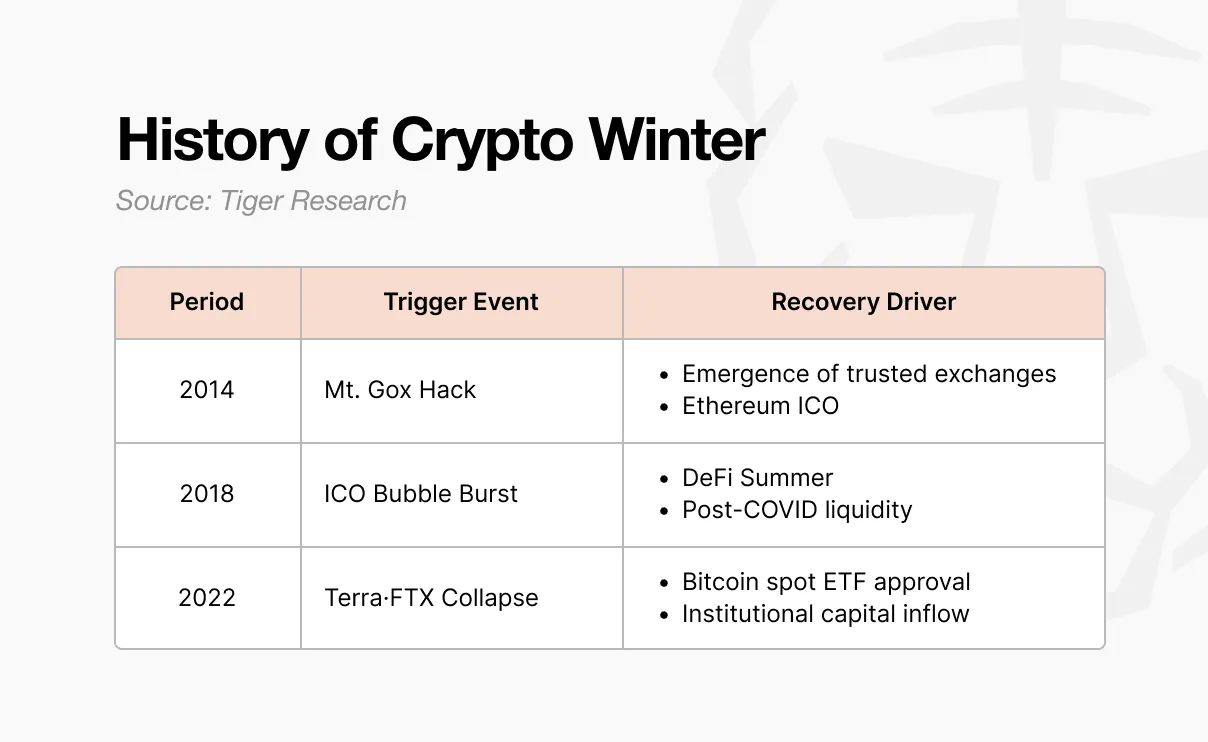
The first winter occurred in 2014. Mt. Gox was the exchange handling 70% of global Bitcoin trading volume at the time. Approximately 850,000 BTC disappeared in a hack, causing a collapse in market trust. New exchanges with internal controls and audit functions emerged, and trust began to recover. Ethereum also entered the world through ICOs, opening up new possibilities for vision and fundraising methods.

This ICO wave became the catalyst for the next bull market. When anyone could issue a token and raise funds, the 2017 boom was ignited. Projects raising billions with just a whitepaper flooded in, but most had no substance.

In 2018, regulatory measures poured out from South Korea, China, and the US, the bubble burst, and the second winter arrived. This winter did not end until 2020. Post-COVID, liquidity poured in, and DeFi protocols like Uniswap, Compound, and Aave gained attention, bringing capital back.

The third winter was the most severe. When Terra-Luna collapsed in 2022, Celsius, Three Arrows Capital, and FTX collapsed in turn. This wasn't just a simple price drop; the very structure of the industry was shaken. In January 2024, the US SEC approved the spot Bitcoin ETF, followed by the Bitcoin halving and Trump's pro-crypto policies, and capital began to flow in again.

2. The Crypto Winter Pattern: Major Event → Collapse of Trust → Talent Drain

All three winters followed the same sequence. A major event occurs, trust collapses, talent leaves.

It always starts with a major event. The Mt. Gox hack, ICO regulation, and the FTX bankruptcy following the Terra-Luna collapse. The scale and form of each event were different, but the result was the same. The entire market was thrown into shock.

Shock quickly spread into a collapse of trust. Those who had been discussing what to build next began to question whether cryptocurrency was truly meaningful technology. The collaborative atmosphere among builders disappeared, and they began to blame each other for who was responsible.

Doubt led to a talent drain. The builders who had been creating new momentum in blockchain fell into doubt. In 2014, they moved to fintech and big tech companies. In 2018, they moved to institutions and AI. They went to places that seemed more certain.

3. Is the current situation a crypto winter?

The pattern of past crypto winters is visible today.

  • Major Event:
  • Trump's tariff policies caused market turbulence
  • Shift in Federal Reserve interest rate policy
  • Overall crypto market decline
  • Collapse of Trust: Skepticism is spreading within the industry. The focus has shifted from what to build next to mutual blame.
  • Pressure of Talent Drain: The AI industry is growing rapidly. It promises faster exits and greater wealth than crypto.

However, it's hard to call this a crypto winter. Past winters erupted from within the industry. Mt. Gox was hacked, most ICO projects were exposed as scams, FTX collapsed. The industry itself lost trust.

Now it's different.

ETF approval started the bull market, tariff policies and interest rates drove the decline. External factors lifted the market, external factors also pushed it down.
Builders are not leaving either.

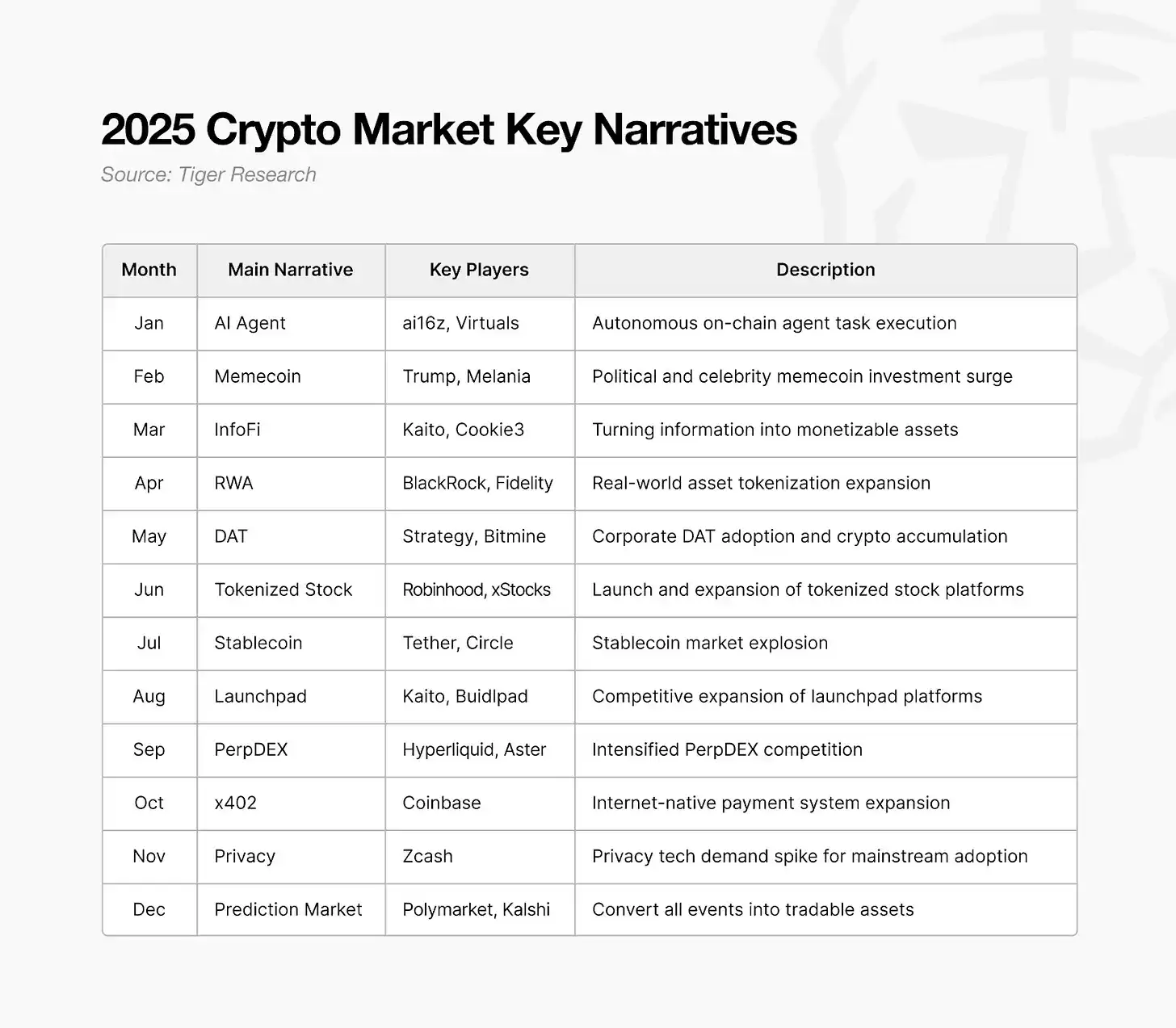
RWA, perpDEX (perpetual decentralized exchanges), prediction markets, InfoFi, privacy. New narratives keep emerging, they are still being created. They haven't pulled the entire market like DeFi did, but they haven't disappeared either. The industry hasn't collapsed; the external environment has changed.

We didn't create spring, so there is no winter.

4. Changes in Market Structure Post-Regulation

Behind this is a major shift in market structure post-regulation. The market has split into three layers: 1) The Compliant Zone, 2) The Non-Compliant Zone, and 3) Shared Infrastructure.
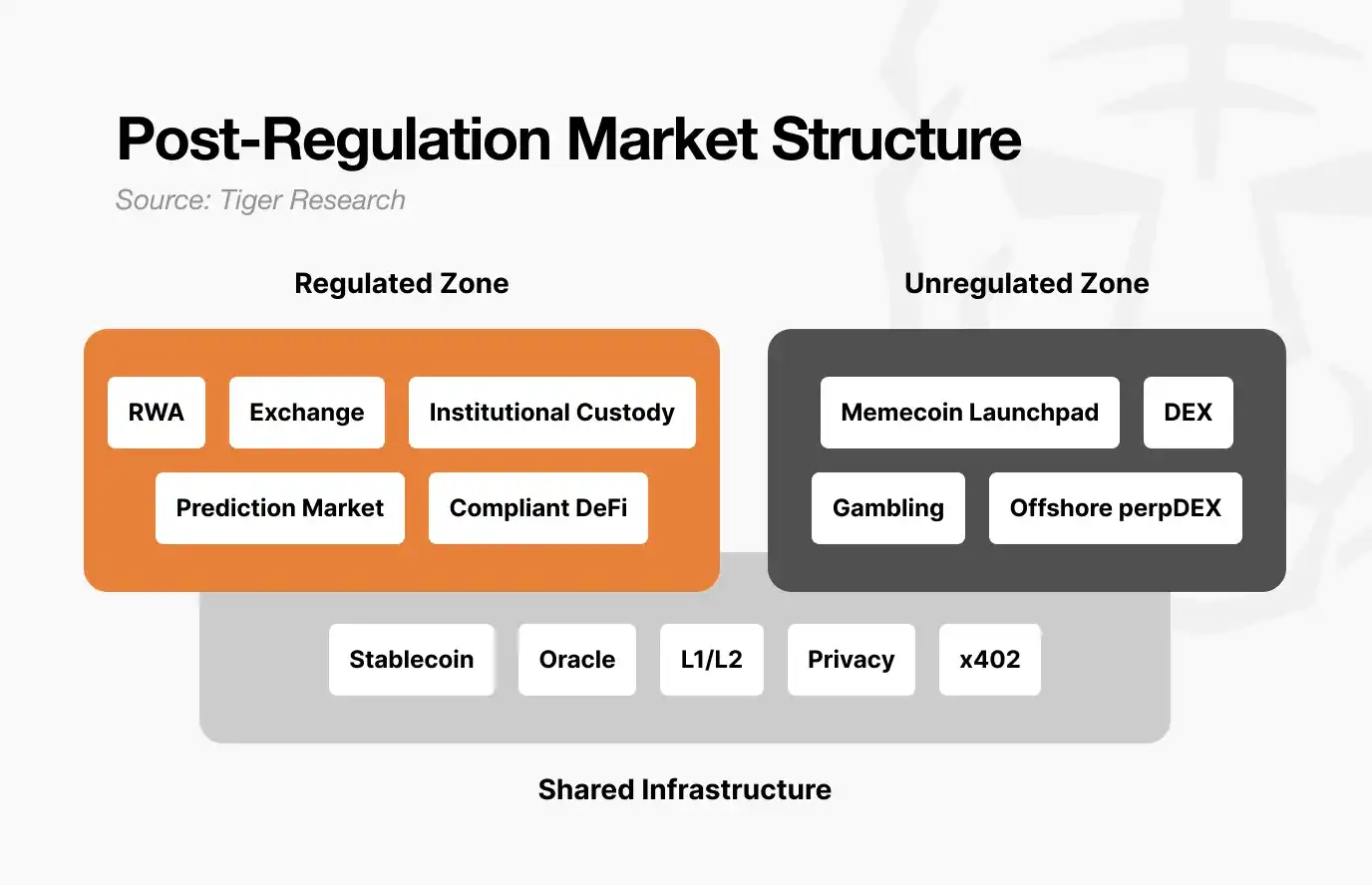
The Compliant Zone includes RWA tokenization, exchanges, institutional custody, prediction markets, and compliance-based DeFi. They undergo audits, make disclosures, and have legal protection. Growth is slow, but the capital scale is large and stable.

However, once in the compliant zone, it's hard to expect explosive returns like in the past. Volatility is lower, and potential upside is limited. But downside risk is also limited.

On the other hand, the Non-Compliant Zone will become more speculative in the future. The barrier to entry is low, and speed is fast. Scenarios of 100x in one day and -90% the next will happen more frequently.

However, this space is not meaningless. Industries born in the non-compliant zone are creative, and once validated, they move into the compliant zone. DeFi did this, prediction markets are doing it now. It acts as an experimental field. But the non-compliant zone itself will become increasingly separated from compliant zone businesses.

Shared Infrastructure includes stablecoins and oracles. They are used in both the compliant and non-compliant zones. The same USDC is used for institutional RWA payments and for Pump.fun trading. Oracles provide data for tokenized treasury validation and for anonymous DEX liquidations.

In other words, as the market splits, capital flows have also changed.

In the past, when Bitcoin rose, altcoins rose too through a trickle-down effect. Now it's different. Institutional capital entering through ETFs stays with Bitcoin, full stop. Compliant zone capital does not flow into the non-compliant zone. Liquidity only stays where value has been proven. And even Bitcoin has not yet proven its value as a safe-haven asset relative to risk assets.

5. Conditions for the Next Bull Run

Regulation is being sorted out. Builders are still building. So two things remain.

First, a new killer use case must emerge from the non-compliant zone. Something that creates value that didn't exist before, like DeFi Summer in 2020. AI agents, InfoFi, and on-chain social are candidates, but they haven't reached the scale to drive the entire market yet. The process where experiments in the non-compliant zone are validated and move into the compliant zone must be recreated. DeFi did this, prediction markets are doing it now.

Second, the macroeconomic environment. Even if regulation is sorted out, builders are building, and infrastructure is accumulating, if the macroeconomic environment is not supportive, the upside is limited. The 2020 DeFi Summer erupted when liquidity was released post-COVID. The post-ETF approval rise in 2024 also coincided with expectations of rate cuts. No matter how the crypto industry performs, it cannot control interest rates and liquidity. For what the industry builds to gain traction, the macroeconomic environment must turn.

A 'crypto season' where everything rises together like in the past is unlikely to reappear. Because the market has split. The compliant zone grows steadily, the non-compliant zone experiences big rises and falls.

The next bull run will come. But it won't come for everyone.

Пов'язані питання

QWhat is the main difference between the current crypto market downturn and previous crypto winters according to Tiger Research?

AThe current downturn is driven by external factors (tariff policies and interest rates), while previous crypto winters were caused by internal industry issues like the Mt. Gox hack, ICO scams, and the FTX collapse.

QHow has the market structure changed post-regulation as described in the article?

AThe market has split into three layers: the compliant zone (regulated entities), the non-compliant zone (speculative and experimental projects), and shared infrastructure (used by both, like stablecoins and oracles).

QWhy does ETF capital no longer flow into altcoins as it did in the past?

AETF capital remains within the compliant zone and stays primarily in Bitcoin, as institutional investors focus on proven value rather than speculative altcoins, breaking the previous 'trickle-down' effect.

QWhat two conditions are necessary for the next crypto bull run according to the article?

AA killer application must emerge from the non-compliant zone (similar to DeFi Summer in 2020), and the macroeconomic environment must become supportive (e.g., lower interest rates and increased liquidity).

QWhat pattern did all three previous crypto winters follow?

AThey followed a sequence: a major event (e.g., Mt. Gox hack, ICO regulatory crackdown, Terra-Luna collapse) leading to a loss of trust, which then caused talent to leave the industry for more stable sectors.

Пов'язані матеріали

Claude's Major New Feature: Screen Recording + Voice, Distilling Your Skills into AI Tasks in One Click

Claude has introduced a major new feature called "Record a Skill," available for Pro, Max, and Team users. This function, found in the Claude desktop app's CoWork menu, allows users to create reusable AI skills simply by recording their screen and providing voice narration while performing a task. Claude then automatically analyzes the recording and generates a functional Skill. A hands-on test confirmed the feature works seamlessly. Users start recording via the Skills manager, perform their workflow while verbally explaining the steps and logic, and avoid including sensitive information. After recording, Claude processes the content and creates the Skill, which can be saved and later invoked with a slash command (/). This eliminates the need for manual adjustments or writing complex instruction files. The innovation goes beyond mere efficiency. Previously, creating a Skill required writing a detailed SKILL.md file in Markdown—a significant barrier for non-technical users. "Record a Skill" bypasses this by directly capturing both actions and the implicit reasoning shared in the narration. This lowers the barrier to knowledge transfer and automation, addressing a core challenge in corporate knowledge management: the difficulty of getting experts to write and maintain documentation. However, the feature also highlights a shift in the nature of work. A case study from March 2026 showed a freelancer whose five-year client relationship was effectively replaced by a hand-coded Claude Skill automating their content workflow. With the even lower barrier of screen recording, the ability to distill personal expertise into automatable skills accelerates this trend. The "moat" for work is moving from simply knowing how to do a task to mastering tasks that are difficult or impossible to automate.

marsbit6 хв тому

Claude's Major New Feature: Screen Recording + Voice, Distilling Your Skills into AI Tasks in One Click

marsbit6 хв тому

Feeding AI "Noise" Can Also Boost Scores, This Work Enables Positive Transfer with Noise

Feeding "Noise" to AI Can Improve Performance: A Method Enables Positive Transfer from Noise This work, Semi-Supervised Noise Adaptation (SSNA), introduces a Noise Adaptation Framework (NAF) that challenges traditional transfer learning. Instead of requiring a labeled source domain of real data (e.g., images, text), NAF uses randomly generated Gaussian noise as the source. For a target task with C classes, it constructs C noise clusters by sampling from Gaussian distributions. Although this synthetic noise contains no semantic meaning, NAF trains it to form a discriminative class structure in a shared representation space—clustering same-class noise and separating different classes. The key is aligning this learned structure from the noise domain to the real, sparsely labeled target domain. A small number of target labels are still essential to establish the correspondence between noise clusters and actual classes. The training objective combines: 1) supervised loss on the few labeled target samples, 2) classification loss for the noise to build its structure, and 3) a distribution alignment loss (using Negative Domain Similarity) to minimize the gap between the noise and target domains in the shared space. Experiments show significant gains in few-label settings. With just 4 labels per class, NAF with a ResNet-18 backbone improves accuracy over a standard supervised baseline (ERM) by +12.35% on CIFAR-10, +7.61% on CIFAR-100, +4.38% on DTD-47, and +2.74% on Caltech-101. It also benefits fine-grained datasets and scales to ImageNet-1K (with 100 labels/class) and text classification (AG News). NAF can be integrated into existing semi-supervised methods like FixMatch for further gains. Ablation studies confirm the transferred benefit comes from the discriminative structure of the noise, not randomness itself. Collapsing all noise into a single point causes negative transfer, while increasing separation between noise cluster centers improves performance. The amount of noise per class is less critical once a basic structure forms. In conclusion, this work demonstrates that for positive transfer, the semantic content of source data may not be necessary. What can be effectively transferred is the *organizational structure* of categories within a representation space. This offers a promising alternative for scenarios where real source data is unavailable due to privacy, copyright, or procurement constraints.

marsbit7 хв тому

Feeding AI "Noise" Can Also Boost Scores, This Work Enables Positive Transfer with Noise

marsbit7 хв тому

The White House's "Exclusive" Teleprompter Operator Makes Over $100,000 by Profiting from Insider Information Predictions

"White House Speech Prompt Operator Earns Over $100,000 Using Insider Information on Prediction Markets" U.S. White House staffer Gabriel Perez, a long-time teleprompter operator for former President Donald Trump, has been suspended without pay for using non-public information to profit on prediction markets. As one of the few individuals with advance access to Trump's prepared speech texts, Perez placed bets on specific words or phrases Trump would mention in speeches over a three-month period, earning over $100,000. His activities were flagged by the prediction platform Kalshi, which froze over $90,000 in his account and reported him to the Commodity Futures Trading Commission (CFTC). While Perez avoided criminal charges, he is required to return his profits and cease such trading. This case marks the third major instance of insider trading on prediction markets involving government or corporate insiders, following earlier cases involving a special forces soldier and a Google engineer. The incident highlights the vulnerability of "mention" markets on prediction platforms, where individuals with advance knowledge or even the speakers themselves can easily manipulate outcomes. In response, platforms like Kalshi are tightening rules, now requiring users to disclose their employers to help prevent similar abuses.

marsbit1 год тому

The White House's "Exclusive" Teleprompter Operator Makes Over $100,000 by Profiting from Insider Information Predictions

marsbit1 год тому

Торгівля

Спот
活动图片