Tiger Research: Can Bitcoin, Plunging Amid Geopolitical Crisis, Still Be Called 'Digital Gold'?

marsbitОпубліковано о 2026-03-04Востаннє оновлено о 2026-03-04

Анотація

Tiger Research questions Bitcoin's status as "digital gold" after its price fell sharply during the Iran-Israel geopolitical crisis in February 2026, while gold rose. Historical data from six major crises shows Bitcoin consistently drops during such events, unlike gold. Neither sovereign states (which hoard gold but exclude Bitcoin from reserves) nor investors treat Bitcoin as a safe-haven asset. For investors, it falls with stocks but doesn’t rise with them—a poor risk profile. Three structural asymmetries explain this gap: 1) market structure (Bitcoin’s derivatives market is 6.5x larger than spot, causing cascading sell-offs), 2) participant composition (leveraged traders dominate vs. patient capital in gold), and 3) behavioral accumulation (gold has decades of "crisis buying" trust; Bitcoin lacks this record). However, Bitcoin proves useful in crises for its functional value—enabling transfers when borders close or banks fail, as seen in Ukraine and Iran. For Bitcoin to become "next-generation gold," these asymmetries must shrink. Key enablers include generational shift (as digital-native generations inherit wealth) and algorithmic adoption (embedding "buy in crisis" logic into AI trading systems. Bitcoin isn’t digital gold yet, but could evolve into a new asset class if these changes occur.

This report is written by Tiger Research, February 2026. Following the airstrike incident in Iran, the price of gold rose, while the price of Bitcoin plummeted. Can we still believe Bitcoin is 'digital gold'? We will explore the conditions Bitcoin must meet to become the 'next gold'.

Key Takeaways

  • In every geopolitical crisis, the price of gold rises, and the price of Bitcoin falls. After six tests, the 'digital gold' narrative has never been confirmed by data.
  • Countries hoard gold but exclude Bitcoin from their reserves. For investors, Bitcoin exhibits asymmetry: it falls with stocks but does not rise with them. Three structural asymmetries prevent Bitcoin from gaining safe-haven status: derivative excess (market structure), dominance of leveraged traders (participant composition), and lack of a behavioral track record (behavioral accumulation).
  • Bitcoin is not a safe-haven asset, but it is a 'useful asset in a crisis,' functioning effectively when borders are closed or banks fail.
  • If these three asymmetries diminish, Bitcoin may no longer be a replica of gold but could become a全新的全新的 (brand new) 'next-generation gold.' Generational shift and the widespread application of algorithms are key factors that could accelerate this process.

1. Is Bitcoin Really 'Digital Gold'?

On February 28, 2026, the US and Israel launched airstrikes against Iran. Immediately after the operation was announced, the price of gold rose. In contrast, the price of Bitcoin plummeted to $63,000 that day before recovering within 24 hours.

The same event, yet completely opposite reactions.
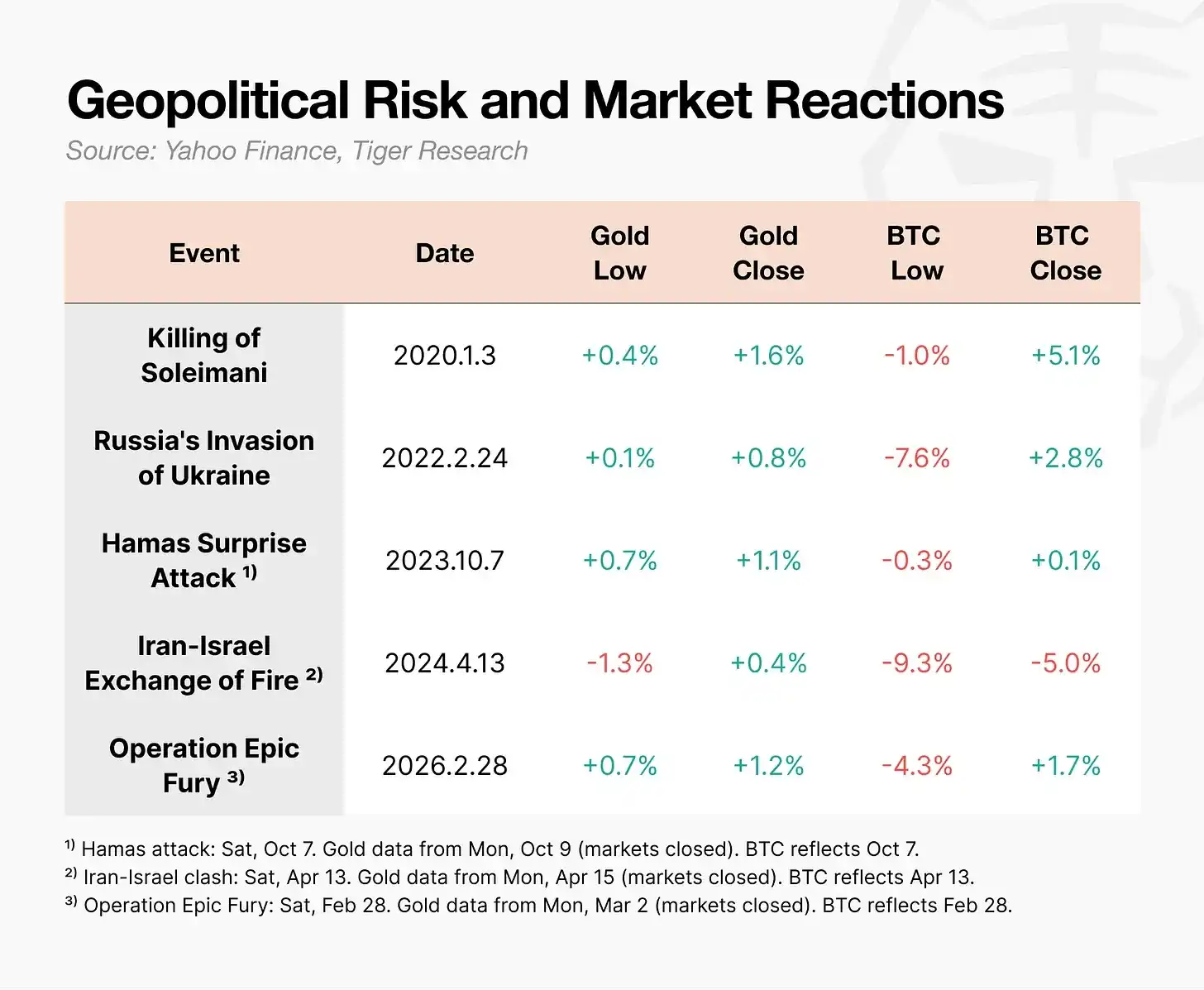
During geopolitical shocks like war, Bitcoin's movement differs from gold's.

Bitcoin often recovers quickly after an initial drop, but the chain reaction triggered by forced liquidations of leveraged traders exacerbates the decline. During the Iran-Israel conflict, Bitcoin's intraday drop reached 9.3%; during the Ukraine war, it fell by 7.6%. This stands in stark contrast to gold, which rose during the same periods.

Bitcoin is often the first asset to fall at the onset of a crisis. Can we really still call it 'digital gold'?

2. Bitcoin is Not 'Digital Gold' for Nations or Investors.

Bitcoin was not originally designed to be 'digital gold.' The title of Satoshi Nakamoto's 2008 whitepaper was 'Bitcoin: A Peer-to-Peer Electronic Cash System.' Its starting point was as a transfer mechanism, not a store of value.

The concept of 'digital gold' as we know it today gained popularity during the period of zero interest rates and quantitative easing in 2020. As fears of currency devaluation peaked, Bitcoin attracted attention as a store of value. However, in practice, neither nations nor investors treat Bitcoin as 'digital gold.'

2.1. Sovereign Nations: Hoard Gold, But Not Bitcoin

Data from the World Gold Council shows that central banks have never stopped buying gold year after year. However, no major central bank includes Bitcoin in its full reserve assets.

Some might counter that the US formally established a 'Strategic Bitcoin Reserve' via executive order in March 2025. The text of the order even noted that 'Bitcoin is often referred to as 'digital gold.'' But the details tell a different story. The reserve is limited to assets seized through criminal and civil forfeiture proceedings. The government is not purchasing new Bitcoin but merely holding seized Bitcoin instead of selling it.

Notably, as the attractiveness of US Treasury bonds declines, Europe and China are actively buying gold, but Bitcoin has not yet made their list of alternatives.

2.2 Investors: Falls Together, Doesn't Rise Together

The second half of 2025 was crucial. The Nasdaq hit a record high, while Bitcoin plummeted over 30% from its October high of $125,000. These two assets began to decouple.

But the real issue is not the decoupling itself, but the direction. Bitcoin falls when stocks fall but does not rise when stocks rise. For investors, this is the worst combination. There is no point in holding an asset that bears downside risk but misses upside gains. Bitcoin is far from a safe haven; even as a risk asset, its appeal is questionable.

3. Why Bitcoin Has Failed to Become 'Digital Gold'

A safe-haven asset is not merely one whose price rises. Academically, it refers to an asset whose correlation with other assets drops to zero or even turns negative during extreme economic downturns. The key question is whether its reaction in a crisis is predictable. Measured by this standard, the gap between gold and Bitcoin is evident.
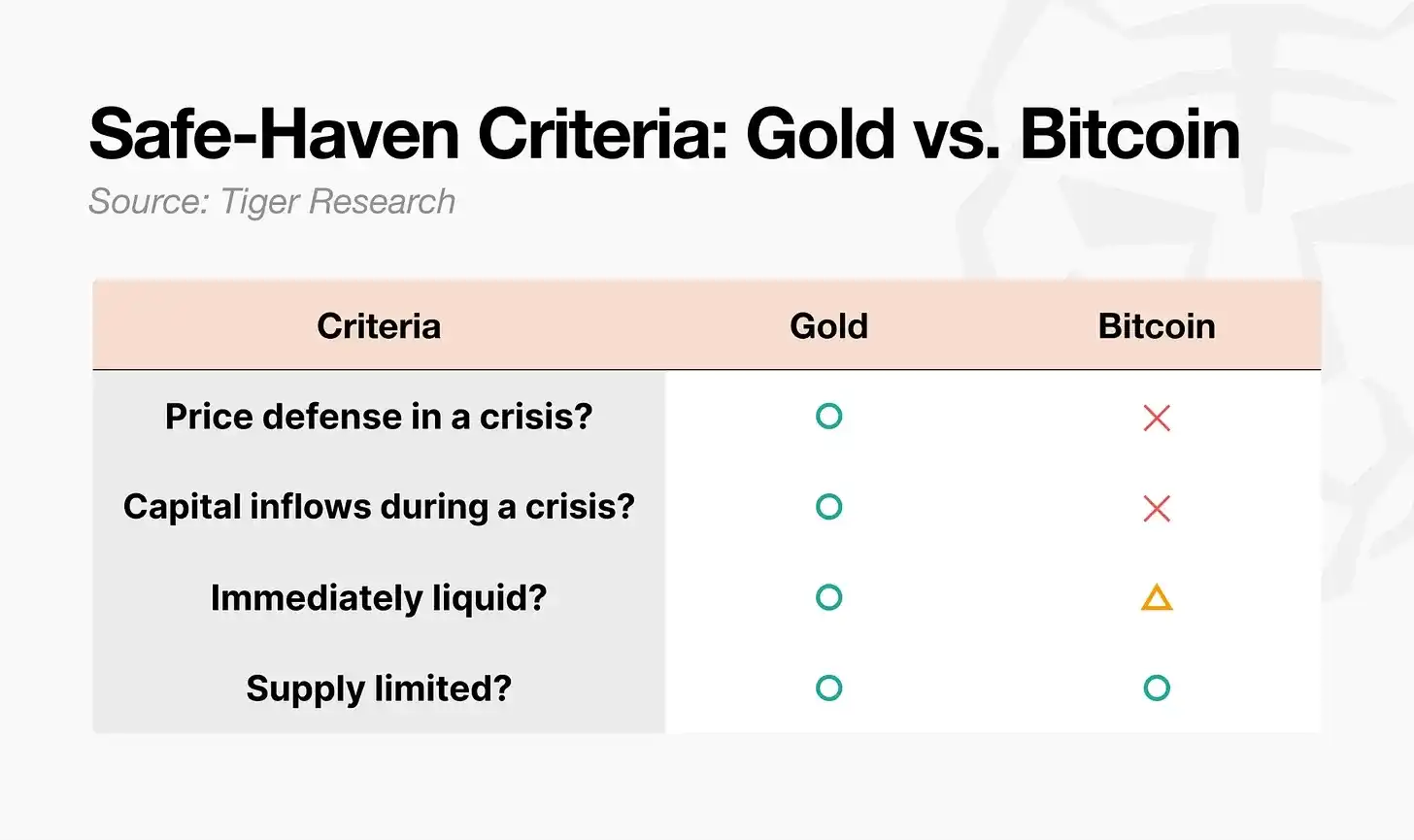
Gold meets all four requirements. Bitcoin clearly meets only one: fixed supply. Liquidity is conditional. The other two requirements are not met. Three structural asymmetries can explain this gap.

  • Market Structure Asymmetry: Physical demand for gold supports a price floor, and its futures have lower leverage. Bitcoin's derivative trading volume is about 6.5 times its spot trading volume, and its market trades 24/7, making it often the first asset sold off when a crisis hits.
  • Participant Asymmetry: The buyers during gold crises are patient capital, such as central banks, pension funds, and sovereign wealth funds. The main participants in the Bitcoin market are leveraged traders and hedge funds—capital that is the first to flee when a crisis erupts.
  • Behavioral Accumulation Asymmetry: The behavioral pattern of 'buying gold in a crisis' has repeated for decades, eventually becoming a fixed pattern. Bitcoin needs time to earn the same trust.

4. Not Safe, But Proven Useful

In terms of safety, it's hard to call Bitcoin 'digital gold.' But its role in crises is undeniable.

After the outbreak of the Russia-Ukraine war in 2022, the Ukrainian central bank immediately restricted electronic transfers and limited ATM withdrawals. Bank branches closed, and people couldn't even access their deposits. Some refugees crossed the border carrying USB drives with Bitcoin seed phrases. Reports indicate that upon arrival in Poland, they exchanged Bitcoin for local currency via Bitcoin ATMs or P2P transactions to cover living expenses.

The UN Refugee Agency went further, distributing the stablecoin USDC to displaced persons and running a program allowing them to exchange it for local currency at MoneyGram outlets. During the 2026 'Operation Epic Fury,' outflows from Iran's largest crypto exchange, Nobitex, surged 700% immediately after the airstrikes.
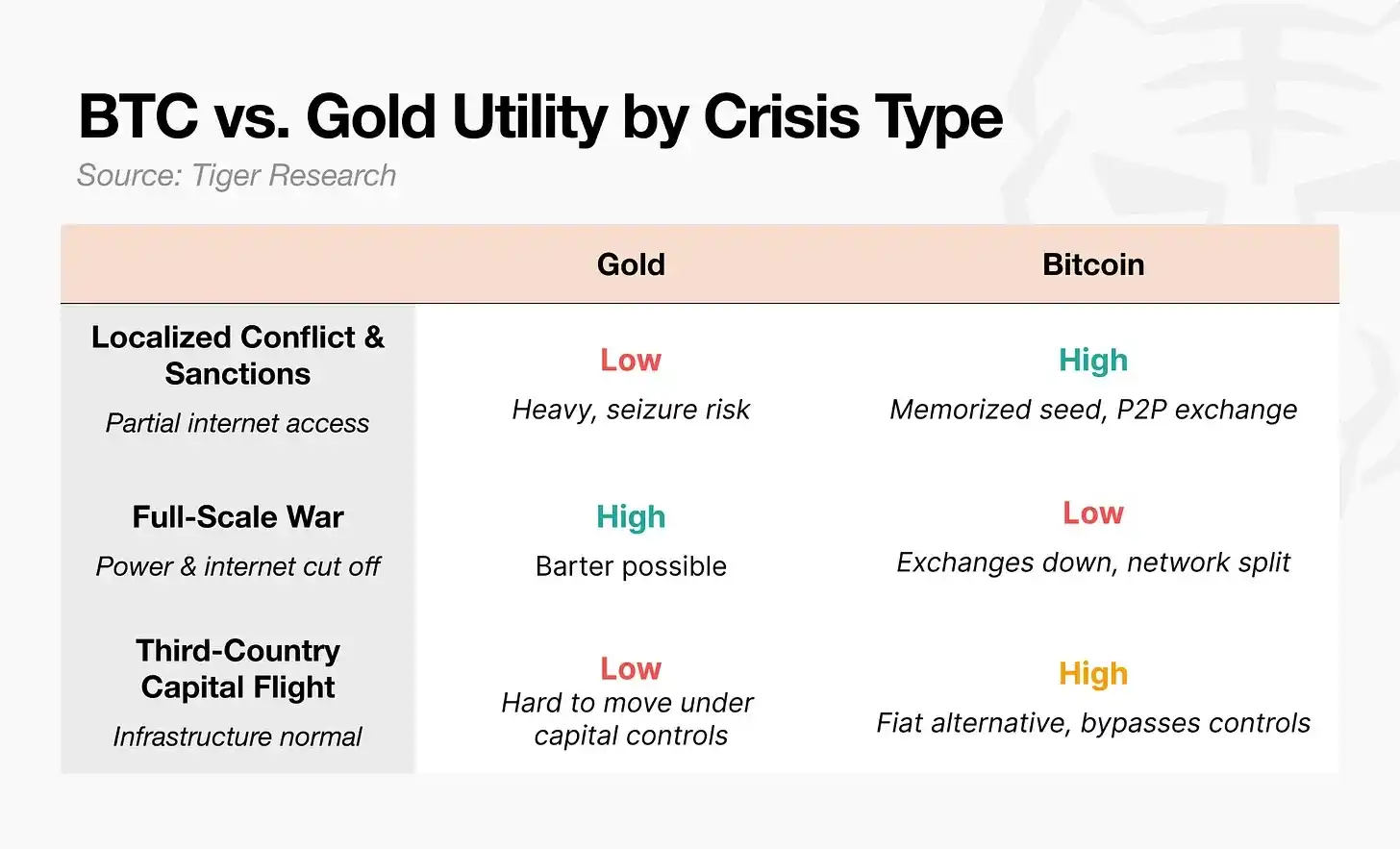
These cases show people turn to Bitcoin not because it is a safe-haven asset, but because it functions when the financial system fails.

In finance, a 'safe-haven asset' refers to one whose price remains stable during a crisis. This is different from an asset that can be used during a crisis. Bitcoin clearly provides functional value for transfer and remittance in wartime, but it cannot guarantee its own price. What constitutes a safe-haven asset is not utility, but the predictability of price behavior. Bitcoin has the former but cannot guarantee the latter.

5. Bitcoin's 'Next-Generation Gold' Scenario

In every crisis, Bitcoin's movement is the opposite of gold's. Neither nations nor investors see it as 'digital gold.' Yet, its utility in regions with closed borders and shuttered banks is undeniable. Given this potential, the path to 'next-generation gold' opens if these three asymmetries diminish.

5.1 Market Structure Shift

Derivative trading volume being 6.5 times spot volume triggers chain sell-offs in every crisis. Recently, futures open interest has declined, and price discovery mechanisms show signs of shifting towards spot and ETFs. But the real test is whether leverage will be rebuilt in the next bull market.

5.2. Participant Shift

After the approval of spot ETFs in 2024, institutional capital flooded in, and Bitcoin became a mainstream financial asset. But this created a paradox: the more institutional investors include Bitcoin in their portfolios, the more likely it is to be sold off alongside stocks during risk-off sentiment. Bitcoin's accessibility increased, but its independent price volatility disappeared. This is the financialization paradox.

Gold ETFs have also become mainstream, yet in crises, gold moves opposite to stocks because 'buying in a crisis' is a pattern formed over half a century. To break this paradox, the participant composition must shift from leveraged traders to patient capital.

There is an often-overlooked variable: generational shift. When Generation Z begins to inherit and manage real wealth, gold might remain their parents' safe haven. This generation's first investment account was not a securities account but a crypto exchange. For a generation whose first接触 (contact with) asset was Bitcoin, they might instinctively choose Bitcoin over gold in a crisis. This participant shift might not begin with institutional decisions but with generational behavioral change.

5.3 Behavioral Accumulation Shift

After the Nixon Shock, the 'buy gold in a crisis' pattern took about 50 years to form. Does Bitcoin need the same time? Not necessarily. This US-Iran conflict was the sixth test, and the result was the same again: an intraday plunge, then a rebound. As this pattern continues, belief grows that 'it will fall, but it always recovers.'

A more important variable is algorithms. A significant portion of Bitcoin trading volume today comes from AI agents and algorithmic trading. If a 'buy Bitcoin in a crisis' strategy is embedded in these algorithms, this pattern could form without the accumulation of human behavior. In this case, trust is built in code before it is built in people.

Bitcoin is not 'digital gold' today. But if market structure, participant composition, and behavioral accumulation patterns shift based on its proven utility, it has the potential to become 'next-generation gold.' It is not a replica of gold, but the birth of a全新 category.


Пов'язані питання

QAccording to the article, why does Bitcoin fail to act as a 'digital gold' during geopolitical crises?

AThe article states that Bitcoin fails to act as 'digital gold' because its price consistently falls during geopolitical crises, unlike gold which rises. This is due to three structural asymmetries: an oversupply of derivatives (market structure), dominance by leveraged participants (participant composition), and a lack of a long-term behavioral track record (behavioral accumulation).

QWhat is the 'financialization paradox' mentioned in the report regarding Bitcoin?

AThe 'financialization paradox' refers to the situation where increased institutional adoption of Bitcoin through instruments like ETFs makes it more mainstream and accessible, but also causes it to be sold off alongside stocks during risk-off events, thereby losing its independent price action and failing to act as a safe haven.

QHow does the article differentiate between a 'safe haven asset' and a 'useful asset in a crisis'?

AThe article defines a 'safe haven asset' as one whose price remains stable or increases predictably in a crisis, like gold. In contrast, a 'useful asset in a crisis' is one that provides functional utility, such as enabling transfers when borders are closed or banks fail, but does not guarantee its own price stability. Bitcoin is presented as the latter.

QWhat potential factors could help Bitcoin transition into becoming 'next-generation gold'?

AThe potential factors for Bitcoin to become 'next-generation gold' are a shift in market structure (reduced derivatives leverage), a shift in participant composition (from leveraged traders to patient capital like sovereign wealth funds), and a shift in behavioral accumulation, potentially accelerated by generational change and the embedding of 'buy-in-crisis' logic into trading algorithms.

QWhat evidence does the article provide for Bitcoin's utility as a 'useful asset in a crisis'?

AThe article cites examples such as Ukrainian refugees using Bitcoin stored on USB drives to access funds and convert them to local currency in Poland after the 2022 invasion, the UNHCR distributing stablecoins to displaced persons, and a 700% surge in outflows from an Iranian crypto exchange following airstrikes, demonstrating its use when traditional financial systems fail.

Пов'язані матеріали

Why Pricing Social Interactions is Doomed to Fail?

Titled "Why Putting a Price on Social Interaction Is Doomed to Fail," this article critiques attempts to monetize social networks directly through SocialFi models, arguing their inevitable failure stems from a fundamental misunderstanding of media dynamics. Using Marshall McLuhan's theory of "hot" and "cold" media, the author posits that social networks are inherently "cold" media. Their value isn't contained in individual posts but is co-created through user participation, interpretation, and fragmented, ongoing interaction (e.g., replies, shares). This ambiguity and need for user involvement are core to their function. The article asserts that SocialFi projects like Friend.tech failed because introducing real-time, tradable financial pricing (a definitive "hot" signal) into this "cold" environment doesn't add a layer—it replaces the medium's essence. The unambiguous price signal overshadows and nullifies the nuanced, participatory social signal. Users become traders, not participants, and when speculative profits vanish, the underlying social ecosystem—never genuinely cultivated—collapses entirely. This principle extends beyond crypto. The author argues platforms like Twitter have gradually "heated up" through metrics (likes, retweets counts, algorithmically defined value), shifting users from participants to performers and eroding organic engagement. The solution isn't to abandon capital but to manage its entry point. Successful models like Substack, Patreon, or Bandcamp allow capital to "condense" at specific, isolated nodes (e.g., subscriptions, one-time payments) without permeating and "heating" every social interaction. They preserve the core "cold," participatory medium while enabling monetization at designated boundaries. The NFT boom and bust serves as a stark parallel: the ancient "cold" medium of collecting (valued for story, community, gradual accumulation) was rapidly destroyed by platforms that introduced real-time floor prices, rarity scores, and trading dashboards, transforming collectors into speculators and vaporizing cultural value when prices fell. The core lesson: "Liquidity equals heat." Injecting high liquidity and definitive pricing into a "cold" participatory medium doesn't optimize it; it fundamentally alters and destroys its value-creating mechanism. The future lies not in pricing every social gesture but in finding precise, non-invasive points for capital to condense without overheating the entire ecosystem.

marsbit2 хв тому

Why Pricing Social Interactions is Doomed to Fail?

marsbit2 хв тому

Jensen Huang's CMU Speech: In the AI Era, Don't Just Watch, Build

Jensen Huang, CEO of NVIDIA and a first-generation immigrant, delivered the commencement address to Carnegie Mellon University's class of 2026. He shared his personal journey from a humble background to founding NVIDIA, emphasizing resilience, learning from failure, and the responsibility that comes with leadership. Huang framed the present moment as the dawn of the AI revolution, a shift he believes is more profound than previous computing waves. He described AI as fundamentally resetting computing—moving from human-written software to machines that understand, reason, and use tools. This will create a new industry for generating intelligence and transform every sector. While acknowledging AI's potential to automate tasks and displace some jobs, Huang distinguished between the *tasks* of a job and its core *purpose*. He argued AI will augment human capability, not replace humans. The real risk, he stated, is not AI itself, but people being left behind by those who effectively use AI. He presented AI as a generational opportunity for massive infrastructure investment—in chip factories, data centers, energy grids, and advanced manufacturing—that could re-industrialize nations like the U.S. and bridge the digital divide by making computing and intelligent tools accessible to all. Huang called for a balanced approach: advancing AI safely and responsibly, establishing prudent policies, ensuring broad access, and encouraging universal participation. He urged the graduates not to fear the future but to engage with optimism and ambition, reminding them of CMU's motto, "My heart is in the work." His core message was clear: this is their moment to actively build and shape the AI-powered future, not merely observe it.

marsbit59 хв тому

Jensen Huang's CMU Speech: In the AI Era, Don't Just Watch, Build

marsbit59 хв тому

The Era Has Arrived Where Human Writers Must Prove They Are Not Machines

The article describes an era where AI-generated content is flooding the market, forcing human authors to prove they are not machines. It begins with the example of dozens of AI-written, error-ridden biographies of Henry Kissinger appearing on Amazon within hours of his death, a pattern repeated for other deceased celebrities and even living experts who find fraudulent books under their names. This spam content has exploded, with monthly new book releases on platforms like Amazon reaching 300,000 by late 2025. The issue spans genres, from suspiciously high proportions of AI-written teen romance and self-help books to dangerous, AI-generated foraging guides containing lethal advice. The platforms' automated review systems, designed to catch plagiarism and banned words, are ill-equipped to detect AI-generated text that avoids these pitfalls while being nonsensical or fraudulent. The problem has infiltrated traditional publishing. A major publisher, Hachette, had to recall a bestselling horror novel after AI detection tools suggested 78% of its content was machine-generated. An acclaimed European philosophy book was later revealed to be entirely written by AI under a fake author persona. In response, authors are fighting back. At the 2026 London Book Fair, 10,000 writers published a blank book titled "Don't Steal This Book" containing only their signatures—using emptiness as a protest weapon in an age of AI overproduction. Initiatives like the "Human Author Certification" program have emerged, ironically placing the burden on humans to prove their work is not machine-made. The article warns of a vicious cycle: AI-generated low-quality books pollute the data used to train future AI models, leading to "model collapse" and an ever-worsening flood of digital waste, eroding trust in publishing and devaluing human creativity.

marsbit1 год тому

The Era Has Arrived Where Human Writers Must Prove They Are Not Machines

marsbit1 год тому

Торгівля

Спот
Ф'ючерси
活动图片