They Knew the TGA Game of the Year Winner in Advance and Made Tens of Thousands of Dollars

marsbitОпубліковано о 2025-12-12Востаннє оновлено о 2025-12-12

Анотація

Summary: The 2025 TGA (The Game Awards) ceremony concluded with the indie game "Light & Shadow: Expedition 33" making history by winning both "Best Independent Game" and the coveted "Game of the Year (GOTY)" award, breaking a long-standing TGA curse. Prior to the event, the prediction market platform Polymarket had already listed the topic, with "Light & Shadow's" probability of winning GOTY consistently above 80% for over a month. Several traders, including users DieselDiesel, trumpnogo, and kasae, placed unusually large, concentrated bets on this outcome weeks in advance, a move that would have resulted in massive losses if wrong. Their bets appeared to be "all-in" convictions rather than calculated risks. Just three hours before the GOTY announcement, after the "Best Indie" award was given to the same game, a mysterious user (bobo9997) deposited $10,000 and bet it all on "Yes" for "Light & Shadow" winning GOTY at a price of $0.98 per share—a bet that would yield less than $200 in profit if correct. The final award confirmed the predictions. The early traders realized significant profits, with their winnings from this single event representing a large percentage of their total historical earnings on the platform (e.g., 176% for DieselDiesel). The article suggests these traders likely had insider knowledge of the results, using the prediction market as a anonymous, low-risk method to monetize their confidential information, turning a guaranteed outcome into thousands of d...

Today, the highly anticipated The Game Awards (TGA) ceremony finally concluded.

Let's jump back to 3 hours before the awards ended. At that time, the "Best Independent Game" had just been awarded to the popular title "Light & Shadow: Expedition 33," but this instead made many fans worried: historically, no game has ever won both the "Best Independent Game" and the "Game of the Year (GOTY)" awards at TGA. As a GOTY favorite, "Light & Shadow" now needed to break the curse that had existed since TGA's inception and create an unprecedented moment in gaming history.

Just as everyone was filled with anxiety, a mysterious individual registered an account on a seemingly unrelated "prediction market" platform and deposited ten thousand dollars. He found the topic "Will Light & Shadow win the 2025 GOTY?" on the platform and bet the entire ten thousand dollars on "Yes." At that time, the price for "Yes" was $0.98 per share, meaning that even if "Light & Shadow" did indeed make gaming history by winning both awards, his ten-thousand-dollar bet would only yield a profit of less than two hundred dollars. However, if "Light & Shadow" failed to break the TGA curse, the probability of the topic would instantly drop to 0, which meant his newly deposited ten thousand dollars would be wiped out. What kind of狂热 fan of "Light & Shadow" would take such a reckless risk? And how do prediction markets attract game fans from around the world to guess the winners in advance?

The "Pre-Determined" Script

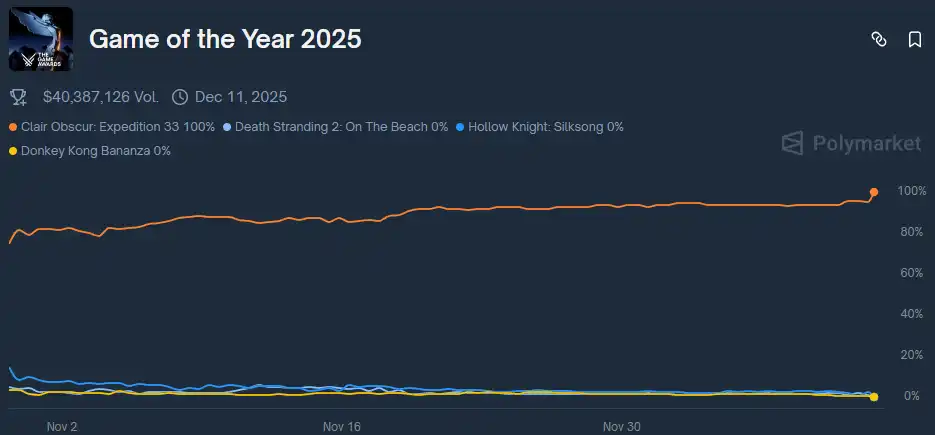
As early as October 30th, a month and a half before the awards ceremony, the prediction market Polymarket had already launched the topic for "2025 Game of the Year." The probability of "Light & Shadow" winning was firmly pinned above 80% from the start, while the probabilities of other highly anticipated AAA titles winning were suppressed below 10%. Because such a one-sided situation usually only occurs in events where the outcome is already certain, this anomaly made many traders smell something unusual: this wasn't just optimism, this was certainty.

Among these traders with a "certain" attitude, a few operated in an extremely unified style, hinting at the possibility of insider trading. DieselDiesel, trumpnogo, and kasae all bet on "Light & Shadow wins TGA 2025 GOTY" when the probability was around 85%, and the amounts they bet were dozens or even hundreds of times larger than their usual bets. This highly concentrated,反常 betting behavior meant they faced enormous risks: if "Light & Shadow" ultimately did not win, they would not only have to give up all past profits but also suffer huge losses.

As time progressed and the probability of "Light & Shadow" winning increased, they did not sell any of their held shares to realize profits. Even 3 hours before the award announcement, after the "Best Independent Game" award had been announced, they, already significantly浮盈, remained motionless as if they knew the future, betting their entire account balance alongside the mysterious individual mentioned at the beginning for that final, tiny profit.

The Historic Award Moment and the Cashing Out of Insiders

Amid doubts and unease, TGA played out exactly like the script these few traders had arranged over a month ago, dispelling the final suspense: the highly anticipated "Light & Shadow," having already won the "Best Independent Game" award, broke the historical curse and won the Game of the Year award.

And while players on one side cheered and celebrated, the mystery was solved in the prediction market on the other side: the three traders who had been convinced since a month ago that "Light & Shadow" would win confirmed their role of "foreseeing the future" and realized huge profits:

DieselDiesel made a profit of $5,357 in this event, accounting for 176% of all his other trading profits;

trumpnogo made a profit of $2,958 in this event, accounting for 62% of all his other trading profits;

kasae made a profit of $1,658 in this event, accounting for 220% of all his other trading profits.

And the mysterious individual (bobo9997) mentioned at the beginning, because he was certain that "Light & Shadow" would make history," used ten thousand dollars to win a "whopping" $200.
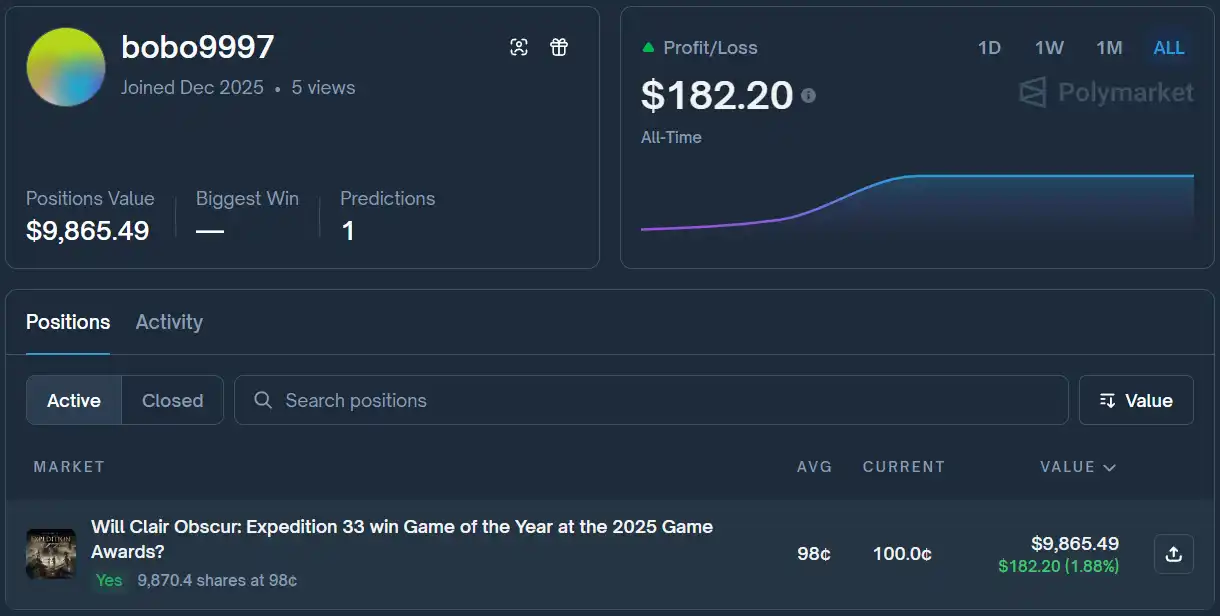
"Even Those Who Foresee the Future Need to Eat"

The most noteworthy common point among these four traders is that while many players doubted whether "Light & Shadow" could break the historical curse, they were "willing to risk" nearly $100,000 in positions to "gamble" on this historic moment happening, and this "gamble" brought them less than two thousand dollars in combined profits.

Now, let's assume these "foreseers" are TGA vote auditing staff. As insiders with an annual income of $100,000, if they wanted to monetize the information in a traditional way, they would need to sell the insider information to media platforms, but this represents various potential fines, dismissal, and even imprisonment. However, with the emergence of prediction markets, they can use anonymity to convert information asymmetry into real money equivalent to 1 to 3 months of their disposable income.

When we view them as assumed insiders who already knew the result in advance, everything becomes clear: being 100% sure that "Light & Shadow" would be GOTY, their final "bet" was just using the one-hour wait time before the announcement to换取 seemingly huge risks but实际上毫无变数的 two thousand dollars in profit. This kind of seemingly high-risk but实际上毫无变数的赚钱 "bet" was almost impossible to encounter before platforms like prediction markets appeared.

However, with the popularity of Polymarket, how many people can resist converting information into real money anonymously?
Пов'язані питання

QWhat is the name of the prediction market platform mentioned in the article where users bet on the TGA 2025 Game of the Year outcome?

AThe prediction market platform mentioned is Polymarket.

QWhich game won both the 'Best Indie Game' and 'Game of the Year (GOTY)' awards at TGA 2025, breaking a historical curse?

AThe game that won both awards is 'Light and Shadow: Expedition 33'.

QWhat were the usernames of the three traders who made unusually large bets on 'Light and Shadow' winning GOTY and profited significantly?

AThe three traders were DieselDiesel, trumpnogo, and kasae.

QHow much did the mysterious user 'bobo9997' profit from betting $10,000 on 'Light and Shadow' winning GOTY at the last moment?

AThe user 'bobo9997' profited approximately $200 from the bet.

QWhat is the suggested explanation in the article for the traders' confident and large bets on 'Light and Shadow' winning GOTY?

AThe article suggests that the traders likely had insider information, possibly from being involved in the TGA vote auditing process, which they anonymously monetized through the prediction market.

Пов'язані матеріали

NVIDIA Begins Adding Soap to the Bubble

NVIDIA is taking on a dual role: not just as a leading chip supplier, but as a massive capital allocator across the entire AI supply chain. In 2026, the company has committed over $40 billion in investments within five months, targeting everything from optical fiber manufacturing and data center operations to foundational AI model development. This investment spree, described as a systematic "sprinkler" approach, primarily funds companies that are major buyers of NVIDIA's own GPUs. Critics, including analysts from Goldman Sachs, label this a "circular revenue" loop—comparable to a supplier financing a customer to buy more of its products. A prominent example is NVIDIA's investment in OpenAI, which is expected to generate around $13 billion in revenue for NVIDIA, much of which may be reinvested back into OpenAI. While CEO Jensen Huang dismisses the "circular financing" critique as "absurd," arguing the investments are confidence votes in long-term generational shifts, some analysts express discomfort. They note that while investments in critical supply chain components like optics are strategically sound, funding new cloud providers like CoreWeave feels like "pre-paying for your own GPUs." The strategy carries significant risks. If the AI investment cycle turns, the market may question how much demand is genuine versus artificially sustained by NVIDIA's own balance sheet. Despite posting record-breaking earnings—$215.9 billion in annual revenue and $120 billion in net profit for FY2026—NVIDIA's stock fell after its report, signaling that "beating expectations" may no longer be enough to assure investors about the duration of the AI spending boom. The article concludes that while a bubble isn't necessarily a fraud, NVIDIA's actions resemble adding soap to a bubble—making it appear more robust and durable. This creates a complex scenario requiring extreme冷静 from investors to distinguish between real structural growth and financial engineering.

marsbit8 хв тому

NVIDIA Begins Adding Soap to the Bubble

marsbit8 хв тому

Short Positions Have Been Squeezed Out: Will the Next Leg of the U.S. Stock AI Rally Continue in Seoul?

"Short Squeeze Exhausted: Will the Next Leg of the AI Rally Continue in Seoul?" A Nomura report suggests the US AI stock rally, which saw the S&P 500 rise ~16.6% in 28 days largely driven by 10 key stocks, may be pausing. The fuel from short covering, CTA fund positioning, and volatility-control strategies is nearing its limit. For the rally to continue, new momentum from retail and sentiment-driven FOMO (Fear Of Missing Out) is needed. South Korea's market provided a potential answer on the very day the report was published. The KOSPI index surged 4.32%, triggering a buy-side circuit breaker, led by massive gains in chip giants SK Hynix (+11.98%) and Samsung. This surge is characterized by retail "hynix FOMO" and overseas funds precisely buying into AI themes via chip-focused ETFs, shifting from broad Korean market ETFs. The Korean rally is a high-beta extension of the US AI capital expenditure story, as major cloud providers plan massive infrastructure spending, directly benefiting memory chip leaders. However, this linkage also implies vulnerability. The sustainability of this next leg depends on whether US tech stocks correct, the trajectory of US inflation (with upcoming CPI data key), and geopolitical tensions around the Strait of Hormuz. Seoul has emerged as the new epicenter of the AI trade, but its fate remains tied to these broader macro and market dynamics.

marsbit13 хв тому

Short Positions Have Been Squeezed Out: Will the Next Leg of the U.S. Stock AI Rally Continue in Seoul?

marsbit13 хв тому

Borrowing Money from a Hundred Years Later, Building Incomprehensible AI

Tech giants like Alphabet, Amazon, Meta, and Microsoft are undergoing a radical financial transformation due to AI. Their traditional "light-asset, high-free-cash-flow" model is being dismantled by staggering capital expenditures on AI infrastructure—data centers, GPUs, and power. Combined 2026 guidance exceeds $700 billion, a 4.5x increase from 2022, causing free cash flow to plummet (e.g., Amazon's fell 95%). To fund this, they are borrowing unprecedented sums through long-dated, multi-currency bonds (e.g., Alphabet's 100-year bond). The world's most conservative capital—pensions, insurers—is now funding Silicon Valley's most speculative bet. This shift makes these companies resemble heavy-asset industrials (railroads, utilities) rather than software firms, threatening their premium valuations. Historically, such infrastructure booms (railroads, fiber optics) followed a pattern: genuine technology, overbuilding fueled by competitive frenzy, aggressive debt financing, and a crash triggered by financial conditions—not technology failure. The infrastructure remained, but many original builders and financiers did not survive. The core gamble is a "time arbitrage": using cheap debt today to build scale and lock in customers before AI capabilities commoditize. They are betting that AI revenue will materialize before debt comes due. Their positions vary: Amazon is under immediate cash pressure; Meta's path to monetization is unclear; Alphabet has a robust core business buffer; Microsoft has the shortest path from infrastructure to revenue. The contract is set: the most risk-averse global capital has lent its time to Silicon Valley, awaiting a future that is promised but uncertain.

marsbit1 год тому

Borrowing Money from a Hundred Years Later, Building Incomprehensible AI

marsbit1 год тому

Торгівля

Спот
Ф'ючерси
活动图片