
These Vibe Coding Crypto Mini-Games Are So Addictive

marsbitОпубліковано о 2026-01-20Востаннє оновлено о 2026-01-20

Анотація

The article explores the rising popularity of "vibe coding" in the cryptocurrency space, focusing on small, addictive games that deliver rapid dopamine hits through instant feedback. Initially skeptical of such trends, the author was convinced after trying games like *Rug Pull Simulator* (a token launch simulation), a meme-trading escape game, and *Vesting Victim* (an FDV guessing game). These games thrive on immediate, repetitive rewards—whether through strategic decision-making, timing the market, or testing valuation intuition—rather than long-term value or complex narratives. Vibe coding leverages AI tools to quickly turn ideas into playable demos, capitalizing on low development costs and high social media virality. It represents a shift toward instant gratification in a market where long-term promises have lost credibility, offering a form of "industrialized dopamine" that is highly engaging, if not necessarily profound. The author concludes by embracing these fast-paced, addictive experiences as a product of the current environment, even if they lack lasting impact.

Dopamine release can happen in as fast as 0.2 seconds.

That's why vibe coding is so hot in the crypto space right now.

For a long time, the market environment hasn't been great, and I had lost interest in new things, like some of the "little toys" made by vibe coding. Even the "Life K-Line" game, which was so popular it made it to CCTV, didn't change my disappointed view on industry innovation.

In my original perception, the things vibe coding produces now could only be at the level of games like "Emperor's Growth Plan" made by the Flatfish Studio—having little to do with "doing serious work." They create buzz, not accumulation; emotion, not value. I preferred to believe what those who would still impact the world twenty years after their death said, and I'd rather spend my time on products that might still be great two decades from now, not on this noise that looks like it could be washed away by the next wave of trends.

Until today, after Crypto Veda's explanations and my colleagues practically forcing it on me, I spent a few hours playing Rug Pull Simulator (Token Launch Simulator), the meme exit game Rug Pull Simulator (a coincidental同名 with the previous one) by GMGN boss Haze (Brother Chicken), and Tykoo Muscle Bro's FDV guessing game Vesting Victim—all products of this vibe coding wave.

So addictive.

How to describe this kind of pleasure? It's like you've been watching long videos on Bilibili and suddenly try Douyin for the first time; or like being used to a slow-burning relationship and suddenly experiencing fast-food romance; or like someone long suppressed by life getting high on drugs for the first time.

Take the Token Launch Simulator, for example. You start from the perspective of a project side, which isn't exactly moral. You have a limited amount of startup capital, the product is still at the PPT stage, and you decide what to do next, how to play with your users and community.

One operational cycle is a month, and you can only do two things, so resources are limited. You invest your limited resources and money into product development, narrative spreading, community operations, etc. The game doesn't tell you which path is right. Then, uncertain events pop up one after another: sometimes funding comes through, sometimes regulators target you, sometimes the community suddenly spirals out of control, sometimes security risks explode.
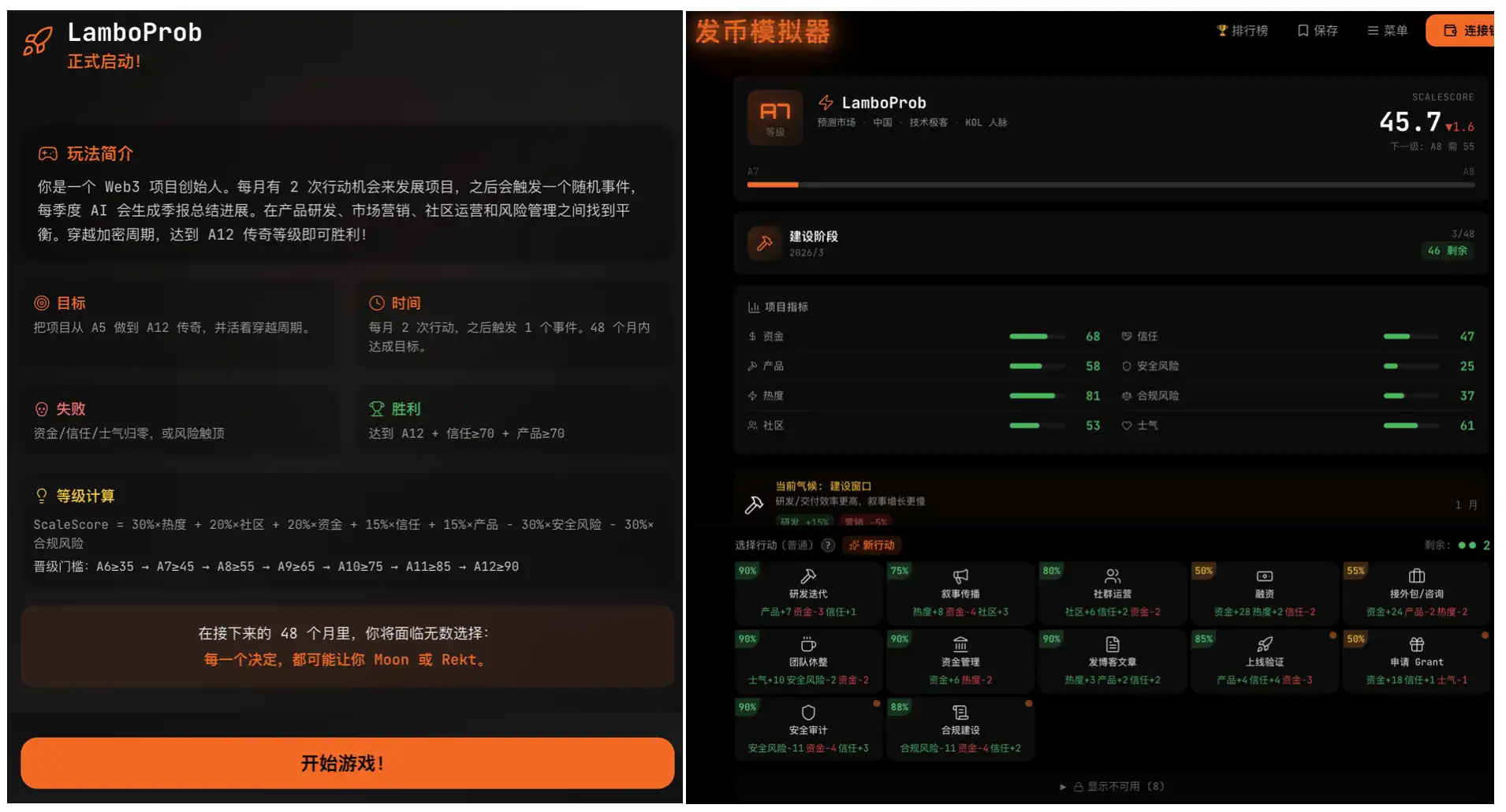
The pleasure emerges right here.

This pleasure doesn't come from eventually winning A9, A10 levels of wealth, but from the constant, continuous, never-ending immediate feedback. You just can't stop.

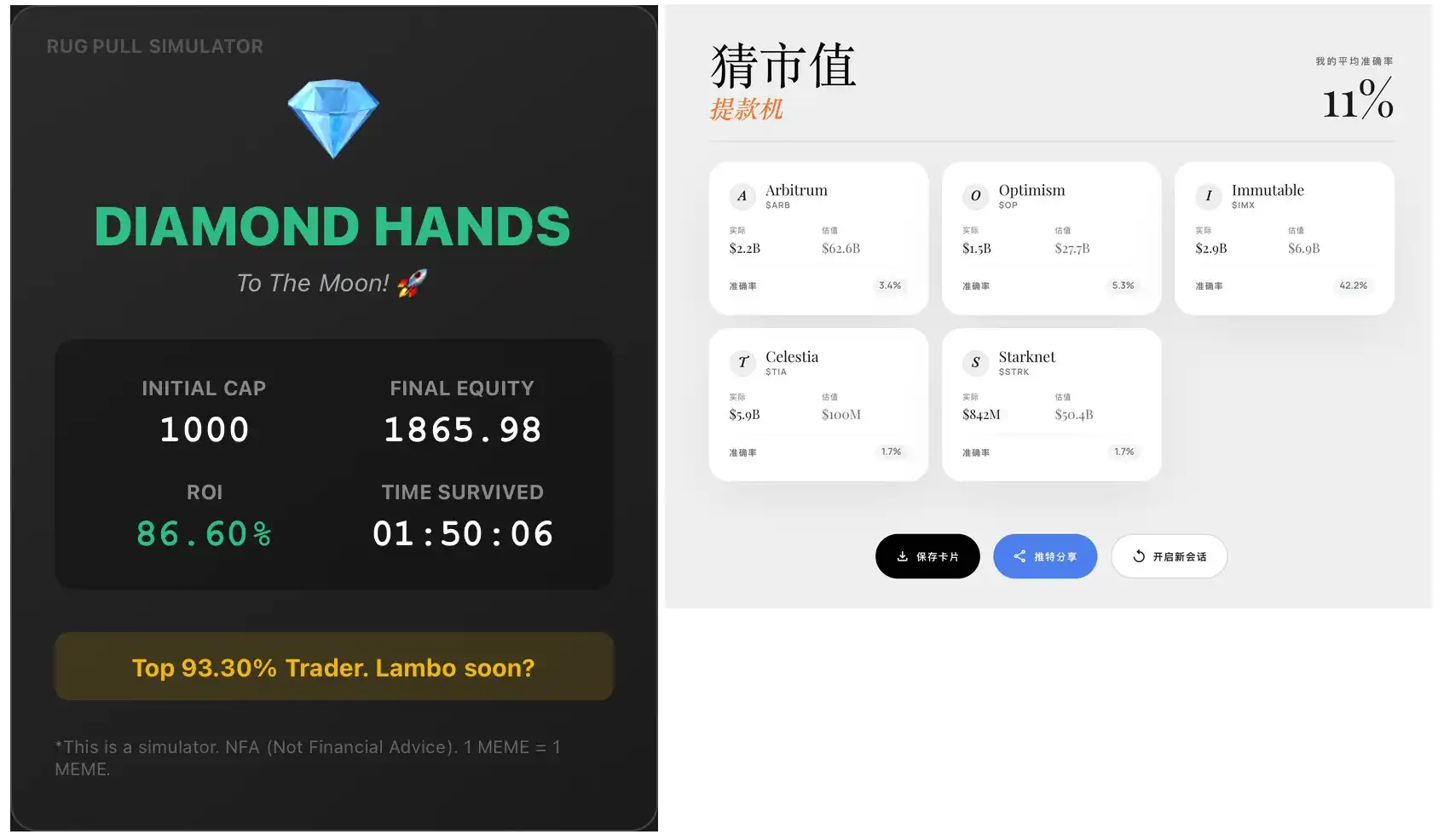
Another example is Brother Chicken's Rug Pull Simulator, a testing ground for trading memecoins, a speed-run version of GMGN's game. The pleasure lies in the rhythm of "exiting at the top." Buy low, spend marketing points to pump the price. If it pumps too fast, you fear a rug pull; if it's too slow, you get impatient. Successfully exit at the top, and profits are immediately credited—it feels like you've truly mastered the market's rhythm. Fail, and you can immediately try again.

Dopamine release in 0.2 seconds, faster than feedback in real trading.

Then there's Vesting Victim. While it doesn't have high-frequency clicking or the直观刺激 of price charts, it plays on your intuition about valuation. Based on a project's TVL, user count, funding situation, you judge its FDV, input the number, and the next second the system tells you the deviation. This "second-level verification" makes it impossible to stop. You unconsciously want to play another round—this time I'll guess more accurately—your nervous system directly receiving reward signals.
This is also the most addictive part of vibe coding. It doesn't need grand narratives or long-term investment. Copilot, Cursor, AI templates have drastically compressed the time from "an idea to a playable demo." It also doesn't rely on any future promises. No one expects today's vibe coding to produce great projects; being "fun today" is enough.

We just need to make choices in the present, get immediate feedback, and experience the pleasure of operations and results directly mapping onto our nerves. And this kind of pleasure is more direct, real, and easier to spread virally on social media than any complex economic model, long-term strategy, or whiteboard prediction.

The essence of vibe coding is, in a market where no one believes in long-term narratives anymore, monetizing attention with the lowest delivery cost.

It is, in a sense, the industrialization of dopamine—small doses, fast feedback, low addiction threshold, high repeat engagement; a form that is more brutal for project teams and more honest for users; and a natural product of today's market environment.

So when this era arrives, don't resist it, and stop lecturing about profound insights and morality. Let's indulge together in these fast-food toys, enjoy the pleasure of immediate feedback, enjoy the dopamine.

Even if it might never be great.

Пов'язані питання

QWhat is the core appeal of Vibe Coding games in the crypto space according to the article?

AThe core appeal is the immediate, continuous feedback loop that triggers dopamine release in as fast as 0.2 seconds, offering a highly addictive and entertaining experience without the promise of long-term value or a grand narrative.

QName two specific Vibe Coding games mentioned in the article and describe their core mechanics.

A1. Rug Pull Simulator (by an unnamed team): Players assume the role of a project founder with limited resources, making monthly decisions on development, marketing, or community management, and dealing with random events. 2. Another Rug Pull Simulator (by Haze from GMGN): A memecoin trading sim where players buy low, use marketing points to pump the price, and attempt to sell at the top for instant profit.

QHow does the article describe the development process of Vibe Coding projects?

AThe article states that the development process is extremely compressed. Using tools like Copilot, Cursor, and AI templates, an idea can be turned into a playable demo very quickly, requiring no long-term investment or complex future promises.

QWhat does the article suggest is the 'essence' of Vibe Coding in the current market?

AThe essence of Vibe Coding is described as the industrialization of dopamine, using the lowest delivery cost to instantly monetize attention in a market where no one believes in long-term narratives anymore.

QWhat was the author's initial opinion on Vibe Coding, and how did it change?

AThe author initially viewed Vibe Coding products as mere noise, creating temporary hype and emotion rather than lasting value, comparable to simple games. Their opinion changed after trying the games themselves, finding the immediate feedback and addictive '爽感' (shuǎng gǎn - pleasurable feeling) to be incredibly compelling.

Пов'язані матеріали

Ten-Thousand-Word Analysis: From $10 to $290, MRVL Wins the Entire AI Era by 'Not Making GPUs'

Marvell Technology's stock price surged from under $10 in 2016 to a record $290 in June 2026, fueled not by making GPUs, but by dominating AI infrastructure connectivity. This analysis argues the market misvalues MRVL as merely a smaller Broadcom in custom AI chips, overlooking its true, unique position. Marvell's core strength lies in enabling high-speed data flow for AI clusters through three interconnected businesses. First, it holds a commanding ~70% market share in high-speed optical DSPs (essential for data center light modules), a deep-moat business with accelerating growth. Second, its custom AI chip design business serves hyperscalers like AWS, Microsoft, and Google, with a significant revenue pipeline despite lower margins. Third, stable cash flows come from Ethernet switch chips and enterprise storage controllers. Together, they form a full-stack "AI data movement" platform. CEO Matt Murphy's transformative leadership since 2016, involving strategic divestments, key acquisitions (like Inphi for optical DSPs), and securing long-term agreements with major cloud providers, repositioned the company. A pivotal $2 billion strategic investment from NVIDIA in 2026 underscored Marvell's critical role in the AI ecosystem, particularly through collaborations like NVLink Fusion. While Marvell faces risks—including client concentration (losing the Amazon Trainium3 design), lower-margin business mix, competitive threats, insider selling, and complex supply chains—its fundamentals remain strong. The optical interconnect moat is widening with the acquisition of Celestial AI (photonics fabric), and financial metrics show accelerating revenue growth and operating leverage. With a PEG ratio suggesting undervaluation relative to its growth, the thesis is that the market undervalues Marvell's monopolistic position in AI "plumbing" while overemphasizing its competitive custom chip segment. The story transcends investing, symbolizing how in any complex system—from the internet to AI—the value of "connection" ultimately surpasses that of individual "nodes."

marsbit4 хв тому

Ten-Thousand-Word Analysis: From $10 to $290, MRVL Wins the Entire AI Era by 'Not Making GPUs'

marsbit4 хв тому

AI Relay Stations Spark Heated Debate on Zhihu: Behind Cheap Tokens, What Are Users Really Worried About?

A discussion on Zhihu about "AI relay stations" shifted the niche developer topic of "cheap tokens" into broader user awareness. Users moved beyond simply questioning the legitimacy of these services to focus on practical concerns: Where do cheap tokens truly come from? Is the model being accessed the real one? Can relay stations see prompts, code, and API keys? For occasional users, are the risks worth it? The core debate centered less on price and more on trust. A primary worry is model authenticity—the risk of "model swapping," where users paying for a premium model might be routed to a cheaper one, creating an information asymmetry. Others argued that cost comparisons matter; while cheaper than official pay-as-you-go APIs, relay stations may not be the lowest-cost option versus subscriptions, domestic models, or free tiers, making user needs assessment crucial. Speculation about token sources ranged from legitimate bulk discounts to gray-area methods like account sharing or exploiting regional pricing. This opacity makes risk assessment difficult for users. Data security emerged as a critical concern, especially for enterprise use. When processing sensitive information like code, contracts, or client data, the inability to verify a relay station's data handling, retention, or access policies poses significant compliance and confidentiality risks. The evolving consensus suggests relay stations can be used cautiously for low-sensitivity, disposable tasks (e.g., summarizing public info, simple translation). However, they should not be the default for sensitive, professional, or production workflows involving proprietary data, Agents, or automated systems. Recommendations include avoiding large prepayments, not relying on a single service, using test prompts to monitor quality, anonymizing data where possible, and keeping official channels as backups. Ultimately, the discussion framed tokens not just as a billing unit but as a measure of real cost encompassing price, model integrity, data security, and service stability. The popularity of relay stations highlights user demand for affordable access, but the debate underscores a key trade-off: the savings from cheap tokens may come at the price of trust, transparency, and control over one's data and AI experience.

marsbit34 хв тому

AI Relay Stations Spark Heated Debate on Zhihu: Behind Cheap Tokens, What Are Users Really Worried About?

marsbit34 хв тому

In-Depth Research Report on TradFi: The Convergence Wave of Crypto and Traditional Finance

In 2026, the crypto industry is undergoing a profound infrastructure-level transformation—TradFi assets are migrating on-chain at an unprecedented pace. According to CoinGecko's Q1 2026 report, the total value locked (TVL) of tokenized real-world assets (RWA) has surpassed $31 billion, a nearly 4x increase from $7.8 billion at the beginning of 2025, with the sector’s aggregate market capitalization reaching $19.3 billion. Among these, the market cap of tokenized stocks surged from $2 million to $486 million, with Q1 spot trading volume reaching $15.1 billion—a single quarter already surpassing the entire second half of 2025. RWA perpetual contract Q1 trading volume reached a staggering $524.8 billion, far exceeding the $313 billion for all of 2025. Meanwhile, BlackRock's BUIDL fund has reached $2.3 billion in scale and has filed for two new tokenized funds, signaling that the world's largest asset manager's tokenization strategy is evolving from pilot to product suite expansion. HTX, as a core participant in the crypto exchange sector, officially launched TradFi perpetual futures products including NVDA, AAPL, MSFT, META, and SPY in 2026, enabling crypto users to gain 24/7 trading access to core U.S. equities. Boston Consulting Group predicts that global tokenized asset scale could reach $16 trillion by 2030, while McKinsey offers a conservative estimate of approximately $2 trillion. The on-chain migration of TradFi assets is no longer a "future narrative" but a structural transformation unfolding in real time, as crypto exchanges evolve from single crypto asset trading platforms toward "multi-asset-class trading infrastructure."

HTX Learn37 хв тому

In-Depth Research Report on TradFi: The Convergence Wave of Crypto and Traditional Finance

HTX Learn37 хв тому

Торгівля

Спот
Ф'ючерси
活动图片

