The World of Gold, the Dollar, and Debt: A Revaluation of the Balance Sheet

marsbitОпубліковано о 2026-02-02Востаннє оновлено о 2026-02-02

Анотація

The article "The World of Gold, the Dollar, and Debt: A Revaluation of the Balance Sheet" argues that the fundamental, often hidden mechanism organizing modern society is not money itself, but the continuous extension of debtor-creditor relationships. Nations, communities, and individuals essentially trade the future for the present. Economic growth and consumption are fueled by an institutionalized consensus that the future can be allocated in advance, with debt being the technical instrument of this system. From this perspective, the core question becomes: who has the power to discount the future into the present and define that future? Money creation and contraction are merely expressions of this debt-based world. The true "magic" of finance is the intertemporal exchange of resources. The roles of the US dollar and gold are clarified through this lens. The dollar is not merely currency; it is the primary tool for coordinating and denominating global debt. The system functions as a massive intertemporal trade: the US provides future promises, while the world provides present productive capacity to承接 (undertake) that debt. Gold is unique as the only major financial asset with no corresponding liability; it is the ultimate settlement that requires no counterparty's promise. It is therefore often seen as inefficient in a healthy debt system but gains value when the future兑现 (fulfillment) of promises is doubted. The author posits that true避险 (risk aversion) is not about find...

Author: Iron Pillar Brother in CRYPTO

The most fundamental, yet most hidden, organizational coordination mechanism in modern society is not currency itself, but the continuous extension of the debtor-creditor relationship.

Whether it's a country, a community, an organization, or an individual, the essential action being repeated is: trading the future for the present.

The economic growth and consumer prosperity we take for granted do not stem from wealth appearing out of thin air, but from a highly institutionalized consensus: the future can be allocated in advance. Debt is the technical implementation of this consensus.

Understanding the world from this perspective reveals a more fundamental core: who has a greater ability to discount the future into the present, and who has the power to define the future.

In this sense, the creation and contraction of money are merely expressions of the world of debt. The magic of finance really boils down to one thing: the intertemporal exchange of resources.

I. Understanding Gold and the Dollar from a Debt Perspective

If you place debt at the center of how the world operates, the roles of gold and the dollar immediately become clear. The dollar is not money; it is a tool for coordinating and denominating debt.

U.S. Treasury debt is not simply a liability of the United States itself. Placed within the global balance sheet, the dollar system is: the U.S. outputs promises about the future, and the world provides present productive capacity to承接 (undertake) the debt. Using the dollar as a contract, the two parties have reached the largest intertemporal transaction in human history.

The uniqueness of gold lies in the fact that it is the only financial asset that does not correspond to any liability. It requires no one's endorsement, no one's promise; it is the final settlement in itself. On the balance sheet, gold is the only asset without a counterparty.

Precisely because of this, gold often appears inefficient, unyielding, and lacking imagination when the debt system is functioning well. But when people begin to doubt whether the future can be smoothly兑现 (honored/cashed in), the value of gold is re-understood.

Some say gold hedges against geopolitical risk. But if you continue to deconstruct this using the balance sheet, this statement is incomplete. Geopolitics does not directly destroy wealth; what it truly disrupts is the stability of debt relationships.

II. Hedging is About Finding a Healthy Balance Sheet

Understanding the logic above, it becomes clear that if you understand the world as an ever-expanding balance sheet, then so-called hedging is not about finding a certain asset that is forever safe, but rather, at different stages, finding balance sheet structures that are still healthy and sustainable. The most fundamental risk is not volatility, but an imbalance in the debt structure.

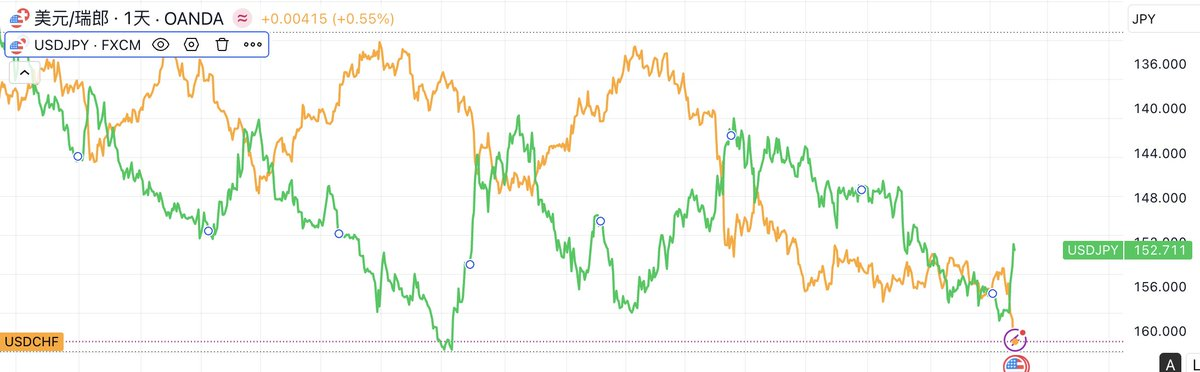
Therefore, if observing recent market trends, the depreciation of the dollar and the huge fluctuations of the yen are accompanied by the rapid appreciation of the fiat currency of countries with relatively healthy balance sheets, like Switzerland.
If we extend this view further, why is silver rising? Why are more commodities rising? Looking at it from a broader macro perspective, there is currently only one fundamental variable affecting the debtor-creditor relationship: AI.

AI is not merely an industry; in my view, its fundamentality lies in its ability to reshape the balance sheet. On one end, it infinitely drives down human efficiency costs exponentially—software becomes cheaper, labor is replaced, information processing approaches zero cost. On the other end, however, it creates an unprecedented rigid capital demand in the real world—computing power, electricity, land, energy, and minerals have become the most powerful real-world constraints.

These two forces are simultaneously acting on the global balance sheet: the efficiency side is becoming lighter, while the capital side is becoming heavier. This is fundamental to the current reshaping of the debt system.

In other words: any work that can be digitized, logicalized, or automated is seeing its cost approach zero. Software, copywriting, design, basic code—these once expensive intellectual assets are becoming as cheap as tap water. But everything has its cost. Correspondingly, the generation of every Token is背后 (backed by) the burning of computing chips, the consumption of electricity, and the transmission through copper cables. The smarter AI becomes, the more贪婪 (rapaciously) it demands from the physical world.

Over the past few decades, global growth relied more on financial engineering—credit expansion, leverage rolling, expectation management. The future could be continuously discounted, making debt seem light and controllable. But when growth becomes re-bound to variables that cannot be虚构 (fabricated/fictionalized), like computing power, electricity, resources, and productive capacity, debt is no longer just a numbers game. From this angle, when you look at silver and commodities, what the market is pricing is the提前定价 (pre-pricing) of future production capacity constraints.

Thus, when growth is locked in by physical constraints, the magic of debt fails. Because no matter how much currency you inject, if there isn't enough copper to build power grids, enough silver to make panels, AI's computing power cannot run.

III. Has the End Times for the Dollar Arrived?

Nothing is eternal, including gold. Understanding the operating logic of the debt world means one must also accept a less pleasing conclusion: gold is not the eternal answer either. Its current rise is merely due to the scarcity of being an asset without a counterparty. However, gold cannot generate cash flow, cannot improve production efficiency, and cannot replace real capital formation. From a balance sheet perspective, it's roughly equivalent to temporarily freezing risk.

Returning to the dollar, why is it still used for pricing even though the market has long been singing its demise? It's because you need the world's deepest asset pool for collateral, settlement, and hedging; you hold U.S. debt not just because you believe in the U.S., but because you need an asset recognized by the global financial system that can be used for抵押融资 (collateralized financing) at any time.

The strength of the dollar lies not in its financial correctness, but in the irreplaceability of its network effects. It is currently the only container in human civilization capable of承载 (bearing/carrying) the extension of tens of trillions in debt.

Over the past few decades, the core capability of the dollar system has been: discounting the future into the present. The U.S. issues debt, the world buys it; the U.S. consumes, the world supplies. This is essentially the global redistribution of time value.

But as the U.S. fiscal path relies increasingly on持续扩表 (continuous balance sheet expansion) and debt rolling, the credit of the dollar undergoes a subtle change: it remains the best choice, but it is no longer a free choice; the opportunity cost has risen significantly.

But the fatal blow is not this. It is that when growth relies increasingly on electricity, computing power, resources, and productive capacity, the financial system's expertise in using expectations, leverage, and discount rates to凭空 (out of thin air) bring the future to the present will encounter the hard constraints of the physical world.

The so-called Greenland (likely referring to resource acquisition/control), tariffs, and manufacturing reshoring are essentially games围绕 (revolving around) these hard constraints. In other words, the U.S. must率先 (take the lead in) completing the reshaping of AI infrastructure, turning the dollar into the sole voucher for purchasing the world's strongest computing power and most efficient productive capacity. This is the necessary condition for the dollar's王者归来 (return of the king).

Otherwise, against the backdrop of physical constraints and AI redefining global division of labor, the dollar system will gradually lose its ability to discount the future, slowly moving towards its末法时代 (end times/dharma-ending age). A slow but irreversible relative decline, until a monetary anchor that better represents real productive capacity and technological dominance emerges to replace it.

Пов'язані питання

QWhat is the core organizational mechanism of modern society according to the article, and how is it implemented?

AThe article states that the most fundamental and implicit organizational coordination mechanism of modern society is not currency itself, but the continuous extension of debt-credit relationships. It is implemented through a highly institutionalized consensus that the future can be allocated in advance, with debt being the technical method for realizing this consensus.

QHow does the article define the unique role of gold in the financial system from a balance sheet perspective?

AFrom a balance sheet perspective, the article defines gold as the only financial asset that does not correspond to any liability. It is the ultimate form of payment that requires no one's endorsement or promise, making it an asset with no counterparty risk on the balance sheet.

QWhat does the article suggest 'risk aversion' truly means in the context of a global balance sheet?

AThe article suggests that 'risk aversion' is not about finding a perpetually safe asset, but rather about identifying balance sheet structures that are still healthy and sustainable at different stages. The fundamental risk is not volatility, but an imbalance in the debt structure.

QAccording to the author, what is the fundamental impact of AI on the global balance sheet and the existing debt system?

AThe author argues that AI's fundamental impact lies in its ability to reshape the balance sheet. It drastically reduces the cost of human efficiency on one end (making software, labor, and information processing cheaper), while simultaneously creating unprecedented rigid capital demands for compute power, electricity, land, energy, and minerals on the other. This creates a tension where the 'efficiency' side becomes lighter and the 'capital' side becomes heavier, fundamentally challenging the existing debt system.

QWhat is the necessary condition for the US dollar to maintain its dominance ('return of the king'), as per the article's analysis?

AThe necessary condition for the US dollar to maintain its dominance, according to the article, is for the United States to lead in reshaping AI infrastructure, making the dollar the sole credential for purchasing the world's strongest computing power and most efficient productive capacity. Without this, the dollar system could gradually lose its ability to discount the future and enter a period of relative decline.

Пов'язані матеріали

From Gas Limit to 'Keyed Nonces', How to Understand the Next Step in Ethereum Scalability?

Ethereum’s scalability efforts are shifting toward a user-centric approach—focusing not only on higher TPS, but on translating technical upgrades into lower costs, smoother operations, and better wallet experiences. Two recent developments highlight this direction: - **Raising the Gas Limit to 200 million**: Following the Fusaka upgrade that increased it to 60 million, a consensus has formed around a potential future increase to 200 million. This would boost Ethereum’s execution capacity, but it is planned alongside other upgrades—such as ePBS, Block-Level Access Lists (BAL), and EIP-8037—to manage state growth and keep node operation viable for average participants. - **Keyed Nonces (EIP-8250)**: This proposal aims to improve how transactions are queued. Instead of a single linear nonce per account, it introduces multiple independent nonce domains. This prevents different types of transactions—such as private payments, session keys, or batch operations—from blocking each other. Vitalik Buterin views this as a foundational step toward better privacy support and more flexible state scalability. Together, these upgrades are part of a broader move to push complexity from wallets, DApps, and relays back into the protocol layer. For everyday users, this means future Ethereum interactions could become less congested, more intuitive, and safer—especially as core improvements in account abstraction, cross-L2 interoperability, and node decentralization continue to progress. Ultimately, Ethereum is evolving to handle not just more transactions, but more varied and complex on-chain use cases while preserving its decentralized foundation.

marsbit9 хв тому

From Gas Limit to 'Keyed Nonces', How to Understand the Next Step in Ethereum Scalability?

marsbit9 хв тому

Leaving OpenAI, How Much Has Their Net Worth Increased?

Former OpenAI employees have collectively accrued near-trillion dollar valuations through ventures and investments, charting AI's future. The article highlights two main paths: founding high-value companies like Anthropic and Perplexity, or applying insider insights as investors. Leopold Aschenbrenner exemplifies the investor path. After being fired from OpenAI, he leveraged firsthand knowledge of AI's massive energy demands to make hugely successful public market bets on nuclear and fuel cell companies, practicing "cross-industry cognitive arbitrage." Other alumni, like the Zero Shot VC fund founders, use their technical foresight for early-stage investing. Their key advantage lies not just in picking winners, but in knowing which technical approaches are likely dead ends—a "veto list" derived from internal OpenAI experience. Angel investing within the network, as seen with Mira Murati and Sam Altman, operates on deep, pre-existing understanding of a founder's capabilities, reducing due diligence to near zero. This creates an ecosystem bound by a shared belief in AGI's imminent arrival, differing from networks like the "PayPal Mafia" which were built on shared past struggles. The shift of these builders to investors signals a profound conviction: their situational awareness of the AI landscape is now so clear that deploying capital based on that judgment is more efficient than building themselves. They are allocating bets on the future they helped shape from the inside.

marsbit19 хв тому

Leaving OpenAI, How Much Has Their Net Worth Increased?

marsbit19 хв тому

Countdown to the AI Bull Market? Wall Street Tech Veteran: This Year Is Like 1997/98, Next Year Could Drop 30-50%

"AI Bull Market Countdown? Wall Street Veteran: This Year Feels Like 1997/98, Next Year Could Drop 30-50%" In an interview, veteran tech analyst Dan Niles draws parallels between the current AI boom and the 1997-98 period of the internet boom, suggesting the bull run isn't over yet. The core new driver is identified as "Agentic AI," which performs multi-step tasks and consumes vastly more computing power than conversational AI. This shift is expected to boost demand for cloud infrastructure and benefit CPU makers like Intel and AMD, potentially pressuring GPU leader Nvidia. However, Niles warns of significant short-term overbought conditions in semiconductors. His central warning is for a potential major market correction of 30-50% starting in early 2027. Drivers include a slowdown from high growth comparables, the outsized capital demands of companies like OpenAI, and a wave of massive tech IPOs sucking liquidity from the market. A J.P. Morgan survey of 56 global investors aligns with this view, finding that 54% expect a >30% U.S. stock correction by 2027. Among mega-cap tech, Niles favors Google due to its full-stack AI capabilities and cash flow, expresses concern about Meta's user growth, and sees potential for Apple's AI Siri and foldable iPhone. Niles advises investors to be nimble, hold significant cash, and closely monitor the conflicting signals from equities, oil prices, and bond yields, which he believes cannot all be correct simultaneously.

marsbit53 хв тому

Countdown to the AI Bull Market? Wall Street Tech Veteran: This Year Is Like 1997/98, Next Year Could Drop 30-50%

marsbit53 хв тому

Торгівля

Спот
Ф'ючерси
活动图片




