The World of Gold, the Dollar, and Debt: A Revaluation of the Balance Sheet

marsbitОпубліковано о 2026-02-02Востаннє оновлено о 2026-02-02

Анотація

The article "The World of Gold, the Dollar, and Debt: A Revaluation of the Balance Sheet" argues that the fundamental, often hidden mechanism organizing modern society is not money itself, but the continuous extension of debtor-creditor relationships. Nations, communities, and individuals essentially trade the future for the present. Economic growth and consumption are fueled by an institutionalized consensus that the future can be allocated in advance, with debt being the technical instrument of this system. From this perspective, the core question becomes: who has the power to discount the future into the present and define that future? Money creation and contraction are merely expressions of this debt-based world. The true "magic" of finance is the intertemporal exchange of resources. The roles of the US dollar and gold are clarified through this lens. The dollar is not merely currency; it is the primary tool for coordinating and denominating global debt. The system functions as a massive intertemporal trade: the US provides future promises, while the world provides present productive capacity to承接 (undertake) that debt. Gold is unique as the only major financial asset with no corresponding liability; it is the ultimate settlement that requires no counterparty's promise. It is therefore often seen as inefficient in a healthy debt system but gains value when the future兑现 (fulfillment) of promises is doubted. The author posits that true避险 (risk aversion) is not about find...

Author: Iron Pillar Brother in CRYPTO

The most fundamental, yet most hidden, organizational coordination mechanism in modern society is not currency itself, but the continuous extension of the debtor-creditor relationship.

Whether it's a country, a community, an organization, or an individual, the essential action being repeated is: trading the future for the present.

The economic growth and consumer prosperity we take for granted do not stem from wealth appearing out of thin air, but from a highly institutionalized consensus: the future can be allocated in advance. Debt is the technical implementation of this consensus.

Understanding the world from this perspective reveals a more fundamental core: who has a greater ability to discount the future into the present, and who has the power to define the future.

In this sense, the creation and contraction of money are merely expressions of the world of debt. The magic of finance really boils down to one thing: the intertemporal exchange of resources.

I. Understanding Gold and the Dollar from a Debt Perspective

If you place debt at the center of how the world operates, the roles of gold and the dollar immediately become clear. The dollar is not money; it is a tool for coordinating and denominating debt.

U.S. Treasury debt is not simply a liability of the United States itself. Placed within the global balance sheet, the dollar system is: the U.S. outputs promises about the future, and the world provides present productive capacity to承接 (undertake) the debt. Using the dollar as a contract, the two parties have reached the largest intertemporal transaction in human history.

The uniqueness of gold lies in the fact that it is the only financial asset that does not correspond to any liability. It requires no one's endorsement, no one's promise; it is the final settlement in itself. On the balance sheet, gold is the only asset without a counterparty.

Precisely because of this, gold often appears inefficient, unyielding, and lacking imagination when the debt system is functioning well. But when people begin to doubt whether the future can be smoothly兑现 (honored/cashed in), the value of gold is re-understood.

Some say gold hedges against geopolitical risk. But if you continue to deconstruct this using the balance sheet, this statement is incomplete. Geopolitics does not directly destroy wealth; what it truly disrupts is the stability of debt relationships.

II. Hedging is About Finding a Healthy Balance Sheet

Understanding the logic above, it becomes clear that if you understand the world as an ever-expanding balance sheet, then so-called hedging is not about finding a certain asset that is forever safe, but rather, at different stages, finding balance sheet structures that are still healthy and sustainable. The most fundamental risk is not volatility, but an imbalance in the debt structure.

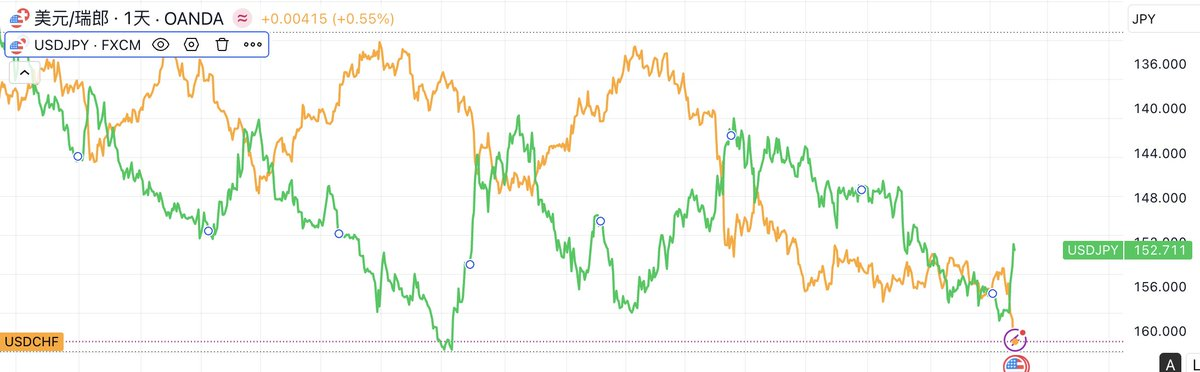
Therefore, if observing recent market trends, the depreciation of the dollar and the huge fluctuations of the yen are accompanied by the rapid appreciation of the fiat currency of countries with relatively healthy balance sheets, like Switzerland.
If we extend this view further, why is silver rising? Why are more commodities rising? Looking at it from a broader macro perspective, there is currently only one fundamental variable affecting the debtor-creditor relationship: AI.

AI is not merely an industry; in my view, its fundamentality lies in its ability to reshape the balance sheet. On one end, it infinitely drives down human efficiency costs exponentially—software becomes cheaper, labor is replaced, information processing approaches zero cost. On the other end, however, it creates an unprecedented rigid capital demand in the real world—computing power, electricity, land, energy, and minerals have become the most powerful real-world constraints.

These two forces are simultaneously acting on the global balance sheet: the efficiency side is becoming lighter, while the capital side is becoming heavier. This is fundamental to the current reshaping of the debt system.

In other words: any work that can be digitized, logicalized, or automated is seeing its cost approach zero. Software, copywriting, design, basic code—these once expensive intellectual assets are becoming as cheap as tap water. But everything has its cost. Correspondingly, the generation of every Token is背后 (backed by) the burning of computing chips, the consumption of electricity, and the transmission through copper cables. The smarter AI becomes, the more贪婪 (rapaciously) it demands from the physical world.

Over the past few decades, global growth relied more on financial engineering—credit expansion, leverage rolling, expectation management. The future could be continuously discounted, making debt seem light and controllable. But when growth becomes re-bound to variables that cannot be虚构 (fabricated/fictionalized), like computing power, electricity, resources, and productive capacity, debt is no longer just a numbers game. From this angle, when you look at silver and commodities, what the market is pricing is the提前定价 (pre-pricing) of future production capacity constraints.

Thus, when growth is locked in by physical constraints, the magic of debt fails. Because no matter how much currency you inject, if there isn't enough copper to build power grids, enough silver to make panels, AI's computing power cannot run.

III. Has the End Times for the Dollar Arrived?

Nothing is eternal, including gold. Understanding the operating logic of the debt world means one must also accept a less pleasing conclusion: gold is not the eternal answer either. Its current rise is merely due to the scarcity of being an asset without a counterparty. However, gold cannot generate cash flow, cannot improve production efficiency, and cannot replace real capital formation. From a balance sheet perspective, it's roughly equivalent to temporarily freezing risk.

Returning to the dollar, why is it still used for pricing even though the market has long been singing its demise? It's because you need the world's deepest asset pool for collateral, settlement, and hedging; you hold U.S. debt not just because you believe in the U.S., but because you need an asset recognized by the global financial system that can be used for抵押融资 (collateralized financing) at any time.

The strength of the dollar lies not in its financial correctness, but in the irreplaceability of its network effects. It is currently the only container in human civilization capable of承载 (bearing/carrying) the extension of tens of trillions in debt.

Over the past few decades, the core capability of the dollar system has been: discounting the future into the present. The U.S. issues debt, the world buys it; the U.S. consumes, the world supplies. This is essentially the global redistribution of time value.

But as the U.S. fiscal path relies increasingly on持续扩表 (continuous balance sheet expansion) and debt rolling, the credit of the dollar undergoes a subtle change: it remains the best choice, but it is no longer a free choice; the opportunity cost has risen significantly.

But the fatal blow is not this. It is that when growth relies increasingly on electricity, computing power, resources, and productive capacity, the financial system's expertise in using expectations, leverage, and discount rates to凭空 (out of thin air) bring the future to the present will encounter the hard constraints of the physical world.

The so-called Greenland (likely referring to resource acquisition/control), tariffs, and manufacturing reshoring are essentially games围绕 (revolving around) these hard constraints. In other words, the U.S. must率先 (take the lead in) completing the reshaping of AI infrastructure, turning the dollar into the sole voucher for purchasing the world's strongest computing power and most efficient productive capacity. This is the necessary condition for the dollar's王者归来 (return of the king).

Otherwise, against the backdrop of physical constraints and AI redefining global division of labor, the dollar system will gradually lose its ability to discount the future, slowly moving towards its末法时代 (end times/dharma-ending age). A slow but irreversible relative decline, until a monetary anchor that better represents real productive capacity and technological dominance emerges to replace it.


Пов'язані питання

QWhat is the core organizational mechanism of modern society according to the article, and how is it implemented?

AThe article states that the most fundamental and implicit organizational coordination mechanism of modern society is not currency itself, but the continuous extension of debt-credit relationships. It is implemented through a highly institutionalized consensus that the future can be allocated in advance, with debt being the technical method for realizing this consensus.

QHow does the article define the unique role of gold in the financial system from a balance sheet perspective?

AFrom a balance sheet perspective, the article defines gold as the only financial asset that does not correspond to any liability. It is the ultimate form of payment that requires no one's endorsement or promise, making it an asset with no counterparty risk on the balance sheet.

QWhat does the article suggest 'risk aversion' truly means in the context of a global balance sheet?

AThe article suggests that 'risk aversion' is not about finding a perpetually safe asset, but rather about identifying balance sheet structures that are still healthy and sustainable at different stages. The fundamental risk is not volatility, but an imbalance in the debt structure.

QAccording to the author, what is the fundamental impact of AI on the global balance sheet and the existing debt system?

AThe author argues that AI's fundamental impact lies in its ability to reshape the balance sheet. It drastically reduces the cost of human efficiency on one end (making software, labor, and information processing cheaper), while simultaneously creating unprecedented rigid capital demands for compute power, electricity, land, energy, and minerals on the other. This creates a tension where the 'efficiency' side becomes lighter and the 'capital' side becomes heavier, fundamentally challenging the existing debt system.

QWhat is the necessary condition for the US dollar to maintain its dominance ('return of the king'), as per the article's analysis?

AThe necessary condition for the US dollar to maintain its dominance, according to the article, is for the United States to lead in reshaping AI infrastructure, making the dollar the sole credential for purchasing the world's strongest computing power and most efficient productive capacity. Without this, the dollar system could gradually lose its ability to discount the future and enter a period of relative decline.

Пов'язані матеріали

Borrowing Money from a Hundred Years Later, Building Incomprehensible AI

Tech giants like Alphabet, Amazon, Meta, and Microsoft are undergoing a radical financial transformation due to AI. Their traditional "light-asset, high-free-cash-flow" model is being dismantled by staggering capital expenditures on AI infrastructure—data centers, GPUs, and power. Combined 2026 guidance exceeds $700 billion, a 4.5x increase from 2022, causing free cash flow to plummet (e.g., Amazon's fell 95%). To fund this, they are borrowing unprecedented sums through long-dated, multi-currency bonds (e.g., Alphabet's 100-year bond). The world's most conservative capital—pensions, insurers—is now funding Silicon Valley's most speculative bet. This shift makes these companies resemble heavy-asset industrials (railroads, utilities) rather than software firms, threatening their premium valuations. Historically, such infrastructure booms (railroads, fiber optics) followed a pattern: genuine technology, overbuilding fueled by competitive frenzy, aggressive debt financing, and a crash triggered by financial conditions—not technology failure. The infrastructure remained, but many original builders and financiers did not survive. The core gamble is a "time arbitrage": using cheap debt today to build scale and lock in customers before AI capabilities commoditize. They are betting that AI revenue will materialize before debt comes due. Their positions vary: Amazon is under immediate cash pressure; Meta's path to monetization is unclear; Alphabet has a robust core business buffer; Microsoft has the shortest path from infrastructure to revenue. The contract is set: the most risk-averse global capital has lent its time to Silicon Valley, awaiting a future that is promised but uncertain.

marsbit9 хв тому

Borrowing Money from a Hundred Years Later, Building Incomprehensible AI

marsbit9 хв тому

The 'VVV' Concept Soars 9x in Half a Year, The New AI Narrative on Base Chain

"The article explores the 'VVV' concept as the new AI-focused narrative within the Base ecosystem, centered around the token $VVV of the privacy-focused, uncensored generative AI platform Venice, led by crypto veteran Erik Voorhees. Venice has seen significant growth in 2026, with its API users surging, partly attributed to exposure from OpenClaw. The platform now boasts over 2 million total users and 55,000 paid subscribers. Correspondingly, the $VVV token price has risen over 9x this year. Key to its performance are tokenomics designed for value accrual: reduced annual emissions, subscription revenue used for buyback-and-burn, and a unique staking mechanism. Staking $VVV yields $sVVV, which can be used to mint $DIEM tokens. Each staked $DIEM provides a daily $1 credit for using Venice's API services, creating tangible utility. The article also highlights other tokens associated with the 'VVV' narrative. $POD, the token of distributed AI network Dolphin (which co-developed Venice's default AI model), saw a massive price surge. $cyb3rwr3n, a project for a Venice credit auction market, gained attention due to perceived connections to Venice's team despite official denials. Finally, $SR of robotics platform STRIKEROBOT.AI rose after announcing a partnership with Venice for robot vision-language model development. Overall, the 'VVV' ecosystem combines AI platform growth, deflationary tokenomics, and innovative utility mechanisms, driving significant investor interest and price action in related tokens."

marsbit18 хв тому

The 'VVV' Concept Soars 9x in Half a Year, The New AI Narrative on Base Chain

marsbit18 хв тому

Anthropic and OpenAI Have Single-Handedly Severed the Logic of Pre-IPO Stock Tokenization

The pre-IPO stock token market is experiencing significant turmoil following strong statements from AI giants Anthropic and OpenAI. Both companies have updated their official policies, declaring that any transfer of their company shares—including sales, transfers, or assignments of share interests—without prior board approval is "invalid" and will not be recognized in their corporate records. This means buyers in such unauthorized transactions would not be recognized as shareholders and would have no shareholder rights. A major point of contention is the use of Special Purpose Vehicles (SPVs), which are legal entities commonly used by pre-IPO token platforms to pool investor funds and indirectly acquire shares from employees or early investors. The companies explicitly state they do not permit SPVs to acquire their shares, and any such transfer violates their restrictions. They warn that third parties selling shares through SPVs, direct sales, forward contracts, or stock tokens are likely engaged in fraud or are offering worthless investments due to these transfer limits. This stance directly threatens the core model of many pre-IPO token platforms, which rely on SPV structures. The announcement revealed additional risks within this model, such as complex "SPV-within-SPV" layering that obscures legal transparency, increases management fees, and creates a chain reaction risk of invalidation. Following the news, tokens like ANTHROPIC and OPENAI on platforms like PreStocks fell sharply (over 20%). The market reaction highlights a divergence: while asset-backed pre-IPO tokens plummeted, purely speculative pre-IPO futures contracts, which are bilateral bets on future IPO prices with no claim to actual shares, remained relatively stable as they are unaffected by the transfer restrictions. The industry is split on the implications. Some believe the fundamental logic of pre-IPO token trading is broken if leading companies reject SPV-held shares, potentially causing a domino effect. Others, like Rivet founder Nick Abouzeid, argue that buyers of such unofficial tokens always knowingly accepted the risk of non-recognition by the company. The statements serve as a stark risk warning and a corrective measure for a market where valuations for some AI-related pre-IPO tokens had soared to irrational levels, far exceeding recent funding round valuations.

marsbit1 год тому

Anthropic and OpenAI Have Single-Handedly Severed the Logic of Pre-IPO Stock Tokenization

marsbit1 год тому

Anthropic and OpenAI Personally Sever the Logic of Pre-IPO Crypto-Stocks

The pre-IPO token market has been rocked by strong statements from Anthropic and OpenAI. Both AI giants have updated official warnings, declaring that any sale or transfer of their company shares without explicit board approval is "invalid" and will not be recognized on their corporate records. This directly targets Special Purpose Vehicles (SPVs), the common legal structure used by pre-IPO token platforms. These platforms typically use an SPV to acquire shares from employees or early investors, then issue blockchain-based tokens representing a claim on the SPV's economic benefits. Anthropic and OpenAI's position means that if an SPV's share purchase lacked authorization, the underlying asset could be deemed worthless, nullifying the token's value. Anthropic explicitly warned that any third party selling its shares—via direct sales, forwards, or tokens—is likely fraudulent or offering a valueless investment. The crackdown highlights risks in the popular SPV model, including complex multi-layered "Russian doll" SPV structures that obscure legal ownership, add fees, and concentrate risk. If one layer is invalidated, the entire chain could collapse. Following the announcements, tokens like ANTHROPIC and OPENAI on platforms like PreStocks fell sharply (over 20%). In contrast, purely speculative pre-IPO prediction contracts remained stable, as they involve no actual share ownership. The move is seen as a corrective measure amid a market frenzy where some pre-IPO token valuations (e.g., Anthropic's token hitting a $1.4 trillion implied valuation) far exceeded recent official funding rounds. Opinions are split: some believe this undermines the core logic of pre-IPO token trading if top companies reject SPVs, while others argue buyers always assumed this legal risk when accessing unofficial channels. The statements serve as a stark warning and a potential catalyst for market de-leveraging and clearer boundaries.

Odaily星球日报1 год тому

Anthropic and OpenAI Personally Sever the Logic of Pre-IPO Crypto-Stocks

Odaily星球日报1 год тому

The Waged Worker Driven to Poverty by AI Subscriptions

"AI Membership: The Hidden Cost Pushing Workers Toward 'Poverty'" The widespread corporate push for AI adoption is creating a hidden financial burden for employees. Companies, from giants like Alibaba to small firms, are mandating AI use, often tying token consumption to KPIs, but frequently refuse to cover the costs. Workers are forced to pay for subscriptions out of pocket to stay competitive and avoid being replaced. Front-end developer Long Shen spends up to 2000 RMB monthly on tools like Cursor and ChatGPT Plus, seeing it as a necessary 3% salary investment to handle 90% of his coding tasks. While it boosted his performance and led to promotions, he now faces idle time at work, pretending to be busy. Designer Peng Peng navigates strict company firewalls by using personal devices and accounts for AI image generation tools like Midjourney, spending hundreds monthly without reimbursement, while her boss demands faster, more numerous revisions. The pressure creates workplace anxiety and suspicion. Programmer Li Huahua, after a friend's experience of raised KPIs following AI success, fears being branded a "traitor" for using it yet worries about falling behind if she doesn't. The dynamic allows management to demand results without understanding the tools or covering expenses, treating employees like AI "agents." While some, like entrepreneur Jin Tu, find high value in paid AI, building entire systems and winning competitions, for most, it's a trap. Free tools like Kimi and Doubao are introducing fees, closing off alternatives. The initial efficiency gains individual advantage, but as AI becomes ubiquitous, the personal edge disappears, workloads increase, and a cycle of dependency begins. Workers like Long Shen realize they cannot maintain AI-generated code without AI, making stopping harder than continuing to pay. The tool promising liberation is instead becoming a compulsory, costly chain in the modern workplace.

marsbit2 год тому

The Waged Worker Driven to Poverty by AI Subscriptions

marsbit2 год тому

Торгівля

Спот
Ф'ючерси
活动图片




