The White House Did the Math: How Much More Could Banks Lend If Stablecoin Interest Is Banned?

marsbitОпубліковано о 2026-04-13Востаннє оновлено о 2026-04-13

Анотація

The White House Council of Economic Advisers (CEA) refuted a previous claim that interest-bearing stablecoins could reduce bank lending by $1.5 trillion, estimating the actual impact at just $2.1 billion—nearly 700 times smaller. The key argument centers on where stablecoin reserves are allocated. Most major issuers, like Tether and Circle, hold the majority of reserves in U.S. Treasuries and repurchase agreements, not bank deposits. Only a small portion (around 12% for USDC) is held in bank deposits subject to 100% reserve requirements—the only scenario that meaningfully reduces bank lending capacity. Even if a ban on stablecoin interest payments drove an estimated $54.4 billion back to banks, only 12% of that would affect lending capacity. After accounting for reserve requirements and banks’ existing excess liquidity, the net increase in lending would be minimal. The report also highlights negative side effects: an $800 million annual welfare loss for stablecoin holders and potential reduced foreign demand for U.S. Treasuries, which could raise borrowing costs. The cost-benefit ratio of an interest ban is estimated at 6.6, making it an inefficient policy with clear costs and uncertain benefits.

Written & Compiled by: KarenZ, Foresight News

Last summer, during the debate over the "GENIUS Act" in the U.S. Congress, economist Andrew Nigrinis threw out a number—if stablecoins could pay interest, bank loans could evaporate by $1.5 trillion.

This number spread quickly in Washington. Banking lobby groups used it as an argument, some lawmakers used it as a reason, and ultimately a clear prohibition was added to the bill: any stablecoin issuer is prohibited from paying interest or returns to holders. The logic is straightforward—if you can earn more money on-chain, who would still deposit money in banks? With fewer deposits, banks have no ammunition, and borrowers suffer as a result.

Sounds reasonable, right?

However, the "GENIUS Act" did not explicitly restrict third-party platforms from offering interest-like yields. But parts of the currently proposed "CLARITY Act" attempt to plug this loophole.

In April this year, the White House Council of Economic Advisers (CEA) released a research report saying: wait, this claim might be a bit overblown. The CEA directly responded to this logic using a full set of equilibrium models and reached a possibly unexpected conclusion: banning stablecoins from distributing yields has a very small effect on protecting bank lending.

The number they calculated is: $2.1 billion, not $1.5 trillion—a difference of nearly 700 times.

Where Does a Dollar Go After Entering a Stablecoin?

The statement "stablecoins suck away deposits" sounds very visual, but it skips a key step—what does the issuer do with that money after it's used to buy the stablecoin?

The CEA breaks it down into three scenarios:

Scenario 1: The issuer buys Treasury bonds with the reserves:

A user withdraws $1 from Bank A to buy a stablecoin. The issuer takes this $1 and immediately buys a Treasury bond from a dealer. The dealer, after selling the bond, deposits the received $1 into Bank B. The final result: Bank A has one less deposit, Bank B has one more deposit. The total amount of deposits in the entire banking system remains unchanged; it just changed which bank owns it.

Scenario 2: The issuer deposits the reserves as cash in a bank, but the bank is required to hold 100% reserves:

Again, $1 enters the stablecoin system, and the issuer deposits it into Bank C. The book deposit of Bank C remains unchanged, but regulations require Bank C to back this deposit with 100% central bank reserves—meaning this $1 is "locked up" and cannot be expanded into loans via the credit multiplier. This is the true meaning of loss of bank lending capacity.

Scenario 3: Reserves flow into a money market fund:

If the fund then buys Treasury bonds, the logic returns to Scenario 1.

If the fund deposits the cash into the Fed's overnight reverse repo facility (ON RRP), this money becomes a liability of the Fed and is no longer a commercial bank deposit—but the CEA points out that this phenomenon is common to the entire non-bank financial system, not unique to stablecoins.

Therefore, the core of the issue is not the total amount of deposits, but the structure of the deposits—what proportion of stablecoin reserves actually enter that "100% reserved, un-lendable" pocket?

The CEA breaks this down. The two largest issuers in the current market, Tether and Circle, together account for over 80% of the stablecoin market share. What they do with the USD they receive from users is basically one thing: buying U.S. short-term Treasury bonds. Circle's reserve report for the end of 2025 shows that 88% of USDC reserves are held in Treasury bonds and repurchase agreements, with only 12% held in the form of bank deposits. Tether is even more extreme; out of its $147.2 billion in reserves, bank deposits are only $34 million, not even a fraction.

The only scenario that truly affects bank lending capacity is when the issuer deposits the reserves in a bank, and regulations require that bank to hold 100% reserves against that money. That is, for Circle's USDC reserves, only 12% of the reserves take this path. The remaining 88% continues to circulate within the banking system.

Even If It Leaks Out, It Has to Be Caught by Three Nets

Assume stablecoins no longer pay interest, and users start moving money back to banks. But for this capital to become actual bank loans, it must pass through three checkpoints.

First checkpoint: How much capital would actually flow back to banks? The report, referencing historical elasticity data from money market funds for calibration, estimates that under the baseline scenario, approximately $54.4 billion would shift from stablecoins back to traditional deposits due to the yield dropping to zero. This number itself is already high—a significant portion of stablecoin holders are not in it for the yield at all; they want the speed of cross-border transfers or a dollar account independent of their local banking system. Whether it pays interest or not has little impact on their decision.
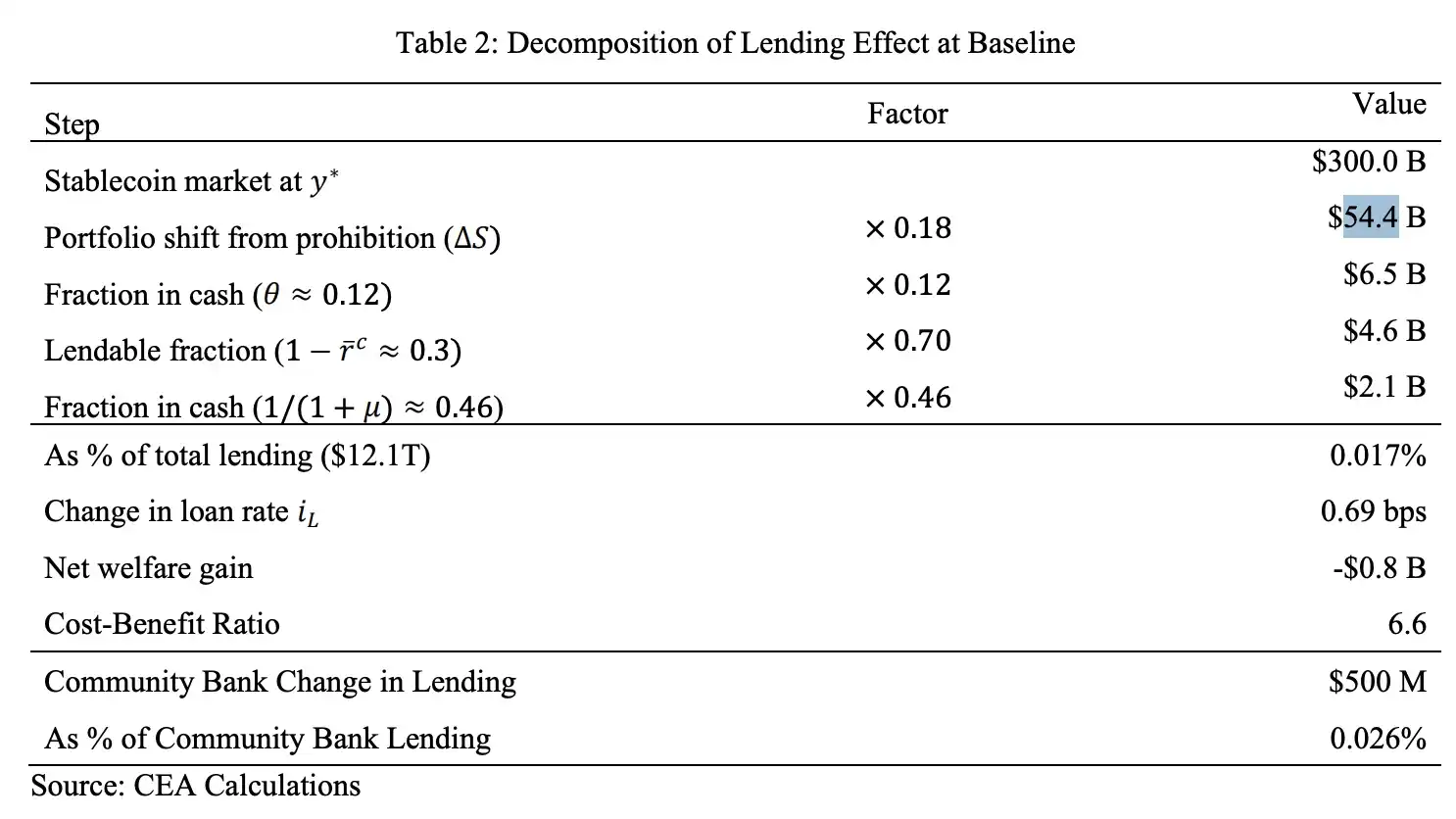
Second checkpoint: Out of this $54.4 billion, how much actually changes bank lending capacity? Only the 12% (in the case of USDC) portion, which is about $6.5 billion. The other 88% was circulating in the Treasury market before and after the ban, having no net impact on bank lending capacity.

Third checkpoint: Can the $6.5 billion entering banks be fully lent out? No. Banks need to hold reserves. The current effective reserve ratio in the U.S. banking system is about 30%, leaving 70% as lendable funds. Moreover, the Fed currently maintains an "ample reserves" framework, with banks collectively holding over $1 trillion in excess liquidity buffers—for every new dollar of lending capacity, ultimately less than 50 cents becomes a real loan, with the rest being actively absorbed by banks into their liquidity buffers.

After passing through these three checkpoints, $54.4 billion becomes $2.1 billion, only 0.02% of total loans (about $12 trillion).

Then calculate the cost on the other side: stablecoin holders lose the approximately 3.5% annualized yield they could have obtained, resulting in a net welfare loss of about $800 million per year.

In the CEA's words, the cost-benefit ratio of this ban is 6.6, meaning the cost is 6.6 times the benefit, making it very inefficient.

How Was That $1.5 Trillion Calculated?

Since the White House model gives $2.1 billion, where did the original $1.5 trillion come from?

The CEA traces its origins in the report. Nigrinis's (2025) estimate directly borrowed the model established by Whited, Wu, and Xiao (2023) for Central Bank Digital Currency (CBDC)—CBDC, as a liability of the Fed, would directly withdraw deposits from the commercial banking system; for every dollar entering, bank loans decrease by about 20 cents. Nigrinis directly applied this multiplier to the stablecoin scenario, while assuming stablecoins would expand massively after offering competitive yields, ultimately推算 (推算 - calculated/derived) the $1.5 trillion loan contraction.

The problem is, there is an essential difference between CBDC and stablecoins: CBDC is a central bank liability; deposits entering it leave the commercial banking system. The reserves of stablecoins mostly flow back to commercial banks through the Treasury market. Nigrinis's model did not track where this money went; it only saw deposits decreasing at one bank, not increasing at another.

This is the fundamental difference between partial equilibrium and general equilibrium. Mistaking the loss of one bank for the loss of the entire system naturally leads to an error of orders of magnitude.

Another Overlooked Account

The report specifically points out an effect not covered by the model but working in the opposite direction: stablecoins' overseas demand for U.S. Treasury bonds.

Over 80% of stablecoin transactions occur outside the U.S.,背后是 (behind which are) ordinary users in countries with unstable currencies using dollar stablecoins as savings tools. This group supports real demand for U.S. Treasury bonds; IMF data shows that the scale of U.S. Treasury bonds held by stablecoin issuers has surpassed that of Saudi Arabia. BIS research shows that every $3.5 billion inflow into stablecoins can depress the 3-month Treasury yield by 5 to 8 basis points. If the ban suppresses stablecoin adoption, this overseas demand channel contracts, U.S. Treasury financing costs rise, and this cost might directly offset that tiny increment on the bank lending side.

So, what does all this actually illustrate?

It's not that stablecoins have no impact on banks, but rather that the source of that impact, to a very large extent, is not "whether they can pay interest." The真正关键的 (truly crucial) thing is what proportion of the stablecoin issuer's reserves are placed in that must-be-100%-reserved lockbox. If regulations push this proportion higher in the future, the impact would才开始变得显著 (begin to become significant).

Regarding the ban on paying interest, for bank lending, the cost-benefit ratio is 6.6; for the stablecoin ecosystem, it cuts off its ability to provide competitive yields to ordinary users; for U.S. Treasury financing, it might even be counterproductive.

One piece of legislation, with no clear beneficiary, but with clear losers. This is what is truly thought-provoking about this report.


Пов'язані питання

QWhat was the original claim made by economist Andrew Nigrinis regarding stablecoin interest and bank lending?

AAndrew Nigrinis claimed that if stablecoins could pay interest, bank loans could be reduced by $1.5 trillion.

QAccording to the White House CEA report, what is the estimated impact on bank lending from banning stablecoin interest payments?

AThe CEA report estimates that banning stablecoin interest payments would only increase bank lending by $2.1 billion, not $1.5 trillion.

QWhat is the key difference between a CBDC and a stablecoin that the CEA report highlights to explain the discrepancy in the estimates?

AThe key difference is that a CBDC is a central bank liability that removes deposits from the commercial banking system, while stablecoin reserves largely flow back into the commercial banking system through the Treasury market.

QWhat percentage of Circle's USDC reserves are held in Treasury bonds and repurchase agreements, according to the article?

A88% of Circle's USDC reserves are held in Treasury bonds and repurchase agreements.

QWhat unintended consequence does the article suggest could result from suppressing stablecoin adoption through an interest ban?

ASuppressing stablecoin adoption could reduce foreign demand for U.S. Treasury bonds, potentially increasing U.S. Treasury financing costs.

Пов'язані матеріали

Single-Day Plunge of 30%, Arthur Hayes Suddenly Liquidates: Why Did ZEC Get Exploded by Security Issues?

On June 5th, Zcash founder Zooko Wilcox disclosed a critical soundness vulnerability in the project's latest Orchard privacy pool. This flaw, found in the elliptic curve multiplication constraints, could allow an attacker to create unlimited counterfeit ZEC within the shielded pool, with transactions appearing valid. The vulnerability was discovered in late May by security researcher Taylor Hornby, who utilized Anthropic's new Opus 4.8 AI model for a targeted audit. The Zcash ecosystem had already performed an emergency network upgrade to patch the issue. However, the detailed disclosure triggered severe market panic, causing ZEC's price to plummet over 30% in a single day. Notably, prominent investor Arthur Hayes announced he had sold his entire ZEC position following the news. The incident starkly challenges the "technological trust" narrative central to privacy coins. Despite years of top-tier cryptographic audits, the bug persisted until uncovered with advanced AI-assisted research. This highlights the growing gap between theoretical perfection and practical implementation in privacy technology. The event serves as a industry-wide warning: in an AI-driven security landscape, the assumption that "undiscovered equals safe" is obsolete. It underscores the urgent need for continuous, proactive security practices combining AI audits, formal verification, and rapid response mechanisms.

foresightnews_api1 год тому

Single-Day Plunge of 30%, Arthur Hayes Suddenly Liquidates: Why Did ZEC Get Exploded by Security Issues?

foresightnews_api1 год тому

Breaking the Curse of DeFi Cascading Liquidations, Vitalik Proposes a New Solution

**Vitalik Buterin Proposes New DeFi Design to Eliminate Forced Liquidations** Ethereum co-founder Vitalik Buterin has published a proposal for a new decentralized finance (DeFi) architecture aimed at removing the automatic liquidation mechanisms prevalent in current lending protocols. The core idea involves creating synthetic assets using options as building blocks, fundamentally avoiding the抵押借贷结构 that triggers forced sell-offs. The proposal responds to a recurring flaw in DeFi: during sharp market downturns, mass自动清算 of under-collateralized positions can exacerbate price declines, creating systemic selling pressure and market instability, as evidenced by recent crypto market volatility. Buterin's model would split an asset like 1 ETH into two option-like derivatives, P and N, pegged to a price index with a set strike price and expiration. At expiry, an oracle determines the settlement price to allocate the underlying ETH between P and N holders. This design eliminates the "cliff" of instant liquidation. Instead, a position's value would gradually drift from its target peg if not actively rebalanced by the user, transferring the rebalancing decision from the protocol to the user or automated tools. A key advantage is the reduced reliance on high-frequency, real-time oracle price feeds, which are vulnerable to manipulation and errors in current systems. The delayed settlement in the options model allows for more robust, fault-tolerant oracle designs. However, significant challenges remain for practical adoption. High transaction costs (slippage) from frequent rebalancing on automated market makers (AMMs) could erode user funds. The model may not be suitable for stablecoins requiring a strict 1:1 dollar peg, as it inherently allows for value drift. Success would depend on developing new liquidity provisioning models and deep markets for these synthetic assets. The proposal represents a fundamental rethinking of DeFi risk management, challenging the industry to explore alternatives to被动集中平仓 rather than merely optimizing existing liquidation processes. It remains a theoretical framework awaiting implementation and testing by development teams.

foresightnews_api1 год тому

Breaking the Curse of DeFi Cascading Liquidations, Vitalik Proposes a New Solution

foresightnews_api1 год тому

Bitcoin's Decline Marks the Transformation of Crypto

Title: The Decline of Bitcoin Marks the Transformation of Crypto While Bitcoin's price recently fell below $70,000, down approximately 45% from its peak, the broader crypto industry is not following it into decline. Instead, crypto is maturing and evolving beyond its dependence on Bitcoin's price movements. Two of Bitcoin's core functions are being usurped. First, AI has captured its role as the primary speculative asset. AI, with its tangible revenue, explosive demand, and massive capital inflows ($700-830 billion in 2024), is siphoning off the speculative "hot money" that once drove Bitcoin. It also contributes to a sustained high-interest-rate environment, further tightening liquidity for assets like Bitcoin. Second, dollar-pegged stablecoins like USDC and USDT have replaced Bitcoin as the crypto market's foundational currency and primary on/off-ramp. Most trading pairs and on-chain transactions are now settled in stablecoins, severing the historical link where all capital inflows had to pass through Bitcoin first. This decoupling allows projects to thrive based on their own fundamentals rather than Bitcoin's price. Examples include Hyperliquid, an on-chain derivatives exchange with annual revenues of $8-13 billion, and prediction market platform Polymarket, valued at $200 billion with $3.65 billion in annual fees. These projects are evaluated on traditional metrics like revenue and user growth. New opportunities are emerging, particularly around privacy. Privacy coins like Zcash (ZEC) are seeing surging demand, while infrastructure like NEAR enables private, cross-chain asset transfers without requiring users to hold a specific token—privacy becomes a universal service layer. In this new paradigm, stablecoins are the universal cash, various project tokens represent equity, and privacy-enabled cross-chain coordination layers (like NEAR) act as the critical infrastructure connecting a fragmented, multi-chain ecosystem. Bitcoin is now just one asset among many. The era where the entire crypto market moved in lockstep with Bitcoin is over. The industry's health should now be judged by project fundamentals—real revenue, active users, and tokenomics that capture value—and the development of the underlying infrastructure enabling a mature, dollar-denominated crypto economy.

foresightnews_api1 год тому

Bitcoin's Decline Marks the Transformation of Crypto

foresightnews_api1 год тому

Lightspark CEO: In Ten Years, Bitcoin Will Be as Invisible as TCP/IP, Yet Power Trillions in Daily Transactions

A decade from now, Bitcoin will function like TCP/IP — invisible yet foundational, supporting trillions in daily transactions globally, according to Lightspark CEO David Marcus. In this future, a coffee shop in Lagos receives instant payment, a manufacturer in São Paulo settles an invoice with a supplier in Ho Chi Minh City, and a freelancer in Bangalore gets paid weekly from an Austin startup — all via Bitcoin's settlement layer, with none of the parties consciously interacting with it. This vision parallels the adoption of open protocols: first driven by necessity where existing systems fail, then scaling rapidly as tools mature and economic benefits become clear. The structural shift begins with wallets. Modern non-custodial wallets, like Spark, allow users to hold dollars, local currency, and Bitcoin in a single address, seamlessly switching between them. This eliminates friction and revolutionizes global custody, moving significant deposits to user-controlled keys not by ideology, but by superior utility. As a result, Bitcoin becomes the default savings layer for billions, as its fixed supply and appreciating value make it a rational choice for savers holding it alongside stablecoins in their everyday wallets. Businesses follow a similar path, from small companies in emerging markets to multinational corporations, holding Bitcoin alongside operational stablecoins. The latest trend is direct Bitcoin transactions for commerce. When both parties hold Bitcoin, transacting in it becomes the simplest option — no conversions, no intermediary currency. This starts in niche areas like high-value B2B settlements but grows as infrastructure makes sending Bitcoin as easy as stablecoins. An accelerating force is AI agents. By 2036, AI agents conducting commerce on behalf of individuals and firms will increasingly choose Bitcoin for settlement. Optimizing for speed, finality, and minimal counterparty risk across jurisdictions, they find Bitcoin's global, neutral, and programmable network ideal for netting and settling obligations. Thus, Bitcoin is becoming the native currency for machine commerce, just as it has become a native savings asset for humans. The global monetary system is being rebuilt from the protocol layer: open infrastructure, default self-custody, Bitcoin settling everything underneath, with stablecoins as the interface. Most users won't think about Bitcoin when they transact — and they won't need to.

foresightnews_api1 год тому

Lightspark CEO: In Ten Years, Bitcoin Will Be as Invisible as TCP/IP, Yet Power Trillions in Daily Transactions

foresightnews_api1 год тому

Торгівля

Спот
Ф'ючерси

Популярні статті

Як купити HOUSE

Ласкаво просимо до HTX.com! Ми зробили покупку Housecoin (HOUSE) простою та зручною. Дотримуйтесь нашої покрокової інструкції, щоб розпочати свою криптовалютну подорож.Крок 1: Створіть обліковий запис на HTXВикористовуйте свою електронну пошту або номер телефону, щоб зареєструвати обліковий запис на HTX безплатно. Пройдіть безпроблемну реєстрацію й отримайте доступ до всіх функцій.ЗареєструватисьКрок 2: Перейдіть до розділу Купити крипту і виберіть спосіб оплатиКредитна/дебетова картка: використовуйте вашу картку Visa або Mastercard, щоб миттєво купити Housecoin (HOUSE).Баланс: використовуйте кошти з балансу вашого рахунку HTX для безперешкодної торгівлі.Треті особи: ми додали популярні способи оплати, такі як Google Pay та Apple Pay, щоб підвищити зручність.P2P: Торгуйте безпосередньо з іншими користувачами на HTX.Позабіржова торгівля (OTC): ми пропонуємо індивідуальні послуги та конкурентні обмінні курси для трейдерів.Крок 3: Зберігайте свої Housecoin (HOUSE)Після придбання Housecoin (HOUSE) збережіть його у своєму обліковому записі на HTX. Крім того, ви можете відправити його в інше місце за допомогою блокчейн-переказу або використовувати його для торгівлі іншими криптовалютами.Крок 4: Торгівля Housecoin (HOUSE)Легко торгуйте Housecoin (HOUSE) на спотовому ринку HTX. Просто увійдіть до свого облікового запису, виберіть торгову пару, укладайте угоди та спостерігайте за ними в режимі реального часу. Ми пропонуємо зручний досвід як для початківців, так і для досвідчених трейдерів.

370 переглядів усьогоОпубліковано 2025.04.27Оновлено 2026.06.02

Як купити HOUSE

Обговорення

Ласкаво просимо до спільноти HTX. Тут ви можете бути в курсі останніх подій розвитку платформи та отримати доступ до професійної ринкової інформації. Нижче представлені думки користувачів щодо ціни HOUSE (HOUSE).

活动图片