The V5 That Never Came: Uniswap Stuck in an Innovation Dilemma

marsbitОпубліковано о 2026-04-11Востаннє оновлено о 2026-04-11

Анотація

ChainCatcher author Gu Yu analyzes Uniswap's perceived slowdown in innovation. Despite its history of rapid iteration—from V1 in 2018 to V4 in 2023—the protocol has not announced a new version since. V4 introduced Hooks, a programmable plugin system allowing custom functions like dynamic fees and MEV protection, but its mainnet launch was delayed to January 2025 due to security audits. V4’s TVL peaked at $1.2 billion but has since fallen to $650 million, only 40% of V3’s TVL. Uniswap expanded to new blockchains and API partnerships but faced challenges with newer initiatives: its appchain, Unichain, saw TVL drop from $900 million to $36 million, and its token auction product (CCA) entered a crowded market. High-profile departures and a 74% drop in UNI token price over the past year reflect operational and growth struggles. A proposal to enable fee mechanisms and burn tokens briefly boosted UNI’s price, but Uniswap’s annualized revenue remains behind competitors like PancakeSwap and Aave. The article concludes that Uniswap’s situation mirrors broader DeFi stagnation but notes its strong security record and leading position in decentralized trading. The future of V5 and its role in driving the next DeFi wave remain uncertain.

Author: Gu Yu, ChainCatcher

In the crypto industry, the pace of innovation is often a key measure of a protocol's vitality. However, Uniswap, which once single-handedly kicked off the DeFi Summer, seems to be slowing down.

Looking back at Uniswap's evolution, its iteration rhythm has always been known for its fast pace: V1, featuring the AMM mechanism, was born in 2018; V2 introduced ERC-20/ERC-20 pairs in 2020; V3 launched concentrated liquidity in 2021; and V4 proposed programmable Hooks in 2023. On average, every 1.5 years, Uniswap would introduce a highly innovative mechanism, reshaping the flow paths of tens of billions of dollars.

However, as of April 2026, nearly three years have passed since the announcement of the V4 proposal, and the market has yet to see any updates on Uniswap's next version.

Currently, Uniswap's product developments still revolve around Uniswap V4, which aims to transform Uniswap from a fixed-function AMM into a highly programmable liquidity platform. The core innovation of this version is Hooks, which are modular, programmable plugins that allow developers to insert custom logic throughout a pool's lifecycle, enabling almost limitless functions such as dynamic fees, limit orders, TWAMM (Time-Weighted Automated Market Maker), MEV protection, loss hedging, custom oracles, continuous clearing auctions (CCA), and more.

In other words, whereas developers previously had to fork Uniswap to implement certain specific functions, leading to the fragmentation of Uniswap's liquidity across many forked DEXs, now developers only need to write a Hook contract to significantly enhance the customizability of Uniswap's liquidity pools.

Although Uniswap announced the specific concept of the V4 version in June 2023, due to security concerns, the version underwent 9 independent audits and a large-scale security competition, delaying its mainnet launch from the initial Q3 2024 to the end of January 2025.

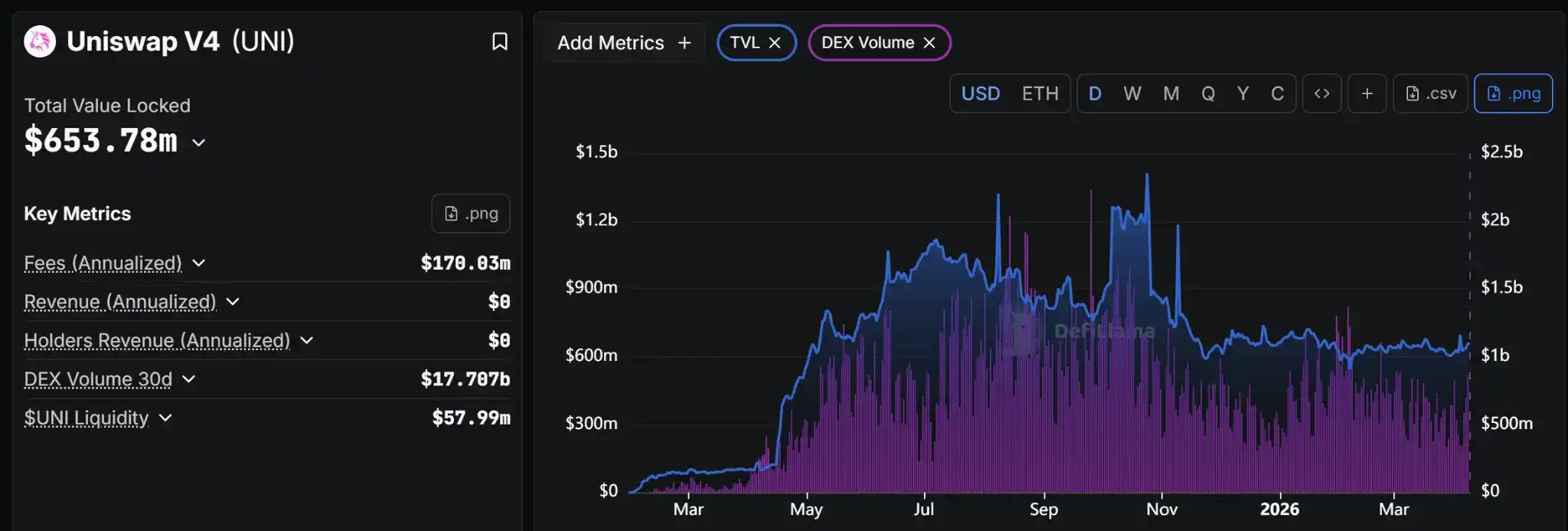
After its launch, the total value locked (TVL) in Uniswap V4 peaked at over $1.2 billion but has since fallen to $650 million, which is still only 40% of the V3 version and also lags behind the V2 version.
Meanwhile, Uniswap has also been "following the rules" in accelerating its expansion in use cases and markets. Over the past six months, Uniswap has launched on blockchains such as Linea, Tempo, X Layer, and Monad to seize market opportunities on emerging chains. On the other hand, Uniswap has been全力 expanding its API partnerships, with recent announcements including adopters like Anchorage Digital, Ledger, Privy, and MetaMask.

Of course, Uniswap has not been without new moves at the product level in recent years. For example, the appchain Unichain and the CCA token auction product have both generated significant market反响.

In February 2025, Uniswap's appchain, Unichain, officially launched on the mainnet, attracting over 90 DeFi protocol integrations. Its TVL peaked at $900 million but has since fallen to $36 million.

At the end of 2025, Uniswap announced the launch of its Continuous Clearing Auction (CCA) function, specifically designed for price discovery and liquidity bootstrapping of new assets, and subsequently partnered with Aztec and Rainbow to complete token sales.

However, it must be pointed out that by 2025, both appchains and token auctions were very "stale" business models in the crypto space. Many projects with stagnant core businesses were exploring "chain issuance" and Launchpad services. Uniswap also "followed suit" and joined this trend, but the practical impact has been very limited.

In earlier years, Uniswap also explored areas like NFT marketplaces and on-chain games through heavy acquisitions of products like Genie and Crypto: The Game. Subsequent data reflected that these were two failed acquisitions.

In the past year, the departures of key personnel such as Growth Lead Sarina Siddhanti, COO Mary Catherine Lader, Head of Strategy & Operations Zach Wong, Chief Legal Officer Katherine Minarik, and Venture Lead Julia Rosenberg also reflect Uniswap's efforts to control operational costs and its struggles with growth.

Uniswap's overall decline is also reflected in the price of its governance token, UNI. Over the past year, the price of UNI fell by over 74% at its worst, dropping below $2 at its lowest point, significantly exceeding the overall decline of mainstream cryptocurrencies. This has sparked criticism from market analysts who call the UNI token "completely worthless."

In September 2025, Arca Chief Investment Officer Jeff Dorman responded to a tweet by Uniswap founder Hayden Adams about the protocol's performance data on X, saying: "We are not bearish on Uniswap, but we are bearish on UNI. In today's market and evolving regulatory environment, it is just a completely meaningless token. Your stance and that of your venture capitalists don't matter. Either switch to a model that distributes revenue or conducts buybacks, or just don't have a token."

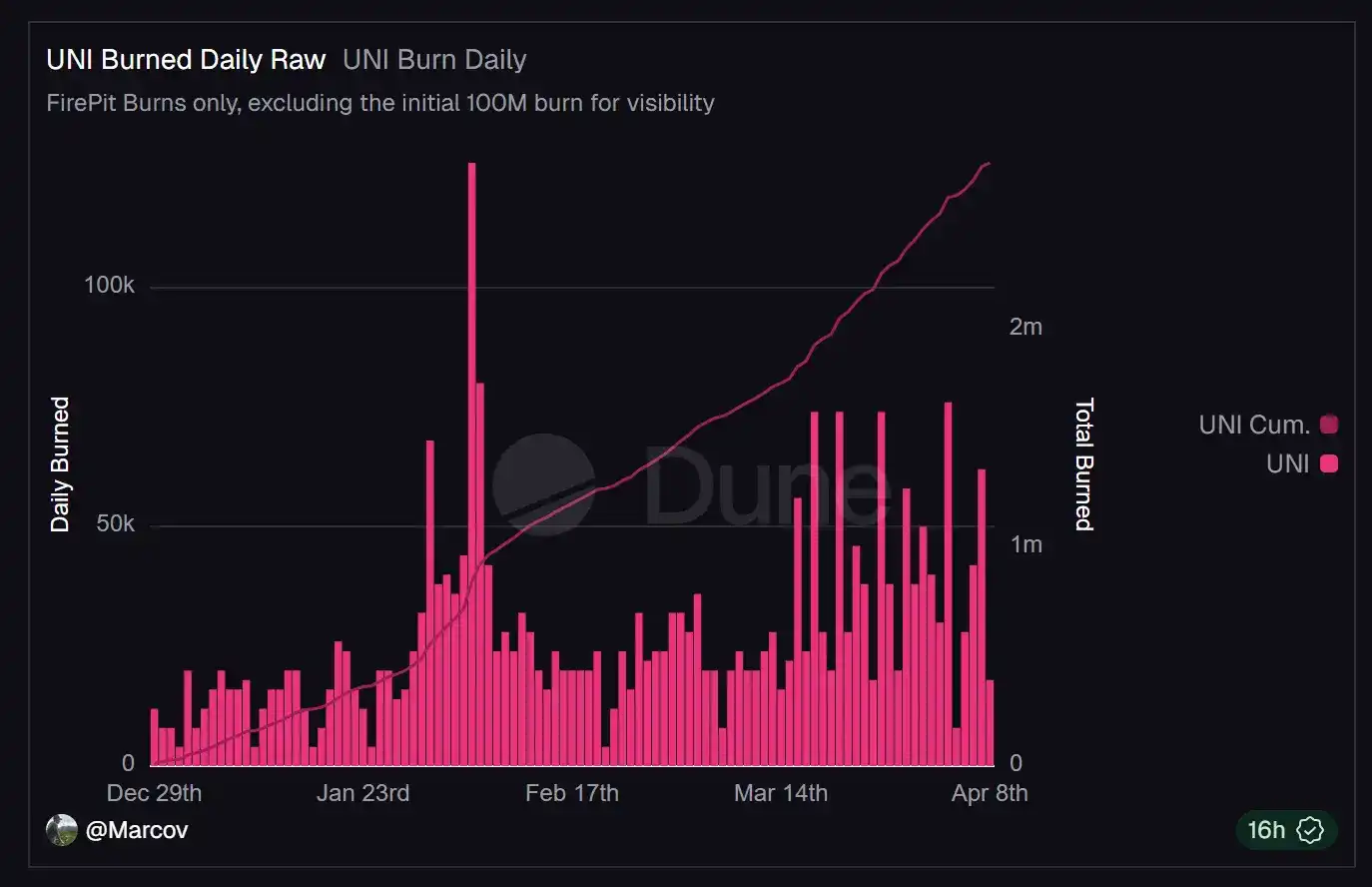
In response to market doubts and to赋予 UNI more value, the Uniswap Foundation proposed in November last year to activate the protocol fee switch for Uniswap V2 and V3 and use the fees to buy back and burn UNI, while also burning 100 million UNI from the treasury. Subsequently, UNI's price surged nearly 38% in a short time, reaching over $9 at its peak.

According to DeFillama data, Uniswap's recent daily fee income ranges between $100,000 and $200,000, with nearly $3.93 million in revenue over the past 30 days. The annualized revenue is approximately $46 million, still lagging behind other DeFi protocols like PancakeSwap, Jupiter, Lido, and Aave.
Uniswap's awkward situation is actually a projection and reflection of the bleak现状 of the DeFi industry: a lack of underlying innovation, exhausted industry narratives, and liquidity being consumed in fragmentation and存量博弈.

However, Uniswap remains one of the very few top DeFi protocols that has not suffered a hack, with no protocol-level fund theft incidents ever occurring. It is also the decentralized exchange protocol with the highest total value locked, and its industry status and user trust remain intact.

But, will there be a Uniswap V5? If so, when will it arrive? Can Uniswap continue to be the engine of the next DeFi Summer?



Пов'язані питання

QWhat is the core innovation of Uniswap V4 and how does it aim to transform the protocol?

AThe core innovation of Uniswap V4 is Hooks, which are modular, programmable plugins that allow developers to insert custom logic throughout a pool's lifecycle. This transforms Uniswap from a fixed-function AMM into a highly programmable liquidity platform, enabling features like dynamic fees, limit orders, TWAMM, MEV protection, and more without requiring a protocol fork.

QAccording to the article, what are the main factors contributing to Uniswap's perceived slowdown in innovation?

AThe main factors include the nearly three-year gap since the V4 announcement with no news of a V5, the delayed mainnet launch of V4 due to extensive security audits, the relatively low TVL adoption of V4 compared to older versions, and the pursuit of 'older' business models like appchains and token auctions instead of groundbreaking new mechanisms.

QHow has the performance of Uniswap's governance token, UNI, reflected the protocol's recent challenges?

AThe UNI token price fell by over 74% in a year, dropping below $2, which was a steeper decline than the overall market for major cryptocurrencies. This performance sparked criticism that the token lacked real value, leading to a proposal to activate fee switches for revenue generation and a token burn to try and increase its value.

QWhat two major initiatives did Uniswap launch in 2025, and how successful were they?

AIn 2025, Uniswap launched the Unichain appchain, which initially attracted over 90 DeFi integrations but saw its TVL plummet from a high of $900 million to $36 million. It also launched a Continuous Clearing Auction (CCA) feature for token launches, partnering with projects like Aztec and Rainbow.

QDespite its current challenges, what key strengths does the article acknowledge that Uniswap still possesses?

AThe article acknowledges that Uniswap remains one of the few major DeFi protocols to have never suffered a hack, has the highest Total Value Locked (TVL) among decentralized exchanges, and maintains its industry status and user trust.

Пов'язані матеріали

Agent Race Ends, Super Workbench Takes Over

The era of fragmented AI agents is ending. Over the past month, China's tech giants—Tencent, Alibaba, and ByteDance—have simultaneously shifted strategy: instead of launching new, standalone AI agents, they are consolidating their various agent projects into unified "super workbenches." Tencent integrated its QClaw teams into WorkBuddy, a strategic product hailed as a potential third flagship after QQ and WeChat. Alibaba is merging its QoderWork, Wukong, and MuleRun agents into a new "Qianwen Office" platform under DingTalk's leadership. ByteDance rebranded its TRAE SOLO coding agent to TRAE Work, signaling a broader focus on workflow collaboration. This convergence marks a pivotal industry consensus. The initial exploration phase, where companies rapidly built numerous overlapping agents for different scenarios, proved costly and inefficient. With open-source tools eroding technical barriers, competition has shifted from agent creation to resource consolidation and cost control. Historically, platform wars are won not by creating more products, but by simplifying them—as seen with browsers unifying web access and super-apps consolidating services. Now, the "super workbench" aims to become the unified AI entry point for work. This reflects a deeper market realization: the primary audience for AI is no longer just programmers (a market in the tens of millions) but all knowledge workers (a market of billions). The real opportunity lies in augmenting everyday tasks—managing emails, documents, data, and meetings—across the entire workday. The core battleground is becoming control over the primary AI entry point that employees use daily. Tencent's WorkBuddy leverages WeChat and Tencent Docs; Alibaba's Qianwen Office taps into DingTalk's organizational data; ByteDance's TRAE Work integrates with Feishu's workflows. Whoever owns this "super workbench" gains strategic control over orchestrating enterprise data and APIs. This shift is redefining enterprise software. Traditional SaaS applications, valued for their user interfaces, will recede into the background. Their core functionalities will be exposed as standardized "Skills" or APIs for the super workbench's agents to invoke. Software value will shift from selling user seats to charging based on API calls and outcomes delivered. The evolution of agents is moving through clear stages: first as novel standalone products, then as consolidated primary work entry points, and finally as pervasive, invisible capabilities embedded into the digital fabric. The recent moves by major tech firms signal the transition from the first stage into the second, accelerating toward the third. In the end, the most successful agent technology may become invisible—like electricity or the HTTP protocol—a fundamental, unnamed infrastructure powering work itself.

marsbit5 хв тому

Agent Race Ends, Super Workbench Takes Over

marsbit5 хв тому

Michael Saylor: 110 Reasons to Oppose BIP-110

Michael Saylor presents 110 arguments against Bitcoin Improvement Proposal (BIP) 110, a soft fork aimed at restricting certain non-monetary data storage uses (like inscriptions) on the Bitcoin blockchain. He acknowledges the proponents' valid concerns—such as node costs, fee pressure, and preserving Bitcoin's monetary focus—but fundamentally disagrees with the proposed solution. Saylor argues that BIP 110 represents a dangerous precedent of using consensus rules to enforce value judgments on transaction validity, moving away from Bitcoin's core principles of neutrality and permissionless innovation. His key objections are organized into eleven categories: 1) It violates neutrality and hard consensus by banning currently valid transactions. 2) It fails to meet the high burden of proof required for a consensus change, lacking concrete data on the alleged crisis. 3) Its seven bundled technical restrictions are overly broad, targeting generic script functionalities and blocking future upgrade paths. 4) It sacrifices compatibility and future optionality by closing off designed upgrade hooks. 5) Its temporary rules add significant complexity (grandfathering, expiry states) without sufficient justification. 6) The economic and security impacts, particularly on miner revenue and fee markets, are uncertain and unmodeled. 7) Superior, market-based tools (fee markets, relay/mining policies) already exist to manage blockchain load. 8) It stifles innovation by creating a chilling effect for developers. 9) Its modified activation mechanism (55% threshold, forced signaling) is aggressive and risks network splits. 10) The precedent it sets—using consensus to suppress disliked but legal uses—is more dangerous than the problem it aims to solve. 11) A better path exists: improving measurements, refining resource-based policies, and allowing market forces to work. Saylor concludes that Bitcoin's strength lies in its neutral rules, open markets, and hard consensus. Changing these foundational elements to target specific use cases is an unnecessary and risky "iatrogenic" intervention. He advocates for guarding Bitcoin's neutrality rather than acting as its redeemer.

marsbit21 хв тому

Michael Saylor: 110 Reasons to Oppose BIP-110

marsbit21 хв тому

Торгівля

Спот
活动图片
