The V5 That Never Came: Uniswap Stuck in an Innovation Dilemma

marsbitОпубліковано о 2026-04-11Востаннє оновлено о 2026-04-11

Анотація

ChainCatcher author Gu Yu analyzes Uniswap's perceived slowdown in innovation. Despite its history of rapid iteration—from V1 in 2018 to V4 in 2023—the protocol has not announced a new version since. V4 introduced Hooks, a programmable plugin system allowing custom functions like dynamic fees and MEV protection, but its mainnet launch was delayed to January 2025 due to security audits. V4’s TVL peaked at $1.2 billion but has since fallen to $650 million, only 40% of V3’s TVL. Uniswap expanded to new blockchains and API partnerships but faced challenges with newer initiatives: its appchain, Unichain, saw TVL drop from $900 million to $36 million, and its token auction product (CCA) entered a crowded market. High-profile departures and a 74% drop in UNI token price over the past year reflect operational and growth struggles. A proposal to enable fee mechanisms and burn tokens briefly boosted UNI’s price, but Uniswap’s annualized revenue remains behind competitors like PancakeSwap and Aave. The article concludes that Uniswap’s situation mirrors broader DeFi stagnation but notes its strong security record and leading position in decentralized trading. The future of V5 and its role in driving the next DeFi wave remain uncertain.

Author: Gu Yu, ChainCatcher

In the crypto industry, the pace of innovation is often a key measure of a protocol's vitality. However, Uniswap, which once single-handedly kicked off the DeFi Summer, seems to be slowing down.

Looking back at Uniswap's evolution, its iteration rhythm has always been known for its fast pace: V1, featuring the AMM mechanism, was born in 2018; V2 introduced ERC-20/ERC-20 pairs in 2020; V3 launched concentrated liquidity in 2021; and V4 proposed programmable Hooks in 2023. On average, every 1.5 years, Uniswap would introduce a highly innovative mechanism, reshaping the flow paths of tens of billions of dollars.

However, as of April 2026, nearly three years have passed since the announcement of the V4 proposal, and the market has yet to see any updates on Uniswap's next version.

Currently, Uniswap's product developments still revolve around Uniswap V4, which aims to transform Uniswap from a fixed-function AMM into a highly programmable liquidity platform. The core innovation of this version is Hooks, which are modular, programmable plugins that allow developers to insert custom logic throughout a pool's lifecycle, enabling almost limitless functions such as dynamic fees, limit orders, TWAMM (Time-Weighted Automated Market Maker), MEV protection, loss hedging, custom oracles, continuous clearing auctions (CCA), and more.

In other words, whereas developers previously had to fork Uniswap to implement certain specific functions, leading to the fragmentation of Uniswap's liquidity across many forked DEXs, now developers only need to write a Hook contract to significantly enhance the customizability of Uniswap's liquidity pools.

Although Uniswap announced the specific concept of the V4 version in June 2023, due to security concerns, the version underwent 9 independent audits and a large-scale security competition, delaying its mainnet launch from the initial Q3 2024 to the end of January 2025.

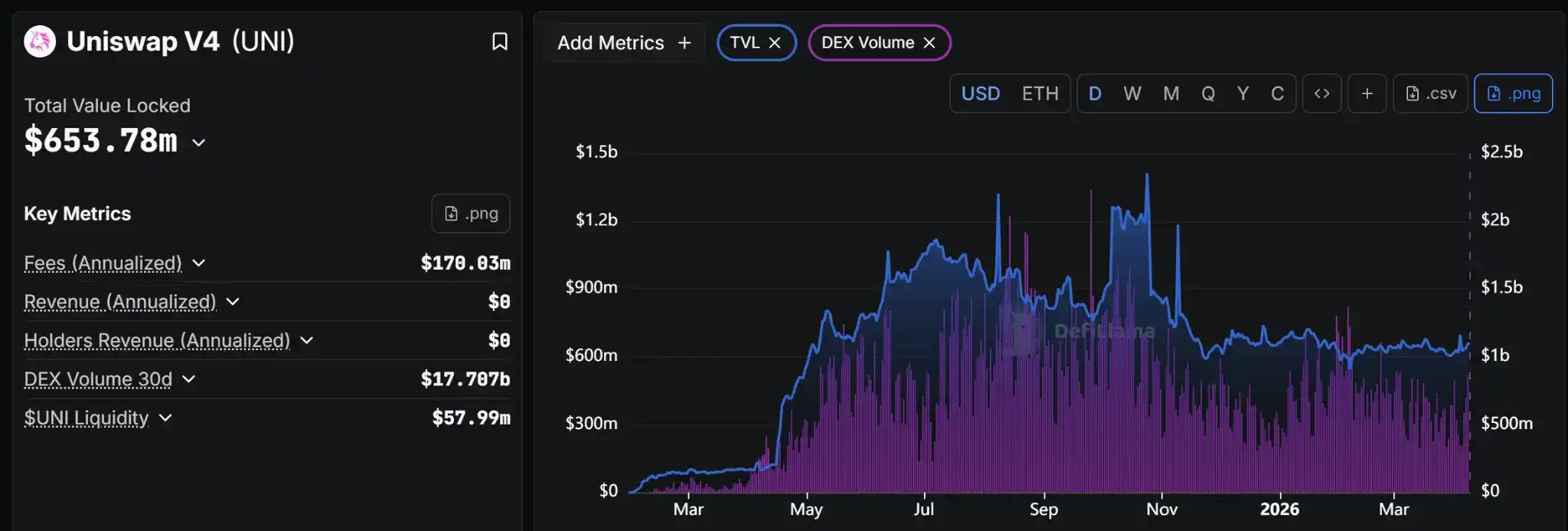
After its launch, the total value locked (TVL) in Uniswap V4 peaked at over $1.2 billion but has since fallen to $650 million, which is still only 40% of the V3 version and also lags behind the V2 version.
Meanwhile, Uniswap has also been "following the rules" in accelerating its expansion in use cases and markets. Over the past six months, Uniswap has launched on blockchains such as Linea, Tempo, X Layer, and Monad to seize market opportunities on emerging chains. On the other hand, Uniswap has been全力 expanding its API partnerships, with recent announcements including adopters like Anchorage Digital, Ledger, Privy, and MetaMask.

Of course, Uniswap has not been without new moves at the product level in recent years. For example, the appchain Unichain and the CCA token auction product have both generated significant market反响.

In February 2025, Uniswap's appchain, Unichain, officially launched on the mainnet, attracting over 90 DeFi protocol integrations. Its TVL peaked at $900 million but has since fallen to $36 million.

At the end of 2025, Uniswap announced the launch of its Continuous Clearing Auction (CCA) function, specifically designed for price discovery and liquidity bootstrapping of new assets, and subsequently partnered with Aztec and Rainbow to complete token sales.

However, it must be pointed out that by 2025, both appchains and token auctions were very "stale" business models in the crypto space. Many projects with stagnant core businesses were exploring "chain issuance" and Launchpad services. Uniswap also "followed suit" and joined this trend, but the practical impact has been very limited.

In earlier years, Uniswap also explored areas like NFT marketplaces and on-chain games through heavy acquisitions of products like Genie and Crypto: The Game. Subsequent data reflected that these were two failed acquisitions.

In the past year, the departures of key personnel such as Growth Lead Sarina Siddhanti, COO Mary Catherine Lader, Head of Strategy & Operations Zach Wong, Chief Legal Officer Katherine Minarik, and Venture Lead Julia Rosenberg also reflect Uniswap's efforts to control operational costs and its struggles with growth.

Uniswap's overall decline is also reflected in the price of its governance token, UNI. Over the past year, the price of UNI fell by over 74% at its worst, dropping below $2 at its lowest point, significantly exceeding the overall decline of mainstream cryptocurrencies. This has sparked criticism from market analysts who call the UNI token "completely worthless."

In September 2025, Arca Chief Investment Officer Jeff Dorman responded to a tweet by Uniswap founder Hayden Adams about the protocol's performance data on X, saying: "We are not bearish on Uniswap, but we are bearish on UNI. In today's market and evolving regulatory environment, it is just a completely meaningless token. Your stance and that of your venture capitalists don't matter. Either switch to a model that distributes revenue or conducts buybacks, or just don't have a token."

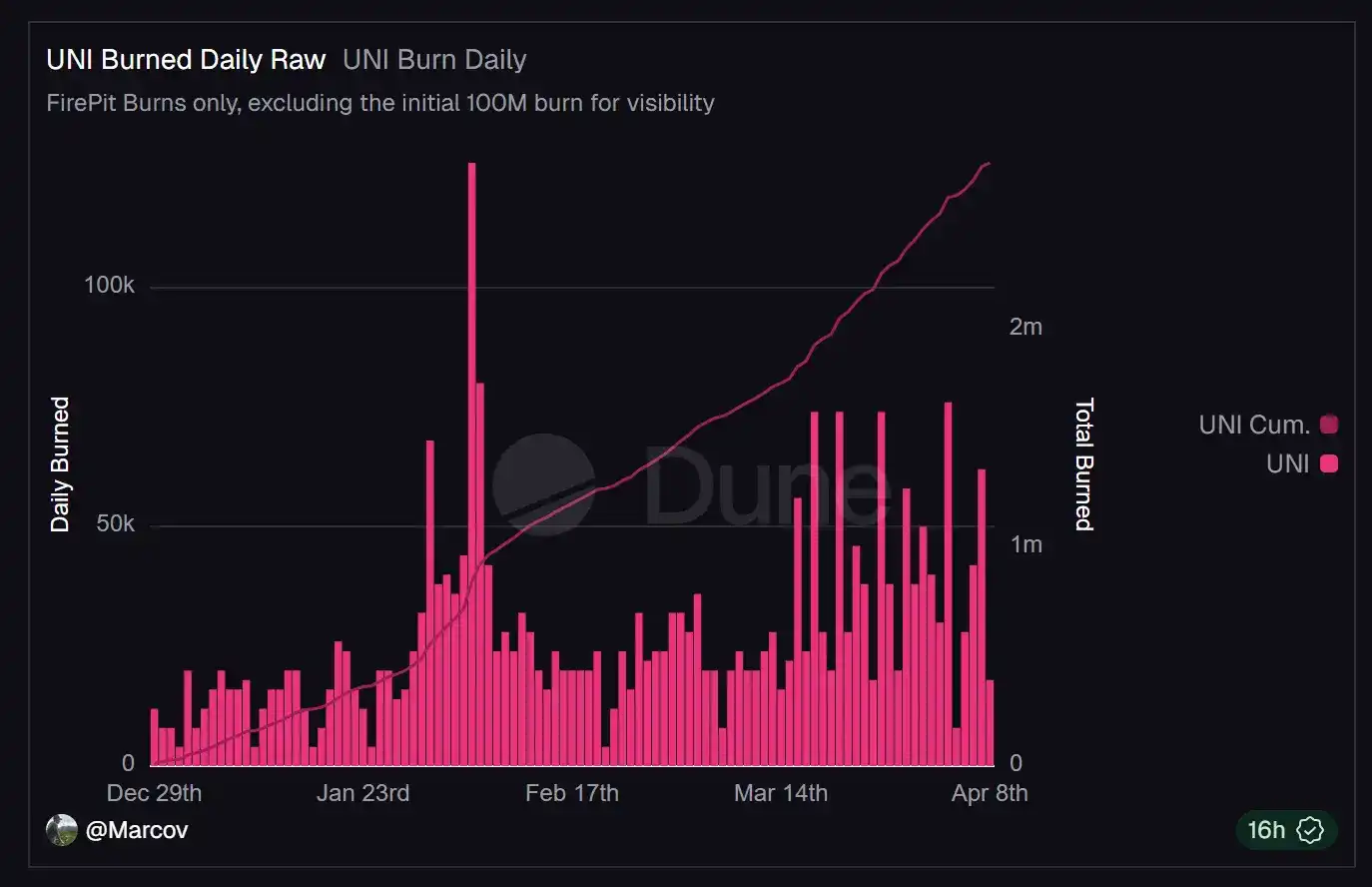
In response to market doubts and to赋予 UNI more value, the Uniswap Foundation proposed in November last year to activate the protocol fee switch for Uniswap V2 and V3 and use the fees to buy back and burn UNI, while also burning 100 million UNI from the treasury. Subsequently, UNI's price surged nearly 38% in a short time, reaching over $9 at its peak.

According to DeFillama data, Uniswap's recent daily fee income ranges between $100,000 and $200,000, with nearly $3.93 million in revenue over the past 30 days. The annualized revenue is approximately $46 million, still lagging behind other DeFi protocols like PancakeSwap, Jupiter, Lido, and Aave.
Uniswap's awkward situation is actually a projection and reflection of the bleak现状 of the DeFi industry: a lack of underlying innovation, exhausted industry narratives, and liquidity being consumed in fragmentation and存量博弈.

However, Uniswap remains one of the very few top DeFi protocols that has not suffered a hack, with no protocol-level fund theft incidents ever occurring. It is also the decentralized exchange protocol with the highest total value locked, and its industry status and user trust remain intact.

But, will there be a Uniswap V5? If so, when will it arrive? Can Uniswap continue to be the engine of the next DeFi Summer?



Пов'язані питання

QWhat is the core innovation of Uniswap V4 and how does it aim to transform the protocol?

AThe core innovation of Uniswap V4 is Hooks, which are modular, programmable plugins that allow developers to insert custom logic throughout a pool's lifecycle. This transforms Uniswap from a fixed-function AMM into a highly programmable liquidity platform, enabling features like dynamic fees, limit orders, TWAMM, MEV protection, and more without requiring a protocol fork.

QAccording to the article, what are the main factors contributing to Uniswap's perceived slowdown in innovation?

AThe main factors include the nearly three-year gap since the V4 announcement with no news of a V5, the delayed mainnet launch of V4 due to extensive security audits, the relatively low TVL adoption of V4 compared to older versions, and the pursuit of 'older' business models like appchains and token auctions instead of groundbreaking new mechanisms.

QHow has the performance of Uniswap's governance token, UNI, reflected the protocol's recent challenges?

AThe UNI token price fell by over 74% in a year, dropping below $2, which was a steeper decline than the overall market for major cryptocurrencies. This performance sparked criticism that the token lacked real value, leading to a proposal to activate fee switches for revenue generation and a token burn to try and increase its value.

QWhat two major initiatives did Uniswap launch in 2025, and how successful were they?

AIn 2025, Uniswap launched the Unichain appchain, which initially attracted over 90 DeFi integrations but saw its TVL plummet from a high of $900 million to $36 million. It also launched a Continuous Clearing Auction (CCA) feature for token launches, partnering with projects like Aztec and Rainbow.

QDespite its current challenges, what key strengths does the article acknowledge that Uniswap still possesses?

AThe article acknowledges that Uniswap remains one of the few major DeFi protocols to have never suffered a hack, has the highest Total Value Locked (TVL) among decentralized exchanges, and maintains its industry status and user trust.

Пов'язані матеріали

Report: Warsh Prepared to Raise Interest Rates in September if Inflation Data Remains Strong in Coming Weeks

Report: Fed Chair Walsh Prepared to Hike Rates in September If Upcoming Inflation Data Stays Strong According to a Financial Times report, Federal Reserve Chair Walsh is prepared to raise interest rates at the September policy meeting if inflation data in the coming weeks remains hot and market expectations for a hike increase. Following this news, short-term US Treasury yields rose. Walsh has adhered to a pared-back communication strategy despite recent market volatility and criticism that his limited guidance has weakened the Fed's inflation-fighting credibility. Sources close to his thinking acknowledge some communication missteps since he took office but insist these won't derail his overall reform agenda. His most significant policy shift has been drastically reducing forward guidance, a practice he has long criticized for boxing in policymakers. Futures markets now price in roughly a 55% chance of a 25-basis-point rate increase in September. Sources indicate that while Walsh has raised the possibility of using balance sheet reduction to tighten policy, interest rates remain the primary tool for now. The Fed's preferred inflation gauge was at 3.7% in June. Walsh is expected to deliver his first major speech at the upcoming Jackson Hole symposium, seen as a key opportunity to clarify his policy framework and address perceived shortcomings in his messaging.

marsbit12 хв тому

Report: Warsh Prepared to Raise Interest Rates in September if Inflation Data Remains Strong in Coming Weeks

marsbit12 хв тому

Chainalysis: Robbery of Crypto Investors Using a 'Soldering Iron' Nets $30 Million in Half a Year

According to a report from Chainalysis, criminals have stolen over $30 million from cryptocurrency investors through violent physical attacks, known as "wrench attacks," in the first half of 2026. This puts the year on track to surpass the record $58 million stolen via such methods in all of 2025. There were 46 documented violent incidents globally by the end of June, up from 40 in the same period of 2025. These attacks, which include kidnappings, home invasions, and hostage-taking, increasingly threaten the personal safety of crypto holders and their families. Only about 26% of these attacks resulted in a ransom being paid, a significant drop from a 49% success rate in 2025. Chainalysis notes the true scale of the problem is likely underreported. The criminals often identify targets in advance through data leaks, social media, or insider information before using low-skilled enforcers for the physical assault. France is a major hotspot, with 30 publicly known incidents by mid-2026, compared to 19 in all of 2025. French authorities have reported over 70 cases, suggesting the real number is even higher. A suspected leak of taxpayer data from the French tax service and a separate breach at crypto tax firm Waltio are considered key factors enabling criminals to find targets. Stolen funds are moved using various methods, from direct transfers to centralized exchanges to more sophisticated techniques involving blockchain bridges, decentralized exchanges, and money-mixing services. The report highlights a lack of a unified industry methodology for tracking these incidents, as evidenced by a different count (52 cases) from analytics firm CertiK for the same period.

cryptonews.ru13 хв тому

Chainalysis: Robbery of Crypto Investors Using a 'Soldering Iron' Nets $30 Million in Half a Year

cryptonews.ru13 хв тому

Shareholders' Accurate Reduction of 1.4 Billion Shares, Under Heavy Performance Pressure, Meish Technology Makes an Emergency Cross-Border Move into Indium Phosphide

Domestic distributed audio-visual and AI vision solutions provider Meish Technology (001229.SZ), despite its AI concept, has shown signs of fatigue shortly after listing, with consecutive declines in revenue and net profit. Amid this pressure, the company is making an urgent foray into the hot "indium phosphide" semiconductor concept. The company moved swiftly, establishing a wholly-owned subsidiary in July and holding an extraordinary shareholders' meeting in August to authorize management to advance the project. This rapid capital operation is seen as a move to tap into the AI computing power industry chain. However, behind this "cross-border self-rescue" lies deep pressure on fundamental performance, precise high-level减持 by a major shareholder who cashed out approximately 142 million yuan just before the stock price peaked, and the new business remaining at a very preliminary "blueprint" stage with no substantive impact on performance yet. Meish Tech's core business of "distributed audio-video control systems" faces intense competition. While maintaining high gross margins, its revenue growth and profit growth have seriously diverged. Although its AI business revenue surged in 2025, it failed to halt the overall profit decline. Since its 2022 IPO, the company's performance has declined, with 2026 first-quarter results even showing a loss. The half-year 2026 forecast predicts a profit plunge of over 70% year-on-year. In this context, the跨界 into the high-tech barrier, capital-intensive indium phosphide field appears more like a gamble driven by market valuation concerns than a strategy based on deep technical积累.

marsbit23 хв тому

Shareholders' Accurate Reduction of 1.4 Billion Shares, Under Heavy Performance Pressure, Meish Technology Makes an Emergency Cross-Border Move into Indium Phosphide

marsbit23 хв тому

Just 3.5 Months After Its Founding, It Started Making External Investments: The Embodied AI Sector Is Collectively 'Investing While Fundraising'

A counterintuitive trend is emerging in China's embodied AI sector: numerous startups that are still actively raising capital themselves are now making strategic investments in other companies. An analysis of 29 such enterprises reveals a pattern of "fundraising while investing," where companies, often still in early funding rounds, rapidly deploy capital into the ecosystem. These 29 investment entities, primarily based in the Pearl River Delta and Yangtze River Delta regions, have executed over 125 investment deals. Notably, 17 of them (59%) are humanoid robot manufacturers, making them the most active investors. The trend shows that newer companies are investing faster; firms founded after 2023 made their first external investment in an average of just 22.8 months, with one company, Poke Robotics, doing so within 3.8 months of its founding. Zhiyuan Robot (智元机器人) stands out as the most active corporate venture capital (CVC) player, completing 37 investments in 23 months. A more complex, networked investment structure is also forming, where companies like Lingchu Intelligent (灵初智能) and Lingxin Qiaoshou (灵心巧手), which received investments from larger players, have themselves become active investors, extending the strategic reach of capital down the supply chain. This collective shift from a few large players to widespread participation signals a strategic move to use capital as a lever to accelerate industry consolidation. Companies are seeking to quickly integrate critical supply chain elements—such as dexterous hands, joint motors, and AI data platforms—into their ecosystems to gain a competitive edge in a rapidly evolving, highly contested market window. The strategy aims to compress the decade-long process of traditional supply chain integration into just a few years, though it carries risks related to technology bets and ongoing capital burn. As the sector's IPO pipeline grows, this "fundraise and invest" model may soon become a standard industry practice.

marsbit26 хв тому

Just 3.5 Months After Its Founding, It Started Making External Investments: The Embodied AI Sector Is Collectively 'Investing While Fundraising'

marsbit26 хв тому

Торгівля

Спот
活动图片