The US Stock Market in 2026, It's Almost Too Easy, and That Makes Me Nervous

marsbitОпубліковано о 2026-05-08Востаннє оновлено о 2026-05-08

Анотація

The U.S. stock market's performance in 2026, particularly in the semiconductor memory sector, has generated significant returns that make some investors uneasy. A popular sentiment contrasts the perceived skill required for success in China's A-shares with the apparent ease of profiting from simply holding U.S. stocks. The primary driver is a global memory chip boom. Stocks like Micron, Seagate, Western Digital, and especially SanDisk (spinning off from WDC in 2025) have skyrocketed, with some gains exceeding 500% or even 2200%. Korean giants Samsung and SK Hynix, dominating their domestic index, have also surged. This rally is fueled by an AI-driven demand surge for memory like HBM (High-Bandwidth Memory), critical for AI chips. Tech giants like Google and Microsoft are placing massive, "unpriced" orders, while analysts continuously upgrade forecasts. SK Hynix reported its 2026 HBM capacity is already sold out. Despite record profits and sky-high margins (e.g., SK Hynix's 72% operating margin), major memory manufacturers are deliberately restricting capital expenditure and capacity expansion, controlling over 90% of DRAM supply. This supply discipline sustains high prices but draws parallels to cartel behavior. The situation presents two narratives. The bullish case sees AI demand as a structural, long-term shift with a prolonged supply gap. The bearish case, exemplified by short-seller Citron's failed bet against SanDisk, warns of a classic commodity cycle where prices e...

「Making money in the A-share market proves you have skill, luck, courage, competence, foresight, insight, and patience.

Making money in the US stock market only proves you have money in the US stock market.」

This has become the reality for most US stock traders in 2026.

Those who quietly bought US memory stocks, uninstalled the app, and went to relax, logged back in one day to find their accounts had multiplied several times over.

Spurred by the US market, A-share memory stocks are also taking off.

Crypto enthusiasts have shifted from discussing memecoins and altcoins to talking about US stocks: 「I live every day in fear of US stocks rising and BTC falling」.

New account holders pose the soul-searching question in group chats: Why is making money in US stocks so easy?

1. Who's Actually Rising in the US Stock Market?

The clear capital theme in the 2026 global market is storage.

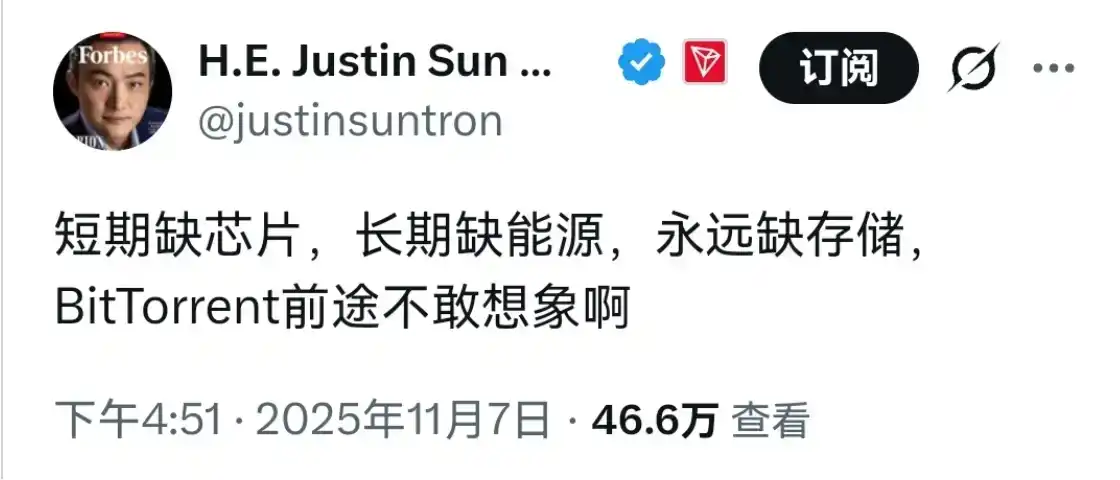
Justin Sun was among the first to tout the storage sector in late 2025.

As netizens calculated, if you had bought US memory-related stocks at the time Sun made his call:

If you bought Micron, you'd be up +222%; if you bought Seagate, up +256%; if you bought Western Digital, up +280%; if you bought SanDisk, up +515%.

If you had invested 500,000 yuan in SanDisk stock a year ago, you would now have 15 million yuan.
What exactly is 'storage'?

Memory chips are the components in computers and phones responsible for 'remembering' things, divided into two types: DRAM handles short-term memory, used to temporarily store data while programs run; NAND handles long-term memory, where your phone's photos and files are stored. Choosing between 128G and 256G for a phone—that capacity is NAND.

Globally, the companies capable of producing these two things number no more than five.

The stocks of these five companies have surged this way over the past year:

SanDisk, spun off from Western Digital in February 2025, an old company making USB drives and SSDs, saw its stock price peak at a 22-fold increase.

Micron, a cyclical stock shunned by fund managers for a decade, rose over 550% in a year, with gross margins pulled from 18% to 56%. Apple's gross margin is about 43%, already considered a high-water mark for profitability in tech. Micron is now higher.

SK Hynix is up 123% this year. Samsung is up 94%.

Seagate, Western Digital, both at all-time highs.

Then there's South Korea.

Samsung and SK Hynix together account for over 30% of the weighting of South Korea's KOSPI index. In 2025, they drove the entire Korean stock market up 76%, clinching the annual champion title among major global indices.

Two memory makers' explosive performance lifted an entire nation's stock market.

On the price side, it's even more direct. DDR4 memory chips, $1.45 at the start of 2025, peaked at $17 in February 2026, an almost 12-fold increase in a year. Kingston 16GB memory sticks in Huaqiangbei rose from 200 yuan to 800 yuan. Part of the reason your recent phone or computer purchase was more expensive lies in these stocks you didn't buy.

SK Hynix's Q1 2026 net profit exploded by 398%, with an operating margin of 72%. Samsung Electronics' overall operating profit skyrocketed 755% year-on-year.

Sell 100 yuan worth of memory, 72 yuan is profit, 28 yuan is cost. This isn't doing business anymore; this is mining.

2. Institutions Have Lost Their Minds Even More Than Retail

In a typical market, institutions are the ones in sharp suits, expressionlessly saying "we are bullish long-term on fundamentals," while retail investors are the ones shouting "to the moon!" in group chats.

In the 2025-2026 storage sector, the institutions went crazy first.

Google, Microsoft, Amazon began placing "price-unlimited, quantity-unlimited" open orders with Micron.

The term "price-unlimited" is worth pondering. It means you name your price, we pay it, no haggling. This procurement method usually appears in wartime scenarios when governments buy military supplies.

In 2025-2026, it appeared in tech companies buying memory sticks.

Broadcom locked in supply through 2028.

SK Hynix said at an investor conference: "Our 2026 HBM production capacity is completely sold out."

Completely. The entire year.

HBM is high-end memory specifically designed to work with AI chips. For every AI chip Nvidia sells, a piece of HBM must accompany it. Globally, only SK Hynix, Samsung, and Micron can make HBM, with SK Hynix holding about 57% market share. "Completely sold out" means one of the most critical components in global AI infrastructure has no spares for the entire year of 2026.

Then came the analysts.

Within three months, Wall Street's consensus estimate for SanDisk's 2026 EPS was revised up by 172%. Citigroup predicted a 144% year-on-year increase in the average price of server DRAM in 2026. Nomura said the supercycle would last at least until 2027, with meaningful supply increases earliest in 2028. Melius upgraded Micron to Buy after the stock had already risen hundreds of percent, adding "still 41% upside over the next 12 months," without blushing or losing breath.

DeepMind CEO Demis Hassabis publicly stated that the overall memory supply chain is constrained, hampering massive AI deployment. Intel CEO Dr. Randhir Thakur (Note: The article uses "陈立武", likely a mistake or alias; actual CEO at the time is Pat Gelsinger, but the translation follows the text) said memory shortages won't ease before 2028.

Then SK Hynix secretly filed with the SEC to issue ADRs in the US, aiming to raise up to $15 billion. A company with fully sold-out capacity and a 72% profit margin decided to go raise more money in New York, reasoning that the Korean market gives too low a valuation, while US investors understand AI better and are willing to pay a higher price.

The A-share market followed suit.

DeMingLi hit limit-up, BIWIN Storage surged, Longsys rose 41%. Small player Shannon Semi's Q1 net profit was preliminarily estimated to grow 6714% to 8747%, a quadruple-digit increase. Topics in finance groups shifted from "Is CSI 300 still worth buying?" to "Which to buy, Micron or SK Hynix?" People who didn't know how to spell HBM two months ago started explaining how High Bandwidth Memory works in group chats.

Even many matchmaking groups started discussing memory stocks.

3. The Most Ironic Scene

On February 24, 2026, Citron Research announced it was shorting SanDisk, giving three reasons.

First, memory is cyclical. 2008, 2012, 2018—each period of high profitability ended in a crash. Existing capacity is already double the 2018 peak. Supply release is just a matter of time.

Second, SanDisk sells a commodity.

"Nvidia has a moat; SanDisk is just a commodity." Nvidia's moat is its CUDA software ecosystem; almost all global AI models run on it, making switching costs extremely high.

SanDisk's SSDs? Samsung could make an identical one tomorrow, possibly cheaper.

Third, major shareholder Western Digital is massively selling SanDisk shares at a 25% discount to the market price.

Selling their own stock at a 25% off. Needing cash urgently is one possibility; another is thinking it will be cheaper later. Neither scenario is called being bullish on future prospects.

Two trading days later, SanDisk rebounded and later continued to hit new all-time highs. Citron's report circulated in various finance groups, becoming meme material.

One question was skipped by everyone: Whose accounts did those shares sold at a 25% discount ultimately end up in?

4. Making Money in US Stocks, As Easy as Breathing?

The world's three most profitable memory companies, at the peak of their profits, collectively chose not to expand production.

SK Hynix's 2025 capital expenditure related to HBM fell 50% year-on-year, officially citing concerns about oversupply in 2027. Samsung's 2026 DRAM capacity growth is only about 5%, far below demand growth.

The entire industry's capital expenditure growth is only 14%, while historically during each expansion phase it's typically 30% to 50%.

Three companies controlling 92% of global DRAM capacity simultaneously choosing not to expand production has a name in any other commodity market: supply-side coordination. OPEC did this with oil, resulting in the 1973 oil crisis. The concentration in the memory chip market is even higher than OPEC's; the combined market share of these three is something thirteen oil-producing nations can't achieve.

Investors interpreting "manufacturers' restraint in expansion" as a positive is logically not wrong; prices can indeed be sustained longer. But what this structure means for the buyers on the other end isn't in any analyst report.

Two plausible narratives can be told about this rally.

The first: AI's demand for memory is a structural shift. AI models in the inference era need to remember increasingly long contexts, requiring memory in orders of magnitude more. The three major memory makers control 92% of capacity, new fabs won't be operational until 2027 at the earliest, and the gap won't disappear before then.

The second: It's just like every other time in history. The 2000 dot-com bubble narrative was "the internet changes everything," which was true. The 2008 subprime narrative was "housing prices won't fall nationwide," which also held up based on historical data back then. The real problem is never whether the story is right, but whether the price has already discounted that story.

The memory industry has an ironclad rule, unbroken for 30 years: Prices rise slowly, but fall fast.

During the 2018 supercycle, from peak to halving took less than two quarters.

No one knows which day this cycle's peak will be. Including those selling shares at a 25% discount, or rather, especially those selling shares at a 25% discount, because they are selling chips—and selling chips to those who are currently believing the story is the most efficient.

The last time you bought a phone, upgrading the memory from 128G to 256G cost you an extra three or four hundred yuan. That three or four hundred yuan traveled through an industry chain, distributing profits layer by layer, and a tiny portion of it ultimately appeared in SK Hynix's 72% operating margin, in Samsung's 755% profit growth, and in all those stocks you didn't buy.

It also, of course, finally aggregates into the moment you open any social media app and see others' soul-searching question: Why is making money in US stocks so easy?


Пов'язані питання

QWhat is the main investment theme driving the global capital markets in 2026, according to the article?

AAccording to the article, the main investment theme driving global capital markets in 2026 is the storage sector, specifically storage memory chips.

QHow did the profitability of leading storage companies like SK Hynix compare to that of Apple in 2026, as mentioned in the article?

AThe article states that in 2026, Micron Technology, a leading storage company, achieved a gross margin of 56%, which was higher than Apple's gross margin of approximately 43%. SK Hynix's operating profit margin was reported to be 72%.

QWhy did Citron Research issue a short report on SanDisk in February 2026, and what was the subsequent market reaction?

ACitron Research issued a short report on SanDisk on February 24, 2026. Their main arguments were that the storage sector is cyclical, SanDisk's products are commodities without a strong moat, and its major shareholder, Western Digital, was selling shares at a 25% discount. The market's initial reaction was a price dip, but SanDisk's stock rebounded after two trading days and continued to reach new highs, making the report a subject of memes in financial chat groups.

QWhat is HBM memory, and why is its supply critically tight in 2026?

AHBM (High Bandwidth Memory) is a high-end type of memory specifically designed to work with AI chips, like those from Nvidia. The article explains that in 2026, the supply of HBM was critically tight because SK Hynix, which holds about 57% of the market, stated its entire 2026 HBM production capacity was already sold out for the year. This shortage is a key bottleneck for global AI infrastructure deployment.

QAccording to the article, what is a unique and potentially concerning behavior of the top three storage companies during the 2026 market boom?

AA unique and potentially concerning behavior highlighted in the article is that during the peak of profitability in 2026, the top three global storage companies (Samsung, SK Hynix, and Micron) collectively chose not to significantly expand their production capacity. Their capital expenditure growth was much lower than historical norms during expansion periods. This lack of supply increase, while supporting high prices, creates a market structure reminiscent of coordinated supply-side control, similar to OPEC in the oil market.

Пов'язані матеріали

Fei-Fei Li's Team Clarifies the Concept of 'World Models', Sora Merely a Renderer

"World Models" has become a widely used yet confusing term in AI. To address this, a team led by Fei-Fei Li and World Labs proposed a functional taxonomy based on the Partially Observable Markov Decision Process framework. This taxonomy categorizes systems called "world models" into three distinct projections: Renderers, Simulators, and Planners. Renderers, like OpenAI's Sora and other video generation models, focus on producing photorealistic visual outputs for human perception. They prioritize visual fidelity over physical accuracy. Simulators, such as NVIDIA Omniverse, aim to compute precise future environmental states for computational tasks like engineering analysis or digital twins. Planners, like Vision-Language-Action models, take in observations and goals to output executable actions for robots or agents. The article clarifies that most current "world models," including Sora, are primarily Renderers. They generate convincing visuals but lack the core ability to simulate state transitions based on actions, a key requirement for a true world model in classic reinforcement learning definitions. This conceptual confusion has practical implications, leading to potential misalignment in technology selection, investment, and public understanding of AI capabilities. Clear categorization is crucial. It helps enterprises avoid costly mistakes (e.g., using a renderer for robot training), allows investors to accurately assess markets, and enables researchers to build comparable benchmarks. While future systems may integrate these functions, recognizing current boundaries is essential for honest assessment and progress.

marsbit7 хв тому

Fei-Fei Li's Team Clarifies the Concept of 'World Models', Sora Merely a Renderer

marsbit7 хв тому

Bloomberg Uncovered: How Do China's Wealthy Circumvent the Annual $50,000 Limit to Transfer Assets?

**Summary: How Wealthy Chinese Circumvent $50,000 Annual Foreign Exchange Limits** Despite China's strict capital controls, including an annual $50,000 per person foreign exchange quota, an estimated $150 billion in funds still leaves the country annually via various gray and underground channels. This report outlines the evolution of China's "capital wall" and the methods used to bypass it. **The Evolving Capital Controls:** * **Foundation (1994):** The system of "current account convertibility with strict capital account controls" was established. * **Quota Set (2007):** The $50,000 individual annual forex purchase limit was formalized. * **Crackdown Begins (2015-2017):** Following market volatility, enforcement tightened. Banks were required to scrutinize transactions, and channels like using UnionPay cards for Hong Kong insurance premiums or buying overseas property were blocked. * **Digital & Legal Upgrades (2024-2026):** Enhanced algorithms now flag suspicious patterns (e.g., "smurfing"). The Common Reporting Standard (CRS) provides Chinese tax authorities with data on citizens' offshore accounts. Unlicensed cross-border brokers have been targeted. **Five Primary Methods for Moving Capital:** 1. **Underground Banking / "Hawala" (Duiqiao):** The largest-scale method. No money crosses borders. Clients pay RMB to a domestic account; an overseas associate deposits equivalent foreign currency into the client's offshore account. Risks include high fees, account freezes, and legal penalties. 2. **"Smurfing" or "Ant Moving":** Using multiple individuals' $50,000 quotas to pool funds for one offshore recipient. Increasingly detected by anti-money laundering algorithms. 3. **Trade Invoice Manipulation:** Businesses over-invoice imports or under-invoice exports via offshore shell companies, creating a pretext to transfer excess funds abroad under the guise of trade. 4. **Channel Migration:** After a crackdown on internet brokers, funds flow toward more compliant but costly channels like major banks' cross-border wealth management services or Qualified Domestic Institutional Investor (QDII) quotas. 5. **Structural Arrangements:** High-net-worth individuals use complex, high-cost legal structures involving offshore trusts, insurance, and investment migration programs to transfer asset ownership. **Regulatory Response: Focusing on People, Not Just Money** The current strategy extends oversight from enterprises to **individual residents**. Tools like CRS allow retroactive visibility into offshore assets. Cryptocurrencies, once seen as a potential loophole, are now actively monitored and prosecuted as an illegal channel. The underlying driver remains: with significant wealth concentrated among millions of affluent households seeking diversification amid domestic economic shifts, the incentive to move assets offshore persists despite regulatory barriers.

marsbit26 хв тому

Bloomberg Uncovered: How Do China's Wealthy Circumvent the Annual $50,000 Limit to Transfer Assets?

marsbit26 хв тому

Ethereum's Ballmer Moment: As Everyone Is Bearish, the Circulating Supply Is Disappearing

"Ethereum's Ballmer Moment: Circulation Shrinks Amid Bearish Sentiment" Amid widespread bearish sentiment, with prominent figures like Bankless founder David Hoffman selling ETH and young developers flocking to Solana, some argue Ethereum is entering its "Ballmer era"—akin to Microsoft's perceived stagnation under Steve Ballmer. While surface-level criticisms about slow protocol development, cautious leadership, and competitive pressure are valid, underlying fundamentals tell a different story. Approximately 30% of ETH is staked, major holders like BitMine are accumulating, and spot ETFs continue to absorb supply. Regulatory clarity, including the SEC/CFTC's March ruling on staking rewards and the potential passage of the CLARITY Act, is transforming crypto from a regulatory threat into a legitimized framework. This institutionalization, alongside a shrinking circulating supply (with net issuance around 0.23% annually), creates significant buy-side pressure independent of fee-based value capture. The broader crypto total addressable market is expanding through regulated stablecoins, tokenized assets, and institutional adoption. While public chains face competition from permissioned alternatives, the winning model appears to be permissioned assets settling on public chains like Ethereum and Solana. The author advocates a non-maximalist, barbell strategy: holding ETH for its institutional role and supply squeeze, SOL for consumer/throughput trends, BTC as a macro hedge, and a basket of next-gen L1s. Key bullish drivers for ETH include rapid circulation shrinkage, potential Q2 staked ETF approvals, regulatory tailwinds solidifying its role as a default settlement layer, and the optionality of an eventual "Satya moment" leadership shift. Despite bearish consensus, the current setup—where crypto is "not hot" and regulatory groundwork is being laid—presents a compelling investment opportunity. The crypto cycle's focus may have shifted to AI, but blockchain infrastructure is gaining a legal and institutional foothold precisely while attention is elsewhere.

marsbit26 хв тому

Ethereum's Ballmer Moment: As Everyone Is Bearish, the Circulating Supply Is Disappearing

marsbit26 хв тому

Торгівля

Спот
Ф'ючерси
活动图片




