The 'True and False Prosperity' of Perpetual Contracts: Can You See Through It?

marsbitОпубліковано о 2026-02-12Востаннє оновлено о 2026-02-12

Анотація

Perpetual futures (perps) have become a dominant force in crypto trading, with volumes surging to about 75% of spot trading activity. While cumulative perp trading volume doubled to $14 trillion in just the past six months—exceeding the total volume of the previous four years—this growth occurred even as the total crypto market cap fell nearly 40%. However, volume alone can be misleading. To better understand market depth and trader conviction, Open Interest (OI) is a critical metric. OI has tripled from ~$4B last February to ~$13B now, indicating increased capital commitment. The OI-to-volume ratio rose from 0.33x to 0.49x over the past year, though it fluctuated significantly—peaking at ~0.72x mid-year before dropping after a major liquidation event in October. At the protocol level, platforms like Hyperliquid show strong capital efficiency, converting over 45% of daily volume into open positions and generating a take rate of ~3.2 bps. Others, like Aster, prioritize capital retention over fee maximization. The key takeaway is that sustainable growth in perp markets depends not just on high volume, but on growing OI and converting trading activity into sticky, confident capital.

Original Author: Prathik Desai

Compiled and Edited by: BitpushNews

Just when you think finance has become dull, it always manages to surprise. Lately, it seems everyone is reshaping the financial system in ways few anticipated, even those from the entertainment and media industries.

Take Jimmy Donaldson (aka "MrBeast" on YouTube), for example. Not only does he have a snack empire, but he recently acquired a banking app aimed at promoting financial literacy and money management among teens and young adults. Why? Perhaps nothing is more straightforward than monetizing a subscriber base of 466 million with financial products.

This summer, the CME Group, the world's largest derivatives market, will launch single-stock futures, allowing users to trade futures on over 50 top U.S. stocks, including Alphabet, NVIDIA, Tesla, and Meta.

These transformations show how people's ways of engaging with finance are changing. And nothing illustrates this better than the explosion of the Perpetual Markets over the past few years.

Perpetual futures (or Perps) are a type of financial derivative contract that allows market participants to speculate on asset prices without an expiration date. Perps also enable people to express views on assets quickly and cheaply. They are more captivating than traditional markets because they offer instant access and leverage. Unlike traditional markets, they don't require broker onboarding processes, jurisdictional paperwork, or adherence to "traditional" market hours.

Furthermore, on-chain perpetual markets allow any asset (whether traditional or crypto) to be traded in a permissionless, highly leveraged manner. This makes speculation fun, especially when humans can't resist betting on the trajectory of volatile assets outside traditional trading hours. This enables risk to be priced in real-time.

Consider what happened two weeks ago. When traditional and crypto markets crashed simultaneously, traders flocked to Hyperliquid, driving perpetual gold and silver trading into a frenzy. On January 31st, Hyperliquid alone accounted for 2% of the global daily trading volume in its Silver perpetual market, which had been live for less than a month.

This explains why dashboards of perpetual contract trading volume are increasingly dominating crypto communities and forums. Volume is an absolute value. It looks large, refreshes every few minutes, and is perfect for leaderboards. But it misses a key nuance: volume might reflect movement that lacks meaning. A market with high volume might have depth, but it could also be due to rewards and incentives encouraging higher-frequency activity. This activity is often recursive and not very meaningful.

This week, I delved into other metrics of the perpetual trading market. When used alongside trading volume, these metrics add more dimensions and tell a completely different story from volume alone.

Let's begin.

A Few Data Points

The user-friendly interface of perpetual markets makes them a low-barrier, default platform for expressing views across various markets and global assets. The wide selection of highly leveraged derivative trading on both traditional and crypto assets on a single platform has led to perpetual contract volumes surpassing spot trading volumes on decentralized exchanges. From 44% in February 2025, the share of perpetual contract volume has surged to about 75% today (relative to spot volume).

This growth has been particularly significant in the past few months:

  • The cumulative total perpetual trading volume across all platforms over the four years ending July 31, 2025, was $6.91 trillion.
  • In just the past six months, this volume has doubled, reaching $14 trillion.
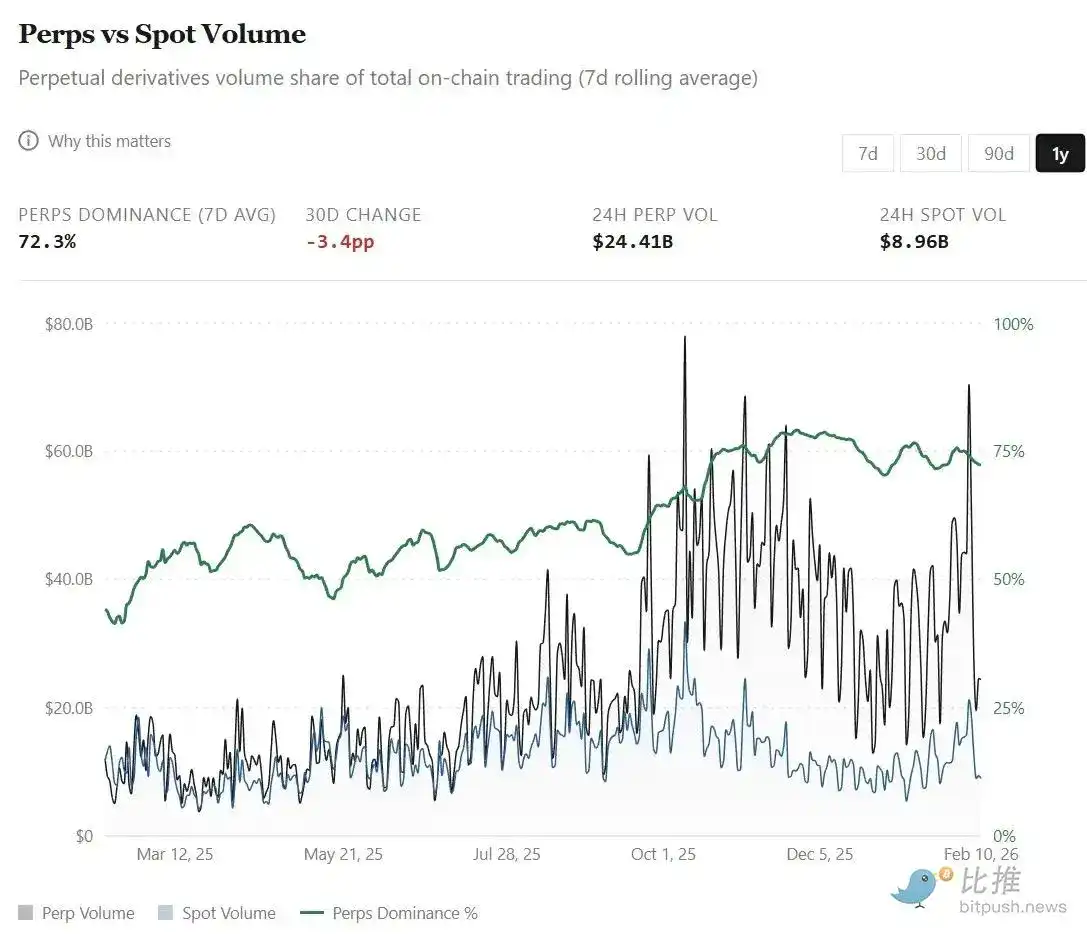
All this growth occurred against the backdrop of the total crypto market capitalization shrinking by nearly 40% between August 1, 2025, and February 9, 2026. This activity indicates that traders are increasingly leaning towards derivative trading, hedging, and short-term positioning, especially when spot markets become highly volatile and bearish.
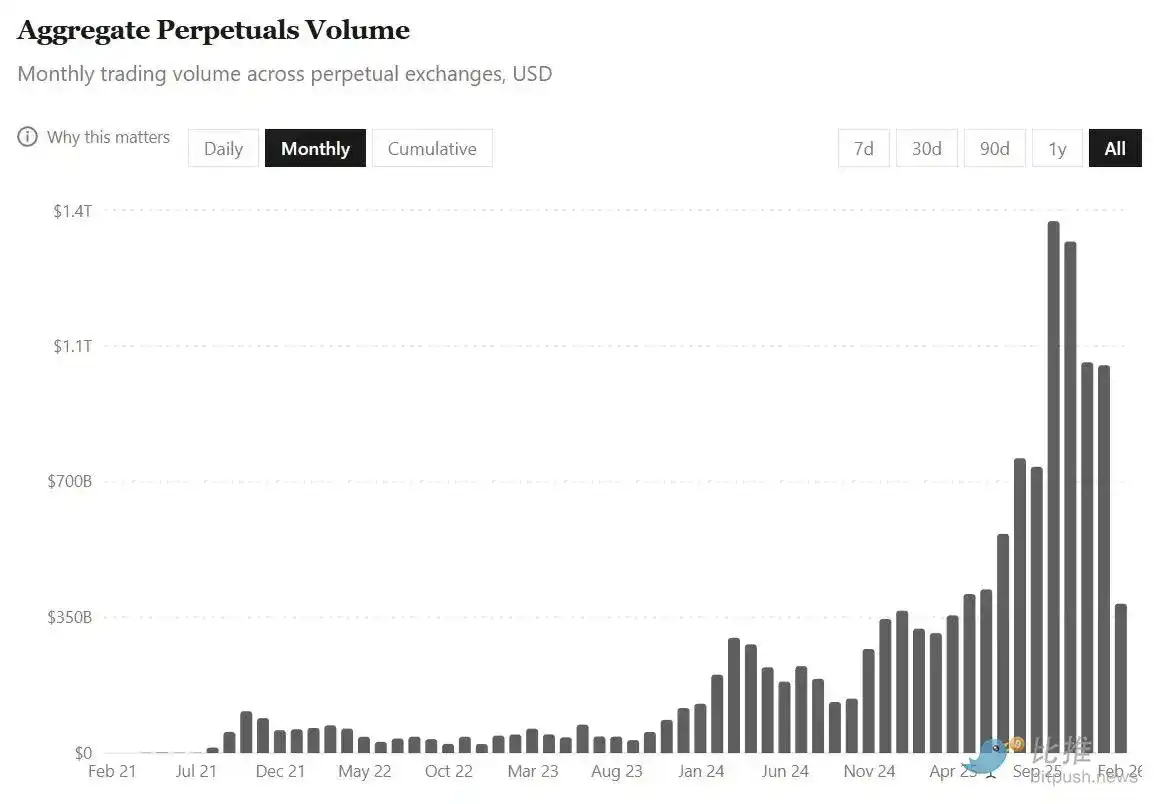
But there's a catch. With such massive activity, it's easy to misread volume metrics. Especially because perpetual trading isn't just about buying and holding assets long-term; it involves repeatedly adjusting bet sizes using leverage over shorter timeframes.

Therefore, when market turnover accelerates rapidly, a question inevitably arises: Do record-breaking volumes reflect more capital inflow, or the same capital cycling faster?

This is where observing Open Interest (OI) becomes meaningful. If volume reflects capital flow, then OI measures outstanding risk exposure. On perpetual exchanges, OI refers to the total dollar value of active, unsettled long and short contracts held by traders.
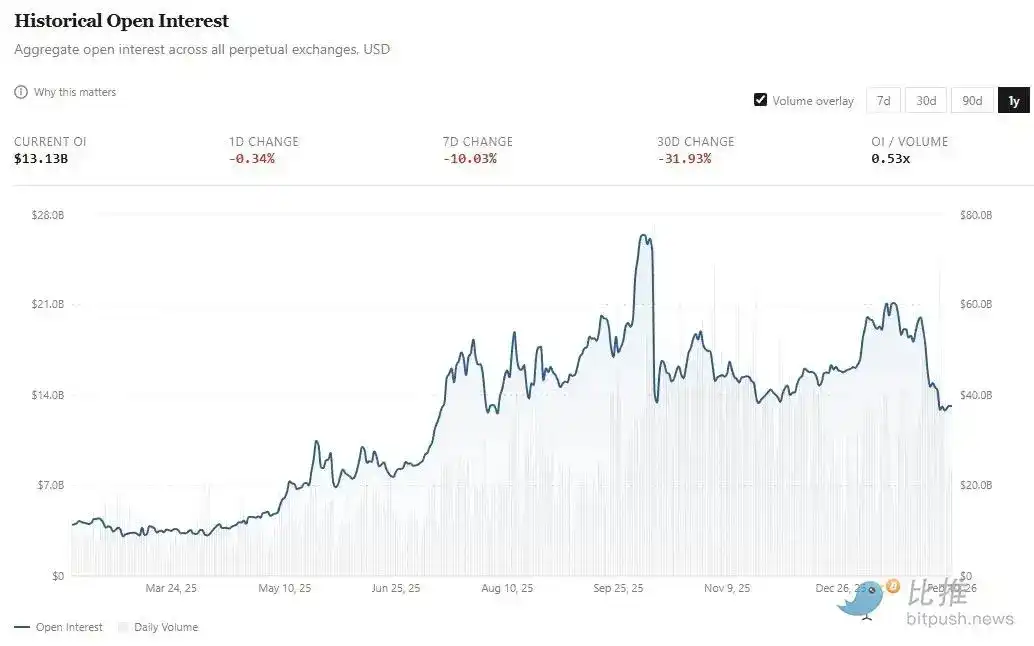
If perpetual trading is being adopted by the mass market, we would hope to see not just larger capital flows but also proportionally growing open interest.

  • Last February, OI averaged around $4 billion;
  • Now, that number has more than tripled to about $13 billion. In fact, the average for the entire January was about $18 billion before dropping roughly 30% in the first week of February.

While perpetual trading volume doubled in the past five months, OI grew by about 50% (from $13B to ~$18B, then back to $13B). To better understand this, I looked at the capital efficiency (the percentage of OI relative to daily volume) over the past year.
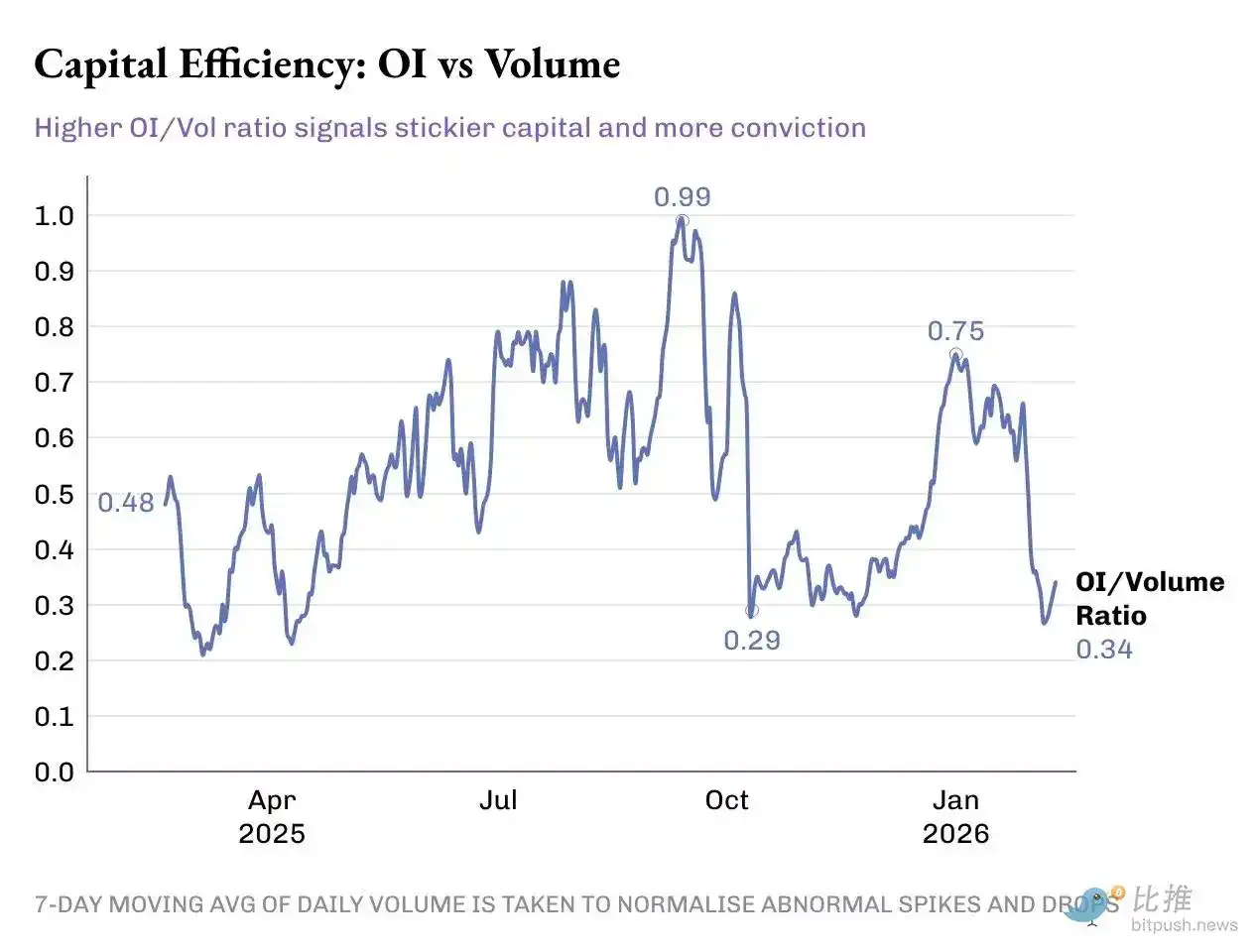
The OI/Volume ratio jumped 50% from last year's 0.33x to 0.49x today. But this progress wasn't smooth; the 50-basis-point increase in this ratio went through multiple peaks and troughs:

Phase 1 (Feb - May 2025): The Quiet Period. The OI/Volume ratio averaged ~0.46x, with average OI of ~$4.8B and average daily volume of ~$11.5B.

Phase 2 (June - Mid-Oct): The Leap. The ratio averaged ~0.72x. During this period, average OI rose to $14.8B, and average daily volume was $23B. This marked not only record-high volumes but also increased risk exposure and greater capital commitment to these derivatives.

Phase 3: Market Reversal. This phase began with the massive liquidation on October 10th, which wiped out over $19B in leveraged positions within 24 hours. From mid-October to late December, the OI/Volume ratio fell to ~0.38x, driven primarily by volume growth while open interest largely stagnated. October, November, and December saw the three highest monthly volumes of 2025, averaging over $1.2 trillion per month. During the same period, OI averaged around $15B, slightly below the previous three-month average.

Protocol Level

Here, I want to add more dimensions at the protocol level for perpetual markets. This helps us understand how efficiently perpetual exchanges convert trading activity into "sticky capital" and revenue.
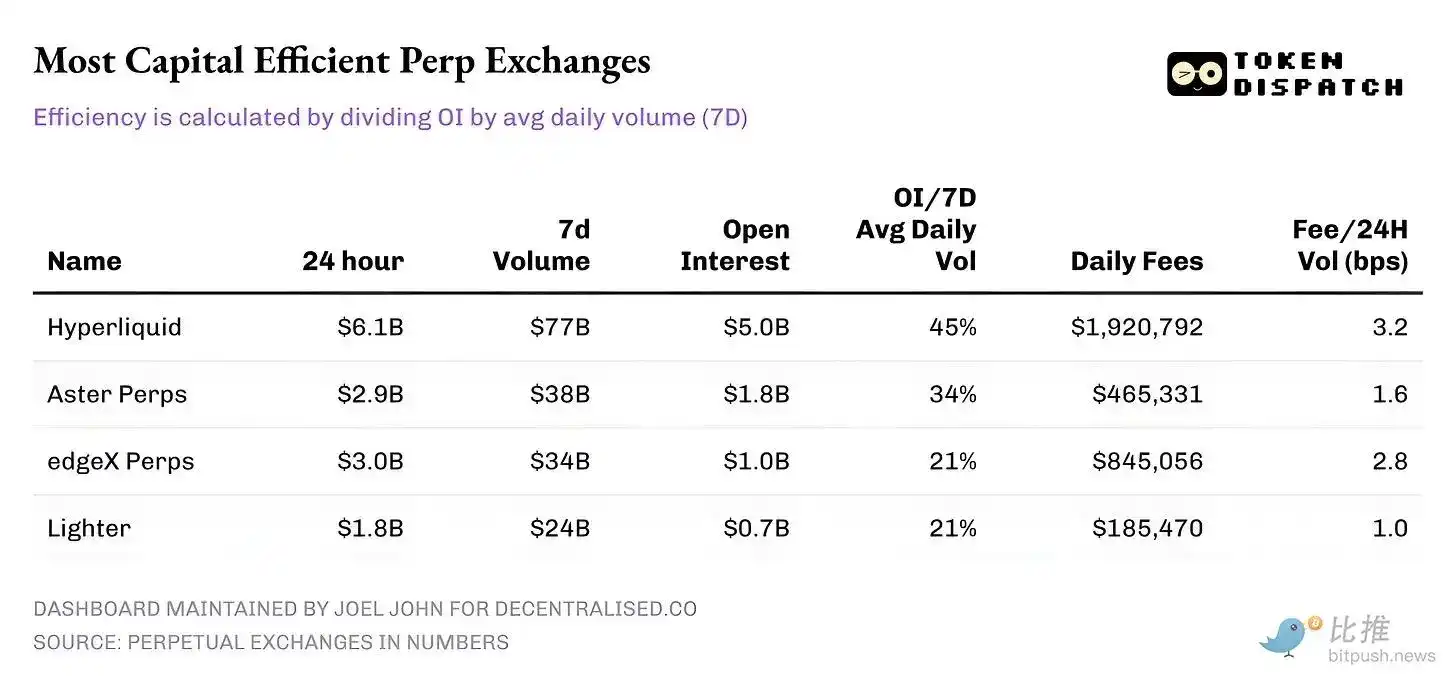
As of February 10th, here's how the top five perpetual exchanges by 24-hour volume performed:

Hyperliquid: Its ratio of OI to 7-day average daily volume is over 45%, able to convert a significant share of volume into lasting positions. This suggests that for every $10 traded on the platform, $4.50 is invested in active positions. This is important because a high OI ratio leads to tighter spreads, deeper liquidity, and confidence in scaling trades without slippage.

Hyperliquid's fee revenue reinforces this story. Its take rate is about 3.2 basis points, converting the largest share of 24-hour volume into fee income.

Aster: Currently ranked second, it maintains a decent capital efficiency (OI/Vol) of 34%, despite having almost half the volume of Hyperliquid. However, its monetization is noteworthy – with a lower take rate (~1.6 bps), Aster clearly prioritizes capital retention on its platform over fee maximization.
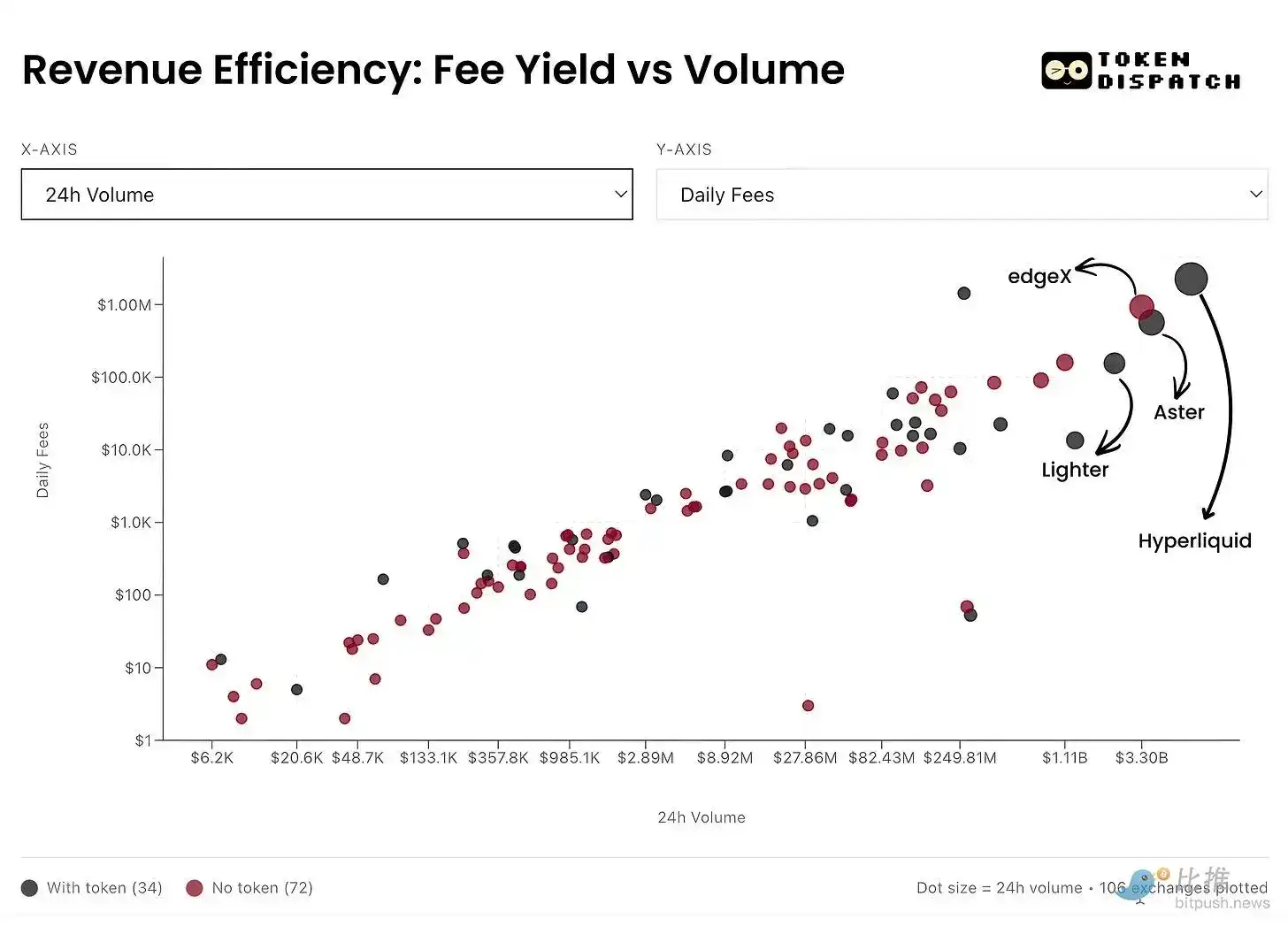
edgeX and Lighter: Both perform similarly on the capital efficiency ladder, with an OI/Vol of 21%. However, edgeX's fee monetization is comparable to Hyperliquid's at 2.8 bps.

Summary

Remarkably, the perpetual contract market today is no longer a simple growth story; it requires a nuanced reading of multiple metrics. At the macro level, volume is exploding: the growth in cumulative perpetual volume over six months exceeded the total of the previous four years. But the picture only becomes clear when OI is read alongside volume.

A clearer victory lies in the growth of the OI/Volume ratio. This is a direct signal that "patient capital" is willing to trust and bet on the variety of products and markets emerging in perpetual trading exchanges.

What's more worth watching in the future is how individual players evolve from here and what they choose to optimize. Over time, exchanges that can optimize "trading conviction" and achieve sustainable monetization will be far more important than those that merely rely on rewards and incentives to dominate volume leaderboards.


Пов'язані питання

QWhat are perpetual futures (Perps) and how do they differ from traditional futures contracts?

APerpetual futures (Perps) are a type of financial derivative contract that allows market participants to speculate on the price of an asset without an expiration date. They differ from traditional futures by offering instant access, leverage, no broker onboarding process, no jurisdictional paperwork, and they do not follow traditional market hours.

QAccording to the article, what key metric should be observed alongside trading volume to better understand the perpetual markets?

AThe key metric to observe alongside trading volume is Open Interest (OI). While trading volume reflects capital flow, OI measures the amount of outstanding risk exposure, representing the total dollar value of active, unsettled long and short contracts held by traders.

QWhat significant trend in the perpetual market's trading volume is highlighted for the period from February 2025 to February 2026?

AThe cumulative perpetual trading volume more than doubled in the last six months, reaching $14 trillion, which exceeded the total volume of the previous four years combined ($6.91 trillion), all while the total crypto market cap shrank by nearly 40%.

QWhich protocol, as of February 10th, had the highest capital efficiency (OI to 7-day average daily volume ratio) and what was its approximate ratio?

AAs of February 10th, Hyperliquid had the highest capital efficiency with an OI to 7-day average daily volume ratio of over 45%.

QWhat does the article suggest is a more important long-term focus for perpetual exchanges than just topping volume leaderboards?

AThe article suggests that a more important long-term focus for perpetual exchanges is optimizing for 'trading conviction' and achieving sustainable monetization, rather than just relying on rewards and incentives to top volume leaderboards.

Пов'язані матеріали

In Conversation with Ray Dalio: We Are Currently in an AI Bubble, with 1% of My Portfolio in Bitcoin

Ray Dalio, founder of Bridgewater Associates, warns in an interview that the current AI boom shows classic bubble characteristics, which could lead to significant economic downturns as seen in past cycles like 1929 or 2000. He explains that speculative enthusiasm, fueled by debt and overvaluation, often precedes a crash when rising rates or taxation force asset sales, causing widespread losses and recession. Dalio also outlines his "Big Cycle" theory, describing an approximate 80-year pattern where widening wealth gaps, massive government deficits, and shifting geopolitical power (like China's rise) create internal conflict and global instability. He emphasizes that we are in a late-cycle, transitional phase where traditional powers like the US and UK face decline. For personal wealth protection, Dalio advises diversification beyond cash into assets like stocks, bonds, real estate, and particularly gold, which he prefers over Bitcoin. While he holds about 1% of his portfolio in Bitcoin as a non-printable hard asset, he views gold as more secure from technological or governmental threats. Regarding AI's impact, Dalio believes it will disproportionately benefit capital owners, worsening inequality by replacing both physical and cognitive labor. He suggests that human intuition and emotional intelligence, combined with AI, will be key for future workers. On taxation, Dalio argues that wealth taxes are impractical and risk triggering asset sell-offs, reducing productive investment. He points to the UK as a cautionary example of debt, low productivity, and political strife. Geopolitically, Dalio foresees a more regionalized world, with the US showing weakness in prolonged conflicts like with Iran, akin to past imperial declines. The ideal outcome, he suggests, is coexisting powerful blocs (e.g., Americas, China-Asia Pacific) without major war.

marsbit3 год тому

In Conversation with Ray Dalio: We Are Currently in an AI Bubble, with 1% of My Portfolio in Bitcoin

marsbit3 год тому

Daily 7.2 Trillion KRW: Foreign Capital's Record Net Buying on Friday! Wall Street Says Headwinds for Korean Stock Fund Flows Have Subsided

South Korean stock market sees a dramatic shift in fund flows. On July 31, foreign investors made a record net purchase of approximately KRW 7.2 trillion in KOSPI stocks, marking a fundamental reversal from the persistent large-scale net outflows seen in previous months. This contributed to a significant narrowing of foreign net selling in July to KRW 9.8 trillion, down sharply from KRW 48.4 trillion in June and KRW 44.5 trillion in May. Simultaneously, domestic institutional pressure eased. South Korean pension funds and asset managers turned to a net buying position in July, purchasing KRW 1.0 trillion worth of KOSPI shares, contrasting with net sales in May and June. Market volatility is expected to be dampened by new financial regulations. Effective July 31, the Financial Services Commission tightened access for retail investors to single-stock leveraged ETFs by raising the minimum cash deposit requirement. Trading volumes for these products subsequently dropped to about 50% of their monthly average. Citigroup Research maintains its year-end KOSPI target of 10,000 points. The firm cites several supportive factors: the substantial easing of headwinds from capital outflows, a robust fundamental outlook for the semiconductor sector, historically low market valuations, strong economic fundamentals, and the potential for policy support from financial authorities if needed.

marsbit3 год тому

Daily 7.2 Trillion KRW: Foreign Capital's Record Net Buying on Friday! Wall Street Says Headwinds for Korean Stock Fund Flows Have Subsided

marsbit3 год тому

Thanks to Dice Rolls, Bitcoin Keys Are Stored Offline, But Not Everyone Will Do It

The article discusses using dice rolls to generate secure Bitcoin wallet seeds, providing entropy independent of potentially flawed hardware random number generators. It explains that each fair dice roll offers about 2.585 bits of entropy, with around 50 rolls needed for a standard 12-word seed phrase and 99+ recommended for higher security. This method gained attention after a vulnerability was revealed in some Coldcard hardware wallets, where a faulty firmware RNG (dating back to 2021) compromised generated keys. The analysis notes that while a dice-generated main seed was safe from this specific flaw, other Coldcard functions (like creating paper wallets, backup keys, or passwords) could still be vulnerable if they used the defective RNG. The piece argues that while dice-based entropy is technically robust, the manual process is error-prone, tedious, and unrealistic for most new users, who might make mistakes in recording or inputting rolls. It concludes that while manual entropy generation should remain an option for advanced users, the long-term goal is to develop reliable, user-friendly hardware and software that securely generates randomness without requiring specialized knowledge. Coldcard users are advised to check their firmware version and replace any secondary secrets (like paper wallet keys) created with vulnerable devices, while also considering multi-signature setups with devices from different manufacturers for added security.

cryptonews.ru8 год тому

Thanks to Dice Rolls, Bitcoin Keys Are Stored Offline, But Not Everyone Will Do It

cryptonews.ru8 год тому

Торгівля

Спот
活动图片




