The Trillion-Dollar Stablecoin War: Binance Decides to Re-enter the Fray

marsbitОпубліковано о 2025-12-24Востаннє оновлено о 2025-12-24

Анотація

The stablecoin market, with $27.6 trillion in on-chain transfers in 2024, has surpassed the combined volume of Visa and Mastercard. This marks a shift from a niche crypto product to a critical piece of global financial infrastructure. The article outlines the evolution of stablecoins. The 1.0 era was defined by first-mover advantage and passive monopolies. Tether's USDT dominates with a 60% market share, while Circle's USDC, despite its compliance focus, faced a crisis during the 2023 Silicon Valley Bank collapse, proving that network effect is the ultimate moat. Binance's journey reflects this competitive landscape. Its first stablecoin, the regulated BUSD, was shut down by U.S. regulators in 2023. It then pivoted to supporting FDUSD and has now taken a strategic stake in a new model with the launch of $U. Unlike traditional stablecoins, $U is a "stablecoin ETF" or "套娃" (nesting doll), backed by a basket of existing stablecoins: USDT, USDC, and the politically-connected USD1 from the Trump family. USD1's rapid growth, including a $2 billion investment into Binance from an Abu Dhabi fund, highlights a new dimension: stablecoins. The article argues that stablecoins are no longer just financial tools but vehicles for political capital and a new front in the battle for monetary influence, as evidenced by the U.S. passing the GENIUS Act to establish a federal regulatory framework. The "nesting doll" structure of $U aims to mitigate single-point risks (e.g., USDT's opacity, US...

In 2024, the total on-chain transfer volume of stablecoins reached $27.6 trillion, surpassing the combined total of Visa and Mastercard for the first time.

This figure was $300 billion five years ago and close to zero a decade ago.

On December 18, a project named United Stables launched a new stablecoin, $U, in Dubai. Its reserves are not U.S. dollar cash or treasury bonds but a combination of three stablecoins: USDC, USDT, and USD1. Using stablecoins to collateralize stablecoins is known in the industry as "nesting."

Binance Wallet integrated immediately, with official endorsement from BNB Chain, and full support from PancakeSwap and Four.Meme.

This configuration sends a clear message in the crypto circle: Binance is personally entering the fray.

$U itself may be insignificant. But the trend it represents is clear: stablecoins are moving from wild growth to a state of rival regimes, and a new battle is beginning.

Stablecoin 1.0 Era: The Monopoly of First Movers

The essence of stablecoins is "on-chain dollars." Users deposit $1 with the issuer and receive 1 token, which can circulate on any blockchain globally, 24/7, with second-level settlement and fees of just a few cents.

Compared to Alipay or bank transfers, the core advantage of stablecoins is that they require no real-name verification, no bank account, and no regulatory approval. A wallet address is the only barrier to entry.

When Tether issued USDT in 2014, the entire crypto market's capitalization was less than $50 billion. So Tether seized the opportunity window: traditional banks generally refused to provide services to cryptocurrency companies. The only way to cash out profits after trading cryptocurrencies was to exchange crypto assets for USDT, locking in dollar-denominated gains.

USDT's rise was not just due to a superior product but also because users had no other choice. This "passive monopoly" has continued to this day. As of December 2025, USDT's market capitalization is approximately $199 billion, accounting for 60% of the stablecoin market.

In 2018, Circle, in partnership with Coinbase, launched USDC, emphasizing compliance: monthly reserve audit reports, funds custodied with regulated financial institutions, and adherence to the U.S. securities regulatory framework. The subtext was that Tether's black-box model would eventually cause problems.

By 2022, USDC's market cap once approached 70% of USDT's. Wall Street bet that the compliant faction would ultimately prevail.

In March 2023, Silicon Valley Bank collapsed. Circle had $3.3 billion in reserves deposited there. USDC briefly depegged to $0.87—an asset promised to always equal $1 had lost 13% of its value.

The lesson the market drew was: compliance is a plus, but not a moat. Banks can fail, regulators can change course; the real barrier is network effects—when your user base and liquidity are large enough, you become the de facto standard.

The survival rule of the Stablecoin 1.0 era was simple: first-mover advantage trumps everything.

Binance's Three Pivots

Exchanges are the traffic hubs of the crypto world, and stablecoins are the unit of account for trading. Whoever controls the mainstream stablecoin holds pricing power. Binance cannot afford to give up this position.

In 2019, Binance partnered with Paxos, a New York-licensed trust company, to issue BUSD. This was a compliant stablecoin regulated by the New York Department of Financial Services, with a peak market cap of $16 billion, second only to USDT and USDC.

BUSD once accounted for 40% of Binance's trading volume. It was a core tool for Binance to establish its autonomous "monetary sovereignty."

In February 2023, the SEC issued a Wells Notice to Paxos, alleging that BUSD was an unregistered security. On the same day, the New York Department of Financial Services ordered Paxos to stop minting new BUSD. Nine months later, Binance founder CZ pleaded guilty in the U.S., and Binance paid a $4.3 billion fine.

$16 billion in stablecoin assets was reduced to zero under regulatory pressure.

Binance reacted quickly. Shortly after BUSD was halted, the Hong Kong company First Digital launched FDUSD,恰好 coinciding with the launch window of Hong Kong's virtual asset licensing system. FDUSD quickly became one of the main stablecoins on the Binance platform, although the two parties never publicly confirmed a partnership.

The move from BUSD to FDUSD was passive survival; the move from FDUSD to $U is active positioning.

The design logic of $U is fundamentally different from the previous two: it does not directly compete with USDT, USDC, or USD1 but incorporates them all into its reserve pool. In a sense, $U is a "stablecoin of stablecoins" or a "stablecoin ETF."
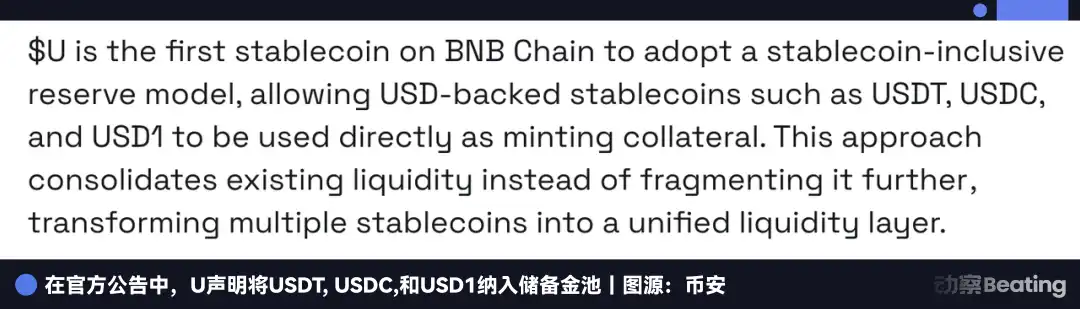
Binance's lesson is: stablecoins reliant on a single regulatory framework always have their lifelines held by others.

The Presidential Family Enters the Fray

The most noteworthy component in $U's reserves is USD1.

In March 2025, the Trump family issued the USD1 stablecoin through World Liberty Financial. According to public disclosures, Trump family-related entities hold 60% of the parent company's equity and receive 75% of the net income share. Trump himself serves as the "Chief Cryptocurrency Advocate," while his sons Eric and Donald Jr. serve as "Web3 Ambassadors."

By December 2025, the Trump family had already profited over $1 billion from the project.

Two months after its issuance, USD1 received its first major order: the Abu Dhabi sovereign wealth fund MGX invested $2 billion in Binance, using USD1 as the payment tool.

This was the largest cryptocurrency payment in history, instantly providing the nascent stablecoin with $2 billion in "practical endorsement."

As of December, USD1's market cap is approximately $2.7 billion, ranking seventh among stablecoins and becoming one of the fastest-growing.

Now, USD1 has been included in $U's reserves. This implies a hidden chain of interests: part of Binance's ecosystem trading volume is converted into usage scenarios for USD1; part of USD1's usage scenarios is converted into income for the Trump family.

The deeper game lies in the monetization of political capital. After Trump returned to the White House, the SEC suspended investigations into several crypto projects, including cases involving Sun Yuchen, a major investor in World Liberty Financial. Treasury Secretary Besant stated clearly at the White House Crypto Summit: "We will use stablecoins to maintain the dollar's status as the world's reserve currency."

Stablecoins are no longer just financial tools; they are becoming carriers of political resources.

The Logic of Nesting

Using stablecoins to collateralize stablecoins might seem redundant. But this design is based on three considerations.

Risk Diversification. USDT's hidden danger lies in its opaque reserves; USDC's隐患在于 its over-reliance on the U.S. banking system, as the Silicon Valley Bank incident warned; USD1's隐患在于 its deep binding with Trump's political fate. Holding any one alone means bearing its specific risk. Combining the three theoretically allows for risk hedging.

Liquidity Aggregation. The pain point of the stablecoin market is fragmented liquidity. USDT has its liquidity pools, USDC has its own, and funds are scattered across dozens of public chains and hundreds of DeFi protocols. $U attempts to connect these isolated pools, providing users with a unified liquidity entry point.

Narrative Upgrade. The competitive dimension of Stablecoin 1.0 was "who is more transparent" and "who is more compliant"—a rhetoric repeated for a decade. $U attempts to provide a new narrative framework: "settlement currency designed for the AI era," "supporting gasless signature transfers."

Of course, gasless transfers are part of the EIP-3009 standard, which existed in 2020, and USDC already supports it. So "AI-native" is more of a universal label; any on-chain stablecoin can be called by smart contracts and enable automatic machine-to-machine payments. $U's real differentiation lies not in technology but in its ecosystem and aggregated architecture.

Naturally, the nested structure also implies risk transmission: if one layer has a problem, the effects ripple through.

If USDT were to collapse one day, $U would not go to zero completely but would certainly承受 the impact: reserves shrinking, redemption pressure surging, depegging risk rising.

所谓 "Risk diversification" is more accurately "diversifying the intensity of impact from a single point of failure," ensuring that holders don't lose everything if any underlying asset fails. It's a bottom-protection mindset, not a risk-free design.

From Gray Zone to Great Power Game

2025 is the first year of stablecoin regulation.

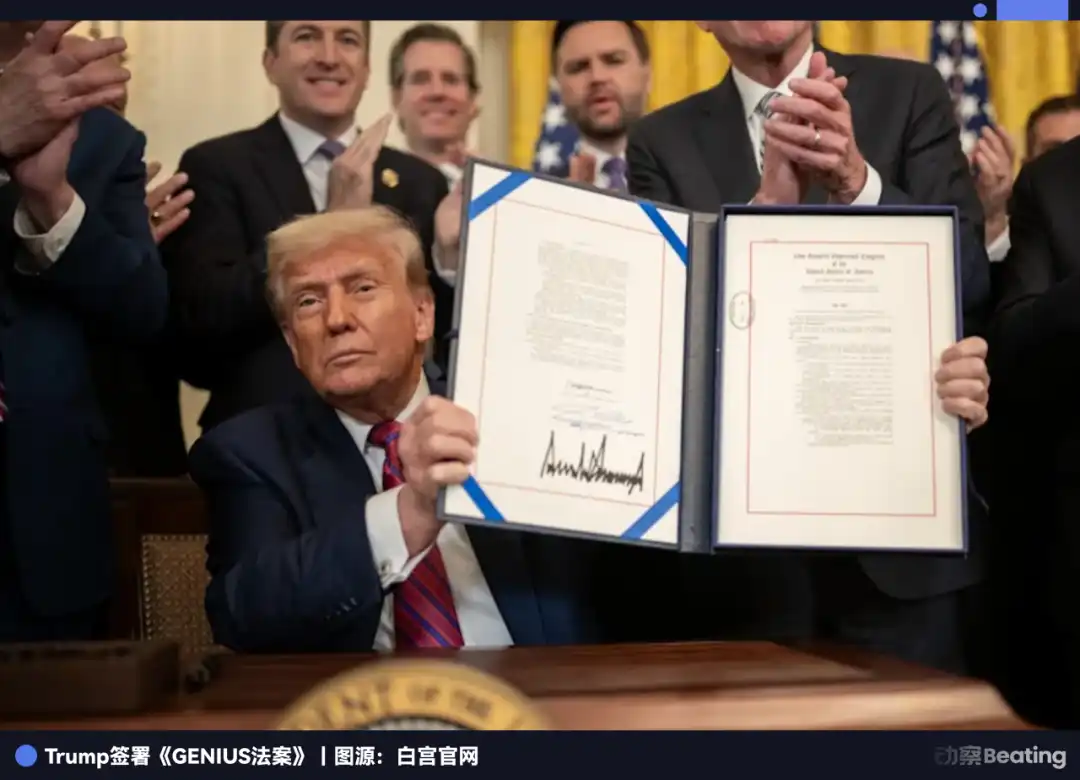
In June, Circle listed on the NYSE, with an IPO price of $31, closing at $69 on the first day, its market cap approaching $20 billion, becoming the "first stablecoin stock." In the same month, the U.S. Senate passed the GENIUS Act with 68 votes in favor, establishing a federal regulatory framework for stablecoins for the first time. The EU's MiCA regulations came into full effect, and Hong Kong, Japan, and Singapore相继 introduced licensing systems.

Over the past decade, stablecoins existed in a gray area, with regulators lacking grounds for intervention. Now, with an annual transfer volume exceeding the world's largest payment network, no government can continue to pretend not to see it.
Data shows: 34% of adults in Turkey hold USDT to hedge against the lira's depreciation; nearly 30% of remittances in Nigeria are completed via stablecoins; tech workers in Argentina普遍 use USDC to receive salaries, bypassing local currency inflation. In these countries, stablecoins are already the de facto "shadow dollar."

The foundation of dollar hegemony is not the Fed's money-printing ability but the inertia of global trade being denominated and settled in dollars. If stablecoins become the next-generation cross-border payment infrastructure, controlling stablecoins means controlling dollar hegemony in the digital age.

This is the underlying logic behind the Trump family's entry and the reason why the GENIUS Act passed with rare bipartisan consensus: in Washington, stablecoins are no longer a小众 issue for the crypto circle but a strategic resource concerning national interests.

The Imminent Battle

Whether $U will succeed is still uncertain. Its current circulating market cap is negligible compared to USDT's nearly $200 billion and USDC's nearly $80 billion.

But it represents a new paradigm in stablecoin competition.

Competition in the 1.0 era was about going it alone: Tether established a monopoly with first-mover advantage, Circle tried to leverage compliance to撬动 the market, and Binance fought for pricing power through BUSD. The core question was "who can survive."

Competition in the 2.0 era is about forming alliances. PayPal issued PYUSD, Ripple launched RLUSD, Robinhood teamed up with Galaxy Digital and Kraken to form the USDG alliance. Traditional financial giants, crypto-native players, sovereign capital, and political forces have all entered the arena.

The new core question becomes "who can tie more players together."

$U's strategy is to achieve aggregation through "nesting": not making enemies with any party, but turning everyone into its "underlying asset." Binance's intention is to build a "decentralized centralization": using an aggregated architecture to分散 regulatory risk while maintaining control over the core ecosystem.

This hundred-army battle has no final outcome. The regulatory balance is still swaying, technological boundaries are still expanding, and political variables are still accumulating.

The only certainty is: stablecoins have moved from being supporting actors in cryptocurrency to key infrastructure in the global financial system. An annual trading volume of $27 trillion is enough to make anyone who underestimates it pay the price.


Трендові криптовалюти

Пов'язані питання

QWhat is the total on-chain transfer volume of stablecoins in 2024, and how does it compare to Visa and Mastercard?

AIn 2024, the total on-chain transfer volume of stablecoins reached $27.6 trillion, surpassing the combined total of Visa and Mastercard for the first time.

QWhat is the unique feature of the new stablecoin $U launched by United Stables, and what is this structure called in the industry?

AThe unique feature of $U is that its reserves are not US dollars or treasury bonds but a combination of three other stablecoins: USDC, USDT, and USD1. This structure is referred to as a 'nested doll' or '套娃' in the industry.

QWhat was the major event in March 2023 that caused USDC to depeg, and what was the market's lesson from this incident?

AIn March 2023, the collapse of Silicon Valley Bank caused USDC to depeg, briefly dropping to $0.87. Circle had $3.3 billion in reserves held at the bank. The market learned that compliance is an advantage but not a moat; the real barrier is network effect—when a stablecoin has enough users and liquidity, it becomes the de facto standard.

QHow did the Trump family get involved in the stablecoin market, and which major transaction significantly boosted the credibility of their stablecoin USD1?

AThe Trump family entered the stablecoin market in March 2025 by issuing USD1 through World Liberty Financial. A major transaction that significantly boosted its credibility was the Abu Dhabi sovereign fund MGX's $2 billion investment in Binance, which was paid using USD1.

QWhat are the three main considerations behind the design of the 'nested doll' stablecoin $U, as mentioned in the article?

AThe three main considerations behind the design of $U are: 1) Risk diversification by combining multiple stablecoins to hedge against specific risks; 2) Liquidity aggregation to connect fragmented liquidity pools across different blockchains and DeFi protocols; 3) Narrative upgrade, positioning it as a settlement currency for the AI era and promoting features like gasless transfers.

Пов'язані матеріали

After Three Consecutive Quarters of Decline, Can the Crypto Market Find a Window for Stabilization in Q3?

The cryptocurrency market has just concluded its worst-performing quarter since 2022, with total capitalization dropping 12.6% to $2.1 trillion. All core metrics indicate capital is leaving the sector, not just rotating within it. Bitcoin fell 14.2% and Ethereum dropped 25.4% in Q2, breaking their previous correlation with US tech stocks. A key driver is the reversal in US spot Bitcoin ETF flows, which saw a net outflow of approximately $4.67 billion in Q2, including a record monthly outflow near $4.5 billion in June. While recent data suggests long-term holders are accumulating again, sustained ETF outflows mean continued selling pressure. Market focus is now singularly on the Federal Reserve. The upcoming July FOMC meeting is seen as the most critical event for Q3. A dovish signal could support Bitcoin reclaiming a $68,000-$84,000 range, while a hawkish stance might establish a new trading band around $50,000-$56,000. Additionally, regulatory uncertainty persists, with the progress of the crucial *CLARITY Act* stalling in the Senate, reducing its perceived 2026 passage probability to 40-45%. Despite the broad downturn, a few sectors showed growth. Prediction markets saw nominal volume surge 48.7% year-over-year to $113.8 billion, and tokenized collectibles transaction volume rose 143% quarterly to $1.4 billion. The Real-World Asset (RWA) tokenization sector also continued steady growth, now representing ~$28.1 billion in on-chain value. The market's foundation for an extreme crash appears limited, with Bitcoin price hovering near its 200-week moving average. However, the trading paradigm has shifted from narrative-driven speculation to decisions based on price action, policy developments, and interest rate expectations, making a broad sentiment-driven rally unlikely in the near term.

marsbit14 год тому

After Three Consecutive Quarters of Decline, Can the Crypto Market Find a Window for Stabilization in Q3?

marsbit14 год тому

BIT Trading Moment: BTC Still Suppressed by Weekly 200 EMA, Rejection May Restart Decline; Storage and Semiconductors that Surged Last Night Begin Falling in Evening Trading

**Crypto & Stock Market Wrap: Bitcoin Tests Resistance, Stocks Retreat After AI Surge** Bitcoin consolidates around $66,000, facing key resistance near $68,000—an area seen as a major psychological and technical hurdle where previous rallies have failed. Analysts note the cryptocurrency is caught between its 200-week moving average (~$63,333) and 200-week EMA (~$68,328). A clear break above $68k is needed to signal a stronger bullish trend, while a rejection could lead to a retest of $63k support. Market sentiment remains cautious, with low futures open interest pointing to a low-liquidity rebound rather than a full bull market. Bitcoin spot ETFs saw another $203 million inflow. US stock futures pointed lower after a strong Tuesday session led by a massive rebound in semiconductors and memory stocks. The rally was fueled by renewed optimism about AI-driven hardware demand, with Micron, SanDisk, and SK Hynix surging. However, those gains reversed in pre-market trading. Super Micro Computer (SMCI) soared over 20% after hours on strong guidance and a record backlog. Other standouts included Rocket Lab and nuclear energy plays Oklo and X-Energy. Rising oil prices (Brent above $91) and climbing Treasury yields (10-year near 4.64%), however, are reigniting inflation concerns and acting as a headwind for equities. In Asia, markets were mixed. South Korea's KOSPI pared early gains to close slightly higher as semiconductor stocks like SK Hynix gave back initial surges. Japan's Nikkei edged lower as the yen hit a fresh 38-year low against the dollar, raising fears of potential market intervention. Key events to watch include the Samsung Galaxy launch, AMD's AI event, and a slew of major tech earnings from Alphabet, Tesla, and IBM after the close on Wednesday, followed by the ECB meeting and Intel's earnings on Thursday.

marsbit14 год тому

BIT Trading Moment: BTC Still Suppressed by Weekly 200 EMA, Rejection May Restart Decline; Storage and Semiconductors that Surged Last Night Begin Falling in Evening Trading

marsbit14 год тому

Former CFTC Chairman, Circle President Tarbert: Preaching Long-Termism While Cashing Out $30 Million Himself

Former CFTC Chairman and Circle President Heath Tarbert has consistently advocated for a long-term vision in public, urging patience from investors as Circle’s stock price has fallen significantly from its peak. However, it has been revealed that since Circle’s IPO, Tarbert has continuously sold his CRCL shares through pre-arranged trading plans, cashing out approximately $30 million, without making any public market purchases. This contrast between his public messaging and personal actions has drawn criticism. Tarbert joined Circle in July 2023 as Chief Legal Officer, leveraging his regulatory experience to help guide the company through its IPO and expansion. Despite promoting stablecoins as long-term infrastructure, he established a 10b5-1 trading plan just before Circle went public, leading to substantial stock sales over the following year. In March 2026, he initiated another plan to sell more shares. His career trajectory highlights a pattern of moving between high-level regulatory roles and influential positions in the financial sector. After resigning as CFTC Chairman in early 2021, he joined Citadel Securities as Chief Legal Officer just 27 days later, during a period of intense regulatory scrutiny for the firm. He later joined Circle, aiding its efforts to navigate regulatory challenges for its public listing. While Tarbert's expertise in policy and compliance is valuable to companies like Circle, his actions—advocating long-term confidence while personally divesting—raise questions about the alignment between his public statements and his private financial decisions, leaving investors who followed his advice to bear the market risks.

marsbit14 год тому

Former CFTC Chairman, Circle President Tarbert: Preaching Long-Termism While Cashing Out $30 Million Himself

marsbit14 год тому

Gate Research Institute: The 'Wall Street-ization' Wave of Crypto Financial Products – Competition or Integration?

The article titled "Gate Research Institute: Are Crypto Financial Products Sparking a 'Wall Street' Wave—Competition or Convergence?" explores the evolving relationship between the crypto ecosystem and traditional finance (TradFi). The piece begins by reflecting on Bitcoin's original 2009 vision of decentralization, disintermediation, and moving away from banks. It then contrasts this with the 2024 landscape, where key crypto assets like Bitcoin are increasingly held through Wall Street products like ETFs issued by giants like BlackRock. The article questions whether this signifies that TradFi is systematically taking over the rights to issue, price, custody, and distribute crypto financial assets. The core argument is that this is not a zero-sum takeover but rather a bidirectional convergence where each side addresses the other's weaknesses. Crypto offers 24/7 global markets, programmable settlement, and open access but lacks compliant channels, institutional-grade custody, deep fiat liquidity, and mainstream distribution. TradFi possesses these but is constrained by legacy systems, limited operating hours, and slow settlement. Two primary convergence paths are highlighted: * **Path A (CEX to TradFi):** Exemplified by Gate, which has progressed from offering tokenized stocks and CFDs to providing direct, real stock trading (US, Hong Kong, South Korea) within its platform, using USDT. * **Path B (TradFi to Crypto):** Exemplified by Robinhood, which has integrated crypto trading, acquired exchanges like Bitstamp, and is moving traditional assets like stocks onto the blockchain via tokenization and its own Layer 2. Both paths are ultimately competing to become the next-generation, unified financial account—a "super account" where users can seamlessly trade cryptocurrencies, stocks, ETFs, RWA (Real World Assets), and tokenized treasury products in one interface. The growth of RWA and tokenized treasuries (e.g., BlackRock's BUIDL) is presented as the asset-layer fusion, providing stable, yield-bearing assets on-chain and acting as a bridge between the two worlds. In conclusion, the "Wall Street-ization" of crypto is framed as a mutual transformation. Decentralized ideals persist in the protocol layer, while at the application layer, a more efficient, global, and accessible unified capital market is emerging from this convergence. The future competition lies not between crypto exchanges and stockbrokers, but between platforms vying to offer the most comprehensive asset coverage, liquidity, and user experience within a single account.

marsbit14 год тому

Gate Research Institute: The 'Wall Street-ization' Wave of Crypto Financial Products – Competition or Integration?

marsbit14 год тому

Торгівля

Спот

Популярні статті

Що таке BNB WHALES

Розуміння BNB Whales: Глибоке занурення у світ криптовалют Вступ до BNB Whales У яскравому світі криптовалют регулярно з'являються нові проекти, які часто обіцяють інноваційні рішення та унікальні враження. Одним з таких проектів є BNB Whales, запущений у 2023 році та побудований на BNB Smart Chain (BEP20). BNB Whales прагне встановити відмінну присутність у криптовалютній екосистемі, зосереджуючись на створенні інтерактивної платформи, яка поєднує переваги технології блокчейн із соціальними та ігровими взаємодіями. Ця стаття має на меті глибше розглянути BNB Whales, вивчаючи його основні компоненти, механіку та траєкторію розвитку. Що таке BNB Whales? BNB Whales — це ініціатива у світі криптовалют, яка прагне забезпечити різноманітний спектр можливостей та функцій для своїх користувачів у зростаючому середовищі Web3. Використовуючи стандарт BEP20, проект працює з загальною емісією токенів у 100 трильйонів (100,000,000,000,000,000). Незважаючи на цю значну цифру, варто зазначити, що наразі жоден токен не перебуває в обігу, що вказує на те, що проект, можливо, ще на ранніх стадіях розвитку. Основною метою BNB Whales є створення платформи, де користувачі можуть брати участь у різних інтерактивних активностях, вигідно користуючись безпекою та прозорістю, які забезпечує технологія блокчейн. Спонукаючи унікальне і захоплююче середовище, BNB Whales прагне створити міцну спільноту користувачів, які зацікавлені у проекті та його розвитку. Хто є творцем BNB Whales? Особистість творця BNB Whales на даний момент залишається невідомою, що ускладнює розуміння засадничих принципів проекту та візійних ідей. Відсутність публічно доступної інформації про керівництво проекту може викликати запитання серед потенційних інвесторів та користувачів щодо його управлінської структури та відповідальності. Хто є інвесторами BNB Whales? Оскільки BNB Whales продовжує розвиватися, інформація про конкретних інвесторів або підтримку з інвестиційних фондів наразі недоступна. Офіційна документація проекту, включаючи його білі книги, не розкриває жодних індивідуальних або інституційних фінансових спонсорів. Відсутність прозорості в цьому відношенні може іноді ставити під сумнів легітимність і сталий розвиток нових проектів у криптовалютній екосистемі. Як працює BNB Whales? BNB Whales працює на BNB Smart Chain, використовуючи стандарт BEP20, який відомий своєю ефективністю та низькими транзакційними витратами, залучаючи різноманітних розробників та проекти. Унікальний аспект BNB Whales полягає у його зосередженні на створенні платформи, керованої спільнотою. Хоча точні деталі роботи скромні, проект акцентує увагу на взаємодії та залученості, потенційно включаючи ігрові елементи у свої пропозиції. Акцент на спільноті є вирішальним, оскільки він відповідає сучасним трендам у світі криптовалют, де внесок користувачів та участь часто визначають успіх проекту. Подальші інновації можуть бути очікувані, але наразі конкретні механізми та функції, які відрізняють BNB Whales від інших криптоініціатив, залишаються повністю неясними. Без детальної інформації про його функціональність важко всебічно оцінити відмінності проекту. Хронологія BNB Whales Розвиток BNB Whales відбувся через ключові етапи, що ознаменували його подорож у світі криптовалют. Нижче представлено хронологію значущих подій, що стосуються проекту: 2023: Запуск BNB Whales, що стало його входом на ринок. 2023: Публікація білій книги проекту, яка викладає загальні цілі та операційну структуру. У процесі: BNB Whales продовжує розвивати свої функції, прагнучи створити міцну базу користувачів і розширити свої пропозиції. Ключові моменти про BNB Whales Платформа: BNB Smart Chain (BEP20) Загальна пропозиція: 100 трильйонів токенів (100,000,000,000,000,000) Обіг: 0 токенів (вказує на початкову стадію) Мета проекту: Сприяти створенню захоплюючої криптовалютної платформи для взаємодії та побудови спільноти. Творець: Невідомий Інвестори: Не розкрито Операційний статус: Активний з постійним розвитком і розширенням Висновок Оскільки BNB Whales орієнтується в конкурентній криптовалютній середовищі, він пропонує погляд на потенціал проектів, керованих спільнотою, побудованих на основах технології блокчейн. Зосереджуючи увагу на залученості та взаємодії, ініціатива перебуває на передовій інновацій у просторі Web3. Однак успіх проекту в кінцевому рахунку залежить від чіткості його операційної механіки, розкриття його управлінської структури та створення міцної спільноти користувачів. Для потенційних користувачів та інвесторів BNB Whales представляє собою дослідницький випадок у еволюціонуючій природі проектів криптовалют — той, що ілюструє як захоплюючі можливості, так і складнощі, пов'язані з новими ініціативами. Оскільки сфера продовжує еволюціонувати, важливо стежити за прогресом BNB Whales та його впливом на ширшу криптовалютну екосистему.

427 переглядів усьогоОпубліковано 2024.04.05Оновлено 2024.12.03

Що таке BNB WHALES

Як купити BNB

Ласкаво просимо до HTX.com! Ми зробили покупку Binance Coin (BNB) простою та зручною. Дотримуйтесь нашої покрокової інструкції, щоб розпочати свою криптовалютну подорож.Крок 1: Створіть обліковий запис на HTXВикористовуйте свою електронну пошту або номер телефону, щоб зареєструвати обліковий запис на HTX безплатно. Пройдіть безпроблемну реєстрацію й отримайте доступ до всіх функцій.ЗареєструватисьКрок 2: Перейдіть до розділу Купити крипту і виберіть спосіб оплатиКредитна/дебетова картка: використовуйте вашу картку Visa або Mastercard, щоб миттєво купити Binance Coin (BNB).Баланс: використовуйте кошти з балансу вашого рахунку HTX для безперешкодної торгівлі.Треті особи: ми додали популярні способи оплати, такі як Google Pay та Apple Pay, щоб підвищити зручність.P2P: Торгуйте безпосередньо з іншими користувачами на HTX.Позабіржова торгівля (OTC): ми пропонуємо індивідуальні послуги та конкурентні обмінні курси для трейдерів.Крок 3: Зберігайте свої Binance Coin (BNB)Після придбання Binance Coin (BNB) збережіть його у своєму обліковому записі на HTX. Крім того, ви можете відправити його в інше місце за допомогою блокчейн-переказу або використовувати його для торгівлі іншими криптовалютами.Крок 4: Торгівля Binance Coin (BNB)Легко торгуйте Binance Coin (BNB) на спотовому ринку HTX. Просто увійдіть до свого облікового запису, виберіть торгову пару, укладайте угоди та спостерігайте за ними в режимі реального часу. Ми пропонуємо зручний досвід як для початківців, так і для досвідчених трейдерів.

741 переглядів усьогоОпубліковано 2024.12.12Оновлено 2026.06.02

Як купити BNB

Що таке BNB CARD

Розуміння BNB Card: Революція цифрової ідентичності у Web3 У швидко змінюваному ландшафті технології блокчейн та криптовалют, BNB Card або $BNBCARD вирізняється як помітний проєкт. Цей токен-мем, що керується спільнотою, використовує BNB Smart Chain (BSC), прагнучи інтегрувати мем-культуру з інноваційними рішеннями цифрової ідентичності. Оскільки все більше користувачів занурюються у світи децентралізації, важливо розглянути, що пропонує BNB Card, його операційні нюанси та потенційний вплив на ринок. Що таке BNB Card ($BNBCARD)? В основі BNB Card лежить токен-мем з суттєвою утилітою. Він створений для надання можливостей користувачам шляхом створення персоналізованих карток цифрової ідентичності, які є як виразними, так і функціональними. Проєкт охоплює кілька ключових особливостей: Налаштовувані ID-картки: Користувачі мають можливість розробляти цифрові ID-картки на тему Binance, надаючи їм платформу для самовираження та покращеної взаємодії з громадою. Децентралізована структура: Розроблений на BSC, BNB Card підкреслює ключові атрибути, такі як безпека, прозорість та суверенітет користувачів. Децентралізована природа структури дозволяє проводити транзакції, які є як ефективними, так і безпечними. Модель, орієнтована на спільноту: Акцент на участі знизу вгору, а не на фінансових моделях, що керуються лабораторіями, створює захоплююче середовище для його користувачів. Використовуючи вроджену вірусність мем-культури, BNB Card сприяє потужному руху громади. Основна мета BNB Card полягає в демократизації інструментів цифрової ідентичності у Web3, пропонуючи доступні рішення, які приносять користь користувачам без обтяжень, які зазвичай пов'язані з традиційними системами управління ідентичністю. Творець та інвестори При дослідженні особи, що стоїть за BNB Card, важливо зазначити, що жоден конкретний творець не вказується. Натомість проєкт виглядає керованим спільнотою, що свідчить про колективні зусилля, натхненні ідеєю “Early Builder Card” від Binance. Цей органічний підхід до розвитку є звичним серед проєктів у спектрі токенів-мем, де розвиток часто залежить від пристрасті спільноти, а не від центральної влади. Щодо інвестицій, відсутність публічно розкритих інституційних спонсорів ще більше підкреслює основи проєкту. Він процвітає на органічній підтримці спільноти, що відображає звичайну характеристику проєктів, що керуються мемами, які часто залучають свою аудиторію через соціальні канали, а не формальні інвестиційні маршрути. Як це працює BNB Card використовує кілька механізмів, які окреслюють його функціонування та інноваційний дух: Утиліта токена: Токен BNBCARD надає користувачам доступ до набору інструментів для створення ID, а також забезпечує платформу для управління спільнотою. Токен слугує ланкою, що дозволяє цим функціям працювати. Інтеграція блокчейн: Використовуючи BSC, BNB Card забезпечує сумісність з додатками на основі Ethereum Virtual Machine (EVM). Ця інтеграція надає користувачам переваги низьких транзакційних зборів, покращуючи доступність. Екосистема DIY: Центральним до привабливості BNB Card є його підхід “зроби сам” (DIY) до генерації карток цифрової ідентичності. Цей участь елемент заохочує користувачів до творчого самовираження, сприяючи інклюзивній культурі, що процвітає на внесках та співпраці. Хронологія Хронологія є важливою для розуміння траєкторії BNB Card. Важливі етапи в історії проєкту включають: 18 березня 2025 року: BNB Card був перерахований на LBank, що стало значним кроком у його подорожі на біржі та відкрило двері для ліквідності та доступності для користувачів. 19 березня 2025 року: Важливий момент стався, коли токен зазнав астрономічного зростання на 26,000% протягом 24 годин, привертаючи увагу до свого потенціалу та ентузіазму спільноти. Поточні розробки: Проєкт постійно розширює свої партнерства з децентралізованими біржами (DEX), такими як PancakeSwap, що додатково підвищує ліквідність та залучення користувачів. Інновації та диференціація Розуміння того, що відрізняє BNB Card, вимагає глибшого дослідження його інноваційної структури: Гібрид мем-утиліти: BNB Card успішно поєднує ігрову привабливість мем-культури з практичними застосуваннями в управлінні цифровою ідентичністю. Цей нішевий підхід ефективно задовольняє широку демографію, приваблюючи як технічно підкованих користувачів, так і тих, хто новий у криптовалютах. Децентралізоване управління: Функціонування без централізованого контролю дозволяє проєкту безпосередньо використовувати внески спільноти. Колективний процес прийняття рішень, підкріплений участю громади, надає користувачам можливість впливати на розвиток та напрямок проєкту. Масштабованість: BNB Card має величезні переваги від оновлень дорожньої карти 2025 року для BNB Chain, які включають покращення, такі як збільшення швидкості транзакцій та інтеграцію інструментів штучного інтелекту. Ці покращення вигідно позиціонують проєкт у висококонкурентному середовищі. Висновок BNB Card є символом нової хвилі рішень цифрової ідентичності в екосистемі Web3. Поєднуючи розваги, залучення спільноти та практичну утиліту, він запрошує користувачів активно брати участь у формуванні своїх цифрових персон. Оскільки проєкт орієнтується на динамічний ландшафт криптовалют, його успіх, ймовірно, залежатиме від підтримки сильної спільноти, адаптуючись до технологічних досягнень та потреб користувачів. Інтеграція децентралізації з мем-культурою слугує не лише засобом для залучення користувачів, але й основою для еволюційного наративу, що оточує цифрову ідентичність в епоху блокчейн. Підсумовуючи, BNB Card не лише ілюструє злиття креативності та утиліти в крипто-просторі, але й підкреслює важливість спільноти в управлінні майбутнім децентралізованих технологій.

430 переглядів усьогоОпубліковано 2025.03.26Оновлено 2025.03.26

Що таке BNB CARD

Обговорення

Ласкаво просимо до спільноти HTX. Тут ви можете бути в курсі останніх подій розвитку платформи та отримати доступ до професійної ринкової інформації. Нижче представлені думки користувачів щодо ціни BNB (BNB).

活动图片













