The State of TRON H2 2025: Stablecoin Settlement at Scale Amid Rising Competition

TheNewsCryptoОпубліковано о 2026-01-29Востаннє оновлено о 2026-01-29

Анотація

In the second half of 2025, TRON focused on operational execution and targeted growth, prioritizing initiatives with clear ROI and real-world adoption. Key developments included strategic integrations with platforms like Kalshi and Revolut, enhancing its role as a low-fee, fast settlement layer for stablecoins. The network expanded into chain abstraction through a collaboration with NEAR and improved developer infrastructure with Alchemy RPC support. TRX performance remained strong, rising 26% in 2025, and the network deepened interoperability with Base via LayerZero. TRON maintained its leadership in stablecoin settlement, processing trillions in annual volume and growing monthly active stablecoin users by 38% to over 10 million. Despite increased competition from chains like Plasma and Solana, TRON's stablecoin supply grew 41%, primarily driven by USDT. On-chain metrics showed 300M+ monthly transactions and 20M monthly active accounts, with over half being stablecoin users. Revenue peaked in Q3 but declined in Q4 due to market conditions. Looking ahead, TRON aims to defend its market share by maintaining predictable fees, expanding payment provider integrations, and reducing UX friction.

In our previous report, we covered the events that shaped TRON in the first half of 2025. We looked at how TRON expanded its lineup of Super Representatives. We also covered its technical integrations to support developers and the broader ecosystem. Finally, we discussed the launch of another stablecoin on its network, USD1.

In the second half of 2025, the focus of the TRON team was on operational execution and targeted growth. Rather than chasing speculative integrations, TRON prioritized initiatives with clear ROI and real-world adoption. The team also doubled down on TRON’s core value proposition of low fees, fast settlement, and predictable costs. Together, these efforts improved TRON’s positioning as a blockchain financial infrastructure.

Ecosystem Growth

In H2 2025, TRON’s ecosystem growth strategy centered on distribution and execution, with an emphasis on consumer-facing integrations and coordinated enhancement of TRON’s go-to-market strategy. The network expanded fintech and wallet integrations, including WireX Pay and other user tools, broadening access points for TRX and USDT on TRON across everyday payment and wallet surfaces.

A key example was TRON’s integration with Kalshi, which enabled deposits and withdrawals via TRX and USDT on TRON and positioned TRON as a liquidity rail supporting prediction market activity. In parallel, Revolut selected TRON for a blockchain infrastructure integration tied to its “Crypto 2.0” initiative, adding in-app TRX staking, supporting stablecoin remittances, and 1:1 fiat-to-stablecoin conversion across its European footprint. Together, these launches emphasized TRON’s strengths as a settlement layer: fast confirmations, low fees, and deep stablecoin liquidity.

TRON also expanded into chain abstraction and intent-based UX, reflecting a push to reduce friction for both users and developers. Through a strategic collaboration with NEAR, TRON integrated NEAR Intents, enabling intent-based swaps and cross-chain transfers that abstract away bridging and chain mechanics. This positioned TRON within a broader multichain execution stack designed to simplify onboarding and make interoperability feel native, while also opening up a wider design space for DeFi and emerging AI-driven workflows.

On developer infrastructure, TRON added Alchemy RPC support, improving reliability and scalability for builders, and continued strengthening wallet connectivity through MetaMask and WalletConnect. It also enhanced security and monitoring tooling via ecosystem integrations, supporting more mature production workflows as partner activity scaled. Complementing these upgrades, Ledger added full native TRON support, enabling organizations to manage TRX and TRC20 tokens like USDT with governance controls, multi-approval flows, and whitelisting, with an emphasis on clear-signing protections. This broadened TRON’s enterprise readiness by connecting stablecoin-heavy workflows to higher-assurance operational and security tooling.

The FSRA of ADGM accepted USDT on TRON as an Accepted Fiat-Referenced Token, allowing ADGM-licensed entities to use it in regulated activity. The milestone strengthened TRON’s institutional positioning as a compliant, low-fee stablecoin settlement rail, supported by ongoing regulator engagement and financial crime prevention efforts.

TRX Performance and Cross-Chain Expansion

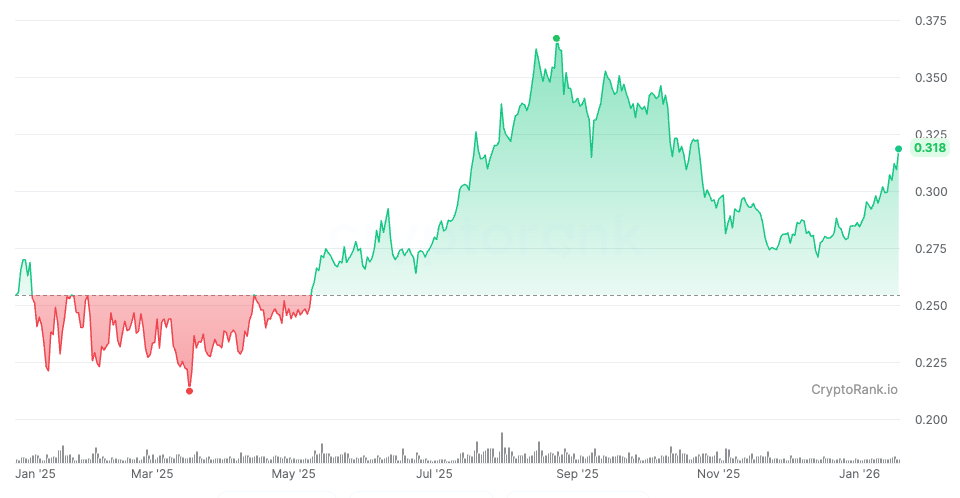
Amid the ecosystem expansion and ongoing infra improvements, TRX, the native token of the TRON blockchain, delivered a strong performance in 2025. TRX was up 26% since Jan 1, 2025, with a significant share of that upside concentrated in Q2 to Q3.

TRON also pushed deeper into interoperability through an integration with Base, the Ethereum L2 incubated by Coinbase. Enabled by LayerZero, the bridge allows TRX to move onto Base and be accessed directly in the Base App via Base-native DEXs such as Aerodrome, expanding TRX liquidity and utility beyond TRON’s own execution environment. In the context of TRON’s scale and payments-first positioning, the Base connection reinforced the broader trend toward multichain participation and lower-friction capital movement across ecosystems.
TRON is Leading Stablecoin Settlement Despite Increased Competition

One of TRON’s key competitive advantages is its strength in stablecoin settlement. Despite the launch of several stablecoin-focused blockchains, including Plasma and Stable, TRON maintained leading positions across multiple stablecoin indicators throughout 2025.

Across the year, TRON ranked among the top chains by P2P stablecoin transaction volume, closely followed by Ethereum. This reflected TRON’s role as a global stablecoin settlement rail, processing trillions in annual payment volume and continuing to serve high-frequency, cost-sensitive flows.

This performance was supported by expanding real-world usage, including merchant payments, payroll, and remittances, particularly across LATAM, Africa, and Asia. In parallel, TRON deepened engagement with global payment providers and PSPs, strengthening settlement efficiency and stablecoin treasury operations to support larger, more consistent transaction throughput.

In 2025, monthly active stablecoin users on TRON grew 38% and surpassed 10 million. This reflects steady growth in stablecoin-using addresses over time, signaling more sustainable, recurring adoption rather than one-off activity.

Stablecoin Monthly Active Users on TRON

However, TRON still ranked second behind Ethereum, which continued to lead in stablecoin supply due in part to its large USDC supply. The gap to the next tier of chains remained wide, reinforcing a clear separation between the top two settlement networks and the rest.

That said, competition in stablecoin settlement continued to intensify. New entrants and fast-growing environments began appearing in the top 10, including HyperEVM and stablecoin-focused Plasma, signaling a broader push to capture stablecoin-driven payments and transfer flows.

Stablecoin supply on TRON rose 41% in 2025, primarily driven by USDT growth. Beyond USDT, TRON’s stablecoin base also expanded through higher supply of USDD and TUSD, alongside several newly added stablecoins.

TRON On-Chain Metrics Overview

Usage Metrics

In 2025, TRON’s transaction count followed a steady uptrend and surpassed 300M monthly transactions for the first time since mid-2023. Versus January 2025, monthly transactions were up by nearly 50%.

However, TRON faced strong competition from major general-purpose chains. Solana, BNB Chain, and Base saw periods of elevated activity driven largely by memecoin trading and other user-facing dApps. By contrast, TRON’s activity was primarily stablecoin-led, reflecting its role as a settlement network rather than a memecoin trading venue.

By the end of 2025, TRON averaged around 20M monthly active accounts, up 33% versus the start of the year. As shown above, just over 50% of these accounts were stablecoin users, while the remainder was primarily driven by TRX transfers and smart contract activity that did not involve stablecoins.

Monthly Active Addresses

Revenue Outlook

Revenue trended up through the first three quarters of 2025. In Q3 2025, TRON’s staking revenue reached a new all-time high of nearly $900M, while burn-related revenue remained relatively stable at around $150M to $180M. In Q4, total revenue declined sharply, driven primarily by broader market weakness and the corresponding drop in TRX price.

Compared with H1 2025, Solana outpaced TRON (and Ethereum) in H2, moving into the top spot for burn-related revenue. TRON’s position remained relatively stable, and it retains a credible path to reclaim the top rank if Solana’s activity cools, particularly if on-chain trading flows become more competitive and fragmented across venues and chains.

TRON DeFi Landscape Overview

Throughout 2025, TVL on TRON was volatile, largely reflecting TRX price action. Even so, TVL was up 15% versus the start of 2025. That growth was not enough to keep TRON in the top five chains by TVL, as it ceded rank to Bitcoin, Base, and BNB Chain, according to DeFiLlama.

The Bottom Line

2025 reinforced TRON’s core positioning as a stablecoin-led settlement network. Stablecoin supply grew 41%, monthly active stablecoin users rose 38% to over 10M, and activity rebounded to 300M+ monthly transactions, reflecting sustained demand for low-fee, high-throughput transfers.

In 2026, competition should intensify from both stablecoin-focused chains like Plasma and fast-growing general-purpose ecosystems like Solana, Base, and BNB Chain. For TRON, defending share will likely come down to keeping fees and settlement predictable, expanding distribution through payment providers and fintech partners, and continuing to reduce UX friction through interoperability and developer tooling.

Disclaimer: TheNewsCrypto does not endorse any content on this page. The content depicted in this Press Release does not represent any investment advice. TheNewsCrypto recommends our readers to make decisions based on their own research. TheNewsCrypto is not accountable for any damage or loss related to content, products, or services stated in this Press Release.


TagsStablecoinTron

Трендові криптовалюти

Пов'язані питання

QWhat were the key areas of TRON's focus in the second half of 2025?

AIn the second half of 2025, TRON's focus was on operational execution and targeted growth. The team prioritized initiatives with clear ROI and real-world adoption, doubled down on its core value proposition of low fees, fast settlement, and predictable costs, and improved its positioning as a blockchain financial infrastructure.

QWhich two major integrations are highlighted as examples of TRON's ecosystem growth in H2 2025?

ATwo major integrations highlighted were with Kalshi, which enabled deposits and withdrawals via TRX and USDT, and with Revolut for its 'Crypto 2.0' initiative, which added in-app TRX staking, stablecoin remittances, and fiat-to-stablecoin conversion.

QHow did TRX, the native token of the TRON blockchain, perform in 2025?

ATRX delivered a strong performance in 2025, with its price increasing by 26% since January 1, 2025. A significant share of that growth was concentrated in the second and third quarters.

QWhat was the growth rate for both stablecoin supply and monthly active stablecoin users on TRON in 2025?

AIn 2025, the stablecoin supply on TRON rose by 41%, and the number of monthly active stablecoin users grew by 38%, surpassing 10 million.

QDespite increased competition, how did TRON rank in terms of stablecoin settlement compared to other chains?

ATRON maintained a leading position in stablecoin settlement, ranking among the top chains by P2P stablecoin transaction volume, closely following Ethereum. It processed trillions in annual payment volume and continued to serve high-frequency, cost-sensitive flows.

Пов'язані матеріали

Debate: Korean Workers Fear Unemployment, While Musk Envisions a Society 'Without Work'?

While South Korean auto workers fear job losses from robotics, Elon Musk envisions a future where AI and robots render most work optional. This article explores the growing tension between immediate anxieties over automation and long-term visions of a post-work society. The piece begins with recent strikes at Hyundai's Korean plants, where unions, amid standard wage negotiations, also sought job guarantees against advancing robotics—specifically mentioning Boston Dynamics' Atlas. This reflects how anxiety about technological displacement is emerging even before robots are fully capable of replacing skilled labor on assembly lines. The author argues that while current robotics still struggle with the nuanced, experiential knowledge of veteran workers, the *perception* of imminent replacement is fueling social conflict prematurely. This modern "Luddite" sentiment is compared to the 19th-century English textile workers who smashed machines. Historically, Luddites weren't simply anti-technology; they were protesting the rapid devaluation of their skills and the unequal distribution of productivity gains. Similarly, today's workers ask who will bear the cost of transition and share in the new wealth created by machines. In contrast, figures like Elon Musk propose an optimistic endpoint: with AI and robotics driving extreme abundance, the link between work and survival could break. He suggests concepts like "Universal High Income" could allow society to share the technological bounty, transforming work from a necessity into a choice. The core challenge, however, lies in the transition. The author notes that technology's benefits diffuse slowly, while its disruptive costs—job losses, skill obsolescence—can be concentrated and immediate. The risk is a painful interim period where productivity gains are captured by a few before new social contracts, safety nets, and retraining systems are established. The conclusion calls for proactive governance. Just as past industrial revolutions gave rise to labor standards and social safety nets, the robotics era needs its own frameworks. These should address job transition support, distribution of productivity gains, safety liability, and ethical deployment. Embracing such "constraints" is not opposition to progress but a necessary step to ensure technology benefits society broadly. The discussion sparked by Hyundai's workers, therefore, is not premature but essential.

marsbit3 хв тому

Debate: Korean Workers Fear Unemployment, While Musk Envisions a Society 'Without Work'?

marsbit3 хв тому

CATL Invests in a 00s Graduate from Harbin Institute of Technology

Contemporary Amperex Technology Co., Limited (CATL) has exclusively invested in the Pre-A round of RoboParty, a company founded by 22-year-old Huang Yi. A former student at Harbin Institute of Technology, Huang built a bipedal humanoid robot in his dorm room and later dropped out to launch RoboParty in Shanghai. The company focuses on developing a fully open-source platform for humanoid robots, combining self-developed hardware, operating systems (Party OS), and foundational models. RoboParty's strategy emphasizes open-source collaboration to accelerate development and build a developer ecosystem, positioning itself as foundational infrastructure for embodied AI. Since its 2025 founding, the team—composed largely of top-tier university graduates—has secured six funding rounds in eight months, with investors including Matrix Partners, Xiaomi, and now CATL. This investment by CATL's corporate venture arm signals strong industry confidence in RoboParty's potential for real-world manufacturing and complex scenarios. Huang Yi prioritizes technological excellence and developer community growth over rapid commercialization. The company has already garnered significant interest from developers and research institutions globally. With a focus on continuous, rapid iteration and open innovation, RoboParty aims to prove the versatility of humanoid robots and drive the field toward an open-source future.

marsbit6 хв тому

CATL Invests in a 00s Graduate from Harbin Institute of Technology

marsbit6 хв тому

Will SpaceX's First Quarterly Report Rescue Its Stock Price Under the Pressure of 1.2 Billion Shares Unlocking?

SpaceX is set to release its first quarterly earnings report since going public, a key test for its stock which has declined 20% from its IPO price. Approximately 9.12 billion shares are set to unlock on August 6, with an additional 3.19 billion following a week later, creating potential selling pressure from early investors. A strong report may be the only catalyst to reverse the downtrend. The report will cover three segments: Space, Connectivity (Starlink), and AI. The AI business, centered on the merged xAI, is the biggest uncertainty. While it generated $818 million in revenue last quarter, it also reported a $2.5 billion operating loss and $7.7 billion in capital expenditures. New data center rental agreements with Anthropic and Google, particularly the substantial $1.25 billion monthly deal with Anthropic, add significant revenue variability this quarter. Investors await guidance on AI's future outlook and the timeline for launching AI computing satellites via Starship. Starlink remains the stable profit driver, ending last quarter with 10.3 million subscribers. Key metrics will be user growth, average revenue per user (ARPU), and enterprise/government contract backlogs. The Space segment, which posted a $657 million operating loss last quarter, will be scrutinized for updates on Starship development following its 13th test flight and the pace of Falcon 9 launches, many of which support internal Starlink deployment. Wall Street expects Q2 revenue of around $6.9 billion and EBITDA of $2.1 billion. However, as this is the first earnings report, analyst forecasts lack a historical baseline and could see significant variance. With a current market cap of ~$1.4 trillion and a high valuation, the market's reaction post-earnings will hinge on the report's strength, the magnitude of post-lockup selling, and ongoing investor concerns.

marsbit6 хв тому

Will SpaceX's First Quarterly Report Rescue Its Stock Price Under the Pressure of 1.2 Billion Shares Unlocking?

marsbit6 хв тому

Soaring 20% Then Dropping 5%: When Will the Bottom of the Korean Stock Market Be?

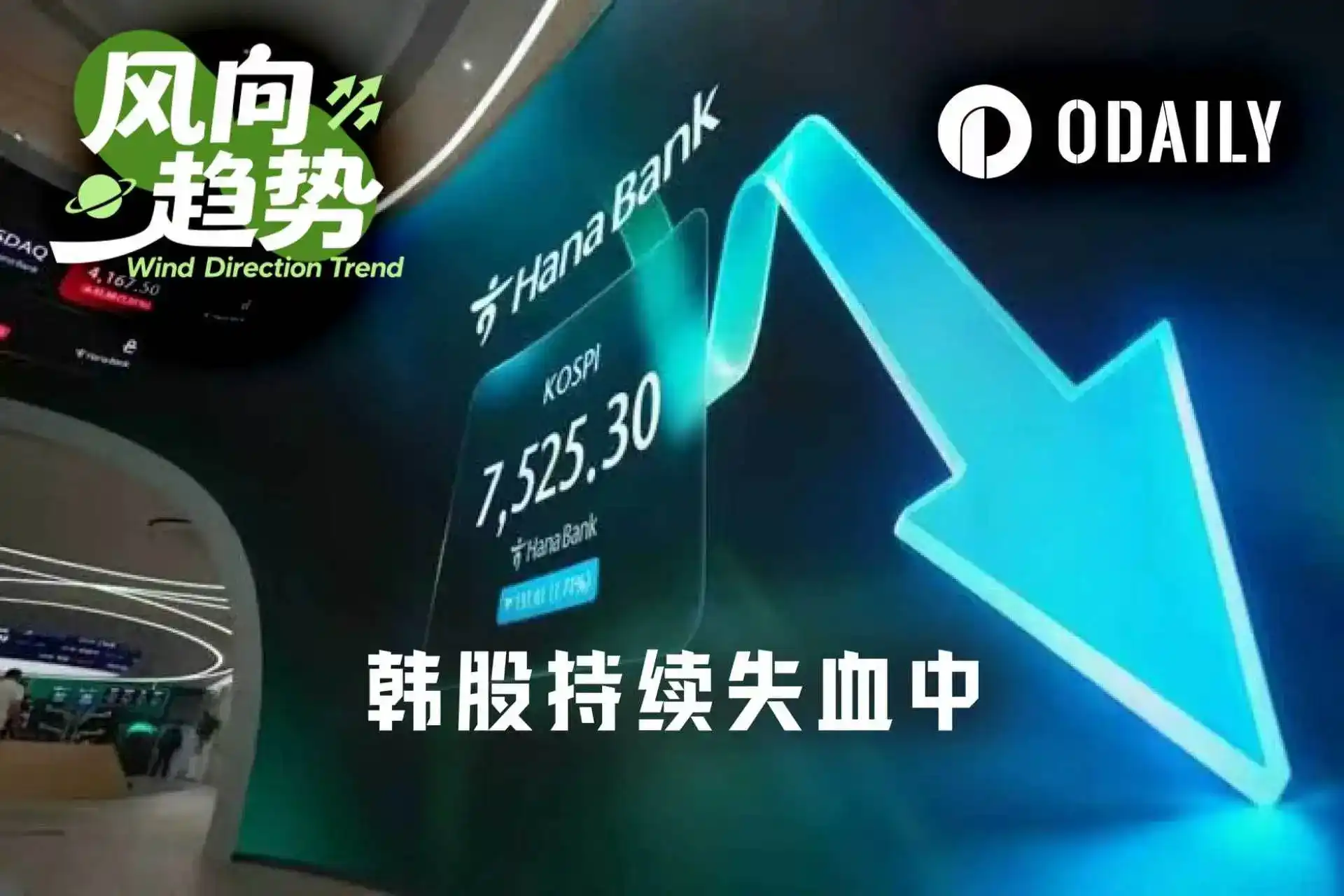
"South Korean stocks face a turbulent period as the KOSPI index, after a 20% surge, fell 5% to 6257 points. The market is grappling with severe issues: over 500,000 leveraged retail accounts have been liquidated, and more than 24 trillion won has flowed from stocks into bank deposits for safety. This reflects a significant loss of market liquidity and shaken investor confidence. In response, Korean financial regulators are taking action. They have tripled the minimum保证金 (margin) requirement for single-stock leveraged ETF trades to 30 million won and are considering granting themselves "emergency intervention" powers. These could include capping leverage ratios and setting investment limits on these ETFs, seen by many as amplifying market volatility. Initial results show a 75% drop in these products' trading volume post-regulation. The market downturn has political repercussions, pushing President Yoon Suk-yeol's approval rating to a new low. Meanwhile, foreign investors made a record net purchase of 7.18 trillion won during a recent rebound, while domestic retail investors sold off massively. Morgan Stanley has upgraded South Korean stocks to "overweight," citing the ongoing "leverage unwinding" and potential for a 36% upside, with giants like Samsung Electronics and SK Hynix providing valuation support. However, analysts caution that the market's structure remains vulnerable to foreign capital flows, and the current low may not be the bottom."

marsbit22 хв тому

Soaring 20% Then Dropping 5%: When Will the Bottom of the Korean Stock Market Be?

marsbit22 хв тому

Торгівля

Спот

Популярні статті

Як купити TRX

Ласкаво просимо до HTX.com! Ми зробили покупку TRON (TRX) простою та зручною. Дотримуйтесь нашої покрокової інструкції, щоб розпочати свою криптовалютну подорож.Крок 1: Створіть обліковий запис на HTXВикористовуйте свою електронну пошту або номер телефону, щоб зареєструвати обліковий запис на HTX безплатно. Пройдіть безпроблемну реєстрацію й отримайте доступ до всіх функцій.ЗареєструватисьКрок 2: Перейдіть до розділу Купити крипту і виберіть спосіб оплатиКредитна/дебетова картка: використовуйте вашу картку Visa або Mastercard, щоб миттєво купити TRON (TRX).Баланс: використовуйте кошти з балансу вашого рахунку HTX для безперешкодної торгівлі.Треті особи: ми додали популярні способи оплати, такі як Google Pay та Apple Pay, щоб підвищити зручність.P2P: Торгуйте безпосередньо з іншими користувачами на HTX.Позабіржова торгівля (OTC): ми пропонуємо індивідуальні послуги та конкурентні обмінні курси для трейдерів.Крок 3: Зберігайте свої TRON (TRX)Після придбання TRON (TRX) збережіть його у своєму обліковому записі на HTX. Крім того, ви можете відправити його в інше місце за допомогою блокчейн-переказу або використовувати його для торгівлі іншими криптовалютами.Крок 4: Торгівля TRON (TRX)Легко торгуйте TRON (TRX) на спотовому ринку HTX. Просто увійдіть до свого облікового запису, виберіть торгову пару, укладайте угоди та спостерігайте за ними в режимі реального часу. Ми пропонуємо зручний досвід як для початківців, так і для досвідчених трейдерів.

1.6k переглядів усьогоОпубліковано 2024.12.10Оновлено 2026.06.02

Як купити TRX

Обговорення

Ласкаво просимо до спільноти HTX. Тут ви можете бути в курсі останніх подій розвитку платформи та отримати доступ до професійної ринкової інформації. Нижче представлені думки користувачів щодо ціни TRX (TRX).

活动图片