The Revelation from the Raydium Theft Incident: New DeFi Vulnerabilities Lurking in Forgotten Old Contracts

Foresight NewsОпубліковано о 2026-06-13Востаннє оновлено о 2026-06-13

Анотація

**Raydium Exploit Reveals DeFi's Hidden Risk: Forgotten "Zombie" Contracts** A recent attack on Raydium's deprecated V3 AMM pools resulted in a loss of approximately $1.34 million. The hacker exploited pools that were no longer supported by Raydium's current UI or SDK but remained fully functional and accessible on-chain. This incident highlights a critical, often overlooked category of risk in DeFi: inactive or legacy smart contracts that projects fail to properly decommission. Since March 2025, there have been at least 8 publicly reported attacks targeting such abandoned contracts, with total losses around $10.8 million. Including older pools and deprecated features, the count rises to 10 incidents with roughly $22.5 million in losses. These "zombie contracts" represent a lifecycle management failure rather than a code vulnerability, yet they are typically misclassified under general "code bug" categories in security reports, masking the true scale of the problem. The root cause is that projects often merely document a contract as "deprecated" without taking essential technical steps to secure it: withdrawing remaining assets, disabling external call functions, and implementing ongoing monitoring. These forgotten, under-monitored components become prime targets for attackers. To address this, the industry needs to recognize "zombie contracts" as a distinct risk category and establish standardized decommissioning protocols. Essential steps should include: 1) a formal ret...


Author: Gino Matos

Compiler: Luffy, Foresight News


TL;DR:


  • Hackers stole approximately $1.34 million in assets by exploiting Raydium's long-discontinued V3 Automated Market Maker liquidity pools.
  • This incident exposes a widespread issue: Old contracts decommissioned by DeFi projects are still operational on-chain. These forgotten underlying infrastructures have become easily overlooked attack targets.
  • Public reports indicate that since March 2025, there have been at least 8 similar theft incidents targeting old contracts within the industry, suggesting that a vast amount of unattended legacy code remains externally callable.


Recently, a vulnerability in Raydium's AMM V3 resulted in a loss of $1.34 million. This incident involved five liquidity pools outside the project's current product ecosystem. These pools were unsupported by Raydium's UI or SDK and inaccessible to ordinary users, yet they were ultimately exploited by hackers.


This attack targeted the neglected old contracts and underlying infrastructures within the industry, revealing major flaws in the full lifecycle management of smart contracts. This type of problem is not unique to this one Solana-based decentralized exchange.


The Overlooked Risk Category


According to publicly available security incident reports, from March 2025 to the present, there have been at least 8 confirmed attack cases explicitly due to abandoned, phased-out, or old contracts, with cumulative losses of approximately $10.8 million.


If attacks involving old liquidity pools and outdated supporting products are included in the statistics, the number of related incidents reaches 10 (including this Raydium theft), with total losses amounting to about $22.5 million.


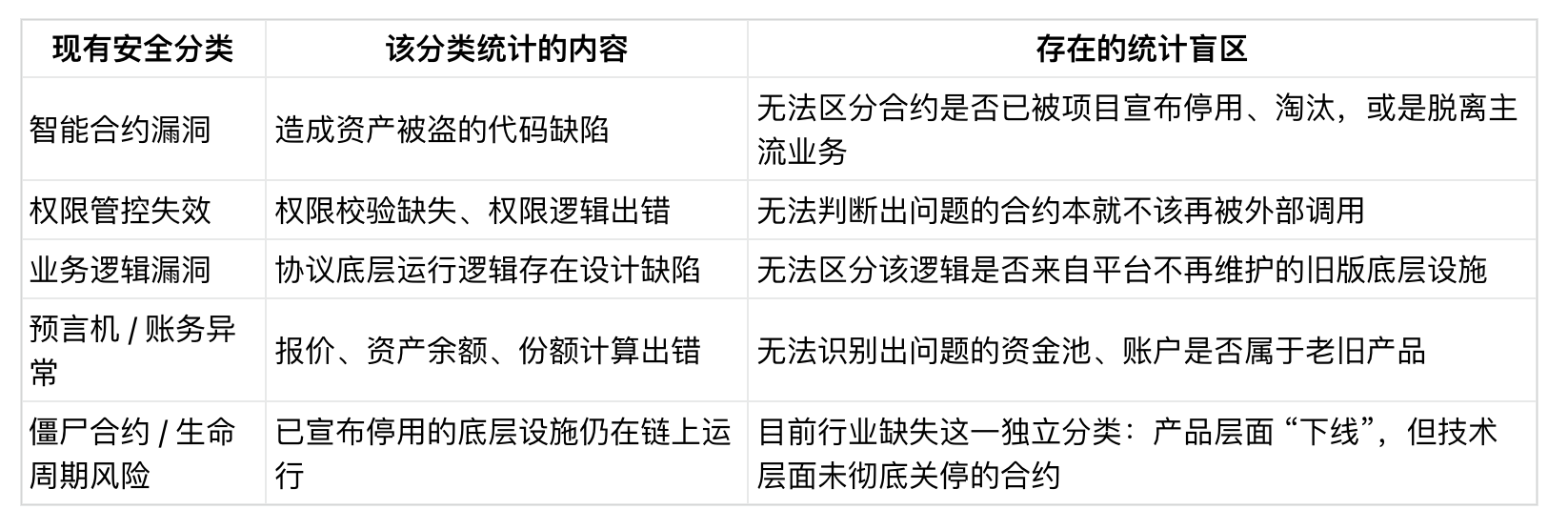
Most current industry security incident tracking platforms categorize attack types based on technical causes. Common classifications include: smart contract code vulnerabilities, permission control failures, oracle manipulation, private key leakage, cross-chain bridge defects, etc.


Zombie contracts (i.e., old contracts declared discontinued by projects but still normally callable on-chain) belong to a completely different risk dimension. They are security incidents caused by failures in contract lifecycle management, yet they have always been buried within the statistical entries of various conventional vulnerabilities and have not been classified separately.


The reason Raydium's V3 AMM liquidity pools were abandoned stems from the formal shutdown of the Serum project they relied on, rendering this set of old contracts completely non-functional. The corresponding liquidity assets have been idle on-chain ever since.


Raydium's currently used new version of the contract performs dual verification of two key pieces of information: first, it checks asset proportions through a total supply verification mechanism; second, it verifies the minting address of liquidity tokens and various associated account information.


However, this outdated V3 contract completely omitted these two verification processes. Hackers exploited this vulnerability by forging new liquidity tokens and impersonating legitimate certificates, directly bypassing all risk control rules.


In this incident, a total of approximately 150,177 RAY, 5,603 SOL, and 893,700 USDC were stolen. These assets had been stored in the platform's old liquidity pools for a long time. Although detached from mainstream operations, their on-chain call permissions were never deactivated.


Eight Cases Reveal Common Problems


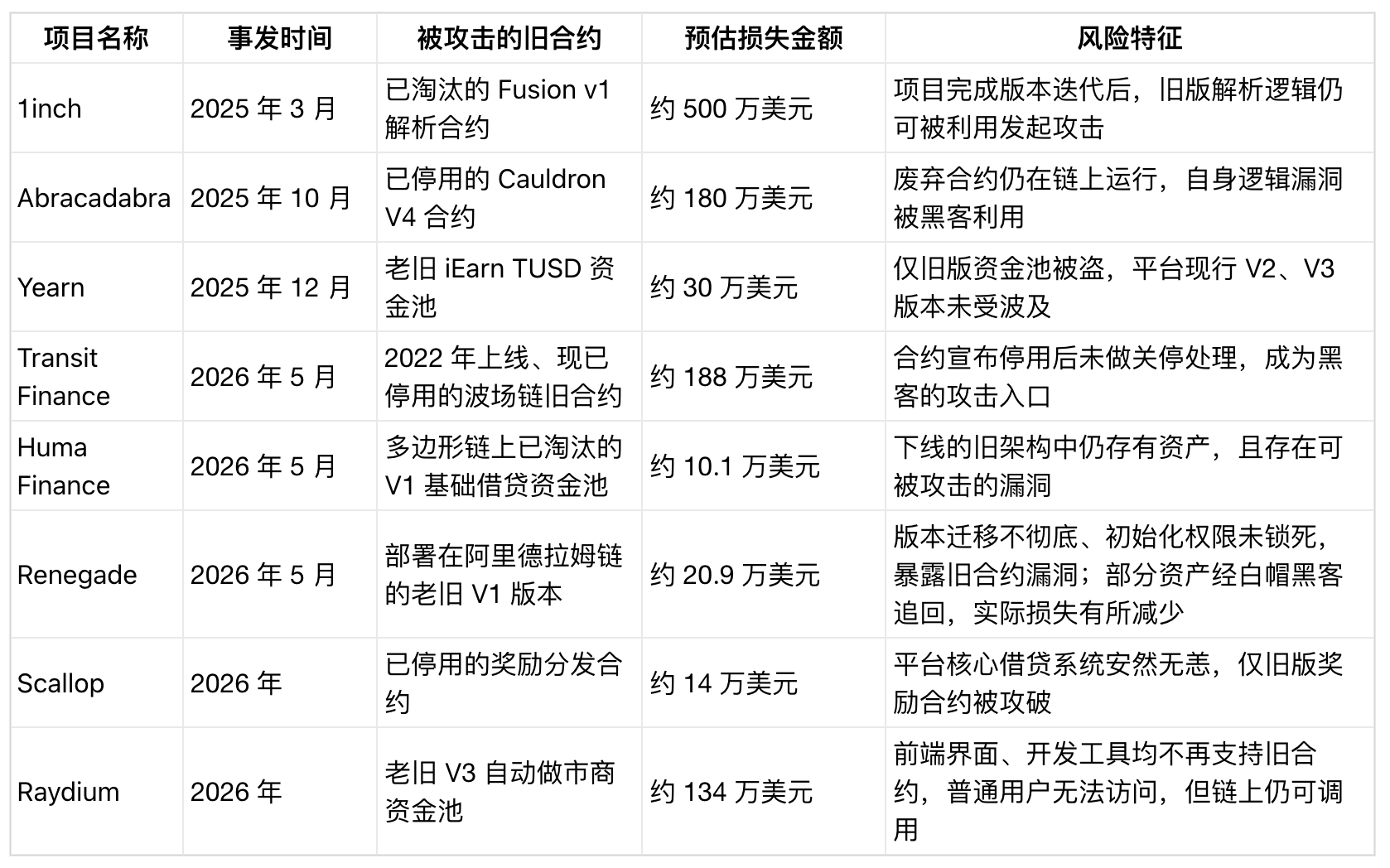
Since 2025, several well-known DeFi projects have stumbled over old contracts. All incidents share the same characteristics: the project team claimed that the current version of the product and active users were unaffected, but because the old contracts were not completely shut down, the project treasury ultimately bore the full losses.


Why Old Contract Risks Are Overlooked


Currently, the vast majority of industry security incident classification systems focus on attack methods, tampering targets, and code failure points, representing an analytical perspective "starting from technical vulnerabilities." This also leads to the masking of zombie contract incidents. The core of such problems is never coding errors, but the failure of projects to execute the necessary complete shutdown of old contracts.


A 2025 industry research paper analyzed 50 major global crypto security incidents between 2022 and 2025, with cumulative losses exceeding $1 billion. The study pointed out that high-harm on-chain attacks are often the result of chain risk superposition, simultaneously involving human operations, daily maintenance, economic models, contract lifecycle management, community governance, and other levels.


The paper proposed a four-layer root cause analysis framework, clearly classifying contract lifecycle management vulnerabilities and community governance vulnerabilities as independent risk categories separate from code writing vulnerabilities. The zombie contract problem is a typical lifecycle management vulnerability. However, in existing security statistics systems, such incidents are uniformly categorized as "code vulnerabilities," and the corresponding loss data is concealed under other classifications, failing to attract sufficient industry attention.


Beware the "Contract Graveyard": Old Infrastructure Becomes a New Attack Hotspot


If DeFi projects continue to treat "contract shutdown" as an optional, trivial matter—merely annotating "this contract is discontinued" in product documentation without transferring idle assets, disabling call functions, or continuously monitoring status—then hackers will persistently target this "contract graveyard."


Every large DeFi project's historical deployment records have now become attack targets that hackers can search and exploit. The currently counted $22.5 million in losses is merely the value from publicly exposed cases; the real risk is far higher.


Those old liquidity pools holding assets but detached from mainstream user workflows, historical authorization interfaces, and early partnership integration modules receive far less operational monitoring than current business systems, making them precisely the preferred targets for hackers.


To change the status quo, "zombie contracts" must first be listed as an independent risk category with separate incident statistics. Secondly, the contract decommissioning process must be incorporated into standardized security procedures, placed on equal footing with code audits. Only by implementing full lifecycle operations and maintenance can the attack surface be effectively reduced.


Currently, the industry's handling methods are largely similar. Raydium used its project treasury to cover the $1.34 million loss. Transit Finance and Huma Finance also bore user losses through the project side.


This also means that contract decommissioning is no longer just a documentation annotation task; it is an essential security control link.


Seven Security Control Standards for Contract Decommissioning


For the shutdown of old contracts, the industry can establish standardized control processes. The specific requirements and their functions are as follows:
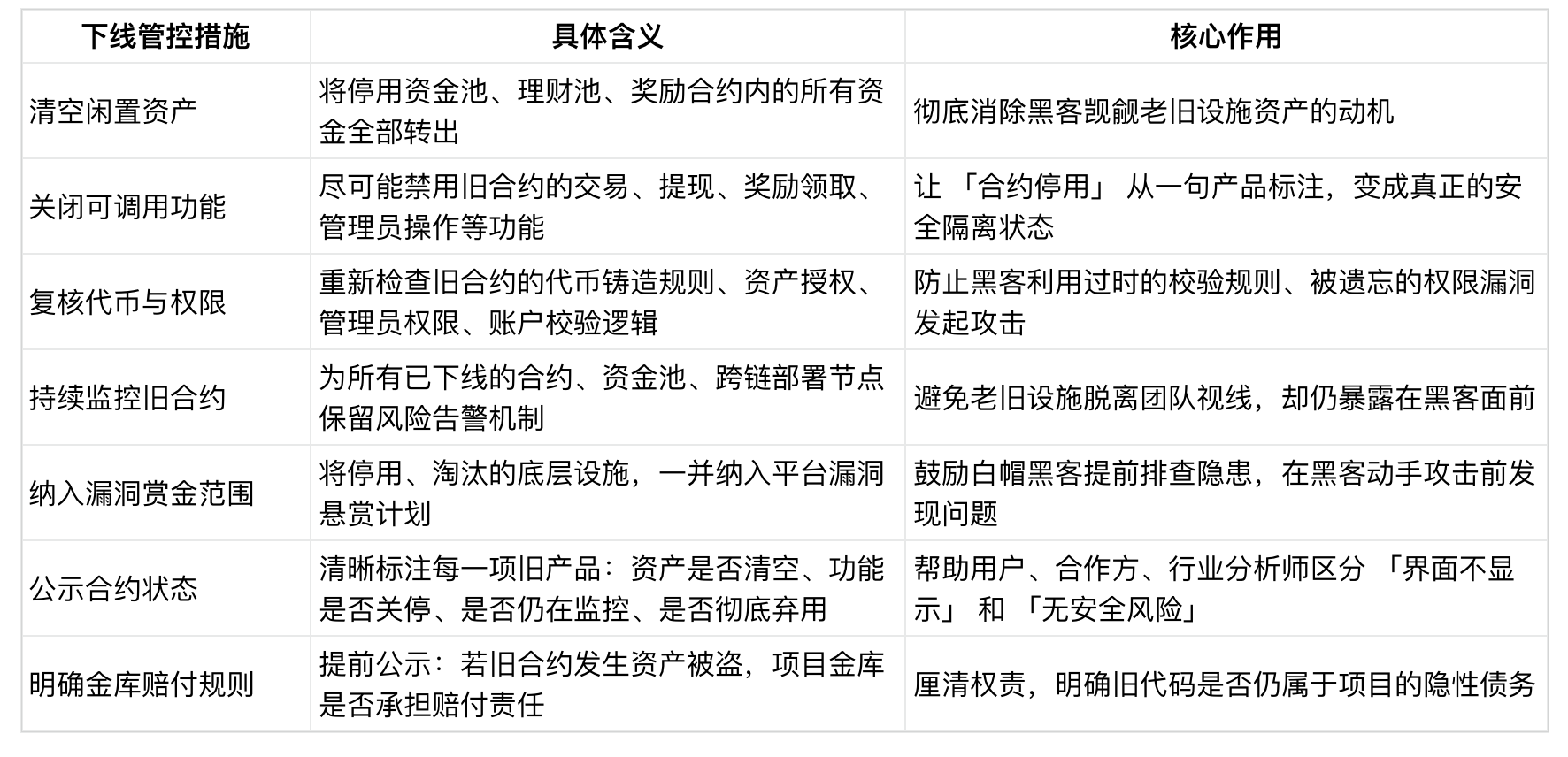


Simply annotating "contract discontinued" in documentation merely shifts the security risk to the project treasury, while the attack vulnerability remains. Announcing a shutdown only at the product level without a complete technical deactivation leaves old contracts perpetually callable: project teams neglect oversight, while hackers watch closely at all times.


The value of a DeFi project is not only reflected in its current total value locked (TVL) but also in the historical code and underlying architectures accumulated along its journey. And this forgotten history has now become a new security突破口 (breakthrough point).


Пов'язані питання

QWhat is the main vulnerability exploited in the recent Raydium hack, and what was the estimated loss?

AThe main vulnerability was in Raydium's deprecated V3 Automated Market Maker (AMM) liquidity pools. Hackers exploited these old, inactive contracts to steal approximately $1.34 million worth of assets.

QAccording to the article, what new risk category does the Raydium incident and similar attacks highlight for the DeFi industry?

AThe incident highlights the risk category of 'zombie contracts' or outdated smart contracts that have been deprecated but remain operational and callable on the blockchain, becoming overlooked attack surfaces.

QHow many similar attacks targeting outdated or deprecated contracts have been reported since March 2025, and what is the total estimated loss mentioned?

ASince March 2025, there have been at least 8 reported attacks specifically targeting deprecated or old contracts, with a cumulative loss of about $10.8 million. Including older liquidity pools and related products, the total is 10 incidents with losses around $22.5 million.

QWhy are these 'zombie contract' risks often overlooked in current security incident classifications?

ACurrent security classifications focus on technical vulnerabilities (like code bugs, oracle manipulations). 'Zombie contract' issues stem from lifecycle management failures—contracts not being properly decommissioned—and are therefore often mis-categorized under general 'code vulnerability' labels, obscuring their specific nature.

QWhat does the article suggest as a key action to properly address the risk of outdated contracts?

AThe article suggests establishing standardized security control processes for contract decommissioning. This includes measures like withdrawing all idle assets, permanently disabling key functions, revoking permissions, and continuous monitoring, treating contract sunsetting as a critical security task on par with code auditing.

Пов'язані матеріали

EF's Epic Reorganization: 20% Layoffs, Budget Halved, Is Ethereum Gearing Up for a Leaner Future?

The Ethereum Foundation (EF) has announced a major organizational restructuring, involving a 20% staff reduction (approx. 54 employees) and a division into functional clusters like Protocol, Access, User, Community, and Institutional layers. Co-founder Vitalik Buterin further revealed plans to cut the EF's budget by around 40% over the coming years, aiming to reduce its annual spending rate from about 15% to roughly 5% by 2030, transitioning to an endowment-driven model. This overhaul is seen as a long-overdue correction to the EF's ambiguous role. As Ethereum grew, the foundation faced persistent criticism over ETH sales, perceived lack of execution, and unclear strategy, often becoming a focal point for community frustration amid ETH's price stagnation. The reform aims to redefine the EF's boundaries, narrowing its focus to core protocol research, public goods funding, and ecosystem coordination, while offloading more applied development work to the broader market. Concurrently, ecosystem forces like the newly formed Ethlabs (founded by ex-EF researchers) and other independent groups are stepping in to fill the space, signaling a shift from a centralized model to a more distributed, collaborative ecosystem structure. The move was notably praised by Solana co-founder toly, who viewed a "leaner" EF as potentially more decisive and agile.

Odaily星球日报24 хв тому

EF's Epic Reorganization: 20% Layoffs, Budget Halved, Is Ethereum Gearing Up for a Leaner Future?

Odaily星球日报24 хв тому

Dragonfly Partner Haseeb: The Fastest-Growing Companies of the Future May All Get Stuck at 149 Employees

Dragonfly partner Haseeb explores the distorted economics of AI model pricing, drawing parallels to tax policy. He notes that startups and small teams (under 150 users) enjoy heavily subsidized, fixed-price AI subscriptions (like Claude Code), where the marginal cost of an additional token is effectively zero. This creates a powerful incentive for them to maximize token usage ("token-maxxing") and innovate aggressively with AI automation. In contrast, large enterprises (over 150 users) are forced onto "Enterprise" plans, paying per-token API fees with high (~75%) markups. This acts like a steep "tax" on AI-powered labor, disincentivizing marginal automation and experimental use, and encouraging them to retain more human workers. Haseeb argues this pricing creates a "150-person cliff," a regulatory notch similar to labor laws in France that discourage firms from growing past 50 employees. He predicts the fastest-growing future companies may deliberately cap their headcount at 149 to avoid the punitive enterprise pricing. This would foster an "AI-first" management philosophy obsessed with automation and outsourcing to stay lean. While not intentionally designed, this bifurcated pricing could become one of the most influential de facto tax policies, shaping how AI replaces labor—not through mass layoffs at big firms, but through agile, AI-native startups outcompeting them.

marsbit36 хв тому

Dragonfly Partner Haseeb: The Fastest-Growing Companies of the Future May All Get Stuck at 149 Employees

marsbit36 хв тому

How xBubble Breaks Through in the VC-Heavily-Backed OPC Economy

xBubble: Addressing the Structural Gap in the VC-Backed OPC Economy The concept of OPC (One Person Company) is evolving from a buzzword to a significant AI-driven market. While AI coding tools like Replit and Lovable have validated demand from non-technical users wanting to build applications, a key gap remains: the leap from creating a demo to running a stable, evolving business. These tools still require users to manage the development process, including technical judgments for integrations, modifications, and deployments—a major hurdle for OPCs. xBubble, by DAPPOS, tackles this by shifting from "Prompt-to-Code" to "SOP-to-Business." Instead of generating code from instructions, its core is a system of pre-organized SOPs (Standard Operating Procedures) that translate business goals—like "sell World Cup merchandise"—into complete, executable workflows. This includes generating cohesive assets, pages, payment systems, and backend logic. The platform is augmented by a network of third-party service providers who handle infrastructure (hosting, domains, payment setup), acting like "on-site service engineers." Users can pay for these services directly with xBubble credits, simplifying onboarding. This ecosystem aims to deliver not just an app, but a complete, modifiable business launch path. xBubble targets a clear OPC segment: small commercial nodes (e.g., creators, merchants) with existing products, customers, or channels, but for whom a full tech team is unjustifiable. Its potential lies in SOPs accumulating expertise from real cases, improving reliability and reducing delivery costs over time. Additionally, its native support for crypto payments caters to global or digital-native OPCs. In summary, as AI democratizes software creation, xBubble's opportunity is to prove that "SOP-to-Business" provides more immediate value for launching a real, operational business than a powerful but unstructured AI coding tool.

链捕手38 хв тому

How xBubble Breaks Through in the VC-Heavily-Backed OPC Economy

链捕手38 хв тому

If It's Not a Clear Yes, It's a No: A Nine-Year Retrospective by a VC Who Survived Four Cycles

**"Invest Only When Certain": A Nine-Year Retrospective from a VC Across Four Cycles** IOSG founder Jocy shares hard-earned lessons from nine years and over a hundred investments in Web3. The core challenge isn't identifying successful founders, but understanding why talented founders with solid ideas still fail. Through building a "failed founder database," IOSG identified six recurring failure patterns. **Founder Trait Red Flags:** 1. **Emotionally Unstable:** Founders who react defensively to criticism or publicly lash out under pressure (e.g., 80% drawdowns) often fail. Resilience is key. 2. **Lacking Hunger / Having a Fallback:** Founders with significant safety nets (family wealth, cushy fallback jobs) may lack the "do-or-die" commitment needed to survive crypto's brutal cycles. 3. **Unchecked Ego:** Includes "polished execution machines" who excel in known frameworks but struggle when paradigms shift, and "professor-types" who are technically brilliant but resistant to commercial feedback or coaching. **Project Structure Red Flags:** 4. **Token-First, Not Product-First:** Treating the token solely as a fundraising tool with no real utility or connection to product value is a major warning sign. The project should have value even if the token goes to zero. 5. **No Day-1 Exit Thesis:** Founders must have a clear, staged capital strategy from the start, understanding what each funding round needs to prove to unlock the next. "Exit before entry" is crucial. 6. **No Full-Cycle Experience:** Founders who haven't lived through a complete crypto bull/bear cycle (e.g., 2018, 2022) often underestimate their vulnerability. IOSG limits initial checks for such teams to $250k, sizing for risk. **The Positive Flipside: Desirable Founder Traits** The ideal candidate exhibits: obsessive problem-depth, being a second-time founder with a non-consensus vision, strong communication skills with *controlled* ego, relentless perseverance, and a global perspective with agency and taste (increasingly vital in the AI era). **Three Survival Tips for Founders:** 1. **Cash Flow Over Narrative:** Real revenue is what sustains projects, not vanity metrics. 2. **Tokens Are a Liability:** Avoid issuing a token unless absolutely necessary. The hidden costs (market making, liquidity, compliance) are immense, often a multi-million-dollar burden. 3. **Respect Liquidity:** Sell during peaks to build treasury, buy back to support the protocol during troughs. Be realistic about valuations and your ability to deliver for the next round. The final principle is simple yet paramount: **"If it's a borderline 'yes' or 'no,' don't invest."** In an industry that reinvents itself every few years, the discipline to consistently say "no" is the ultimate secret to longevity.

Foresight News1 год тому

If It's Not a Clear Yes, It's a No: A Nine-Year Retrospective by a VC Who Survived Four Cycles

Foresight News1 год тому

Торгівля

Спот
Ф'ючерси
活动图片