The Real Progress and Investment Opportunities of Decentralized AI Computing Power Networks in 2026

marsbitОпубліковано о 2026-05-25Востаннє оновлено о 2026-05-25

Анотація

In 2026, the AI compute market is marked by centralized GPU consolidation and a significant GPU shortage for smaller players. In this context, Decentralized Physical Infrastructure Networks (DePIN), valued at $9.4B+, have emerged as a viable, revenue-generating alternative. Leading protocols like Aethir ($150M ARR), io.net (130k+ GPUs), Akash, Bittensor, and Render are carving out distinct niches, moving beyond hype to deliver verifiable income primarily from non-crypto-native clients. The key advantage of decentralized GPU networks lies in serving latency-tolerant, cost-sensitive workloads like AI inference, fine-tuning, data preprocessing, and agent operations, offering substantial cost savings (45-80%) compared to major cloud providers. However, reliability variance, lack of robust SLAs, and fragmented tech stacks remain significant adoption hurdles. The sector is maturing with critical 2026 shifts: 1) Evolution of tokenomics towards demand-driven, revenue-linked models (e.g., Render's BME, io.net's IDE), and 2) Clearer enterprise adoption pathways, with traditional firms integrating decentralized compute. For new entrants, opportunities are now concentrated in specialized tooling layers (orchestration, verification, SLA management), vertical applications (e.g., bio-med, content generation), and innovative token designs tied to real usage, rather than generic GPU aggregation. The convergence with the emerging AI Agent economy presents a significant future growth vector.

In 2026, the global AI computing power market has entered an extremely dynamic phase. On one hand, leading technology companies are consolidating GPU resources at an unprecedented pace. For example:

  • xAI's Colossus supercomputing cluster has aggregated 550,000 NVIDIA GPUs and is progressing toward the publicly stated roadmap goal of 1 million GPUs;
  • Project Stargate, initiated by OpenAI, Oracle, SoftBank, and others, has deployed over 450,000 NVIDIA GPUs in Texas, with a target total power of 1.2GW.
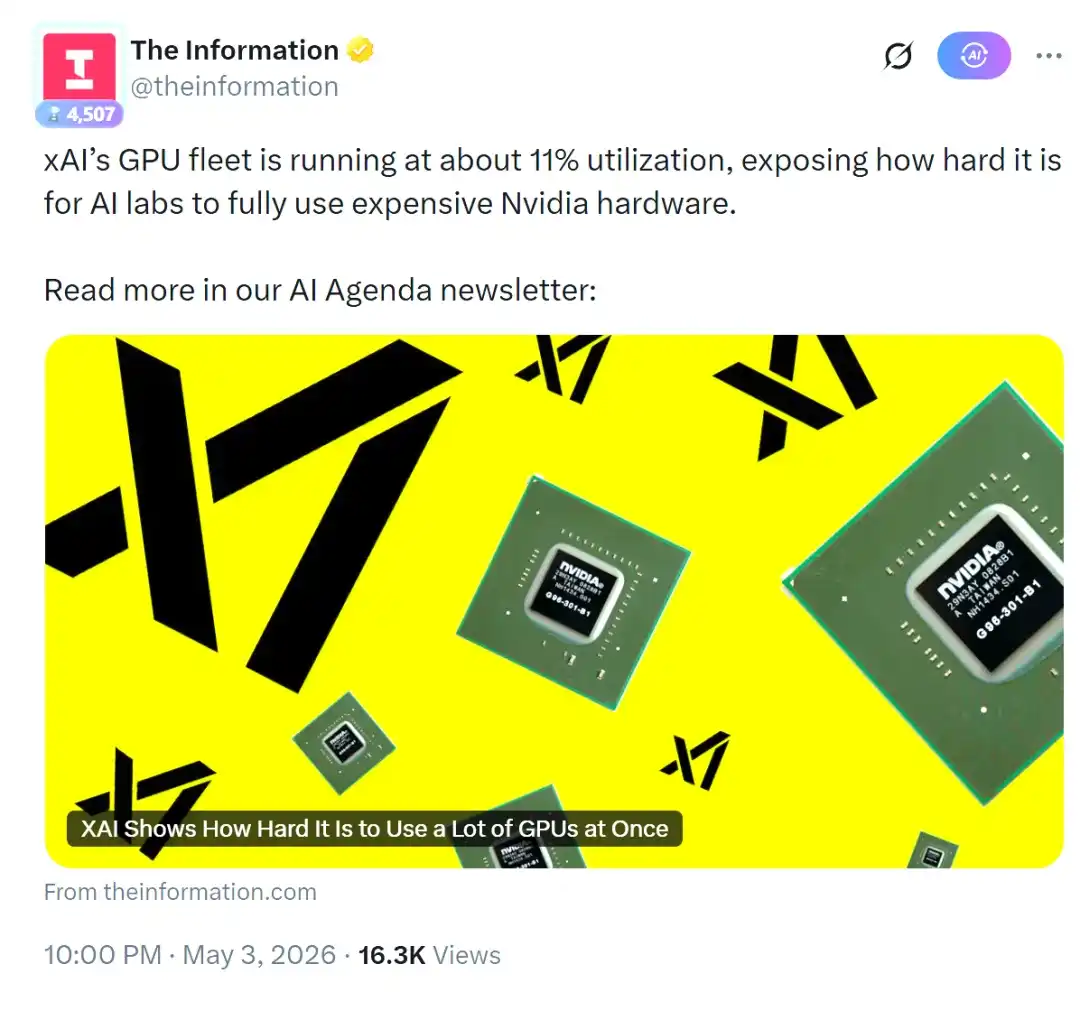
On the other hand, a large number of small and medium-sized AI startups and independent research teams are suffering from computing power shortages. AWS's H100 clusters experienced waiting periods of 8 to 12 months from 2023 to 2024, with cloud computing bills easily exceeding millions of dollars.

It is precisely in this context of severe supply shortage that the Decentralized Physical Infrastructure Networks (DePIN) track has rapidly emerged.

  • As of the end of March 2026, the total market capitalization of the DePIN track is approximately $9.423 billion, with nearly 250 active projects tracked by CoinGecko.
  • The sector reached a market cap high of about $19.2 billion in September 2025, achieving a year-on-year growth of approximately 270% compared to $5.2 billion in the same period of 2024.
  • More crucially, according to on-chain data aggregated by DeFiLlama and Dune Analytics, the annualized protocol revenue of decentralized GPU computing protocols exceeded $200 million in early 2026.

We have to admit that this sector has crossed a massive threshold that other crypto narratives have never achieved—it is generating real revenue from non-crypto-native clients.

I. Industry Panorama: From Fervent Narrative to Revenue Realization

In 2026, the DePIN computing power industry began to have verifiable revenue data, rather than just a stack of market cap tables and token emission schedules. Over the past two years, the sector has formed a clear hierarchical structure. The operational status of major protocols is shown in the following table:

Table 1: Key Data Comparison of Mainstream Decentralized Computing Networks in 2026
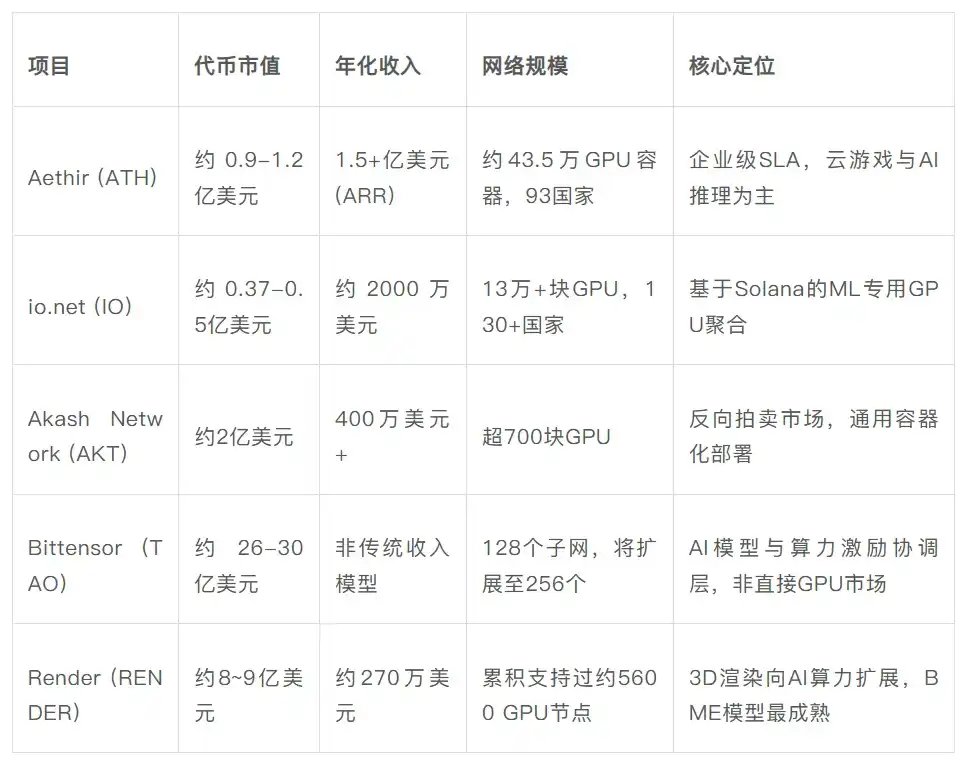
Data source: Official disclosures of each project, Messari quarterly reports, CoinMarketCap, CoinGecko / Coinbase. Data as of May 2026. Note: Bittensor does not have "protocol revenue" in the traditional sense—it is an AI model incentive coordination layer, rewarding participants via inflationary token issuance, with each subnet generating revenue independently.

As can be seen from the table above, these five protocols occupy different ecological positions.

  • Aethir leads in enterprise-level revenue, with an annualized recurring revenue of approximately $150 million. It is currently the protocol with the largest revenue scale in the decentralized computing track, serving clients including game studios, AI inference providers, and model training teams.
  • io.net focuses on orchestrating distributed ML computing clusters, covering over 130,000 GPU devices across more than 130 countries.
  • Akash has formed genuine price competition through its reverse auction pricing mechanism. Its Q1 2026 computing power expenditure broke a historical high of over $5 million, and the AKT token has risen over 72% year-to-date.
  • Bittensor is entirely different; it doesn't rent GPU hardware but incentivizes AI intelligence output itself, forming a decentralized machine intelligence market through 128 subnets.
  • Render started with 3D rendering, having cumulatively rendered over 67 million frames, and is now expanding into general AI computing.

II. Capability Boundaries: What Decentralized GPU Networks Can and Cannot Do

Decentralized GPU networks have long been caught between two extreme narratives: one side claims costs are only one-tenth of AWS's and will soon disrupt cloud computing; the other side believes distributed GPUs cannot support real AI workloads at all. Both judgments are biased.

The key to understanding this sector lies in confronting the structural characteristics of consumer-grade GPUs.

On one hand, the computing power supply of decentralized networks largely comes from consumer-grade GPUs, which have limited VRAM capacity, and inter-node bandwidth relies on home broadband. This inherently makes them unsuitable for synchronous training of frontier large models—such tasks require thousands of high-end GPUs to be interconnected with extremely low latency, a scenario designed for hyperscale clouds.

On the other hand, for workloads with higher latency tolerance and cost sensitivity, the cost-effectiveness advantage of decentralized networks is quite evident: parallel molecular screening in AI drug discovery, batch rendering for text-to-image and text-to-video, and large-scale data preprocessing pipelines are typical matching scenarios.

Furthermore, the continuous expansion of open-source models and the technological evolution of lightweight inference are systematically expanding the serviceable market for decentralized networks. An increasing number of models can run efficiently on a single or a few consumer-grade GPUs. The barriers to inference and fine-tuning are decreasing, which happens to be the most competitive range for decentralized networks.

Chart 2: Matching Relationship between AI Workloads and Computing Power Infrastructure
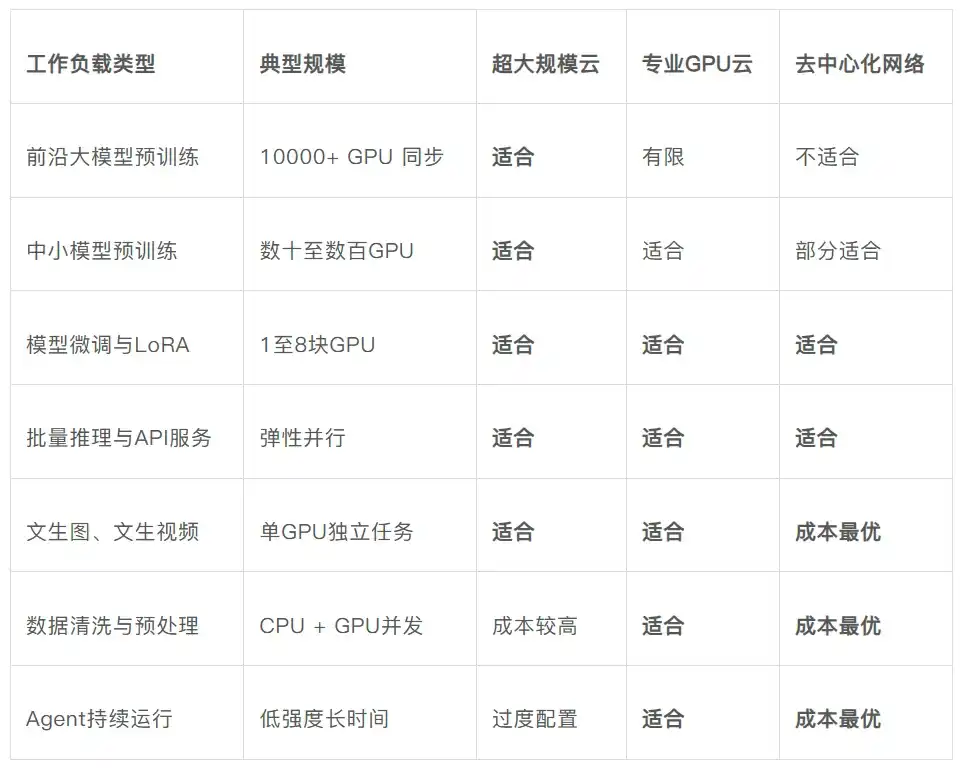
Data source: Compiled from Together AI's multi-node training report (January 2026), Dell LLM cluster network traffic technical documentation (December 2025), Cointelegraph industry analysis (January 2026).

Based on this, the real opportunity for decentralized GPUs concentrates on fragmented, distributed, and price-sensitive scenarios such as inference, fine-tuning, data preprocessing, and Agent continuous operation, rather than directly competing with hyperscale clouds in the frontier training market.

It is worth noting that from the perspective of current AI production environments, the proportion of training in total computing power consumption is now far lower than that of inference and Agent-like tasks, the latter being the main source of growth in computing power demand. This means that the market targeted by decentralized networks is not marginal in scale—it corresponds precisely to the largest and fastest-growing layer in the AI computing power demand structure.

III. Is the Price Advantage Real: Is It Really 60% Cheaper?

One reason decentralized computing power is highly sought after is the widely circulated claim of being "60% cheaper." This statement originates from a cost comparison between the two. The publicly listed price on the Akash Network website shows the hourly rental rate for an H100 GPU is approximately $1.33; after a price reduction of about 44% in June 2025, the per-GPU hourly rate for an AWS p5 instance (averaged across 8 cards) is about $3.93. This is the comparison most frequently cited in reports and the source of the claim "decentralized is over 60% cheaper."

Chart 3: H100 GPU Hourly Rental Price Comparison (Early 2026)
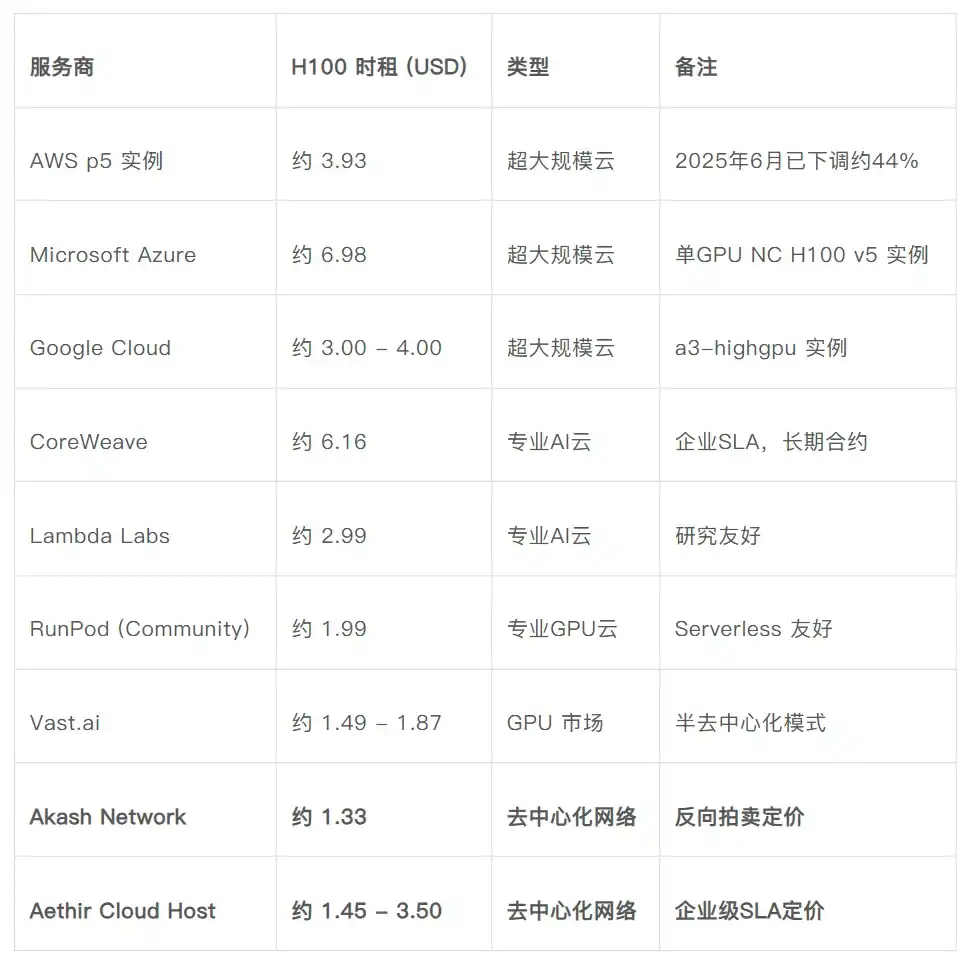
Data source: AWS, Azure, Google Cloud public pricing; Akash Network official website; Aethir official documentation; getdeploying.com (May 2026); IntuitionLabs' "H100 Rental Prices Compared" (May 2026); Silicon Data "H100 Price Spike" (January 2026).

The table above compares the price difference for H100 GPU rentals between centralized platforms and decentralized networks. The comparison leads to the following conclusions:

First, the price advantage of decentralized GPU networks over hyperscale clouds is real—approximately 60% lower compared to the AWS p5 average price, and can be as low as 75%~80% compared to single-GPU instances (AWS/Azure).

Second, compared to fully competitive professional GPU clouds (RunPod, Vast.ai), the price gap with decentralized GPU networks narrows to 15%~35%, and is basically flat in some scenarios.

Third, what truly constitutes differentiation are more structural attributes: no enterprise account required, no minimum usage commitment, on-demand start-stop, flexible geographical distribution of nodes, and no vendor lock-in—this is the real charm of decentralized GPUs.

However, one point that must be raised simultaneously is: Hidden costs cannot be ignored. The node stability of decentralized networks varies greatly. In production scenarios, redundant deployment or increased fault-tolerance mechanisms are needed. These additional costs erode the nominal price advantage to varying degrees. This is one of the main practical barriers facing large-scale enterprise adoption of decentralized GPUs in 2026.

IV. The Real Changes in the Sector in 2026

Based on existing data, the decentralized computing power sector is undergoing two observable deep-seated changes in 2026.

The first is the maturation of tokenomics. Early DePIN projects generally relied on inflationary token subsidies for hardware suppliers, a model with inherent flaws: falling token prices lead to shrinking supplier profits, supplier exits reduce network availability, which further depresses token prices, creating a vicious cycle. Between 2025 and 2026, leading projects have gradually shifted to new models that directly bind token mechanisms to real business volume.

Render Network's BME (Burn-Mint Equilibrium) model, established through RNP-001, requires creators to pay for rendering tasks at fiat prices. Payments are automatically converted to RENDER tokens and burned upon task completion. This mechanism has been operating for years.

io.net's original tokenomics relied on fixed emissions and price-sensitive supplier income, making it prone to a "death spiral." Its upcoming IDE (Incentive Dynamic Engine), slated for Q2 2026, will replace fixed emissions with a demand-driven model, stabilize supplier income pegged to the US dollar, and dynamically adjust token supply based on real-time revenue and token prices.

These two models differ in mechanism but share a common logic: linking token burning and minting to real computing power consumption and anchoring supplier income to the US dollar value. This is the first time decentralized infrastructure has a financial structural logic in token design comparable to traditional SaaS businesses.

The second is the gradual clarification of market entry paths. Early DePIN computing power networks almost exclusively served crypto-native teams, creating a natural market ceiling. Since 2025, several cases of traditional enterprises entering the decentralized computing power system through specific collaborations have emerged.
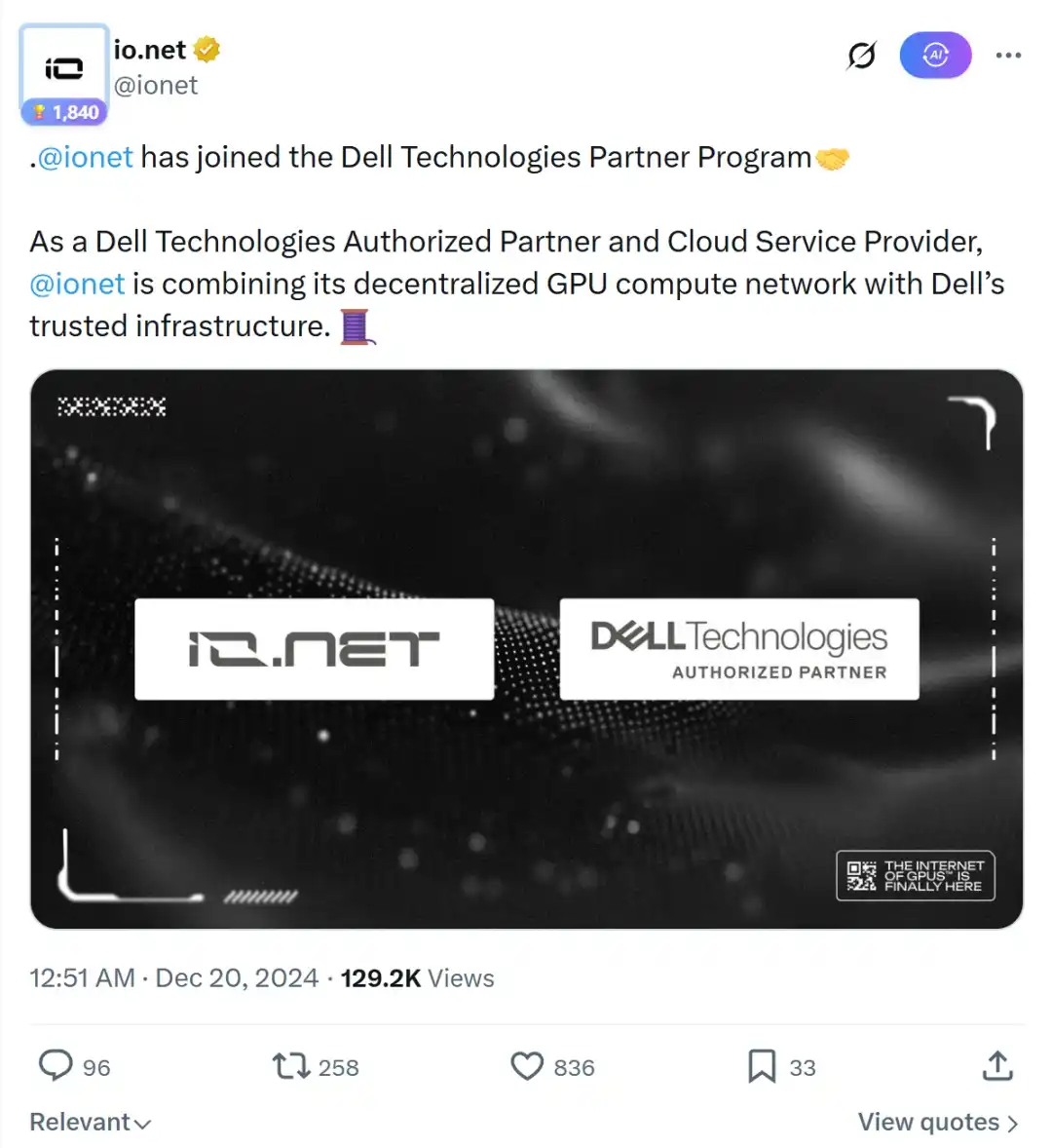
As early as December 2024, io.net joined the Dell Technologies Partner Program as an authorized partner and cloud service provider. The two sides will collaborate on marketing and demand development, enabling enterprise clients to integrate and deploy decentralized GPU computing power with Dell hardware. Prior to that, in April 2024, io.net established a partnership with the AI creative platform KREA, whose enterprise client list includes Nike, Apple, FC Barcelona, Publicis Group, and Meta. io.net provided KREA with NVIDIA A100-80GB GPU clusters at approximately one-third of the market average price.

Meanwhile, Aethir's over 150 paying enterprise clients are distributed across AI, Web3, and gaming sectors. Its Q3 2025 single-quarter revenue reached $39.8 million, with annualized revenue exceeding $147 million, covering scenarios such as AI inference, model training, and Agent platforms.

Regarding Akash, Venice.ai (a private, uncensored generative AI application) uses Akash GPUs to handle inference requests, and FLock.io (a federated learning platform) allows operators to deploy validator nodes on Akash. Both integrations were completed in 2024.

The common feature of the above cases is that non-crypto-native enterprises have begun to incorporate decentralized computing power into actual procurement and technical integration, moving beyond mere narrative levels. Although the number of cases is not vast, they represent a substantive breakthrough in market entry paths.

Chart 4: Key Metric Changes in the DePIN Computing Power Sector (2024 - 2026)
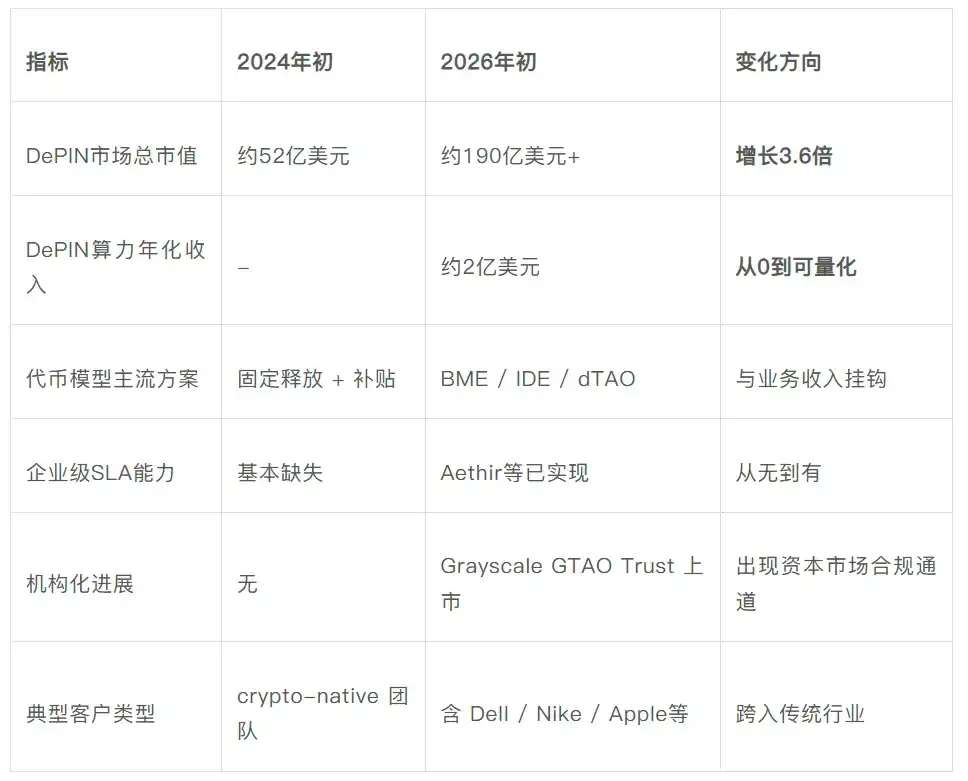
Data source: BlockEden "Decentralized GPU Networks 2026," "DePIN Revenue Inflection"; Yellow.com (May 2026); Messari project report series; CoinGecko "Top Bittensor Subnets" (April 2026).

However, it must also be admitted that: the decentralized computing power sector still faces significant unresolved core obstacles.

First, raw GPU quotes are indeed cheaper (offering discounts of 45-60%), but reliability variance often forces users to over-provision computing power, significantly eroding the nominal cost savings.

Second, enterprise adoption of decentralized computing power still faces difficulties, such as: orchestration challenges, difficulties in debugging distributed failures, and lack of enforceable SLA (Service Level Agreement) guarantees.

Third, the DePIN technology stack is highly fragmented—computing power, storage, verification, and data are scattered across different protocols. Developers must piece together multiple systems to complete production-level deployments, significantly increasing engineering costs.

An exception worth noting on the enterprise front is Aethir. Aethir maintains a 99.31% uptime across over 435,000 GPU containers, possesses enforceable enterprise-level SLAs, and is one of the few projects in the decentralized computing power sector currently capable of meeting enterprise contract-level service requirements.

Of course, the existence of these problems represents both current constraints and tangible gaps that project teams can concretely address.

V. Implications for Ecosystem Player Development Paths

For ecosystem players entering this sector in 2026, the aforementioned data points to several specific judgments:

First, avoid redundant construction of basic aggregation layers. io.net, Akash, and Aethir have already established GPU aggregation networks of considerable scale across different price points. New projects that merely enter as generic GPU aggregators, without significant differentiation—whether in geographic coverage, compliance qualifications, special hardware types, or vertical industry certifications—will find it difficult to establish sustainable advantages. Projects like Render (extending from rendering to AI computing) and Aethir (extending from cloud gaming to enterprise AI inference), which themselves have accumulated resources in specific scenarios, are more likely to gain initial users and differentiated pricing power than pure generic aggregation networks.

Second, tooling and middleware layers are more realistic entry points. Each of the aforementioned unresolved problems—reliability management, distributed debugging, SLA guarantees, cross-chain settlement, Agent-level computing power procurement, and reconciliation—corresponds to a tooling-type project that can stand independently.
  • Gensyn's Verde is an early example. It is a verification protocol specifically designed for machine learning in decentralized environments. Its core is a lightweight dispute arbitration system capable of pinpointing the first step in the training computation graph where the trainer and verifier diverge. Thus, only that single operation needs to be recomputed, not the entire task, significantly reducing verification overhead.
  • Other ideas include, for instance, what io.net proposed: utilizing the MCP protocol to enable AI Agents to directly procure and schedule computing resources without human KYC or enterprise accounts, thereby bypassing the onboarding barriers of traditional cloud services, which are unfriendly to autonomous Agents.

Building toolchains around these underlying protocols offers more clear-cut differentiation space than creating another GPU marketplace.

Third, opportunities at the vertical application layer are diverging. Specific scenarios such as AI biomedicine, AI image/video generation, AI Agent continuous operation, on-chain data analysis and backtesting, and privacy computing (combined with TEE) have different sensitivities to computing power cost, latency tolerance, and reliability requirements. Cases like the Templar subnet training the 72B-parameter Covenant model on Bittensor demonstrate that small-scale, task-specific training is feasible on decentralized networks; however, the subsequent team departure incident also indicates that the governance and team stability of vertical application projects are deeply tied to token market performance.

Fourth, tokenomics design has become a core barrier. Token models like BME and IDE, which are tied to real business volume, have become the de facto standard for the new generation of DePIN computing projects. The early path of releasing tokens first, attracting hardware to the network, and then promoting market cap to attract users has been proven unsustainable in the 2026 market environment. The token model design of new projects must answer from day one: where does the token demand side come from?

Fifth, a point needs to be added: the integration of decentralized GPU networks and the AI Agent economy has just begun in 2026. When the number of AI Agents experiences exponential growth in the next 12 to 18 months, the demand for decentralized computing power will no longer be an option for enterprise-level teams but the default entry point for non-human economic activities. This change is structurally compatible with decentralized computing power networks—the human KYC and enterprise account systems of traditional cloud services are unfriendly to Agents, while permissionless computing power markets can fill this gap.

VI. Observations from Go2Mars Research Institute

The state of decentralized GPU networks in 2026 is neither the "complete disruption of cloud computing" touted by proponents nor the "conceptual scam" claimed by skeptics. It has become a layer within the AI infrastructure stack with real revenue, clear capability boundaries, and is purchasable by enterprises—but its most suitable scenarios still concentrate in areas such as inference, fine-tuning, data preparation, and Agent continuous operation. The market for frontier foundational model training still belongs to hyperscale centralized clouds.

For ecosystem players, this means the opportunity window for the next 12 to 18 months is concentrated in three types of positions.

  • The first category is the tooling layer around the Agent economy and AI inference, including infrastructure for computing power orchestration, behavior verification, metering and billing, SLA guarantees, and cross-chain settlement.
  • The second category is the application layer tied to specific vertical industries, including cost-sensitive and latency-tolerant scenarios such as biomedicine, content generation, and on-chain data science.
  • The third category is the deep integration of next-generation tokenomics and enterprise-level payment paths, requiring direct binding of token demand side with real business volume.

The research institute team has recently engaged in in-depth cooperation with multiple AI × Crypto project teams in areas such as track positioning, technology path selection, token model design, market entry strategies, and VC connections. If a project team believes they are better suited to enter one of the three aforementioned positions, please feel free to contact us for further research and incubation support.


Пов'язані питання

QWhat is the current market state of decentralized GPU networks in 2026 according to the article, and what key metric indicates their real-world traction?

AIn 2026, the decentralized GPU network (DePIN) sector has matured from speculative narrative to a revenue-generating layer. The key metric indicating its real-world traction is that decentralized GPU computing protocols have achieved an annualized protocol revenue exceeding $200 million in early 2026, derived from non-crypto native customers.

QBased on the article's comparison, what are the main areas where decentralized GPU networks demonstrate true price advantages over centralized clouds, and what are the limitations?

AThe main price advantage is for on-demand H100 GPU rentals, where decentralized networks (e.g., Akash at ~$1.33/hr) can be ~60% cheaper than major cloud providers (e.g., AWS p5 at ~$3.93/hr) and up to 75-80% cheaper compared to single-GPU instances. The key limitation is the 'hidden cost' of variable node reliability, which necessitates redundant deployments and fault tolerance mechanisms, partially eroding the nominal price savings for production workloads.

QWhat are the two deep-seated changes the decentralized compute sector is undergoing in 2026, as highlighted in the article?

AThe two deep-seated changes are: 1) The maturation of token economics, with leading projects shifting to models that directly link token mint/burn mechanics to real compute consumption (e.g., Render's BME, io.net's planned IDE), anchoring provider revenue to USD value. 2) The clarification of market entry paths, with concrete examples of non-crypto native enterprises (like KREA's clients, Venice.ai, FLock.io) beginning to integrate and procure decentralized compute resources.

QWhat are the core unresolved challenges currently facing the decentralized compute sector, as per the article's analysis?

AThe core unresolved challenges are: 1) High variance in node reliability, forcing users to over-provision compute and eating into cost savings. 2) Enterprise adoption hurdles like orchestration difficulty, complex distributed debugging, and a lack of enforceable Service Level Agreements (SLAs). 3) A highly fragmented DePIN tech stack, requiring developers to integrate multiple protocols (compute, storage, verification) for production deployment, increasing engineering costs.

QFor ecosystem participants in 2026, what are the three primary opportunity areas identified by the Go2Mars Research Institute based on the sector's current state?

AThe three primary opportunity areas are: 1) The tooling layer around Agent economy and AI inference, including compute orchestration, behavior verification, metering/billing, SLA guarantees, and cross-chain settlement. 2) The application layer tied to specific verticals like biopharma, content generation, and on-chain data science, which are cost-sensitive and latency-tolerant. 3) The deep integration of next-generation token economics with enterprise payment pathways, ensuring token demand is directly tied to real business volume.

Пов'язані матеріали

Understanding Bound in One Article: The "Multi-signature + Timelock" Escape Mechanism and the Off-Chain Matching Black Box

**Title**: Understanding Bound: The Escape Mechanism of "Multi-Sig + Time Lock" and the Off-Chain Matching Black Box **Summary**: Bound Exchange, evolved from the earlier radFi platform, introduces a novel approach to Bitcoin trading by combining self-custody security with exchange-like speed. Its core mechanism relies on a 2-of-2 multi-signature (multi-sig) address for user deposits. One private key is held by the user via a passkey, and the other is held by Bound. This setup requires both keys to sign any transaction, preventing Bound from unilaterally accessing user funds (non-custodial). To address the risk of Bound becoming unavailable, a 3-month timelock is integrated into the Bitcoin script. After this period, users can withdraw their assets with just their single signature, ensuring an escape hatch. For trading, Bound operates a concentrated liquidity AMM. However, as Bitcoin L1 lacks smart contracts, the AMM curve, liquidity management, and trade price calculations occur off-chain in Bound's backend database. On-chain Bitcoin transactions serve only as final settlement receipts for pre-determined amounts. This creates a centralization point: the critical sequence of trade execution—which determines the exact price along the curve for each order—is managed off-chain by Bound in a non-transparent "black box." While the 2-of-2 setup protects user本金 (principal), the pricing and ordering of trades introduce potential operational MEV risks, as the order processing is invisible and unverifiable on-chain. In practice, users can also connect external wallets (like Unisat) for fully self-custodied trading, but this requires manually signing every transaction. The platform currently supports deposits of BTC and Runes only.

marsbit5 хв тому

Understanding Bound in One Article: The "Multi-signature + Timelock" Escape Mechanism and the Off-Chain Matching Black Box

marsbit5 хв тому

Amid Internal and External Challenges, Is Ethereum's Neutral Route Still Viable?

"Ethereum is facing a dual crisis of market pressure and internal challenges. Its native token ETH is in a mid-term downtrend, with negative sentiment prevailing, weak price action, and significant outflows from ETFs. The ETH/BTC ratio has hit a ten-month low, and institutional holdings have shrunk. Concurrently, the Ethereum Foundation has seen a major exodus of core personnel following its commitment to a neutral, non-commercial development roadmap focused on censorship resistance, openness, privacy, and security (CROPS). This stance has sparked debate. Critics, including former members, argue that the ecosystem lacks a dedicated, well-funded entity to promote ETH's commercial value and compete with rival chains. Proposals suggest creating a new, independent body to drive adoption and token value, forming a dual-model with the Foundation. While some investors view the personnel changes as normal turnover and remain bullish on Ethereum's long-term fundamentals, the immediate path forward is unclear. Analysts believe Ethereum must execute its technical roadmap (like upcoming upgrades), clarify governance, and focus on high-value sectors like DeFi and tokenization to convert its technological edge into a compelling investment thesis. The current downturn tests whether its decentralized model can adapt to balance core principles with commercial competitiveness."

marsbit11 хв тому

Amid Internal and External Challenges, Is Ethereum's Neutral Route Still Viable?

marsbit11 хв тому

Technology Has No Barriers, 24/7 Trading is the Key to Hyperliquid's Success

The article argues that Hyperliquid's competitive edge lies not in technological superiority but in its 24/7 trading model, which fundamentally challenges traditional finance's fixed market hours. Based in Singapore with an 11-person team, Hyperliquid has generated significant revenue and trading volume. Its core advantage is the ability to facilitate trading continuously, including during weekends when major exchanges like the CME are closed. This was demonstrated when Hyperliquid listed a SpaceX pre-IPO perpetual contract on a Sunday, allowing the market to price the company hours before traditional institutions opened. This disruption has drawn regulatory scrutiny from traditional giants like CME and ICE, who cite risks like lack of KYC and market manipulation. However, the article suggests their concern stems from Hyperliquid eroding the "time monopoly" of established markets. The piece contrasts Hyperliquid's synthetic derivatives—pure price-betting contracts with no underlying asset or centralized issuer—with other models like PreStocks (dependent on real股权) and Ondo (licensed but targetable). Hyperliquid's code-based, decentralized structure makes it resilient to takedowns, even if founders face legal action. Ultimately, the author concludes that while it raises legitimate regulatory questions, Hyperliquid's "unforgeable" competitive barrier is the time advantage of non-stop trading, a feature legacy systems cannot replicate.

marsbit11 хв тому

Technology Has No Barriers, 24/7 Trading is the Key to Hyperliquid's Success

marsbit11 хв тому

New Information Laundering in Prediction Markets: How Secrets Blend into Investment Signals

"The New Information Laundering in Prediction Markets: How Secrets Infiltrate Investment Signals In late February 2026, nine linked anonymous wallets on Polymarket placed over 80 bets on specific details of a US-Iran war, winning over $2.4 million with a 98% win rate. This exemplifies 'information laundering'—a destructive flaw inherent to prediction markets. These markets function by aggregating trader supply and demand on an order book to set prices, which represent collective probability estimates. This makes them valuable real-time sentiment indicators for institutions. However, the system cannot distinguish between public information and stolen secrets. Confidential information enters one end, and 'clean' market prices—bearing no trace of their illicit origin—emerge from the other. For example, an insider knowing of an imminent strike can buy contracts at low odds, pushing the price up and disguising the secret as a savvy market signal, then profit massively when the event occurs. Analysts can sometimes uncover these schemes due to the blockchain's transparency, as seen with Bubblemaps. Paradoxically, this same transparency can inadvertently broadcast secrets to adversarial observers, providing them with low-cost intelligence. Current laws, like insider trading regulations focused on corporate information, fail to address this issue, especially concerning events like military actions with no 'issuer.' Jurisdictional challenges are amplified as platforms operate offshore, easily bypassing national bans with VPNs. Recent US congressional investigations and proposed bills aim to ban war betting and trading on non-public information by officials. The core issue is that information laundering is not a bug but a feature: a market that perfectly converts knowledge into price will inherently reward those with the best information, including those who obtained it illicitly. As prediction markets grow, potentially reaching hundreds of billions in volume, society must confront whether it can tolerate a machine that profitably transforms its most guarded secrets into public, tradable numbers."

链捕手20 хв тому

New Information Laundering in Prediction Markets: How Secrets Blend into Investment Signals

链捕手20 хв тому

Trump’s Dual Pressure: When the Iran Deal Meets the Midterm Elections

U.S. President Donald Trump’s efforts to negotiate a deal with Iran are triggering a political backlash within his own Republican Party, as the approach of midterm elections intensifies internal divisions. Reports of a potential agreement—involving a temporary ceasefire, phased sanctions relief, and the unfreezing of Iranian assets in exchange for discussions on Tehran diluting or transferring its stockpile of highly enriched uranium—have drawn sharp criticism from GOP hawks. Key allies like Senators Lindsey Graham and Ted Cruz warned that such concessions could allow Iran to recuperate, undermine recent U.S. military gains, and ultimately strengthen a hostile regime. The dispute highlights a broader political struggle for Trump, who must reconcile his "America First" posture with diplomatic compromise while facing a tough electoral landscape. With Republicans fighting to maintain control of Congress and Trump’s approval ratings declining, the Iran deal has quickly become a test of party loyalty and perceived toughness. Public sparring between Trump aides and critics—including former Secretary of State Mike Pompeo—underscores the internal pressure. While Secretary of State Marco Rubio defended Trump’s historically hardline stance, skeptics like Senator Thom Tillis questioned the logic of any deal that leaves nuclear materials in Iran. The outcome now hinges on whether Trump can persuade his party’s hardliners to accept a negotiated exit.

marsbit23 хв тому

Trump’s Dual Pressure: When the Iran Deal Meets the Midterm Elections

marsbit23 хв тому

Торгівля

Спот
Ф'ючерси

Популярні статті

Що таке GROK AI

Grok AI: Революція в розмовних технологіях ери Web3 Вступ У швидко змінюваному ландшафті штучного інтелекту Grok AI вирізняється як помітний проєкт, що поєднує сфери передових технологій та взаємодії з користувачами. Розроблений компанією xAI, яку очолює відомий підприємець Ілон Маск, Grok AI прагне переосмислити, як ми взаємодіємо зі штучним інтелектом. Оскільки рух Web3 продовжує процвітати, Grok AI має на меті використати потужність розмовного ШІ для відповіді на складні запитання, надаючи користувачам досвід, який є не лише інформативним, але й розважальним. Що таке Grok AI? Grok AI — це складний розмовний чат-бот, розроблений для динамічної взаємодії з користувачами. На відміну від багатьох традиційних систем ШІ, Grok AI охоплює ширший спектр запитів, включаючи ті, які зазвичай вважаються недоречними або виходять за межі стандартних відповідей. Основні цілі проєкту включають: Надійне міркування: Grok AI акцентує увагу на здоровому глузді, щоб надавати логічні відповіді на основі контекстуального розуміння. Масштабоване управління: Інтеграція допоміжних інструментів забезпечує моніторинг та оптимізацію взаємодій користувачів для покращення якості. Формальна верифікація: Безпека є пріоритетом; Grok AI впроваджує методи формальної верифікації для підвищення надійності своїх результатів. Розуміння довгого контексту: Модель ШІ відзначається здатністю зберігати та згадувати обширну історію розмов, що сприяє змістовним та контекстуально обізнаним дискусіям. Стійкість до атак: Зосереджуючись на покращенні своїх захистів від маніпульованих або зловмисних вхідних даних, Grok AI прагне зберегти цілісність взаємодій з користувачами. По суті, Grok AI — це не просто пристрій для отримання інформації; це занурюючий розмовний партнер, який заохочує динамічний діалог. Творець Grok AI Геній, що стоїть за Grok AI, — це ніхто інший, як Ілон Маск, особа, яка стала синонімом інновацій у різних сферах, включаючи автомобільну промисловість, космічні подорожі та технології. Під егідою xAI, компанії, що зосереджена на розвитку технологій ШІ на користь суспільства, бачення Маска прагне переосмислити розуміння взаємодій з ШІ. Лідерство та основоположна етика глибоко впливають на прагнення Маска розширити технологічні межі. Інвестори Grok AI Хоча конкретні деталі щодо інвесторів, які підтримують Grok AI, залишаються обмеженими, загальновідомо, що xAI, інкубатор проєкту, заснований і підтримується переважно самим Ілоном Маском. Попередні підприємства та активи Маска забезпечують надійну підтримку, що додатково зміцнює довіру до Grok AI та потенціал для зростання. Однак наразі інформація про додаткові інвестиційні фонди або організації, що підтримують Grok AI, не є доступною, що позначає область для потенційного майбутнього дослідження. Як працює Grok AI? Операційна механіка Grok AI є такою ж інноваційною, як і його концептуальна структура. Проєкт інтегрує кілька передових технологій, які сприяють його унікальним функціональним можливостям: Надійна інфраструктура: Grok AI побудований з використанням Kubernetes для оркестрації контейнерів, Rust для продуктивності та безпеки, і JAX для високопродуктивних числових обчислень. Ця трійка забезпечує ефективну роботу чат-бота, його масштабованість та швидке обслуговування користувачів. Доступ до знань у реальному часі: Однією з відмінних рис Grok AI є його здатність отримувати дані в реальному часі через платформу X — раніше відому як Twitter. Ця можливість надає ШІ доступ до останньої інформації, що дозволяє надавати своєчасні відповіді та рекомендації, які можуть бути пропущені іншими моделями ШІ. Два режими взаємодії: Grok AI пропонує користувачам вибір між “Розважальним режимом” та “Звичайним режимом”. Розважальний режим дозволяє більш ігровий та гумористичний стиль взаємодії, тоді як Звичайний режим зосереджується на наданні точних і правильних відповідей. Ця універсальність забезпечує індивідуальний досвід, що відповідає різним уподобанням користувачів. По суті, Grok AI поєднує продуктивність із залученням, створюючи досвід, який є одночасно збагачуючим і розважальним. Хронологія Grok AI Шлях Grok AI відзначений важливими етапами, які відображають його розвиток та етапи впровадження: Початковий розвиток: Фундаментальна фаза Grok AI тривала приблизно два місяці, протягом яких проводилося початкове навчання та налаштування моделі. Випуск бета-версії Grok-2: У значному досягненні була оголошена бета-версія Grok-2. Цей випуск представив дві версії чат-бота — Grok-2 та Grok-2 mini — кожна з яких оснащена можливостями для спілкування, кодування та міркування. Публічний доступ: Після бета-розробки Grok AI став доступним для користувачів платформи X. Ті, хто має акаунти, підтверджені номером телефону та активні принаймні сім днів, можуть отримати доступ до обмеженої версії, що робить технологію доступною для ширшої аудиторії. Ця хронологія відображає систематичний розвиток Grok AI від початку до публічної взаємодії, підкреслюючи його прагнення до постійного вдосконалення та взаємодії з користувачами. Ключові особливості Grok AI Grok AI охоплює кілька ключових особливостей, які сприяють його інноваційній ідентичності: Інтеграція знань у реальному часі: Доступ до актуальної та релевантної інформації відрізняє Grok AI від багатьох статичних моделей, забезпечуючи захоплюючий та точний досвід для користувачів. Універсальні стилі взаємодії: Пропонуючи різні режими взаємодії, Grok AI задовольняє різноманітні уподобання користувачів, запрошуючи до творчості та персоналізації у спілкуванні з ШІ. Передова технологічна основа: Використання Kubernetes, Rust та JAX надає проєкту надійну основу для забезпечення надійності та оптимальної продуктивності. Етичні міркування в дискурсі: Включення функції генерації зображень демонструє інноваційний дух проєкту. Однак це також піднімає етичні питання, пов'язані з авторським правом та поважним зображенням впізнаваних фігур — триваюча дискусія в спільноті ШІ. Висновок Як піонер у сфері розмовного ШІ, Grok AI втілює потенціал трансформаційних користувацьких досвідів в цифрову епоху. Розроблений компанією xAI та керований візією Ілона Маска, Grok AI інтегрує знання в реальному часі з передовими можливостями взаємодії. Він прагне розширити межі того, що може досягти штучний інтелект, зберігаючи при цьому акцент на етичних міркуваннях та безпеці користувачів. Grok AI не лише втілює технологічний прогрес, але й представляє нову парадигму спілкування в ландшафті Web3, обіцяючи залучити користувачів як глибокими знаннями, так і ігровою взаємодією. Оскільки проєкт продовжує розвиватися, він слугує свідченням того, що може досягти перетин технологій, творчості та людської взаємодії.

429 переглядів усьогоОпубліковано 2024.12.26Оновлено 2024.12.26

Що таке GROK AI

Що таке ERC AI

Euruka Tech: Огляд $erc ai та його амбіцій у Web3 Вступ У швидко змінюваному ландшафті технології блокчейн та децентралізованих додатків нові проекти з'являються часто, кожен з унікальними цілями та методологіями. Одним з таких проектів є Euruka Tech, який працює у широкій сфері криптовалют та Web3. Основна увага Euruka Tech, зокрема його токена $erc ai, зосереджена на представленні інноваційних рішень, розроблених для використання зростаючих можливостей децентралізованих технологій. Ця стаття має на меті надати всебічний огляд Euruka Tech, дослідження його цілей, функціональності, ідентичності його творця, потенційних інвесторів та його значення в ширшому контексті Web3. Що таке Euruka Tech, $erc ai? Euruka Tech характеризується як проект, який використовує інструменти та функціональність, що пропонуються середовищем Web3, зосереджуючи увагу на інтеграції штучного інтелекту у своїй діяльності. Хоча конкретні деталі про структуру проекту дещо неясні, він розроблений для покращення залучення користувачів та автоматизації процесів у крипто-просторі. Проект має на меті створити децентралізовану екосистему, яка не лише полегшує транзакції, але й включає прогностичні функції через штучний інтелект, звідси і назва його токена, $erc ai. Мета полягає в тому, щоб надати інтуїтивно зрозумілу платформу, яка сприяє розумнішим взаємодіям та ефективній обробці транзакцій у зростаючій сфері Web3. Хто є творцем Euruka Tech, $erc ai? На даний момент інформація про творця або засновницьку команду Euruka Tech залишається невизначеною та дещо непрозорою. Ця відсутність даних викликає занепокоєння, оскільки знання про бекграунд команди часто є важливим для встановлення довіри в секторі блокчейн. Тому ми класифікували цю інформацію як невідому, поки конкретні деталі не стануть доступними в публічному домені. Хто є інвесторами Euruka Tech, $erc ai? Аналогічно, ідентифікація інвесторів або організацій, які підтримують проект Euruka Tech, не надається через доступні дослідження. Аспект, який є критично важливим для потенційних зацікавлених сторін або користувачів, які розглядають можливість співпраці з Euruka Tech, - це впевненість, що походить від встановлених фінансових партнерств або підтримки від авторитетних інвестиційних компаній. Без розкриття інформації про інвестиційні зв'язки важко зробити всебічні висновки про фінансову безпеку або довговічність проекту. Відповідно до знайденої інформації, цей розділ також має статус невідомий. Як працює Euruka Tech, $erc ai? Незважаючи на відсутність детальних технічних специфікацій для Euruka Tech, важливо враховувати його інноваційні амбіції. Проект прагне використовувати обчислювальну потужність штучного інтелекту для автоматизації та покращення досвіду користувачів у середовищі криптовалют. Інтегруючи ШІ з технологією блокчейн, Euruka Tech має на меті надати такі функції, як автоматизовані угоди, оцінка ризиків та персоналізовані інтерфейси користувачів. Інноваційна суть Euruka Tech полягає в його меті створити безшовний зв'язок між користувачами та величезними можливостями, які пропонують децентралізовані мережі. Завдяки використанню алгоритмів машинного навчання та ШІ, він має на меті мінімізувати труднощі для нових користувачів і спростити транзакційні досвіди в рамках Web3. Ця симбіоз між ШІ та блокчейном підкреслює значення токена $erc ai, який виступає як міст між традиційними інтерфейсами користувачів та розвиненими можливостями децентралізованих технологій. Хронологія Euruka Tech, $erc ai На жаль, через обмежену інформацію про Euruka Tech ми не можемо представити детальну хронологію основних подій або досягнень у подорожі проекту. Ця хронологія, яка зазвичай є безцінною для відстеження еволюції проекту та розуміння його траєкторії зростання, наразі недоступна. Як тільки інформація про значні події, партнерства або функціональні доповнення стане очевидною, оновлення, безумовно, підвищать видимість Euruka Tech у крипто-сфері. Роз'яснення щодо інших проектів “Eureka” Варто зазначити, що кілька проектів та компаній мають схожу назву з “Eureka”. Дослідження виявило ініціативи, такі як AI-агент від NVIDIA Research, який зосереджується на навчанні роботів складним завданням за допомогою генеративних методів, а також Eureka Labs та Eureka AI, які покращують користувацький досвід в освіті та аналітиці обслуговування клієнтів відповідно. Однак ці проекти відрізняються від Euruka Tech і не повинні бути змішані з його цілями чи функціональністю. Висновок Euruka Tech, разом із його токеном $erc ai, представляє обіцяючого, але наразі невідомого гравця в ландшафті Web3. Хоча деталі про його творця та інвесторів залишаються невідомими, основна амбіція поєднання штучного інтелекту з технологією блокчейн є центром інтересу. Унікальні підходи проекту до сприяння залученню користувачів через передову автоматизацію можуть виділити його на фоні прогресу екосистеми Web3. Оскільки крипто-ринок продовжує еволюціонувати, зацікавлені сторони повинні уважно стежити за новинами, пов'язаними з Euruka Tech, оскільки розвиток задокументованих інновацій, партнерств або визначеного дорожньої карти може представити значні можливості в найближчому майбутньому. На даний момент ми чекаємо на більш суттєві інсайти, які можуть розкрити потенціал Euruka Tech та його позицію в конкурентному крипто-ландшафті.

403 переглядів усьогоОпубліковано 2025.01.02Оновлено 2025.01.02

Що таке ERC AI

Що таке DUOLINGO AI

DUOLINGO AI: Інтеграція вивчення мов з Web3 та інноваціями штучного інтелекту В епоху, коли технології змінюють освіту, інтеграція штучного інтелекту (ШІ) та блокчейн-мереж відкриває нові горизонти для вивчення мов. З'являється DUOLINGO AI та його асоційована криптовалюта, $DUOLINGO AI. Цей проект прагне об'єднати освітні можливості провідних платформ для вивчення мов з перевагами децентралізованих технологій Web3. У цій статті розглядаються ключові аспекти DUOLINGO AI, його цілі, технологічна структура, історичний розвиток та майбутній потенціал, зберігаючи чіткість між оригінальним освітнім ресурсом та цією незалежною криптовалютною ініціативою. Огляд DUOLINGO AI В основі DUOLINGO AI лежить прагнення створити децентралізоване середовище, де учні можуть отримувати криптографічні винагороди за досягнення освітніх етапів у мовній компетенції. Застосовуючи смарт-контракти, проект має на меті автоматизувати процеси перевірки навичок та розподілу токенів, дотримуючись принципів Web3, які підкреслюють прозорість та власність користувачів. Модель відрізняється від традиційних підходів до вивчення мов, акцентуючи увагу на структурі управління, що базується на спільноті, що дозволяє власникам токенів пропонувати поліпшення змісту курсів та розподілу винагород. Деякі з помітних цілей DUOLINGO AI включають: Гейміфіковане навчання: Проект інтегрує досягнення на блокчейні та невзаємозамінні токени (NFT), щоб представляти рівні мовної компетенції, сприяючи мотивації через захоплюючі цифрові винагороди. Децентралізоване створення контенту: Це відкриває можливості для викладачів та мовних ентузіастів вносити свої курси, сприяючи моделі розподілу доходів, яка вигідна всім учасникам. Персоналізація на основі ШІ: Використовуючи сучасні моделі машинного навчання, DUOLINGO AI персоналізує уроки, щоб адаптуватися до індивідуального прогресу навчання, подібно до адаптивних функцій, що є в усталених платформах. Творці проекту та управління Станом на квітень 2025 року команда, що стоїть за $DUOLINGO AI, залишається псевдонімною, що є поширеною практикою в децентралізованому криптовалютному середовищі. Ця анонімність має на меті сприяти колективному розвитку та залученню зацікавлених сторін, а не зосереджуватися на окремих розробниках. Смарт-контракт, розгорнутий на блокчейні Solana, зазначає адресу гаманця розробника, що свідчить про зобов'язання до прозорості щодо транзакцій, незважаючи на те, що особи творців залишаються невідомими. Згідно з його дорожньою картою, DUOLINGO AI прагне перетворитися на Децентралізовану Автономну Організацію (DAO). Ця структура управління дозволяє власникам токенів голосувати з важливих питань, таких як реалізація функцій та розподіл скарбниці. Ця модель узгоджується з етикою розширення прав і можливостей спільноти, що спостерігається в різних децентралізованих додатках, підкреслюючи важливість колективного прийняття рішень. Інвестори та стратегічні партнерства На даний момент немає публічно відомих інституційних інвесторів або венчурних капіталістів, пов'язаних з $DUOLINGO AI. Натомість ліквідність проекту в основному походить з децентралізованих бірж (DEX), що є різким контрастом до стратегій фінансування традиційних компаній у сфері освітніх технологій. Ця модель знизу вгору вказує на підхід, орієнтований на спільноту, що відображає зобов'язання проекту до децентралізації. У своєму білому документі DUOLINGO AI згадує про формування співпраці з неуточненими “блокчейн-освітніми платформами”, спрямованими на збагачення своїх курсів. Хоча конкретні партнерства ще не були розкриті, ці спільні зусилля натякають на стратегію поєднання інновацій блокчейну з освітніми ініціативами, розширюючи доступ та залучення користувачів у різноманітні навчальні напрямки. Технологічна архітектура Інтеграція ШІ DUOLINGO AI включає два основні компоненти на основі ШІ для покращення своїх освітніх пропозицій: Адаптивний навчальний двигун: Цей складний двигун навчається на основі взаємодій користувачів, подібно до власних моделей великих освітніх платформ. Він динамічно регулює складність уроків, щоб вирішувати конкретні проблеми учнів, зміцнюючи слабкі місця через цілеспрямовані вправи. Розмовні агенти: Використовуючи чат-боти на базі GPT-4, DUOLINGO AI надає платформу для користувачів, щоб брати участь у симульованих розмовах, сприяючи більш інтерактивному та практичному досвіду вивчення мови. Інфраструктура блокчейну Побудований на блокчейні Solana, $DUOLINGO AI використовує комплексну технологічну структуру, яка включає: Смарт-контракти для перевірки навичок: Ця функція автоматично нагороджує токенами користувачів, які успішно проходять тести на компетентність, підкріплюючи структуру стимулів для справжніх навчальних результатів. NFT значки: Ці цифрові токени позначають різні етапи, яких досягають учні, такі як завершення розділу курсу або оволодіння конкретними навичками, що дозволяє їм обмінюватися або демонструвати свої досягнення в цифровому форматі. Управління DAO: Члени спільноти, наділені токенами, можуть брати участь в управлінні, голосуючи за ключові пропозиції, що сприяє культурі участі, яка заохочує інновації в курсах та функціях платформи. Історичний хронологічний графік 2022–2023: Концептуалізація Основи DUOLINGO AI закладаються з створення білого документа, що підкреслює синергію між досягненнями ШІ у вивченні мов та децентралізованим потенціалом блокчейн-технологій. 2024: Бета-реліз Обмежений бета-реліз представляє пропозиції з популярних мов, винагороджуючи ранніх користувачів токенами в рамках стратегії залучення спільноти проекту. 2025: Перехід до DAO У квітні відбувається повний запуск основної мережі з обігом токенів, що спонукає обговорення в спільноті щодо можливих розширень на азійські мови та інші розробки курсів. Виклики та майбутні напрямки Технічні труднощі Незважаючи на свої амбітні цілі, DUOLINGO AI стикається з суттєвими викликами. Масштабованість залишається постійною проблемою, особливо в балансуванні витрат, пов'язаних із обробкою ШІ, та підтриманням чутливої, децентралізованої мережі. Крім того, забезпечення якості створення контенту та модерації в умовах децентралізованої пропозиції створює складнощі у підтримці освітніх стандартів. Стратегічні можливості Дивлячись у майбутнє, DUOLINGO AI має потенціал використовувати партнерства з мікрокреденційними академічними установами, надаючи блокчейн-верифіковані підтвердження мовних навичок. Крім того, розширення через різні блокчейни може дозволити проекту залучити ширші бази користувачів та додаткові екосистеми блокчейну, покращуючи його взаємодію та охоплення. Висновок DUOLINGO AI представляє інноваційне злиття штучного інтелекту та блокчейн-технологій, пропонуючи альтернативу, орієнтовану на спільноту, традиційним системам вивчення мов. Хоча його псевдонімна розробка та нова економічна модель несуть певні ризики, зобов'язання проекту до гейміфікованого навчання, персоналізованої освіти та децентралізованого управління освітлює шлях вперед для освітніх технологій у сфері Web3. Оскільки ШІ продовжує розвиватися, а екосистема блокчейну еволюціонує, ініціативи на кшталт DUOLINGO AI можуть переосмислити, як користувачі взаємодіють з мовною освітою, наділяючи спільноти та винагороджуючи залучення через інноваційні механізми навчання.

433 переглядів усьогоОпубліковано 2025.04.11Оновлено 2025.04.11

Що таке DUOLINGO AI

Обговорення

Ласкаво просимо до спільноти HTX. Тут ви можете бути в курсі останніх подій розвитку платформи та отримати доступ до професійної ринкової інформації. Нижче представлені думки користувачів щодо ціни AI (AI).

活动图片