The Other Side of XMR's Surge: Regulation, Black Market, and Real Demand

比推Опубліковано о 2026-01-14Востаннє оновлено о 2026-01-14

Анотація

Monero (XMR), a leading privacy-focused cryptocurrency, reached a new all-time high of over $690 on January 13, 2025, marking a 262% surge from around $200 a year prior. This rally occurred amid a broader market downturn and increasing global regulatory pressure, including its delisting from major exchanges like Binance and a recent ban on privacy coins in Dubai. Analysis reveals that the price surge was not primarily driven by trading on centralized exchanges, as spot and derivatives trading volumes remained relatively modest. Instead, key factors include significant capital deployment in mining, with network difficulty rising sharply throughout 2025 despite temporary volatility, indicating strong interest from large-scale miners. On-chain data shows a substantial increase in average transaction fees—tripling since mid-2025—suggesting growing real demand for private transactions. Users are willing to pay higher fees for Monero’s privacy features, especially as regulatory crackdowns intensify. This has created a counterintuitive effect where bans may have strengthened demand among users seeking censorship-resistant transactions. The rally reflects both “white” (legitimate privacy needs) and “black” (asymmetric information and potential market manipulation) factors. The opaque nature of Monero’s ecosystem means retail investors face significant risks, as evidenced by high volatility and the potential for sharp corrections, similar to those seen with other privacy coins like...

Author: Frank, PANews

Original Title: The More It's Banned, The More It Rises? Unpacking the Black and White Truth Behind XMR's Surge


XMR (Monero), one of the leading players in the privacy sector, hit a new all-time high on January 13, with its price peaking at over $690, reigniting discussions about privacy coins.

From January 2025 to now, over the past year, XMR has surged from around $200, achieving a maximum gain of 262%. Amid widespread weakness in mainstream altcoins, such a rise is exceptionally rare. More intriguingly, this rally occurred against a backdrop of unprecedented global regulatory tightening.

Due to compliance pressures, major centralized exchanges like Binance had already delisted XMR spot trading. Then, on January 12, the Dubai Virtual Assets Regulatory Authority (VARA) officially announced a ban on the trading and custody of privacy tokens throughout Dubai and its free zones. However, far from casting a shadow over XMR, this ban was met with defiance as the coin hit a new high, almost mocking the Dubai government.

So, who is the real driving force behind XMR's rise, caught between dwindling exchange liquidity and regulatory crackdowns? PANews peels back the surface to find the real demand behind this market movement.

Exchanges Are Not the Core Pricing Venue

Despite the hot market, it is not primarily driven by funds within exchanges.

In terms of spot trading, while XMR's recent trading volume has increased with the price rise, it has generally remained in the range of tens of millions to $200 million, without any particularly dramatic spikes. Looking back, the significant peak in spot trading volume was actually on November 10, reaching $410 million. This means that during this recent doubling rally, spot trading (or buying pressure on centralized exchanges) was not the main driver.

The situation is similar for futures. The volume peak also occurred on November 10. Until about a week ago, futures trading volume did not show a significant surge and even showed some signs of decline. Observing the open interest data, the change curve in USD terms almost perfectly overlaps with the price movement. The number of XMR positions in the market did not abnormally spike; the increase in open interest value was solely due to the rising coin price, not a large influx of new capital opening positions.
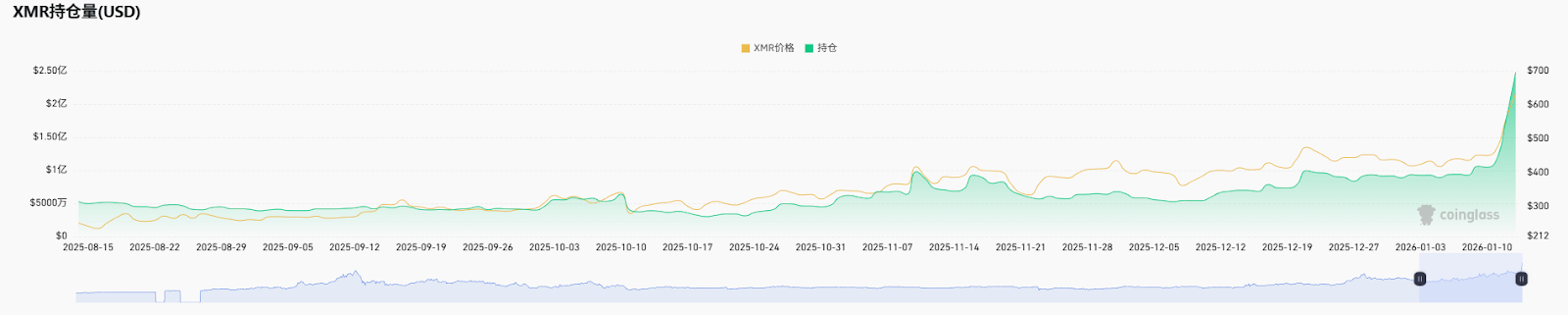
Clearly, mainstream exchanges are not the core pricing venue for XMR currently.

Undercurrents on the Supply Side: Miner Shake-up and Early Positioning

Since the "visible" funds are unremarkable, we need to turn to the "invisible" on-chain world. As the network with the strongest privacy, XMR offers very little information to mine, but changes in mining difficulty and mining rewards allow us to glimpse the capital布局 (layout) on the supply side.

Historical mining difficulty typically represents capital's enthusiasm for participating in the network ecosystem. Data shows that XMR's mining difficulty began to climb rapidly at the end of 2024 and was in a state of rapid growth throughout the first half of 2025. Although it fluctuated between September and November, it recently began a new round of difficulty increase.
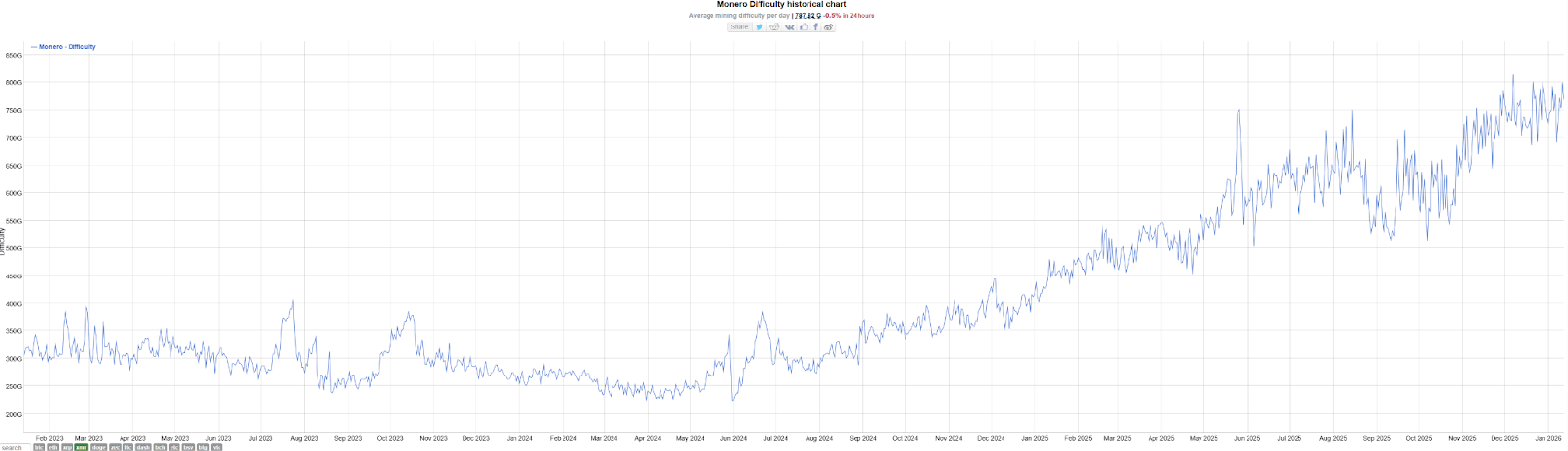
An interlude must be mentioned here: In September, the Qubic project claimed it controlled over 51% of XMR's total network hash rate and performed a "demonstration attack," causing a chain reorganization spanning 18 blocks on the XMR network. This event served as a wake-up call for the community, after which a large number of miners migrated their hash rate to the established mining pool SupportXMR. This incident was the main reason for the剧烈波动 (violent fluctuations) in mining difficulty around the end of 2025, but it also侧面印证了 (serves as side evidence of) the activity and resilience of the hash rate market.

More noteworthy is the联动 (linkage) between the mining reward curve and the difficulty.

Before April 2025, the mining rewards on the Monero network experienced a significant drop. Correlating with the difficulty chart from that time, the hash rate rose sharply while the price remained震荡 (volatile). This divergence led to diluted rewards, likely forcing some smaller miners with higher costs out of the market. Data showing a回调 (pullback) in mining difficulty in April supports this猜想 (conjecture).
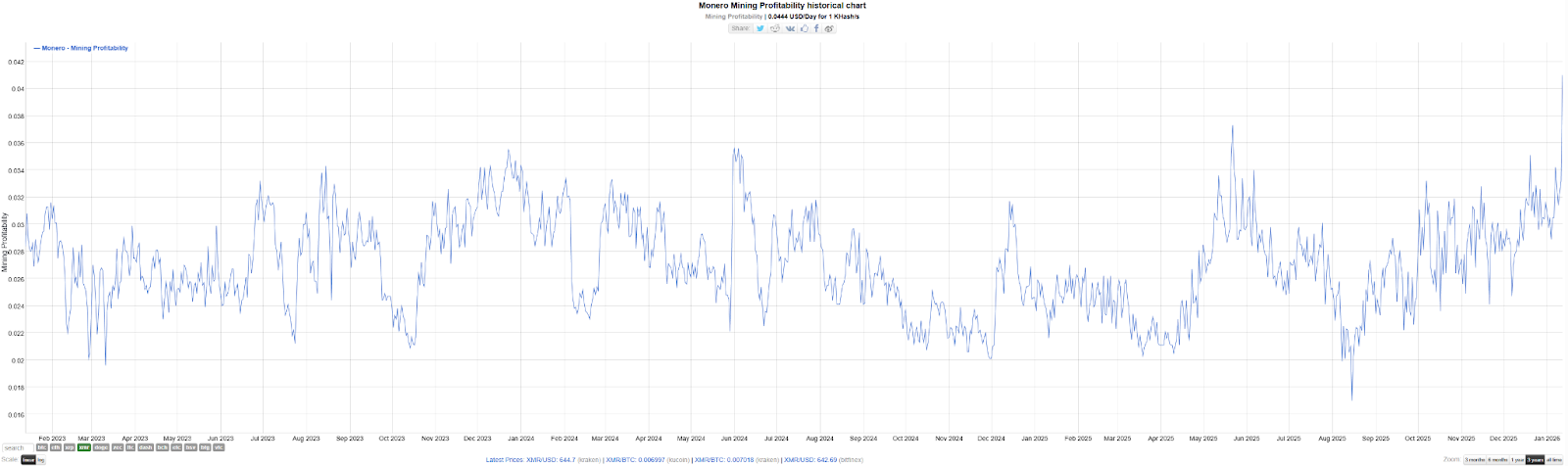
This was a classic case of "miner capitulation" and "筹码交换 (chips exchange/churn)." After this, as prices rose significantly, mining rewards and difficulty resumed同步上涨 (synchronous growth). Judging from the data changes in this phase, as early as the beginning of 2025, some large mining enterprises or capital with strong risk resistance might have started positioning early in Monero token mining despite the low rewards.

Demand-Side Verification: Paying a High Premium for Privacy

If miners represent confidence on the supply side, then the average transaction fee most accurately reflects demand on the user side.

Looking at the chart, Monero's average transaction fee was relatively stable before the first half of 2025, basically staying below $0.1. But starting in June, a growth trend emerged; by December 11, the highest average fee一度达到 (once reached) over $0.3, more than triple the level from six months prior.
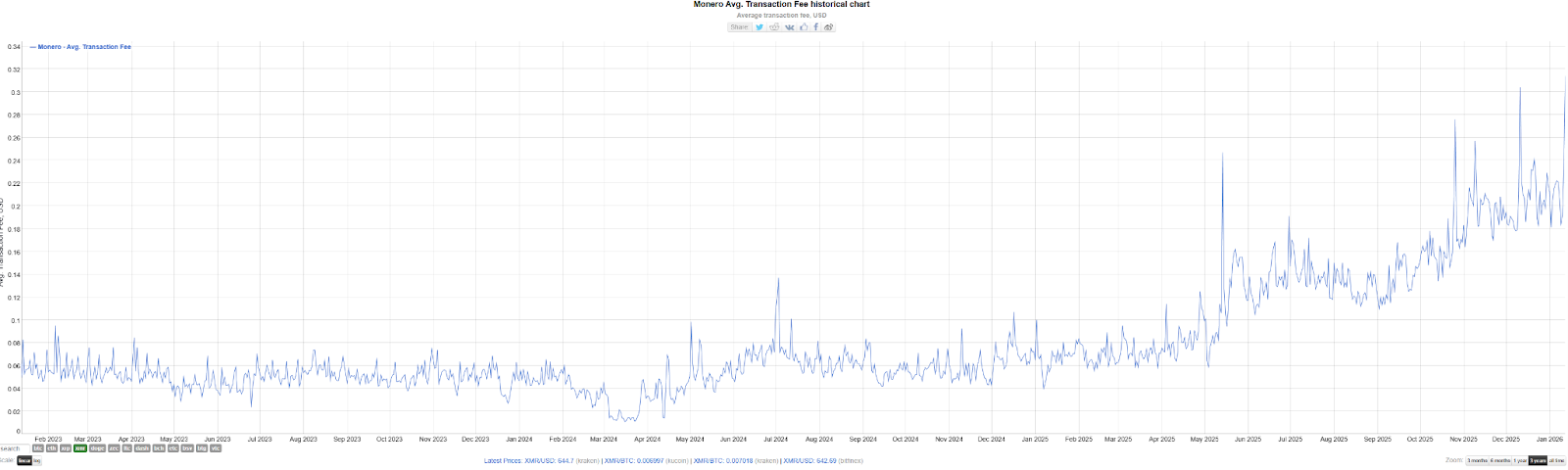
Because Monero has a dynamic block size adjustment mechanism, a surge in fees means a large number of users are trying to send transactions quickly and are willing to pay high fees to compensate miners for the cost of block expansion. This侧面证明 (serves as indirect proof) that starting from the second half of 2025, the real on-chain transaction demand for Monero began to increase significantly.

However, we also discovered an interesting pattern: spikes in on-chain fees often coincide with sharp price increases.

For example, on April 28, XMR suddenly rose 14%, and the average transaction fee that day surged to $0.125; during the subsequent period of slow price爬升 (climb), fees fell back to a trough (lowest at $0.058 on May 4). This indicates that while market volatility can drive on-chain demand in the short term, when the volatility subsides, on-chain demand also returns to calm. Although sometimes they are not synchronized (e.g., fees rose on May 14 but the price didn't move), overall, during these more than six months, price increases briefly drove on-chain demand, and the growth in real on-chain demand in turn triggered market optimism about XMR, with the two互为因果 (being mutually causal).

The Truth in Black and White

Combining the above data, the truth behind XMR's surge likely has "black and white" aspects.

The so-called "white" truth is the "antifragile" rebound of privacy demand under high regulatory pressure.

The反向推动 (reverse driving effect) of regulation is becoming increasingly apparent. The VARA ban not only failed to crush XMR but made market participants realize: regulatory agencies can ban exchanges, but they cannot ban the protocol itself. As major exchanges退出 (exit) the XMR trading环节 (segment), the logic of pricing reliant on market makers and derivative contracts was rewritten. XMR returned to a model controlled by real users or certain heavyweight players. After脱离 (detaching from) the exchange system, privacy coins have developed an independent rhythm completely different from the mainstream market.

The so-called "black" truth is the capital game under information asymmetry.

Behind this opacity, there might be an "iceberg" of whales. The "unimpressive" trading data (even on January 13, when it hit a new high, futures open interest was only $240 million, and liquidation volume was just over $1 million) indicates that mainstream institutions almost failed to predict and participate in this rally in advance, only following along.

This information asymmetry, held by a few, leads to extreme price volatility. Especially when the market starts paying attention to such a rise, it often signals short-term emotional overheating. Referring to the privacy coin ZEC in November, it experienced a retracement of over 50% after its surge. Ultimately, in the privacy coin market, there is a large amount of "information asymmetry," which puts ordinary retail investors at an absolute disadvantage.

Amid the剧烈波动 (violent fluctuations) of privacy coins, on-chain data is perhaps our only reliable guide. But in the depths without transparency, the high premium of freedom always comes with unknown risks.


Twitter:https://twitter.com/BitpushNewsCN

Bitpush TG Discussion Group:https://t.me/BitPushCommunity

Bitpush TG Subscription: https://t.me/bitpush

Original Link:https://www.bitpush.news/articles/7602643

Пов'язані питання

QWhat was the peak price of XMR (Monero) on January 13th, and what was its maximum percentage increase from its price at the beginning of 2025?

AXMR reached a peak price of over $690 on January 13th. Its maximum percentage increase from its price of around $200 at the beginning of 2025 was 262%.

QDespite the price surge, why were mainstream centralized exchanges like Binance not considered the core pricing venues for XMR?

ABecause the spot trading volume on these exchanges did not see a significant, exaggerated increase during the rally, and the open interest in futures contracts only rose in dollar value due to the price increase, not from a large influx of new capital opening positions.

QWhat event in September 2025 caused significant volatility in XMR's mining difficulty, and what was the community's response?

AThe Qubic project claimed to control over 51% of XMR's network hashrate and performed a 'demonstrative attack,' causing an 18-block chain reorganization. In response, a large number of miners migrated their hashrate to the established mining pool, SupportXMR.

QWhat on-chain metric is cited as the most authentic reflection of user-side demand for Monero, and what was its trend in the latter half of 2025?

AThe average transaction fee is cited as the most authentic reflection of user-side demand. It began to show a growth trend starting in June 2025, with the highest average fee reaching over $0.30 by December 11th, a more than 3x increase from six months prior.

QAccording to the article, what are the 'white' and 'black' truths behind XMR's price surge?

AThe 'white' truth is the 'anti-fragile'反弹反弹 of privacy demand under high regulatory pressure, where the asset became less dependent on exchanges. The 'black' truth is capital博弈博弈 in an environment of information asymmetry, where a few major players ('whales') with an information advantage could be driving the volatile price action, putting retail investors at a significant disadvantage.

Пов'язані матеріали

Has Hook Summer Really Arrived? sato, Lo0p, FLOOD Ignite the New Narrative of Uniswap v4

"Hook Summer" Arrives? Sato, Lo0p, FLOOD Ignite Uniswap v4 Narrative Amidst a slight market recovery, attention within the Ethereum ecosystem has shifted to Meme coins built on Uniswap v4's Hook protocol. Following ASTEROID, tokens like sato, sat1, Lo0p, and FLOOD have become market focal points, with market caps ranging from millions to tens of millions, bringing concentrated liquidity to a narrative-dry market. Uniswap v4 Hooks are "plugin smart contracts" that allow developers to inject custom logic at key points in a liquidity pool's lifecycle (initialization, adding/removing liquidity, swaps, etc.), making the AMM programmable. Recent representative projects include: * **sato**: Market cap peaked over $38M; uses a v4 curve mechanism for minting/burning, locking ETH as reserve. * **sat1**: Market cap briefly exceeded $10M, positioning as an "optimized sato," but later declined significantly. * **Lo0p**: Market cap neared $6.6M; a "lending AMM protocol" allowing users to borrow ETH against deposited LO0P tokens without immediate selling pressure. * **FLOOD**: Market cap approached $6M; channels trading reserves into Aave v3 to generate yield, which is retained in the pool. The emergence of these Hook-based tokens could drive long-term growth for the Uniswap ecosystem by attracting users and liquidity to v4 pools. Combined with Uniswap's activated fee switch (partially used to burn UNI), the long-term outlook for UNI appears positive. However, short-term UNI price appreciation is not directly guaranteed. Factors include the sustainability and lifecycle of these new tokens, their price volatility, overall market conditions, and regulatory pressures. Currently, Uniswap v4's TVL ($595M) lags behind v3 and v2, indicating Hook adoption still requires time to mature. In summary, the Hook ecosystem serves as "long-term nourishment" for UNI, but acts more as a "catalyst" than a direct "booster" in the short term. Note: These are early-stage experimental tokens and may carry unknown risks.

marsbit10 хв тому

Has Hook Summer Really Arrived? sato, Lo0p, FLOOD Ignite the New Narrative of Uniswap v4

marsbit10 хв тому

Has Hook Summer Truly Arrived? sato, Lo0p, FLOOD Ignite the New Uniswap v4 Narrative

With the broader market showing signs of recovery, a new wave of interest has emerged around Ethereum-based meme coins. Following ASTEROID, tokens like sato, sat1, Lo0p, and FLOOD, built upon the Uniswap v4 Hook protocol, are capturing market attention. Their market capitalizations range from millions to tens of millions of dollars, injecting much-needed focused liquidity into a market lacking narratives. This article explores whether this trend signifies an incoming "Hook Summer" and its potential impact on UNI's price. Hooks are essentially plug-in smart contracts for Uniswap v4 liquidity pools, allowing developers to inject custom logic at key points in a pool's lifecycle (like initialization, adding/removing liquidity, swaps). This transforms the AMM into programmable building blocks. Key highlighted projects include: * **sato**: Peaked over $38M market cap. It utilizes a v4 curve for minting/burning; buying locks ETH as reserve to mint new tokens, while selling redeems ETH from the reserve and burns tokens. * **sat1**: Market cap briefly exceeded $10M, promoted as an "optimized sato," but later declined significantly. * **Lo0p**: Reached nearly $6.6M. It's a lending AMM protocol where buying LO0P tokens locks them as collateral, allowing users to borrow ETH from the pool reserve at 40% LTV, aiming to improve capital efficiency for idle ETH in LPs. * **FLOOD**: Peaked near $6M. Its mechanism directs asset reserves from buys into Aave v3 to generate yield, with fees and interest retained in the pool to potentially influence the token's price long-term. In the long term, the development of the Hook ecosystem can attract users and liquidity to Uniswap v4, benefiting UNI's fundamentals—especially combined with the recent activation of the protocol fee switch, where a portion of fees is used to burn UNI. However, in the short term, these Hook-based tokens are unlikely to directly drive significant UNI price appreciation. Their impact is moderated by factors like token sustainability, price volatility, and broader market and regulatory conditions. Currently, Uniswap v4's TVL ($595M) still trails behind v2 and v3, indicating adoption and growth will take time. The article concludes that while the Hook ecosystem provides long-term "nourishment" for UNI, its short-term role is more of a "catalyst" than a "booster." Readers are cautioned that these are early-stage experimental tokens and may carry unknown risks.

Odaily星球日报23 хв тому

Has Hook Summer Truly Arrived? sato, Lo0p, FLOOD Ignite the New Uniswap v4 Narrative

Odaily星球日报23 хв тому

Interview with Michael Saylor: I Did Say I Would Sell Bitcoin, But Never a Net Sale

Interview with Michael Saylor: I Said We'd Sell Bitcoin, But Never Be a Net Seller In a recent podcast, MicroStrategy Executive Chairman Michael Saylor clarified the company's stance on potentially selling Bitcoin. Following MicroStrategy's earnings call statement about being prepared to sell BTC to fund dividends for its STRC (Strategic) credit product, Saylor emphasized the distinction between selling and being a "net seller." Saylor explained the core business model: MicroStrategy sells credit instruments like STRC and uses the proceeds to buy Bitcoin, which is viewed as "digital capital" expected to appreciate around 30-40% annually. A portion of these capital gains can then be used to pay the dividends on the credit products. He stressed that even if the company sells some Bitcoin for dividends, it simultaneously buys much more with new credit issuance. For example, after raising $3.2 billion from STRC sales in April, the dividend obligation was only $80-90 million, making the company a net buyer. The clarification aims to counter market narratives questioning the value of Bitcoin on MicroStrategy's balance sheet if it were never sold, and to dismiss claims of a "Ponzi scheme." Saylor reiterated his personal philosophy for investors: "Don't be a net seller of bitcoin" and ensure your Bitcoin holdings increase each year. Saylor also discussed Bitcoin's role as the foundation for "digital credit," noting that STRC has become the largest and most liquid preferred stock issue in the U.S., offering high risk-adjusted returns (Sharpe ratio). He highlighted Bitcoin's deep liquidity, stating that even large purchases by MicroStrategy do not move the market significantly, which is driven by macro factors, geopolitical tensions, and capital flows from ETFs and credit products. Finally, Saylor reflected on his early inspiration from sci-fi books, which motivated his path to MIT, and maintained his fundamental thesis on Bitcoin remains unchanged: it is superior digital capital enabling superior digital credit.

链捕手27 хв тому

Interview with Michael Saylor: I Did Say I Would Sell Bitcoin, But Never a Net Sale

链捕手27 хв тому

Beaten SK Hynix Employees in China: Year-end Bonus Less Than 5% of Korean Staff's

"SK Hynix Chinese Staff Hit Hard: Bonuses Less Than 5% of Korean Counterparts" Driven by the AI boom, South Korea's SK Hynix is experiencing record performance, with media reports predicting massive year-end bonuses for its employees, making them highly desirable in the matchmaking market. However, this prosperity starkly contrasts with the situation for the company's Chinese employees. According to reports, SK Hynix operates under a rule allocating 10% of operating profit for employee bonuses. While projections suggest Korean employees could receive bonuses reaching millions of RMB, a Chinese employee with over a decade of technical experience revealed the disparity: "If they get 3 million, Chinese staff get less than 5% of that." After adjustments based on KPI ratings, this employee's highest bonus was slightly over 100,000 RMB. Bonuses are paid annually in Korea but semi-annually in China. During the industry downturn in 2023-2024, Chinese employees received no bonus at all. The gap extends beyond bonuses. Recruitment posts for SK Hynix's Chinese factories (in Wuxi, Dalian, Chongqing) show engineer monthly salaries ranging from 10,000 to 35,000 RMB, with a 13th-month salary promised. Chinese employees also receive standard benefits like annual leave but lack stock incentives, which are reportedly unavailable to them. Furthermore, management positions in China are predominantly held by Korean personnel, though industry observers note a gradual increase in local middle managers over time. SK Hynix has confirmed the 10% bonus rule but cautioned that specific future bonus amounts remain unpredictable. The company forecasts strong demand for HBM and other high-value enterprise products for the next 2-3 years, driven by AI infrastructure investment. This focus on business-to-business markets may continue to constrain supply for consumer products, potentially prolonging price increases for components like memory.

链捕手40 хв тому

Beaten SK Hynix Employees in China: Year-end Bonus Less Than 5% of Korean Staff's

链捕手40 хв тому

Торгівля

Спот
Ф'ючерси

Популярні статті

Як купити XMR

Ласкаво просимо до HTX.com! Ми зробили покупку Monero (XMR) простою та зручною. Дотримуйтесь нашої покрокової інструкції, щоб розпочати свою криптовалютну подорож.Крок 1: Створіть обліковий запис на HTXВикористовуйте свою електронну пошту або номер телефону, щоб зареєструвати обліковий запис на HTX безплатно. Пройдіть безпроблемну реєстрацію й отримайте доступ до всіх функцій.ЗареєструватисьКрок 2: Перейдіть до розділу Купити крипту і виберіть спосіб оплатиКредитна/дебетова картка: використовуйте вашу картку Visa або Mastercard, щоб миттєво купити Monero (XMR).Баланс: використовуйте кошти з балансу вашого рахунку HTX для безперешкодної торгівлі.Треті особи: ми додали популярні способи оплати, такі як Google Pay та Apple Pay, щоб підвищити зручність.P2P: Торгуйте безпосередньо з іншими користувачами на HTX.Позабіржова торгівля (OTC): ми пропонуємо індивідуальні послуги та конкурентні обмінні курси для трейдерів.Крок 3: Зберігайте свої Monero (XMR)Після придбання Monero (XMR) збережіть його у своєму обліковому записі на HTX. Крім того, ви можете відправити його в інше місце за допомогою блокчейн-переказу або використовувати його для торгівлі іншими криптовалютами.Крок 4: Торгівля Monero (XMR)Легко торгуйте Monero (XMR) на спотовому ринку HTX. Просто увійдіть до свого облікового запису, виберіть торгову пару, укладайте угоди та спостерігайте за ними в режимі реального часу. Ми пропонуємо зручний досвід як для початківців, так і для досвідчених трейдерів.

242 переглядів усьогоОпубліковано 2024.12.10Оновлено 2025.03.21

Як купити XMR

Обговорення

Ласкаво просимо до спільноти HTX. Тут ви можете бути в курсі останніх подій розвитку платформи та отримати доступ до професійної ринкової інформації. Нижче представлені думки користувачів щодо ціни XMR (XMR).

活动图片













