The Next Bitcoin Bull Market May Begin with a Private Credit Crisis

marsbitОпубліковано о 2026-03-13Востаннє оновлено о 2026-03-13

Анотація

The next major Bitcoin bull market may be triggered by a crisis in the private credit sector, according to an analysis by Jordi Visser. Although Bitcoin and other liquid assets are typically sold off first during a liquidity crisis, the core opportunity arises in the subsequent phase when governments intervene with stimulus measures. The private credit market, valued at around $3 trillion and projected to reach $5 trillion by 2029, is showing signs of stress, including redemption limits and asset write-downs. A significant risk stems from heavy exposure to software companies, whose business models are being disrupted by AI, undermining assumptions about stable cash flows and high margins. Bitcoin is currently under pressure due to its correlation with both software stocks and global liquidity conditions. However, historical patterns—such as during the March 2020 crash and the 2023 regional banking crisis—show that Bitcoin tends to decline sharply during initial panic but rebounds strongly once policymakers inject liquidity. The U.S. financial system, characterized by high sovereign debt and deep financialization, is unlikely to tolerate prolonged credit contraction. When retail and institutional funds are exposed to opaque private credit risks, government intervention becomes inevitable. Bitcoin, originally conceived as a peer-to-peer electronic cash system resistant to centralized financial control, stands to benefit from such interventions. Its underlying value is reinf...

Written by: Jordi Visser

Compiled by: Luffy, Foresight News

The next major bull run for Bitcoin might be triggered from the most unexpected area: the private credit market.

This is not because a private credit crash would immediately benefit Bitcoin. In a true liquidity crisis, highly liquid assets like Bitcoin are often among the first to be sold off alongside other assets. The first phase of a crisis is not about salvation, but about liquidation; the core logic, however, emerges in the second phase.

In a system burdened with high debt, extreme financialization, and political intolerance for prolonged credit write-downs, the 'receding tide' of liquidity rarely lasts long. And when governments reinject liquidity, Bitcoin often grasps the significance of this move faster than almost any other asset.

Warren Buffett described this scenario in the plainest terms long ago: 'Only when the tide goes out do you discover who's been swimming naked.' He also mocked private equity's 'much-admired fee structure and obsession with leverage,' and later warned that in some rare moments, 'credit vanishes in an instant, and debt becomes a fatal financial trap.'

Buffett wasn't talking about Bitcoin then; he was diagnosing a financial system built on leverage, opacity, and confidence. And this diagnosis applies perfectly to today's private credit market. When the tide recedes, hidden vulnerabilities are no longer theoretical risks but become the entire market reality.

This is precisely why private credit is so crucial right now. According to Morgan Stanley estimates, the market size was about $3 trillion in early 2025 and is expected to approach $5 trillion by 2029. Warning signs are already appearing.

This week, Morgan Stanley imposed redemption restrictions on one of its private credit funds because investor redemption requests neared 11% of the fund's total size; simultaneously, JPMorgan Chase wrote down some loans made to private credit funds, and concerns about exposure to the software sector continue to heat up.

The key is not that the entire market is in crisis, but that the pressure is no longer hypothetical—it is now tangibly reflected in redemption restrictions, asset write-downs, and changes in lender behavior.

AI is the Catalyst for the Crisis

The core risk is not just leverage itself, but leverage tied to an industry being repriced in real-time by AI.

Morgan Stanley noted in March that about 25% of Business Development Company (BDC) investment portfolios are allocated to the software sector. Given AI's impact on software business models, this proportion is remarkably high.

For years, the financing logic for the software industry has been based on the assumption that recurring revenue equals stable cash flow, strong customer stickiness, high profit margins, and robust exit paths. AI is颠覆ing all of this: pricing power is being squeezed, products are rapidly becoming commoditized features, competitive moats are narrowing, and compute power and R&D spending are becoming rigid costs.

In other words, a significant amount of private credit has been extended based on a software business model that may already be obsolete.

Bitcoin is Also in the Storm

All discussions about software valuations and private credit ultimately point to Bitcoin. The correlation is clear when overlaying Bitcoin's price action with that of software stocks and private equity stocks:
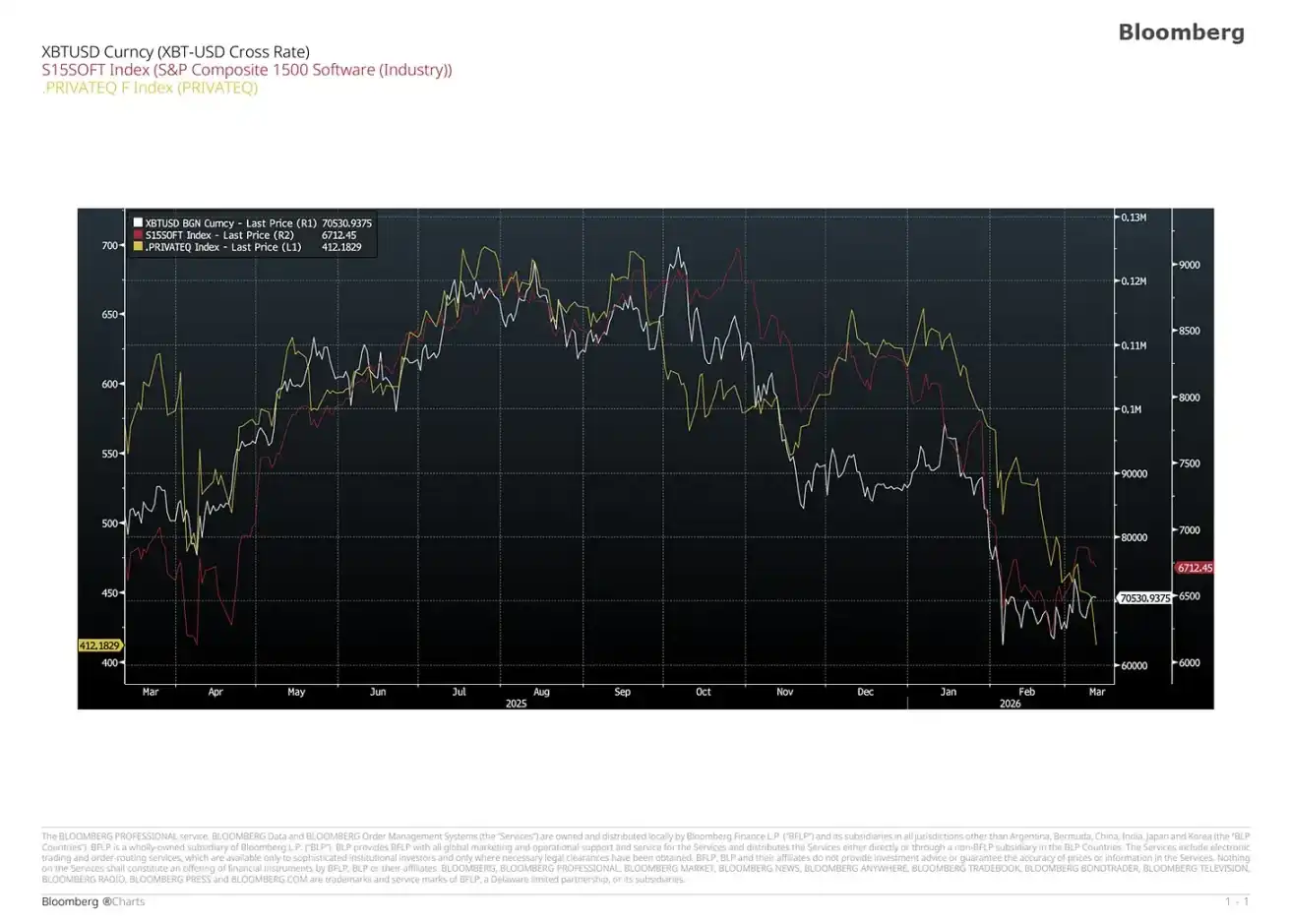
Bitcoin's price movement exhibits characteristics of both software sector Beta and liquidity Beta, and currently, both forces are suppressing it.

Back in 2025, I anticipated Bitcoin would experience strong gains, driven by increased government support and the rise of AI agents. These factors were supposed to strengthen crypto network effects, causing it to be revalued alongside the software sector as a high-growth asset class. Although stablecoin trading volume and market capitalization have risen, this optimistic expectation for Bitcoin ultimately did not materialize.

Instead, with the rollout of technologies like Opus 4.5 and OpenClaw, the market focus shifted to AI's颠覆ion of the software industry itself. Investors reassessed the sustainability of traditional software models, valuation multiples were quickly adjusted downward, and this also impacted private credit, a key funding source for the software ecosystem.

AI forced a disruptive repricing of the software industry, putting pressure on one of Bitcoin's key macro pricing logics; simultaneously, the global liquidity cycle tightening打压ed its other core characteristic: high sensitivity to global liquidity.

This is why cracks in private credit won't immediately benefit Bitcoin: in the short term, the effect is often the opposite. Bitcoin is liquid, widely held, and easy to sell. In the first phase of market stress, liquidity priority far outweighs long-term value logic.

Bitcoin Falls First in Panic, Rises First in Bailouts

History confirms this rhythm.

In the 'cash is king' panic of March 2020, Reuters reported Bitcoin plunged over 20% in a single day and over 30% over five days, as investors sold almost everything. Then, policy easing began. By January 2021, Bitcoin had risen over 900% from its March low, as governments expanded spending to counter the pandemic shock, and investors feared inflation and currency devaluation. Bitcoin fully reflected this expectation.

Bitcoin isn't immune to panic; it just reflects the subsequent policy-induced rally earlier and more sharply than other assets.

The same script played out during the 2023 US regional banking crisis: Silicon Valley Bank saw $42 billion in depositor withdrawals in one day, with another $100 billion in withdrawal requests queued for the next day. Subsequently, authorities guaranteed all depositors, and the Fed launched the Bank Term Funding Program, offering loans at par against eligible collateral. Following that turmoil, Bitcoin's price climbed to a nine-month high and more than doubled by year-end.

The core pattern remains consistent: Bitcoin often suffers during cash scrambles, then turns around to price in the benefits of policy rescue.

Why Redemption is Inevitable

This mechanism is particularly critical now because the US financial system cannot withstand prolonged liquidity tightening.

In February 2026, the US Congressional Budget Office stated the federal deficit for FY2026 would reach $1.9 trillion, with publicly held debt at 101% of GDP. Meanwhile, the Buffett Indicator (total US stock market cap / GDP) was around 219% in early March.

This is the reality of financialization: high sovereign debt, and an asset market size far exceeding the real economy. In this structure, policymakers have no room to let liquidation proceed purely organically. The modern economy is too linked to asset prices, and the state and economic growth are too tied to market functioning for pure liquidation to be sustainable.

The Fed has long shown this reflex. In March 2025, it slowed quantitative tightening (QT), decided on October 1st to stop running off its securities portfolio by December 1st, and initiated Reserve Management Purchases in December to maintain ample reserves. Even without a full-blown crisis, the system was already moving back towards easing.

Once you understand that the financial system itself requires liquidity restarts, it's not hard to judge: policymakers are almost certain not to stand idly by when the next private credit crisis hits.

This is even more true politically. In September 2025, the US SEC Investor Advisory Committee noted that despite expanded public access through registered products, private market assets are less transparent and riskier. Morningstar reported that Q3 2025 net assets in semi-liquid funds had reached $493 billion.

When retail money and wealth channel funds are packaged into illiquid credit exposures, private credit ceases to be a niche institutional issue and becomes a public concern. When opaque risks morph into public problems, government intervention becomes inevitable.

Bitcoin Returns to Its Original Logic

The Bitcoin whitepaper proposed a peer-to-peer electronic cash system allowing direct transfers between parties without financial institutions. The famous inscription on the genesis block—'The Times 03/Jan/2009 Chancellor on brink of second bailout for banks'—speaks to its political undertone.

The whitepaper provided the technical architecture; the genesis block carried the political metaphor. Bitcoin was born from a rebellion against bailout culture, intermediary reliance, and arbitrary market rescues.

Therefore, whenever governments step in to save fragile systems built on hidden leverage, Bitcoin's original logic becomes more potent.

Meanwhile, financial infrastructure is moving towards 24/7 operation. In October 2025, the Fed announced plans for Fedwire and the National Settlement Service to operate on Sundays and holidays by 2028 or 2029. This isn't official adoption of Bitcoin, but it signals the system's acknowledgment of an important fact: the economy is increasingly digital and continuous, becoming less compatible with traditional banking hours.

If AI agents become genuine economic participants, funds and collateral will need to move at software speed. This doesn't mean every transaction must settle in Bitcoin, but it does mean that scarce, neutral, digital collateral will become more important.

The tide Buffett spoke of is receding in the private credit market. AI is first exposing the most vulnerable credit assets, especially those that mistook software revenue for permanent cash flow. Bitcoin is suffering in the first wave because it is perceived as both a software and liquidity double Beta.

But US debt is too high, the economy too financialized, and retail money too intertwined with private assets for policymakers to tolerate prolonged disorderly liquidation. Liquidity will eventually return. And whenever liquidity is restarted, Bitcoin is often one of the first assets to react.

This is why private credit is so crucial in the current environment.

It is deeply ironic that Bitcoin was made for precisely such moments: a world of shadow banking, hidden leverage, high government debt, and crisis responses reliant on liquidity injections. Private credit isn't just a risk sector within the market; it's a convergence point for rigid valuations, embedded leverage, AI颠覆ion, retail fund involvement, and policy reflex reactions.

Recent private credit redemption restrictions and asset write-downs suggest the adjustment process may have already begun. If private credit becomes the epicenter of the next liquidity receding tide, Bitcoin's next major bull market won't start with halving narratives or perfect macro conditions, but with risk exposure, policy rescue, and the market's eventual realization: the financial system still runs on liquidity injections.


Пов'язані питання

QWhy might the next Bitcoin bull market be triggered by a private credit crisis, according to the article?

AThe article argues that a private credit crisis would expose systemic fragility, leading to government liquidity injections. Bitcoin, being highly sensitive to liquidity shifts, would rally strongly once policymakers intervene to stabilize the market, as it historically reacts faster to monetary easing than other assets.

QHow does AI act as a catalyst for the private credit crisis mentioned in the article?

AAI disrupts the software industry's business model, which underpins much of private credit lending. It erodes pricing power, narrows competitive moats, and increases costs, forcing a repricing of software assets. This devalues the collateralizing loans, exacerbating risks in the credit market.

QWhat historical pattern does Bitcoin exhibit during financial crises, as described in the article?

ABitcoin initially sells off alongside other liquid assets during panic phases (e.g., March 2020 or the 2023 regional bank crisis) as investors seek cash. However, it rebounds sharply and earlier than most assets once policymakers inject liquidity, pricing in the implications of monetary expansion and fiscal rescue measures.

QWhy does the article claim policymakers will inevitably intervene in a private credit crisis?

AThe U.S. financial system is highly leveraged and interconnected, with public debt at 101% of GDP and heavy retail exposure to private credit. Policymakers cannot tolerate prolonged, disorderly liquidation due to the risk of broad economic contagion, making government liquidity support a political and economic necessity.

QHow does Bitcoin's foundational logic align with the scenario of a private credit crisis and government bailouts?

ABitcoin was created as a peer-to-peer electronic cash system to bypass financial intermediaries and resist bailout culture. Its genesis block explicitly criticized bank rescues. Thus, when governments intervene to save over-leveraged, opaque systems like private credit, it reinforces Bitcoin's value proposition as a decentralized, neutral alternative to state-backed liquidity solutions.

Пов'язані матеріали

Торгівля

Спот
Ф'ючерси

Популярні статті

Що таке BITCOIN

Розуміння HarryPotterObamaSonic10Inu (ERC-20) та його позиції у крипто-просторі Останніми роками ринок криптовалют спостерігав за зростанням популярності мем-коінів, які привертають інтерес не тільки трейдерів, але й тих, хто шукає спілкування та розважальну цінність. Серед цих унікальних токенів є HarryPotterObamaSonic10Inu (ERC-20), інтригуючий проект, що поєднує культурні посилання з тканинами криптовалюти. Ця стаття досліджує ключові аспекти HarryPotterObamaSonic10Inu, вивчаючи його механізми, спільноту та його взаємодію з ширшим крипто-ландшафтом. Що таке HarryPotterObamaSonic10Inu (ERC-20)? Як випливає з його назви, HarryPotterObamaSonic10Inu є мем-коіном, побудованим на блокчейні Ethereum, класифікованим за стандартом ERC-20. На відміну від традиційних криптовалют, які можуть підкреслювати практичну корисність або інвестиційний потенціал, цей токен процвітає завдяки розважальній цінності та силі своєї спільноти. Проект спрямований на створення середовища, де зацікавлені користувачі можуть об'єднуватися, ділитися ідеями та брати участь у заходах, натхненних різноманітними культурними явищами. Однією з примітних особливостей HarryPotterObamaSonic10Inu є нульовий податок на транзакції. Цей привабливий елемент має на меті заохочувати торгівлю та участь у спільноті, позбавлену додаткових витрат, які можуть відлякувати дрібних трейдерів. Загальна пропозиція монет становить один мільярд токенів, що позначає намір підтримувати суттєву циркуляцію в межах спільноти. Творець HarryPotterObamaSonic10Inu (ERC-20) Походження HarryPotterObamaSonic10Inu дещо окутане таємницею; деталі про творця залишаються невідомими. Розвиток цього токена позбавлений впізнаваної команди або чіткої стратегії, що не є рідкістю в секторі мем-коінів. Натомість проект виник органічно, а його розвиток значною мірою залежить від ентузіазму та участі його спільноти. Інвестори HarryPotterObamaSonic10Inu (ERC-20) Щодо зовнішніх інвестицій та підтримки, HarryPotterObamaSonic10Inu також залишається невизначеним. Токен не зазначає жодних відомих інвестиційних фондів або значної організаційної підтримки. Натомість життєва сила проекту полягає в його базовій спільноті, яка інформує про його зростання та стійкість через колективні дії та залученість у крипто-просторі. Як працює HarryPotterObamaSonic10Inu (ERC-20)? Як мем-коін, HarryPotterObamaSonic10Inu функціонує передусім поза традиційними рамками, що часто регулюють вартість активів. Є кілька відмінних аспектів, що визначають, як працює проект: Транзакції без податку: Завдяки відсутності податкових зборів на транзакції, користувачі можуть вільно купувати та продавати токен, не турбуючись про приховані витрати. Залучення спільноти: Проект процвітає завдяки взаємодії спільноти, використовуючи соціальні медіа для створення шуму та сприяння залученню. Обговорення, обмін контентом та залученість є ключовими елементами, що допомагають розширити його охоплення та зміцнити лояльність серед прихильників. Відсутність практичної корисності: Слід зазначити, що HarryPotterObamaSonic10Inu не пропонує конкретної корисності в рамках фінансової екосистеми. Натомість він класифікується як токен, що призначений в основному для розваги та спільнотних активностей. Культурне посилання: Токен кмітливо вплітає елементи популярної культури, щоб привернути інтерес, зв'язуючи з ентузіастами мемів та крипто-стежками. HarryPotterObamaSonic10Inu ілюструє, як мем-коіни функціонують інакше, ніж традиційні криптовалютні проекти, увійшовши на ринок як інноваційні соціальні конструкти, а не утилітарні активи. Хронологія HarryPotterObamaSonic10Inu (ERC-20) Історія HarryPotterObamaSonic10Inu відзначена кількома значними етапами: Створення: Токен виник з вірусного мему, захопивши уяву багатьох крипто-ентузіастів. Конкретні дати створення недоступні, що підкреслює його органічний розвиток. Лістинг на біржах: HarryPotterObamaSonic10Inu з'явився на різних біржах, дозволяючи зручніший доступ і торгівлю спільноти. Ініціативи залучення спільноти: Ведення діяльності, спрямованої на покращення взаємодії спільноти, включаючи конкурси, кампанії в соціальних мережах та створення контенту від фанатів та прихильників. Плани на майбутнє: Дорожня карта проекту включає запуск колекції NFT, мерчандайзинг та електронну комерцію, пов'язану з його культурними темами, що далі залучає спільноту та намагається додати більше вимірів до його екосистеми. Ключові моменти про HarryPotterObamaSonic10Inu (ERC-20) Спільнотний підхід: Проект надає пріоритет колективному внеску та креативності, забезпечуючи, щоб участь користувачів була в центрі його розвитку. Класифікація як мем-коін: Це є його епігенез розважальної криптовалюти, що відрізняється від традиційних інвестиційних інструментів. Жодного прямого відношення до Bitcoin: Незважаючи на схожість у назві, HarryPotterObamaSonic10Inu є відмінним і не має жодного зв’язку з Bitcoin або іншими усталеними криптовалютами. Зосередженість на співпраці: HarryPotterObamaSonic10Inu створено для того, щоб надати простір для співпраці та обміну історіями серед його власників, забезпечуючи шлях для творчості та спільного зв'язку. Перспективи на майбутнє: Амбіція розширитися за межі початкової концепції в NFT та мерчандайз відкриває шлях для проекту потенційно потрапити в більш мейнстрімні сфери цифрової культури. Оскільки мем-коіни продовжують захоплювати уяву спільноти криптовалют, HarryPotterObamaSonic10Inu (ERC-20) вирізняється своїми культурними зв'язками та орієнтованим на спільноту підходом. Хоча він може не відповідати типовій моделі утилітарного токена, його суть полягає в радощах і товариськості, що підтримуються серед його прихильників, підкреслюючи еволюційну природу криптовалют в усе більш цифрову епоху. Оскільки проект продовжує розвиватися, важливо спостерігати за тим, як динаміка спільноти вплине на його траєкторію в постійно змінюваному ландшафті технології блокчейн.

1.7k переглядів усьогоОпубліковано 2024.04.01Оновлено 2024.12.03

Що таке BITCOIN

Як купити BTC

Ласкаво просимо до HTX.com! Ми зробили покупку Bitcoin (BTC) простою та зручною. Дотримуйтесь нашої покрокової інструкції, щоб розпочати свою криптовалютну подорож.Крок 1: Створіть обліковий запис на HTXВикористовуйте свою електронну пошту або номер телефону, щоб зареєструвати обліковий запис на HTX безплатно. Пройдіть безпроблемну реєстрацію й отримайте доступ до всіх функцій.ЗареєструватисьКрок 2: Перейдіть до розділу Купити крипту і виберіть спосіб оплатиКредитна/дебетова картка: використовуйте вашу картку Visa або Mastercard, щоб миттєво купити Bitcoin (BTC).Баланс: використовуйте кошти з балансу вашого рахунку HTX для безперешкодної торгівлі.Треті особи: ми додали популярні способи оплати, такі як Google Pay та Apple Pay, щоб підвищити зручність.P2P: Торгуйте безпосередньо з іншими користувачами на HTX.Позабіржова торгівля (OTC): ми пропонуємо індивідуальні послуги та конкурентні обмінні курси для трейдерів.Крок 3: Зберігайте свої Bitcoin (BTC)Після придбання Bitcoin (BTC) збережіть його у своєму обліковому записі на HTX. Крім того, ви можете відправити його в інше місце за допомогою блокчейн-переказу або використовувати його для торгівлі іншими криптовалютами.Крок 4: Торгівля Bitcoin (BTC)Легко торгуйте Bitcoin (BTC) на спотовому ринку HTX. Просто увійдіть до свого облікового запису, виберіть торгову пару, укладайте угоди та спостерігайте за ними в режимі реального часу. Ми пропонуємо зручний досвід як для початківців, так і для досвідчених трейдерів.

4.3k переглядів усьогоОпубліковано 2024.12.12Оновлено 2025.03.21

Як купити BTC

Що таке $BITCOIN

ЦИФРОВЕ ЗОЛОТО ($BITCOIN): Комплексний аналіз Вступ до ЦИФРОВОГО ЗОЛОТА ($BITCOIN) ЦИФРОВЕ ЗОЛОТО ($BITCOIN) — це проект на основі блокчейну, що працює в мережі Solana, який має на меті поєднати характеристики традиційних дорогоцінних металів з інноваціями децентралізованих технологій. Хоча він має таку ж назву, як і Bitcoin, який часто називають “цифровим золотом” через його сприйняття як засобу збереження вартості, ЦИФРОВЕ ЗОЛОТО є окремим токеном, розробленим для створення унікальної екосистеми в ландшафті Web3. Його мета — позиціонувати себе як життєздатний альтернативний цифровий актив, хоча деталі щодо його застосувань і функціональностей все ще розробляються. Що таке ЦИФРОВЕ ЗОЛОТО ($BITCOIN)? ЦИФРОВЕ ЗОЛОТО ($BITCOIN) — це токен криптовалюти, спеціально розроблений для використання в блокчейні Solana. На відміну від Bitcoin, який виконує широко визнану роль зберігання вартості, цей токен, здається, зосереджується на більш широких застосуваннях і характеристиках. Помітні аспекти включають: Інфраструктура блокчейну: Токен побудований на блокчейні Solana, відомому своєю здатністю обробляти швидкі та низьковартісні транзакції. Динаміка постачання: ЦИФРОВЕ ЗОЛОТО має максимальне постачання, обмежене 100 квадрильйонами токенів (100P $BITCOIN), хоча деталі щодо його обігового постачання наразі не розголошуються. Утиліта: Хоча точні функціональності не викладені, є вказівки на те, що токен може бути використаний для різних застосувань, потенційно пов'язаних з децентралізованими додатками (dApps) або стратегіями токенізації активів. Хто є творцем ЦИФРОВОГО ЗОЛОТА ($BITCOIN)? На даний момент особа творців і команди розробників, що стоять за ЦИФРОВИМ ЗОЛОТОМ ($BITCOIN), залишається невідомою. Ця ситуація є типовою для багатьох інноваційних проектів у сфері блокчейну, особливо тих, що пов'язані з децентралізованими фінансами та феноменом мем-коінів. Хоча така анонімність може сприяти культурі, орієнтованій на спільноту, вона посилює занепокоєння щодо управління та підзвітності. Хто є інвесторами ЦИФРОВОГО ЗОЛОТА ($BITCOIN)? Доступна інформація вказує на те, що ЦИФРОВЕ ЗОЛОТО ($BITCOIN) не має жодних відомих інституційних спонсорів або помітних венчурних капіталовкладень. Проект, здається, працює за моделлю “рівний до рівного”, зосереджуючись на підтримці та прийнятті спільноти, а не на традиційних шляхах фінансування. Його активність і ліквідність переважно розташовані на децентралізованих біржах (DEX), таких як PumpSwap, а не на встановлених централізованих торгових платформах, що ще більше підкреслює його підхід знизу вгору. Як працює ЦИФРОВЕ ЗОЛОТО ($BITCOIN) Операційні механізми ЦИФРОВОГО ЗОЛОТА ($BITCOIN) можна детальніше розглянути на основі його дизайну блокчейну та характеристик мережі: Механізм консенсусу: Використовуючи унікальний proof-of-history (PoH) Solana в поєднанні з моделлю proof-of-stake (PoS), проект забезпечує ефективну валідацію транзакцій, що сприяє високій продуктивності мережі. Токеноміка: Хоча конкретні дефляційні механізми не були детально описані, велике максимальне постачання токенів вказує на те, що воно може задовольняти мікротранзакції або нішеві випадки використання, які ще потрібно визначити. Інтероперабельність: Існує потенціал для інтеграції з більш широкою екосистемою Solana, включаючи різні платформи децентралізованих фінансів (DeFi). Однак деталі щодо конкретних інтеграцій залишаються невизначеними. Хронологія ключових подій Ось хронологія, яка підкреслює значні віхи, пов'язані з ЦИФРОВИМ ЗОЛОТОМ ($BITCOIN): 2023: Початкове розгортання токена відбувається на блокчейні Solana, позначене його адресою контракту. 2024: ЦИФРОВЕ ЗОЛОТО набуває видимості, оскільки стає доступним для торгівлі на децентралізованих біржах, таких як PumpSwap, що дозволяє користувачам торгувати ним проти SOL. 2025: Проект спостерігає спорадичну торгову активність і потенційний інтерес до ініціатив, очолюваних спільнотою, хоча на даний момент не зафіксовано жодних значних партнерств або технічних досягнень. Критичний аналіз Сильні сторони Масштабованість: Основна інфраструктура Solana підтримує високі обсяги транзакцій, що може підвищити утиліту $BITCOIN у різних сценаріях транзакцій. Доступність: Потенційно низька торгова ціна за токен може привабити роздрібних інвесторів, сприяючи більш широкій участі завдяки можливостям дробового володіння. Ризики Відсутність прозорості: Відсутність публічно відомих спонсорів, розробників або процесу аудиту може викликати скептицизм щодо стійкості та надійності проекту. Волатильність ринку: Торгова активність сильно залежить від спекулятивної поведінки, що може призвести до значної волатильності цін і невизначеності для інвесторів. Висновок ЦИФРОВЕ ЗОЛОТО ($BITCOIN) постає як цікавій, але неоднозначний проект у швидко розвиваючійся екосистемі Solana. Хоча він намагається використати наратив “цифрового золота”, його відхід від встановленої ролі Bitcoin як засобу збереження вартості підкреслює необхідність чіткішого розмежування його передбачуваної утиліти та структури управління. Майбутнє прийняття та адаптація, ймовірно, залежатиме від вирішення поточної непрозорості та більш чіткого визначення його операційних та економічних стратегій. Примітка: Цей звіт охоплює синтезовану інформацію, доступну станом на жовтень 2023 року, і можуть відбутися події, що виходять за межі дослідницького періоду.

75 переглядів усьогоОпубліковано 2025.05.13Оновлено 2025.05.13

Що таке $BITCOIN

Обговорення

Ласкаво просимо до спільноти HTX. Тут ви можете бути в курсі останніх подій розвитку платформи та отримати доступ до професійної ринкової інформації. Нижче представлені думки користувачів щодо ціни BTC (BTC).

活动图片












