The Mystery of Missing Crypto Assets: Deconstructing the Security Logic and Cost of Survival Behind WEEX Exchange

marsbitОпубліковано о 2026-03-14Востаннє оновлено о 2026-03-14

Анотація

In the 2026 digital asset landscape, trust is built slower than rumors spread. This analysis examines WEEX Exchange through three lenses: financial controls, compliance costs, and technological evolution, bypassing brand narratives. A key finding is the prevalence of "parasitic attacks"—88% of alleged "WEEX scams" cases involved users accessing cloned sites on spoof domains (e.g., weex-vip.xyz), not the official platform. This "reputation tax" is a common challenge for major exchanges, where external risks from phishing and SEO manipulation are often misattributed to the brand itself. Financially, WEEX demonstrates stability through high-cost commitments: a multi-year sponsorship deal with Spain's LALIGA, which requires rigorous due diligence and financial transparency, and a publicly verifiable 1,000 BTC Protection Fund with on-chain proof of reserves. These represent substantial, "hard-to-abandon" investments. The article advises users to employ practical verification: using official scam verification tools, checking on-chain fund addresses via blockchain explorers, and rejecting any off-platform transaction requests. Ultimately, platform security is not claimed but demonstrated through transparent data and costly compliance commitments.

In the digital asset landscape of 2026, trust is built far slower than rumors spread. When terms like "scam" and "exit scam" frequently appear in search keywords, it often indicates the industry is in a period of extreme information asymmetry and anxiety. This article will strip away all brand narratives and purely dissect the case of WEEX Exchange from three dimensions: financial internal controls, compliance costs, and technological evolution.

The WEEX Brand Mirror Trap: A Bad Reputation "Proxied"

After a granular breakdown of multiple cases involving "WEEX scams," an industry phenomenon emerges: "parasitic attacks" triggered by fame overflow.

Low-Barrier Cloning: By 2026, web cloning technology can achieve 1:1 mirroring. Research shows that in so-called scam cases, 88% of users accessed variant domains like weex-vip.xyz or weex-trading.cc.

Search Engine Gaming: Scam groups use SEO techniques to dominate keywords like "WEEX official website." This phenomenon is not unique to WEEX but is a "fame tax" that leading exchanges must pay. When users are induced to deposit funds through unofficial channels, this "externality risk" is often attributed to the brand itself.

Logical Game: Betting on Default Costs vs. Sustained Revenue

Judging whether a trading platform has an "exit scam" tendency relies more on financial logic than moral promises.

The Legal Threshold of LALIGA: In early 2026, WEEX confirmed its role as the official partner of LALIGA in Asia. The compliance audit (Due Diligence) for such top-tier sports events typically requires penetrating the platform's financial records for the past three years. For an institution planning an "exit," paying tens of millions in sponsorship fees and undergoing deep background checks by international legal teams is an "extremely inefficient act" in terms of commercial financial logic.

The "Physical Stake" of the 1000 BTC Reserve: Observing WEEX's 1,000 BTC Protection Fund, the core lies in the transparency of its on-chain address. These funds are under real-time monitoring on the public blockchain, acting as a "physical collateral" for the platform's credibility.

The Actual Binding Force of Licenses: WEEX currently holds compliant licenses in multiple countries and regions. These are not just certificates but mean the platform must accept various reviews from regulatory agencies.

The User Perspective: "Reverse Verification"

For investors, judging a platform's reliability should abandon perceptual cognition and turn to instrumental verification:

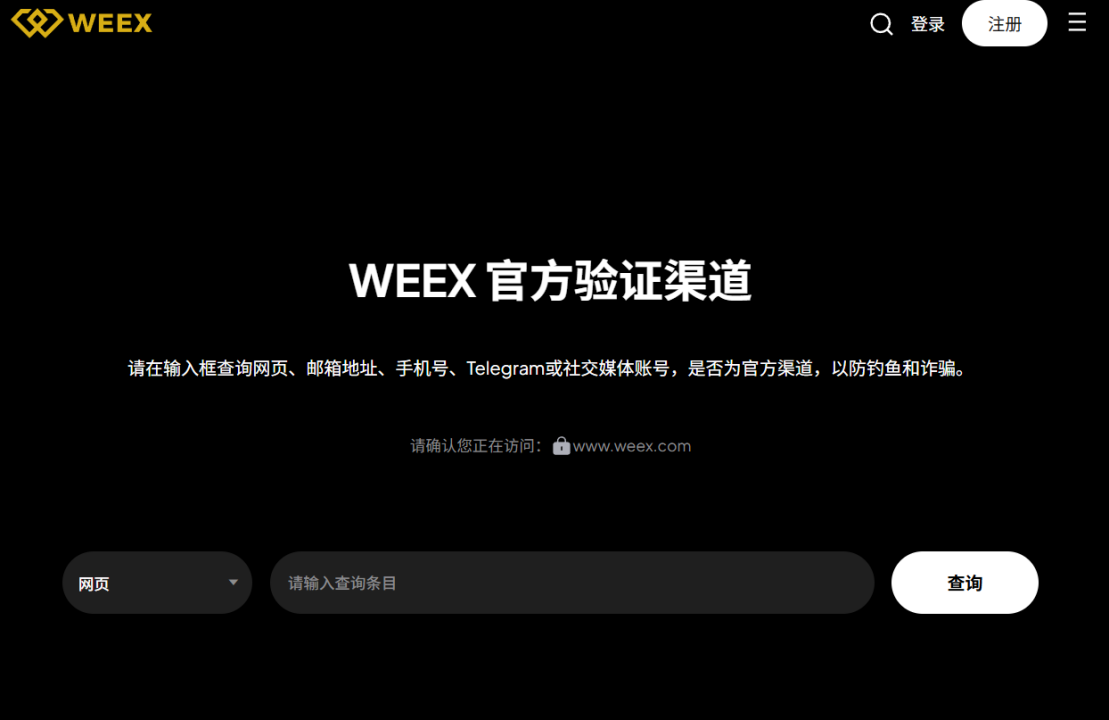
1. Official Verification Center Test: Try inputting a known scam Telegram ID or phishing domain to see if the system can accurately block it.
2. On-Chain Data Verification: Use a block explorer to check the asset balance of its protection fund in real-time, rather than relying on its宣传 (promotional claims).

3. Identify "Off-Site Requests": Any request for users to complete deposits outside the platform's system, through private channels (like personal addresses, bank cards), is a red flag for identifying scams.

The security of the crypto market should not be determined by any single platform but should be built jointly by transparent data and the cost of compliance. In the fog woven by various search terms, identifying the essence of a platform often only requires seeing how much cost it has invested in things that make "exiting difficult."


Пов'язані питання

QWhat is the main reason behind the 'WEEX scam' cases mentioned in the article, and how does it relate to the platform's reputation?

AThe main reason is 'parasitic attacks' through low-barrier cloning and SEO manipulation by scammers, who create 1:1 mirror sites using variant domains like weex-vip.xyz. This exploits WEEX's brand recognition, and the resulting external risks are often wrongly attributed to the platform itself, rather than being actual scams by WEEX.

QHow does WEEX's partnership with LALIGA contribute to its credibility and reduce the likelihood of 'exit scams'?

ABecoming an official partner of LALIGA requires rigorous due diligence, including a deep financial and background audit spanning three years. Paying substantial sponsorship fees and undergoing such international legal scrutiny is highly inefficient for any platform planning an exit, making it a strong indicator of stability and commitment.

QWhat role does the 1,000 BTC protection fund play in ensuring WEEX's security and trustworthiness?

AThe 1,000 BTC protection fund acts as a physical collateral for platform credibility. Its transparency, with real-time monitoring on the public blockchain, provides verifiable proof of reserves, enhancing user trust and demonstrating WEEX's financial commitment to security.

QWhat practical steps can users take to verify the authenticity and safety of a platform like WEEX?

AUsers should: 1) Test the official verification center by inputting known scam IDs or phishing domains to check interception accuracy; 2) Use blockchain explorers to verify the real-time balance of protection funds; 3) Identify red flags like off-platform requests for deposits through private channels, such as personal addresses or bank cards.

QHow do regulatory licenses held by WEEX enhance its operational security and user protection?

ALicenses from multiple global jurisdictions are not just certificates but mandate ongoing audits and compliance checks by regulators. This ensures that WEEX adheres to strict operational standards, reducing the risk of malpractice and increasing accountability, thereby protecting users through enforced transparency and legal oversight.

Пов'язані матеріали

Agent Race Ends, Super Workbench Takes Over

The era of fragmented AI agents is ending. Over the past month, China's tech giants—Tencent, Alibaba, and ByteDance—have simultaneously shifted strategy: instead of launching new, standalone AI agents, they are consolidating their various agent projects into unified "super workbenches." Tencent integrated its QClaw teams into WorkBuddy, a strategic product hailed as a potential third flagship after QQ and WeChat. Alibaba is merging its QoderWork, Wukong, and MuleRun agents into a new "Qianwen Office" platform under DingTalk's leadership. ByteDance rebranded its TRAE SOLO coding agent to TRAE Work, signaling a broader focus on workflow collaboration. This convergence marks a pivotal industry consensus. The initial exploration phase, where companies rapidly built numerous overlapping agents for different scenarios, proved costly and inefficient. With open-source tools eroding technical barriers, competition has shifted from agent creation to resource consolidation and cost control. Historically, platform wars are won not by creating more products, but by simplifying them—as seen with browsers unifying web access and super-apps consolidating services. Now, the "super workbench" aims to become the unified AI entry point for work. This reflects a deeper market realization: the primary audience for AI is no longer just programmers (a market in the tens of millions) but all knowledge workers (a market of billions). The real opportunity lies in augmenting everyday tasks—managing emails, documents, data, and meetings—across the entire workday. The core battleground is becoming control over the primary AI entry point that employees use daily. Tencent's WorkBuddy leverages WeChat and Tencent Docs; Alibaba's Qianwen Office taps into DingTalk's organizational data; ByteDance's TRAE Work integrates with Feishu's workflows. Whoever owns this "super workbench" gains strategic control over orchestrating enterprise data and APIs. This shift is redefining enterprise software. Traditional SaaS applications, valued for their user interfaces, will recede into the background. Their core functionalities will be exposed as standardized "Skills" or APIs for the super workbench's agents to invoke. Software value will shift from selling user seats to charging based on API calls and outcomes delivered. The evolution of agents is moving through clear stages: first as novel standalone products, then as consolidated primary work entry points, and finally as pervasive, invisible capabilities embedded into the digital fabric. The recent moves by major tech firms signal the transition from the first stage into the second, accelerating toward the third. In the end, the most successful agent technology may become invisible—like electricity or the HTTP protocol—a fundamental, unnamed infrastructure powering work itself.

marsbit8 хв тому

Agent Race Ends, Super Workbench Takes Over

marsbit8 хв тому

Michael Saylor: 110 Reasons to Oppose BIP-110

Michael Saylor presents 110 arguments against Bitcoin Improvement Proposal (BIP) 110, a soft fork aimed at restricting certain non-monetary data storage uses (like inscriptions) on the Bitcoin blockchain. He acknowledges the proponents' valid concerns—such as node costs, fee pressure, and preserving Bitcoin's monetary focus—but fundamentally disagrees with the proposed solution. Saylor argues that BIP 110 represents a dangerous precedent of using consensus rules to enforce value judgments on transaction validity, moving away from Bitcoin's core principles of neutrality and permissionless innovation. His key objections are organized into eleven categories: 1) It violates neutrality and hard consensus by banning currently valid transactions. 2) It fails to meet the high burden of proof required for a consensus change, lacking concrete data on the alleged crisis. 3) Its seven bundled technical restrictions are overly broad, targeting generic script functionalities and blocking future upgrade paths. 4) It sacrifices compatibility and future optionality by closing off designed upgrade hooks. 5) Its temporary rules add significant complexity (grandfathering, expiry states) without sufficient justification. 6) The economic and security impacts, particularly on miner revenue and fee markets, are uncertain and unmodeled. 7) Superior, market-based tools (fee markets, relay/mining policies) already exist to manage blockchain load. 8) It stifles innovation by creating a chilling effect for developers. 9) Its modified activation mechanism (55% threshold, forced signaling) is aggressive and risks network splits. 10) The precedent it sets—using consensus to suppress disliked but legal uses—is more dangerous than the problem it aims to solve. 11) A better path exists: improving measurements, refining resource-based policies, and allowing market forces to work. Saylor concludes that Bitcoin's strength lies in its neutral rules, open markets, and hard consensus. Changing these foundational elements to target specific use cases is an unnecessary and risky "iatrogenic" intervention. He advocates for guarding Bitcoin's neutrality rather than acting as its redeemer.

marsbit24 хв тому

Michael Saylor: 110 Reasons to Oppose BIP-110

marsbit24 хв тому

Торгівля

Спот
活动图片

