"The Most Prolific Angel", has backed another IPO.
Recently, Taoran Semiconductor completed its counseling and filing registration with the Beijing Securities Regulatory Bureau. Previously, the company had successively completed relocation and shareholding system reform, making ample preparations for its listing.
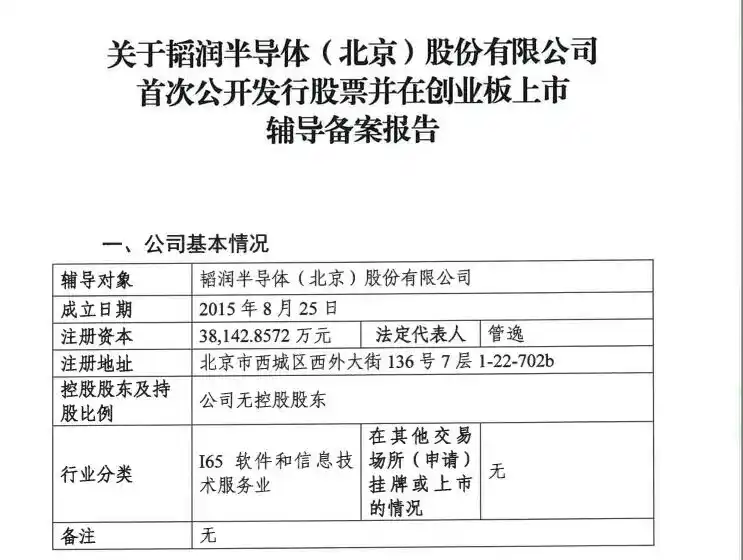
Source: Taoran Semiconductor Counseling Filing
Founded in 2015, this leading player in China's analog signal chain subdivision is helmed by Guan Yi, a veteran with nearly two decades of experience in chip design. The company is in the domestic leading echelon in the field of high-performance analog and mixed-signal chip design.
One of the most widely known labels for this company is being incubated by "the most prolific angel investor" Xia Zuoquan, who famously "hit the jackpot" with BYD, achieving an investment return exceeding 80,000 times.
His entry not only provided Taoran Semiconductor with funding but also handed over ecosystem resources.
After the entry of Zhengyuan Investment, led by Xia Zuoquan, Taoran Semiconductor transformed from an unknown entity into a dark horse disrupting the scene, galloping across the primary market. From 2018 to date, it has completed 12 rounds of financing, covering industrial capital, state-owned capital, and financial capital, cumulatively raising over 1 billion yuan.
During this period, BYD, as industrial capital, joined in betting on the company, further promoting the realization of bidirectional industrial synergy between smart cars and semiconductors. From 2022 to 2024, Taoran Semiconductor's revenue growth exceeded 80%.
With technology in one hand and commercialization in the other, this IPO has become the latest interpretation of Xia Zuoquan's patient capital.
Overseas Returnee Chip Engineer Pushing Domestic Substitution, Incubated by the "Most Prolific Angel"
It was no coincidence that Taoran Semiconductor became an investment target for the "Most Prolific Angel".
In 2010, after resigning from his position as Vice President of BYD Group and remaining only as a director, Xia Zuoquan began to focus full-time on equity investment. Coming from an industrial background, he believed that the country was in a period of great transformation involving economic restructuring and adjustment, where technological innovation was the most promising path.
Therefore, Zhengyuan Investment had a clear goal from the start: only invest in hard-tech enterprises that enhance national technological strength, focusing on high-tech fields such as intelligent manufacturing, robotics, aerospace, TMT, and new energy.
To manage the high mortality risk of investing early, Xia Zuoquan prioritized people in risk control, starting by being strict with himself.
In his view, early-stage investors must understand technology and enterprises to think from the same perspective as the invested company and become co-entrepreneurs. Simultaneously, this ensures that the invested areas have a strong industrial ecosystem and a clear understanding of industrial development trends.
Therefore, within Zhengyuan Investment, all partners must have an industrial background or engineering education. Most have long-term work experience at technology companies like BYD, Huawei, and ZTE, imbuing the firm's investments with a strong technical foundation.
It was precisely this background that allowed Zhengyuan Investment to spark synergy with Taoran Semiconductor.
Taoran Semiconductor's founder, Guan Yi, holds a master's degree from New York University and previously worked in the APD department at Broadcom. With nearly 20 years in chip design, he led large-scale, complex mixed-signal projects like the main control chip for 4G base stations.
At that time, core technologies for high-performance mixed-signal chips were long monopolized by overseas manufacturers like Broadcom and Marvell, with very low domestic substitution rates. As a highly competitive and capital-intensive field, iterating chip design and going through tape-out once could cost millions.
In 2015, he gave up a high overseas salary and resolutely returned to China to found Taoran Semiconductor, aiming to achieve domestic substitution and innovation at the national data infrastructure level and fill the long-standing industrial gap in the domestic high-end analog chip field.
From the beginning, he defined Taoran Semiconductor's vision: to be a technology-driven, leading chip design company serving the B2B industries like communications and automotive. He led the team to focus on developing underlying architecture, undergoing a period of technological incubation.
In 2017, the company's first self-developed chip gained initial industry recognition. In 2018, its first high-performance analog chip was successfully taped out. These developments signaled its future potential and attracted Xia Zuoquan, who is skilled at identifying people, understands technology, and assesses timing.
Xia Zuoquan has publicly stated multiple times: he prefers teams willing to focus deeply on hardcore technology, pursuing long-term technological breakthroughs rather than chasing short-term trends.
Having long been within the BYD system, he was well aware of the long-standing import substitution demand for high-speed in-vehicle communication and BMS signal chain chips in new energy vehicles, where domestic substitution was almost non-existent, and both policy and downstream demand were long-term positive.
Therefore, in 2018, when Taoran Semiconductor opened its doors to external financing, Xia Zuoquan extended an olive branch. Zhengyuan Investment entered its angel round with several million yuan.
This transaction became the entry point for Taoran Semiconductor's gallop across the primary market.
In the subsequent eight years, Taoran Semiconductor raised 12 consecutive rounds, cumulatively raising over 1 billion yuan. Institutions like Tongchuang Weiye, Shenzhen Capital Group, Gaorong Ventures, BYD, and local state-owned capital from Shanghai and Fujian all rushed in. During this time, Zhengyuan Investment consistently accompanied the journey and continued to increase its stake.
According to Tianyancha, Xia Zuoquan is the only individual shareholder in Taoran Semiconductor besides founder Guan Yi, holding a final beneficial stake of 5.3194%. The Zhengyuan Investment under his leadership holds a total of 9.3432%, making it the second-largest institutional shareholder.
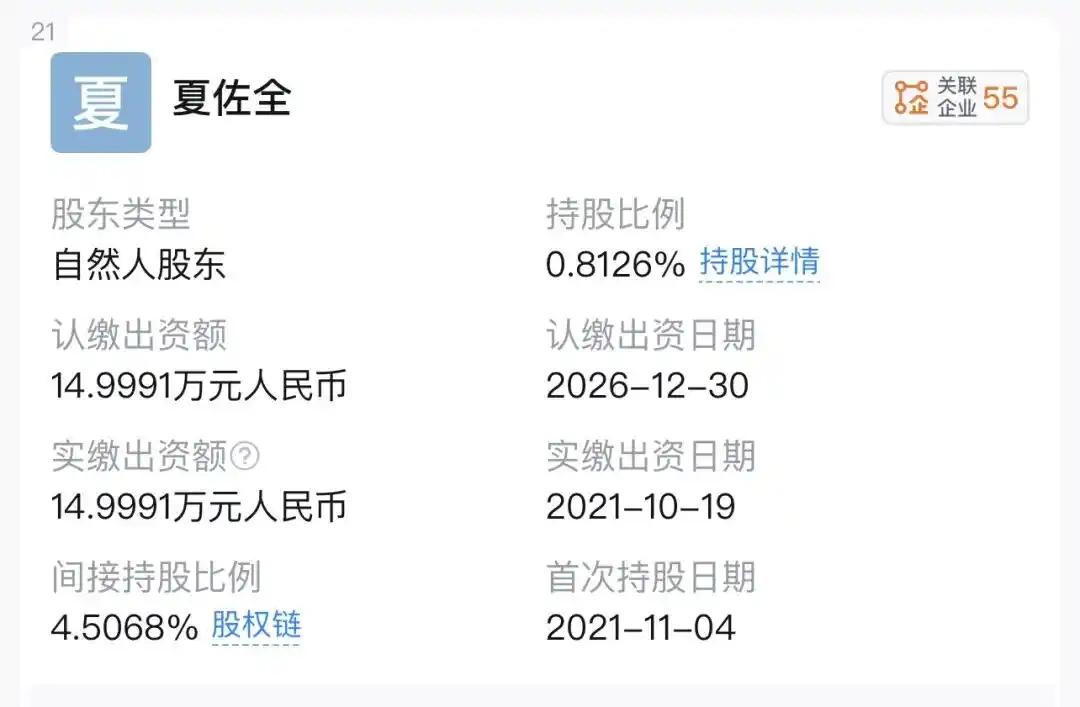
Source: Tianyancha
With the help of capital, in 2020, the company successfully developed and delivered key IP for its core customers. In 2023, it was recognized as a National-Level "Little Giant" specialized and sophisticated SME. By 2025, multiple products had entered mass production cycles.
To date, as one of the few domestic companies with both short-range and medium/long-range optical communication DSP capabilities, its mass-produced products have filled multiple gaps in domestic substitution.
Currently, the company has established deep cooperation with multiple domestic clients in fields such as communications, data centers, and new energy vehicles, driving sustained high revenue growth.
Official data shows that, benefiting from the sustained release of demand for high-speed interconnect chips under the AI infrastructure wave, from 2022 to 2024, Taoran Semiconductor maintained a revenue compound annual growth rate exceeding 80% and successfully entered the supply chain of a top 3 domestic communications equipment manufacturer.
The 63-Year-Old "Most Prolific Angel", Accompanies the Run to a 5th IPO
Taoran Semiconductor's progress from financing to preparing for listing is the latest chapter in Xia Zuoquan's IPO accompaniment.
Looking at the homepage of Zhengyuan Investment's website, it's not hard to see that following the opportunities identified by Xia Zuoquan—from Ubtech, United Fortune, Yutai Microelectronics (listed on STAR Market) to Debao CNC, Bomingwei, Shenzhen Xineng Semiconductor, and Ruishi Chuangxin—Zhengyuan Investment has made strategic investments in the hard-tech sector, primarily focusing on early-stage investments.
Xia Zuoquan once stated that entrepreneurs are the creators of social wealth, and the prerequisite for investment returns is to help these high-tech enterprises grow. Therefore, serving the invested companies well is the most important thing.
He also emphasized, "Investment is an industrial chain, from seed-round investment, VC investment, PE investment, to later secondary markets. Invested companies need corresponding investors at each stage. Moreover, investors at every link of this investment chain should adhere to the concept of long-term investment to help companies grow."
Looking at these words, Xia Zuoquan is putting them into practice.
In 1995, as a co-founder and initial angel investor of BYD, he invested 300,000 yuan in angel funding to back Wang Chuanfu. In the following years, when BYD entered a period of rapid business growth and transformation, Xia Zuoquan even joined full-time, deeply participating in corporate governance and system building.
It can be said that Xia Zuoquan accompanied BYD from being the "Battery King" to transforming into the "Chinese Auto King," before stepping back and gradually disengaging from daily operations.
To this day, he has not only reaped an investment return exceeding 80,000 times but also remains firmly among BYD's top three individual shareholders.
In 2013, with the foresight that robotics was a major trend, he became one of the earliest angel investors in Ubtech, later rescuing the company from difficulties multiple times.
According to Securities Times, the angel round funding was "burned through" in less than half a year, and Xia Zuoquan personally lent 6 million yuan to help the company through the crisis. At the end of 2014, he also provided 10 million yuan for Ubtech's operations using his personal credit guarantee.
In his view, Ubtech's founder Zhou Jian possessed an entrepreneurial spirit and the ability to commercialize products. Even if it failed, he was still worthy of respect. He told Zhou Jian, "Do what's best for the company's long-term development. If you're short on money, I can lend it to you."
In 2023, Ubtech successfully listed on the Hong Kong Stock Exchange, securing the title of "the first humanoid robotics stock." In the same year, Yutai Micro, an Ethernet physical layer (PHY) chip design company he invested in in 2017, also listed on the STAR Market.
Then, in April 2026, Shanghai Intelligent, a core equipment manufacturer for lithium battery slurry mixing that Zhengyuan Investment had invested in four years prior, successfully listed on the ChiNext board.
This means that once Taoran Semiconductor successfully IPOs, it will become the fifth listed company backed by Xia Zuoquan, following BYD, Ubtech, Yutai Micro, and Shanghai Intelligent.
Xia Zuoquan once said that technology for good bears fruit.
"When we invest, we must always maintain a sense of reverence, not be overly speculative, and not treat investment as a tool for personal enrichment. Only then can we ultimately achieve good returns while benefiting industrial development."
The "2025 Hurun China Rich List" shows Xia Zuoquan's wealth at 35.5 billion yuan, ranking 172nd. His wealth increased by 34% compared to 2024, primarily composed of his BYD holdings, plus the appreciation of listed equity in companies like Ubtech and Yutai Micro under Zhengyuan Investment.
This saying has proven true in Xia Zuoquan's own case.
This article is from the WeChat public account "Lieyun Jingxuan", author: Sun Yuan