The Mag7 Myth Shatters: 9 Consecutive Drops, Amazon Follows Microsoft into Bear Market

marsbitОпубліковано о 2026-02-14Востаннє оновлено о 2026-02-14

Анотація

Amazon's stock has experienced a nine-day losing streak, its longest in nearly two decades, officially entering a bear market after falling more than 23% from its recent high. It becomes the second member of the "Magnificent Seven" (Mag7) to do so, following Microsoft, which entered a bear market in late January and is down 27.8%. Meta is also nearing bear market territory, down 19.6% from its peak, as investor confidence is shaken by aggressive AI spending plans. The four major cloud hyperscalers—Amazon, Microsoft, Meta, and Alphabet—are projected to spend a combined $650 billion on capital expenditures in AI by 2026, with Amazon leading at $200 billion. This massive spending is raising significant concerns among investors about returns on investment and its impact on free cash flow. For Amazon, this level of expenditure could push its free cash flow into negative territory this year, potentially forcing it to raise more capital from debt markets. Analysts note a rotation within the Mag7, with investors moving away from companies like Microsoft and Nvidia to favor others like Alphabet, whose vertically integrated tech infrastructure helps alleviate some spending concerns. The next key catalyst for AI-related stocks is expected to be Nvidia's earnings report on February 25th, which will indicate whether the AI boom is sustaining.

Author: Zhao Ying, Bao Yilong, Wall Street Insights

Amazon's stock has fallen for nine consecutive days, marking its longest losing streak in nearly 20 years.

After entering a technical bear market on Thursday, becoming the second Mag7 company to fall into a bear market, Amazon's stock continued to decline on Friday.

Investors are strongly resisting the aggressive AI spending plans of tech giants, leading to significant declines in these star stocks.

On Friday, Amazon's stock closed at $198.79, down more than 23% from its recent high, officially crossing the bear market threshold the previous day, Thursday.

Among the four major hyperscale cloud service providers, Amazon has the highest planned capital expenditure for 2026, reaching $200 billion.

Amazon, Microsoft, Meta, and Alphabet are expected to collectively spend $650 billion on capital expenditures in the AI field by 2026.

Meta could be the next Mag7 member to fall into a bear market. As of Friday's close, it was down 19.6% from last year's high, just 0.4% away from the bear market threshold of a 20% decline. Although Meta's Q4 revenue and profits exceeded Wall Street expectations, increased AI spending and margin pressures have dampened investor confidence.

Microsoft was the first Mag7 member to enter a bear market. The company's stock fell into a bear market on January 29, after the Azure cloud business growth reported the previous day fell short of investor expectations. As of Friday's close, Microsoft's stock was down 27.8% from its recent high.
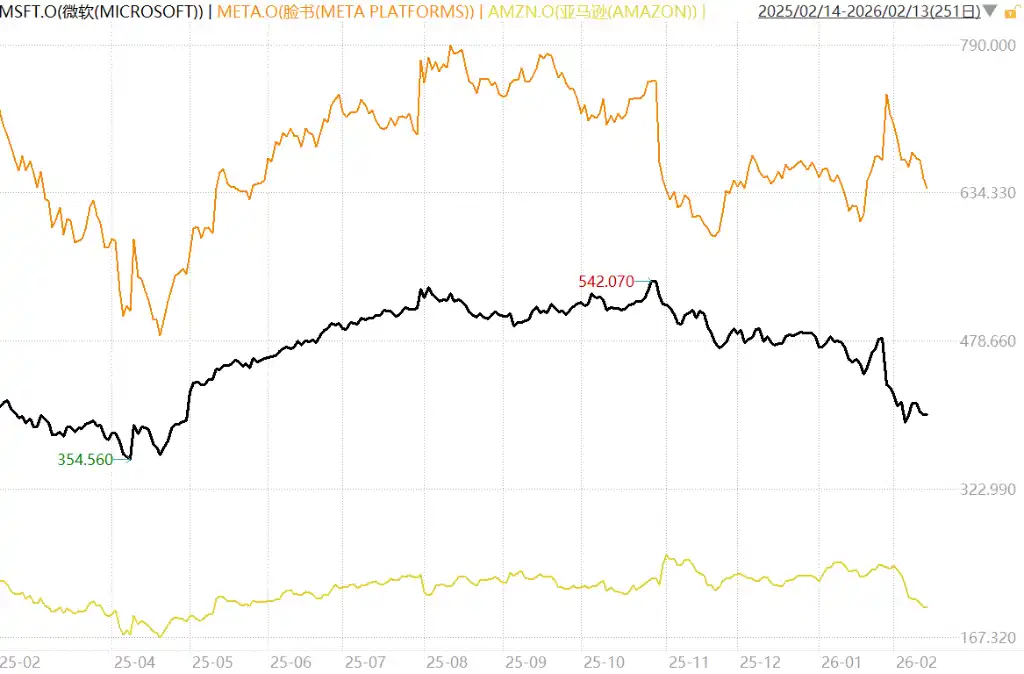
(Chart of Amazon, Microsoft, and Meta's performance over the past year)

Investors Rotate Within Mag7, Free Cash Flow Pressure Highlights

Mike Treacy, Vice President of Risk at Apex Fintech Solutions, stated that the recent sell-off highlights the growing divergence among Mag7 members.

Since last fall, investors have shifted away from OpenAI-related deals involving Microsoft, NVIDIA, and Oracle, favoring the Alphabet and Broadcom ecosystems instead.

Treacy pointed out that Alphabet's vertically integrated technology stack has somewhat offset concerns about excessive spending, shielding the stock from the worst of the tech sell-off. Alphabet's stock closed Thursday down 9.2% from its recent high.

Treacy noted that Google's self-sufficiency should command a premium relative to other companies that may be adversely affected by a single link in the industry chain.

Amazon, Microsoft, and Meta's stocks have been hit harder because investors lack confidence that these companies' AI spending will yield sufficient returns on investment.

For Amazon, the increased level of expenditure could lead to negative free cash flow this year, meaning the company may need to start raising more funds in the debt market.

Treacy believes that the next major catalyst for AI trades will be NVIDIA's earnings report on February 25. This report will show whether the AI boom is cooling down or if NVIDIA has successfully captured the tens of billions of dollars its largest clients are investing into the field.

Related reading: Trading Moment: AI Panic Escalates Ahead of CPI, Bitcoin Grinds Bottom, May Struggle to Repeat "Spring Festival Rally"


Пов'язані питання

QWhat is the main reason for the recent decline in Mag7 stocks, particularly Amazon and Microsoft?

AInvestors are strongly resisting the aggressive AI spending plans of tech giants, leading to significant sell-offs in these star stocks.

QWhich Mag7 company was the first to enter a bear market, and when did it happen?

AMicrosoft was the first Mag7 member to enter a bear market, with its stock falling into bear territory on January 29.

QHow much is Amazon's planned capital expenditure for 2026, and what is the total AI-related capital expenditure expected from the four major cloud service providers?

AAmazon plans a capital expenditure of $200 billion for 2026. The four major cloud service providers (Amazon, Microsoft, Meta, and Alphabet) are expected to spend a total of $650 billion in AI-related capital expenditures by 2026.

QWhich Mag7 company is at risk of being the next to fall into a bear market, and how close is it to the 20% decline threshold?

AMeta is at risk of being the next Mag7 member to fall into a bear market. As of Friday's close, it was down 19.6% from last year's high, just 0.4% away from the bear market threshold of a 20% decline.

QWhat potential financial pressure does Amazon face due to its increased capital expenditure in AI?

AThe increase in capital expenditure levels could lead Amazon's free cash flow to turn negative this year, meaning the company may need to raise more capital by entering the debt market.

Пов'язані матеріали

Within Strategy's Framework, STRC's Dividend Yield Remains at 12% as Share Price Stays Below Par Value

Michael Saylor, Executive Chairman of Strategy (MSTR), confirmed that the dividend rate for its STRC perpetual preferred shares will remain at 12.00% through August 2026. The rate has increased from 9% at its July 2025 launch to the current high via a "ratchet" mechanism, which permanently raises the rate by 0.5% whenever the share price falls below $95. This mechanism is intended to push the price back toward its $100 par value and support Strategy's "at-the-market" (ATM) program for issuing new shares to fund Bitcoin purchases. However, the mechanism has not worked as intended. STRC shares closed at $89.46 on July 31, remaining about 10-11% below par value despite the record-high dividend. Competition from rival Strive's higher-yielding SATA securities has pressured demand. The persistent discount has forced Strategy to suspend new STRC issuances via its ATM program, limiting this funding channel for Bitcoin acquisitions. STRC's struggles reflect Bitcoin's own volatility, as the preferred shares historically move in tandem. Analysts have warned the ratchet structure carries long-term, one-way risk. A law firm is investigating Strategy's ability to maintain dividend payments if Bitcoin's price stays low. Retail investors own roughly 83% of outstanding STRC shares, a group seen as prone to panic selling during downturns. In response, Strategy has established financial reserves, including a liquidity cushion covering about 26 months of dividend/interest obligations, and a $2 billion share buyback program alongside a Bitcoin monetization framework, though the company emphasized it is not obligated to sell any Bitcoin.

cryptonews.ru14 хв тому

Within Strategy's Framework, STRC's Dividend Yield Remains at 12% as Share Price Stays Below Par Value

cryptonews.ru14 хв тому

Analyst: Bitcoin's Price Will Drop to $60k in August, Then Rebound to $70k

Financial analyst Andrey Poroshin has provided a new forecast for Bitcoin's price dynamics in August. Poroshin, an analyst at the Bitbanker exchange, expects the cryptocurrency market to experience a downturn this month, with prices retesting the $60,000 level due to a lack of supportive macroeconomic catalysts. He noted that the recent US Federal Reserve decision to hold interest rates did not significantly impact the market, while inflation remains above the 2% target. Poroshin stated that Bitcoin is ending July under pressure from moderate volatility and a lack of new macroeconomic stimuli, leading to continued market caution. According to his base scenario, Bitcoin will drop to a range of $60,000 to $62,000 before recovering to $70,000. He pointed out that even $70,000 remains below the cost of mining in the US, which has prompted some miners to shift towards AI data center operations. Poroshin cited the winding down of BitMEX's operations as a potential catalyst for a price rebound, suggesting the exit of weaker players often coincides with market reversals and reduced short-term selling pressure. He believes Bitcoin is currently less susceptible to geopolitical shocks, such as the Iran-US conflict, and does not expect significant market changes in August related to the pending CLARITY Act. Looking ahead, Poroshin forecasts that September will bring more active price fluctuations driven by potential Fed rate decisions and possible discussions or approval of the CLARITY Act.

cryptonews.ru14 хв тому

Analyst: Bitcoin's Price Will Drop to $60k in August, Then Rebound to $70k

cryptonews.ru14 хв тому

Торгівля

Спот
活动图片




