The Inevitable Rise of Equity-like Tokens

marsbitОпубліковано о 2026-01-21Востаннє оновлено о 2026-01-21

Анотація

The article "The Inevitable Rise of Equity-Like Tokens" discusses the long-standing conflict between equity holders and token holders in crypto projects, using Uniswap's delayed fee switch implementation as a key example. It argues that neither extreme—fully eliminating equity for on-chain ownership nor abandoning tokens entirely—is optimal. Equity provides legal rights, governance control, and access to deeper capital markets, while tokens offer transparency, instant settlement, and community alignment. The piece highlights that tokenization of traditional equities is accelerating, with initiatives like the DTC pilot program and Nasdaq’s proposed tokenized securities trading. The author concludes that 2026 will be a year of innovation in equity-like tokens, merging legal protections with digital ownership, ultimately moving beyond the equity-vs-token debate toward a unified model of transparent, legally-backed digital ownership.

Author: Matty

Compiled by: Jiahuan, ChainCatcher

In November 2025, more than 5 years after the $UNI airdrop, Uniswap finally activated the fee switch.

This process involved years of delays and repeated governance battles, even reaching an extremely awkward moment in 2024 when a 'stakeholder' (widely believed to be an equity investor) blocked a proposal that was supposed to benefit token holders. Despite this, the UNIfication proposal ultimately passed with over 62 million votes.
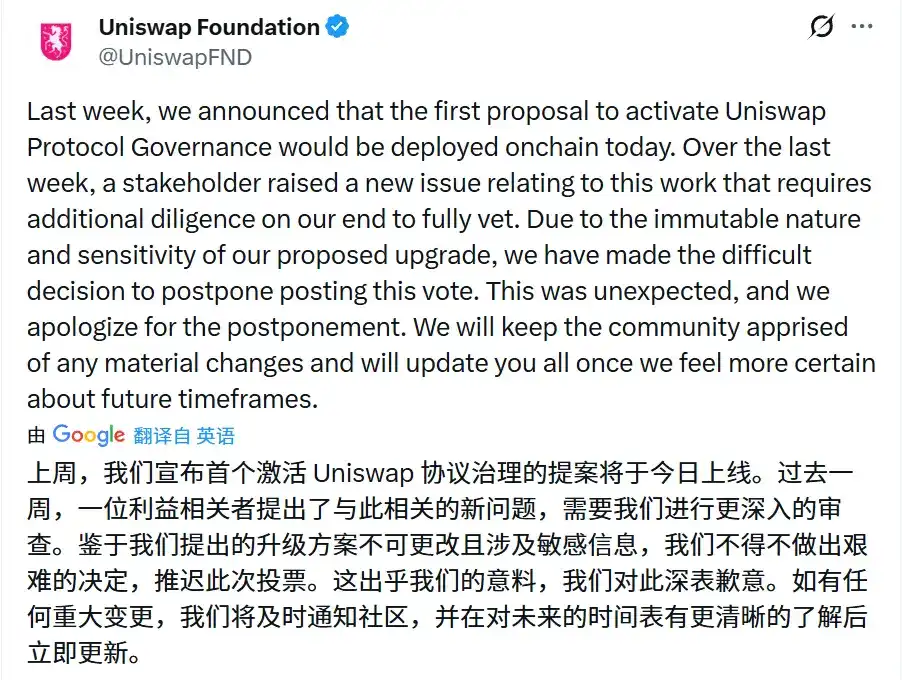
The fact that the largest DEX in crypto took this long to figure out how to reward its token holders is telling of the current state of the relationship between equity and tokens. Although UNI token holders theoretically "own" the protocol, they could only watch from the sidelines as equity investors captured all the value from front-end fees.

While Uniswap is a prime example of the equity-token divide, this issue has worsened over years and affects almost every protocol that consistently generates revenue. Equity holders and token holders often compete for the same value pool, while operating under fundamentally different legal, governance, and economic frameworks.

The proposed solutions within the industry vary widely: from completely eliminating equity and moving all ownership on-chain, to going to the other extreme—abandoning tokens altogether. Both approaches have their proponents, but also significant flaws.

Extreme Path One: Full De-equitization

Completely eliminating equity and moving all ownership concepts on-chain is undoubtedly a theoretical solution. In this vision, smart contracts replace shareholder agreements, on-chain balances replace cap tables, and governance tokens replace board votes.

Instant settlement. Transparent ownership. What's not to like?

One major problem is: Unless the enterprise's assets, operations, and customers are entirely on-chain, the off-chain court system will always be the ultimate arbiter for dispute resolution. You can try to have all your off-chain contracts and agreements reference on-chain logic, but this still doesn't change the fact that off-chain courts are the arbiters, and not everything can be moved on-chain within your control.

For example, I could own a tokenized real estate NFT issued by a smart contract that states I own the corresponding property, but if the off-chain deed for that land says otherwise, good luck presenting your NFT when the sheriff comes to serve the eviction notice. (Again, you can take steps to try to ensure the off-chain deed matches the on-chain state, but this doesn't negate the fact that off-chain enforcement takes precedence).

The "no equity, pure token" approach is only feasible for a small subset of projects:

Fully on-chain networks and protocols, such as Bitcoin, some public blockchains, and fully autonomous DeFi. These projects have no company, no employees, no servers, and no external dependencies. After all, this was the original beauty of Bitcoin! An uncensorable system and unconfiscatable asset.

But for the vast majority of projects (and the vast majority of potential on-chain activity), this is not feasible. Web2 and Web2.5 companies have off-chain assets, customers, payments, and operations.

Extreme Path Two: Full De-tokenization

At the other end of the spectrum, some projects (actually, the vast majority of companies) decide to forgo tokens entirely. They raise equity, build products, and avoid all the headaches tokens can bring—while also sacrificing all the benefits.

  • Benefits: No tokens mean no SEC knocking on your door. No worrying about whether governance tokens are securities. No need to design tokenomics, worry about emissions, or explain buyback mechanisms.

  • Costs: Giving up instant settlement, transparent ownership records, cost efficiency gains, and the ability to align incentives for a global community.

Traditional equity transfer is expensive, settles slowly, and is inaccessible to most potential investors. Gaining exposure to equity in private startups remains expensive, inefficient, and opaque. Even in 2026, the processes required to trade public stocks seem archaic compared to DeFi.

Tokens, despite their flaws, have the potential to solve these problems. They enable community ownership and user-owned products. Abandoning this entirely is a step backward.

To find the optimal balance between these two extremes, we need to understand what equity provides that tokens cannot.

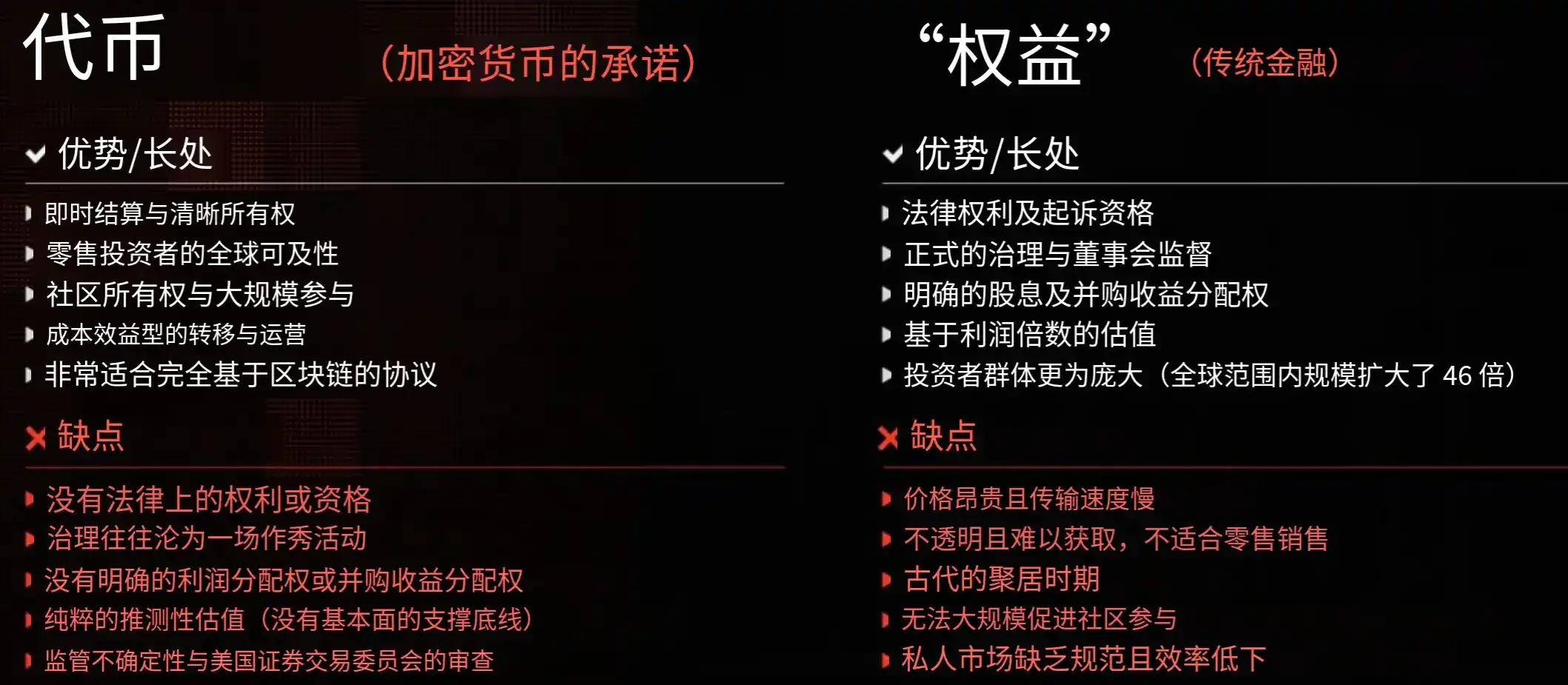
What Equity and Tokens Each Provide
1. Legal Rights and Recourse

When you own equity, you have legal standing. You can sue, enforce rights. If directors breach fiduciary duties or fraud occurs, you have an established legal framework to recover losses.

Token holders (with very few exceptions) have little to no legally recognized rights or protections. They often must simply hope the market saves their investment.

While theoretically a company's entire budget could be placed on-chain, having founders subject every decision to a shareholder vote, without legal rights, introduces massive operational inefficiencies and defeats the purpose of the investment—trusting the team's vision and capabilities.

2. Formal Governance Control

Equity shareholders elect the board, approve major transactions, and have codified rights. In contrast, governance tokens often provide an illusion of control.

As Vitalik has noted, token governance has serious flaws: low turnout (<10%), whale manipulation, lack of expertise. More often, on-chain governance devolves into "decentralized theater," where teams can often ignore votes if they dislike the outcome, as execution still requires manual action.

3. Legal Clarity for Value Accrual

In M&A activity, equity holders have clear legal rights to proceeds. As recent cases involving Tensor and Axelar have shown, token holders are often left out in the cold, even when the related project is acquired.

Because of this strong legal right to profit-sharing, stocks trade more reliably on multiples of expected future profits. Token valuations are often purely speculative, with no fundamental backing.

Even if a project generates revenue, most do not reliably route it to token holders due to regulatory risk and fiduciary duty conflicts. While off-chain agreements can be constructed to simulate this right, it is far less reliable than the legal foundation of equity.

4. Broader and Deeper Investor Pool

Simply put, the investor pool and total buying power of equity markets are vastly larger than token markets.

  • The US stock market alone is worth over 20 times the entire crypto industry.

  • Global equity markets are worth over 46 times the crypto industry.

Projects that choose tokens over equity effectively access only 2%-5% of the potential buying power they could reach.

2026: The Year of the Equity-like Token

One thing is certain: from tokenized equity to new forms of on-chain governance, 2026 will be a year of innovation and experimentation for equity-like tokens.

The DTC Pilot Program (launching in the second half of 2026) will be the first US initiative allowing participants to hold tokenized security entitlements on a blockchain. This represents the backbone of US capital markets infrastructure moving on-chain:

  • Nasdaq has proposed trading tokenized securities.

  • Securitize offers real public stocks with full on-chain legal ownership.

  • Centrifuge and others are tokenizing equity through SEC-registered transfer agents.

The convergence of traditional financial infrastructure with blockchain rails is no longer a pipe dream—it's happening.

For crypto-native projects, Uniswap's five-year journey to the fee switch is a cautionary tale. The equity-token split won't resolve itself automatically. It requires intentional design, clear agreements, and structures to resolve conflicts of interest.

Ultimately, this divergence stems from regulatory uncertainty and a lack of legal frameworks. Whether through the SEC's "crypto projects" or the Clarity Act, the US is expected to get long-awaited regulatory certainty as early as January this year.

By the end of this year, we will no longer be discussing equity vs. tokens. We will be discussing ownership—transparent, transferable, legally protected, and natively digital ownership.


Пов'язані питання

QWhat is the main conflict discussed in the article regarding Uniswap and similar protocols?

AThe main conflict is between equity holders (like venture capital investors) and token holders, who are often competing for the same value pool from protocol revenues, but operate under vastly different legal, governance, and economic frameworks.

QWhat are the two extreme paths proposed to resolve the equity vs. token conflict, and what are their major drawbacks?

AThe two extremes are: 1) Fully eliminating equity and moving all ownership on-chain, which is only feasible for fully on-chain networks and fails when off-chain assets/courts are involved. 2) Fully eliminating tokens, which avoids regulatory headaches but sacrifices the benefits of instant settlement, transparent ownership, and global community coordination.

QAccording to the article, what key advantages does traditional equity have over governance tokens?

AEquity provides: 1) Legal rights and recourse (ability to sue, enforce rights). 2) Formal governance control (election of board, approval of major transactions). 3) Legal clarity for value accumulation (clear rights in M&A). 4) Access to a much larger and deeper pool of investors and capital.

QWhat significant infrastructure development is mentioned for 2026 regarding tokenized securities in the US?

AThe DTC Pilot Program, launching in late 2026, will for the first time allow participants in the US to hold tokenized security entitlements on a blockchain. This is part of a broader trend of traditional finance infrastructure (like Nasdaq) moving on-chain.

QWhat does the author predict will be the focus by the end of the year, moving beyond the 'equity vs. token' debate?

AThe author predicts the focus will shift to discussing 'ownership' itself—transparent, transferable, legally protected, and natively digital ownership, thanks to expected regulatory clarity and technological innovation.

Пов'язані матеріали

A 'Overlooked' Market Event: Joint US-Japan-South Korea Intervention, Rare US Treasury Involvement, and Bessent's Quiet 'Market Rescue'?

Summary: The United States, Japan, and South Korea executed their largest coordinated foreign exchange intervention in nearly 30 years. The action targeted depreciation pressure on the Japanese yen and South Korean won. This move is seen as a significant effort by the US to stabilize the financial markets of its key allies and prevent the spillover of risks. Key details: * Japan reportedly intervened on July 30 using approximately 8.45 trillion yen (about $52.8 billion). South Korean authorities also intervened that day, selling dollars to support the won. * Notably, the US Treasury Department intervened directly in yen markets for the first time in roughly 30 years. The New York Fed, reportedly acting on behalf of the Treasury, sold euros to buy yen via Goldman Sachs and Morgan Stanley on July 31. Analysts view the use of the euro-yen pair as a way to alleviate yen pressure without adding selling pressure to the US dollar. * Prior to the action, the New York Fed conducted "rate checks" on both USD/JPY and EUR/JPY, a newer signaling tool that falls between verbal and physical intervention. The intervention is interpreted as going beyond traditional currency stabilization. Analysts, such as Michael Hartnett of Bank of America, suggest it resembles a "Price Keeping Operation" for the AI era. The core US objectives are perceived to be: 1. Preventing rapid yen depreciation from triggering a sharp rise in Japanese government bond yields. 2. Containing financial stress from spreading across Asian markets like South Korea and Japan. 3. Reducing the risk of disorderly capital flows impacting the US bond market. This coordinated action underscores the importance of Japan and South Korea as critical partners in the US semiconductor and AI supply chain. Stabilizing their financial markets is seen as vital to mitigating risks to the broader tech industry and the US market itself. The intervention coincides with market pressures, including the KOSDAQ index hitting a low since October 2022. While seen as a move to control volatility, some analysts caution it may not fundamentally reverse existing market trends.

marsbit4 хв тому

A 'Overlooked' Market Event: Joint US-Japan-South Korea Intervention, Rare US Treasury Involvement, and Bessent's Quiet 'Market Rescue'?

marsbit4 хв тому

Will the Federal Reserve Definitely Raise Interest Rates in September? How Will Cryptocurrencies and US Stocks Bear the Pressure?

In early August 2024, market expectations for a September Federal Reserve rate hike surged dramatically, from below 50% to over 80%, driven by renewed inflation concerns. This shift followed a contentious July FOMC meeting where a 9-3 vote to hold rates revealed a growing hawkish faction advocating for an immediate hike, citing prolonged above-target inflation. The key catalyst is escalating conflict near the Strait of Hormuz, which has pushed oil prices up approximately 20% in July, threatening to reignite inflation. The next critical data point is the July CPI report on August 12th; a hot reading could solidify hike expectations. For crypto assets, particularly Bitcoin, this represents near-term pressure. Bitcoin continues to exhibit high-beta, risk-on characteristics, making it sensitive to tightening liquidity and higher opportunity costs. However, historical precedent suggests that if a hike is perceived as the cycle's end rather than its start, the negative impact may be brief, with markets quickly pivoting to anticipate future rate cuts. U.S. stocks, especially crypto-linked equities like Coinbase and high-valuation tech stocks, face amplified volatility. Higher rates increase discount rates in valuation models, pressuring growth stocks. This coincides with a pivotal tech earnings season where investor focus has shifted from massive AI capital expenditures to demonstrable revenue and cash flow generation. Companies with negative cash flows and weak growth narratives could see severe pressure if a September hike materializes, as financing costs would rise. Key indicators to watch include oil prices, upcoming inflation data, and Fed commentary at events like the Jackson Hole symposium.

Odaily星球日报4 хв тому

Will the Federal Reserve Definitely Raise Interest Rates in September? How Will Cryptocurrencies and US Stocks Bear the Pressure?

Odaily星球日报4 хв тому

From South Korea to the United States: Blue-Collar Jobs Are Becoming Increasingly Popular, Thanks to AI

AI is reshaping the labor market's value proposition. The traditional four-year college degree is losing its appeal as a guaranteed career path, while skilled blue-collar trades like electricians, welders, and plumbers are experiencing historic demand and wage premiums. This shift is driven by dual pressures: AI's displacement of certain white-collar roles and a booming need for physical infrastructure and data center construction. Data confirms the trend. In the U.S., vocational school revenue surged, and a significant portion of recent layoffs are AI-related. Surveys show a majority of Gen Z adults plan to pursue blue-collar work, citing better job security against AI automation. Vocational education interest has exploded recently. Experts cite a psychological shift as younger generations seek tangible, AI-resistant careers and avoid high student debt. In many cases, salaries for skilled trades now match or exceed those requiring a bachelor's degree. In South Korea, semiconductor vocational high schools boast near-total employment, with graduates securing high-paying roles at companies like Samsung. The shortage is structural, exacerbated by a retiring baby boomer workforce and massive infrastructure projects. Companies like JPMorgan Chase, Meta, and Lowe's are investing heavily in training programs. However, overcoming historical stigma and a "perception gap" around trade careers remains a key challenge to closing the talent gap.

marsbit1 год тому

From South Korea to the United States: Blue-Collar Jobs Are Becoming Increasingly Popular, Thanks to AI

marsbit1 год тому

Торгівля

Спот
活动图片