Author: Matty
Compiled by: Jiahuan, ChainCatcher
In November 2025, more than 5 years after the $UNI airdrop, Uniswap finally activated the fee switch.
This process involved years of delays and repeated governance battles, even reaching an extremely awkward moment in 2024 when a 'stakeholder' (widely believed to be an equity investor) blocked a proposal that was supposed to benefit token holders. Despite this, the UNIfication proposal ultimately passed with over 62 million votes.
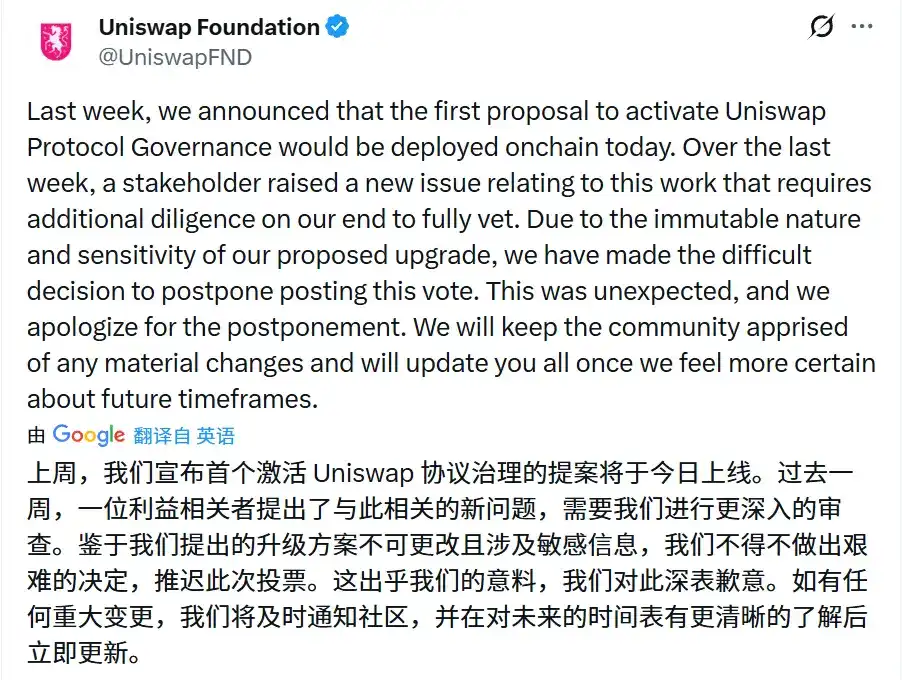
The fact that the largest DEX in crypto took this long to figure out how to reward its token holders is telling of the current state of the relationship between equity and tokens. Although UNI token holders theoretically "own" the protocol, they could only watch from the sidelines as equity investors captured all the value from front-end fees.
While Uniswap is a prime example of the equity-token divide, this issue has worsened over years and affects almost every protocol that consistently generates revenue. Equity holders and token holders often compete for the same value pool, while operating under fundamentally different legal, governance, and economic frameworks.
The proposed solutions within the industry vary widely: from completely eliminating equity and moving all ownership on-chain, to going to the other extreme—abandoning tokens altogether. Both approaches have their proponents, but also significant flaws.
Extreme Path One: Full De-equitization
Completely eliminating equity and moving all ownership concepts on-chain is undoubtedly a theoretical solution. In this vision, smart contracts replace shareholder agreements, on-chain balances replace cap tables, and governance tokens replace board votes.
Instant settlement. Transparent ownership. What's not to like?
One major problem is: Unless the enterprise's assets, operations, and customers are entirely on-chain, the off-chain court system will always be the ultimate arbiter for dispute resolution. You can try to have all your off-chain contracts and agreements reference on-chain logic, but this still doesn't change the fact that off-chain courts are the arbiters, and not everything can be moved on-chain within your control.
For example, I could own a tokenized real estate NFT issued by a smart contract that states I own the corresponding property, but if the off-chain deed for that land says otherwise, good luck presenting your NFT when the sheriff comes to serve the eviction notice. (Again, you can take steps to try to ensure the off-chain deed matches the on-chain state, but this doesn't negate the fact that off-chain enforcement takes precedence).
The "no equity, pure token" approach is only feasible for a small subset of projects:
Fully on-chain networks and protocols, such as Bitcoin, some public blockchains, and fully autonomous DeFi. These projects have no company, no employees, no servers, and no external dependencies. After all, this was the original beauty of Bitcoin! An uncensorable system and unconfiscatable asset.
But for the vast majority of projects (and the vast majority of potential on-chain activity), this is not feasible. Web2 and Web2.5 companies have off-chain assets, customers, payments, and operations.
Extreme Path Two: Full De-tokenization
At the other end of the spectrum, some projects (actually, the vast majority of companies) decide to forgo tokens entirely. They raise equity, build products, and avoid all the headaches tokens can bring—while also sacrificing all the benefits.
-
Benefits: No tokens mean no SEC knocking on your door. No worrying about whether governance tokens are securities. No need to design tokenomics, worry about emissions, or explain buyback mechanisms.
-
Costs: Giving up instant settlement, transparent ownership records, cost efficiency gains, and the ability to align incentives for a global community.
Traditional equity transfer is expensive, settles slowly, and is inaccessible to most potential investors. Gaining exposure to equity in private startups remains expensive, inefficient, and opaque. Even in 2026, the processes required to trade public stocks seem archaic compared to DeFi.
Tokens, despite their flaws, have the potential to solve these problems. They enable community ownership and user-owned products. Abandoning this entirely is a step backward.
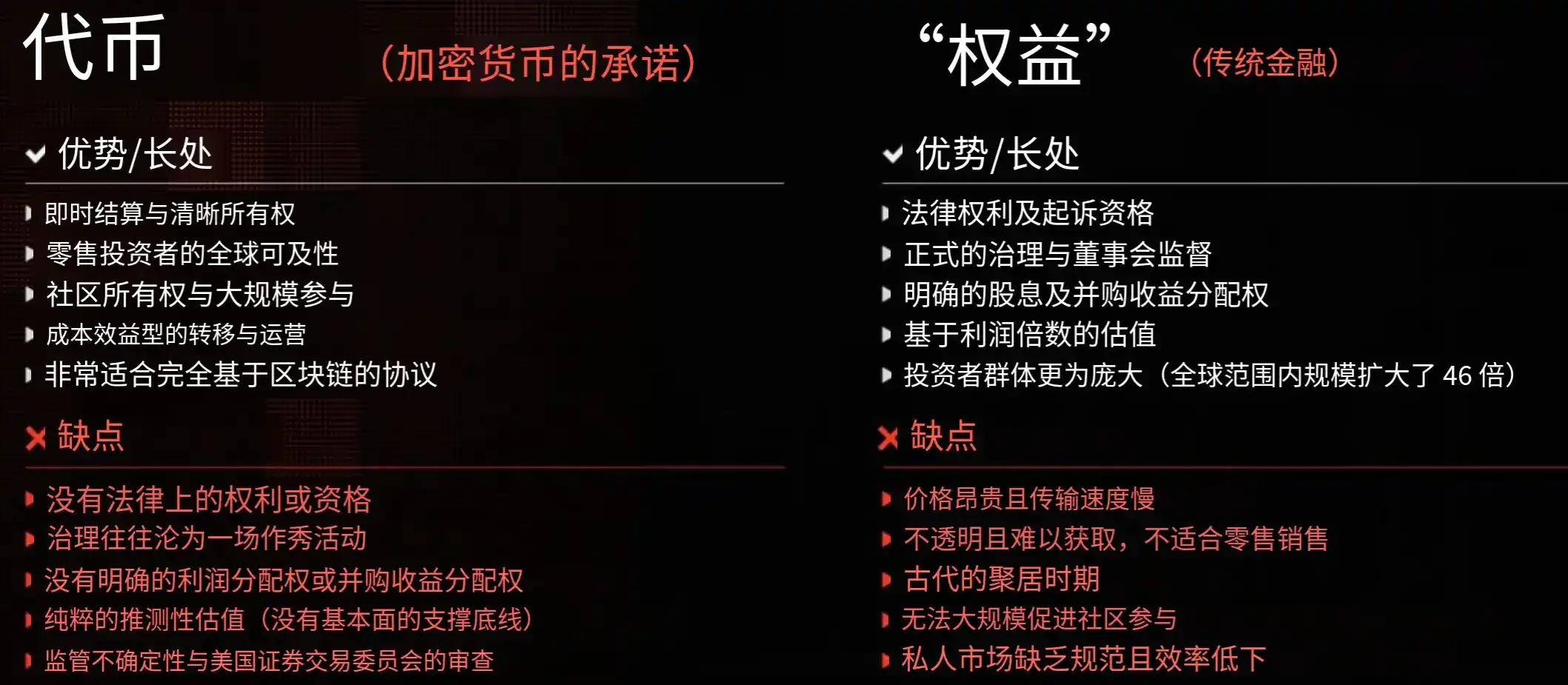
To find the optimal balance between these two extremes, we need to understand what equity provides that tokens cannot.
What Equity and Tokens Each Provide
1. Legal Rights and Recourse
When you own equity, you have legal standing. You can sue, enforce rights. If directors breach fiduciary duties or fraud occurs, you have an established legal framework to recover losses.
Token holders (with very few exceptions) have little to no legally recognized rights or protections. They often must simply hope the market saves their investment.
While theoretically a company's entire budget could be placed on-chain, having founders subject every decision to a shareholder vote, without legal rights, introduces massive operational inefficiencies and defeats the purpose of the investment—trusting the team's vision and capabilities.
2. Formal Governance Control
Equity shareholders elect the board, approve major transactions, and have codified rights. In contrast, governance tokens often provide an illusion of control.
As Vitalik has noted, token governance has serious flaws: low turnout (<10%), whale manipulation, lack of expertise. More often, on-chain governance devolves into "decentralized theater," where teams can often ignore votes if they dislike the outcome, as execution still requires manual action.
3. Legal Clarity for Value Accrual
In M&A activity, equity holders have clear legal rights to proceeds. As recent cases involving Tensor and Axelar have shown, token holders are often left out in the cold, even when the related project is acquired.
Because of this strong legal right to profit-sharing, stocks trade more reliably on multiples of expected future profits. Token valuations are often purely speculative, with no fundamental backing.
Even if a project generates revenue, most do not reliably route it to token holders due to regulatory risk and fiduciary duty conflicts. While off-chain agreements can be constructed to simulate this right, it is far less reliable than the legal foundation of equity.
4. Broader and Deeper Investor Pool
Simply put, the investor pool and total buying power of equity markets are vastly larger than token markets.
-
The US stock market alone is worth over 20 times the entire crypto industry.
-
Global equity markets are worth over 46 times the crypto industry.

Projects that choose tokens over equity effectively access only 2%-5% of the potential buying power they could reach.
2026: The Year of the Equity-like Token
One thing is certain: from tokenized equity to new forms of on-chain governance, 2026 will be a year of innovation and experimentation for equity-like tokens.
The DTC Pilot Program (launching in the second half of 2026) will be the first US initiative allowing participants to hold tokenized security entitlements on a blockchain. This represents the backbone of US capital markets infrastructure moving on-chain:
-
Nasdaq has proposed trading tokenized securities.
-
Securitize offers real public stocks with full on-chain legal ownership.
-
Centrifuge and others are tokenizing equity through SEC-registered transfer agents.
The convergence of traditional financial infrastructure with blockchain rails is no longer a pipe dream—it's happening.
For crypto-native projects, Uniswap's five-year journey to the fee switch is a cautionary tale. The equity-token split won't resolve itself automatically. It requires intentional design, clear agreements, and structures to resolve conflicts of interest.
Ultimately, this divergence stems from regulatory uncertainty and a lack of legal frameworks. Whether through the SEC's "crypto projects" or the Clarity Act, the US is expected to get long-awaited regulatory certainty as early as January this year.
By the end of this year, we will no longer be discussing equity vs. tokens. We will be discussing ownership—transparent, transferable, legally protected, and natively digital ownership.






