The Hunter Becomes the Hunted: The Most Profitable MEV Bot Gets Hacked

marsbitОпубліковано о 2026-06-21Востаннє оновлено о 2026-06-21

Анотація

A well-known and highly profitable Ethereum MEV Bot, Jaredfromsubway.eth, suffered a sophisticated on-chain attack this Saturday, losing over $7.5 million. Analysis by Blockaid and others reveals this was not a conventional phishing or smart contract exploit, but a targeted "counter-MEV honeypot attack." The attacker meticulously laid a trap over several weeks, deploying 66 fake token contracts and liquidity pools disguised as major assets like WETH and USDC. These pools created the illusion of arbitrage opportunities. The MEV Bot's automated system detected these signals, executed trades, and in the process, granted approval permissions to attacker-controlled contracts. These approvals were not revoked, creating a persistent vulnerability. The attacker then exploited this in a single transaction, draining the bot's ETH, USDC, and USDT holdings. Jaredfromsubway.eth is notorious as one of Ethereum's most active and profitable MEV Bots, primarily known for executing "sandwich attacks" to profit from transaction slippage. Estimates suggest it has earned tens of millions in MEV revenue. The incident highlights escalating crypto security threats, demonstrating that even top-tier automated "predators" are vulnerable to novel, logic-based attacks designed to exploit their own operational rules. Following the hack, an unverified X account impersonating Jaredfromsubway.eth emerged, falsely offering a bounty for the return of funds, prompting developer warnings for users to stay vig...

By Azuma(@azuma_eth)

Jaredfromsubway.eth, a well-known MEV Bot address long active on the Ethereum network, was targeted in a highly specific on-chain attack on Saturday, resulting in losses exceeding $7.5 million.

Investigations by Blockaid and several on-chain analytics firms revealed that this incident was not a traditional phishing attack or smart contract exploit, but rather a "counter-MEV honeypot attack" specifically designed to exploit the operational logic of MEV Bots.

Over the preceding weeks, the attacker systematically deployed 66 counterfeit token contracts and fake liquidity pools. These assets were meticulously disguised on-chain as major stable assets like WETH, USDC, and USDT, creating seemingly genuine arbitrage trading pathways.

The attack chain unfolded as follows — fake liquidity pools generated signals of "exploitable price gaps"; the MEV bot automatically identified the arbitrage opportunity and executed a trade; during the transaction, the robot granted authorization to an auxiliary contract controlled by the attacker; this authorization was not revoked promptly, leading to persistent exposure of permissions; finally, the attacker triggered a pre-embedded backdoor logic in a single transaction, directly transferring assets such as ETH, USDC, and USDT held by the MEV bot's address.

On-chain data shows that the total scale of assets stolen from Jaredfromsubway.eth this time has exceeded $7.5 million. The attacker subsequently split and transferred some of the assets, further dispersing the fund flow through mixing tools.

Who is Jaredfromsubway.eth? The Most Notorious MEV Bot Address

The reason this attack is so notable now is that the victim, Jaredfromsubway.eth, is itself the most active, most profitable, and most notorious MEV Bot on the Ethereum network (perhaps without even needing 'one of').

"MEV attacks" are essentially a category of on-chain arbitrage behaviors centered around "transaction ordering rights." In the Ethereum network, transactions wait in the mempool to be included in a block before they are confirmed. Block builders or searchers can adjust transaction order, insert transactions, or rearrange transactions within a block to extract additional profits.

The most typical attack type is the "Sandwich Attack"— the attacker inserts a buy order before and a sell order after a user's transaction, profiting from price slippage within a short timeframe. This behavior is extremely common in high-liquidity DeFi trading pairs and constitutes one of the most fundamental profit models within the MEV ecosystem.

Jaredfromsubway.eth is precisely the most representative automated executor of this mechanism. Unlike traditional "single-point arbitrage bots," this MEV Bot operates more like a highly industrialized MEV execution system. It continuously monitors unconfirmed transactions in the mempool, identifies in real-time transaction paths vulnerable to sandwiching, and within an extremely short time window, completes transaction construction, gas bidding, and order insertion, systematically capturing slippage profits.

Data from Cointelegraph Research shows that between November 2024 and October 2025, approximately 60,000 to 90,000 sandwich attacks occurred monthly on the Ethereum network, with about 70% related to Jaredfromsubway.eth's strategy system.

In May this year, when Ethereum co-founder Vitalik Buterin exchanged 26,544 DigitalBits (XDB), his transaction was also precisely targeted and sandwiched by Jaredfromsubway.eth.

There is no official statistic on Jaredfromsubway.eth's historical revenue, but conservative estimates suggest that the address has accumulated tens of millions of dollars in MEV profits during its active periods. During some peak periods, its single-day profits could reach hundreds of thousands of dollars, and it consistently appeared at the top of Ethereum MEV rankings for a long time.

Crypto Security Threats Escalate: Even Top Predators Are Not Safe

While some may marvel at the "hunter finally getting hunted," the hacking of Jaredfromsubway.eth also rings an alarm bell for cryptocurrency risks once again.

In past perceptions, MEV Bots like Jaredfromsubway.eth belonged to the "predator" side of the on-chain ecosystem — they continuously capture slippage and arbitrage opportunities in user transactions through automated strategies, inherently occupying an advantageous position, and could even be considered a representative class of attackers in the crypto market.

But this time, it became the target of design, inducement, and eventual harvesting. Moreover, the attacker did not choose a traditional vulnerability exploitation path. Instead, they constructed a long-running "behavioral trap," allowing the MEV Bot's automated system to proceed step by step towards erroneous decisions while fully complying with its own rules.

It must be admitted that even participants like Jaredfromsubway.eth, who were once most adept at "exploiting the rules," are now exposed to more multidimensional attack surfaces.

It is also worth noting that after the Jaredfromsubway.eth hack, an unknown account on X with 94,000 followers changed its name to Jaredfromsubway.eth and falsely claimed it would "offer a $1 million bounty for the full return of all funds."
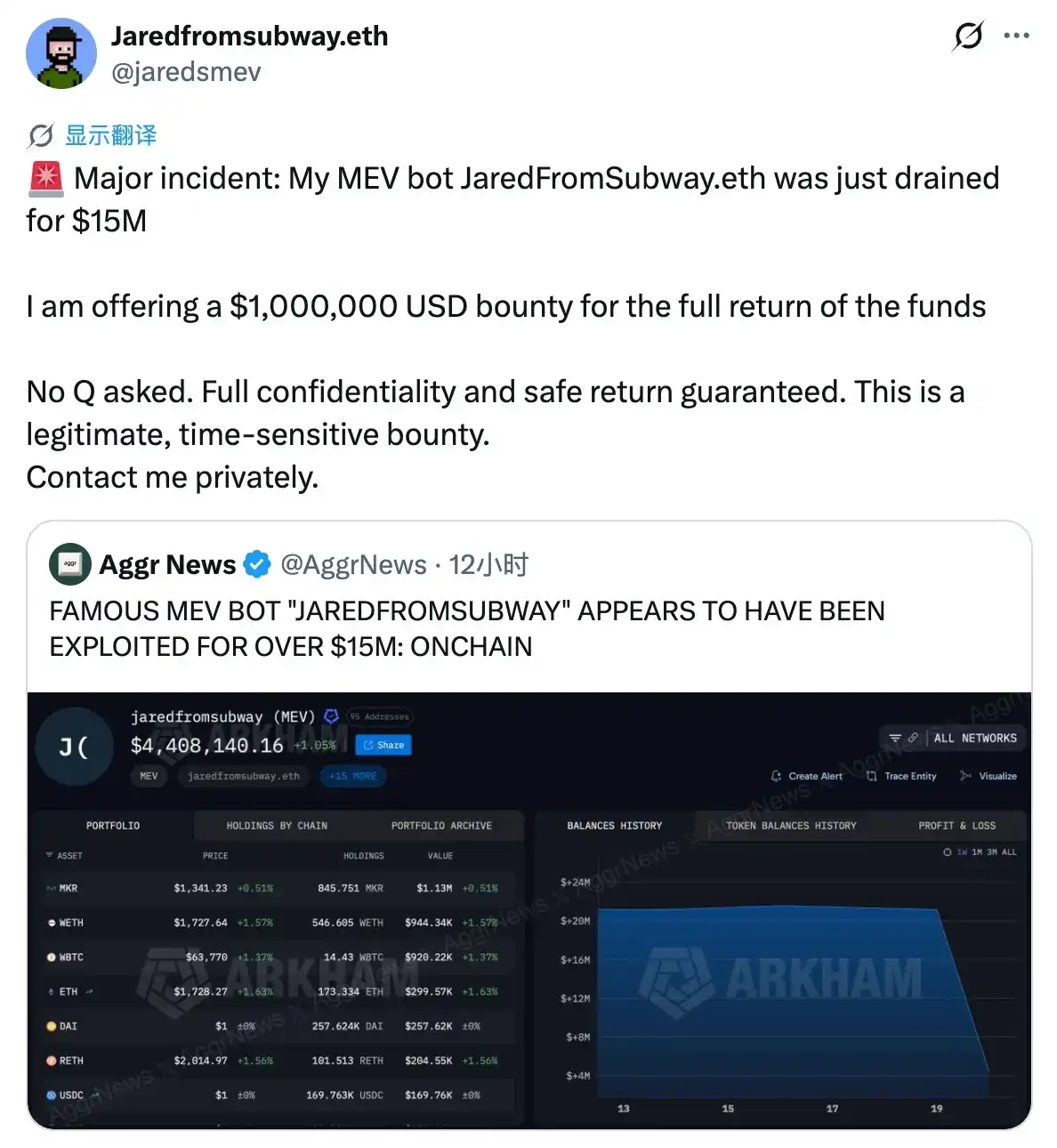
Several developers issued risk warnings regarding this, emphasizing that the account is not an official Jaredfromsubway.eth account (the MEV Bot team has no official account) and that it cannot be ruled out that this account might be used for scams in the future. Users are urged to remain highly vigilant.


Пов'язані питання

QWhat type of attack was the Jaredfromsubway.eth MEV bot a victim of?

AIt was a victim of a 'counter-MEV honeypot attack', a targeted attack designed to exploit the behavioral logic of MEV bots, not a traditional phishing or smart contract exploit.

QWho is Jaredfromsubway.eth and what is it known for in the Ethereum ecosystem?

AJaredfromsubway.eth is one of the most active, profitable, and notorious MEV bots on the Ethereum network. It is particularly known for executing 'sandwich attacks' to capture slippage profits from user transactions.

QWhat was the estimated total loss for Jaredfromsubway.eth in this attack?

AThe estimated total loss for Jaredfromsubway.eth in this attack was over $7.5 million in assets like ETH, USDC, and USDT.

QWhat specific attack method was used to set up the trap for the MEV bot?

AThe attackers deployed 66 fake token contracts and fake liquidity pools over several weeks. These mimicked mainstream assets like WETH, USDC, and USDT to create seemingly profitable arbitrage opportunities, ultimately tricking the bot into granting permissions that were later exploited.

QWhat did the impersonator account on X (formerly Twitter) falsely claim after the attack?

AAn impersonator account on X, with the name changed to Jaredfromsubway.eth, falsely claimed it would offer a '$1 million bounty for the full return of all funds'.

Пов'язані матеріали

Base Under Pressure

**Title: The Pressure Mounts for Base** Base, the Ethereum Layer 2 scaling solution backed by Coinbase, is facing significant pressure and public scrutiny from its leadership following the launch of Robinhood Chain. Base co-founder Jesse Pollak recently acknowledged strategic missteps, admitting that the chain's past focus on social and creator tokens (e.g., through Farcaster, Zora) failed to deliver sustainable adoption. He has refocused on core infrastructure, handing leadership of the Base App back to Coinbase's Cobie. While Base remains a top L2 contender alongside OP Mainnet and Arbitrum, and boasts the highest TVL (nearly $12B), its weaknesses are being highlighted by the new competitor. Key criticisms include its slow progress on decentralization. Base has faced issues with its single sequencer causing block production halts, and L2BEAT is reportedly considering downgrading its decentralization rating from Stage 1 to Stage 0. This contrasts sharply with the rapid initial success of Robinhood Chain, whose DEX quickly entered the top five by volume. The leadership styles of the parent companies are also being compared: Robinhood's CEO actively engages with new projects, while a recent incident where Coinbase's Brian Armstrong briefly changed his profile picture—sparking and then crashing a related meme token—drew community ire and mockery. Pollak stated Base is working with Coinbase on tokenized stocks backed 1:1 by real equity, differentiating it from Robinhood's derivatives model. However, the article argues that Base's most urgent task is to address its long-standing technical and trust issues. With more traditional finance players likely to emulate Robinhood's path, Base must use this competitive pressure to solidify its position as long-term financial infrastructure.

Foresight News8 хв тому

Base Under Pressure

Foresight News8 хв тому

White House Concession Removes Ethical Hurdle, Clarity Act Races Against Final Window Before Recess?

On July 21st, industry sources reported that the Trump administration has agreed to include an ethics provision in the "Clarity Act" (Digital Asset Market Clarity Act of 2025). This concession addresses the long-standing conflict-of-interest concerns regarding government officials and the crypto industry, potentially removing the final major obstacle to the bill's progress. Additionally, Patrick Witt, the executive director of the White House's Digital Asset Advisory Committee, confirmed he will remain in his role to help finalize the bill, alleviating previous concerns about his potential departure. The Clarity Act aims to establish a unified federal regulatory framework for the U.S. digital asset market. Its core objective is to resolve regulatory ambiguity by defining different types of digital assets (digital commodities, investment contract assets, and permitted payment stablecoins) and clarifying the respective oversight roles of the SEC and CFTC. This would end the long-running jurisdictional dispute between the two agencies and provide clearer compliance paths for the industry. With the ethics issue moving toward resolution, the most urgent challenge now is time. The U.S. Congress is set to begin its August recess in mid-August, leaving only a few working weeks to finalize the text and advance the bill through the Senate. Industry advocates, like the Blockchain Association's Kristin Smith, stress that this is a critical moment. If negotiations conclude successfully in the coming weeks, the Clarity Act could pass a key hurdle before the recess; otherwise, it may face significant delays. If enacted, the Clarity Act could mark a historic turning point in crypto regulation. By providing a clearer and more predictable legal framework, it aims to reduce uncertainty for businesses, developers, and traditional financial institutions looking to enter the digital asset space, potentially setting a global benchmark for market structure regulation.

Odaily星球日报14 хв тому

White House Concession Removes Ethical Hurdle, Clarity Act Races Against Final Window Before Recess?

Odaily星球日报14 хв тому

AI Era, Industrial Revolution, and Future Civilization Interview — Zhang Dingwen: The Future Does Not Belong to Chasers

"AI Era, Industrial Revolution and Future Civilization: An Interview with Zhang Dingwen – The Future Does Not Belong to Those Who Chase" In this interview, entrepreneur Zhang Dingwen reflects on his entrepreneurial journey and philosophy, moving beyond discussions of financing or success to emphasize understanding the "era" itself. He argues that true entrepreneurs should not chase short-term trends ("winds"), but position themselves in the direction of long-term technological and societal evolution. Zhang shares key lessons from his early days, including the realization that user value does not automatically translate to commercial value. For him, the core of entrepreneurship is not building a company but constantly upgrading one's own "cognition" – the ability to interpret information, ask the right questions, and understand the underlying "causes" behind business outcomes, not just the effects. His thinking has evolved from a focus on creating good products to a strategic focus on building "entrances" – platforms that naturally connect users to digital services. He sees smart wearables, like watches, not merely as hardware but as potential future gateways combining technological, financial, social, and even fashion attributes to create sustained user relationships and ecosystems. Ultimately, Zhang's vision transcends individual products or companies. He discusses business competition in three stages: product, platform, and finally, "civilization" – where the greatest companies influence how society operates by defining new rules and ways of life. He believes the mission of a truly great enterprise is to solve problems of its time, build enduring trust, and contribute lasting value, leaving behind not just wealth but a positive impact on how the world works. The future, he concludes, belongs not to the fastest, but to those with the correct long-term direction and a commitment to continuous learning and evolution.

marsbit25 хв тому

AI Era, Industrial Revolution, and Future Civilization Interview — Zhang Dingwen: The Future Does Not Belong to Chasers

marsbit25 хв тому

Cryptocurrency & Stock Market Barometer丨Strategy Cash Reserves Increase to $3.23 Billion, Halting BTC Purchases; Vanguard and Other Asset Managers Increase Holdings in Strategy Stock (July 21)

Market Overview & Warnings: The article warns of high volatility in South Korean stocks and continued dependence on U.S. stocks on geopolitics. Chinese A-shares remain under pressure. It advises against using leverage in current equity markets. For crypto-linked stocks, most have limited growth except Robinhood, with caution advised. U.S. Stock Market: Bearish bets on U.S. stocks, particularly targeting AI-related companies, have reached record highs since 2010, signaling deep skepticism about the sustainability of the AI-driven rally. Tech and chip stocks led a market decline, with the Philadelphia Semiconductor Index potentially entering a bear market. Increased expectations for Federal Reserve interest rate hikes and geopolitical tensions contributed to the negative sentiment. Bitcoin Treasury Company Updates: * Strategy: Increased its cash reserves to $3.23 billion and paused Bitcoin purchases. Several major asset managers, including Vanguard Group and Capital Group, increased their holdings of Strategy (MSTR) stock. * Global corporate Bitcoin buying slowed significantly to just $1.33 million last week. * Other notable activity: Strive purchased 21 BTC; ORANGE JUICE raised $40 million for Bitcoin acquisitions; Bitcoin Japan Corp. raised $60 million, allocating $4.08 million for its first BTC purchase. Other Crypto Treasury Holdings: * Ethereum: BitMine increased its ETH holdings to 5.78 million, nearing its 5% of supply goal. Its total crypto assets, cash, and securities are valued at $11.5 billion. * Solana: No significant corporate treasury activity reported. * Altcoins: HypeStrat made no adjustments to its treasury; its mNAV ratio fell to a long-term low. (Note: This summary is for informational purposes only and does not constitute investment advice.)

marsbit26 хв тому

Cryptocurrency & Stock Market Barometer丨Strategy Cash Reserves Increase to $3.23 Billion, Halting BTC Purchases; Vanguard and Other Asset Managers Increase Holdings in Strategy Stock (July 21)

marsbit26 хв тому

Торгівля

Спот
活动图片