The Hundred Platforms War on Robinhood’s Launchpad: Who Will Have the Last Laugh?

marsbitОпубліковано о 2026-07-20Востаннє оновлено о 2026-07-20

Анотація

Following the unexpected shutdown of Noxa, a "war of a hundred platforms" has erupted for the launchpad space on Robinhood. After nearly a week, the landscape is clearer but remains highly competitive. Pons has emerged as the current frontrunner, leading in both daily new token launches and trading volume over the weekend, with an average daily volume of around $45 million. Its market share reached 52.1% based on intraday volume, fueling a rebound in its token's market cap to a new high of approximately $24 million. Key drivers include market bets on filling Noxa's void, strong attention from figures like bonkguy (associated with the Bonk community), and endorsements from influencers. However, other platforms are aggressively competing. Arrow, originally focused on tokenized stock collateralized lending, has pivoted to become a DeFi hub including a launchpad, leveraging its high token concentration and a narrative involving a former Robinhood employee as an advisor. Stonkbroker has gained traction even before its official launch; its NFT collection, utilizing ERC-6551 for enhanced utility, has surged close to 2 ETH. The model creates a flywheel where NFT holders receive dividends from launchpad revenue (in tokenized stocks) but must spend the platform's token to activate these rights. Bankr is taking a different, clever approach by allowing new meme coins to be paired with over 90 tokenized stocks like $TSLA or $AAPL instead of ETH. Its founder even launched $REAL paired w...

After Noxa's unexpected shutdown, Robinhood entered the “Hundred Platforms War” phase on its launchpad. Nearly a week has passed, and while the situation has become somewhat clearer, there is still a lot of uncertainty.

Pons: The Current Frontrunner

Over the past weekend, Pons has taken the lead in both daily new token launches and daily trading volume. Particularly in daily trading volume, Pons has surpassed Noxa for two consecutive days, with an average daily volume of around $45 million over those two days.

Although Noxa is no longer issuing new tokens, early influential projects like $CASHCAT are still contributing significantly to its daily volume data. Pons' lead in daily volume indicates it is currently the preferred choice not only for launching new tokens but also as the primary destination for active liquidity.

Yesterday, based on calculations of market share by intraday trading volume, Pons reached a 52.1% market share.
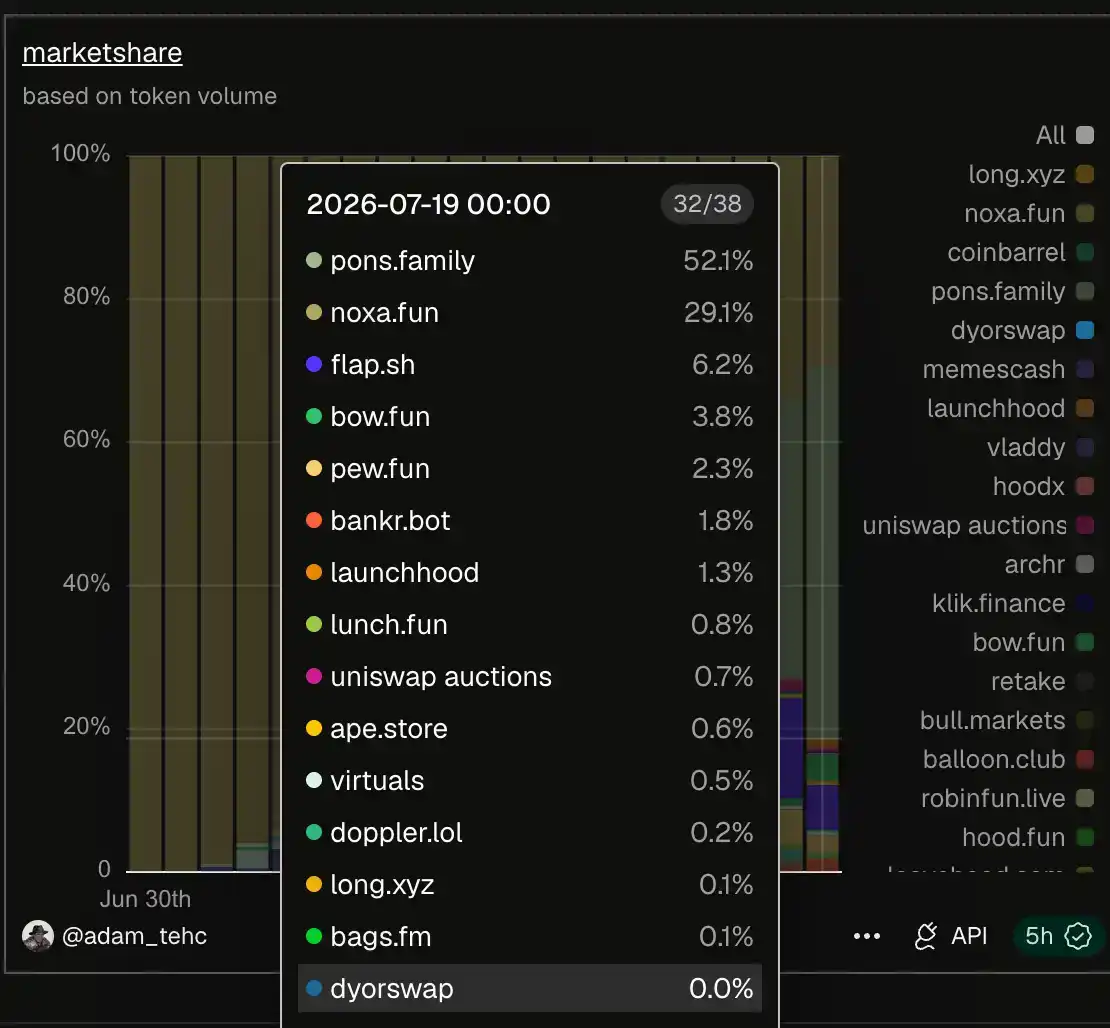
This helped the price of $PONS rebound after once falling to a market cap of approximately $4 million, reaching a new high of around $24 million. We can certainly argue that, based on Pons' revenue since its inception, its annualized estimates, combined with the already burned 20% of tokens, and compared horizontally with $PUMP, the rebound of $PONS from $4 million was to be expected.
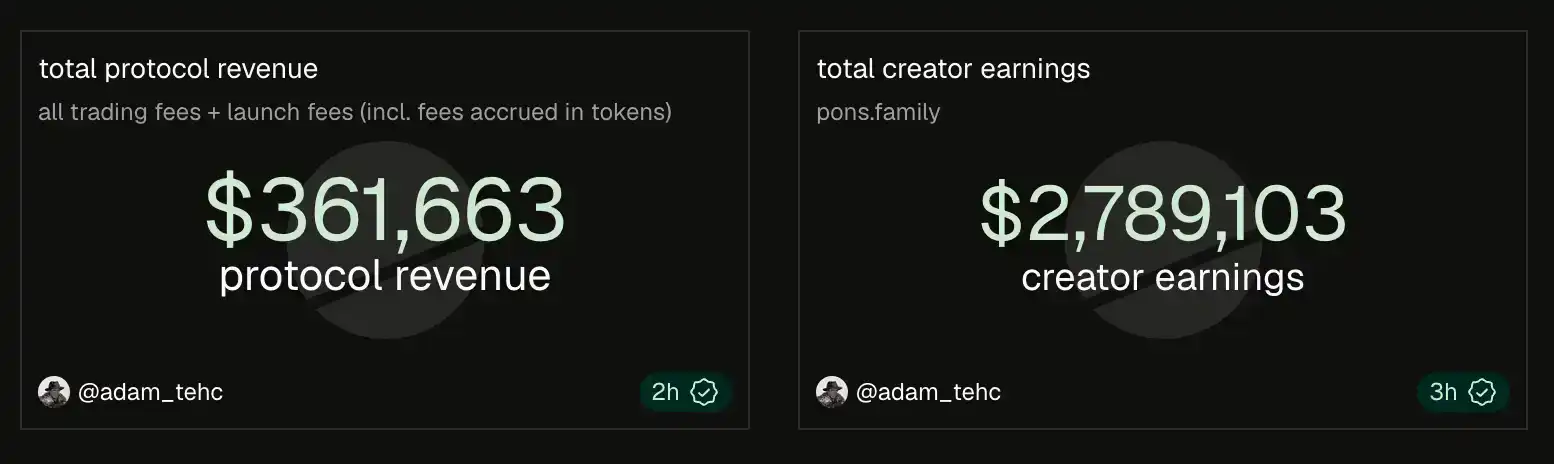
However, the logic can be simplified and clearer. Firstly, the market is betting on the huge vacuum left by Noxa's exit from the launchpad sector, and Pons has the best data. Secondly, there needs to be an attention-grabbing event with room for market imagination. Pons also leads in this regard, as bonkguy openly bought in and even increased his holdings once. Additionally, @cryptogle, an advisor to WLFI, has been actively promoting $PONS, fueling market speculation that Pons is backed by the "Bonk gang."

Finally, Pons' lead does not mean it has achieved final victory, as many other platforms are eager to challenge.

Arrow: High Control, Doing Everything

One reason Arrow's token price previously surged to a market cap of $35 million is its high level of control:
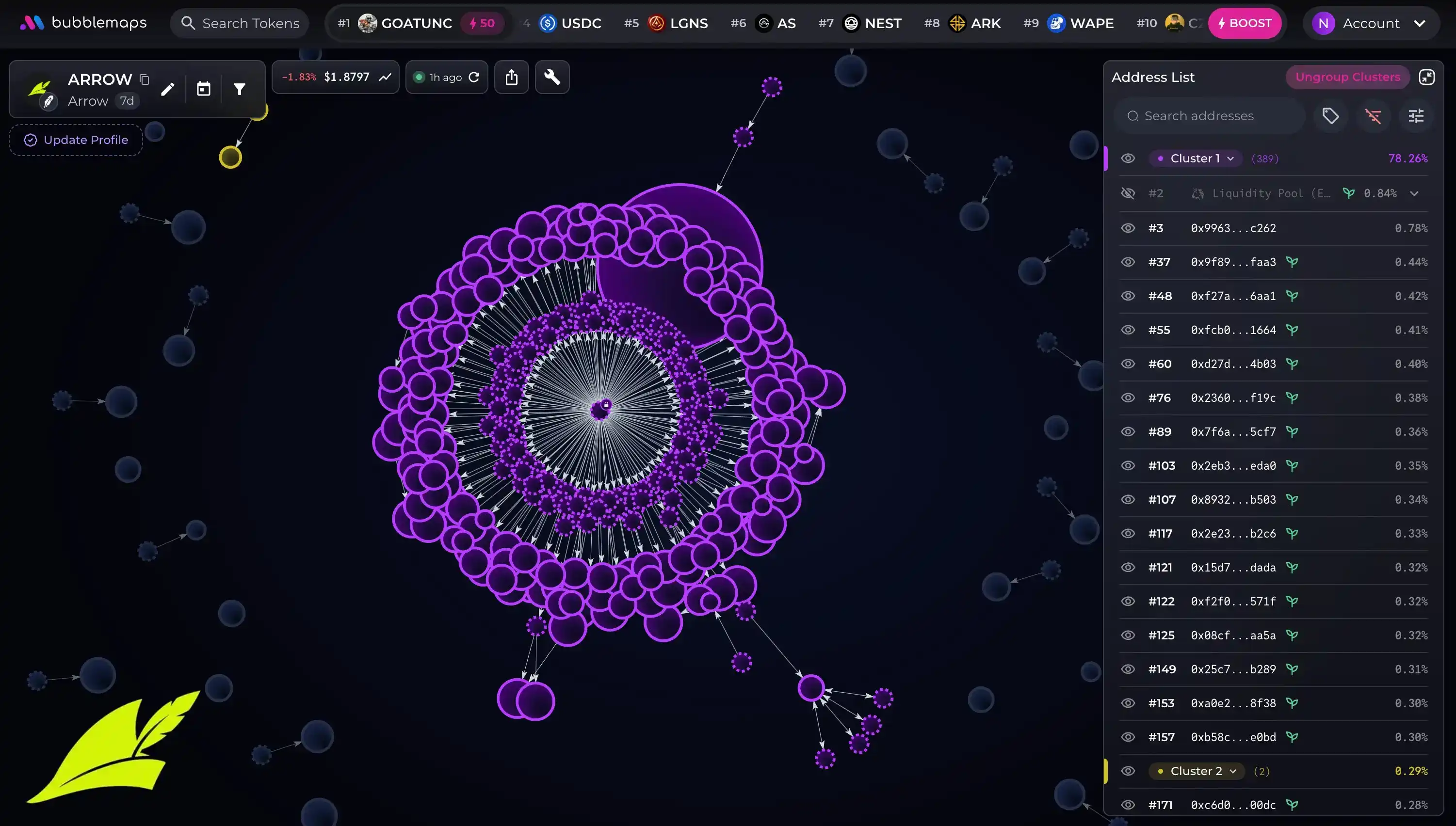
Another reason is that after meme coin $CASHCAT became a leader, people sought opportunities in the RWA narrative, and Arrow happened to be involved in tokenized stock lending and borrowing.

The launchpad business is highly profitable, so Arrow decided to enter this space as well. Its narrative has thus upgraded from tokenized stock lending to a comprehensive DeFi hub on Robinhood. In terms of attention, Pons relies on the Bonk gang, while Arrow's narrative features Ash Manicka, a former Robinhood employee, as the project's strategic advisor.

The platform hasn't officially launched yet, but it's imminent. Keep an eye on it.

Stonkbroker: Platform Not Yet Launched, NFTs Already Soaring

This project planned to launch NFTs before Robinhood's mainnet went live and had already built a launchpad during the testnet phase.

The original idea was to use royalties generated by the project to purchase tokenized stocks on Robinhood and airdrop them to holders. The implementation path involves this NFT series incorporating ERC-6551, where each NFT is also an Ethereum wallet, enabling direct airdrops to NFTs.

The use of ERC-6551, rather than just tracking holder addresses, opens up many possibilities for gameplay. Its platform hasn't officially started, but the NFTs have already been pumped to nearly 2 ETH, and its token surged to a peak market cap exceeding $15 million, making it one of the big winners over the weekend.
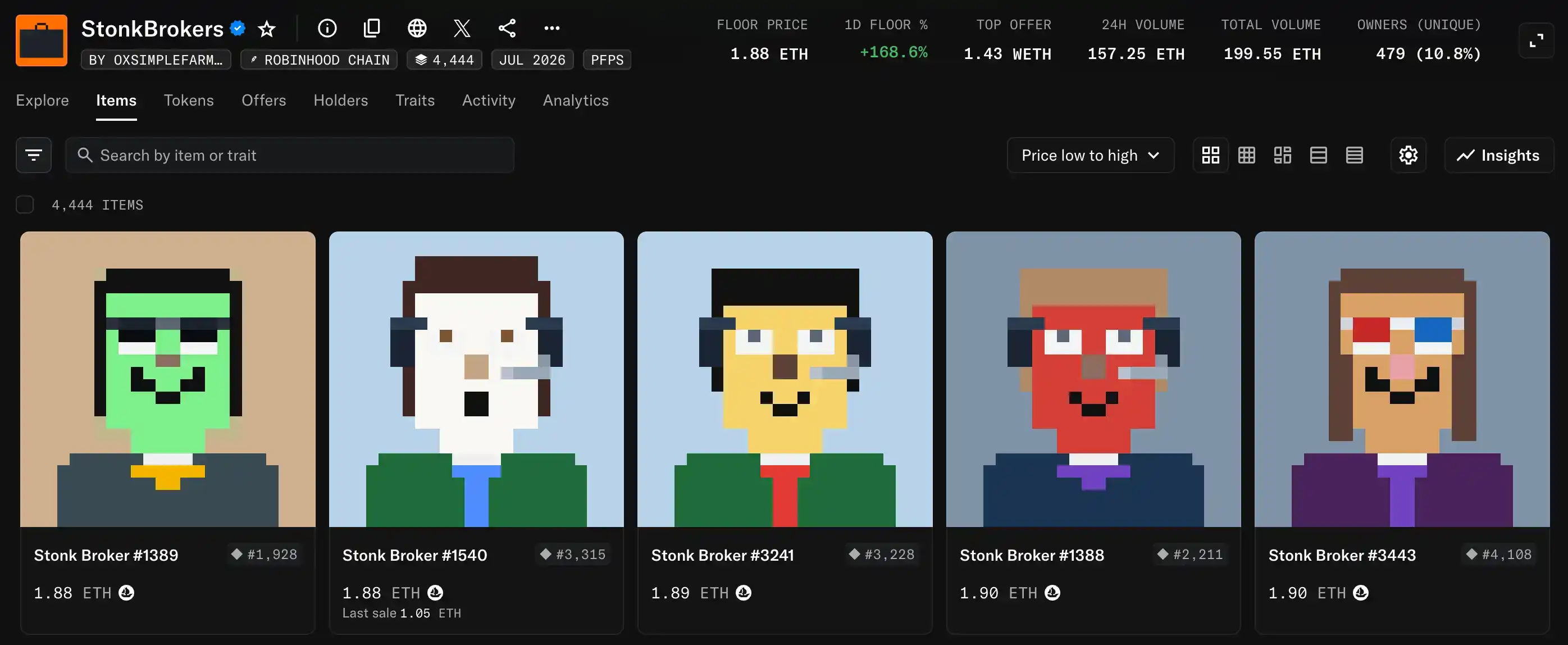
This NFT series has a total supply of 4,444. In the future, 70% of the launchpad's revenue will be used to purchase tokenized stocks on Robinhood and airdropped to NFT holders. However, holders need to spend a portion of $STONKBROKER to activate the NFT for dividend eligibility. The more tokens spent, the greater the multiplier for dividends:
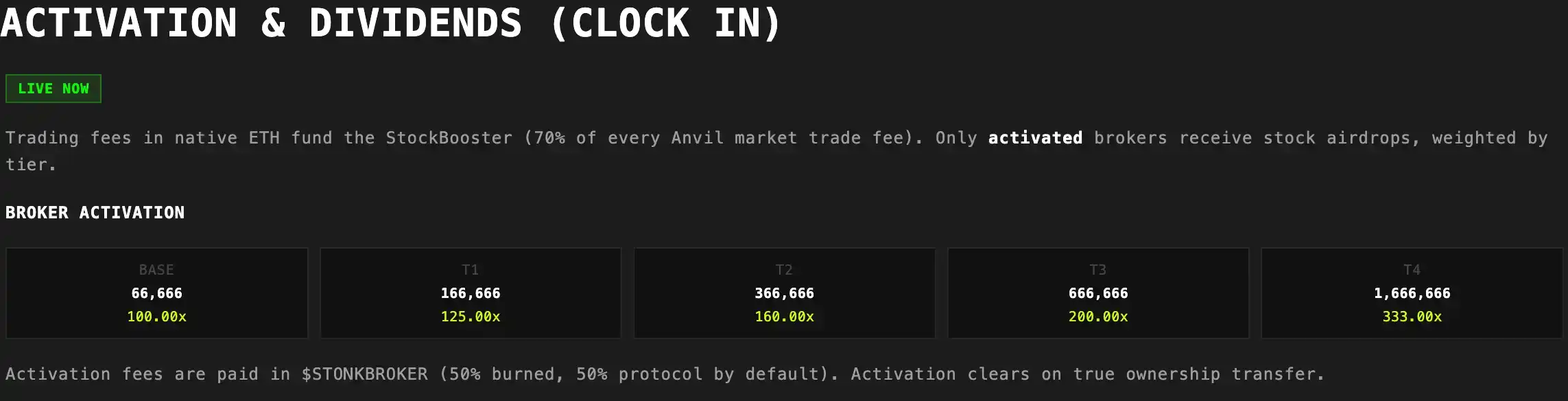
Every time NFT ownership is transferred, the new holder must spend $STONKBROKER to activate dividends again.

This essentially creates a token-NFT flywheel. Holding the image is like being a shareholder of the platform, but you need to spend tokens to acquire dividend rights. The more popular the platform, the higher the dividends for NFTs, and the more expensive the tokens required to activate dividend rights become.

The current situation is that the platform hasn't even launched, but expectations have already been hyped to the max. This is likely due to the novelty of the gameplay and the strong interest from the NFT community. This platform isn't just a launchpad; it will also include a Swap and lending/AMM features tailored to this NFT series.

Bankr: Issuing Meme Coins Paired with Tokenized Stocks

This is indeed a clever approach. Just a few hours ago, Bankr launched a new feature supporting the use of over 90 tokenized stocks like $TSLA, $AAPL, $SPY to form trading pairs with newly launched meme coins, meaning the liquidity pool consists of stocks instead of ETH.
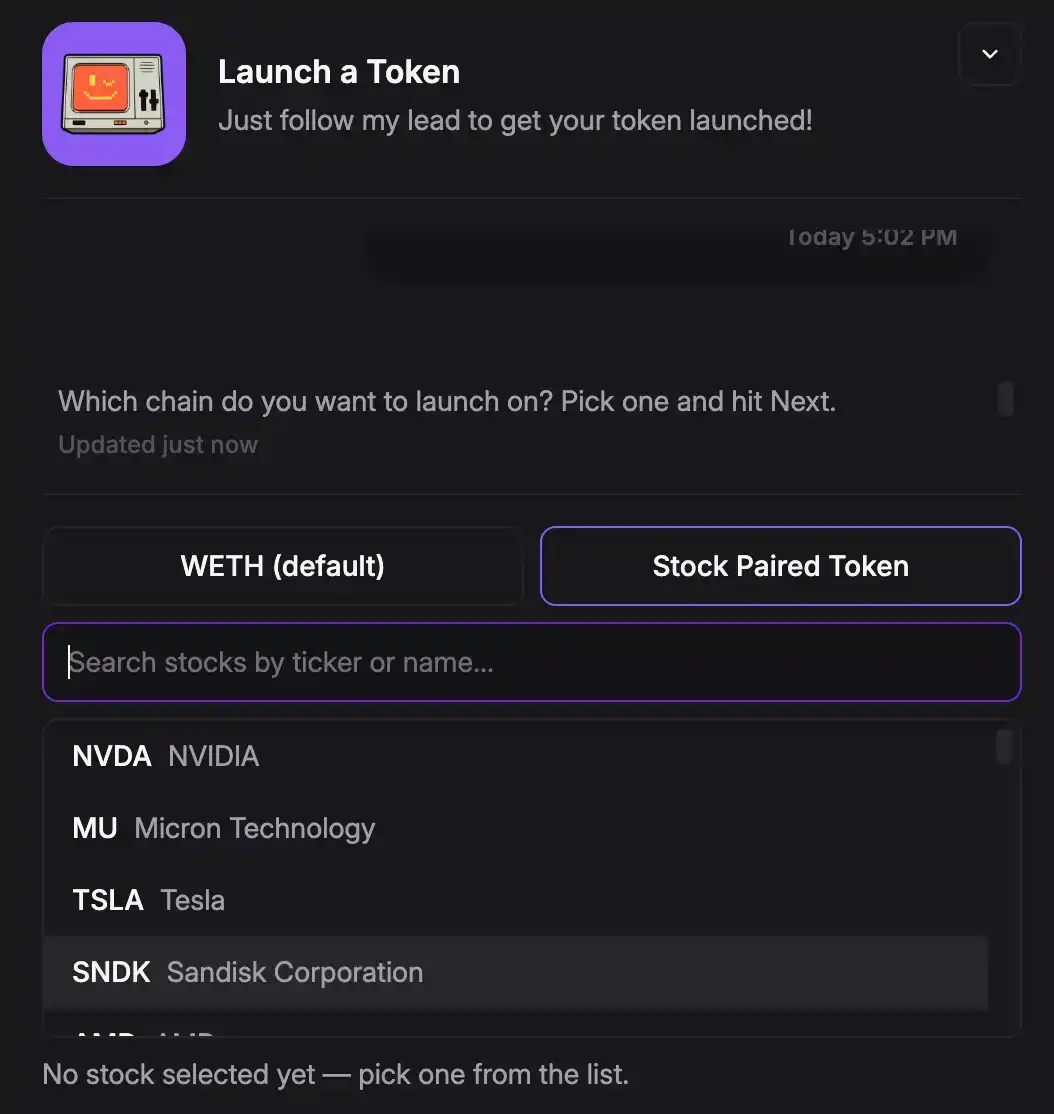
Similar gameplay existed before. For example, about two months ago on HyperEVM, a platform called alt.fun gained popularity for a few days by using contract positions, including stock contracts, to launch meme coins, with its top project reaching a market cap of $9 million.

However, considering Robinhood's CEO has repeatedly emphasized that their chain aims to focus on both RWA and meme coins, this kind of gameplay on this chain seems to have more room for speculation. Moreover, somewhat dramatically, Bankr's founder, @0xDeployer, launched his own token $REAL, paired with Nvidia stock. He even posted on X recruiting a CTO/team for this coin, seeking people who truly know how to operate and promising to provide advice:
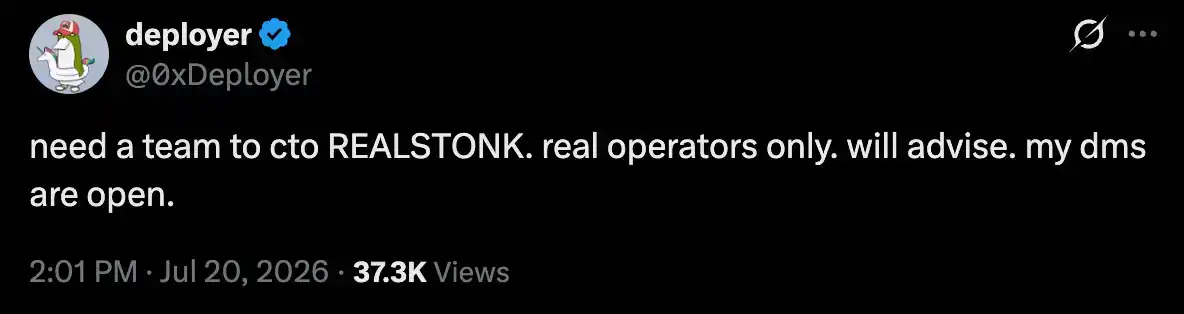
If $REAL takes off, Bankr might use this clever method to overtake competitors in the short term. Meme coins paired with tokenized stocks could potentially become trendy.

Conclusion

The tokens directly related to the platforms mentioned above (excluding $REAL) already have market caps exceeding $10 million. Without a clear winner in this "war," making heavy bets carries relatively high risk. At this stage, the best strategy is to monitor each platform closely. The more fiercely they compete, the more opportunities will likely emerge.


Трендові криптовалюти

Пов'язані питання

QAccording to the article, which platform is currently leading the Robinhood launchpad 'hundred-team battle' in terms of daily transaction volume?

APons is currently leading in terms of daily transaction volume, achieving a 52.1% market share based on intraday trading volume calculations mentioned in the article.

QWhat are the two key reasons mentioned for Pons's recent price recovery and market leadership?

AThe two key reasons are: 1) The market is betting on the massive gap left by Noxa's exit, and Pons has the best data to fill it. 2) Pons has strong attention and narrative driven by bonkguy's public purchase and the speculation that it's backed by the 'Bonk gang'.

QHow does the Stonkbroker project plan to distribute its launchpad's income to its NFT holders?

AStonkbroker plans to use 70% of its launchpad's income to buy tokenized US stocks on Robinhood and airdrop them to the holders of its ERC-6551 NFTs. However, holders must spend some $STONKBROKER tokens to activate their NFT to be eligible for these dividends.

QWhat unique feature does Bankr's launchpad recently introduce for creating meme coin trading pairs?

ABankr recently introduced a feature that allows users to create trading pairs for newly issued meme coins using over 90 types of tokenized US stocks like $TSLA, $AAPL, and $SPY, instead of just ETH.

QWhat is the article's suggested investment strategy regarding the competition among these Robinhood launchpads?

AThe article suggests that the best strategy is to monitor the competing launchpads closely, as the more fiercely they compete, the more opportunities they will create, rather than making heavy bets on any single project before the outcome is clear.

Пов'язані матеріали

The Most Difficult Thing to Predict on Polymarket Is... When the POLY Airdrop Will Happen

During the recent World Cup, Polymarket saw record-breaking activity, with its "World Cup winner" market reaching $4.32 billion in volume, making it the platform's highest-volume single prediction event ever. Over the six-week tournament, football markets amassed $85 billion in nominal trading volume, cementing sports as a major growth driver. Capitalizing on this surge in traffic, Polymarket quietly increased fees for its sports markets in early July. The taker fee multiplier was raised from 0.03 to 0.05, effectively raising maximum costs per trade by nearly 70% and moving sports out of its lowest fee tier. This follows a broader trend of the platform gradually expanding fee structures across various market categories since the start of the year to boost revenue. However, community focus is increasingly shifting from trading volumes to the long-awaited POLY token airdrop. Despite a senior executive confirming in late 2025 that a token and airdrop were planned for after U.S. market re-entry, no timeline has been provided. Recent actions, like an affiliated account deleting a potentially suggestive tweet and official help pages stating "no airdrop or token generation event has been announced," have fueled speculation and frustration. The community is divided on the reasons for the delay. Some believe Polymarket is waiting for a more favorable regulatory window in the U.S., while others speculate that the platform's strong organic growth and rising fee revenue have reduced the urgency to issue a token, potentially following a path similar to OpenSea. The prolonged uncertainty has led users to question not the *if*, but the *when*, of the POLY airdrop, turning it into one of the platform's most unpredictable events.

Odaily星球日报6 хв тому

The Most Difficult Thing to Predict on Polymarket Is... When the POLY Airdrop Will Happen

Odaily星球日报6 хв тому

After Investing in Changxin, Hefei State Capital Makes Another Move

Two events unfolded within the same week. On July 13th, the Hefei Industrial Investment Xinzhi Xinyu Equity Investment Partnership with a pledged scale of 5 billion RMB was established. Three days later, ChangXin Technology launched its online and offline public offering at a price of 8.66 RMB per share, aiming to raise approximately 57.9 billion RMB. The link between these events is the Hefei Industrial Investment Group (Hefei ChanTou). Hefei ChanTou directly holds shares in ChangXin Technology through its wholly-owned subsidiary, ChangXin Integration, and is also behind the newly established 5 billion RMB fund. This highlights a strategic move: as ChangXin approaches its IPO, Hefei ChanTou establishes a new fund to prepare for the next round of industrial investment. Founded in 2015, Hefei ChanTou is a state-owned capital investment platform focused on industrial financing and innovation. Beyond direct equity holdings in major projects like ChangXin's 12-inch memory wafer manufacturing base, it manages various provincial and municipal government-guided funds. Its self-managed fund scale exceeds 100 billion RMB. ChangXin Technology, now China's leading DRAM manufacturer, exemplifies the classic "Hefei model." A decade ago, when founder Zhu Yiming sought entry into the capital-intensive DRAM sector, Hefei's state capital provided the crucial long-term support. Pre-IPO, entities within the Hefei ChanTou system hold significant direct and indirect stakes, with a theoretical combined value of roughly 116.2 billion RMB based on the IPO price. However, this long-cycle, concentrated investment model brings financial pressure. Hefei ChanTou's financials show significant liabilities, net outflows from investing activities, and reliance on investment income. The focus is now shifting alongside Hefei's broader "654X" industrial system, which encompasses six dominant industries, five emerging industries (like AI and biopharma), and four future industries (including quantum tech and nuclear fusion). The narrative is one of transition. As the ChangXin project reaches a major milestone with its IPO, the new 5 billion RMB fund symbolizes the beginning of the next investment chapter—targeting a more diverse and early-stage array of sectors within Hefei's expanded industrial vision.

marsbit15 хв тому

After Investing in Changxin, Hefei State Capital Makes Another Move

marsbit15 хв тому

Should Developers Build on Corporate Blockchains Like Base and Robinhood?

Should developers build on enterprise-backed public chains like Base, Robinhood, or Stripe's Tempo? While these chains offer enticing benefits—primarily access to the platform's existing user base for accelerated growth—they come with significant, well-documented risks stemming from the inherent conflict of interest when a company controls both the underlying chain and major on-chain applications. The core promise is traffic distribution: projects gain exposure through platforms like the Coinbase wallet or app. However, this model creates five major risks: 1. **Direct Competition**: The platform can leverage its data and position to launch and prioritize its own competing products, similar to Amazon creating private-label goods or Microsoft bundling Internet Explorer. 2. **Wallet Agnosticism**: Companion wallets (e.g., Coinbase Wallet) must support multiple chains and integrate top applications across the ecosystem to remain competitive, diluting the promised exclusive traffic advantage for the enterprise chain. 3. **Competitor Exclusion**: Rival platforms (e.g., Coinbase vs. Robinhood) have no incentive to promote applications built on a competitor's chain. 4. **Profit Extraction**: The party controlling end-users holds disproportionate bargaining power and can capture most of the value, squeezing protocol profits down to marginal cost. 5. **Unfulfilled Promises**: Promised traffic support can be deprioritized or withdrawn based on shifting corporate strategies. In contrast, neutral chains like Ethereum or Solana avoid these platform risks entirely. For developers considering enterprise chains, risk mitigation strategies include: evaluating substantial onboarding grants, seeking (though often weak) contractual guarantees, and, most crucially, pursuing a multi-chain strategy while building independent user acquisition channels. Enterprise chains may be useful for initial cold-start growth, but the ultimate goal should be cultivating a dedicated user base rather than long-term dependence on a single, conflicted platform.

marsbit16 хв тому

Should Developers Build on Corporate Blockchains Like Base and Robinhood?

marsbit16 хв тому

Торгівля

Спот

Популярні статті

Як купити WAR

Ласкаво просимо до HTX.com! Ми зробили покупку WAR (WAR) простою та зручною. Дотримуйтесь нашої покрокової інструкції, щоб розпочати свою криптовалютну подорож.Крок 1: Створіть обліковий запис на HTXВикористовуйте свою електронну пошту або номер телефону, щоб зареєструвати обліковий запис на HTX безплатно. Пройдіть безпроблемну реєстрацію й отримайте доступ до всіх функцій.ЗареєструватисьКрок 2: Перейдіть до розділу Купити крипту і виберіть спосіб оплатиКредитна/дебетова картка: використовуйте вашу картку Visa або Mastercard, щоб миттєво купити WAR (WAR).Баланс: використовуйте кошти з балансу вашого рахунку HTX для безперешкодної торгівлі.Треті особи: ми додали популярні способи оплати, такі як Google Pay та Apple Pay, щоб підвищити зручність.P2P: Торгуйте безпосередньо з іншими користувачами на HTX.Позабіржова торгівля (OTC): ми пропонуємо індивідуальні послуги та конкурентні обмінні курси для трейдерів.Крок 3: Зберігайте свої WAR (WAR)Після придбання WAR (WAR) збережіть його у своєму обліковому записі на HTX. Крім того, ви можете відправити його в інше місце за допомогою блокчейн-переказу або використовувати його для торгівлі іншими криптовалютами.Крок 4: Торгівля WAR (WAR)Легко торгуйте WAR (WAR) на спотовому ринку HTX. Просто увійдіть до свого облікового запису, виберіть торгову пару, укладайте угоди та спостерігайте за ними в режимі реального часу. Ми пропонуємо зручний досвід як для початківців, так і для досвідчених трейдерів.

283 переглядів усьогоОпубліковано 2024.12.11Оновлено 2026.06.02

Як купити WAR

Обговорення

Ласкаво просимо до спільноти HTX. Тут ви можете бути в курсі останніх подій розвитку платформи та отримати доступ до професійної ринкової інформації. Нижче представлені думки користувачів щодо ціни WAR (WAR).

活动图片