The Hidden War Behind Stablecoins: Issuers, Applications, and Users—Who Will Be the 'Biggest Winner'?

marsbitОпубліковано о 2026-02-17Востаннє оновлено о 2026-02-17

Анотація

The article explores the intense competition among stablecoin issuers, applications, and users over the lucrative profits generated by stablecoins. Issuers like Tether and Circle earn significant risk-free returns by investing user funds in cash equivalents, creating a highly profitable business model. However, applications (wallets, exchanges, DeFi protocols) that control user relationships demand a share of these profits, leveraging their distribution power to negotiate revenue-sharing agreements or even launch their own branded stablecoins (e.g., Aave’s GHO or PayPal’s PYUSD via white-label services). Users, especially in developed markets, increasingly expect yield on their stablecoin holdings, pressuring applications to offer returns. This dynamic creates a three-way tug-of-war, with applications caught between profit-retentive issuers and yield-seeking users. The author suggests that users may ultimately benefit the most from this competition, gaining a larger share of the profits as the ecosystem evolves.

Author: Jonah Burian, Investor at Blockchain Capital

Compiled by: Felix, PANews

Summary: In this three-party game, users may ultimately be the beneficiaries and receive the majority of the profits.

In recent years, as stablecoin issuers have generated massive annual profits, the battle for benefits among issuers, application layers, and users has intensified. An investor from Blockchain Capital reveals the profit distribution mechanisms and evolving business logic of stablecoins. Below are the details.

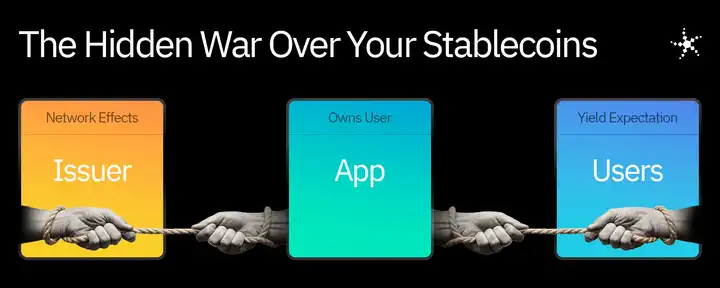
Stablecoin issuers possess one of the most profitable business models on Earth, and these substantial profits have made them a target for various stakeholders. At Blockchain Capital, we have closely observed the three-way tug-of-war among issuers, application layers, and users as they compete for these profits.

We have invested in several major issuers (such as Tether, Circle, and Paxos) and also in applications trying to claim their share (such as Aave, Phantom, Polymarket, and RedotPay). Here are our observations.

Issuers Reap Significant Profits

Users send fiat currency to issuers, who then mint digital dollars on the blockchain. Behind the scenes, issuers invest this fiat in cash or cash equivalents, earning a risk-free interest rate. That’s the entire business. In contrast, banks take your deposits but must lend them out, manage credit risk, and maintain branches; insurers collect premiums but ultimately must pay claims. Stablecoin issuers essentially hold government bonds, generating cash flow without complexity or risk.

Issuer revenue grows with the increase in assets under management, while operational costs remain largely unchanged: this is a pure, unconstrained cash flow machine. Tether reports a team size of about 300 people and expects to achieve $10 billion in profits by 2025. This is arguably one of the best business models in history.

However, massive profits inevitably attract competition.

Applications Also Want a Share

Most users never interact directly with issuers; they access stablecoins through applications like Phantom, which control the user relationship.

Large exchanges, DeFi protocols, and well-known wallets have significant bargaining power over issuers. They can designate default stablecoins and integrate or deprecate them through single product decisions, exerting some control over fund flows. If tens of billions of dollars in stablecoins remain within an application, that app can demand a share of the float interest. The logic is simple: we are distributing your assets and anchoring user behavior, so you must share the profits, or we will steer users toward competing stablecoins.

This is already happening. The most typical example is the relationship between Coinbase and Circle. Early on, Coinbase was the primary distribution engine for USDC and negotiated a profit-sharing agreement. It is reported that Coinbase receives 100% of the interest income generated by USDC on its platform and 50% of the interest income from USDC outside the platform. Whether within or outside the portfolio, applications are increasingly adopting this strategy, actively negotiating for their share.

Creating Branded Stablecoins: Bypassing Issuers

Applications can also attempt to launch their own branded stablecoins or "wrappers," completely bypassing issuers. Instead of directly steering users to USDC or USDT, they offer a dollar balance backed by a combination of stablecoins and short-term notes. In this case, the distributor is partially involved in the issuance business. Aave’s GHO stablecoin is one such example.

However, applications often lack the resources or licenses required to build a full issuance infrastructure. Therefore, they opt for white-label solutions like "Issuer-as-a-Service." Paxos is currently the leading white-label provider, supporting PayPal’s PYUSD. This allows PayPal to profit from the float interest without negotiating with large issuer.

Issuer Leverage

Applications cannot fully control issuers. Established stablecoins like USDC and USDT have strong network effects. They are the reserve assets of the entire DeFi ecosystem and the base trading pairs for most transactions. Branded stablecoins may be less attractive to users due to lower liquidity and integration compared to other stablecoins.

Additionally, white-label stablecoins are not as "neutral" as USDT. A company competing with PayPal at the application layer may be reluctant to accept PYUSD, as doing so would fund a competitor. Similarly, this dynamic may have affected Circle’s early development, as exchanges like Binance may have been hesitant to fully promote USDC due to its close ties with rival Coinbase, which is why Binance instead defaulted to supporting USDT. Today, USDT trading volume on Binance is about five times that of USDC.

User Demand for Floating Returns

In developed markets, user expectations for returns put pressure on issuers and applications. When the risk-free interest rate is around 4%, users in the U.S. naturally ask why their digital dollars aren’t earning any yield. When one wallet offers returns and a competitor doesn’t, users flock to the former.

If this expectation becomes the norm, the application layer faces a dilemma. To remain competitive, we expect applications may have to return some of the profits to users, forcing them to negotiate more aggressively with issuers. If an application cannot secure a share, it will struggle to pay interest to users without incurring losses. As more products promote "stablecoin balance returns," the model where "all profits remain with the underlying issuer" will be difficult to sustain.
However, this pressure is not universal. In many overseas markets, the core value of dollar stablecoins lies in hedging against local inflation and foreign exchange controls, rather than pursuing returns. A user struggling to prevent their assets from halving in value each year may not care much about earning 4% interest. For global issuers with high penetration in these regions, user demand for returns is not as urgent as in the U.S. market. We believe this dynamic may benefit Tether, which has the largest overseas user base.

Conclusion

In summary, user expectations and issuer profits have placed applications in a difficult position. They are caught between users who expect returns and issuers who want to retain profits. The stablecoin architecture is evolving rapidly, and the distribution of profits is still being contested. My guess is: users may ultimately be the beneficiaries of this game and receive the majority of the profits.

Related reading: A Guide to Stablecoin Returns: Which of the 8 Types Is Best?

Пов'язані питання

QWhat is the core business model of stablecoin issuers and why is it considered highly profitable?

AStablecoin issuers accept fiat currency from users and mint digital dollars on the blockchain. They invest this fiat in cash or cash equivalents, earning a risk-free interest rate. This model is highly profitable because their revenue scales with the growth of assets under management, while operational costs remain largely fixed, creating a powerful cash flow machine with minimal complexity or risk.

QHow do applications (like exchanges and wallets) attempt to capture a share of the profits from stablecoins?

AApplications, which control the user relationship, use their significant bargaining power to demand a share of the float income from issuers. They can dictate the default stablecoin and influence capital flows. Their logic is that they are distributing the issuer's assets and anchoring user behavior, so they deserve a share of the profits, or they will steer users to a competitor's stablecoin.

QWhat are two strategies applications might use to bypass traditional stablecoin issuers?

AApplications can either 1) launch their own branded stablecoin or 'wrappers' backed by a combination of stablecoins and short-term notes, or 2) use a white-label 'Issuer-as-a-Service' solution from a provider like Paxos, which allows them to profit from the float without negotiating with a major issuer.

QWhat leverage do major stablecoin issuers like USDT and USDC have over applications?

AMajor stablecoins like USDT and USDC have strong network effects; they are the reserve assets for the entire DeFi ecosystem and the base trading pairs for most transactions. Their brand recognition and liquidity are superior. Furthermore, a branded stablecoin from a competitor's application may not be seen as 'neutral' and could be rejected, as it would fund a rival.

QWhy does the author speculate that users might be the ultimate beneficiaries of the stablecoin profit struggle?

AThe author speculates that user expectations for yield, particularly in developed markets, will put pressure on applications. To remain competitive, applications will be forced to pass a portion of the earnings back to users. This dynamic, driven by competition for users, could ultimately result in users capturing the majority of the收益 (yield).

Пов'язані матеріали

Agent Race Ends, Super Workbench Takes Over

The era of fragmented AI agents is ending. Over the past month, China's tech giants—Tencent, Alibaba, and ByteDance—have simultaneously shifted strategy: instead of launching new, standalone AI agents, they are consolidating their various agent projects into unified "super workbenches." Tencent integrated its QClaw teams into WorkBuddy, a strategic product hailed as a potential third flagship after QQ and WeChat. Alibaba is merging its QoderWork, Wukong, and MuleRun agents into a new "Qianwen Office" platform under DingTalk's leadership. ByteDance rebranded its TRAE SOLO coding agent to TRAE Work, signaling a broader focus on workflow collaboration. This convergence marks a pivotal industry consensus. The initial exploration phase, where companies rapidly built numerous overlapping agents for different scenarios, proved costly and inefficient. With open-source tools eroding technical barriers, competition has shifted from agent creation to resource consolidation and cost control. Historically, platform wars are won not by creating more products, but by simplifying them—as seen with browsers unifying web access and super-apps consolidating services. Now, the "super workbench" aims to become the unified AI entry point for work. This reflects a deeper market realization: the primary audience for AI is no longer just programmers (a market in the tens of millions) but all knowledge workers (a market of billions). The real opportunity lies in augmenting everyday tasks—managing emails, documents, data, and meetings—across the entire workday. The core battleground is becoming control over the primary AI entry point that employees use daily. Tencent's WorkBuddy leverages WeChat and Tencent Docs; Alibaba's Qianwen Office taps into DingTalk's organizational data; ByteDance's TRAE Work integrates with Feishu's workflows. Whoever owns this "super workbench" gains strategic control over orchestrating enterprise data and APIs. This shift is redefining enterprise software. Traditional SaaS applications, valued for their user interfaces, will recede into the background. Their core functionalities will be exposed as standardized "Skills" or APIs for the super workbench's agents to invoke. Software value will shift from selling user seats to charging based on API calls and outcomes delivered. The evolution of agents is moving through clear stages: first as novel standalone products, then as consolidated primary work entry points, and finally as pervasive, invisible capabilities embedded into the digital fabric. The recent moves by major tech firms signal the transition from the first stage into the second, accelerating toward the third. In the end, the most successful agent technology may become invisible—like electricity or the HTTP protocol—a fundamental, unnamed infrastructure powering work itself.

marsbit9 хв тому

Agent Race Ends, Super Workbench Takes Over

marsbit9 хв тому

Michael Saylor: 110 Reasons to Oppose BIP-110

Michael Saylor presents 110 arguments against Bitcoin Improvement Proposal (BIP) 110, a soft fork aimed at restricting certain non-monetary data storage uses (like inscriptions) on the Bitcoin blockchain. He acknowledges the proponents' valid concerns—such as node costs, fee pressure, and preserving Bitcoin's monetary focus—but fundamentally disagrees with the proposed solution. Saylor argues that BIP 110 represents a dangerous precedent of using consensus rules to enforce value judgments on transaction validity, moving away from Bitcoin's core principles of neutrality and permissionless innovation. His key objections are organized into eleven categories: 1) It violates neutrality and hard consensus by banning currently valid transactions. 2) It fails to meet the high burden of proof required for a consensus change, lacking concrete data on the alleged crisis. 3) Its seven bundled technical restrictions are overly broad, targeting generic script functionalities and blocking future upgrade paths. 4) It sacrifices compatibility and future optionality by closing off designed upgrade hooks. 5) Its temporary rules add significant complexity (grandfathering, expiry states) without sufficient justification. 6) The economic and security impacts, particularly on miner revenue and fee markets, are uncertain and unmodeled. 7) Superior, market-based tools (fee markets, relay/mining policies) already exist to manage blockchain load. 8) It stifles innovation by creating a chilling effect for developers. 9) Its modified activation mechanism (55% threshold, forced signaling) is aggressive and risks network splits. 10) The precedent it sets—using consensus to suppress disliked but legal uses—is more dangerous than the problem it aims to solve. 11) A better path exists: improving measurements, refining resource-based policies, and allowing market forces to work. Saylor concludes that Bitcoin's strength lies in its neutral rules, open markets, and hard consensus. Changing these foundational elements to target specific use cases is an unnecessary and risky "iatrogenic" intervention. He advocates for guarding Bitcoin's neutrality rather than acting as its redeemer.

marsbit24 хв тому

Michael Saylor: 110 Reasons to Oppose BIP-110

marsbit24 хв тому

Торгівля

Спот
活动图片


