The Hidden Market Makers Behind the Gold Surge: This Crypto Firm Earning Billions Annually Has Amassed 140 Tons of Gold

marsbitОпубліковано о 2026-01-28Востаннє оновлено о 2026-01-28

Анотація

The article reveals that Tether, the issuer of the USDT stablecoin, has accumulated approximately 140 tons of physical gold, valued at around $23 billion, making it one of the largest private holders of gold globally—surpassing many national reserves. Tether’s CEO, Paolo Ardoino, announced ambitions to become one of the world’s top “gold central banks.” The company has been aggressively purchasing gold since 2025, acquiring over 70 tons last year alone, significantly influencing gold's price surge. Tether’s gold is stored in a secure Swiss vault, and the firm is expanding its influence by hiring seasoned metal market executives, investing in gold mining royalties, and launching a gold-backed stablecoin, XAU₮, which dominates the tokenized gold market. The company’s aggressive accumulation is backed by substantial profits—$15 billion in net income in 2025—driven primarily by interest from its vast holdings of U.S. Treasuries and strategic Bitcoin investments. Tether is expanding its reach with a new federally regulated stablecoin, USAT, targeting the U.S. market. Its growing influence in both traditional finance and crypto has positioned it as a major, albeit controversial, force in global markets.

Author: Nancy, PANews

Gold is going crazy. In less than a month since the start of the year, various funds have been frantically buying, pushing gold prices to repeatedly hit new historical highs.

Amid this precious metal狂欢盛宴, an "invisible big player" has unexpectedly come into view: stablecoin giant Tether has quietly accumulated 140 tons of gold reserves.

Holding 140 Tons of Gold, Aiming to Become the World's Largest Gold Central Bank

Tether, which 'has mines at home,' is becoming a major player in the gold market.

"We will soon become one of the world's largest 'gold central banks,' so to speak." Tether CEO Paolo Ardoino recently stated unabashedly in an interview with Bloomberg.

This is not just talk. To date, Tether has accumulated approximately 140 tons of physical gold, worth about $23 billion at current prices. Typically, Tether purchases directly from Swiss refineries and top global financial institutions, with large metal orders often taking months to deliver. Upon arrival, the gold is stored in a nuclear bunker built during the Cold War in Switzerland, protected by multiple layers of heavy steel doors, and Switzerland boasts one of the world's top confidentiality systems.

In terms of scale, Tether has become the largest known holder of physical gold outside the banking systems and nations, ranking among the top 30 global gold holders, with holdings exceeding those of countries like Greece, Qatar, and Australia.

Although Tether began布局 gold assets many years ago, its large-scale entry真正 occurred in 2025. Last year alone, Tether purchased over 70 tons of gold, becoming one of the top three buyers of gold globally this year. Its procurement scale not only surpassed that of almost all single central banks except the Polish central bank but also exceeded that of many large gold ETFs.

It can be said that Tether is also a significant driver behind this year's rise in gold prices.
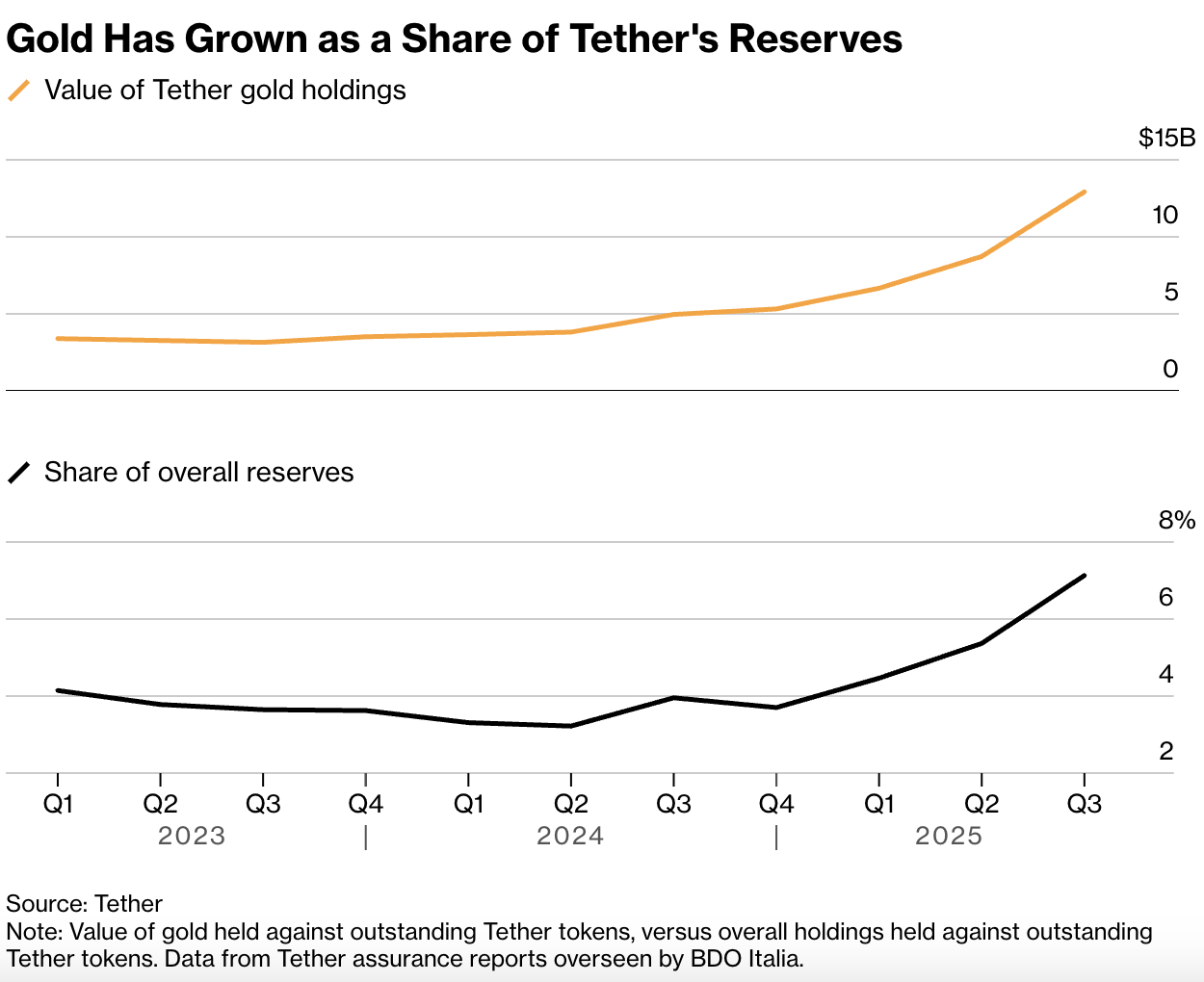
According to Ardoino, Tether's current gold procurement rate is about 1 to 2 tons per week, and it plans to maintain this pace in the coming months, "maybe slowing down, but we will assess gold demand quarterly."

But Tether's ambitions go beyond just hoarding gold. In the Bloomberg interview, Ardoino stated that Tether is evaluating the market and potential trading strategies, planning to actively trade its gold reserves to capture arbitrage opportunities. Simultaneously, the company is working on building "the world's best gold trading floor," aiming to establish stable, long-term channels for gold acquisition and compete with large banks like JPMorgan Chase and HSBC that dominate the global precious metals market.

To this end, Tether last year prominently brought on two heavyweight trading veterans: former HSBC global head of metals trading Vincent Domien, and former head of precious metals procurement for Europe, the Middle East, and Africa, Mathew O’Neill, specifically负责 expanding its gold business landscape. (Related reading: Tether's Gold Empire: The Ambition and Cracks of a 'Borderless Central Bank')

Upstream in the industry chain, Tether has also begun using its financial muscle to secure positions. Tether has successively invested in several Canadian mid-tier gold mining royalty companies, including Elemental Royalty, Metalla Royalty & Streaming, Versamet Royalties, and Gold Royalty, locking in future production capacity and revenue sharing through equity investments.

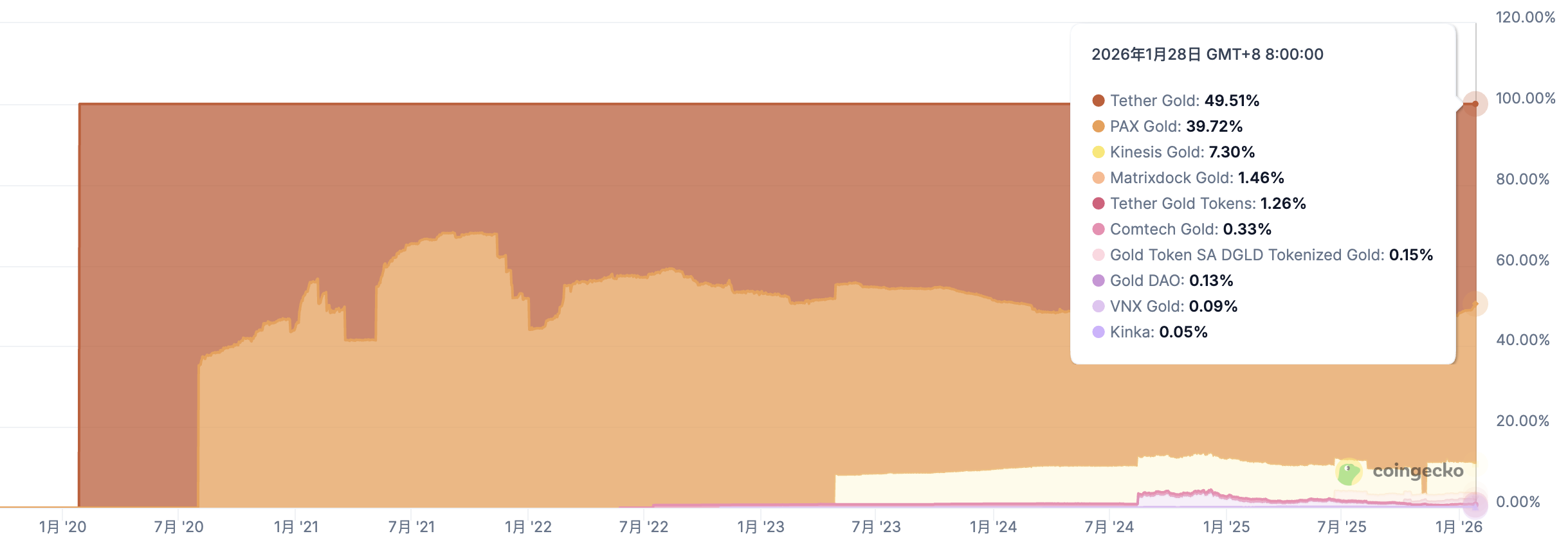
At the financial product level, Tether launched the gold-pegged stablecoin Tether Gold (XAU₮) as early as 2020. As of the end of last year, this token was backed by 16.2 tons of physical gold. Not long ago, Tether also introduced a new unit of account for XAU₮ called Scudo, where 1 Scudo represents one-thousandth of a troy ounce of gold, aiming to make gold a more usable form of payment.

CoinGecko data shows that as of January 28, the circulating market value of XAU₮ had reached $2.7 billion, growing about 91.3% over the past year, capturing 49.5% of the tokenized gold track market share, firmly holding the top position.
From physical gold hoarding to industry chain布局, to financial product innovation, the large-scale investments by this gold enthusiast have even left traditional commodity圈 insiders baffled, with some形容 Tether as "the strangest company they have ever encountered."

But now, as gold prices continue to刷新历史 highs, Tether's bet is yielding惊人的 returns.

Earning $15 Billion Annually, Building a Capital Arsenal

The confidence behind Tether's疯狂囤积 gold comes from a high-speed运转的 "money printing machine."

According to a Fortune report, Tether generated approximately $15 billion in net profit in 2025, a significant increase from the previous year's $13 billion. This百亿 profit is supported by a global workforce of only about 200 people. Roughly calculated, the per capita profit is as high as $75 million, an efficiency level that leaves traditional financial giants in the dust.

The core of this profitability comes from the capital pool沉淀 by its stablecoin business.

Today, the US dollar stablecoin USDT issued by Tether is the most widely used stablecoin globally, with over 500 million users. CoinGecko data shows that as of January 28, 2026, the circulation of USDT issued by Tether was接近 $1870 billion, firmly holding the top spot in the stablecoin赛道. Trading activity is同样领先; Artemis Analytics data shows that in 2025, total stablecoin transaction volume grew 72% to $33 trillion, with USDT contributing $13.3 trillion, accounting for over 33%.

Building on this, Tether is further expanding the scale of its capital沉淀 through合规化.

On January 27, Tether officially launched USAT, a stablecoin regulated by the U.S. federal government. It is issued by Anchorage Digital Bank, the first federally regulated stablecoin issuer in the U.S., with Cantor Fitzgerald serving as the designated reserve custodian and preferred primary dealer, and former White House advisor Bo Hines appointed as CEO. This is seen as a key step for Tether's full-scale entry into the U.S. domestic market.

Simultaneously, leveraging its investments in content platforms like Rumble, Tether is attempting to integrate USAT business into the traffic ecosystem, thereby quickly reaching 100 million U.S. users, with a target of a $1 trillion market cap within five years. If progress is smooth, USAT could become the first真正意义上的 competitor to USDC in the U.S. market.

After obtaining an almost zero-cost liability side, Tether easily套取 interest rate differentials by allocating high-liquidity, low-risk assets.

Among these, U.S. Treasury interest is the core source of Tether's收益. In a high-interest rate cycle, U.S. Treasury interest directly amplifies Tether's profitability. Currently, Tether holds approximately $1350 billion in U.S. Treasury bonds, exceeding the holdings of sovereign nations like South Korea and making it the 17th largest holder of U.S. Treasury bonds globally.

Additionally, Tether is also a super player in Bitcoin. Since 2023, Tether has allocated up to 15% of its monthly net profit to定期 Bitcoin. Its current holdings exceed 96,000 BTC, making it one of the largest institutional holders of Bitcoin globally, with an average cost of about $51,000, far below the current market price.围绕 the Bitcoin ecosystem, Tether has also built its own mining farms, invested in mining companies, and布局 DAT (Crypto Treasury), continuously expanding its industry influence, and has一度 been the subject of overseas conspiracy theories about being a "BTC隐形操盘手." (Related reading: Caught in BTC隐形操盘手 Conspiracy Theories? Unveiling the Full Picture of Tether's Bitcoin Strategy)

Furthermore, to leverage more potential收益, Tether has开启了大撒币 mode over the past few years, extending its investment触角 to areas such as satellite communications, AI data centers, agriculture, telecommunications, and media.

Thus, an arbitrage machine spanning traditional finance and the crypto world has gradually taken shape, continuously supplying Tether with capital ammunition, becoming the chips for its large-scale bets.


Пов'язані питання

QHow much gold has Tether accumulated and what is its current value?

ATether has accumulated approximately 140 tons of physical gold, with a current value of about $23 billion.

QWhat is Tether's goal regarding its gold reserves, as stated by its CEO?

ATether's CEO, Paolo Ardoino, stated that the company aims to become one of the world's largest 'gold central banks'.

QWhat was Tether's net profit in 2025 and what is the primary source of this profitability?

ATether's net profit in 2025 was approximately $15 billion, primarily sourced from the interest on U.S. Treasury bonds held from its stablecoin business.

QWhat is the name of the gold-backed stablecoin issued by Tether and what is its market position?

ATether's gold-backed stablecoin is called Tether Gold (XAU₮), and it holds a 49.5% market share in the tokenized gold sector, ranking first.

QHow does Tether store its physical gold reserves and where are they located?

ATether stores its physical gold in a nuclear bunker from the Cold War era in Switzerland, which has multiple layers of heavy steel doors and top-tier confidentiality systems.

Пов'язані матеріали

Has the 'Digital Gold' Narrative for BTC Failed?

**Title: Has the "Digital Gold" Narrative for Bitcoin Failed?** The article argues that Bitcoin's "digital gold" narrative remains valid despite a recent sharp price decline (from a peak near $126k in Oct 2025 to briefly under $61k in Feb 2026). It presents a long-term investment framework based on three core points: **1. Viewing Bitcoin as an Asset:** Bitcoin is presented as a superior potential store of value compared to gold. Key arguments are its absolute scarcity (21 million cap), superior portability, and transparent auditability via its public ledger. While acknowledging its current use in early, volatile stages (~3-4% global adoption), the author draws parallels to the early, disruptive phases of the internet and e-commerce. **2. Understanding the Recent Downturn:** The current ~50% correction is framed as a predictable, consensus-driven cycle following its post-halving peak (the 2024 halving preceded the Oct 2025 high). A crucial factor is a historic "changing of hands": the influx of new institutional buyers via ETFs allowed early, low-cost holders (miners, OG believers) to take profits. The author notes that while severe, Bitcoin's historical drawdowns (e.g., 93% in 2011, 77% in 2021-22) have been progressively smaller, suggesting maturing holder structure and decreasing volatility over time. **3. The Long-Term Perspective:** The long-term thesis hinges on Bitcoin capturing a portion of gold's market value. With Bitcoin's market cap at ~$1.4 trillion (at $70k) versus gold's ~$20 trillion, significant upside potential exists if the "digital gold" narrative is partially realized. However, the author strongly cautions that short-term risks remain, the bottom is unpredictable, and high volatility is inherent. The real risk is not Bitcoin failing but poor personal position management (over-leverage, wrong capital) and a lack of deep understanding, which can force investors out during severe downturns. The conclusion uses Amazon's 95% crash post-2000 dot-com bubble and subsequent 42x recovery as an analogy. The ultimate question is not if Bitcoin's price will rise, but if an investor's strategy and conviction can withstand the volatility to see the long-term play out. The recent divergence (gold up, Bitcoin down) is posed not as a narrative failure, but as potential evidence of this ongoing, painful transition from a speculative asset to a mainstream allocation.

marsbit2 год тому

Has the 'Digital Gold' Narrative for BTC Failed?

marsbit2 год тому

Has BTC's 'Digital Gold' Narrative Failed?

The article discusses Bitcoin's "digital gold" narrative, its recent price drop, and long-term outlook through the perspective of "Jason". It argues the narrative is not a failure but that Bitcoin represents a superior, new asset class due to its fixed supply (21 million), portability, and auditability. The piece compares its current ~3-4% global adoption rate to early internet/e-commerce, suggesting significant growth potential. Regarding the 2025-2026 price decline (from ~$126k to briefly under $61k), the author views it as a predictable, consensus-driven sell-off within Bitcoin's ~4-year cycle post-halving, exacerbated by a major "handover" from early, low-cost holders to new institutional buyers via ETFs. A key observation is that historical peak-to-trough drawdowns have lessened over time (e.g., 93% in 2011 to ~50% in 2026), indicating maturing volatility as holder structure changes. For the long term, the author uses a simple framework: Bitcoin's total market cap (~$1.4T at $70k) is only about 7% of gold's (~$20T). Even capturing 30-50% of gold's value would imply substantial upside. However, the article strongly cautions against viewing this as investment advice, emphasizing extreme volatility and the critical importance of risk management, position sizing, and deep fundamental understanding to survive severe drawdowns. It concludes by drawing a parallel to Amazon's 95% crash in 2000 and subsequent 42x recovery, stressing that the key is surviving market cycles to realize long-term potential.

链捕手2 год тому

Has BTC's 'Digital Gold' Narrative Failed?

链捕手2 год тому

From Code to Cognition: A Ten-Thousand-Word Guide to the Evolution of the Robot Brain

"From Code to Cognition: The Evolution of Robot Brains" The journey of robotic intelligence has shifted dramatically from manually coded systems to AI-driven brains. For decades, robots relied on layered software stacks—perception, state estimation, planning, control—each handcrafted. While predictable, they lacked adaptability. The 2010s saw deep learning revolutionize perception (e.g., object detection) and control (via reinforcement learning), but learned skills remained narrow. The arrival of Large Language Models (LLMs) marked a turning point. LLMs acted as high-level planners, interpreting natural language instructions and generating sequences of actions for traditional robotic systems to execute. However, true integration came with Visual-Language-Action (VLA) models, which fused vision, language, and motion prediction into a single network. Pioneered by models like RT-2 and open-source projects like OpenVLA, VLAs enable robots to reason and act directly from visual input and commands. The most advanced humanoid robots now employ a "dual-brain" architecture: a slow-thinking, large VLA (System 2) for reasoning and planning, and a fast-reacting, small network (System 1) for high-frequency motion control, sometimes with an even lower-level System 0 for balance. This split balances cognition with the physics of real-time movement. Computation is split between onboard hardware (e.g., NVIDIA Jetson) for safety-critical control loops and cloud/edge servers for non-critical tasks like learning and interfaces. A crucial driver is the open-source ecosystem—models like GR00T and OpenVLA allow startups to build upon pre-trained brains and fine-tune them with their own data, accelerating development. Despite progress, current systems struggle with recovery from errors, sample inefficiency, and long-horizon tasks. This has spurred the rise of **World Models**—neural networks that predict the consequences of actions. By simulating possible futures before acting (like NVIDIA Cosmos or Meta V-JEPA), robots can plan, recover, and generalize better. This represents the next frontier: shifting intelligence from learned reactions to an internal model of physics and cause-and-effect. The field is rapidly evolving. While not yet at its "ChatGPT moment," the convergence of cheaper hardware, scalable simulation, and world models points toward robots that are increasingly capable, adaptive, and useful. The question is shifting from "what can robots do?" to "what *should* they do?"

marsbit2 год тому

From Code to Cognition: A Ten-Thousand-Word Guide to the Evolution of the Robot Brain

marsbit2 год тому

AI Bubble Is Bursting

The AI Bubble is Bursting: A Necessary Purge on the Path to Ubiquitous Intelligence Market volatility has reignited debates about an AI bubble, with figures like Ray Dalio pointing to high valuations. However, this parallels the dot-com bubble, which, despite its crash, laid the physical infrastructure for today's internet era. The current AI investment frenzy, with tech giants planning trillions in infrastructure spending far outstripping current AI application revenues, appears similarly imbalanced. This 'bubble' is seen as an inevitable phase for a disruptive technology, paying the "innovation tax." Critically, AI inference costs have plummeted over 99.7% since 2023, making intelligence nearly free at the margin. This hasn't reduced spending but has instead unlocked massive new demand, as seen in enterprise AI cloud expenditure tripling. This follows the Jevons Paradox: efficiency gains lead to greater total consumption. The market is now entering a cleansing phase, weeding out speculative ventures lacking real moats. The deeper shift is a move from capital expenditure (CapEx) on hardware to value creation in operational expenditure (OpEx) through AI applications that solve real industry problems. While infrastructure valuations are high, rapid earnings growth from widespread AI adoption across sectors—from manufacturing and finance to law and healthcare—may digest these valuations over time. Ultimately, this creative destruction will leave behind robust infrastructure and optimized models, cheaply powering an AI-augmented future for all industries, much as the internet became indispensable after its own bubble burst. The core productive potential remains undiminished.

链捕手3 год тому

AI Bubble Is Bursting

链捕手3 год тому

Торгівля

Спот
Ф'ючерси
活动图片