The First Fed Chair with Crypto Holdings? Kevin Warsh Discloses at Least 20 Crypto Investments Including Solana and dYdX

marsbitОпубліковано о 2026-04-15Востаннє оновлено о 2026-04-15

Анотація

Kevin Warsh, a former Federal Reserve governor and nominee for Fed Chair, has disclosed at least 20 cryptocurrency-related investments in a 69-page financial filing submitted to the U.S. Office of Government Ethics. The disclosure, required ahead of his Senate confirmation hearing, reveals indirect holdings in major crypto projects including Solana, dYdX, Optimism, Polychain Capital, Dapper Labs, and Lightning Network, among others. These investments are held through various venture funds and special purpose vehicles. Warsh and his wife, Jane Lauder, have a combined net worth of at least $192 million. While the crypto holdings are described as small, risk-focused positions, they span multiple sectors: L1 and L2 blockchains, DeFi protocols, NFT platforms, payment systems, and AI-integrated chains. Warsh has publicly endorsed Bitcoin in the past, calling it “a very good police for policy” and “the new gold for those under 40.” If confirmed, he would become the first Fed Chair with direct exposure to crypto venture investments. His confirmation hearing is scheduled for April 21, though political opposition remains a potential hurdle.

Author: Claude, Deep Tide TechFlow

Deep Tide Guide: Kevin Warsh, nominated by Trump for Fed Chair, submitted a 69-page financial disclosure revealing combined assets with his wife of at least $192 million, including indirect investments in at least 20 crypto-related entities such as Solana, dYdX, Polychain Capital, Optimism, and Dapper Labs. If confirmed, he would become the first Fed Chair with exposure to crypto venture capital. The confirmation hearing is scheduled for April 21st, but Republican Senator Tillis still threatens to vote no due to the Powell investigation stalemate.
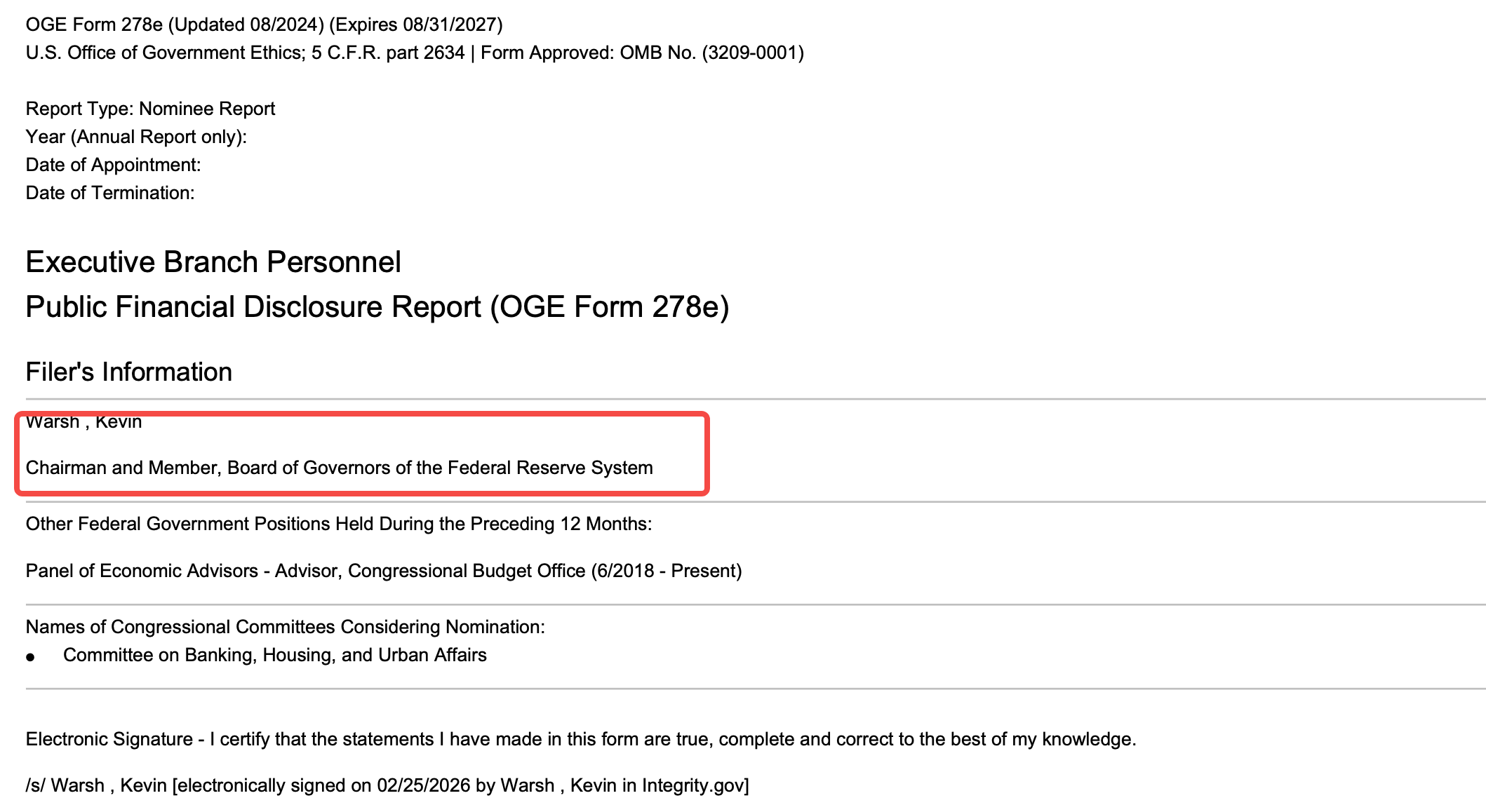
Warsh's crypto holdings list emerged through a 69-page government ethics document.

Fed Chair nominee Kevin Warsh submitted his financial disclosure to the U.S. Office of Government Ethics (OGE) on April 14th, the final procedural step before the Senate confirmation hearing. The document shows that Warsh and his wife Jane Lauder have combined assets of approximately $192 million, potentially more. But what truly captured the crypto industry's attention were the over twenty crypto and Web3-related holdings buried deep within the file.
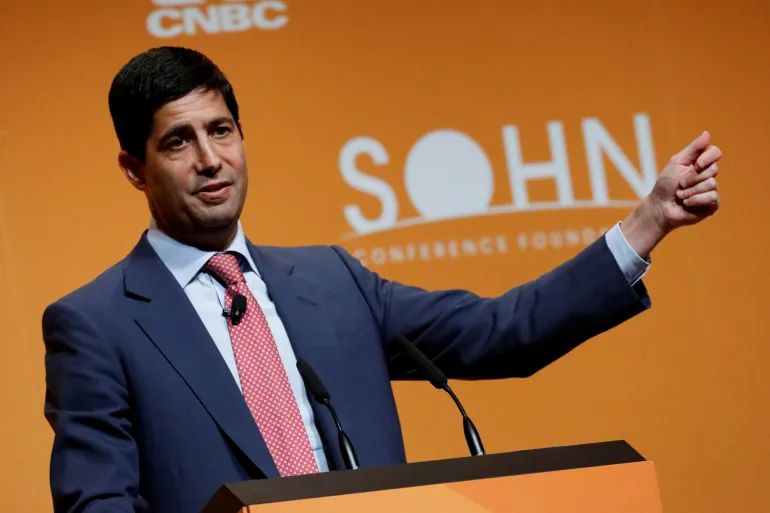
Warsh had previously stated clearly in a public interview at the Hoover Institution: Bitcoin doesn't make him uncomfortable; he considers it an important asset that can help policymakers judge whether their decisions are correct. Now, the disclosure proves he's gone beyond mere words—his money is indeed on this track.

At Least 20 Crypto Entities: Nearly Full Coverage from L1 Public Chains to DeFi Protocols

Warsh's crypto exposure is distributed across multiple venture capital fund structures. Through the AVGF I fund, he indirectly holds interests in Solana, Optimism, and the Lightning Network; through DCM Investments 10 LLC, he holds stakes in dYdX and Polychain Capital, with the same vehicle also including dozens of fintech and Web3 projects like Compound, Lighter, Lemon Cash, and Blast (an Ethereum L2 protocol).

Under the AVF series of funds, crypto-related holdings also appear including Dapper Labs, Deso, Eulith, Onjuno, Ridian, Friends With Benefits, and Zero Gravity (an L2 AI blockchain platform). Warsh also directly holds shares worth $1,001 to $15,000 in Web3 company Metatheory Inc. through Founder Bets Master SPV LLC.
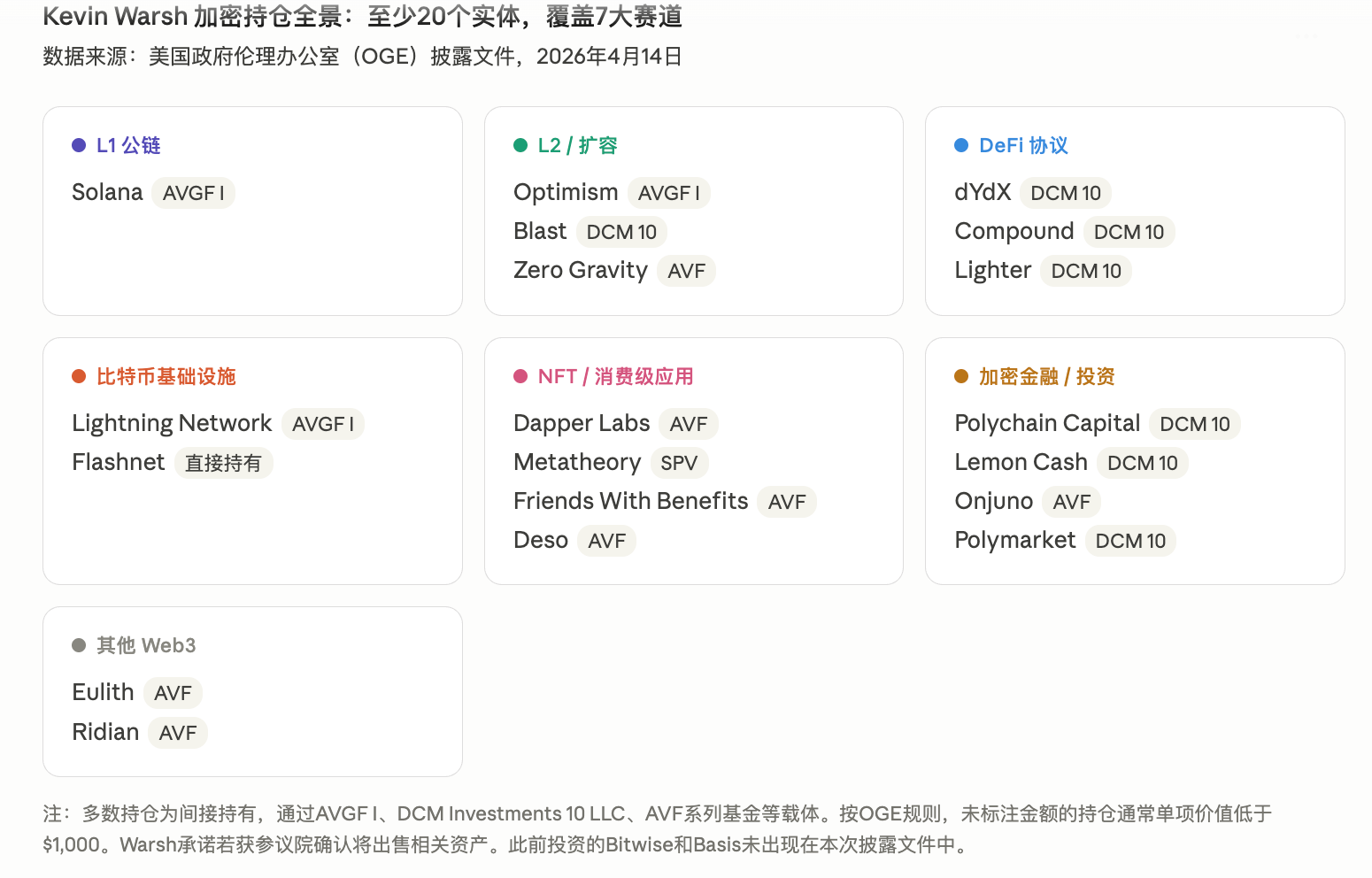
Furthermore, according to Bitcoin Magazine, Warsh also holds equity in Bitcoin payments startup Flashnet, a company positioned as a Bitcoin merchant payment system similar to the Lightning Network. Warsh had previously invested in crypto index management company Bitwise and algorithmic stablecoin project Basis, although these investments did not appear in this disclosure.

In terms of coverage, this holdings list touches nearly every major sector of the crypto industry: L1 public chains (Solana), L2 scaling (Optimism, Blast), DeFi protocols (dYdX, Compound), NFT infrastructure (Dapper Labs), prediction markets (Polymarket), Bitcoin payments (Flashnet, Lightning Network), and even social tokens (Friends With Benefits) and AI blockchain (Zero Gravity).

However, according to OGE rules, holdings without specified amounts typically mean the individual item is valued below $1,000, indicating these crypto positions are mostly small risk bets rather than concentrated positions.

Full Picture of $192 Million in Assets: Druckenmiller Advisory Fees, Juggernaut Fund & Opaque Holdings

Crypto holdings are just one corner of Warsh's vast asset portfolio.

The two largest investments in the file are two positions in the Juggernaut Fund LP, each marked as "over $50 million," but the underlying assets are not disclosed due to confidentiality agreements. Warsh has committed to selling all of these if confirmed. Additionally, about twenty-plus THSDFS LLC series holdings, with individual amounts up to $5 million, also have undisclosed underlying assets due to confidentiality clauses.

Regarding income, Warsh received a $10.2 million advisory fee from the Duquesne Family Office of Wall Street legend Stanley Druckenmiller. He also received $1.55 million from GoldenTree Asset Management, $750,000 from Cerberus Capital Management in advisory fees, and a $750,000 speaking fee from Brevan Howard—all institutions with digital asset trading businesses.

OGE certifying official Heather Jones noted in the review opinion that once Warsh completes the promised asset sales, he will meet the compliance requirements of the Ethics in Government Act.

Warsh's wife, Jane Lauder, is the granddaughter of Estée Lauder's founder, with Forbes estimating her personal net worth at approximately $1.9 billion.

Once Called Bitcoin a "Good Police for Policy," Now His Holdings Confirm His Judgment

Warsh's attitude toward Bitcoin is unique among past and current senior Fed officials.

As early as 2011, Warsh saw the Bitcoin whitepaper from Marc Andreessen at a dinner. In 2018, he wrote in The Wall Street Journal that Bitcoin could become a "sustainable store of value" similar to gold. In 2021, he stated on CNBC that for people under 40, Bitcoin is their new gold.

In 2025, in a Hoover Institution interview, he gave his most complete statement to date: Bitcoin is not a substitute for the dollar, but it can be a very good police for policy. He also characterized software development in the crypto industry as part of U.S. economic competitiveness.

For the crypto industry, Warsh's disclosure is a double-edged signal. On one hand, a Fed Chair with firsthand venture capital exposure to DeFi and blockchain infrastructure may understand the nuances of this technology better than his predecessors; on the other hand, forced sales and recusal obligations may limit his ability to translate these sympathetic attitudes into concrete actions early in his tenure.


Пов'язані питання

QWho is Kevin Warsh and what significant financial disclosure did he make?

AKevin Warsh is a nominee for the position of Federal Reserve Chair. He submitted a 69-page financial disclosure to the U.S. Office of Government Ethics, revealing a combined net worth of at least $192 million with his wife and indirect investments in at least 20 crypto-related entities.

QWhat are some of the major crypto projects and companies that Kevin Warsh has indirect investments in?

AHis disclosed crypto investments include Solana, dYdX, Polychain Capital, Optimism, Dapper Labs, Compound, Lightning Network, Blast, and Flashnet, covering sectors like L1 blockchains, L2 scaling, DeFi, NFTs, and Bitcoin payments.

QWhat is the significance of Kevin Warsh potentially becoming the Federal Reserve Chair with these crypto holdings?

AIf confirmed, Kevin Warsh would be the first Federal Reserve Chair to have a venture capital exposure to the cryptocurrency market, indicating a potential for a more nuanced understanding of the technology within the highest levels of U.S. monetary policy.

QWhat was Kevin Warsh's previous public stance on Bitcoin and cryptocurrency?

AWarsh has publicly stated that Bitcoin does not make him uneasy, views it as an important asset that can act as a 'good police' for policy makers to judge their decisions, and has referred to it as 'new gold' for people under 40.

QWhat are the two largest investments in Warsh's portfolio and what is the plan for them if he is confirmed?

AThe two largest investments are two positions in the Juggernaut Fund LP, each valued at 'over $50 million'. Warsh has committed to divest these holdings, along with other specified assets, if his nomination is confirmed to comply with government ethics rules.

Пов'язані матеріали

Gensyn AI: Don't Let AI Repeat the Mistakes of the Internet

In recent months, the rapid growth of the AI industry has attracted significant talent from the crypto sector. A persistent question among researchers intersecting both fields is whether blockchain can become a foundational part of AI infrastructure. While many previous AI and Crypto projects focused on application layers (like AI Agents, on-chain reasoning, data markets, and compute rentals), few achieved viable commercial models. Gensyn differentiates itself by targeting the most critical and expensive layer of AI: model training. Gensyn aims to organize globally distributed GPU resources into an open AI training network. Developers can submit training tasks, nodes provide computational power, and the network verifies results while distributing incentives. The core issue addressed is not decentralization for its own sake, but the increasing centralization of compute power among tech giants. In the era of large models, access to GPUs (like the H100) has become a decisive bottleneck, dictating the pace of AI development. Major AI companies are heavily dependent on large cloud providers for compute resources. Gensyn's approach is significant for several reasons: 1) It operates at the core infrastructure layer (model training), the most resource-intensive and technically demanding part of the AI value chain. 2) It proposes a more open, collaborative model for compute, potentially increasing resource utilization by dynamically pooling idle GPUs, similar to early cloud computing logic. 3) Its technical moat lies in solving complex challenges like verifying training results, ensuring node honesty, and maintaining reliability in a distributed environment—making it more of a deep-tech infrastructure company. 4) It targets a validated, high-growth market with genuine demand, rather than pursuing blockchain integration without purpose. Ultimately, the boundaries between Crypto and AI are blurring. AI requires global resource coordination, incentive mechanisms, and collaborative systems—areas where crypto-native solutions excel. Gensyn represents a step toward making advanced training capabilities more accessible and collaborative, moving beyond a niche controlled by a few giants. If successful, it could evolve into a fundamental piece of AI infrastructure, where the most enduring value in the AI era is often created.

marsbit10 год тому

Gensyn AI: Don't Let AI Repeat the Mistakes of the Internet

marsbit10 год тому

Why is China's AI Developing So Fast? The Answer Lies Inside the Labs

A US researcher's visit to China's top AI labs reveals distinct cultural and organizational factors driving China's rapid AI development. While talent, data, and compute are similar to the West, Chinese labs excel through a pragmatic, execution-focused culture: less emphasis on individual stardom and conceptual debate, and more on teamwork, engineering optimization, and mastering the full tech stack. A key advantage is the integration of young students and researchers who approach model-building with fresh perspectives and low ego, prioritizing collective progress over personal credit. This contrasts with the US culture of self-promotion and "star scientist" narratives. Chinese labs also exhibit a strong "build, don't buy" mentality, preferring to develop core capabilities—like data pipelines and environments—in-house rather than relying on external services. The ecosystem feels more collaborative than tribal, with mutual respect among labs. While government support exists, its scale is unclear, and technical decisions appear driven by labs, not state mandates. Chinese companies across sectors, from platforms to consumer tech, are building their own foundational models to control their tech destiny, reflecting a broader cultural drive for technological sovereignty. Demand for AI is emerging, with spending patterns potentially mirroring cloud infrastructure more than traditional SaaS. Despite challenges like a less mature data industry and GPU shortages, Chinese labs are propelled by vast talent, rapid iteration, and deep integration with the open-source community. The competition is evolving beyond a pure model race into a contest of organizational execution, developer ecosystems, and industrial pragmatism.

marsbit12 год тому

Why is China's AI Developing So Fast? The Answer Lies Inside the Labs

marsbit12 год тому

3 Years, 5 Times: The Rebirth of a Century-Old Glass Factory

Corning, a 175-year-old glass company, is experiencing a dramatic revival as a key player in AI infrastructure, driven by surging demand for high-performance optical fiber in data centers. AI data centers require vastly more fiber than traditional ones—5 to 10 times as much per rack—to handle high-speed data transmission between GPUs. This structural demand shift, coupled with supply constraints from the lengthy expansion cycle for fiber preforms, has created a significant supply-demand gap. Nvidia has invested in Corning, along with Lumentum and Coherent, in a $4.5 billion total commitment to secure the optical supply chain for AI. Corning's competitive edge lies in its expertise in producing ultra-low-loss, high-density, and bend-resistant specialty fiber, which is critical for 800G+ and future 1.6T data rates. Its deep involvement in co-packaged optics (CPO) with partners like Nvidia further solidifies its position. While not the largest fiber manufacturer globally, Corning's revenue from enterprise/data center clients now exceeds 40% of its optical communications sales, and it has secured multi-year supply agreements with major hyperscalers including Meta and Nvidia. Financially, Corning's optical communications revenue has surged, doubling from $1.3 billion in 2023 to over $3 billion in 2025. Its stock price has risen nearly 6-fold since late 2023. Key future catalysts include the rollout of Nvidia's CPO products and the scale of undisclosed customer agreements. However, risks include high current valuations and potential disruption from next-generation technologies like hollow-core fiber. The company's long-term bet on light over electricity, maintained even through the telecom bubble crash, is now being validated by the AI boom.

marsbit12 год тому

3 Years, 5 Times: The Rebirth of a Century-Old Glass Factory

marsbit12 год тому

Торгівля

Спот
Ф'ючерси

Популярні статті

Як купити DYDX

Ласкаво просимо до HTX.com! Ми зробили покупку dYdX (DYDX) простою та зручною. Дотримуйтесь нашої покрокової інструкції, щоб розпочати свою криптовалютну подорож.Крок 1: Створіть обліковий запис на HTXВикористовуйте свою електронну пошту або номер телефону, щоб зареєструвати обліковий запис на HTX безплатно. Пройдіть безпроблемну реєстрацію й отримайте доступ до всіх функцій.ЗареєструватисьКрок 2: Перейдіть до розділу Купити крипту і виберіть спосіб оплатиКредитна/дебетова картка: використовуйте вашу картку Visa або Mastercard, щоб миттєво купити dYdX (DYDX).Баланс: використовуйте кошти з балансу вашого рахунку HTX для безперешкодної торгівлі.Треті особи: ми додали популярні способи оплати, такі як Google Pay та Apple Pay, щоб підвищити зручність.P2P: Торгуйте безпосередньо з іншими користувачами на HTX.Позабіржова торгівля (OTC): ми пропонуємо індивідуальні послуги та конкурентні обмінні курси для трейдерів.Крок 3: Зберігайте свої dYdX (DYDX)Після придбання dYdX (DYDX) збережіть його у своєму обліковому записі на HTX. Крім того, ви можете відправити його в інше місце за допомогою блокчейн-переказу або використовувати його для торгівлі іншими криптовалютами.Крок 4: Торгівля dYdX (DYDX)Легко торгуйте dYdX (DYDX) на спотовому ринку HTX. Просто увійдіть до свого облікового запису, виберіть торгову пару, укладайте угоди та спостерігайте за ними в режимі реального часу. Ми пропонуємо зручний досвід як для початківців, так і для досвідчених трейдерів.

139 переглядів усьогоОпубліковано 2024.12.13Оновлено 2025.03.21

Як купити DYDX

Обговорення

Ласкаво просимо до спільноти HTX. Тут ви можете бути в курсі останніх подій розвитку платформи та отримати доступ до професійної ринкової інформації. Нижче представлені думки користувачів щодо ціни DYDX (DYDX).

活动图片












