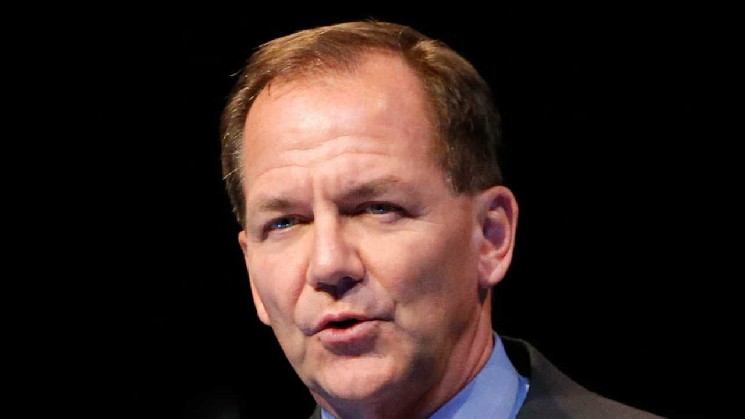
The First Fed Chair with Crypto Holdings? Kevin Warsh Discloses at Least 20 Crypto Investments Including Solana and dYdX

marsbitОпубліковано о 2026-04-15Востаннє оновлено о 2026-04-15

Анотація

Kevin Warsh, a former Federal Reserve governor and nominee for Fed Chair, has disclosed at least 20 cryptocurrency-related investments in a 69-page financial filing submitted to the U.S. Office of Government Ethics. The disclosure, required ahead of his Senate confirmation hearing, reveals indirect holdings in major crypto projects including Solana, dYdX, Optimism, Polychain Capital, Dapper Labs, and Lightning Network, among others. These investments are held through various venture funds and special purpose vehicles. Warsh and his wife, Jane Lauder, have a combined net worth of at least $192 million. While the crypto holdings are described as small, risk-focused positions, they span multiple sectors: L1 and L2 blockchains, DeFi protocols, NFT platforms, payment systems, and AI-integrated chains. Warsh has publicly endorsed Bitcoin in the past, calling it “a very good police for policy” and “the new gold for those under 40.” If confirmed, he would become the first Fed Chair with direct exposure to crypto venture investments. His confirmation hearing is scheduled for April 21, though political opposition remains a potential hurdle.

Author: Claude, Deep Tide TechFlow

Deep Tide Guide: Kevin Warsh, nominated by Trump for Fed Chair, submitted a 69-page financial disclosure revealing combined assets with his wife of at least $192 million, including indirect investments in at least 20 crypto-related entities such as Solana, dYdX, Polychain Capital, Optimism, and Dapper Labs. If confirmed, he would become the first Fed Chair with exposure to crypto venture capital. The confirmation hearing is scheduled for April 21st, but Republican Senator Tillis still threatens to vote no due to the Powell investigation stalemate.
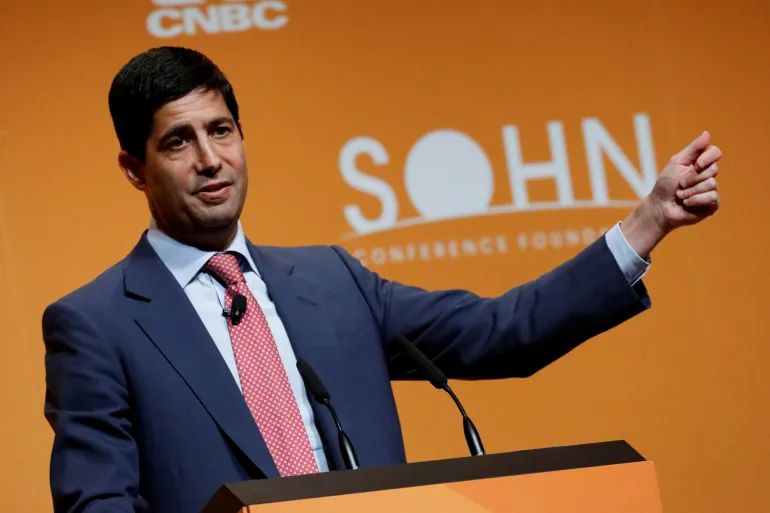
Warsh's crypto holdings list emerged through a 69-page government ethics document.

Fed Chair nominee Kevin Warsh submitted his financial disclosure to the U.S. Office of Government Ethics (OGE) on April 14th, the final procedural step before the Senate confirmation hearing. The document shows that Warsh and his wife Jane Lauder have combined assets of approximately $192 million, potentially more. But what truly captured the crypto industry's attention were the over twenty crypto and Web3-related holdings buried deep within the file.
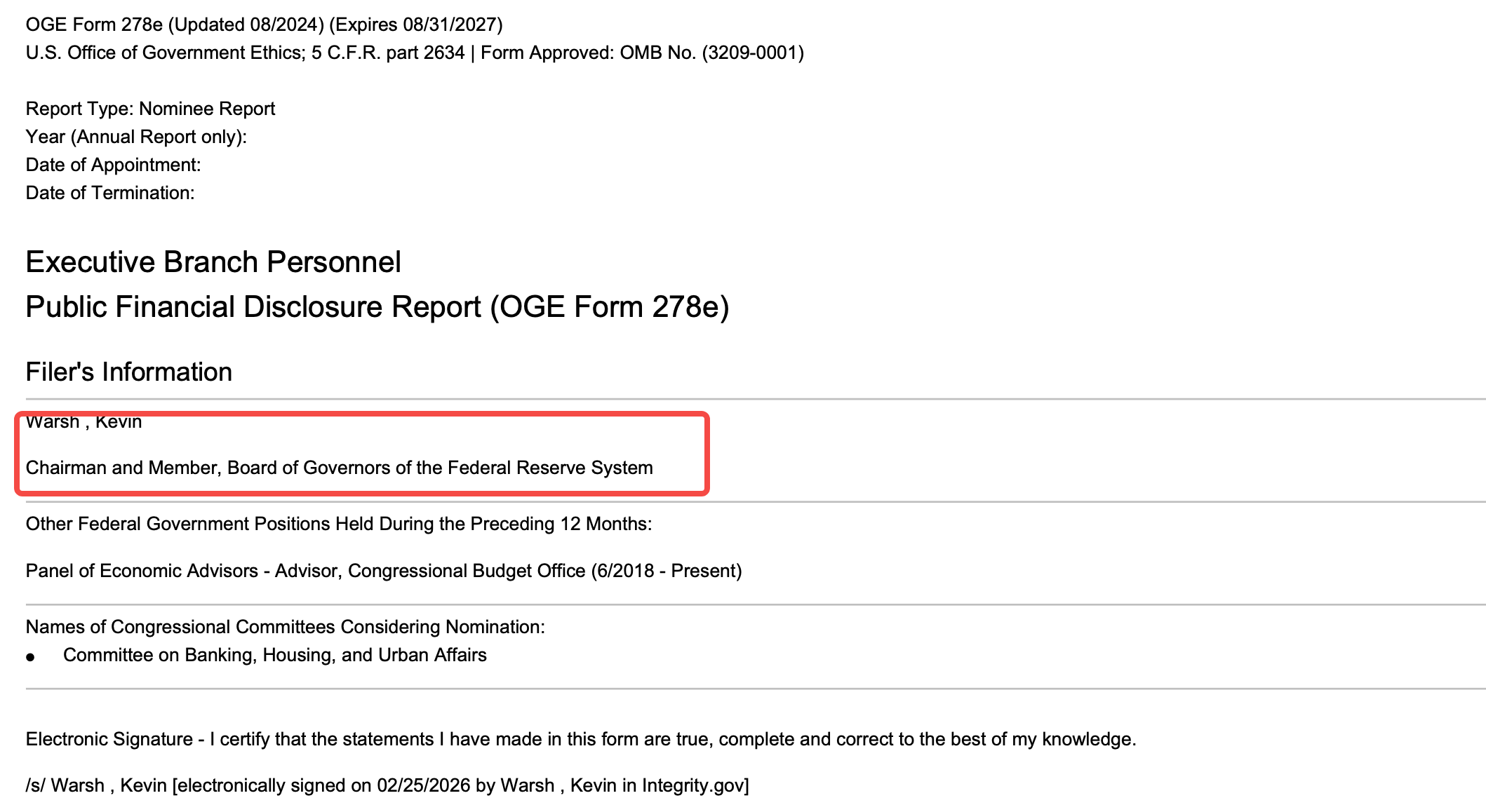
Warsh had previously stated clearly in a public interview at the Hoover Institution: Bitcoin doesn't make him uncomfortable; he considers it an important asset that can help policymakers judge whether their decisions are correct. Now, the disclosure proves he's gone beyond mere words—his money is indeed on this track.

At Least 20 Crypto Entities: Nearly Full Coverage from L1 Public Chains to DeFi Protocols

Warsh's crypto exposure is distributed across multiple venture capital fund structures. Through the AVGF I fund, he indirectly holds interests in Solana, Optimism, and the Lightning Network; through DCM Investments 10 LLC, he holds stakes in dYdX and Polychain Capital, with the same vehicle also including dozens of fintech and Web3 projects like Compound, Lighter, Lemon Cash, and Blast (an Ethereum L2 protocol).

Under the AVF series of funds, crypto-related holdings also appear including Dapper Labs, Deso, Eulith, Onjuno, Ridian, Friends With Benefits, and Zero Gravity (an L2 AI blockchain platform). Warsh also directly holds shares worth $1,001 to $15,000 in Web3 company Metatheory Inc. through Founder Bets Master SPV LLC.
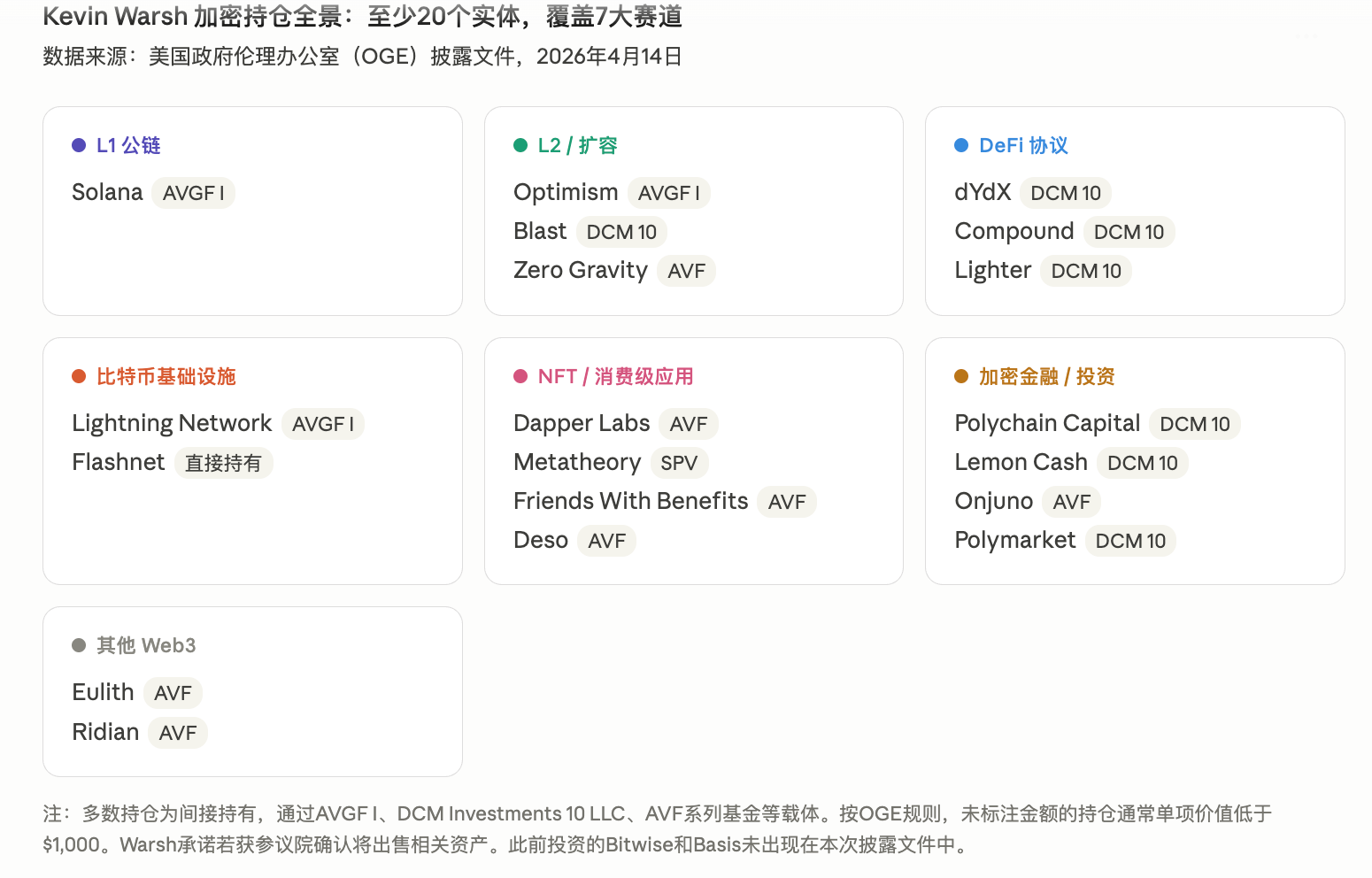
Furthermore, according to Bitcoin Magazine, Warsh also holds equity in Bitcoin payments startup Flashnet, a company positioned as a Bitcoin merchant payment system similar to the Lightning Network. Warsh had previously invested in crypto index management company Bitwise and algorithmic stablecoin project Basis, although these investments did not appear in this disclosure.

In terms of coverage, this holdings list touches nearly every major sector of the crypto industry: L1 public chains (Solana), L2 scaling (Optimism, Blast), DeFi protocols (dYdX, Compound), NFT infrastructure (Dapper Labs), prediction markets (Polymarket), Bitcoin payments (Flashnet, Lightning Network), and even social tokens (Friends With Benefits) and AI blockchain (Zero Gravity).

However, according to OGE rules, holdings without specified amounts typically mean the individual item is valued below $1,000, indicating these crypto positions are mostly small risk bets rather than concentrated positions.

Full Picture of $192 Million in Assets: Druckenmiller Advisory Fees, Juggernaut Fund & Opaque Holdings

Crypto holdings are just one corner of Warsh's vast asset portfolio.

The two largest investments in the file are two positions in the Juggernaut Fund LP, each marked as "over $50 million," but the underlying assets are not disclosed due to confidentiality agreements. Warsh has committed to selling all of these if confirmed. Additionally, about twenty-plus THSDFS LLC series holdings, with individual amounts up to $5 million, also have undisclosed underlying assets due to confidentiality clauses.

Regarding income, Warsh received a $10.2 million advisory fee from the Duquesne Family Office of Wall Street legend Stanley Druckenmiller. He also received $1.55 million from GoldenTree Asset Management, $750,000 from Cerberus Capital Management in advisory fees, and a $750,000 speaking fee from Brevan Howard—all institutions with digital asset trading businesses.

OGE certifying official Heather Jones noted in the review opinion that once Warsh completes the promised asset sales, he will meet the compliance requirements of the Ethics in Government Act.

Warsh's wife, Jane Lauder, is the granddaughter of Estée Lauder's founder, with Forbes estimating her personal net worth at approximately $1.9 billion.

Once Called Bitcoin a "Good Police for Policy," Now His Holdings Confirm His Judgment

Warsh's attitude toward Bitcoin is unique among past and current senior Fed officials.

As early as 2011, Warsh saw the Bitcoin whitepaper from Marc Andreessen at a dinner. In 2018, he wrote in The Wall Street Journal that Bitcoin could become a "sustainable store of value" similar to gold. In 2021, he stated on CNBC that for people under 40, Bitcoin is their new gold.

In 2025, in a Hoover Institution interview, he gave his most complete statement to date: Bitcoin is not a substitute for the dollar, but it can be a very good police for policy. He also characterized software development in the crypto industry as part of U.S. economic competitiveness.

For the crypto industry, Warsh's disclosure is a double-edged signal. On one hand, a Fed Chair with firsthand venture capital exposure to DeFi and blockchain infrastructure may understand the nuances of this technology better than his predecessors; on the other hand, forced sales and recusal obligations may limit his ability to translate these sympathetic attitudes into concrete actions early in his tenure.


Трендові криптовалюти

Пов'язані питання

QWho is Kevin Warsh and what significant financial disclosure did he make?

AKevin Warsh is a nominee for the position of Federal Reserve Chair. He submitted a 69-page financial disclosure to the U.S. Office of Government Ethics, revealing a combined net worth of at least $192 million with his wife and indirect investments in at least 20 crypto-related entities.

QWhat are some of the major crypto projects and companies that Kevin Warsh has indirect investments in?

AHis disclosed crypto investments include Solana, dYdX, Polychain Capital, Optimism, Dapper Labs, Compound, Lightning Network, Blast, and Flashnet, covering sectors like L1 blockchains, L2 scaling, DeFi, NFTs, and Bitcoin payments.

QWhat is the significance of Kevin Warsh potentially becoming the Federal Reserve Chair with these crypto holdings?

AIf confirmed, Kevin Warsh would be the first Federal Reserve Chair to have a venture capital exposure to the cryptocurrency market, indicating a potential for a more nuanced understanding of the technology within the highest levels of U.S. monetary policy.

QWhat was Kevin Warsh's previous public stance on Bitcoin and cryptocurrency?

AWarsh has publicly stated that Bitcoin does not make him uneasy, views it as an important asset that can act as a 'good police' for policy makers to judge their decisions, and has referred to it as 'new gold' for people under 40.

QWhat are the two largest investments in Warsh's portfolio and what is the plan for them if he is confirmed?

AThe two largest investments are two positions in the Juggernaut Fund LP, each valued at 'over $50 million'. Warsh has committed to divest these holdings, along with other specified assets, if his nomination is confirmed to comply with government ethics rules.

Пов'язані матеріали

GPT-5.6 Countdown: Abandon the Illusion of a Single API, Computational Iteration Can't Outpace a Single Page of Compliance

In mid-June, three seemingly independent industry events—the compliance-driven throttling of Fable 5, the open-sourcing of GLM-5.2, and the leaked release timeline for GPT-5.6—are pushing the global AI industry toward a watershed moment. These shifts signal a fundamental restructuring of the industry's underlying logic. First, **"usability" has substantially overtaken "advanced capabilities"** as the primary weight, pushing the global large language model (LLM) supply chain into a "dual-track" phase of controlled closed-source and local open-source coexistence. Second, **the competitive moats of closed-source giants are shifting**. Their technical focus is moving from "language intelligence" toward "spatial intelligence (world models)"—a domain heavily reliant on computing power. Third, faced with常态化 transnational compliance risks, **a "model-agnostic" decoupled design has become a survival necessity for application-layer developers to maintain business continuity.** The article details how Anthropic's Fable 5, despite its advanced engineering feats, was restricted for non-U.S. citizens within 72 hours of launch, highlighting how geopolitical compliance can instantly limit even the most advanced models. In response, the open-source camp, exemplified by Zhipu AI's MIT-licensed GLM-5.2, is gaining market share by offering stable performance improvements and significant cost advantages (up to 70% savings for enterprises), while achieving full adaptation with domestic semiconductor platforms. Meanwhile, closed-source leaders like OpenAI are pivoting. The anticipated GPT-5.6 reportedly shifts focus from language to spatial intelligence and world models, aiming to rebuild a generational gap in areas like 3D understanding, simulation, and industrial design that demand immense compute. The core conclusion is that the LLM supply chain's logic has changed. Enterprises must now evaluate infrastructure based on a composite of technical performance and policy compliance. For developers, complete reliance on a single closed-source API poses unacceptable risk. Implementing a truly model-agnostic architecture—enabling swift switches to compliant, locally deployable open-source alternatives—is no longer just good practice but a fundamental baseline for business continuity.

marsbit1 год тому

GPT-5.6 Countdown: Abandon the Illusion of a Single API, Computational Iteration Can't Outpace a Single Page of Compliance

marsbit1 год тому

Is the 'Token Subsidy War' Among AI Giants Almost Over?

The article discusses the ongoing "token subsidy war" among AI giants like OpenAI and Anthropic, questioning whether it's nearing its end. It reveals that current AI subscription prices are heavily subsidized, with some plans offering tokens at up to 70 times the actual cost to attract and retain heavy users, especially developers and enterprises. This strategy mirrors past internet-era subsidy battles, but with a key difference: AI tokens lack "lock-in" effects. Unlike ride-hailing or food delivery apps, users can easily switch between AI providers as APIs become standardized, making it difficult for companies to raise prices post-subsidy. The piece highlights a structural asymmetry in the competition. Giants like Google, with massive advertising revenue, can afford to subsidize tokens indefinitely, akin to using "tokens as a weapon." In contrast, venture-backed companies like OpenAI and Anthropic face pressure to become profitable, especially as they approach IPO. The article cites Google Ventures founder Bill Maris, who suggests Google could slash token prices by 80%, putting immense pressure on competitors. Two potential endgames are presented: the "internet service" model (subsidize, monopolize, then raise prices) and the "utility" model (tokens become a standardized, low-margin commodity like electricity). Given the low switching costs, the latter seems more likely. The competition may not have a single winner but could instead accelerate AI's evolution into a foundational, infrastructure-level technology, akin to a public utility. For now, users continue to benefit from heavily subsidized token costs.

marsbit1 год тому

Is the 'Token Subsidy War' Among AI Giants Almost Over?

marsbit1 год тому

Beyond the Stadium: The Profitable Games Surrounding the World Cup

"Beyond the Pitch: The Profit Game Around the World Cup" The FIFA World Cup transcends being a sporting spectacle, evolving into a massive global arena for speculation and profit-seeking. The 2026 tournament has amplified this dynamic, creating a multi-layered ecosystem of financial opportunism alongside the football. **Prediction markets** have surged into the mainstream. Platforms like Polymarket and Kalshi saw trading volumes for World Cup contracts soar, attracting new users with their financial trading model and high-profile, chain-based wealth stories that overshadow traditional sports betting in terms of growth and narrative. However, **traditional sportsbooks** remain the dominant force, leveraging established user habits, legal markets, and comprehensive product offerings to handle the vast majority of speculative wagers, with projections suggesting record-breaking betting volumes. Capital markets also react. **"Concept stocks"** in countries like South Korea and Japan experience volatile price swings based on team performance and anticipated fan spending on items like chicken, beer, and viewing parties, effectively becoming a stock market reflecting fan sentiment. The **ticket resale market** has become a sophisticated arena for arbitrage. Prices fluctuate wildly based on team draws and star power, with sellers sometimes listing tickets they don't yet own in a practice akin to short-selling, while FIFA's own "Right to Buy" tokens add another layer of speculative trading. **Collectibles and merchandise** offer another avenue. Panini sticker albums, with their inherent scarcity and nostalgic value, can become high-value collectibles. Limited-edition or locally themed jerseys command significant premiums on secondary markets, and even counterfeit vendors profit from fans' desire for affordable match-day identity. The **cryptocurrency** space has seen a frenzy of speculative, unauthorized World Cup-themed meme coins on chains like Solana. These tokens, often exploiting team names and player imagery, experience extreme pump-and-dump cycles, creating stories of massive gains for a few early entrants and steep losses for many others. Finally, an entire industry thrives on **providing information and tools** to other speculators. Developers create platforms like SeatSidekick to track ticket inventory and prices, while paid Telegram groups and subscriptions sell betting tips and predictions, monetizing the widespread desire for an informational edge. In essence, the World Cup has become a compressed, global laboratory for speculation. While the games determine champions on the field, a parallel, complex network of financial transactions—spanning prediction contracts, bets, stocks, tickets, collectibles, crypto, and information services—settles its own scores in the global market.

marsbit1 год тому

Beyond the Stadium: The Profitable Games Surrounding the World Cup

marsbit1 год тому

How Does Codex Use a Computer? Three Entry Points and Permission Boundaries

This article explains the three primary methods for Codex to interact with a computer, each with distinct use cases, permission boundaries, and trust levels. **1. Computer Use:** This offers the broadest access, allowing Codex to visually control and interact with the graphical user interface of authorized macOS/Windows apps, system settings, and even iOS simulators. It's ideal for tasks lacking APIs or structured tools, such as operating legacy software or multi-app workflows. However, it's the slowest method and has the widest permission scope, requiring careful supervision for sensitive actions. **2. Chrome Extension:** This grants Codex access to the user's logged-in Chrome browser state, including cookies, profiles, and open tabs. It's best for tasks requiring user identity across websites like Gmail, LinkedIn, Salesforce, or internal dashboards. Its key advantage is multi-tab control for complex workflows. While more powerful for browser-based tasks than Computer Use, it carries higher sensitivity as actions are performed under the user's identity. **3. In-App Browser:** This is a browser isolated within the Codex thread, separate from the user's personal browsing data. It excels in web development and debugging scenarios—previewing local servers, testing responsive layouts, or annotating designs directly on the page. Its isolation is a strength for development but a limitation for tasks requiring login sessions. The core principle is to choose the narrowest, safest, and most structured interface for the task. Use plugins or MCPs first, resort to visual control (Computer Use) only for GUI-dependent tasks, employ the Chrome extension for identity-reliant browser work, and prefer the In-App Browser for isolated development. **Appshots** are clarified as a fourth, complementary tool for *inputting* context—capturing a screenshot of a window to point Codex to something—rather than a method for Codex to *act*. Together, this layered approach highlights a key to AI agent productization: not granting unlimited permissions, but constraining them within clear boundaries for specific tasks while preserving user oversight.

marsbit3 год тому

How Does Codex Use a Computer? Three Entry Points and Permission Boundaries

marsbit3 год тому

Торгівля

Спот
Ф'ючерси

Популярні статті

Як купити DYDX

Ласкаво просимо до HTX.com! Ми зробили покупку dYdX (DYDX) простою та зручною. Дотримуйтесь нашої покрокової інструкції, щоб розпочати свою криптовалютну подорож.Крок 1: Створіть обліковий запис на HTXВикористовуйте свою електронну пошту або номер телефону, щоб зареєструвати обліковий запис на HTX безплатно. Пройдіть безпроблемну реєстрацію й отримайте доступ до всіх функцій.ЗареєструватисьКрок 2: Перейдіть до розділу Купити крипту і виберіть спосіб оплатиКредитна/дебетова картка: використовуйте вашу картку Visa або Mastercard, щоб миттєво купити dYdX (DYDX).Баланс: використовуйте кошти з балансу вашого рахунку HTX для безперешкодної торгівлі.Треті особи: ми додали популярні способи оплати, такі як Google Pay та Apple Pay, щоб підвищити зручність.P2P: Торгуйте безпосередньо з іншими користувачами на HTX.Позабіржова торгівля (OTC): ми пропонуємо індивідуальні послуги та конкурентні обмінні курси для трейдерів.Крок 3: Зберігайте свої dYdX (DYDX)Після придбання dYdX (DYDX) збережіть його у своєму обліковому записі на HTX. Крім того, ви можете відправити його в інше місце за допомогою блокчейн-переказу або використовувати його для торгівлі іншими криптовалютами.Крок 4: Торгівля dYdX (DYDX)Легко торгуйте dYdX (DYDX) на спотовому ринку HTX. Просто увійдіть до свого облікового запису, виберіть торгову пару, укладайте угоди та спостерігайте за ними в режимі реального часу. Ми пропонуємо зручний досвід як для початківців, так і для досвідчених трейдерів.

153 переглядів усьогоОпубліковано 2024.12.13Оновлено 2026.06.02

Як купити DYDX

Обговорення

Ласкаво просимо до спільноти HTX. Тут ви можете бути в курсі останніх подій розвитку платформи та отримати доступ до професійної ринкової інформації. Нижче представлені думки користувачів щодо ціни DYDX (DYDX).

活动图片