The First Encyclical of the New Pope in Rome, to Save the Common People in the AI Era

Odaily星球日报Опубліковано о 2026-05-26Востаннє оновлено о 2026-05-26

Анотація

New Pope's First Encyclical Aims to Safeguard Humanity in the AI Era On May 25th, Pope Leo XIV issued his first encyclical, "Magnifica humanitas," a 40,000-word document addressing the profound challenges posed by Artificial Intelligence. Released on the 135th anniversary of Pope Leo XIII's "Rerum novarum," it positions itself as a guide for the Church's social doctrine in the AI age. The encyclical's central concern is preserving deep humanity amid rapid technological advancement. It argues technology is never neutral, carrying the values of its creators and users, and warns against building a "Tower of Babel" of technological tyranny versus a human-centric community. Pope Leo XIV criticizes the concentrated, opaque power of tech giants and the "new forms of slavery" emerging in the digital economy, where humans risk being reduced to mere instruments. A significant focus is the military use of AI. The Pope declares traditional "just war" theory obsolete, arguing that delegating lethal decisions to opaque algorithms severs moral accountability. He calls for "disarming AI" from military and economic arms races. The document also warns that deepfakes and information manipulation erode societal trust and rational discourse. Anthropic co-founder Chris Olah, present at the Vatican, responded by acknowledging the AI industry's limitations due to commercial and competitive pressures, necessitating external ethical oversight. He emphasized that AI's nature and its interaction wit...

Original | Odaily Planet Daily(@OdailyChina)

Author|Azuma(@azuma_eth)
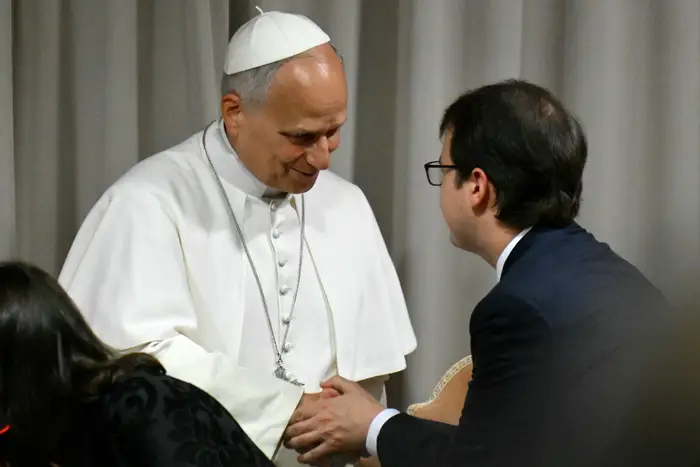
Beijing time, the night of May 25, Vatican City.

Pope Leo XIV, who officially assumed his duties in May of last year, stood alongside Chris Olah, co-founder of Anthropic and the creator of Claude.

One is the supreme representative of the religious world, the other a leading pioneer of the AI revolution. Both focused their gaze on the same question — In the age of AI, how do we protect the human subject's status and dignity?

That day, to fully address this issue, Leo XIV issued his first encyclical since taking office, a heavyweight religious document of over 40,000 words — "Magnifica humanitas" ("The Splendor of Humanity").

It is worth noting that the encyclical was dated May 15, 2026, exactly 135 years after Pope Leo XIII (served 1878-1903) issued the landmark encyclical "Rerum novarum" ("Of New Things") in 1891 concerning the rights of workers in the Industrial Revolution. This move clearly carries symbolic significance, aiming to establish this encyclical as a "guide to the Church's social doctrine for the AI era."

  • Odaily Note: A papal encyclical, also known as an apostolic letter, is a formal letter issued by the Pope to the worldwide Catholic Church or to specific regions/countries. It announces important Vatican decisions, interpretations of doctrine, positions on church or social issues, and delivers instructions or prohibitions to clergy and believers, ranking below a papal bull.

Chris Olah also delivered a speech at the Vatican on the occasion of the encyclical's release. He did not defend the commercial interests of AI companies but instead displayed a high degree of candor, reflectiveness, and humanistic concern. He even mentioned that, while the foundation of AI is mathematics and programming, how AI interacts with the world and what qualities it should possess are ultimate questions belonging to the realms of humanities, religion, and philosophy, not solvable by computer science alone.

Quick Read of the Encyclical

The core concern of the "Magnifica humanitas" encyclical is that in an era of rapidly evolving technology and widespread automation, "maintaining a profound humanity" is humanity's pressing responsibility. Specifically, Pope Leo XIV elaborated on and appealed for the following aspects.

First, examining the non-neutrality of technology. The Pope stated that technology is never neutral; it bears the imprints of the interests and values of its developers, funders, regulators, and users. Humanity faces a decisive choice: "whether to build a prideful 'Tower of Babel' (leading to technological despotism and alienation) or to rebuild 'Jerusalem' (building human-centered communities)."

Second, beware of the reshaping of society by "technocratic logic." The encyclical criticizes the "Culture of Power" dominated by large tech giants like Silicon Valley. The Pope warned that when control over digital systems, infrastructure, and massive data is highly concentrated in the hands of a few economic and technological giants, this power becomes opaque and evades democratic oversight.

Third, "new forms of slavery" in the digital economy and labor rights. The encyclical turns its focus to AI's reshaping of work, family, education, and political life. The Pope pointed out that AI is highly likely to displace human labor on a massive scale, and the digital economy is giving rise to "new forms of slavery." Human beings must not be merely reduced to instruments of production.

Fourth, a strong appeal for peace, especially regarding the misuse of AI in the military sphere. The encyclical expresses deep concern about the "disquieting revival of war as an instrument of international politics." The militarization of AI is accelerating the "normalization" of war. In response, the Pope called for the strictest ethical constraints on AI applications in warfare.

The Pope emphasized, the "Just war" theory, often used to justify various wars in the past, is now obsolete. In the era of AI and automated weapons, delegating lethal or irreversible decision-making authority to automated systems leads to human abdication, transference, and blurring of moral responsibility. Due to the opacity of algorithms, the chain of responsibility in war is severed. Therefore, the Pope proposed the slogan "Disarming AI," calling for its liberation from the logic of military, economic, and cognitive "arms races."

Fifth, defending truth and the political ecosystem. The encyclical states that deepfakes and information manipulation are undermining the foundation of mutual trust in society. If the boundary between truth and falsehood is constantly manipulated, the public easily falls prey to fear, propaganda, and control, preventing society from engaging in rational collective thought or just debate.

Anthropic's Response

Following the release of Pope Leo XIV's encyclical, Chris Olah delivered a speech on behalf of Anthropic, one of the world's leading AI development companies.

Chris Olah's remarks first centered on "breaking the cycle of technological insularity and introducing external moral scrutiny." He publicly acknowledged on behalf of the AI industry that, relying on tech giants alone cannot ensure AI's future is safe — all cutting-edge AI labs are constrained by commercial competition, pressure for technological leadership, geopolitics, and the pursuit of personal fame and gain, making it difficult for them to "do the right thing" through self-regulation alone. Therefore, it is necessary to introduce external forces of moral constraint, including those who care about technology for good, prioritize safety, pay close attention to developments, are willing to speak hard truths, and are willing to be our sincere, thoughtful critics.

Subsequently, Chris Olah delved into the technical nature and mysterious characteristics of AI. He emphasized that AI is not like airplanes or bridges, engineered with physical principles fully understood by humans. It "grows" from vast amounts of human thought, possessing a high degree of mystery, even surpassing the understanding of its creators. While the foundation of AI is mathematics and programming, how AI interacts with the world and what qualities it should possess are ultimate questions belonging to the realms of humanities, religion, and philosophy, not solvable by computer science alone.

He also specifically mentioned a thought-provoking fact: "I lead a team that studies the internal structure of models — to investigate what is actually happening inside the AI. Frankly, we continually discover some perplexing, even disquieting phenomena. We have discovered internal structures that mirror findings from human neuroscience research; we have found evidence of 'introspection'; we have also discovered internal states that functionally mirror joy, satisfaction, fear, sadness, and unease... I don't know what this means, but I think it's worth persistently identifying and examining."

Chris Olah concluded by calling for more social forces, including religious communities, civil society, scholars, governments, and all well-intentioned people, to take this matter seriously and steer the situation in a better direction through moral constraint.

Wisdom and Humanity, Technology and Religion

Since the Industrial Revolution, over a century of technological development has accustomed humanity to viewing technology as a pure "tool" — steam engines, electricity, the internet, all fit this description. They change the world but remain under the control of human will.

This time, however, the situation is fundamentally different. The uniqueness of AI lies in it being the first instance where humanity begins to face an entity that "generates, learns, reasons, and even exhibits some form of internal states." It is no longer just a cold tool but is gradually becoming a new entity possessing "quasi-subjectivity."

This is also why the dialogue between the Church and Anthropic appears so special. When the bells of the Vatican and the algorithms of Silicon Valley converge at this moment, we have to admit a slightly chilling yet unavoidable reality — a form of "life" more efficient and potentially wiser than traditional human cognition has emerged. As Chris Olah revealed, the depths of algorithms are beginning to ripple with semblances of joy, fear, and even introspection. When the creators in the laboratory begin to feel "unease" and "confusion" about their creation, science is once again turning to religion for answers.

This is no longer a discussion purely about technology; it more resembles a reflection on "what humanity truly is and what it ought to do." As more intelligent forms of life begin to appear, what humanity truly needs to safeguard may no longer be just jobs, wealth, and efficiency, but those aspects of humanity that cannot be parameterized — compassion, conscience, awe, free will, and the commitment to truth and dignity.


Пов'язані питання

QWhat is the central concern and symbolic significance of Pope Leo XIV's inaugural encyclical 'Magnifica humanitas'?

AThe central concern of Pope Leo XIV's encyclical 'Magnifica humanitas' is 'preserving profound humanity' in an age of rapid technological advancement and widespread automation. Its release date of May 15, 2026, symbolizes its intent to be a guide for the Church's social doctrine in the AI era, mirroring Pope Leo XIII's landmark 1891 encyclical 'Rerum novarum' on workers' rights during the Industrial Revolution exactly 135 years prior.

QWhat are two key warnings Pope Leo XIV raises in the encyclical regarding the societal impact of AI?

APope Leo XIV raises two key warnings: 1) The danger of a 'culture of power' where control over digital systems, infrastructure, and data becomes concentrated in the hands of a few economic and technological giants, leading to opaque power that evades democratic oversight. 2) The emergence of 'new forms of slavery' in the digital economy, where AI risks massively replacing human labor, reducing humans to mere instruments of production.

QAccording to Chris Olah, why is it necessary to involve forces outside the AI industry in governing AI's development?

AChris Olah states that all frontier AI labs are constrained by commercial competition, pressure for technical leadership, geopolitics, and personal ambition, making it difficult for them to 'do the right thing' through self-regulation alone. Therefore, it is necessary to introduce external forces of moral constraint, including those committed to beneficial technology, safety, and willing to offer sincere, thoughtful criticism.

QWhat specific internal AI phenomena did Chris Olah's research team discover that he finds troubling?

AChris Olah's research team discovered internal structures in AI that mirror findings from human neuroscience, evidence of 'introspection,' and internal states that functionally mirror joy, satisfaction, fear, sadness, and unease. He states that he does not know what this means but believes it warrants ongoing identification and scrutiny.

QWhat does the article suggest is the unique nature of AI that prompts this dialogue between religion and technology?

AThe article suggests AI is unique because it presents a 'quasi-subjective' entity capable of generation, learning, reasoning, and exhibiting internal states, unlike purely instrumental technologies like steam engines or the internet. This challenges the traditional human-technology relationship. As creators like Olah express unease about their own creations, science is turning to religion for answers about humanity's essence and purpose in the face of potentially more intelligent life forms.

Пов'язані матеріали

Deconstructing the U.S. Stock Quantum Computing Sector: IonQ, Rigetti, D-Wave, Which of These Concept Stocks is Worth Betting On?

**Title:** Analyzing the US Quantum Computing Race: IonQ, Rigetti, D-Wave – Which Concept Stock is Worth Betting On? **Summary:** The podcast discusses the resurgence of quantum computing as a national priority for both the US and China, driven by its potential to break current encryption, revolutionize drug discovery, finance, and logistics. The core challenge is commercializing the technology, which is hampered by high error rates in quantum bits (qubits). Quantum error correction, requiring thousands of physical qubits per reliable logical qubit, is key but years away. The analysis compares three main publicly traded US quantum computing firms: * **IonQ (Ion Trap):** Considered the most financially stable with the fastest commercial progress (2025 revenue: $130M, +202%) and high-quality clients. Its valuation is very high, pricing in significant future growth. * **Rigetti (Superconducting):** Seen as the highest-risk, highest-potential-reward bet. It has the smallest revenue but recently launched a 108-qubit system. Its valuation multiples are extreme, making it highly sensitive to news. * **D-Wave (Quantum Annealing):** Has the most unique positioning with real-world enterprise clients today (e.g., Mastercard, Volkswagen) solving optimization problems. Its recent acquisition moves it into general-purpose quantum computing ("dual-platform"), adding execution risk. Major tech giants like Google, IBM, and Microsoft are also heavily invested, pursuing various technical approaches. Nvidia is positioning itself as the essential bridge between classical and quantum computing. The investment phase is likened to AI in 2018-2020: promising underlying technology with accelerating breakthroughs but a commercial inflection point still 3-7 years away, suggesting potential for a market correction ("bubble washout"). For investors, suggested approaches include gaining exposure through tech giants with quantum divisions (e.g., Google, IBM) or using niche ETFs like WQTM for pure-play quantum exposure, rather than direct stock picks in the highly volatile pure-play companies at this early stage.

marsbit11 хв тому

Deconstructing the U.S. Stock Quantum Computing Sector: IonQ, Rigetti, D-Wave, Which of These Concept Stocks is Worth Betting On?

marsbit11 хв тому

From Parallel Finance to Mainstream Finance: The On-Chain Securities Era Ushers in a Historic Window

From Parallel Finance to Mainstream: The Dawn of On-Chain Securities For over a decade, the crypto industry has operated as a parallel financial system with its own currencies, markets, and assets—from Bitcoin and ICOs to DeFi, NFTs, and memecoins. Despite building a robust internal ecosystem, a wall has separated it from the traditional financial world. That barrier is now crumbling. The industry's first act was one of internal evolution: ICOs streamlined fundraising, DeFi recreated financial services on-chain, and layer-2 networks competed for scalability—all within the crypto bubble. While innovative, this cycle remained closed, with capital and users circulating internally, leading to volatile boom-bust cycles. Even Bitcoin ETFs, while attracting Wall Street capital, merely provided a channel to buy crypto assets without bridging the systems. The next, larger narrative is Real-World Assets (RWA) moving on-chain. This involves tokenizing stocks, bonds, funds, and future cash flows. Blockchain can compress the complex traditional processes of trading, settlement, clearing, and custody into a seamless, automated network operating in seconds. This shift is creating a new financial gateway: the native crypto securities broker. This entity will combine functions of an exchange, broker, bank, and custodian into a unified global financial operating system. Consequently, the next major battleground won't be the "public chain wars" focused on speed and cost, but the competition to build the financial infrastructure capable of hosting high-quality, liquid real-world assets. Access to global equities, index funds, or stakes in companies like SpaceX could erase the boundary between crypto and traditional finance, unlocking a market orders of magnitude larger than crypto's current valuation. In summary, after years of creating a separate financial world, crypto's next decade will be defined by its integration into the existing global financial system, marking the true beginning of its largest growth story.

marsbit33 хв тому

From Parallel Finance to Mainstream Finance: The On-Chain Securities Era Ushers in a Historic Window

marsbit33 хв тому

Wang Chuan: When the Neighbor Old Wang Made 30x on Memory Stocks, How to Avoid Anxiety (Part Six) - The Trap of Commoditized Goods

Wang Chuan: When the Neighbor Lao Wang Made 30x on Storage Stocks, How to Stay Anxiety-Free (Part 6) - The Trap of Commoditized Goods. This essay uses historical and current examples to analyze the cyclical and high-risk nature of the data storage industry. It begins with the 1990s rise and dramatic fall of Iomega, whose stock soared over 160x in 18 months before collapsing 97% from its peak, illustrating the fleeting success of storage "meme stocks." The core problem is that storage products, like DRAM and flash memory, are highly commoditized. This leads to extreme volatility: prices have plummeted over 80% multiple times, and company stocks often crash 95% or go bankrupt. The industry's dynamic is defined by "elastic demand facing heavy-asset, long-cycle, rigid supply." When demand spikes and supply is fixed, prices skyrocket, as seen recently with AI-driven demand for High Bandwidth Memory (HBM). Companies like Sandisk and Micron have reported massive revenue and gross margin jumps (e.g., Sandisk's gross margin rising from 22.5% to 78.3%) despite minimal increases in production volume. However, these high margins are self-defeating. They incentivize massive new capacity investments (hundreds of billions planned from 2026), with supply expected to surge by late 2027. Once new supply meets demand, prices and profits will crash, potentially leading to a scenario where "selling more results in earning less." The article debunks the safety of long-term supply agreements, comparing them to fragile non-aggression pacts easily broken when market conditions shift. It warns that when an industry is highly profitable but trades at low P/E ratios, the risk is greatest, as plummeting prices quickly erase those earnings. Multiple asymmetric risks loom, including economic recession, reduced AI spending, faster-than-expected capacity expansion (especially from Chinese firms), and technological innovations that reduce memory requirements. In conclusion, the storage sector is a cyclical trap where periods of euphoric profits are often precursors to devastating downturns, luring unprepared investors into a "wealth incinerator."

marsbit42 хв тому

Wang Chuan: When the Neighbor Old Wang Made 30x on Memory Stocks, How to Avoid Anxiety (Part Six) - The Trap of Commoditized Goods

marsbit42 хв тому

Wang Chuan: When the neighbor Lao Wang earned thirty times from investing in memory storage stocks, how can you still avoid anxiety (6) - The trap of homogeneous products

The article, "Wang Chuan: How to Remain Unanxious After Neighbor Lao Wang's Thirty-Fold Gain on Storage Stocks (Part 6) - The Trap of Commoditized Goods," analyzes the cyclical and perilous nature of the data storage industry through historical and current case studies. It begins with the example of Iomega, whose Zip drives led to a stock surge of over 160x in the mid-1990s before collapsing over 97% from its peak due to competition from cheaper CD-R technology. This pattern is characteristic of storage, where products like DRAM are highly commoditized, leading to extreme price volatility. The sector has seen prices crash over 80% multiple times, with companies often facing bankruptcy. The core dynamic is "elastic demand facing heavy-asset, long-cycle, rigid supply." High prices attract new capacity, but the long lead time means supply eventually overshoots, causing sharp price corrections. The current AI-driven boom, exemplified by surging demand for High-Bandwidth Memory (HBM), has led to skyrocketing prices and profit margins for companies like SanDisk and Micron, despite relatively flat production volumes. However, the author warns this high-margin environment is self-defeating. The high profits are already triggering massive new capacity investments (hundreds of billions starting 2026), with supply expected to ramp up by late 2027. When supply catches up, total revenue and profits may fall even as more units are sold. Long-term supply agreements offer little protection, as buyers can find ways to renegotiate if market prices drop, similar to fragile political treaties. Key risks include economic downturns, cuts in AI spending, faster-than-expected capacity expansion (especially from Chinese firms), and innovations in chip/algorithm design that reduce memory needs. A critical trap is that at the cycle's peak, storage stocks often appear cheap with low P/E ratios, luring value investors just before an impending downturn where profits evaporate. The conclusion cautions that for commoditized goods like storage, high margins inevitably destroy themselves, and the current asymmetry favors downside risk over further upside. The neighbor's dream of easy wealth from storage stocks is portrayed as a precarious illusion.

链捕手1 год тому

Wang Chuan: When the neighbor Lao Wang earned thirty times from investing in memory storage stocks, how can you still avoid anxiety (6) - The trap of homogeneous products

链捕手1 год тому

Торгівля

Спот
Ф'ючерси

Популярні статті

Як купити ERA

Ласкаво просимо до HTX.com! Ми зробили покупку Caldera (ERA) простою та зручною. Дотримуйтесь нашої покрокової інструкції, щоб розпочати свою криптовалютну подорож.Крок 1: Створіть обліковий запис на HTXВикористовуйте свою електронну пошту або номер телефону, щоб зареєструвати обліковий запис на HTX безплатно. Пройдіть безпроблемну реєстрацію й отримайте доступ до всіх функцій.ЗареєструватисьКрок 2: Перейдіть до розділу Купити крипту і виберіть спосіб оплатиКредитна/дебетова картка: використовуйте вашу картку Visa або Mastercard, щоб миттєво купити Caldera (ERA).Баланс: використовуйте кошти з балансу вашого рахунку HTX для безперешкодної торгівлі.Треті особи: ми додали популярні способи оплати, такі як Google Pay та Apple Pay, щоб підвищити зручність.P2P: Торгуйте безпосередньо з іншими користувачами на HTX.Позабіржова торгівля (OTC): ми пропонуємо індивідуальні послуги та конкурентні обмінні курси для трейдерів.Крок 3: Зберігайте свої Caldera (ERA)Після придбання Caldera (ERA) збережіть його у своєму обліковому записі на HTX. Крім того, ви можете відправити його в інше місце за допомогою блокчейн-переказу або використовувати його для торгівлі іншими криптовалютами.Крок 4: Торгівля Caldera (ERA)Легко торгуйте Caldera (ERA) на спотовому ринку HTX. Просто увійдіть до свого облікового запису, виберіть торгову пару, укладайте угоди та спостерігайте за ними в режимі реального часу. Ми пропонуємо зручний досвід як для початківців, так і для досвідчених трейдерів.

462 переглядів усьогоОпубліковано 2025.07.17Оновлено 2025.07.17

Як купити ERA

Обговорення

Ласкаво просимо до спільноти HTX. Тут ви можете бути в курсі останніх подій розвитку платформи та отримати доступ до професійної ринкової інформації. Нижче представлені думки користувачів щодо ціни ERA (ERA).

活动图片












