The Fall of the $70 Million Myth: How NFTs Went from Auction House to Walmart Shelves

比推Опубліковано о 2026-01-06Востаннє оновлено о 2026-01-06

Анотація

The NFT market has experienced a dramatic decline from its peak, marked by the cancellation of NFT Paris 2025 and a significant drop in market value. Total NFT supply surged by 35% in 2025, while sales fell 37% to $5.63 billion, and the market capitalization plummeted 86% from its 2022 high. Average sale prices dropped to $96, down 75% from the bull market. Even blue-chip NFTs like CryptoPunks and Bored Ape Yacht Club saw floor prices fall by 78% and 83%, respectively. Major platforms like OpenSea are pivoting away from pure NFT trading, with some shutting down entirely. Amid the downturn, Pudgy Penguins emerged as a success story by leveraging its IP for physical consumer products, generating an estimated $50 million annually through retail partnerships with Walmart and others. Its brand-focused strategy, including high-profile advertising, boosted secondary market activity. Meanwhile, NFTs are finding utility in real-world applications, such as tokenized physical assets (e.g., Courtyard’s Pokémon cards) and functional use cases like FIFA’s anti-scalping tickets for the 2026 World Cup. The speculative frenzy around NFTs as standalone financial assets has ended, but the technology persists as a practical tool for verification, ownership, and integration into broader ecosystems—signaling a shift from hype to utility.

Author: Sanqing, Foresight News

Original Title: From the $70 Million Myth to $9 Dolls, Are NFTs Really "Dead"?


On January 5, the NFT Paris developer conference, originally scheduled for February, was suddenly canceled. The banks of the Seine, once alive with all-night parties, are now left with only a cold official tweet: "The market crash has hit us hard. Even with aggressive cost-cutting measures, we are still unable to sustain it."

Five years ago, digital artist Beeple's work "Everydays: The First 5000 Days" sold for a staggering $69.3 million at Christie's auction house. This was followed by CryptoPunks fetching tens of millions and countless digital collectibles backed by mainstream institutions—it was the golden age of NFTs.

From a record-breaking auction sale to a forced industry conference cancellation, NFTs have completed a full cycle from frenzy to reckoning in just five years.
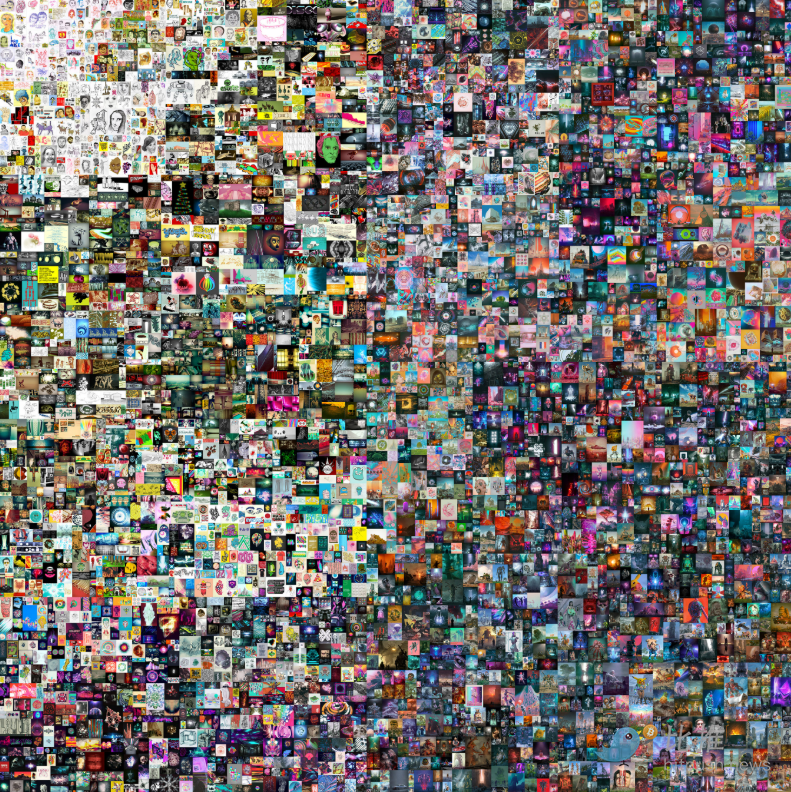
Image – Everydays: The First 5000 Days NFT

Imbalance in NFT Market Supply and Demand

Supply Explosion. According to CryptoSlam data, the supply in 2025 increased by 35% compared to 1 billion in 2024. Over the past four years, the total number of NFTs has skyrocketed from 38 million to 1.34 billion, a growth of approximately 3,400%.

Sales Shrinkage. According to CryptoSlam data, the total NFT sales in 2025 were approximately $5.63 billion, a 37% decrease from $8.9 billion in 2024. According to CoinGecko data, the total NFT market capitalization fell from a peak of about $17 billion in April 2022 to about $2.4 billion by the end of 2025, a drop of about 86%. In 2025 alone, the total NFT market capitalization shrank from about $9.2 billion in January to its year-end size, a staggering 68% drop for the year.

Liquidity Dilution. As the barrier to minting lowered, the market entered a "high-frequency, low-price" mode. According to CryptoSlam data, the average transaction price has fallen from $124 in 2024 to $96 by the end of 2025. Compared to the average transaction price of over $400 during the peak of the 2021-2022 bubble, it has lost three-quarters of its value.
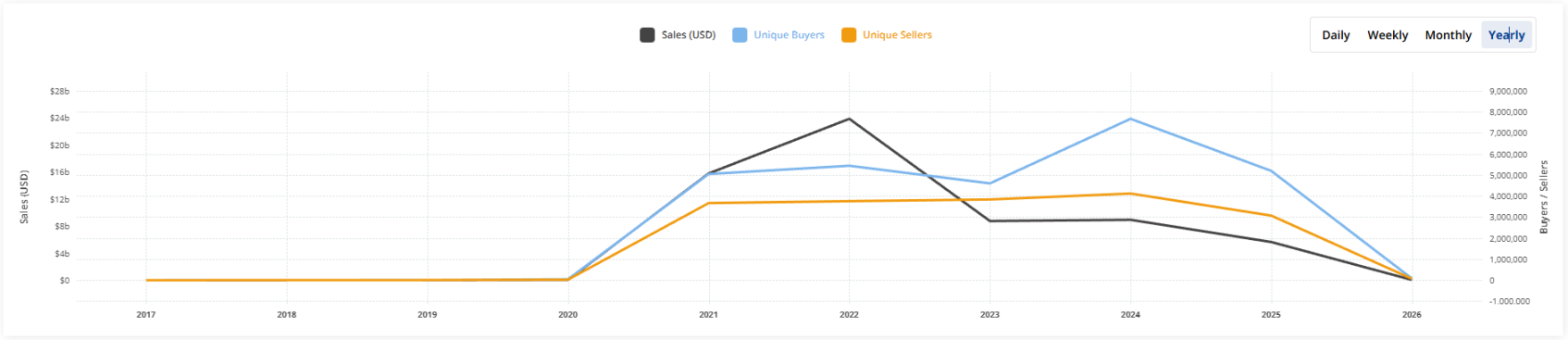
Image Source: CryptoSlam

Even former top-tier NFT projects and blue-chip NFTs couldn't escape the downturn. Taking CryptoPunks as an example, the floor price has fallen to about 30 ETH, down 78% from its peak of 125 ETH in 2021; Bored Ape Yacht Club (BAYC) fell 83% from about 30 ETH to about 5 ETH; Azuki dropped 93% from about 12 ETH to 0.8 ETH.

Collective "Flight" and Evolution of Platforms

The moves of industry leaders signal the end of this cycle.

OpenSea, once the undisputed leader in the NFT marketplace, saw its platform revenue drop from $50-120 million per month during the NFT golden age to less than one million.

Consequently, OpenSea announced a pivot, transforming from a pure "NFT marketplace" to a universal on-chain trading center for "Trade Everything," encompassing physical collectibles and digital assets like tokens, and confirmed it will issue a token.

Blur, which debuted at its peak, has seen its TVL continuously hit new lows, and its token price is down 99% from its high.

Then there's Magic Eden, which rose to prominence on the Solana chain. After a year of operation, it issued a token. Affected by the NFT market sentiment and the realization of airdrop expectations, platform trading volume began to shrink, and its token price also fell over 98% from its high.

Even projects that couldn't keep up with the changing times, like the older NFT marketplace X2Y2, have been eliminated, ceasing operations entirely, with the team shifting to the AI field.

From "Token" to "Brand"

Amid the widespread gloom, Pudgy Penguins has successfully bucked the trend, becoming an outlier in the industry. Its success does not rely on complex innovations in token technology or short-term speculative hype, but rather on transforming digital IP into physical consumer goods, gradually building a sustainable brand ecosystem that bridges Web3 and traditional retail.

Through the dual revenue model implemented by CEO Luca Netz, Pudgy Penguins deeply integrates IP licensing with physical goods. Its physical toys are now available in over 10,000 retail channels globally, including Walmart, Target, and Walgreens. According to an AInvest report, this transformation has brought the project approximately $50 million in annual revenue, effectively offsetting the impact of the overall crypto market contraction.
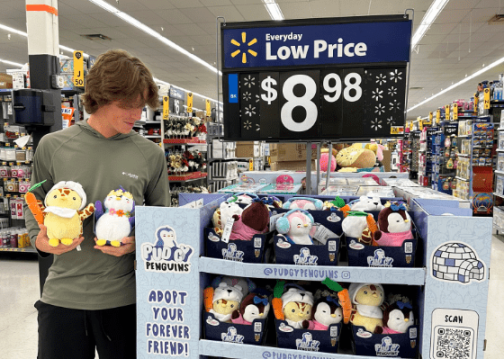
Image – Pudgy Penguins toy shelf in a US Walmart

During the 2025 Christmas season, Pudgy Penguins spent approximately $500,000 to project a giant animation on the Las Vegas landmark Sphere.
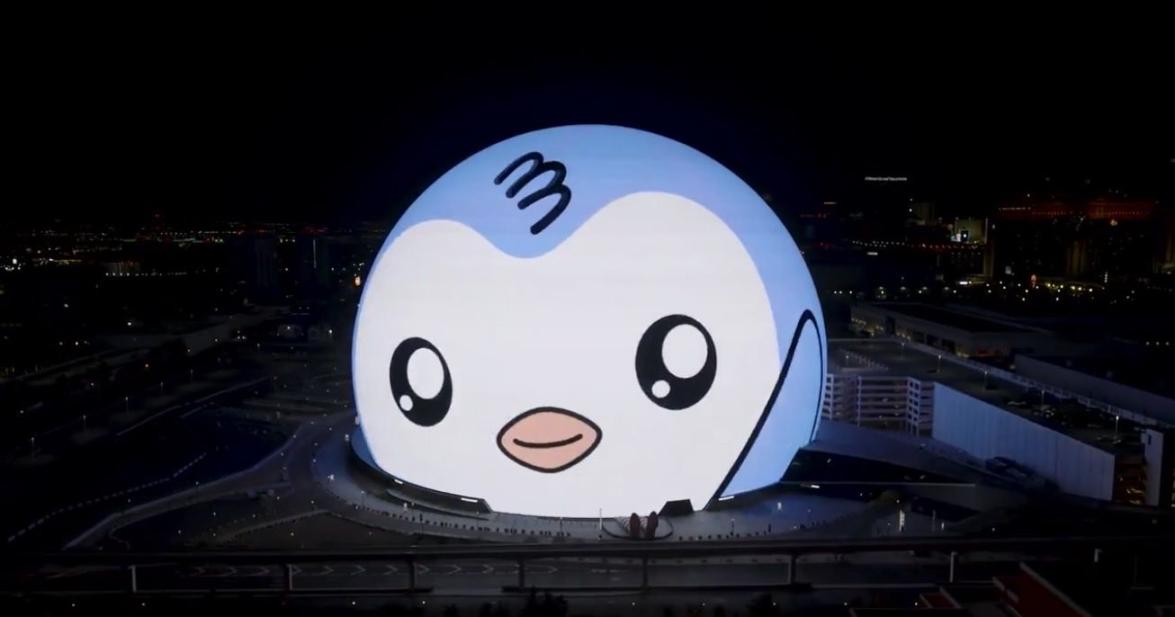
Image – Pudgy Penguins形象 on the Sphere

This advertisement, seen by millions of tourists, avoided crypto jargon and the term NFT, presenting only a family-friendly IP image. This brand exposure, in turn, stimulated liquidity in the secondary market. Over the past 14 days, the floor price of this NFT has risen 25%, and trading volume has increased by about 33%.

This shift from speculation to cultural operation seems to be becoming a consensus among industry survivors. Last May, Yuga Labs, the publisher of Bored Ape Yacht Club (BAYC), transferred the IP rights of the top NFT project CryptoPunks to the non-profit Infinite Node Foundation, aiming to strip it of its speculative, price-volatile nature and seek longer-term artistic preservation and cultural operation.

Physical Backing and Functional Return

Beyond IP branding, NFTs are becoming the underlying tool for connecting real-world assets (RWA).

Physical Card Trading. The platform Courtyard.io is changing the game. They deposit real Pokémon cards into certified vaults and tokenize them as NFTs. In the 30 days leading up to the end of 2025, the platform processed over 230,000 transactions, generating approximately $12.7 million in sales, demonstrating strong market appetite for this type of highly liquid, physically-backed asset.

Functional Tickets. FIFA (Fédération Internationale de Football Association) has also joined this trend, introducing "Priority Purchase Right" NFTs for ticket sales for the 2026 World Cup. These NFTs are not for speculation but serve as a verification tool to prevent scalper premiums and price gouging in the secondary market.

What Died in NFTs, and What Remains

NFTs are not "completely dead," but they have indeed died once.

What died is the fantasy of viewing NFTs as a financial asset that could be endlessly minted and traded based solely on narrative, detached from real-world value. In the face of infinite supply and limited demand, this path was destined to be unsustainable.

What remains is NFT's role as a "credential layer." It is no longer expected to create value alone but is embedded within IP brands, physical assets, and functional scenarios,承担ing the basic functions of rights confirmation, transfer, participation, and verification.

From Pudgy Penguins' toy shelves, to the on-chain flow of physical cards, to the anti-scalping mechanisms for World Cup tickets, NFTs are stepping down from the speculative stage and returning to the toolbox.

For the NFT speculative market, this is undoubtedly a winter. But for NFTs themselves, this is more like a rebirth after disenchantment.


Twitter:https://twitter.com/BitpushNewsCN

Bitpush TG Discussion Group:https://t.me/BitPushCommunity

Bitpush TG Subscription: https://t.me/bitpush

Original link:https://www.bitpush.news/articles/7600451

Трендові криптовалюти

Пов'язані питання

QWhat was the peak auction price of Beeple's NFT 'Everydays: The First 5000 Days' and what does its current market state symbolize?

ABeeple's NFT 'Everydays: The First 5000 Days' was sold for $69.3 million at Christie's auction house. The current state of the NFT market, including the cancellation of events like NFT Paris, symbolizes the complete cycle from狂热 (frenzy) to清算 (liquidation) over a five-year period.

QAccording to data from CryptoSlam, how did the supply and sales volume of NFTs change in 2025 compared to previous years?

AIn 2025, the supply of NFTs increased by 35% compared to 2024's 1 billion, while the total sales volume dropped by 37% from $8.9 billion to approximately $5.63 billion. The total market capitalization also fell by about 86% from its peak in April 2022.

QHow did major NFT platforms like OpenSea and Blur perform in the declining market, and what changes did they make?

AOpenSea's monthly revenue dropped from $50-120 million during the NFT golden age to less than $1 million, leading it to转型 (transform) into a general on-chain trading center for all types of assets. Blur's TVL hit new lows, and its token price fell by 99% from its peak.

QWhat strategy did Pudgy Penguins use to achieve success despite the overall market downturn?

APudgy Penguins succeeded by transforming its digital IP into physical consumer goods, adopting a dual revenue model that combines IP licensing with physical products. Its toys are now sold in over 10,000 retail stores globally, generating an estimated $50 million in annual revenue.

QWhat new practical applications for NFT technology are emerging, as mentioned in the article?

ANew practical applications include platforms like Courtyard.io, which tokenizes physical assets like Pokémon cards as NFTs for high-liquidity trading, and FIFA's use of NFTs as 'priority purchase right' tickets for the 2026 World Cup to prevent scalping and price fraud in the secondary market.

Пов'язані матеріали

Zoomex X Space Recap With David James and the World Cup Trading Panel

Zoomex hosted a World Cup-themed X Space featuring England goalkeeper David James and a panel of traders. The discussion, part of a charity pledge, drew parallels between goalkeeping and trading, focusing on preparation, psychology, and execution. James emphasized that pressure for a goalkeeper comes during periods of inactivity, not sustained attack, and highlighted the importance of concentration. He described two modes for penalty saves: meticulous preparation using data on shooters, and instinct, which is improved by information—a concept traders directly related to market analysis. He discussed how elite preparation turns instinct into trained execution, making spectacular saves feel like practiced outcomes rather than miracles. Errors are now treated as data for correction, not lingering ghosts. James analyzed tournament threats, noting France's exceptional speed across the pitch and suggesting that teams like Mexico and Spain, yet to concede, face a psychological test. On England's chances, James was unequivocal, predicting they would win and nominating the UEFA Foundation for the associated charity donation. The session consistently linked thorough preparation in both football and trading to controlling emotions and executing under pressure, with the core lesson being that preparation eliminates nervousness by replacing unknowns with a plan.

TheNewsCrypto1 год тому

Zoomex X Space Recap With David James and the World Cup Trading Panel

TheNewsCrypto1 год тому

Unitree's IPO Frenzy: The Real Mystery is How It Will Spend the 42 Billion Raised

Unitree, a Chinese robotics company, is set for a public listing after its IPO registration was approved by regulators. The company, which started with quadruped robots and has expanded into humanoids, plans to raise approximately 4.2 billion yuan through its offering. The article traces Unitree's rapid growth from its founding in 2016 to its current status. It highlights key milestones like the 2021 CCTV Spring Festival Gala performance, the 2023 launch of its affordable Go2 robot dog and the H1 humanoid robot, and a series of subsequent product launches. By 2025, the company reported revenue of 1.71 billion yuan, profitability, and sales exceeding 5,500 humanoid robots. As the first publicly-listed humanoid robot company on China's STAR Market, Unitree's main challenges are sustaining growth and deploying its newly raised capital effectively. The humanoid robot sector in China is crowded, with over 140 companies. Competitors include UBTech (focusing on industrial and consumer markets), Fourier, and international players like Tesla Optimus and 1X NEO. The article outlines three critical challenges for Unitree: establishing a strong second product line beyond its quadruped robots, maintaining its price advantage while ensuring quality, and successfully advancing its embodied AI capabilities through partnerships like the one with NVIDIA for the H2 Plus platform. Unitree's likely strategy involves a "developer tools + industry benchmarks" approach: using low-cost models like the R1 and G1 to build developer adoption and volume, leveraging high-end platforms for AI training, and securing pilot projects in sectors like logistics and manufacturing to build case studies. The company's future success hinges on converting its current momentum in shipments and pilot programs into sustainable, large-scale commercial contracts as the broader market evolves.

marsbit1 год тому

Unitree's IPO Frenzy: The Real Mystery is How It Will Spend the 42 Billion Raised

marsbit1 год тому

Examining the Open USD Partner Lineup: Follow Who's Joining to See Where the Money Flows

**Title: Deciphering the Open USD Partner Roster: Following the Money** The launch of Open USD is notable less for the stablecoin itself and more for its expansive list of over 140 founding partners, which reads like a "who's who" of global finance and tech. This coalition, including asset managers like BlackRock, card networks Visa and Mastercard, banks (BNY Mellon, Standard Chartered, etc.), tech giants (Google, IBM), merchants (Shopify), and crypto firms (Coinbase, Ripple, Aave, MetaMask), signals a strategic shift. The diverse membership reveals that stablecoins are increasingly viewed not as products to compete over, but as shared infrastructure too critical to be left to any single entity. Each partner category has distinct motives. Asset managers like BlackRock seek to manage the large, sticky cash reserves, a lucrative fee-generating opportunity. Merchants like Shopify aim for lower-cost settlement and potential yield on balances. Banks join defensively to retain custody and settlement roles, fearing deposit outflows to stablecoins. Tech companies bet on programmable money for future machine-to-machine commerce. Crypto firms gain mainstream legitimacy and distribution channels. Remarkably, the consortium includes direct competitors (Visa vs. Mastercard, Coinbase vs. Ripple), indicating that the fear of exclusion from this emerging financial layer outweighs competitive rivalries. However, this shared governance could also lead to slow decision-making. The roster's composition is the real message: it represents a collective bet that a widely accepted, consortium-owned stablecoin is preferable to proprietary versions or having none at all. For incumbents like Circle and Tether, this alliance poses a significant threat, as potential clients have collectively chosen to build their own alternative. The absence of major U.S. retail banks (busy with their own tokenized deposit networks) is equally telling. In essence, the partner list maps where the industry believes value and risk will flow in a tokenized dollar future, marking stablecoin's evolution from a product to a utility.

Foresight News1 год тому

Examining the Open USD Partner Lineup: Follow Who's Joining to See Where the Money Flows

Foresight News1 год тому

Торгівля

Спот

Популярні статті

Як купити HOUSE

Ласкаво просимо до HTX.com! Ми зробили покупку Housecoin (HOUSE) простою та зручною. Дотримуйтесь нашої покрокової інструкції, щоб розпочати свою криптовалютну подорож.Крок 1: Створіть обліковий запис на HTXВикористовуйте свою електронну пошту або номер телефону, щоб зареєструвати обліковий запис на HTX безплатно. Пройдіть безпроблемну реєстрацію й отримайте доступ до всіх функцій.ЗареєструватисьКрок 2: Перейдіть до розділу Купити крипту і виберіть спосіб оплатиКредитна/дебетова картка: використовуйте вашу картку Visa або Mastercard, щоб миттєво купити Housecoin (HOUSE).Баланс: використовуйте кошти з балансу вашого рахунку HTX для безперешкодної торгівлі.Треті особи: ми додали популярні способи оплати, такі як Google Pay та Apple Pay, щоб підвищити зручність.P2P: Торгуйте безпосередньо з іншими користувачами на HTX.Позабіржова торгівля (OTC): ми пропонуємо індивідуальні послуги та конкурентні обмінні курси для трейдерів.Крок 3: Зберігайте свої Housecoin (HOUSE)Після придбання Housecoin (HOUSE) збережіть його у своєму обліковому записі на HTX. Крім того, ви можете відправити його в інше місце за допомогою блокчейн-переказу або використовувати його для торгівлі іншими криптовалютами.Крок 4: Торгівля Housecoin (HOUSE)Легко торгуйте Housecoin (HOUSE) на спотовому ринку HTX. Просто увійдіть до свого облікового запису, виберіть торгову пару, укладайте угоди та спостерігайте за ними в режимі реального часу. Ми пропонуємо зручний досвід як для початківців, так і для досвідчених трейдерів.

388 переглядів усьогоОпубліковано 2025.04.27Оновлено 2026.06.02

Як купити HOUSE

Обговорення

Ласкаво просимо до спільноти HTX. Тут ви можете бути в курсі останніх подій розвитку платформи та отримати доступ до професійної ринкової інформації. Нижче представлені думки користувачів щодо ціни HOUSE (HOUSE).

活动图片