The Era of On-Chain Voting Is Here: Do Your Stocks Truly 'Belong' to You?

marsbitОпубліковано о 2026-04-10Востаннє оновлено о 2026-04-10

Анотація

The era of on-chain shareholder voting is approaching, as Galaxy Digital (GLXY) pioneers the first-ever on-chain voting for a public company, scheduled for its 2026 annual meeting. This initiative, developed in partnership with fintech firm Broadridge on the Avalanche blockchain, aims to transform tokenized stocks from mere "digital IOUs" into full-fledged equity with complete voting and dividend rights. The move addresses a critical flaw in traditional finance exposed during the 2021 GameStop saga: the disconnect between nominal ownership and actual shareholder rights due to multi-layered intermediation. Broadridge’s solution enables direct, transparent, and immutable voting via digital wallets, eliminating inefficiencies and opacity in the current proxy system. Key features include multi-chain auditability, a streamlined voting interface, and real-time transparency, which could empower retail and institutional investors alike. While this innovation promises greater shareholder engagement and governance transparency, the IMF warns of potential risks, such as accelerated crisis propagation due to blockchain’s settlement speed. Widespread adoption still faces hurdles, including regulatory uncertainty, resistance from traditional financial intermediaries, and technical barriers for users. However, with major players like Nasdaq and Blackrock advancing tokenization efforts, on-chain voting could mark a significant step toward authentic ownership and shareholder-centric cap...

Remember the轰轰烈烈的"GameStop (GME) retail investors versus Wall Street" battle in 2021? At that time, countless retail investors bought GME through platforms like Robinhood, aiming to counter short-selling institutions. But a dramatic scene unfolded: multiple brokerages temporarily restricted buying, allowing only selling. Many angry investors questioned: I paid for these stocks, why can't I decide how to trade them? This exposed the rights gap between retail investors as "nominal holders" and "actual beneficiaries" in the traditional financial system.

Today, a deeper transformation is taking place, one that could fundamentally solve this problem. Recently, led by cryptocurrency investment bank Galaxy Digital (GLXY), the world's first on-chain shareholder voting for a publicly traded company is set to occur at its annual meeting in May 2026. This is not just a technical experiment; it signifies that tokenized stocks are evolving from "digital replicas" into "true equity" with full shareholder rights, potentially reshaping the corporate governance landscape for decades to come.
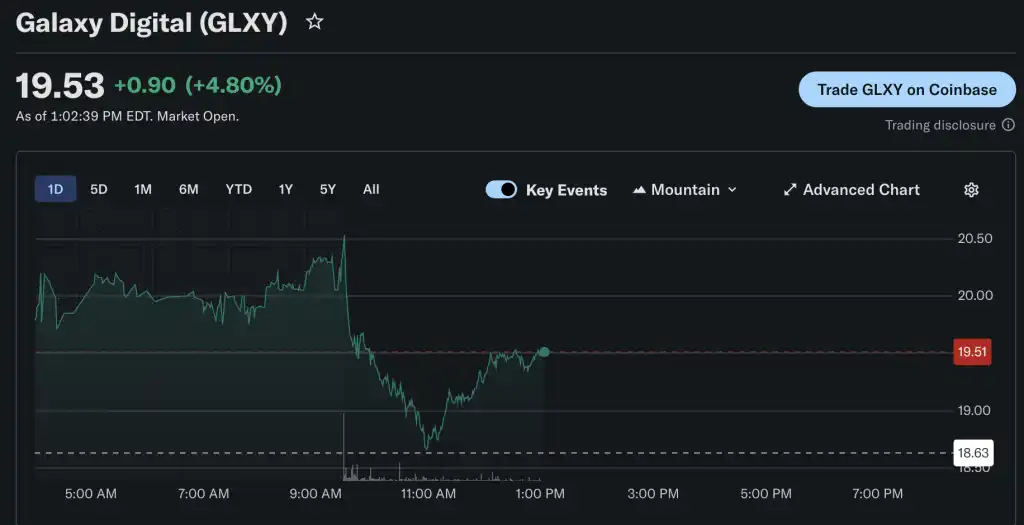
From "Digital IOU" to "True Equity": The Coming of Age for Tokenized Assets

Over the past few years, we have witnessed the evolution of tokenized real-world assets (RWA) from concept to infrastructure. From U.S. Treasury bonds to real estate funds, various assets have been "moved" onto the blockchain. But tokenized stocks have long had an awkward "original sin": many were more like "digital IOUs" tracking stock prices or synthetic derivatives, with holders not enjoying core shareholder rights such as voting rights and dividend rights.

This might be unimportant for retail investors seeking stable returns, but for institutional investors bound by fiduciary duties (such as pension funds, mutual funds), it is a fatal flaw. They cannot invest client funds into a "pseudo-equity" without a voice. Therefore, tokenized stocks have long remained in niche trading scenarios, struggling to gain favor from mainstream institutions.

Galaxy Digital's collaboration with fintech giant Broadridge aims to pierce through this layer. Through a dedicated platform built on the Avalanche blockchain, holders of tokenized GLXY stock will be able to receive meeting materials and submit votes directly from their digital wallets. As Galaxy CEO and Wall Street legend Mike Novogratz stated: "Proxy voting is a core function of equity ownership. Enabling on-chain proxy voting for public companies is no longer a theoretical discussion."

This reminds me of my experience investing in certain Stock Connect (Hong Kong) targets. As a mainland investor, the process for participating in shareholder meeting votes was so cumbersome that it made one give up. The directness, transparency, and immutability brought by on-chain voting are the perfect remedy for such pain points.

Dissecting the "On-Chain Voting" Engine: How Transparency Defeats the "Black Box"?

Broadridge's solution is crucial because it directly addresses the core chronic problems of the traditional proxy voting system: opacity and inefficiency.

Under the current "street name" holding system centered around the Depository Trust Company (DTC), your stock may pass through multiple intermediaries like brokers, custodian banks, and clearinghouses before being registered. Your voting instruction is like a letter needing to be forwarded through multiple post offices; delays or losses at any point could prevent your voice from being heard at the shareholder meeting. Historically, cases of "vote reconciliation failure" due to this are not uncommon.

Broadridge's on-chain platform does three smart things:

  1. Direct Wallet Voting: Voting materials go directly to your digital wallet, and the voting action is completed on-chain. The path is the shortest, with no intermediaries to "cause trouble".
  2. Multi-Chain Auditing: Voting records are not stored on a single chain but are distributed across multiple chains for auditing. This is like storing meeting minutes simultaneously in a bank vault, a court archive, and the cloud. Anyone can trace and verify, greatly enhancing credibility.
  3. Unified Interface: Regardless of whether your stock is held via direct registration, through a broker, or in tokenized form, all voting data is aggregated in one interface. This solves the problem of rights fragmentation due to different holding methods.

According to data disclosed by Broadridge, its platform currently handles a monthly volume of tokenized assets reaching $8 trillion, processing over 70 billion investor communications annually. This is no longer a "small-scale test" but financial-grade infrastructure tested by massive transaction volumes. Its CEO Tim Gokey views precise and low-cost governance tools as a prerequisite for the large-scale institutional adoption of tokenized stocks, not an afterthought.

Opportunities and Undercurrents: When Corporate Governance Enters the "Live Broadcast Era"

The proliferation of on-chain voting will push corporate governance from "black box meetings" towards "transparent live broadcasts." Imagine the voting process for all major resolutions (like board elections, M&A deals, executive compensation) being real-time queryable and immutable. This would greatly reduce the information asymmetry that currently exists between registered shareholders and beneficial owners.

For active investors and activist shareholders, this is undoubtedly good news. They can more precisely aggregate voting power to drive strategic changes in companies. For listed companies, this is also a spur, forcing management to pay more attention to communication with all shareholders (especially small shareholders).

However, the International Monetary Fund (IMF) issued a sober warning in a recent report. It pointed out that tokenized finance could amplify financial crises by accelerating the transmission of market stress, as blockchain settlement speeds could outpace regulators' response times. This risk channel becomes more relevant when both governance and settlement functions migrate to shared blockchain infrastructure.

This is not alarmist. If a company's controversial resolution is quickly passed and executed via on-chain voting, market panic and selling could also spread at the speed of light. Therefore, programmable regulation (such as setting voting cooling-off periods, delayed settlement for large transactions) must develop in sync with technological innovation.

Future Outlook: Who Will Follow? What Are the Obstacles?

Galaxy Digital fired the first shot, but who is next? This is key to determining whether this transformation will be a "solo performance" or a "grand chorus."

Broadridge's platform is designed from the outset to support multiple issuers; it's not tailor-made for Galaxy. Nasdaq has received SEC approval to pilot a tokenized securities trading program, and the New York Stock Exchange is also partnering with Securitize to prepare for launching a digital trading platform. The infrastructure is falling into place.

But widespread adoption still faces obstacles:

  • Regulatory Clarity: Despite pilots, a comprehensive regulatory framework for on-chain securities issuance, trading, and governance is still under construction.
  • Traditional Interest Structures: The existing proxy voting, clearing, and settlement systems involve vast networks of interests, and change will inevitably meet resistance.
  • Technical Threshold and Security: Ordinary investors still need to learn to manage private keys and use wallets; security risks like smart contract vulnerabilities and wallet theft cannot be ignored.

From my personal market observation, since 2024, the scale of tokenized funds issued by asset management giants like BlackRock and Fidelity has continued to grow, indicating institutional capital is quietly entering the market in the form of "asset tokenization." This paves the way for "equity tokenization." Once a few benchmark tech or financial companies follow Galaxy's lead, creating a cluster effect, a tipping point could arrive quickly.

Conclusion: Your Investment, Your Rights

Ultimately, Galaxy Digital's on-chain voting experiment is about a most fundamental principle: the authenticity of ownership. In the digital age, what we invest in is not just a string of price codes, but should also be a clear, complete, and executable certificate of rights.

This transformation will not happen overnight; it will advance amidst applause, controversy, and磨合. But for every investor, it means that in the future, we might truly be able to participate more directly in the fate of the companies we invest in, as "owners." When every vote you cast is clearly recorded on-chain like an inscription, the capital market will have taken a major step towards the ideal of "shareholder primacy." Of course, while embracing new technology, we must also remain清醒 about the new risks that come with it—this is always the unerring rule of investing.


Пов'язані питання

QWhat is the core issue exposed by the GameStop (GME) event in 2021 regarding retail investors?

AThe event exposed the rights gap between retail investors as 'nominal holders' and 'beneficial owners' in the traditional financial system, where their ability to trade was restricted despite owning the shares.

QWhat significant milestone is Galaxy Digital (GLXY) achieving in 2026, and why is it important?

AGalaxy Digital is conducting the world's first on-chain shareholder voting for a public company in May 2026. This is important because it evolves tokenized stocks from mere 'digital replicas' into 'true equity' with full shareholder rights, potentially reshaping corporate governance.

QHow does Broadridge's on-chain voting platform address the problems of traditional proxy voting systems?

AIt addresses opacity and inefficiency by enabling direct voting from digital wallets (shortest path, no intermediaries), distributing voting records across multiple chains for auditability, and providing a unified interface to aggregate votes from different holding methods.

QWhat potential downside or risk does the IMF report highlight regarding tokenized finance and on-chain governance?

AThe IMF warns that tokenized finance could amplify financial crises by accelerating the transmission of market stress, as blockchain settlement speeds may outpace regulatory responses, especially when governance and settlement functions share the same infrastructure.

QWhat are some key obstacles to the widespread adoption of on-chain voting and tokenized securities?

AKey obstacles include the need for clearer comprehensive regulatory frameworks, resistance from existing traditional financial利益格局 (interest networks), and challenges like technical barriers for investors (e.g., managing private keys) and security risks (e.g., smart contract vulnerabilities).

Пов'язані матеріали

TechFlow Intelligence: Trump-Linked Companies Transfer $12 Million in Assets Before China Visit, 'The Big Short' Protagonist Warns of Stock Market Bubble Again

The article reports multiple developments across tech, crypto, and finance. In AI, Mozilla used AI for large-scale code review, Google confirmed hackers used AI to find zero-day exploits, and OpenAI deployed GPT-5.5 to find errors in math benchmarks. A court ruled Anthropic's scanning and destroying books for AI training as fair use, while its Claude platform launched on AWS. Google's new video model 'Omni' was leaked. In crypto/Web3, Trump-linked companies transferred $12M in crypto assets before a China visit. BlackRock chose Ethereum for tokenized funds, and a hacker stole $174k via a malicious NFT that tricked an AI. Jack Dorsey's first tweet NFT plummeted from $2.9M to under $5. In chips/hardware, TSMC approved an additional $20B for its Arizona plant. Apple's Tim Cook and Elon Musk will accompany Trump to China, while Nvidia's Jensen Huang is notably absent. For markets, Michael Burry warned of parabolic stock rises and suggested near-total sell-offs, with online discussions comparing current sentiment to the 1999 bubble. Other notes include WTI oil surpassing $100, a 20% price hike for Beijing-Shanghai high-speed rail, and new products like Unitree's $26.9k humanoid robot. The underlying theme suggests AI is becoming infrastructure, creating pressure on old systems while a new order is not yet ready, leaving investors anxious.

marsbit5 хв тому

TechFlow Intelligence: Trump-Linked Companies Transfer $12 Million in Assets Before China Visit, 'The Big Short' Protagonist Warns of Stock Market Bubble Again

marsbit5 хв тому

2026 New Policy Interpretation: The "Mutual Pursuit" of Intelligent Agents and AI Terminals, and the Three Major Value Reconstructions in the AIoT Industry

In May 2026, China's national ministries released two pivotal policy documents that jointly establish a strategic "dual-track" framework for the AIoT industry. The "Intelligent Agent Standardized Application and Innovation Development Implementation Opinions" defines the "soul"—positioning intelligent agents as core AI products. The "Artificial Intelligence Terminal Intelligence Grading" national standard defines the "body"—establishing a four-tier capability ladder (L1 to L4) for AI hardware. This synchronized policy approach is globally unique, moving beyond market-led (US) or risk-focused (EU) models. It frames AIoT as a new type of "intelligent infrastructure," comparable to electricity or the internet in historical significance. The core analysis identifies a value evolution from IoT 1.0 (connection) to AIoT 4.0 (collaboration, represented by the forward-looking L4 level). This "L4" signifies a paradigm shift: from users operating tools to delegating tasks to agent-like devices ("Intelligent Action of All Things"). The article outlines three strategic paths for companies: becoming Standard Definers, Scenario Integrators (focusing on 19 specified application areas), or Infrastructure Builders. A critical 18-24 month window is identified for strategic positioning. A "Four Levers" strategy is proposed: leveraging Standards (L-level certification), leveraging Scenarios (deep vertical focus), leveraging Open Source (for cost reduction and ecosystem influence), and leveraging Momentum (engaging in global protocol ecosystems). In conclusion, these policies are a starting gun for a decade-long industrial transformation, shifting the industry narrative from "Intelligent Connection of All Things" to "Intelligent Action of All Things," with companies needing to choose their赛道and execution strategy decisively.

marsbit1 год тому

2026 New Policy Interpretation: The "Mutual Pursuit" of Intelligent Agents and AI Terminals, and the Three Major Value Reconstructions in the AIoT Industry

marsbit1 год тому

Splashing Out 27 Billion Yuan, OpenAI Establishes New Company to Accelerate AI Deployment

On May 11th, OpenAI announced the formation of a new company, "OpenAI Deployment Company," with an initial investment of over $4 billion (approximately 27.2 billion RMB). This venture aims to help businesses build and deploy AI solutions. OpenAI is also acquiring the AI consulting firm Toromo to rapidly scale the deployment company's capabilities. This new entity, majority-owned by OpenAI, brings together 19 investment, consulting, and system integration partners, led by TPG with co-lead founding partners including Advent International, Bain Capital, and Brookfield. OpenAI's Chief Revenue Officer, Denise Dresser, stated that while AI is becoming increasingly capable, the current challenge lies in integrating these systems into core business infrastructure and workflows. The deployment company is designed to bridge this gap and translate AI capabilities into operational impact. This move comes as OpenAI emphasizes the next competitive phase will depend on the efficiency of deploying AI in real business scenarios. The company reports over 1 million businesses already use its products and APIs. OpenAI is significantly increasing its investments in computing power, with co-founder Greg Brockman stating the company expects to spend $50 billion on compute this year, a dramatic increase from $3 million in 2017. The announcement follows OpenAI's recent completion of a record $122 billion funding round in late March, led by Amazon, Nvidia, and SoftBank, valuing the company at $852 billion post-money. Major strategic investors committed $110 billion as a base for this round. Concurrently, OpenAI is advancing its core model development. It has shifted focus from its Sora video generator to developing advanced robotics and AI models that interact with the physical world. It has also begun allowing select users access to a new model specialized in identifying software vulnerabilities and is reportedly preparing to launch an enhanced image generation model in the coming weeks. According to reports citing founder Sam Altman, OpenAI is considering an IPO as early as 2027, with a potential valuation around $1 trillion.

marsbit1 год тому

Splashing Out 27 Billion Yuan, OpenAI Establishes New Company to Accelerate AI Deployment

marsbit1 год тому

Торгівля

Спот
Ф'ючерси

Популярні статті

Як купити ERA

Ласкаво просимо до HTX.com! Ми зробили покупку Caldera (ERA) простою та зручною. Дотримуйтесь нашої покрокової інструкції, щоб розпочати свою криптовалютну подорож.Крок 1: Створіть обліковий запис на HTXВикористовуйте свою електронну пошту або номер телефону, щоб зареєструвати обліковий запис на HTX безплатно. Пройдіть безпроблемну реєстрацію й отримайте доступ до всіх функцій.ЗареєструватисьКрок 2: Перейдіть до розділу Купити крипту і виберіть спосіб оплатиКредитна/дебетова картка: використовуйте вашу картку Visa або Mastercard, щоб миттєво купити Caldera (ERA).Баланс: використовуйте кошти з балансу вашого рахунку HTX для безперешкодної торгівлі.Треті особи: ми додали популярні способи оплати, такі як Google Pay та Apple Pay, щоб підвищити зручність.P2P: Торгуйте безпосередньо з іншими користувачами на HTX.Позабіржова торгівля (OTC): ми пропонуємо індивідуальні послуги та конкурентні обмінні курси для трейдерів.Крок 3: Зберігайте свої Caldera (ERA)Після придбання Caldera (ERA) збережіть його у своєму обліковому записі на HTX. Крім того, ви можете відправити його в інше місце за допомогою блокчейн-переказу або використовувати його для торгівлі іншими криптовалютами.Крок 4: Торгівля Caldera (ERA)Легко торгуйте Caldera (ERA) на спотовому ринку HTX. Просто увійдіть до свого облікового запису, виберіть торгову пару, укладайте угоди та спостерігайте за ними в режимі реального часу. Ми пропонуємо зручний досвід як для початківців, так і для досвідчених трейдерів.

435 переглядів усьогоОпубліковано 2025.07.17Оновлено 2025.07.17

Як купити ERA

Обговорення

Ласкаво просимо до спільноти HTX. Тут ви можете бути в курсі останніх подій розвитку платформи та отримати доступ до професійної ринкової інформації. Нижче представлені думки користувачів щодо ціни ERA (ERA).

活动图片












