
The Era of Easy Money with Stablecoins Is Over, DeFi Native Stablecoins May Become the New Engine in Regulatory Gaps

marsbitОпубліковано о 2026-04-09Востаннє оновлено о 2026-04-09

Анотація

The era of passive income from stablecoins is ending due to regulatory changes, particularly the proposed CLARITY Act in the U.S., which aims to restrict centralized exchanges (CEXs) like Coinbase from offering interest on stablecoin holdings such as USDC. This legislation, backed by banking industry lobbying, seeks to prevent stablecoins from functioning as "chain-based deposits" that compete with traditional banks by offering Treasury-like yields without banking regulations. However, the CLARITY Act carves out exceptions for rewards based on "identifiable activities," including platform engagement, transactions, and contributions to blockchain infrastructure. This creates an opportunity for DeFi-native stablecoins like USDe and USDS, which generate yields through mechanisms such as staking, derivatives hedging, and protocol revenue sharing—activities framed as active participation rather than passive income. As a result, centralized stablecoins may revert to their core roles in payments and settlements, while DeFi alternatives could thrive by offering compliant, activity-based yields, reshaping the stablecoin landscape into a dual structure of utility-focused and yield-generating assets.

Author: Jae, PANews

Many regulatory obstacles have emerged on the path to earning interest by holding USDC.

The yield logic of the stablecoin market is undergoing a restructuring from "easy money" to "earned rewards".

The CLARITY Act is taking aim at severing the passive income channels of CEXs (Centralized Exchanges), yet it preserves room for activity rewards for DeFi native stablecoins. According to the draft text disclosed in March, if this bill passes, it could mean: the days of users holding USDC on Coinbase to earn a 4% annualized yield are about to become history.

The old-era dividends of centralized stablecoins may be coming to an end, while DeFi native stablecoins like USDe and USDS have the opportunity to open up growth space in the gaps of regulation, ushering in a further expansion opportunity.

Banking Industry Spends $56.7 Million Lobbying to Block "On-Chain Deposits"

The GENIUS Act, which took effect in July 2025, for the first time established stablecoin issuance rules at the federal level, requiring 1:1 reserves and restricting issuers from directly paying interest, but it left a "distributor loophole": Platforms like Coinbase could, through revenue sharing with issuers like Circle, return U.S. Treasury yield to users in the form of "rewards". This is like banks not being able to directly pay interest on user deposits but being able to give users "red envelopes" through third parties—it's essentially the same thing.

In this gray area, stablecoins quietly broke through their positioning as payment tools, transforming into "on-chain deposits" with built-in yield.

The emergence of the CLARITY Act is precisely to plug this gap. The latest draft text disclosed in March shows that the ban has been extended from issuers to all "digital asset service providers," including CEXs, brokers, and their affiliated companies.

This restrictive trend reflects regulatory considerations regarding the conflict between the "monetary attributes" and "securities attributes" of stablecoins. In regulatory consensus, payment-oriented stablecoins are considered a "Narrow Bank" tool: their functional positioning is for payment and settlement, not as investment products for capital appreciation.

The stringent restrictions on yield distribution in the CLARITY Act are the result of a carefully orchestrated defense battle by the U.S. banking industry. To prevent stablecoins from offering competitive yields, the ABA (American Bankers Association) spent a whopping $56.7 million on lobbying.

The banking industry argues that if users can earn Treasury-like yields of 4%-5% by holding stablecoins, free from traditional banking regulation and deposit insurance constraints, then up to $1.5 trillion in low-cost retail deposits could flow out of the commercial banking system.

This "Deposit Flight" phenomenon is particularly fatal for U.S. community banks, as they heavily rely on retail deposits to support loans to farms, small and medium-sized businesses, and mortgage housing.

Estimates from Standard Chartered show that if stablecoin yields are not banned, the banking system could face a funding gap of $500 billion by 2028.

However, PANews believes that this calculation is based on several assumptions; the speed and scale of deposit migration will be influenced by multiple factors such as user habits, platform security, and regulatory transparency.

The overlap between stablecoin users and bank retail deposit users is relatively limited. The calculation of $1.5 trillion in deposit outflows is based on extreme assumptions, and the actual impact will likely be far lower.

Furthermore, stablecoins and bank deposits differ fundamentally in risk attributes and usage scenarios; the two may not be perfect substitutes.

Passive Yield Sentenced to "Death," Activity Rewards Leave a Narrow Door Open

The CLARITY Act does not impose a blanket ban on all rewards but sets "Identifiable Activity" screening criteria to legally avoid the "expectation of profit" judgment condition in the Howey Test.

The CLARITY Act explicitly prohibits interest payments based on "idle balances," which severely impacts the sharing model that Coinbase and Circle have maintained for years. For a long time, Coinbase has offered rewards as high as 3.5%-5% to its USDC holders, with the source of funds being the interest income from U.S. Treasuries in Circle's reserves.

Data shows that the correlation between USDC rewards and the 3-month U.S. Treasury yield is as high as 98.7%. By cutting this link, regulators are essentially stripping CEXs of their most attractive user growth weapon.

In contrast, the CLARITY Act preserves the legitimacy of incentives for "active behavior." According to Section 404(b)(2) of the bill, rewards generated from three types of activities are deemed compliant:

  1. Platform Activities: Loyalty programs, promotional lotteries, subscription discounts, etc.;
  2. Transactions and Consumption: Payments, transfers, cross-border remittance settlements, etc., made using stablecoins;
  3. On-Chain Infrastructure Contribution: Participating in protocol validation, staking, governance voting, or providing liquidity.

This classification creates a new legal logic: If the yield is not "given for free" but is earned by the user through undertaking specific risks or performing specific labor, then it is no longer a "deposit" but a form of "Payment for Service."

Strictly speaking, the path to earning yield with USDC is not completely blocked; users can still earn rewards by participating in activities using USDC. However, since participating in activities involves certain costs, compared to the previous "easy money" model, the yield obtained will inevitably incur损耗 (loss/wear and tear). The utility of USDC will also revert more to payment, settlement, and consumption.

This恰好 (precisely) creates a clear compliance path and growth opportunity for DeFi native stablecoins.

Derivatives Hedging and Protocol Profit-Sharing, DeFi Native Stablecoins Step on the Compliant "Escape Hatch"

While CEXs tread carefully in the "regulatory minefield," DeFi native stablecoins like USDe and USDS,凭借 (relying on) their截然不同的 (entirely different) yield logic, have stepped into the regulatory gap for compliance.

Taking USDe as an example, it抛弃 (abandons) bank dollar reserves and is supported by a "synthetic dollar" derivatives architecture, with the underlying logic being Delta neutral hedging.

USDe's yield comes from two separate activities, both of which can be interpreted under the CLARITY Act as "activity-based rewards":

  • Staking Layer Yield (Staking Yield): Earned by holding staking tokens like stETH, obtaining consensus layer rewards from the Ethereum network, which is explicitly listed in the bill as a compliant activity for "participating in validation or staking";

  • Derivatives Layer Yield (Funding Rates): By opening equivalent perpetual contract positions on exchanges. In a market with strong bullish sentiment, the funding fees paid by long positions to short positions constitute the main source of yield for USDe.

Under the framework of the CLARITY Act, the yield obtained by USDe holders is essentially a reward for users participating in the specific activity of "risk management and hedging operations," not interest paid by the protocol based on deposit balance.

Because USDe's yield is volatile and bears counterparty risk and smart contract risk, it will legally depart from the category of "bank deposit equivalents."

USDS represents another DeFi native force adapting to regulation.

Users deposit USDS into the Sky protocol, which deploys the deposits to other lending protocols or liquidity pools. In this process, the revenue or fees generated on Sky, as well as RWA (Real World Asset) yields, are distributed to users as returns.

Therefore, USDS incentivizes users through "protocol profit-sharing" rather than "interest payments." The provision in the CLARITY Act draft regarding rewards for "providing liquidity" also, to some extent, provides a legal shield for DeFi protocols adopting models similar to USDS.
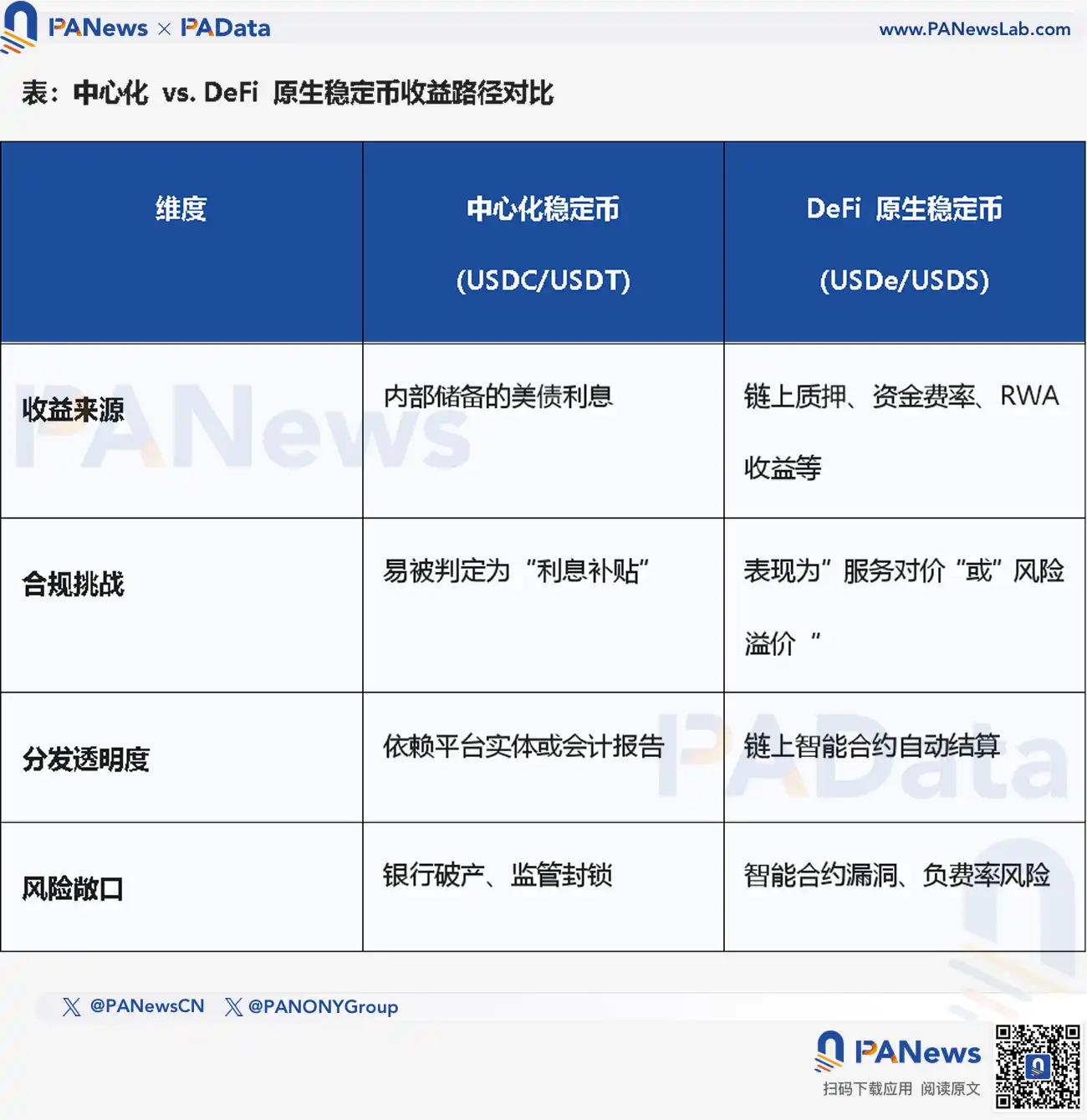
The advancement of the CLARITY Act宣告着 (declares) the impending end of the era of wild growth for stablecoins. Under the spotlight of regulation, the market is moving towards a clear dual-track structure. There are no absolute winners, only survivors who adapt to the rules.

Centralized stablecoins like USDC will inevitably become "instrumentalized," returning to their本源 (origin) of payment and settlement.凭借 (Relying on) compliance, liquidity, ecosystem coverage, and cross-border transfer experience, they will become the preferred digital cash for most ordinary users and enterprises, with yield no longer being their competitive barrier.

DeFi native stablecoins like USDe may承接起 (take on) wealth management needs, becoming the "yield engine" of the crypto market. By deeply anchoring asset value to complex on-chain activities like Delta neutral hedging and liquidity mining, they巧妙地 (cleverly) circumvent the regulatory狙击 (sniper fire) aimed at "bank deposits."

The differentiation in the stablecoin track is an inevitable result of the market seeking optimal solutions within the compliance framework. For investors, understanding the deep logic behind this migration is more important than chasing high yields: future stablecoin yields will no longer belong to passive "holders" but to active "contributors" who participate in protocol activities.

This transformation is both a result of regulatory constraints and an opportunity for DeFi innovation to adapt to regulation.


Пов'язані питання

QWhat is the main regulatory challenge facing stablecoins like USDC in the United States according to the article?

AThe main regulatory challenge is the proposed CLARITY Act, which aims to restrict passive income generation from holding stablecoins by prohibiting rewards based on idle balances, effectively ending the 'earn' programs offered by platforms like Coinbase for USDC holders.

QHow does the CLARITY Act differentiate between prohibited 'passive rewards' and allowed 'activity-based rewards'?

AThe CLARITY Act prohibits rewards based solely on idle balances (passive interest) but allows rewards for identifiable activities such as platform engagement (loyalty programs), transactions (payments, transfers), and on-chain contributions (staking, providing liquidity, governance).

QWhy are traditional banks lobbying against stablecoins offering competitive yields?

ATraditional banks, represented by the American Bankers Association (ABA), are lobbying to prevent stablecoins from offering competitive yields because they fear it could lead to significant deposit flight from the banking system, especially from community banks that rely on low-cost retail deposits for lending.

QHow do DeFi-native stablecoins like USDe and USDS generate yield in a way that may comply with the CLARITY Act?

AUSDe generates yield through staking rewards (e.g., from stETH) and funding rates from perpetual futures positions, which are classified as rewards for specific activities like validation and risk management. USDS uses protocol revenue sharing from deployments in lending or liquidity pools, framed as rewards for providing liquidity.

QWhat is the expected long-term impact of regulations like the CLARITY Act on the stablecoin market?

AThe regulations are expected to create a dual-track market: centralized stablecoins like USDC will become more utility-focused for payments and settlements, while DeFi-native stablecoins like USDe will serve as yield-generating engines for active participants in on-chain activities, aligning with regulatory frameworks for activity-based rewards.

Пов'язані матеріали

The U.S. Government Blocked the Anthropic Model. It Wasn't About 'Jailbreaking' at All.

Last Friday, the U.S. Commerce Department issued an enforcement letter that forced Anthropic to take its two most advanced AI models, Fable 5 and Mythos 5, offline. The stated reason was unspecified national security concerns, initially linked to potential "jailbreaks" of the models' safeguards. However, new details suggest the action stemmed more from a deteriorating relationship between the Trump administration and Anthropic, rather than a genuine technical threat. According to reports, the government cited a little-known export control regulation, compelling Anthropic to block access for all non-U.S. persons, including its own international employees. The company complied, shutting down the models without a court order or specific technical details from the government. Cybersecurity expert Katie Moussouris revealed she was privately shown a research paper detailing a potential safeguard bypass in Fable 5. She argued the described method was minor and did not warrant an export ban, stating that attempts to "fix" it would only weaken the model's defensive capabilities. Moussouris and other experts have since called for the order to be revoked, warning it dangerously removes advanced cybersecurity tools from U.S. defenders. Analysts like Justin Hendrix suggest the move appears retaliatory and sets a dangerous precedent, signaling that the U.S. government can unilaterally shut down a tech company's products. The incident has raised concerns about the reliability of American AI and the potential for political interference in the tech industry, serving as a warning to the broader sector.

marsbit5 хв тому

The U.S. Government Blocked the Anthropic Model. It Wasn't About 'Jailbreaking' at All.

marsbit5 хв тому

Ray Dalio: AI Bull Market Continues to Soar, Should Investors Go All In or Cash Out and Leave the Field?

In his latest notes, Ray Dalio addresses a critical question for investors amid the AI-driven stock market surge: how should one allocate assets during a transformative technological revolution? Dalio emphasizes that technological advancement does not automatically make related stocks attractive. Historical tech cycles—marked by excitement, crowding, volatility, and eventual shakeouts—show that even long-term winners like Microsoft and Apple experienced severe drawdowns. Today's AI sector faces similar uncertainties: overinvestment, intensifying competition, geopolitical tensions (e.g., Taiwan's chip supply), tax policy shifts, anti-AI sentiment, and potential disruption from future technologies like quantum computing. Dalio's core argument focuses on the highly concentrated market structure, where a few tech giants dominate major indices. He warns investors against unknowingly holding concentrated, correlated exposures. Instead of chasing a handful of AI leaders, he advocates for a robust, diversified portfolio of 15 or more high-quality, uncorrelated investments, risk-balanced to match an investor's volatility tolerance. Mathematically, such diversification significantly improves the risk-return ratio—for example, holding 15 uncorrelated assets can boost the ratio by over four times compared to a single concentrated bet. Dalio cautions that future equity returns appear low, with his bubble indicator suggesting real returns could be negative over the next 5-10 years. He stresses that knowing what you don't know is as important as knowing what you do. In an environment of high uncertainty and concentration, avoiding large, concentrated bets on AI stocks is prudent. The optimal strategy is disciplined diversification—the "holy grail" of investing—to navigate this technologically driven cycle with lower risk and comparable or better returns.

marsbit9 хв тому

Ray Dalio: AI Bull Market Continues to Soar, Should Investors Go All In or Cash Out and Leave the Field?

marsbit9 хв тому

The World Cup has only been played for a few days, but some AI prediction models have already been crowned as oracles, while others have stumbled badly.

The 2026 FIFA World Cup has sparked significant interest not only on the pitch but also in AI-driven match prediction. Major models like Qwen, Copilot, and ChatGPT are being used to forecast outcomes, scores, upsets, red cards, and key player performances. Qwen gained early attention by accurately predicting Mexico's 2-0 win over South Africa (including a red card risk) and South Korea's 2-1 victory over the Czech Republic in the opening matches. Copilot's pre-tournament predictions had notable successes, such as correctly calling the Mexico 2-0 scoreline, South Korea's 2-1 win, and Brazil's 1-1 draw with Morocco. However, it also had clear misses, failing to predict upsets like Australia's 2-0 win over Turkey or Switzerland's draw with Qatar. ChatGPT provided detailed analytical reasoning, correctly predicting Mexico's 2-0 win, but its full-tournament predictions tended to favor favorites, missing several underdog results and draws. Tests pitting multiple models (ChatGPT, Gemini, Grok, Claude) against the same match, like Mexico vs. South Africa, showed varying predictions, with only some hitting the exact score. In summary, while AI models like Qwen have shown promising early results in specific match details, and others have had isolated successes, they collectively struggle to consistently identify upsets and underdog performances. AI is becoming an additional reference tool for prediction markets but is far from a definitive source.

marsbit9 хв тому

The World Cup has only been played for a few days, but some AI prediction models have already been crowned as oracles, while others have stumbled badly.

marsbit9 хв тому

Missed Out on SpaceX's IPO? Take a Look at SpaceX's Complete Supply Chain

SpaceX is now public, but its high valuation and losses may deter some investors. However, the real opportunity, as seen with Apple, Tesla, and Nvidia, may lie in its extensive supply chain. SpaceX, funded primarily by its profitable Starlink service, spends hundreds of billions annually on components for its rockets, satellites, and planned orbital AI data centers, creating significant revenue streams for suppliers. Key suppliers are categorized by their indispensability. The first group includes irreplaceable players like **NVIDIA** (GPUs for AI supercomputers), **Eutelsat (SATS)** (spectrum rights), **Filtronic** (millimeter-wave amplifiers), **Materion (MTRN)** (beryllium alloys), and **STMicroelectronics (STM)** (phased array chips). The second category comprises suppliers costly to replace due to long certification cycles or deep integration, such as **Honeywell (HON)** (flight controls), **Carpenter Technology (CRS)** (specialty steel), **Hexcel (HXL)** (carbon fiber), **Broadcom (AVGO)** (data switching), and **Linde** (industrial gases). The third group involves high-volume, cost-critical manufacturers for mass-produced items like Starlink terminals. Major players here include Taiwanese contract manufacturer **Wistron NeWeb (6285)** and several Chinese-listed firms: **Sunway Communication (300136)**, **Parker Advanced Materials (605123)**, **Western Superconducting (002149)**, and **Yingliu Co., Ltd. (603308)**. Other niche providers include **Tianyin Electromechanical**, **Tongyu Communication**, **Trimble (TRMB)**, **Astronics (ATRO)**, and **CTSH**. The timing is now relevant because: 1) SpaceX's procurement is accelerating with plans for 100 launches in 2026, 30 million Starlink terminals, and orbital data centers. 2) Its IPO has brought unprecedented transparency to its supply chain. 3) This phase mirrors early days of the Tesla supply chain boom. The investment thesis shifts from betting on SpaceX's stock to betting on the steady, order-book-driven revenues of its essential suppliers. Risks remain, such as commodity cycles, geopolitical factors, and technological shifts, but the supply chain offers a potentially less speculative path to participate in SpaceX's growth.

marsbit27 хв тому

Missed Out on SpaceX's IPO? Take a Look at SpaceX's Complete Supply Chain

marsbit27 хв тому

Jane Street: The Most Powerful Behind-the-Scenes Operator in the Crypto Industry

Jane Street: Crypto's Most Powerful Behind-the-Scenes Operator A recent 13F filing revealed Jane Street, the secretive Wall Street quant giant, drastically reduced its Bitcoin ETF holdings while increasing stakes in Ethereum ETFs. This move highlights its role not as a directional investor, but as a critical infrastructure player extracting "tolls" from crypto's institutionalization. The firm, founded in 2000 and famously lacking a CEO, has systematically embedded itself across crypto markets. It acts as a key Authorized Participant (AP) and market maker for major Bitcoin and Ethereum ETFs, profiting from arbitrage between ETF shares and underlying assets. Its approach combines quantitative prowess with a willingness to hold positions for structural arbitrage, differing from pure high-frequency traders. Jane Street faces allegations related to the 2022 Terra (LUNA) collapse. A lawsuit claims it used non-public information to withdraw $85 million in UST minutes before a critical withdrawal by Terraform Labs, allegedly exacerbating the crash and avoiding over $200 million in losses. The company denies the claims. Further indicating its reach, a wallet suspected to be operated by Jane Street ("JaneStreetIndia") was identified on the prediction market Polymarket. This bot executed over 11,000 high-frequency trades on short-term crypto price movements with a near-perfect win rate, showcasing a套利 strategy divorced from traditional prediction. Beyond trading, Jane Street holds equity in crypto infrastructure like Kraken, 1inch, and Arbitrum, and mining stocks. Its strategy is clear: avoid betting on winners, but secure a position in the market's essential plumbing. By becoming a ubiquitous part of the liquidity infrastructure—from ETFs to OTC trading and potentially链上 markets—Jane Street operates as a market force itself, raising questions about whether crypto's decentralized,散户-friendly alpha is being permanently eroded by traditional finance's most sophisticated players.

Foresight News30 хв тому

Jane Street: The Most Powerful Behind-the-Scenes Operator in the Crypto Industry

Foresight News30 хв тому

Торгівля

Спот
Ф'ючерси

Популярні статті

Як купити ERA

Ласкаво просимо до HTX.com! Ми зробили покупку Caldera (ERA) простою та зручною. Дотримуйтесь нашої покрокової інструкції, щоб розпочати свою криптовалютну подорож.Крок 1: Створіть обліковий запис на HTXВикористовуйте свою електронну пошту або номер телефону, щоб зареєструвати обліковий запис на HTX безплатно. Пройдіть безпроблемну реєстрацію й отримайте доступ до всіх функцій.ЗареєструватисьКрок 2: Перейдіть до розділу Купити крипту і виберіть спосіб оплатиКредитна/дебетова картка: використовуйте вашу картку Visa або Mastercard, щоб миттєво купити Caldera (ERA).Баланс: використовуйте кошти з балансу вашого рахунку HTX для безперешкодної торгівлі.Треті особи: ми додали популярні способи оплати, такі як Google Pay та Apple Pay, щоб підвищити зручність.P2P: Торгуйте безпосередньо з іншими користувачами на HTX.Позабіржова торгівля (OTC): ми пропонуємо індивідуальні послуги та конкурентні обмінні курси для трейдерів.Крок 3: Зберігайте свої Caldera (ERA)Після придбання Caldera (ERA) збережіть його у своєму обліковому записі на HTX. Крім того, ви можете відправити його в інше місце за допомогою блокчейн-переказу або використовувати його для торгівлі іншими криптовалютами.Крок 4: Торгівля Caldera (ERA)Легко торгуйте Caldera (ERA) на спотовому ринку HTX. Просто увійдіть до свого облікового запису, виберіть торгову пару, укладайте угоди та спостерігайте за ними в режимі реального часу. Ми пропонуємо зручний досвід як для початківців, так і для досвідчених трейдерів.

474 переглядів усьогоОпубліковано 2025.07.17Оновлено 2026.06.02

Як купити ERA

Обговорення

Ласкаво просимо до спільноти HTX. Тут ви можете бути в курсі останніх подій розвитку платформи та отримати доступ до професійної ринкової інформації. Нижче представлені думки користувачів щодо ціни ERA (ERA).

活动图片












