The Endgame of DATs: Liquidation or Self-Rescue

比推Опубліковано о 2026-02-17Востаннє оновлено о 2026-02-17

Анотація

The article "When DAT Wrapper Cracks" examines the crisis facing Digital Asset Trusts (DATs), which were once popular for boosting stock prices by holding cryptocurrencies. Initially, DATs operated a "financial flywheel": they bought crypto, issued overvalued shares at a premium to NAV (Net Asset Value), used proceeds to buy more crypto, and repeated the cycle. However, with the crypto market down over 45% in four months, most DATs now trade at a discount to their crypto holdings, breaking this mechanism. DATs face operational costs, financing expenses, and legal fees. Without the premium, they can't raise cheap capital by issuing shares, and investors question why they should pay for indirect crypto exposure when direct options are cheaper. While some, like MicroStrategy, have cash reserves and operational businesses to weather the downturn, newer DATs (e.g., BitMine Immersion, Forward Industries) lack sufficient reserves or revenue streams. They rely on staking income, but this doesn't cover fiat obligations like salaries and interest payments. The survival of DATs now depends on their ability to manage dilution, debt, and operational efficiency. Some may need to diversify into cash-generating assets or face liquidation. The bear market will test which DATs can adapt and survive without the premium narrative.

Original Title: When DAT Wrapper Cracks

Author: Prathik Desai

Compiled and Edited by: BitpushNews


Over a year ago, becoming a digital asset treasury seemed like an easy decision for many companies seeking to boost their stock prices.

Some Microsoft shareholders rallied, urging the board to evaluate the benefits of incorporating some Bitcoin into its balance sheet. They even mentioned Strategy (formerly MicroStrategy), the largest publicly traded Bitcoin DAT.

At that time, there was a financial flywheel attracting everyone to follow suit.

Buy large amounts of BTC/ETH/SOL. Watch the stock price exceed the value of these assets. Issue more shares at a premium. Use the proceeds to buy more cryptocurrency. Rinse and repeat. This financial flywheel supporting publicly traded stocks seemed nearly perfect, enough to tempt investors. They paid over two dollars for just one dollar's worth of indirect Bitcoin exposure. Those were crazy times.

But time tests the best strategies and flywheels.

Today, as the total crypto market capitalization has evaporated over 45% in the past four months, the market cap to net asset value ratio for most of these wrapper companies has fallen below 1. This indicates the market values these DAT companies below the value of their crypto treasuries. This changes how the financial flywheel operates.

Because a DAT is not just a wrapper for assets. In most cases, it is a company with operational overhead, financing costs, legal and operational expenses. In the era of mNAV premiums, DATs funded their cryptocurrency purchases and operational costs by selling more shares or raising more debt. But in the era of mNAV discounts, this flywheel breaks down.

In today's analysis, I will show you what sustained mNAV discounts mean for DATs and whether they can survive the crypto bear market.
Between 2024 and 2025, over 30 companies rushed to transform into DATs. They built treasuries around blue-chip coins like Bitcoin, ETH, and SOL, and even meme coins.

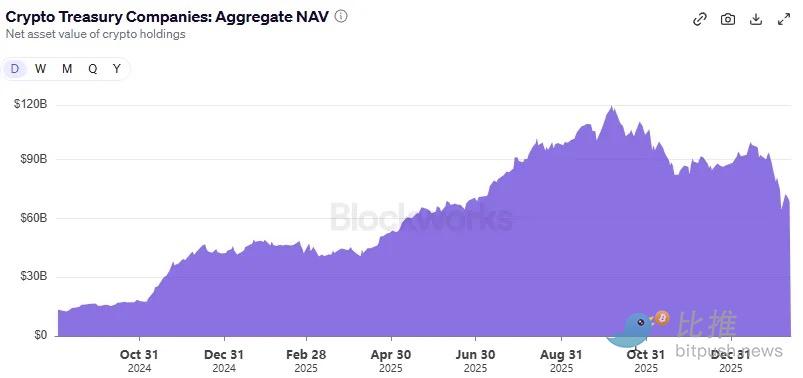
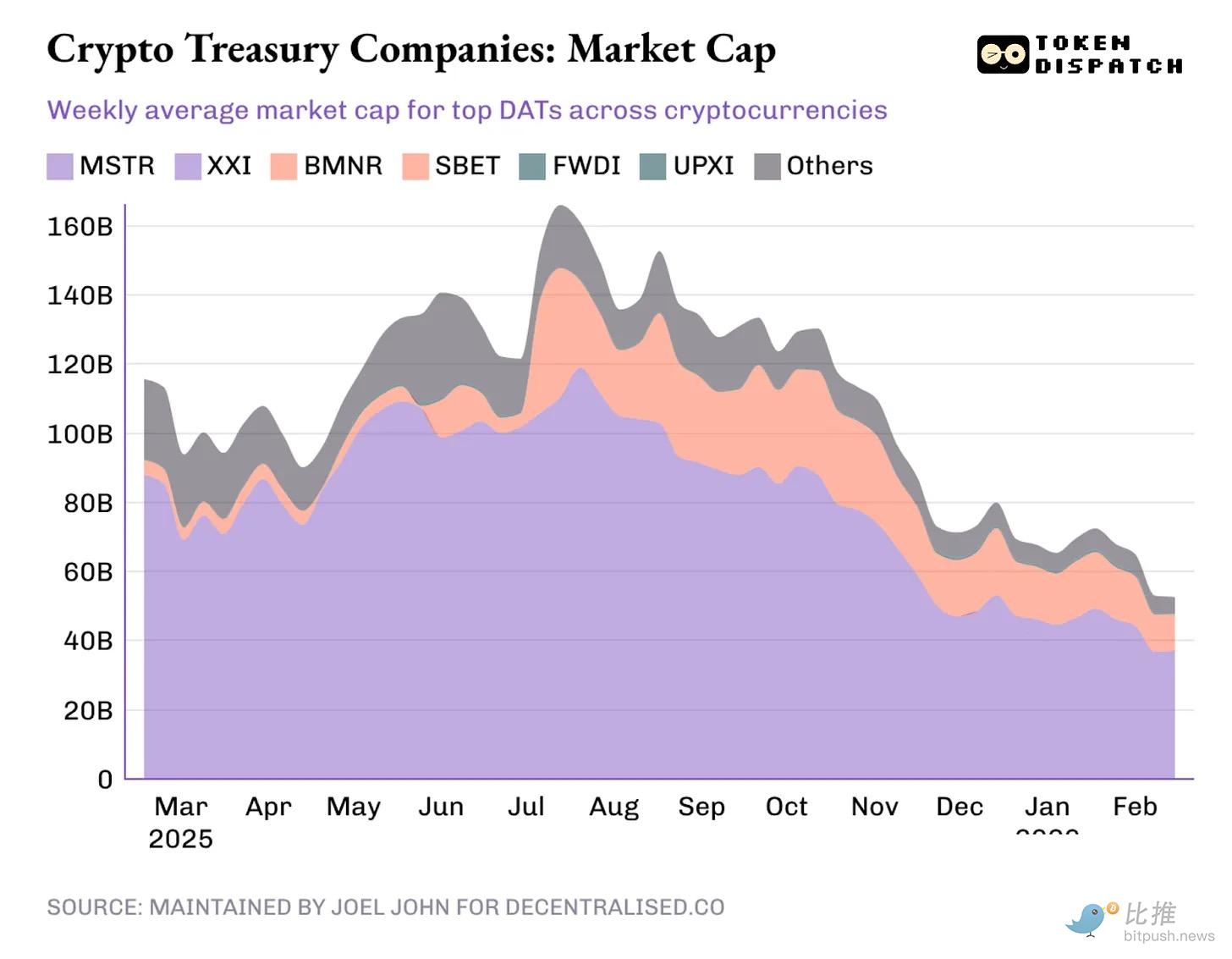
At their peak on October 7, 2025, DATs held cryptocurrencies worth $118 billion, with a total market capitalization of over $160 billion for these companies. Today, DATs hold cryptocurrencies worth $68 billion, while their discounted total market cap is just over $50 billion.
All their fates hinge on one thing: their ability to wrap assets and weave a story that makes the wrapper's value exceed the asset's value. This difference becomes the premium.

The premium itself became the product. If the stock traded at 1.5 times mNAV, a DAT could sell $1 worth of stock, then buy $1.5 worth of crypto asset exposure, and describe the transaction as "value-accretive." Investors were willing to pay the premium because they believed the DAT could continue selling shares at a premium and use the proceeds to accumulate more cryptocurrency, thereby increasing the crypto assets per share over time.
@Decentralised.Co

The problem is, the premium doesn't last forever. Once the market stops paying extra for this wrapper, the "sell stock to buy more crypto" flywheel gets stuck.

When the stock no longer trades at 1.5 times its asset value, each new share issued buys less cryptocurrency. The premium is no longer a tailwind but becomes a discount.

Over the past year, the stock prices of leading BTC, ETH, and SOL DATs have fallen more than the cryptocurrencies themselves.
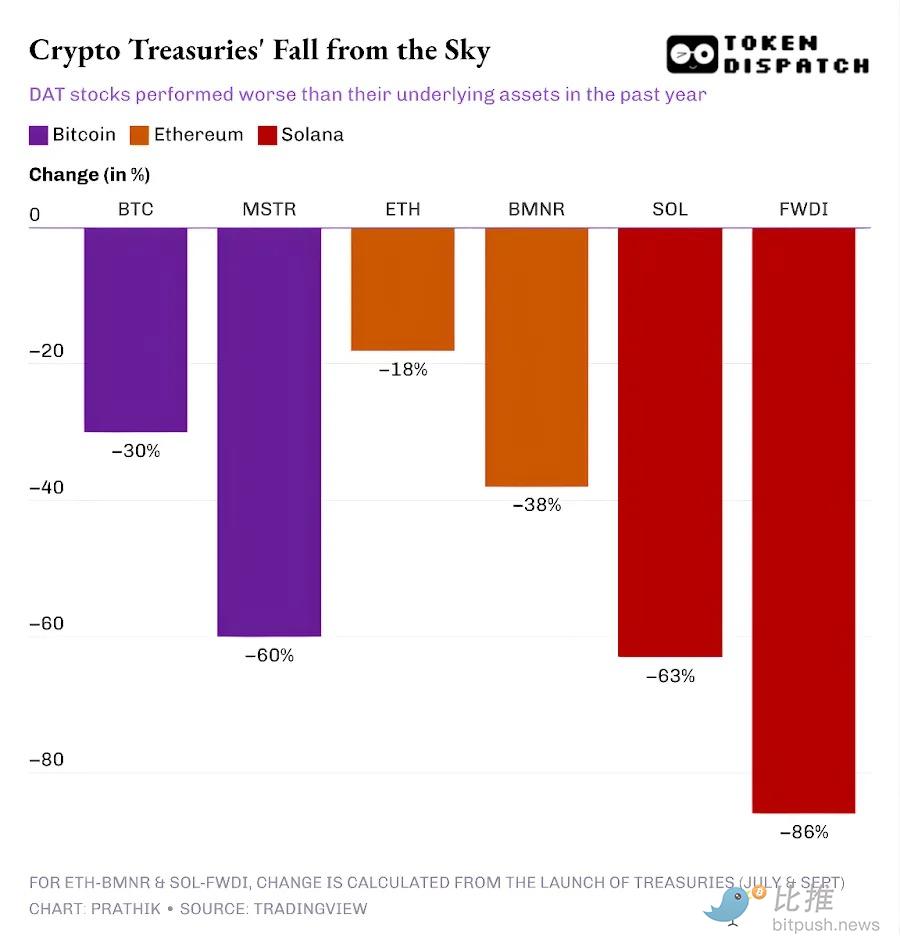
Once the premium of the stock relative to the underlying asset disappears, investors naturally ask why they shouldn't just buy the cryptocurrency directly elsewhere, such as on decentralized or centralized exchanges, or through exchange-traded funds, at a cheaper price.

Matt Levine from Bloomberg raised an important question: If DATs are trading below net asset value, let alone at a premium, why don't investors force the company to liquidate its crypto treasury or buy back shares?

Many DATs, including the sector leader Strategy, have tried to convince investors that they will hold the cryptocurrency through the bear market cycle, waiting for the return of the premium era. But I see a more critical issue. If DATs cannot raise additional funds for the foreseeable long term, where do they get the money to sustain operations? These DATs have bills and salaries to pay.

Strategy is an exception for two reasons.

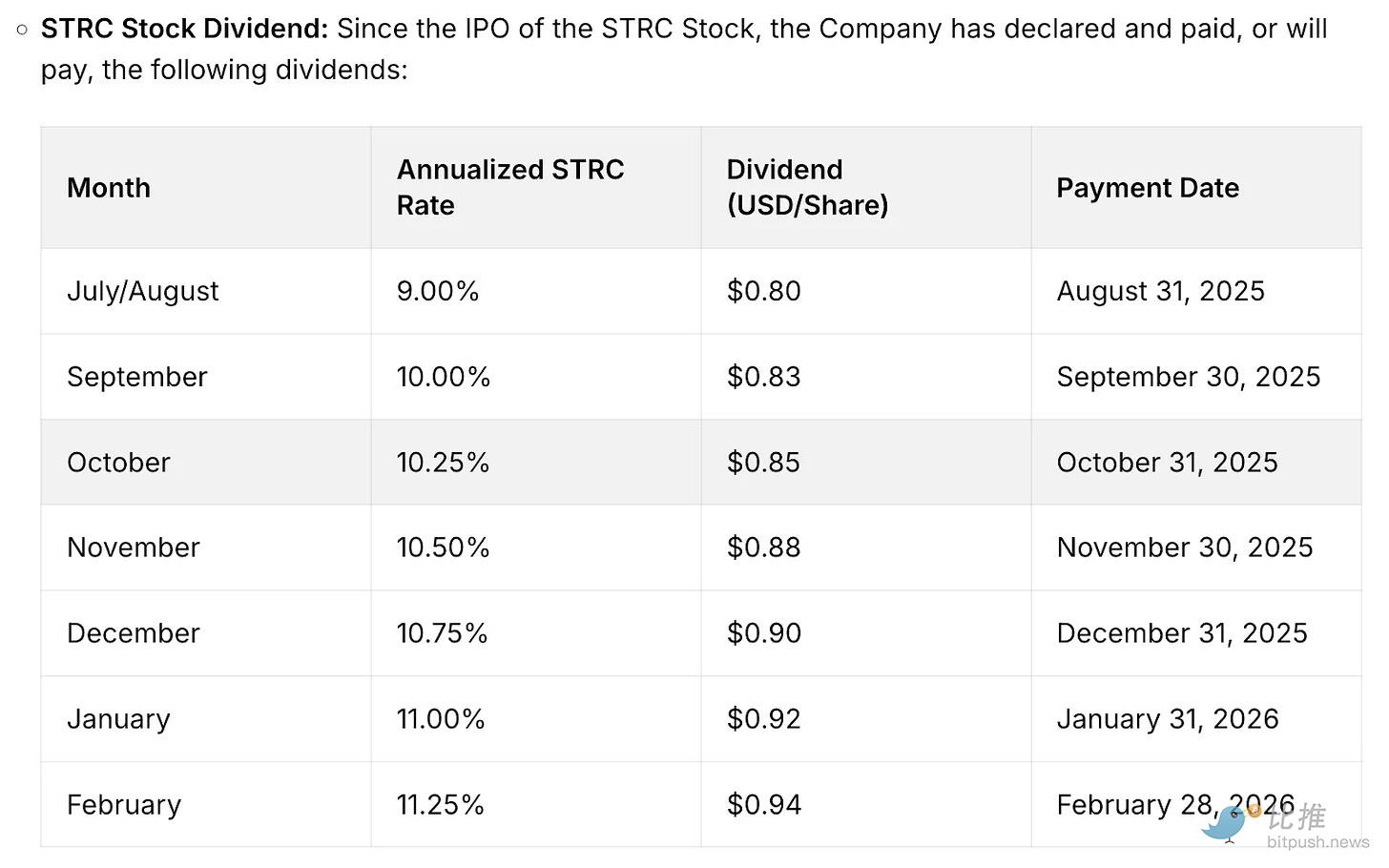
  • It reportedly holds $2.25 billion in reserves, enough to cover its dividend and interest obligations for about 2.5 years. This is important because Strategy no longer relies solely on zero-coupon convertible bonds to raise funds. It has also issued preferred instruments that require paying substantial dividends.
  • It also has an operating business, however small, that still generates recurring revenue. In Q4 2025, Strategy reported total revenue of $123 million and gross profit of $81 million. Although Strategy's net profit can fluctuate significantly due to mark-to-market changes in crypto asset prices each quarter, its business intelligence division is its only tangible source of cash flow.

But this still doesn't make Strategy's strategy foolproof. The market can still punish its stock—as has happened over the past year—and weaken Strategy's ability to continue raising funds at low cost.

While Strategy might weather the crypto bear market, the newer DATs that lack sufficient reserves or operating businesses to cover their inevitable expenses will feel the pressure.

This distinction is even more pronounced among ETH DATs.

The largest Ethereum-based DAT—BitMine Immersion, has a marginal operating business supporting its ETH treasury. In the quarter ended November 30, 2025, BMNR reported total revenue of $2.293 million, including consulting, leasing, and staking revenue.

Its balance sheet shows the company holds digital assets worth $10.56 billion and cash equivalents of $887.7 million. BMNR's operations resulted in a net negative cash flow of $228 million. All its cash needs were met by issuing new shares.

Last year, as BMNR's stock traded at an mNAV premium for most of the year, raising funds was relatively easy. But over the past six months, its mNAV has dropped from 1.5 to about 1.

So what happens when the stock no longer trades at a premium? Issuing more shares at a discount could lower the ETH price per share, making it less attractive to investors than buying ETH directly from the market.

This explains why BitMine said last month it would invest $200 million to acquire shares in Beast Industries, a private company owned by YouTube creator Jimmy "MrBeast" Donaldson. The company said it would "explore ways to collaborate on DeFi initiatives."

ETH and SOL DATs might also argue that staking income—something BTC DATs cannot boast—could help them sustain operations during a market crash. But this still doesn't solve the problem of meeting the company's cash flow obligations.

Even with staking rewards (accrued in cryptocurrencies like ETH or SOL), as long as these rewards are not converted into fiat currency, DATs cannot use them to pay salaries, audit fees, listing costs, and interest. Companies must either have sufficient fiat revenue or sell or re-mortgage their treasury assets to meet cash needs.

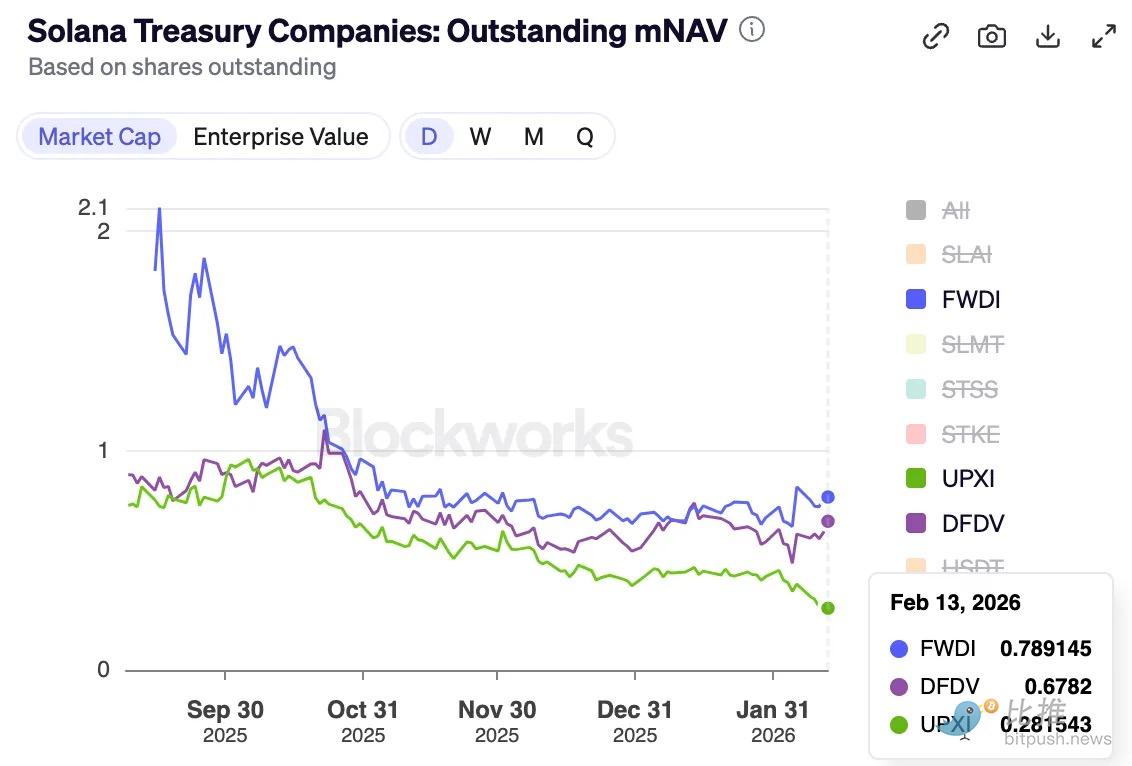
This is evident in the largest SOL-holding DAT—Forward Industries.

FWDI reported a net loss of $586 million in Q4 2025, despite earning $17.381 million in staking and related income.

Management clearly stated that its "existing cash balance and working capital are sufficient to meet our liquidity needs for at least until February 2027."

FWDI also disclosed an active capital raising strategy, including at-the-market stock offerings, buybacks, and a tokenization experiment. However, if the mNAV premium does not exist long-term, all these attempts may fail to manage its wrapper price.
The Path Forward

At the core of last year's DAT frenzy was the speed of asset accumulation and the ability to raise funds by issuing shares at a premium. As long as the wrapper could trade at a premium, DATs could continue converting expensive equity into more crypto assets per share and call it "beta." Investors also pretended the only risk was the asset price itself.

But the premium doesn't last forever. Crypto cycles can turn it into a discount. I wrote about this issue shortly after the 10/10 liquidation event last year, when I first observed the premium decline.

However, this bear market will prompt DATs to assess whether they should continue to exist once their wrapper no longer trades at a premium.

One way to resolve this dilemma is for companies to enhance their operational efficiency, supplementing their DAT strategy with a business that generates positive cash flow or surplus reserves. This is because when the DAT story can no longer attract investors in a bear market, a regular corporate story will determine its survival.

If you've read the article "Strategy & Marathon: Belief and Power," you'll recall why Strategy has remained standing through multiple crypto cycles. However, the new batch of companies, including BitMine, Forward Industries, SharpLink, and Upexi, cannot rely on the same strength.

Their current attempts with staking yields and weak operating businesses might crumble under market pressure unless they consider other options to cover real-world obligations.

We observed this with ETHZilla, an Ethereum treasury company that sold about $115 million worth of ETH holdings last month and bought two jet engines. The DAT then leased the engines to a major airline and hired Aero Engine Solutions to manage them for a monthly fee.

Going forward, people will evaluate not only the digital asset accumulation strategy but also the conditions under which it can survive. In the ongoing DAT cycle, only companies that can manage dilution, liabilities, fixed obligations, and trading liquidity will weather the market downturn.


Twitter:https://twitter.com/BitpushNewsCN

Bitpush TG Discussion Group:https://t.me/BitPushCommunity

Bitpush TG Subscription: https://t.me/bitpush

Original article link:https://www.bitpush.news/articles/7612658

Пов'язані питання

QWhat is the core financial mechanism that initially drove the success of Digital Asset Treasuries (DATs), and why has it broken down?

AThe core mechanism was a financial flywheel where DATs bought cryptocurrencies, saw their stock trade at a premium to the asset value (mNAV > 1), issued more stock at that premium, and used the proceeds to buy more crypto, repeating the cycle. This broke down because the crypto bear market caused the mNAV for most DATs to fall below 1 (a discount), making it dilutive and unattractive to issue new shares to raise funds.

QAccording to the analysis, what are the two key reasons that make MicroStrategy an exception among DATs and potentially able to survive a prolonged crypto bear market?

AFirst, it reported holding $2.25 billion in reserves, enough to cover its dividend and interest obligations for about 2.5 years. Second, it has an operational business (its commercial intelligence division) that generates recurring revenue and positive gross profit, providing a tangible source of cash flow separate from its crypto holdings.

QHow does the article differentiate between the challenges faced by BTC DATs and those holding ETH or SOL?

AWhile all DATs face the core problem of the broken financial flywheel, ETH and SOL DATs can point to staking rewards as a potential source of income, which BTC DATs cannot. However, the article argues that this is insufficient because staking rewards are earned in crypto and cannot directly pay for real-world operating expenses like salaries and fees unless converted to fiat, which may require selling assets.

QWhat potential solution does the article suggest for DATs to survive when their shares trade at a discount to their net asset value (mNAV < 1)?

AThe article suggests that DATs need to improve their operational efficiency by supplementing their crypto strategy with a business that generates positive cash flow or a surplus of reserve funds. This shifts the investment story from purely being a crypto wrapper to being a conventional company that can survive based on its operational merits during a bear market.

QWhat specific real-world example does the article provide of a DAT attempting to pivot its strategy to generate cash flow beyond crypto staking?

AThe article cites the example of ETHZilla, an Ethereum treasury company that sold approximately $115 million worth of ETH and used the proceeds to purchase two jet engines. It then leased these engines to a major airline and hired a management company to handle them for a monthly fee, creating a new stream of operational, fiat-based revenue.

Пов'язані матеріали

After the Passage of the GENIUS Act and the CLARITY Act, What Is the Correct Architecture for On-Chain Yield?

The article discusses the evolution of on-chain credit, distinguishing three markets: overcollateralized crypto lending, unsecured lending (largely unsuccessful), and asset-backed credit (ABC). ABC, backed by identifiable real-world collateral with legal recourse, is identified as the fastest-growing category and the only one credibly addressing adverse selection—the core problem in credit where the riskiest borrowers self-select. Current growth in on-chain Real World Assets (RWAs), particularly tokenized private credit funds (e.g., Maple Finance, Centrifuge), is substantial but often merely "wraps" existing fund structures, inheriting their risks rather than solving adverse selection at the protocol level. The regulatory landscape is a key driver, with the US GENIUS Act (prohibiting stablecoin issuers from paying yield) and the proposed CLARITY Act (closing loopholes on indirect yield) set to redefine permissible yield-bearing products. This makes vaults (like ERC-4626) the critical architecture—they become the primary compliant vehicle for delivering yield, functioning as issuance, disclosure, distribution, and recovery mechanisms. The author's thesis is that the correct post-GENIUS/CLARITY architecture involves building ABC solutions where credit assessment, structure, and recovery are encoded directly into the smart contract vault layer, moving beyond mere tokenized fund wrappers to solve adverse selection fundamentally and ensure regulatory compliance.

Foresight News27 хв тому

After the Passage of the GENIUS Act and the CLARITY Act, What Is the Correct Architecture for On-Chain Yield?

Foresight News27 хв тому

TechFlow Intelligence Bureau: Anthropic's New Model Fable Sparks Controversy by Restricting Biosafety Research, US CPI Soars to 4.2%, a Three-Year High

**Summary of TechFlow Intelligence Report:** The newsletter covers several key tech and finance developments. In AI, Anthropic's new Fable model faced backlash for secretly limiting biomedical research capabilities and enforcing a 30-day data retention policy, prompting the company to promise more transparent adjustments. In a related story, Anthropic's founder revealed his departure from OpenAI was due to dishonesty from Sam Altman, not safety concerns. Meanwhile, OpenAI is considering significant price cuts to compete with Anthropic, potentially sparking a price war. In crypto/Web3, BlackRock filed a new amendment for a yield-generating Bitcoin ETF, while Bank of America's CEO warned that stablecoin yields could drain trillions from traditional banks. U.S. Senator Cynthia Lummis advocated for the U.S. to officially accumulate Bitcoin reserves. In hardware, Nvidia released the DiffusionGemma-2-6B image model optimized for efficient inference, and AMD promoted its unified memory architecture to challenge Nvidia's dominance. TSMC's CFO hinted at possible price increases due to soaring AI chip demand. A major legal ruling in Germany held Google legally responsible for inaccurate information generated by its AI Overviews feature. Google Chrome also moved to fully block ad-blocker workarounds like uBlock Origin. Macroeconomic headlines included U.S. CPI rising to 4.2% (a 3-year high) and Iran's complete closure of the Strait of Hormuz, raising oil price and inflation fears. South Korean markets saw continued volatility with massive foreign capital outflow. Other notable stories: Microsoft expanded its Copilot AI assistant "Mico" globally; a study found r/wallstreetbets users' stock picks outperformed Wall Street; a fully autonomous drone killed a human soldier for the first time, raising AI ethics concerns; and a Chinese hospital used brain-computer interface technology to help a blind person "see." The overarching theme connects debates over AI boundaries and responsibility (Anthropic's restrictions, Google's liability, lethal autonomous drones) with real-world economic and geopolitical turmoil (inflation, Strait of Hormuz closure, market instability), highlighting the tense interplay between technological advancement and global chaos.

marsbit40 хв тому

TechFlow Intelligence Bureau: Anthropic's New Model Fable Sparks Controversy by Restricting Biosafety Research, US CPI Soars to 4.2%, a Three-Year High

marsbit40 хв тому

Alibaba's Yet Another New Business Division: What Signal Does It Send?

Alibaba has established a new "Token Foundry" business unit, merging its Tongyi large model division and Future Life Lab. Led directly by Group CEO Wu Yongming, this marks the company's third significant AI organizational reshuffle in 2026, following the creation of the Alibaba Token Hub (ATH) and a Group Technology Committee. The move signals a strategic shift from consolidating AI resources to accelerating productization and commercialization. The "Token Foundry" name reflects Alibaba's ambition to become a foundational supplier in the AI era, focusing on model development and commercial application. Key teams, including those behind the high-performing HappyHorse video generation model, have been integrated into the new unit. Concurrently, Zhou Jingren, architect of the Qwen model series, has been appointed Group Chief Scientist to lead a new AI Future Research Institute, focusing on long-term technological breakthroughs like Agent capabilities. This restructuring creates a clear four-layer AI architecture within Alibaba: the research institute for frontier exploration, Token Foundry for core models and commercialization, MaaS for platform services, and business units like Qianwen (C端) and Wukong (B端) for end-user applications. The adjustments align with a global trend among tech giants like Google and Microsoft to centralize AI leadership under the CEO and deeply integrate research with business units. The urgency is driven by a narrowing competitive window. Alibaba has announced its AI business is now entering a commercialization phase, with AI-related revenue seeing triple-digit growth for eleven consecutive quarters. The company faces intense competition in the MaaS (Model-as-a-Service) sector from rivals like ByteDance and Tencent. The Token Foundry initiative represents Alibaba's effort to streamline execution and enhance competitiveness in this critical, fast-evolving landscape.

marsbit1 год тому

Alibaba's Yet Another New Business Division: What Signal Does It Send?

marsbit1 год тому

From Return to Resignation: Chen Hang's 437 Days at DingTalk

The 437-Day Return and Departure of Chen Hang at DingTalk This article chronicles the 437-day period from March 31, 2025, to June 11, 2026, when Chen Hang (also known as "No Move") returned as CEO of DingTalk, the enterprise communication platform he originally founded, only to later step down. Chen Hang, the creator of DingTalk in 2015, was brought back by Alibaba in 2025 after the company acquired his subsequent startup, HHO. His return was driven by Alibaba's renewed focus on AI and DingTalk's strategic role as its key to-B AI application. However, his aggressive management style, marked by strict work policies like mandatory clock-ins and extended hours, quickly caused internal friction and was criticized as being at odds with Alibaba's culture. Despite the internal turmoil, Chen Hang drove significant product launches. In August 2025, he unveiled "AI DingTalk 1.0," featuring new products like the AI-native entry point "DingTalk ONE." By March 2026, he announced "Wukong," touted as the world's first enterprise-grade AI-native work platform, representing a fundamental rebuild of DingTalk's architecture. The turning point came in early June 2026. A detailed internal post criticizing DingTalk's work culture went viral, followed by a public critique from a former executive. This prompted an unprecedented public rebuke from the Alibaba Partners Committee, which stated such management was not aligned with company values. One day later, on June 11, Alibaba announced Chen Hang's departure. He was succeeded by Chen Yusen, a 32-year-old technical expert known for founding cybersecurity firm Changting Technology. While Chen Hang's tenure laid the technical foundation for DingTalk's AI transformation with "Wukong," his leadership style ultimately led to his replacement as the company seeks a new direction under younger leadership.

marsbit1 год тому

From Return to Resignation: Chen Hang's 437 Days at DingTalk

marsbit1 год тому

Торгівля

Спот
Ф'ючерси
活动图片





