The Endgame for DATs: Liquidation or Self-Rescue?

marsbitОпубліковано о 2026-02-18Востаннє оновлено о 2026-02-18

Анотація

More than a year ago, becoming a digital asset treasury (DAT) seemed like an easy way for companies to boost their stock prices. They would buy cryptocurrencies, issue shares at a premium to their net asset value (NAV), and use the proceeds to buy more crypto, creating a financial flywheel. However, as the crypto market's total capitalization dropped over 45% in four months, most DATs now trade at a discount to their NAV, breaking this cycle. DATs are not just asset wrappers; they are companies with operational costs. The premium was the product, allowing them to raise cheap capital. Without it, they struggle to fund operations and acquisitions. While some, like MicroStrategy, have cash reserves and an operating business to weather the bear market, newer DATs without sufficient reserves or revenue face significant pressure. They must now prove their operational viability beyond simply holding crypto, as investors question why they should pay a premium for indirect exposure when direct options are cheaper. Survival will depend on managing dilution, debt, and real-world cash flow obligations.

Author: Prathik Desai

Compiled and edited by: BitpushNews

Over a year ago, becoming a digital asset treasury seemed like an easy decision for many companies seeking to boost their stock prices.

Some Microsoft shareholders gathered, urging the board to evaluate the benefits of incorporating some Bitcoin into its balance sheet. They even mentioned Strategy (formerly MicroStrategy), the largest publicly traded Bitcoin DAT.

At that time, there was a financial flywheel attracting everyone to follow.

Buy large amounts of BTC/ETH/SOL. Watch the stock price exceed the value of these assets. Issue more shares at a premium. Use the proceeds to buy more cryptocurrency. Repeat. This financial flywheel supporting publicly traded stocks seemed nearly perfect, enough to tempt investors. They paid over two dollars for just one dollar's worth of indirect Bitcoin exposure. Those were crazy times.

But time tests the best strategies and flywheels.

Today, with the total crypto market capitalization evaporating over 45% in the past four months, the market capitalization to net asset value ratio for most of these wrapper companies has fallen below 1. This indicates the market values these DAT companies below the value of their crypto treasuries. This changes how the financial flywheel operates.

Because a DAT is not just a wrapper for assets. In most cases, it is a company with operating expenses, financing costs, legal and operational fees. In the era of mNAV premiums, DATs funded their cryptocurrency purchases and operating costs by selling more shares or raising more debt. But in the era of mNAV discounts, this flywheel falls apart.

In today's analysis, I will show you what sustained mNAV discounts mean for DATs and whether they can survive the crypto bear market.
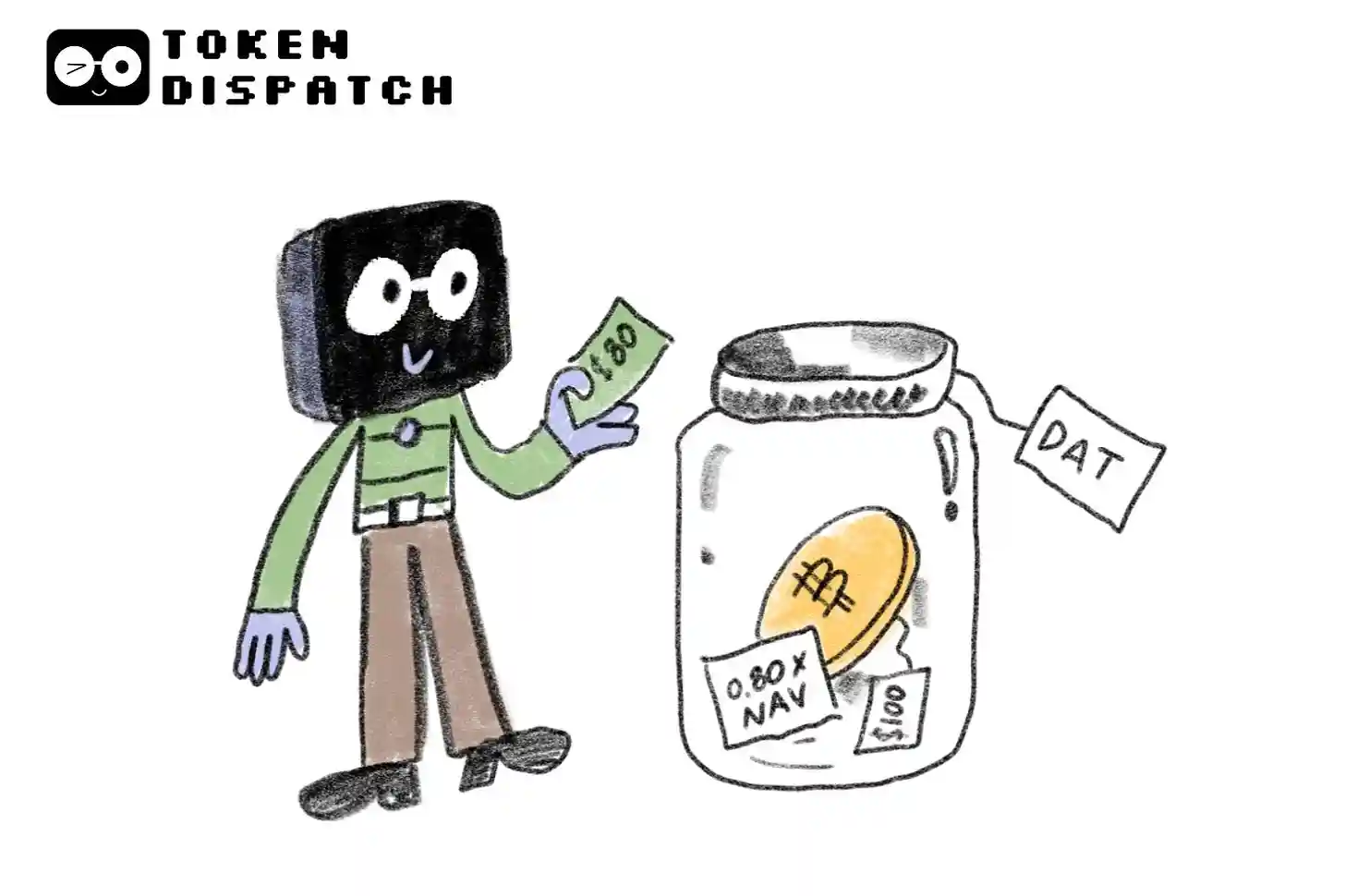
Between 2024 and 2025, over 30 companies rushed to transform into DATs. They built treasuries around blue-chip coins like Bitcoin, ETH, and SOL, and even meme coins.

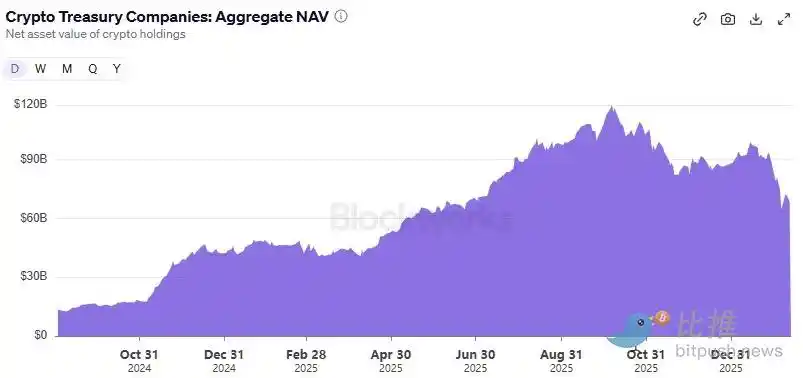
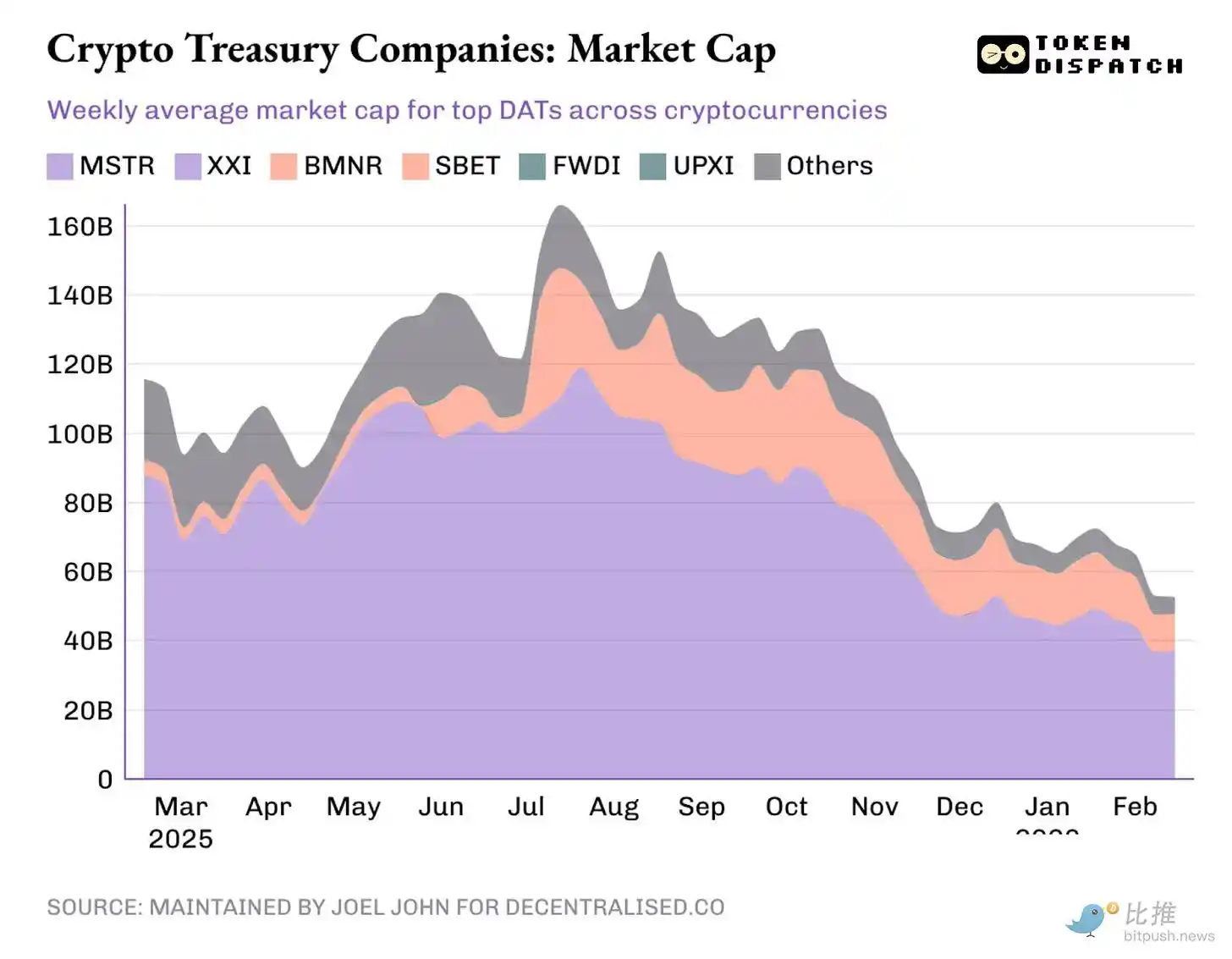
At their peak on October 7, 2025, DATs held cryptocurrencies worth $118 billion, and the total market capitalization of these companies exceeded $160 billion. Today, DATs hold cryptocurrencies worth $68 billion, while their discounted total market capitalization is just over $50 billion.
All their fates hinge on one thing: their ability to wrap assets and weave a story that makes the wrapper's value higher than the asset's value. This difference becomes the premium.

The premium itself became the product. If the stock traded at 1.5 times mNAV, a DAT could sell $1 worth of stock, then buy $1.5 worth of crypto asset exposure, and describe the transaction as "value-accretive." Investors were willing to pay the premium because they believed the DAT could continue to sell shares at a premium and use the proceeds to accumulate more cryptocurrency, thereby increasing the crypto asset value per share over time.
The problem is, the premium doesn't last forever. Once the market stops paying extra for this wrapper, the "sell stock to buy more crypto" flywheel gets stuck.

When the stock no longer trades at 1.5 times its asset value, each new share issued buys less cryptocurrency. The premium is no longer a tailwind, it becomes a discount.

Over the past year, the stock prices of leading BTC, ETH, and SOL DATs have fallen more than the cryptocurrencies themselves.
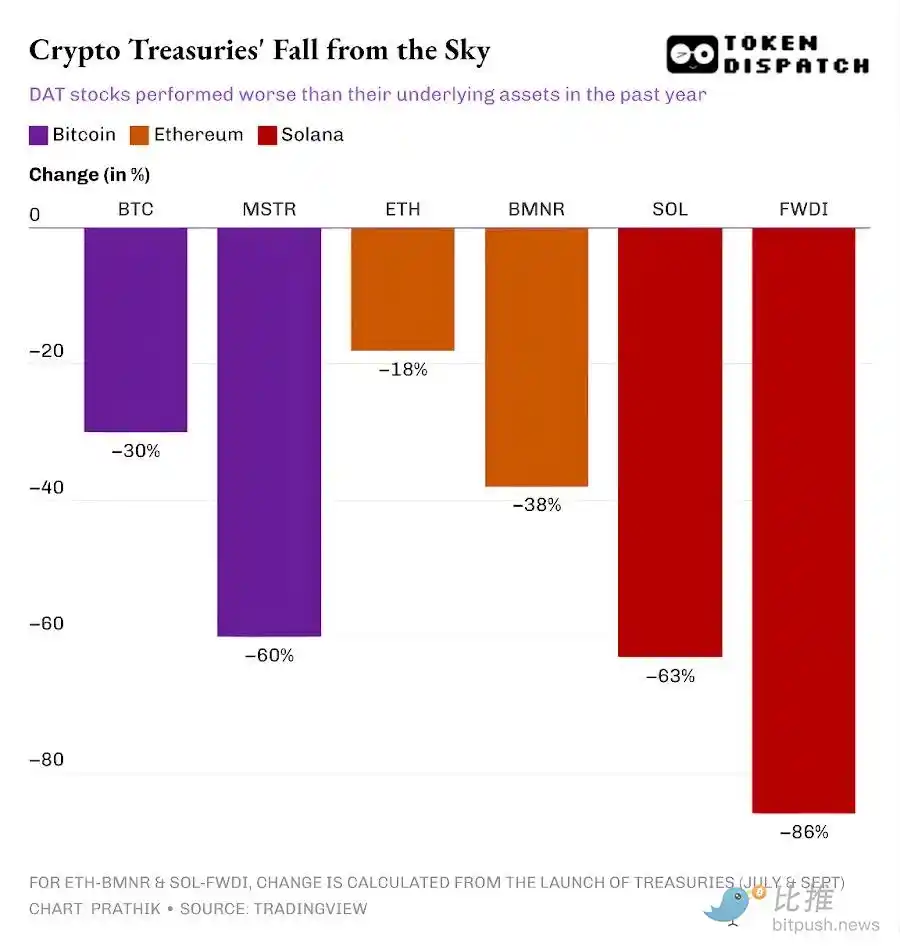
Once the premium of the stock relative to the underlying asset disappears, investors naturally ask why they can't buy the cryptocurrency directly elsewhere, such as on decentralized or centralized exchanges, or through exchange-traded funds, at a cheaper price.

Matt Levine from Bloomberg raised an important question: If DATs are trading below net asset value, let alone at a premium, why don't investors force the company to liquidate its crypto treasury or buy back shares?

Many DATs, including the sector leader Strategy, have tried to convince investors that they will hold cryptocurrency through the bear market cycle, waiting for the return of the premium era. But I see a more critical issue. If DATs cannot raise additional funds for the foreseeable long term, where do they get the money to sustain operations? These DATs have bills and salaries to pay.

Strategy is an exception for two reasons.

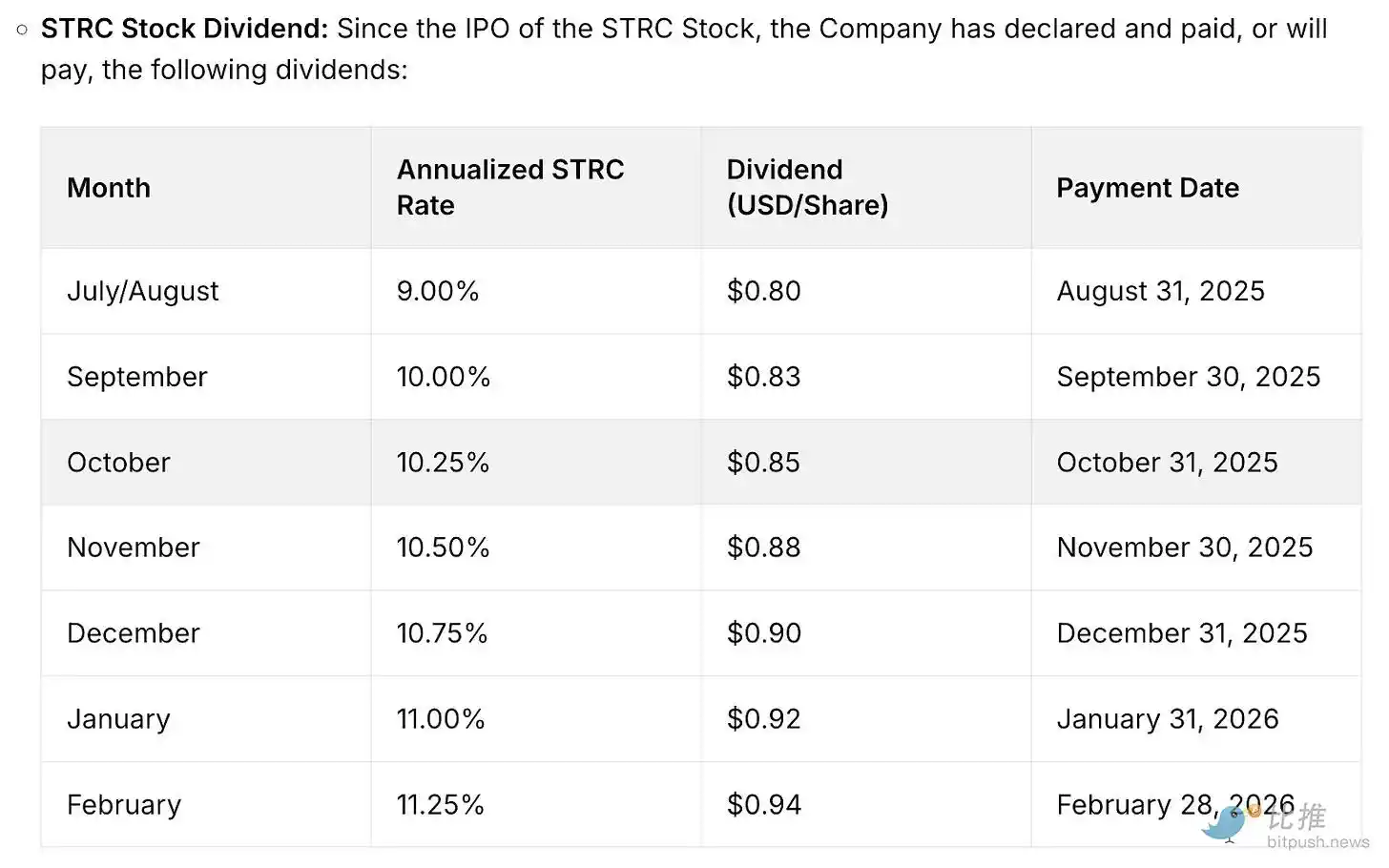
  • It reportedly holds $2.25 billion in reserves, enough to cover its dividend and interest obligations for about 2.5 years. This is important because Strategy no longer relies solely on zero-coupon convertible bonds to raise funds. It has also issued preferred instruments that require paying substantial dividends.
  • It also has an operating business, however small, that still generates recurring revenue. In Q4 2025, Strategy reported total revenue of $123 million and gross profit of $81 million. Although Strategy's net profit can fluctuate significantly due to mark-to-market changes in crypto asset prices each quarter, its business intelligence division is its only tangible source of cash flow.

But this still doesn't make Strategy's strategy foolproof. The market can still punish its stock—as has happened over the past year—and weaken Strategy's ability to continue raising funds at low cost.

While Strategy might weather the crypto bear market, the newer DATs that lack sufficient reserves or operating businesses to cover their inevitable expenses will feel the pressure.

This distinction is even more pronounced among ETH DATs.

The largest Ethereum-based DAT—BitMine Immersion, has a marginal operating business supporting its ETH treasury. In the quarter ended November 30, 2025, BMNR reported total revenue of $2.293 million, including consulting, leasing, and staking income.

Its balance sheet shows the company holds $10.56 billion worth of digital assets and $887.7 million in cash equivalents. BMNR's operations resulted in a net negative cash flow of $228 million. All its cash needs were met by issuing new shares.

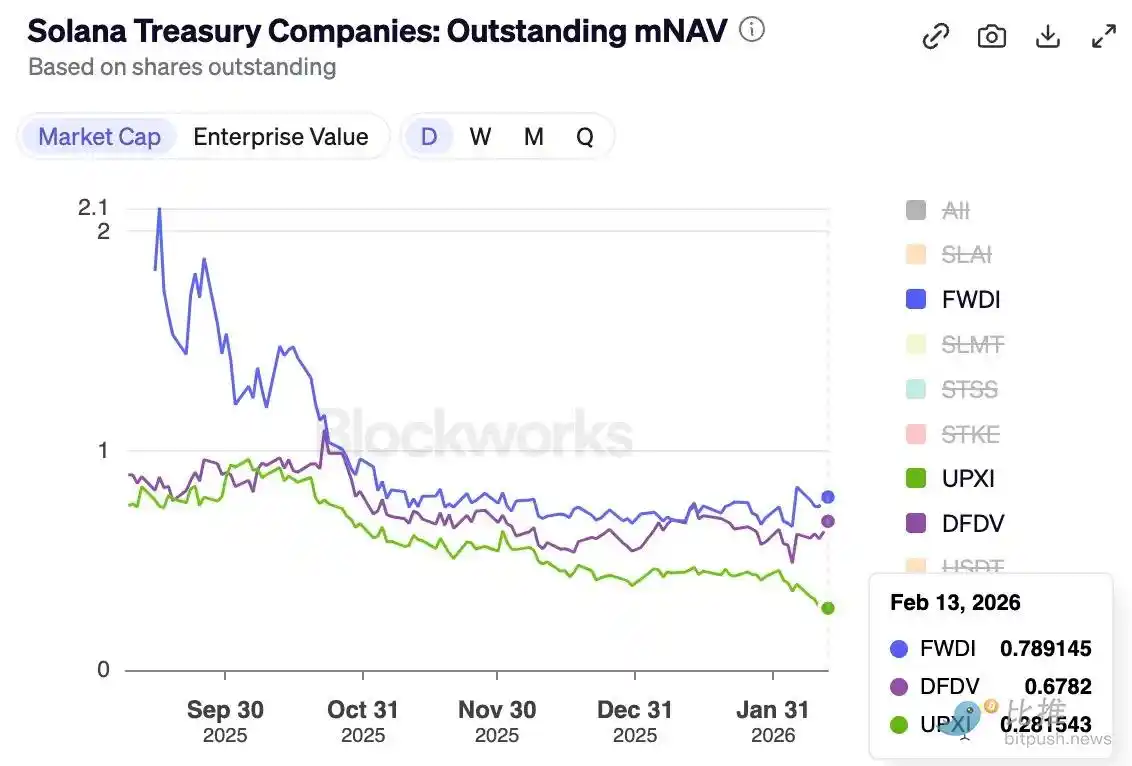
Last year, as BMNR's stock traded at an mNAV premium for most of the year, raising funds was relatively easy. But over the past six months, its mNAV has dropped from 1.5 to around 1.

So what happens when the stock no longer trades at a premium? Issuing more shares at a discount could lower the ETH price per share, making it less attractive to investors than buying ETH directly from the market.

This explains why BitMine said last month it would invest $200 million to acquire shares in Beast Industries, a private company owned by YouTube blogger Jimmy "MrBeast" Donaldson. The company said it would "explore ways to collaborate on DeFi initiatives."

ETH and SOL DATs might also argue that staking income—something BTC DATs cannot boast—can sustain them during a market crash. But this still doesn't solve the problem of meeting the company's cash flow obligations.

Even with staking rewards (accrued in cryptocurrencies like ETH or SOL), as long as these rewards are not converted into fiat currency, DATs cannot use them to pay salaries, audit fees, listing costs, and interest. Companies must either have sufficient fiat revenue or sell or re-mortgage their treasury assets to meet cash needs.

This is evident in the largest SOL-holding DAT—Forward Industries.

FWDI reported a net loss of $586 million in Q4 2025, despite earning $17.381 million in staking and related income.

Management clearly stated that its "existing cash balance and working capital are sufficient to meet our liquidity needs for at least until February 2027."

FWDI also disclosed an active capital raising strategy, including at-the-market stock offerings, buybacks, and a tokenization experiment. However, if the mNAV premium does not exist long-term, all these attempts might fail to manage its wrapper price successfully.
The Path Forward

The core of last year's DAT frenzy was the speed of asset accumulation and the ability to raise funds by issuing shares at a premium. As long as the wrapper traded at a premium, DATs could continue converting expensive equity into more crypto assets per share and call it "beta." Investors also pretended the only risk was the asset price itself.

But the premium doesn't last forever. Crypto cycles can turn it into a discount. I wrote about this issue shortly after observing the premium decline following the 10/10 liquidation event last year.

However, this bear market will prompt DATs to assess whether they should continue to exist once their wrapper no longer trades at a premium.

One way to resolve this dilemma is for companies to enhance their operational efficiency, supplementing their DAT strategy with a business that generates positive cash flow or surplus reserves. This is because when the DAT story can no longer attract investors in a bear market, a regular corporate story will determine its survival.

If you've read the article 'Strategy & Marathon: Belief and Power', you'll recall why Strategy has remained standing through multiple crypto cycles. However, the new batch of companies, including BitMine, Forward Industries, SharpLink, and Upexi, cannot rely on the same strength.

Their current attempts with staking yields and weak operating businesses might crumble under market pressure unless they consider other options to cover real-world obligations.

We observed this with ETHZilla, the Ethereum treasury company that sold about $115 million worth of ETH holdings last month and bought two jet engines. Subsequently, the DAT leased the engines to a major airline and hired Aero Engine Solutions to manage them for a monthly fee.

Looking ahead, people will evaluate not only the digital asset accumulation strategy but also the conditions under which it can survive. In the ongoing DAT cycle, only those companies that can manage dilution, liabilities, fixed obligations, and trading liquidity will weather the market downturn.


Пов'язані питання

QWhat is the core financial mechanism that Digital Asset Trusts (DATs) relied on during the bull market, and why has it broken down?

ADATs relied on a financial flywheel where they bought cryptocurrencies, saw their stock trade at a premium to the net asset value (mNAV), issued more stock at that premium to raise capital, and used the proceeds to buy more crypto, increasing the per-share crypto value. This mechanism broke down because the market capitalization to net asset value ratio for most DATs has fallen below 1, meaning their stocks now trade at a discount. This makes raising capital by issuing new shares dilutive and unattractive to investors, halting the flywheel.

QAccording to the analysis, what are the two key factors that make MicroStrategy (Strategy) an exception and potentially able to survive a prolonged crypto bear market?

AThe two key factors are: 1) It holds a substantial reserve of $2.25 billion, which is sufficient to cover its dividend and interest obligations for approximately 2.5 years. 2) It has an operational business (its commercial intelligence division) that generates recurring revenue and positive gross profit, providing a tangible source of cash flow independent of crypto asset sales.

QWhy is staking income, which ETH and SOL DATs earn, not a complete solution for covering their operational costs during a market downturn?

AStaking rewards are accrued in cryptocurrencies like ETH or SOL. To pay real-world obligations such as salaries, audit fees, and interest in fiat currency, the DAT must either have sufficient fiat revenue from other operations or sell/remortgage their staked assets. The staking income itself, if not converted to cash, does not solve the company's cash flow needs for covering these expenses.

QWhat strategic shift did ETHZilla make to address the challenge of its DAT trading at a discount to its NAV?

AETHZilla sold approximately $115 million worth of its ETH holdings and used the proceeds to purchase two jet engines. It then leased these engines to a major airline and hired a management company to handle them for a monthly fee, diversifying its asset base and creating a new stream of operational, fiat-based revenue.

QWhat is the fundamental question investors are now asking about DATs since their shares trade at a discount to the net asset value (NAV)?

AInvestors are asking why they should pay for indirect exposure to cryptocurrencies through a DAT stock trading at a discount when they can buy the underlying cryptocurrencies (BTC, ETH, SOL) directly on decentralized or centralized exchanges, or through ETFs, at or near their market value, thus getting more crypto for their money.

Пов'язані матеріали

Gensyn AI: Don't Let AI Repeat the Mistakes of the Internet

In recent months, the rapid growth of the AI industry has attracted significant talent from the crypto sector. A persistent question among researchers intersecting both fields is whether blockchain can become a foundational part of AI infrastructure. While many previous AI and Crypto projects focused on application layers (like AI Agents, on-chain reasoning, data markets, and compute rentals), few achieved viable commercial models. Gensyn differentiates itself by targeting the most critical and expensive layer of AI: model training. Gensyn aims to organize globally distributed GPU resources into an open AI training network. Developers can submit training tasks, nodes provide computational power, and the network verifies results while distributing incentives. The core issue addressed is not decentralization for its own sake, but the increasing centralization of compute power among tech giants. In the era of large models, access to GPUs (like the H100) has become a decisive bottleneck, dictating the pace of AI development. Major AI companies are heavily dependent on large cloud providers for compute resources. Gensyn's approach is significant for several reasons: 1) It operates at the core infrastructure layer (model training), the most resource-intensive and technically demanding part of the AI value chain. 2) It proposes a more open, collaborative model for compute, potentially increasing resource utilization by dynamically pooling idle GPUs, similar to early cloud computing logic. 3) Its technical moat lies in solving complex challenges like verifying training results, ensuring node honesty, and maintaining reliability in a distributed environment—making it more of a deep-tech infrastructure company. 4) It targets a validated, high-growth market with genuine demand, rather than pursuing blockchain integration without purpose. Ultimately, the boundaries between Crypto and AI are blurring. AI requires global resource coordination, incentive mechanisms, and collaborative systems—areas where crypto-native solutions excel. Gensyn represents a step toward making advanced training capabilities more accessible and collaborative, moving beyond a niche controlled by a few giants. If successful, it could evolve into a fundamental piece of AI infrastructure, where the most enduring value in the AI era is often created.

marsbit10 год тому

Gensyn AI: Don't Let AI Repeat the Mistakes of the Internet

marsbit10 год тому

Why is China's AI Developing So Fast? The Answer Lies Inside the Labs

A US researcher's visit to China's top AI labs reveals distinct cultural and organizational factors driving China's rapid AI development. While talent, data, and compute are similar to the West, Chinese labs excel through a pragmatic, execution-focused culture: less emphasis on individual stardom and conceptual debate, and more on teamwork, engineering optimization, and mastering the full tech stack. A key advantage is the integration of young students and researchers who approach model-building with fresh perspectives and low ego, prioritizing collective progress over personal credit. This contrasts with the US culture of self-promotion and "star scientist" narratives. Chinese labs also exhibit a strong "build, don't buy" mentality, preferring to develop core capabilities—like data pipelines and environments—in-house rather than relying on external services. The ecosystem feels more collaborative than tribal, with mutual respect among labs. While government support exists, its scale is unclear, and technical decisions appear driven by labs, not state mandates. Chinese companies across sectors, from platforms to consumer tech, are building their own foundational models to control their tech destiny, reflecting a broader cultural drive for technological sovereignty. Demand for AI is emerging, with spending patterns potentially mirroring cloud infrastructure more than traditional SaaS. Despite challenges like a less mature data industry and GPU shortages, Chinese labs are propelled by vast talent, rapid iteration, and deep integration with the open-source community. The competition is evolving beyond a pure model race into a contest of organizational execution, developer ecosystems, and industrial pragmatism.

marsbit12 год тому

Why is China's AI Developing So Fast? The Answer Lies Inside the Labs

marsbit12 год тому

3 Years, 5 Times: The Rebirth of a Century-Old Glass Factory

Corning, a 175-year-old glass company, is experiencing a dramatic revival as a key player in AI infrastructure, driven by surging demand for high-performance optical fiber in data centers. AI data centers require vastly more fiber than traditional ones—5 to 10 times as much per rack—to handle high-speed data transmission between GPUs. This structural demand shift, coupled with supply constraints from the lengthy expansion cycle for fiber preforms, has created a significant supply-demand gap. Nvidia has invested in Corning, along with Lumentum and Coherent, in a $4.5 billion total commitment to secure the optical supply chain for AI. Corning's competitive edge lies in its expertise in producing ultra-low-loss, high-density, and bend-resistant specialty fiber, which is critical for 800G+ and future 1.6T data rates. Its deep involvement in co-packaged optics (CPO) with partners like Nvidia further solidifies its position. While not the largest fiber manufacturer globally, Corning's revenue from enterprise/data center clients now exceeds 40% of its optical communications sales, and it has secured multi-year supply agreements with major hyperscalers including Meta and Nvidia. Financially, Corning's optical communications revenue has surged, doubling from $1.3 billion in 2023 to over $3 billion in 2025. Its stock price has risen nearly 6-fold since late 2023. Key future catalysts include the rollout of Nvidia's CPO products and the scale of undisclosed customer agreements. However, risks include high current valuations and potential disruption from next-generation technologies like hollow-core fiber. The company's long-term bet on light over electricity, maintained even through the telecom bubble crash, is now being validated by the AI boom.

marsbit12 год тому

3 Years, 5 Times: The Rebirth of a Century-Old Glass Factory

marsbit12 год тому

Торгівля

Спот
Ф'ючерси
活动图片




