The End of DeFi Lego: Vaults Are Left with Nothing but Deposits

marsbitОпубліковано о 2026-01-29Востаннє оновлено о 2026-01-29

Анотація

This article argues that the era of "DeFi Lego" – the complex, interlocking composability of decentralized finance protocols – is ending. The primary user behavior has collapsed into a single action: depositing stablecoins into yield-bearing vaults for a return. Major exchanges like Binance, OKX, and HTX are forging their own paths by subsidizing and promoting their own stablecoin products (e.g., USD1, USDG) to capture user value directly. On-chain, the yield landscape has become homogenized, with vaults competing almost solely on the APY they offer for USDT and USDC deposits. Users no longer care about the underlying protocols (Morpho, Aave, etc.) or their governance tokens; they are primarily attracted by high yields and the branding of the platforms offering them (e.g., Kraken, Coinbase). This shift has led to several consequences: governance tokens are losing value, DeFi ecosystem has become a flattened landscape of competing vaults rather than a collaborative system, and the end-user experience is now a simple flow of converting fiat to stablecoins on a CEX, finding the highest-yielding vault, and spending via crypto debit cards. The article concludes that DeFi must learn from traditional finance (TradFi), which successfully serves human needs and builds network effects. To survive, DeFi protocols must move beyond being mere back-end yield generators and find ways to re-engage users, rebuild trust, and create value beyond just high APYs.

Author: Zuo Ye

Binance partners with USD1, exchanges no longer measure the effect of listing based on "trading volume." Binance is selling the largest real user base in the crypto space to projects. WLFI aims to promote the direct adoption of USD1, using it like USDT for interest accrual, pricing, and payments.

This is not an isolated case. OKX subsidizes USDG, Sun Ge's HTX subsidizes U—major exchanges are all finding their own ways out.

On-chain is different. Yield distribution has been homogenized into USDT and USDC. Collaboration between Vaults is decreasing and becoming less transparent, even less than partnerships with mainstream products.

This is happening at a time when even Bitwise is establishing Vaults to manage assets, upgrading the concept of non-custodial wallets to non-custodial vaults, and Kraken is leveraging Euler/Morpho/Aave to build an 8% APY wealth management product.

Does DeFi Lego only have theoretical value left, and how can pure channel value withstand the impact of exchanges?

DeFi Oddity: Scale Grows, Yields Decline

"Network effects are about human connections; tokens are just units of measurement.

In the future, tokens will no longer point to the crypto industry; history will more often use the AI industry as their载体.

When USDe and Binance jointly offered a 12% APY, many thought USDe would move from on-chain to mainstream exchanges and eventually become a real off-chain payment network.

After the October 11th event, Binance essentially abandoned Ethena as a partner,转而 supporting U and WLFI's USD1. Ethena turned to the Hyperliquid ecosystem and survives as a white-label platform.

The real revelation is that if on-chain stablecoins cannot reach truly mainstream industries, then more complex DeFi products must reach users through intermediary industries.

This is why Vault & Yield are hot now, but C-end users no longer choose to hold UNI and Aave. Their understanding of DeFi has collapsed into one thing—deposits.

  • Ideal user flow based on DeFi Summer: Participate in BTC/ETH network nodes, obtain tokens -> Participate in DeFi protocols -> Use DeFi Lego blocks
  • Actual user flow based on the 2026现状: Exchange for USDC via CEX or bank card -> Find Vaults with higher APY -> Spend using Neobank's U card

Yes, users will use Vaults directly, not caring whether the Vault is backed by Morpho or Euler, or even which Vault it is. They care more about Kraken and Coinbase's promotional partnerships.

Among 522 protocols, 709 assets, and 3489 active Pools, the nested relationships between protocols, assets, and Pools are no longer important. This is the end of DeFi Lego.
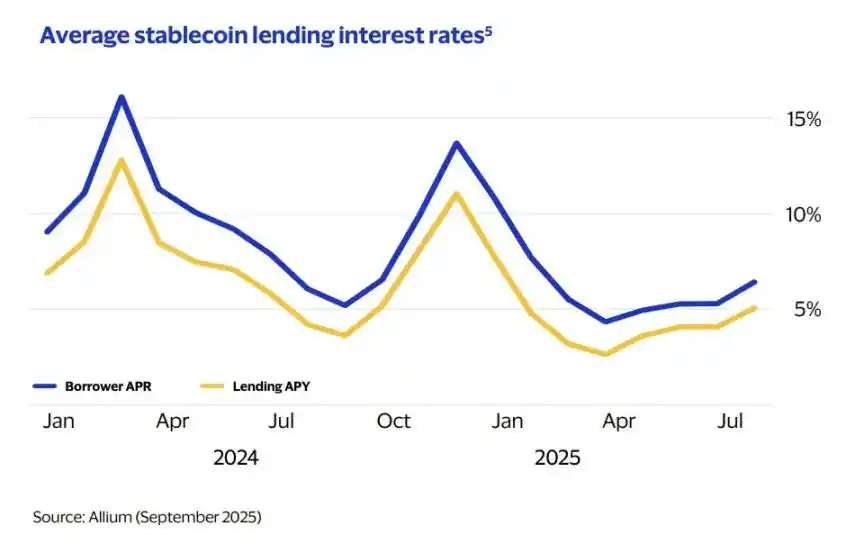
Caption: Average Borrowing Interest Rate

Image Source: @visa

The most直观 example of this end is that stablecoin Borrow APR has fallen to 6.4%. Considering the cumulative lending volume has grown to $670 billion over the past five years,庞大 scale but stable interest rates will become the norm.

The end of DeFi Lego has caused DeFi project governance tokens to completely lose value. The function of governance tokens is not in voting value but in long-term坚定 holding. 1 person creates BNB, 100 people hold BNB, 1000 people trade BNB, 10000 people will believe BNB has value.

The unit of measurement for vaults is not the power consumption of public chains, nor the governance standards of DeFi protocols themselves, but the standard dollar recognized by other vaults. In a sense, USDC/USDT directly取代了 the function of cross-chain bridges.

If USDT/USDC themselves become channels, then Pools/Vaults will not emphasize接入 specific cross-chain bridges and assets; they only need to support stablecoins to meet most people's needs.

People and their value are排斥ed out of the DeFi operating system. Human consumption value is the sole demand for economic operation, and stablecoins ultimately become the sole demand of Vaults.

Even Vaults themselves, as interest-bearing assets for stablecoins, also need users' USDT/USDC. But these stablecoins are not invested in other DeFi protocols, or even in the repurchase of treasury bonds; they lie idle in limited steps waiting for withdrawal.

Referring to the fact that the interest rates on large deposit products of some domestic rural commercial banks have fallen below 1%, we can expect to see the奇景 of stablecoin projects charging users fees in 2026.

Ultimately, all DeFi protocols become homogenized deposit products. Whether it's traditional spot DEX, lending, or Perp DEX, Cap even directly launches Stabledrop, with more airdrop value exchanged for stablecoin assets rather than the project's own tokens.

If you carefully map the current shape of DeFi, it would be a semi-finished product with a "big head, big tail, and hollow middle"—countless DeFi Vaults compete for user deposits, but Vaults no longer intertwine to increase leverage. They even wary of each other to avoid deposit outflows, and the underlying assets are all U.S. bonds,最终 flowing to numerous Neobanks.
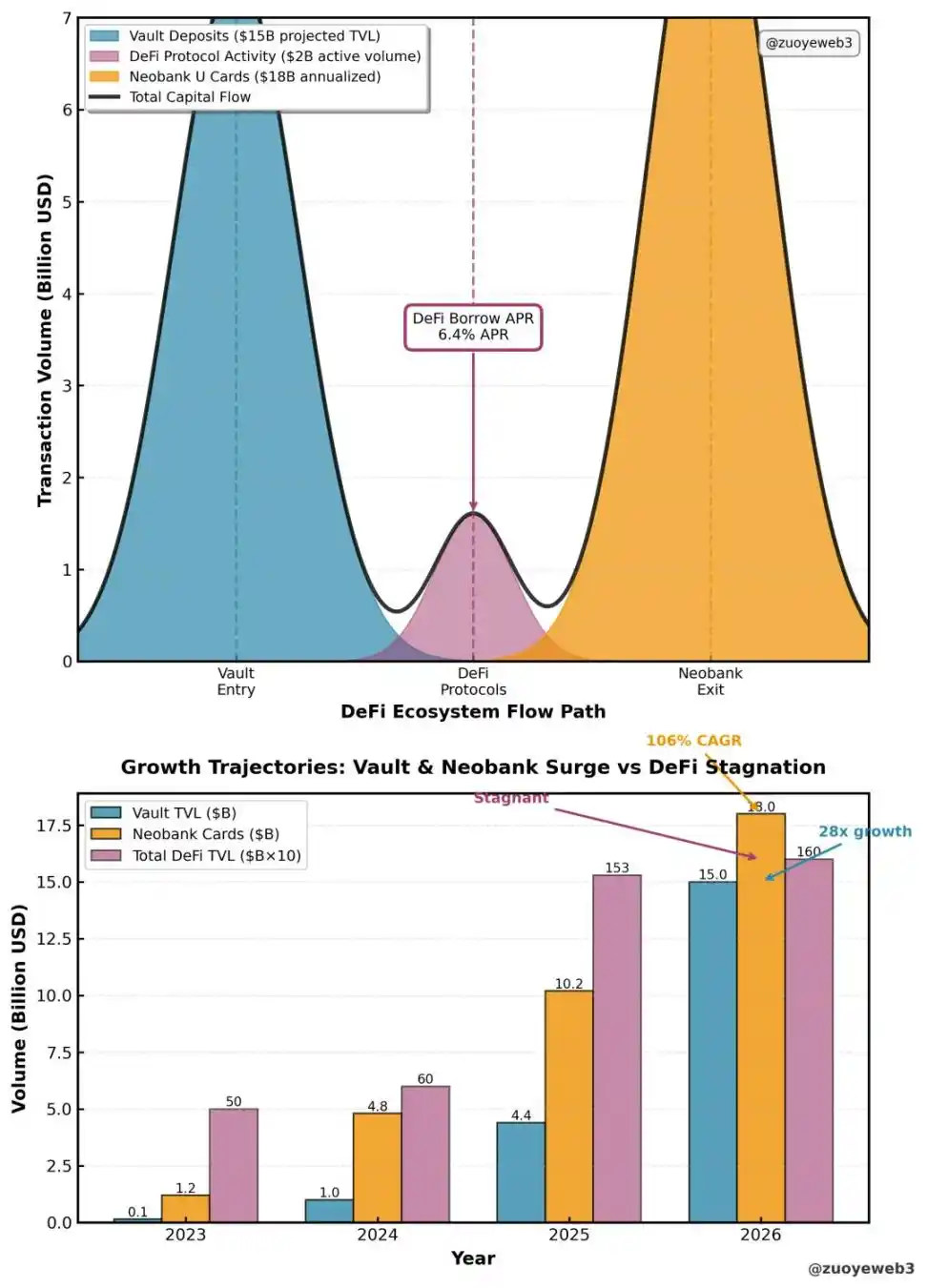
Caption: DeFi Circulation Pattern

Image Source: @visa @artemis @DefiLlama

Neobanks collectively rushing towards U cards has caused their monthly transaction volume to soar from $100 million in 2023 to $1.5 billion. The main users of current Neobanks are still the on-chain群体, proving their considerable spending power, but the decline of DeFi is also a major reason for capital outflow.

This leads to a one-way interaction between users and protocols, but Vaults are彻底扁平化. The few connections are private activities, and users only perceive disputes and fear afterwards, just like the old story of xUSD.

From the history of DeFi and stablecoins, the real scenarios are only three tracks: trading, yield, and consumption. Trading is divided among CEX, Spot DEX, and Perp DEX. DeFi has completely shifted to a Vault model focused on yield. Consumption is split between USDT represented by Tron and emerging NeoBanks.

Frankly, when retail deposits flow into Vaults, stock tokens, Perps, prediction markets, and Meme coins, the disappearance of the altseason is理所应当. In a world where retail has nothing to buy or sell, only deposits have not brought prosperity to DeFi.

TradFi启示: Satisfy People, Don't Persuade Them

Learn from AI, then learn from banking; earn money uprightly.

It can be very clearly stated that current stablecoin yields are Features of individual protocols, not a赛道!

A赛道 requires protocols to push the entire industry forward through competition, like Perp DEX or the AI race. But current DeFi Vaults are all acting as entry points without the配合 of process and exit. They are all competitors with no coordination.

Refer to Taobao's Double Eleven event—the details are becoming increasingly变态; even Alibaba's Qianwen might not be able to calculate the best strategy.

Vaults are the same. The strategies set by various Curators are becoming more complex. Users can do nothing but deposit. When a Vault has problems, users can only face off against the professional litigators from law firms.

From the development needs of DeFi, once ordinary users can only consume passively and cannot participate in the production环节, so-called institutionalization occurs, and ordinary retail investors turn to more alternative, freer financial markets.

  • Retail疯狂 bought GME to battle Wall Street
  • Retail疯狂 bought Meme, rejecting altcoins

A clear trend is that while DeFi is developing towards institutionalization, traditional banking is actively seeking transformation, embracing newer market demands. The most typical example is Revolut's valuation reaching $75 billion.
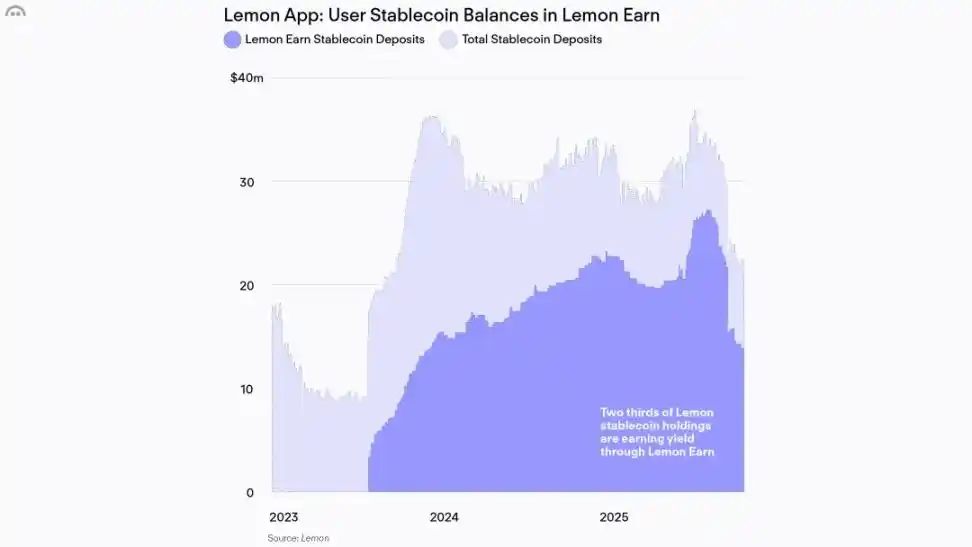
Caption: Off-chain Users Are Worthless

Image Source: @lemonapp_ar

In contrast, the token market cap of Aave, the largest DeFi bank, is only $2.5 billion. Measured by deposits, it would even be among the top 20 banks in the U.S. This is not an isolated case; most DeFi Vault products themselves are worthless.

Refer to Aave's approach in Latin America, embedding itself into younger, more financially underserved populations. Taking the Argentine wealth management product Lemon as an example, it brought 130,000 wealth management users to Aave, but only $40 million in deposits were imported.

Compare this to Aave's on-chain addresses: only 170,000 addresses support its $32 billion TVL. This itself shows that the network effect of retail investors can greatly support project valuation. If only pursuing the scale effect of capital, there is certainly no future for DeFi tokens.

Moreover, as the voice of Vaults within lending protocols increases, the brand value of the traditional protocols themselves decreases. Morpho introduced Sky Vault Curators to "balance" the dominance of Stakehouse. The essence of Aave V4 is also modularization. Eventually, the entire DeFi will become a backend product.

The launch of Aave's mobile app signals anxiety, not greater ease.

In this context, it is not shameful for DeFi to learn from banking. According to a McKinsey report, the global banking industry achieved $1.2 trillion in profits in 2024 alone.

But a crisis has emerged. In 2018, 25% of users would directly choose their开户 bank when spending, but by 2025, this number had dropped to 4%.扪心自问, which Vault has a loyalty rate of 25%?

The疯狂 competition over APY is the consequence of恶性 competition among Vaults. In traditional banking, large banks serve large clients, and small banks serve small clients. Especially younger generations need to gradually build credit scores to gain access to services from high-level banks.

Now is the time for DeFi Vaults to regain the trust of retail investors. Alliances with CEXs are also a beginning. Various Vaults constantly compete for the entry effect of CEXs, making CEXs the upstream of Vaults.

Although they need to actively share profits with CEXs, Vaults can thereby reach tens of millions of real users. Users are not completely passive either;经过 CEXs, they will also seek higher and safer yields, forming a new interaction model.

Conclusion

Products should serve the network, not roles.

When retail investors no longer participate in protocol governance (voting, holding, trading), their remaining awareness of the protocol will also be lost, ultimately leading to the absence of people on-chain.

Now that Vault & Yield has become the mainstream on-chain model, how to rediscover human value in a network without Tokens? DeFi needs to放下身段 and learn from the ever-present TradFi.


Пов'язані питання

QWhat is the main argument presented in the article regarding the current state of DeFi?

AThe article argues that the era of 'DeFi Lego' is over, where protocols were interconnected like building blocks. Instead, DeFi has collapsed into a simplified model where users only care about depositing stablecoins into Vaults to earn yield, with protocols becoming homogenized and their governance tokens losing value. The interaction between protocols has diminished, and the primary flow of value is now from users to centralized exchanges (CEXs) and then into these yield-bearing Vaults.

QAccording to the article, how has the user journey in crypto changed from the 'DeFi Summer' ideal to the current reality in 2026?

AThe ideal user journey during DeFi Summer was: participate in BTC/ETH network nodes to earn tokens -> participate in DeFi protocols -> use various DeFi Lego building blocks'. The current reality in 2026 is: acquire USDC through a CEX or bank card -> find a Vault with a higher APY -> spend using a Neobank's crypto card. Users now interact directly with Vaults as end products, indifferent to the underlying protocols.

QWhat role do centralized exchanges (CEXs) like Binance play in the new DeFi yield landscape described in the article?

ACEXs like Binance have become crucial upstream gateways and partners for DeFi Vaults. They are no longer just measuring listing effects by trading volume but are monetizing their large user bases by selling access to projects. They promote and subsidize specific stablecoins (e.g., Binance with USD1, OKX with USDG), effectively acting as the primary user acquisition channel for Vaults, which then have to share profits with the exchanges.

QWhy does the article suggest that DeFi protocols need to 'learn from TradFi' (Traditional Finance)?

AThe article suggests learning from TradFi because traditional banking, despite its flaws, successfully serves human needs and builds customer relationships over time through trust and graduated services (e.g., building credit scores). In contrast, DeFi Vaults are engaged in a恶性竞争 (vicious competition) purely on APY, leading to user disengagement, a lack of loyalty, and the loss of the 'human network effect' that gives protocols long-term value. DeFi needs to focus on serving people, not just moving capital.

QWhat is the significance of Neobanks and 'U cards' in the current crypto ecosystem as per the article?

ANeobanks and their crypto debit cards (U cards) represent the 'consumption' end of the crypto value flow. Their monthly transaction volume has skyrocketed from $100 million in 2023 to $1.5 billion, indicating strong spending power from crypto users. This trend highlights that the final use case for many users is to off-ramp their yields into spendable currency, further emphasizing that DeFi's current role is primarily as a backend yield generator for stablecoins, which are then spent in the real world.

Пов'язані матеріали

Торгівля

Спот
Ф'ючерси

Популярні статті

Що таке BNB WHALES

Розуміння BNB Whales: Глибоке занурення у світ криптовалют Вступ до BNB Whales У яскравому світі криптовалют регулярно з'являються нові проекти, які часто обіцяють інноваційні рішення та унікальні враження. Одним з таких проектів є BNB Whales, запущений у 2023 році та побудований на BNB Smart Chain (BEP20). BNB Whales прагне встановити відмінну присутність у криптовалютній екосистемі, зосереджуючись на створенні інтерактивної платформи, яка поєднує переваги технології блокчейн із соціальними та ігровими взаємодіями. Ця стаття має на меті глибше розглянути BNB Whales, вивчаючи його основні компоненти, механіку та траєкторію розвитку. Що таке BNB Whales? BNB Whales — це ініціатива у світі криптовалют, яка прагне забезпечити різноманітний спектр можливостей та функцій для своїх користувачів у зростаючому середовищі Web3. Використовуючи стандарт BEP20, проект працює з загальною емісією токенів у 100 трильйонів (100,000,000,000,000,000). Незважаючи на цю значну цифру, варто зазначити, що наразі жоден токен не перебуває в обігу, що вказує на те, що проект, можливо, ще на ранніх стадіях розвитку. Основною метою BNB Whales є створення платформи, де користувачі можуть брати участь у різних інтерактивних активностях, вигідно користуючись безпекою та прозорістю, які забезпечує технологія блокчейн. Спонукаючи унікальне і захоплююче середовище, BNB Whales прагне створити міцну спільноту користувачів, які зацікавлені у проекті та його розвитку. Хто є творцем BNB Whales? Особистість творця BNB Whales на даний момент залишається невідомою, що ускладнює розуміння засадничих принципів проекту та візійних ідей. Відсутність публічно доступної інформації про керівництво проекту може викликати запитання серед потенційних інвесторів та користувачів щодо його управлінської структури та відповідальності. Хто є інвесторами BNB Whales? Оскільки BNB Whales продовжує розвиватися, інформація про конкретних інвесторів або підтримку з інвестиційних фондів наразі недоступна. Офіційна документація проекту, включаючи його білі книги, не розкриває жодних індивідуальних або інституційних фінансових спонсорів. Відсутність прозорості в цьому відношенні може іноді ставити під сумнів легітимність і сталий розвиток нових проектів у криптовалютній екосистемі. Як працює BNB Whales? BNB Whales працює на BNB Smart Chain, використовуючи стандарт BEP20, який відомий своєю ефективністю та низькими транзакційними витратами, залучаючи різноманітних розробників та проекти. Унікальний аспект BNB Whales полягає у його зосередженні на створенні платформи, керованої спільнотою. Хоча точні деталі роботи скромні, проект акцентує увагу на взаємодії та залученості, потенційно включаючи ігрові елементи у свої пропозиції. Акцент на спільноті є вирішальним, оскільки він відповідає сучасним трендам у світі криптовалют, де внесок користувачів та участь часто визначають успіх проекту. Подальші інновації можуть бути очікувані, але наразі конкретні механізми та функції, які відрізняють BNB Whales від інших криптоініціатив, залишаються повністю неясними. Без детальної інформації про його функціональність важко всебічно оцінити відмінності проекту. Хронологія BNB Whales Розвиток BNB Whales відбувся через ключові етапи, що ознаменували його подорож у світі криптовалют. Нижче представлено хронологію значущих подій, що стосуються проекту: 2023: Запуск BNB Whales, що стало його входом на ринок. 2023: Публікація білій книги проекту, яка викладає загальні цілі та операційну структуру. У процесі: BNB Whales продовжує розвивати свої функції, прагнучи створити міцну базу користувачів і розширити свої пропозиції. Ключові моменти про BNB Whales Платформа: BNB Smart Chain (BEP20) Загальна пропозиція: 100 трильйонів токенів (100,000,000,000,000,000) Обіг: 0 токенів (вказує на початкову стадію) Мета проекту: Сприяти створенню захоплюючої криптовалютної платформи для взаємодії та побудови спільноти. Творець: Невідомий Інвестори: Не розкрито Операційний статус: Активний з постійним розвитком і розширенням Висновок Оскільки BNB Whales орієнтується в конкурентній криптовалютній середовищі, він пропонує погляд на потенціал проектів, керованих спільнотою, побудованих на основах технології блокчейн. Зосереджуючи увагу на залученості та взаємодії, ініціатива перебуває на передовій інновацій у просторі Web3. Однак успіх проекту в кінцевому рахунку залежить від чіткості його операційної механіки, розкриття його управлінської структури та створення міцної спільноти користувачів. Для потенційних користувачів та інвесторів BNB Whales представляє собою дослідницький випадок у еволюціонуючій природі проектів криптовалют — той, що ілюструє як захоплюючі можливості, так і складнощі, пов'язані з новими ініціативами. Оскільки сфера продовжує еволюціонувати, важливо стежити за прогресом BNB Whales та його впливом на ширшу криптовалютну екосистему.

367 переглядів усьогоОпубліковано 2024.04.05Оновлено 2024.12.03

Що таке BNB WHALES

Як купити BNB

Ласкаво просимо до HTX.com! Ми зробили покупку Binance Coin (BNB) простою та зручною. Дотримуйтесь нашої покрокової інструкції, щоб розпочати свою криптовалютну подорож.Крок 1: Створіть обліковий запис на HTXВикористовуйте свою електронну пошту або номер телефону, щоб зареєструвати обліковий запис на HTX безплатно. Пройдіть безпроблемну реєстрацію й отримайте доступ до всіх функцій.ЗареєструватисьКрок 2: Перейдіть до розділу Купити крипту і виберіть спосіб оплатиКредитна/дебетова картка: використовуйте вашу картку Visa або Mastercard, щоб миттєво купити Binance Coin (BNB).Баланс: використовуйте кошти з балансу вашого рахунку HTX для безперешкодної торгівлі.Треті особи: ми додали популярні способи оплати, такі як Google Pay та Apple Pay, щоб підвищити зручність.P2P: Торгуйте безпосередньо з іншими користувачами на HTX.Позабіржова торгівля (OTC): ми пропонуємо індивідуальні послуги та конкурентні обмінні курси для трейдерів.Крок 3: Зберігайте свої Binance Coin (BNB)Після придбання Binance Coin (BNB) збережіть його у своєму обліковому записі на HTX. Крім того, ви можете відправити його в інше місце за допомогою блокчейн-переказу або використовувати його для торгівлі іншими криптовалютами.Крок 4: Торгівля Binance Coin (BNB)Легко торгуйте Binance Coin (BNB) на спотовому ринку HTX. Просто увійдіть до свого облікового запису, виберіть торгову пару, укладайте угоди та спостерігайте за ними в режимі реального часу. Ми пропонуємо зручний досвід як для початківців, так і для досвідчених трейдерів.

648 переглядів усьогоОпубліковано 2024.12.12Оновлено 2025.03.21

Як купити BNB

Що таке BNB CARD

Розуміння BNB Card: Революція цифрової ідентичності у Web3 У швидко змінюваному ландшафті технології блокчейн та криптовалют, BNB Card або $BNBCARD вирізняється як помітний проєкт. Цей токен-мем, що керується спільнотою, використовує BNB Smart Chain (BSC), прагнучи інтегрувати мем-культуру з інноваційними рішеннями цифрової ідентичності. Оскільки все більше користувачів занурюються у світи децентралізації, важливо розглянути, що пропонує BNB Card, його операційні нюанси та потенційний вплив на ринок. Що таке BNB Card ($BNBCARD)? В основі BNB Card лежить токен-мем з суттєвою утилітою. Він створений для надання можливостей користувачам шляхом створення персоналізованих карток цифрової ідентичності, які є як виразними, так і функціональними. Проєкт охоплює кілька ключових особливостей: Налаштовувані ID-картки: Користувачі мають можливість розробляти цифрові ID-картки на тему Binance, надаючи їм платформу для самовираження та покращеної взаємодії з громадою. Децентралізована структура: Розроблений на BSC, BNB Card підкреслює ключові атрибути, такі як безпека, прозорість та суверенітет користувачів. Децентралізована природа структури дозволяє проводити транзакції, які є як ефективними, так і безпечними. Модель, орієнтована на спільноту: Акцент на участі знизу вгору, а не на фінансових моделях, що керуються лабораторіями, створює захоплююче середовище для його користувачів. Використовуючи вроджену вірусність мем-культури, BNB Card сприяє потужному руху громади. Основна мета BNB Card полягає в демократизації інструментів цифрової ідентичності у Web3, пропонуючи доступні рішення, які приносять користь користувачам без обтяжень, які зазвичай пов'язані з традиційними системами управління ідентичністю. Творець та інвестори При дослідженні особи, що стоїть за BNB Card, важливо зазначити, що жоден конкретний творець не вказується. Натомість проєкт виглядає керованим спільнотою, що свідчить про колективні зусилля, натхненні ідеєю “Early Builder Card” від Binance. Цей органічний підхід до розвитку є звичним серед проєктів у спектрі токенів-мем, де розвиток часто залежить від пристрасті спільноти, а не від центральної влади. Щодо інвестицій, відсутність публічно розкритих інституційних спонсорів ще більше підкреслює основи проєкту. Він процвітає на органічній підтримці спільноти, що відображає звичайну характеристику проєктів, що керуються мемами, які часто залучають свою аудиторію через соціальні канали, а не формальні інвестиційні маршрути. Як це працює BNB Card використовує кілька механізмів, які окреслюють його функціонування та інноваційний дух: Утиліта токена: Токен BNBCARD надає користувачам доступ до набору інструментів для створення ID, а також забезпечує платформу для управління спільнотою. Токен слугує ланкою, що дозволяє цим функціям працювати. Інтеграція блокчейн: Використовуючи BSC, BNB Card забезпечує сумісність з додатками на основі Ethereum Virtual Machine (EVM). Ця інтеграція надає користувачам переваги низьких транзакційних зборів, покращуючи доступність. Екосистема DIY: Центральним до привабливості BNB Card є його підхід “зроби сам” (DIY) до генерації карток цифрової ідентичності. Цей участь елемент заохочує користувачів до творчого самовираження, сприяючи інклюзивній культурі, що процвітає на внесках та співпраці. Хронологія Хронологія є важливою для розуміння траєкторії BNB Card. Важливі етапи в історії проєкту включають: 18 березня 2025 року: BNB Card був перерахований на LBank, що стало значним кроком у його подорожі на біржі та відкрило двері для ліквідності та доступності для користувачів. 19 березня 2025 року: Важливий момент стався, коли токен зазнав астрономічного зростання на 26,000% протягом 24 годин, привертаючи увагу до свого потенціалу та ентузіазму спільноти. Поточні розробки: Проєкт постійно розширює свої партнерства з децентралізованими біржами (DEX), такими як PancakeSwap, що додатково підвищує ліквідність та залучення користувачів. Інновації та диференціація Розуміння того, що відрізняє BNB Card, вимагає глибшого дослідження його інноваційної структури: Гібрид мем-утиліти: BNB Card успішно поєднує ігрову привабливість мем-культури з практичними застосуваннями в управлінні цифровою ідентичністю. Цей нішевий підхід ефективно задовольняє широку демографію, приваблюючи як технічно підкованих користувачів, так і тих, хто новий у криптовалютах. Децентралізоване управління: Функціонування без централізованого контролю дозволяє проєкту безпосередньо використовувати внески спільноти. Колективний процес прийняття рішень, підкріплений участю громади, надає користувачам можливість впливати на розвиток та напрямок проєкту. Масштабованість: BNB Card має величезні переваги від оновлень дорожньої карти 2025 року для BNB Chain, які включають покращення, такі як збільшення швидкості транзакцій та інтеграцію інструментів штучного інтелекту. Ці покращення вигідно позиціонують проєкт у висококонкурентному середовищі. Висновок BNB Card є символом нової хвилі рішень цифрової ідентичності в екосистемі Web3. Поєднуючи розваги, залучення спільноти та практичну утиліту, він запрошує користувачів активно брати участь у формуванні своїх цифрових персон. Оскільки проєкт орієнтується на динамічний ландшафт криптовалют, його успіх, ймовірно, залежатиме від підтримки сильної спільноти, адаптуючись до технологічних досягнень та потреб користувачів. Інтеграція децентралізації з мем-культурою слугує не лише засобом для залучення користувачів, але й основою для еволюційного наративу, що оточує цифрову ідентичність в епоху блокчейн. Підсумовуючи, BNB Card не лише ілюструє злиття креативності та утиліти в крипто-просторі, але й підкреслює важливість спільноти в управлінні майбутнім децентралізованих технологій.

341 переглядів усьогоОпубліковано 2025.03.26Оновлено 2025.03.26

Що таке BNB CARD

Обговорення

Ласкаво просимо до спільноти HTX. Тут ви можете бути в курсі останніх подій розвитку платформи та отримати доступ до професійної ринкової інформації. Нижче представлені думки користувачів щодо ціни BNB (BNB).

活动图片













