The Economist: The Real Threat of Cryptocurrency to Traditional Banks

深潮Опубліковано о 2025-12-16Востаннє оновлено о 2025-12-16

Анотація

The Economist article "The Real Threat Cryptocurrency Poses to Traditional Banks" examines the escalating tensions between the traditional banking sector and the crypto industry. Despite both benefiting from a more favorable regulatory environment, especially following the passage of the GENIUS Act which provided a legal framework for stablecoins, a significant power shift is occurring. Banks' most immediate concern is regulatory arbitrage in stablecoins. Although the GENIUS Act prohibits issuers from paying interest to prevent deposit outflows, companies like Circle circumvent this by sharing revenue with exchanges, which then pay "rewards" to users. Banks are demanding this loophole be closed. Furthermore, crypto firms are breaking into the core of the financial system. In a landmark move, U.S. regulators granted national bank trust charters to five digital asset firms, including Circle and Ripple, allowing them to provide custody services nationwide. The collective impact of these developments poses a profound threat. The core of the banks' dilemma is their waning political influence. Crypto has firmly entrenched itself within the right-wing, anti-establishment political sphere, amassing a massive war chest for lobbying. Banks are no longer the most powerful financial voice in the Republican party. In a ironic twist, they now sometimes find themselves allied with Democratic senators and left-leaning groups who share concerns over stablecoin risks, proving that political...

Source: The Economist

Compiled by: Chopper, Foresight News

"First they ignore you, then they laugh at you, then they attack you, then you win." This phrase is often attributed to Mahatma Gandhi, but the leader of the Indian independence movement never actually said it. Nevertheless, this fabricated maxim has become a popular mantra in the cryptocurrency industry. The pioneers of digital finance once endured the arrogance, ridicule, and disdain of Wall Street elites, but now, their influence is stronger than ever.

The past year has been a period of bounty for both bankers and digital asset practitioners. The cryptocurrency industry's ability to gain a firm foothold is largely due to the GENIUS Act passed in July, which provided a clear legal basis for the legitimacy of stablecoins. Since Donald Trump won the election, market expectations of a more relaxed regulatory environment have caused bank stocks to rise by 35%. Even if some bankers dislike Trump for other reasons, very few of them favored the regulatory policies of the Joe Biden administration.

Despite this, tensions between the old and new forces are intensifying, and the threat posed by cryptocurrency is far more severe than many bankers once anticipated. While banks may benefit from regulatory loosening, their privileged status as the "financial aristocracy" within the Republican camp is now precarious. Sharing this status with the nouveau riche of the cryptocurrency industry undoubtedly represents a long-term threat to traditional banks.

The most pressing concern for bankers currently is the regulation of stablecoins. The GENIUS Act explicitly prohibits stablecoin issuers from paying interest to purchasers. This compromise clause was originally intended to prevent stablecoins from siphoning off bank deposit demand, thereby weakening banks' lending capacity. However, a regulatory workaround has emerged in the market: stablecoin issuers, represented by Circle, the issuer of USDC, share the proceeds with cryptocurrency exchanges like Coinbase, which then distribute "rewards" to users who purchase stablecoins. Traditional banks are strongly demanding that this regulatory loophole be closed.
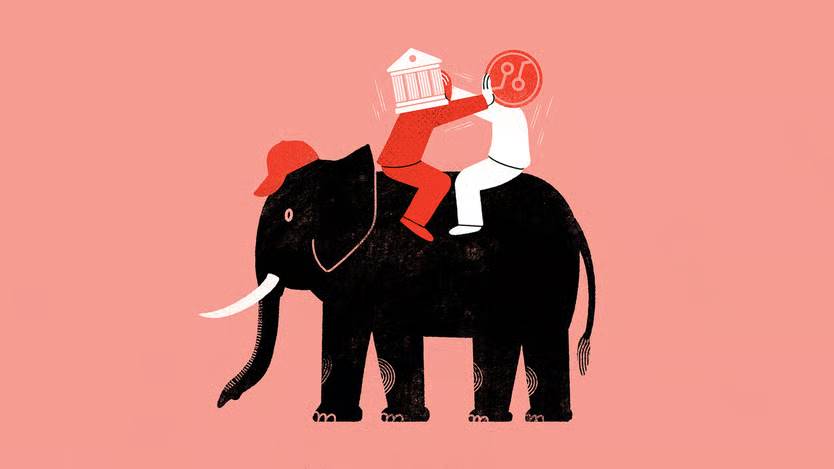
The interest issue is not the entirety of their disagreement. In other areas, cryptocurrency is also attempting to break through the barriers to entry in traditional finance. In October, Christopher Waller, a Federal Reserve Governor and candidate for Fed Chair, suggested that more institutions might be allowed access to the Federal Reserve's payment system, a statement that alarmed bankers. However, Waller later walked back these comments, stating that applicants for such Fed accounts would still need to hold a bank charter.

Finally, on December 12th, the cryptocurrency industry successfully pried open the door to the U.S. federal banking system. U.S. banking regulators approved applications for national bank trust charters from five digital finance companies, including Circle and Ripple. Although this qualification does not grant these institutions the authority to accept deposits or conduct lending businesses, it allows them to provide asset custody services nationwide without relying on state-level approvals. Previously, banks had lobbied regulators intensely against granting new charters to these companies.

Individually, each development—a speech, a bank charter, a certain regulatory workaround for stablecoin issuers—might seem insignificant. But taken together, these movements pose a serious threat to traditional banks. In fact, the core position of traditional banks in lending and brokerage has already been eroded by private credit institutions and new market makers outside the banking system. They are naturally reluctant to lose more ground.

Cryptocurrency firms argue that the preferential policies enjoyed by traditional banks create an unfair competitive environment and harm market competition. This argument may have its merits, but paying interest on stablecoins under the guise of "rewards" is undoubtedly a blatant attempt to circumvent regulation. The fact that lawmakers who voted to ban stablecoin interest payments just months ago are not stepping in to stop such behavior precisely reveals the real dilemma traditional banks face: their political influence has significantly declined.

Traditional banks are no longer the most influential financial force within the Republican camp. Instead, the cryptocurrency industry has firmly established itself within the American right's "anti-establishment, anti-elite" political faction. The industry's largest political action committee, armed with hundreds of millions of dollars, is ready to invest in the 2026 midterm elections, and money has always been a powerful weapon in political games. Now, when the interests of traditional banks conflict with those of the cryptocurrency nouveau riche, the outcome of the game is no longer a foregone conclusion, and may no longer even favor the traditional banks.

There was a time when bankers complained about the stringent regulations of the Biden administration. Ironically, however, they now find themselves relying on the support of a group of Democratic senators. These Democratic lawmakers are more concerned about the potential risks of stablecoins circumventing interest payments and the associated money laundering dangers. In opposing cryptocurrency firms obtaining bank charters, America's largest banks have even formed an alliance with labor unions and center-left think tanks. As in another saying never actually uttered by Gandhi: "The enemy of my enemy is my friend."


Пов'язані питання

QWhat is the main threat that cryptocurrencies pose to traditional banks according to The Economist article?

AThe main threat is that cryptocurrencies are eroding the privileged status of traditional banks as the dominant financial force, particularly within the Republican political camp, and are successfully challenging them through new regulations, licenses, and circumvention of rules like the stablecoin interest ban.

QWhat was the significance of the GENIUS Act passed in July for the crypto industry?

AThe GENIUS Act provided a clear legal framework for the legitimacy of stablecoins, which was a major factor in helping the cryptocurrency industry establish a firm footing.

QHow are stablecoin issuers like Circle circumventing the GENIUS Act's ban on paying interest to purchasers?

AStablecoin issuers share the revenue from the assets backing the stablecoins with cryptocurrency exchanges, such as Coinbase, which then distribute 'rewards' to users who purchase the stablecoins, effectively paying interest under a different name.

QWhat major milestone did the cryptocurrency industry achieve on December 12th regarding the US banking system?

AOn December 12th, US banking regulators approved national bank trust charter applications for five digital finance companies, including Circle and Ripple, allowing them to provide custody services nationwide without needing state-by-state approval.

QWhy does the article suggest that traditional banks' political influence has waned?

ATheir political influence has waned because the cryptocurrency industry has become a powerful financial force within the right-wing, anti-establishment political camp, boasting a massive political action committee with hundreds of millions of dollars, making political outcomes in conflicts between banks and crypto firms no longer a foregone conclusion in the banks' favor.

Пов'язані матеріали

Winter for Crypto IPOs: Consensys and Ledger Withdraw Applications

The crypto IPO window is tightening significantly in 2026, marked by prominent companies delaying or pausing their public listing plans. Following a successful 2025 "harvest year" that saw Circle, Bullish, and Gemini go public amidst a bull market, the tide has turned. Consensys, developer of MetaMask, recently postponed its IPO until at least fall 2026. Hardware wallet leader Ledger also suspended its planned US listing due to unfavorable market conditions, with Kraken having previously delayed its own plans. This shift is driven by a cooling market in 2026, characterized by a significant Bitcoin price correction, declining trading volumes, and reduced investor risk appetite for crypto stocks. The poor post-IPO performance of 2025 listings like Circle and Bullish, which saw major share price declines, has heightened investor caution. This contrasts sharply with the current AI sector, where companies like SpaceX, OpenAI, and Anthropic are commanding massive valuations and investor enthusiasm based on narratives of stable, exponential growth. Crypto companies now face pressure to transition from hype-driven models to demonstrating reliable cash flows and robust compliance. While the paused IPO plans may lead to valuation resets and affect ecosystem liquidity, they also accelerate industry consolidation toward stronger, more compliant infrastructure players. A potential recovery in Bitcoin's price and clearer regulations could reopen the IPO window in the latter half of 2026.

marsbit5 хв тому

Winter for Crypto IPOs: Consensys and Ledger Withdraw Applications

marsbit5 хв тому

ChatGPT Can Manage Your Money for You. Would You Trust It with Your Bank Account?

OpenAI has launched a personal finance tool for ChatGPT, currently in preview for US-based ChatGPT Pro users. This feature allows users to connect their bank and investment accounts (via Plaid, supporting over 12,000 institutions) directly to ChatGPT. It analyzes transactions, generates visual dashboards, and offers conversational financial advice—such as budgeting or planning for major purchases—based on the user's actual data. This move follows OpenAI's acquisitions of fintech startups Roi and Hiro Finance, signaling a strategic push into vertical "super assistant" applications, similar to its earlier health-focused feature. However, the launch has sparked significant privacy concerns. Critics question the safety of granting such sensitive financial access to an AI, especially amid ongoing lawsuits alleging OpenAI shared user chat data with third parties like Meta and Google. OpenAI emphasizes that ChatGPT only reads data (no transaction capabilities), deletes it within 30 days if disconnected, and offers opt-out options for model training. Yet, trust remains a major hurdle. The trend reflects a broader industry shift: AI companies like Anthropic and Perplexity are also targeting high-value, data-rich domains like finance and health. While technically promising, the tool operates in a regulatory gray area—it provides personalized guidance but disclaims formal financial advice or liability. Ultimately, OpenAI's challenge is convincing users to trust an AI with their most private financial information.

marsbit6 хв тому

ChatGPT Can Manage Your Money for You. Would You Trust It with Your Bank Account?

marsbit6 хв тому

Breaking: OpenAI Undergoes Major Reorganization, President Brockman Assumes Command

OpenAI has announced a major internal reorganization just months before its anticipated IPO. The company is merging its three flagship product lines—ChatGPT, Codex, and the API platform—into a single, unified product organization. The most significant leadership change involves co-founder and President Greg Brockman moving from a background technical role to take full, permanent control over all product strategy. This follows the indefinite medical leave of AGI Deployment CEO Fidji Simo. Additionally, ChatGPT's longtime lead, Nick Turley, has been reassigned to enterprise products, with former Instagram executive Ashley Alexander taking over consumer offerings. The consolidation, internally framed as a strategic move towards an "Agentic Future," aims to break down internal silos and create a cohesive "Super App." This planned desktop application would integrate ChatGPT's conversational abilities, Codex's coding power, and a rumored internal web browser named "Atlas" to autonomously perform complex user tasks. The reorganization occurs amid significant internal and external pressures. OpenAI has recently seen a wave of high-profile departures, including Sora co-lead Bill Peebles and other senior technical leaders, leading to concerns about a thinning executive bench. Externally, rival Anthropic recently secured funding at a staggering $900 billion valuation, surpassing OpenAI's own. Google's upcoming I/O developer conference also poses a competitive threat. Analysts suggest the dramatic restructure is a pre-IPO move to present a clearer, more focused narrative to Wall Street—streamlining operations and demonstrating decisive leadership under Brockman to counter internal turbulence and intense market competition.

marsbit3 год тому

Breaking: OpenAI Undergoes Major Reorganization, President Brockman Assumes Command

marsbit3 год тому

Торгівля

Спот
Ф'ючерси
活动图片




